A Time of Witches Summary, Characters and Themes
A Time of Witches by Madeline Martin is a historical fantasy about inherited magic, suppressed female power, family trauma, and the consequences of persecution across generations.
Moving between modern Savannah and seventeenth-century England, the novel connects Lilith Legare to Sybil Brantham, an ancestor condemned during the English witch trials. Their connection turns history into something active rather than fixed, forcing Lilith to understand the abilities her family spent centuries denying. At its center, the book asks what happens when women are taught to fear their own strength, and what becomes possible when they finally reclaim it.
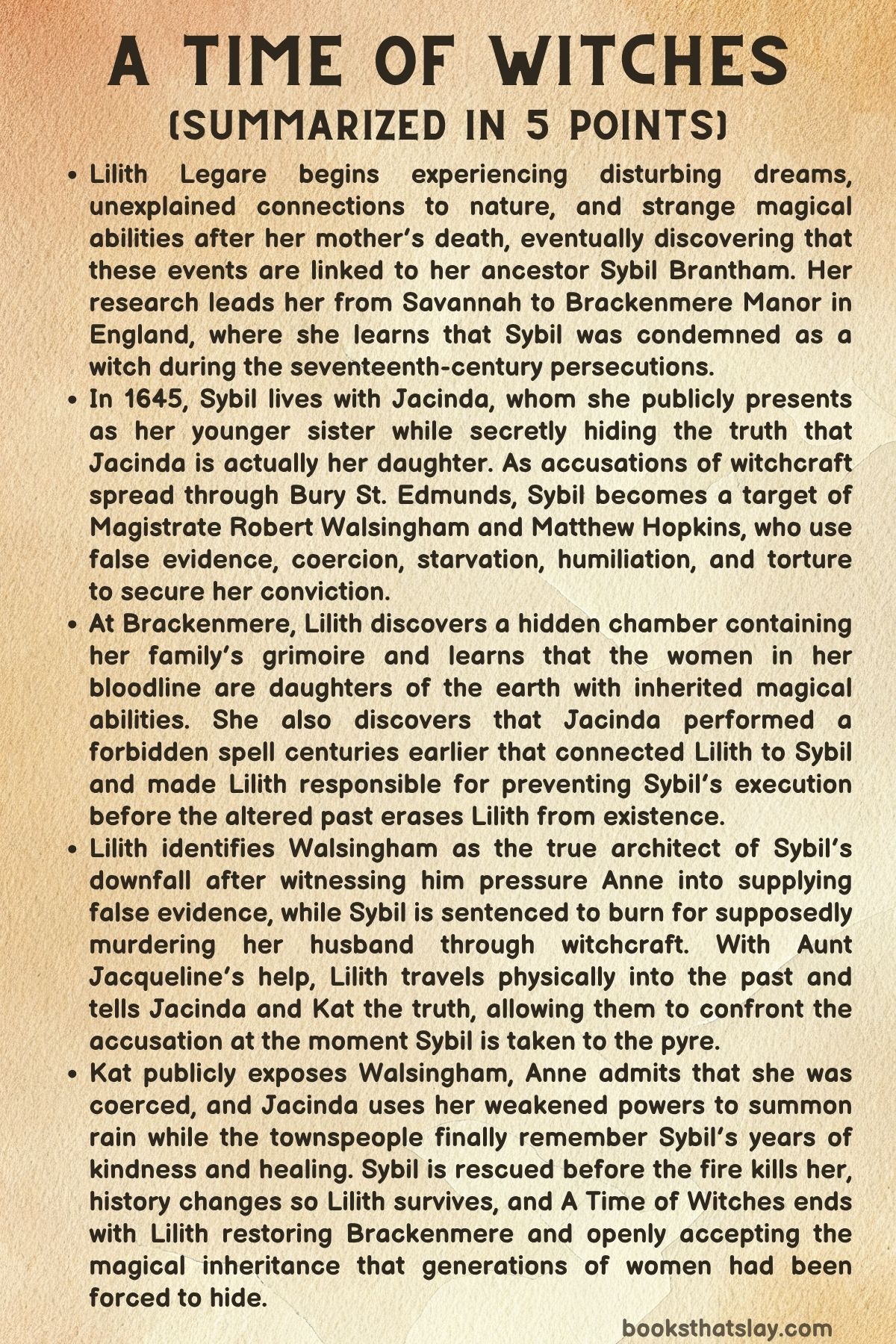
Summary
Lilith Legare’s life changes after the death of her mother, a woman she spent years caring for through cancer despite enduring criticism, emotional cruelty, and constant dismissal. Grief therefore arrives mixed with relief, but it is accompanied by something stranger: animals seek Lilith out, plants respond to her touch, storms appear sensitive to her emotions, and she senses an energy in the natural world that she cannot explain.
Most disturbing are recurring nightmares in which a woman is burned alive as a witch while eighteen other condemned people hang nearby. Lilith eventually witnesses the scene from outside the victim’s body and notices that the woman has the same crescent-shaped birthmark she carries, while a red-gold-haired girl in the crowd somehow sees Lilith and begs her to help.
The story simultaneously moves to Bury St. Edmunds in 1645, where Sybil Brantham lives at Brackenmere Manor with sixteen-year-old Jacinda. Sybil possesses a connection to the earth and understands herbal healing, while Jacinda has far more powerful elemental abilities that Sybil suppresses with an iron bracelet because accusations of witchcraft are spreading rapidly through the region.
Sybil’s fears intensify because Matthew Hopkins, the notorious Witchfinder General, appears to be approaching Bury St. Edmunds. Sybil, Kat, and Edith, three women united by their connection to the earth, attempt protective magic, yet Sybil knows that Jacinda’s extraordinary abilities make concealment increasingly difficult.
Another danger comes from Magistrate Robert Walsingham, who has pursued Sybil for years and refuses to accept her rejection of him. His resentment becomes especially dangerous in a culture where a powerful man can turn suspicion into legal persecution, and Sybil realizes that his wounded pride may threaten both her and Jacinda.
In Savannah, Lilith visits a supernatural shop called Enchanted and meets a mysterious older woman who already knows about her nightmare. The woman warns that Lilith is trapped by the past and will eventually cease to exist unless she saves the condemned woman, giving Lilith only one name: Sybil.
Searching through her late mother’s possessions, Lilith discovers family records linking her ancestry to Brackenmere Manor. Her mother’s journal also reveals that she knew something unusual existed within Lilith but deliberately discouraged it, partly because she herself felt an emptiness where that connection should have been; most importantly, Lilith discovers that Sybil Brantham was her ancestor and was recorded as having been burned as a witch.
Lilith contacts Brackenmere’s present owner, Asher Walsingham, and travels to England despite having little idea what she expects to accomplish. At Brackenmere she meets Asher, his eccentric Aunt Jacqueline, and later the cat Dragon, while the ruined manor immediately produces visions of its seventeenth-century past.
Lilith recognizes rooms she has never physically visited and eventually sees Jacinda, who can perceive and communicate with her despite the centuries separating them. Sybil, however, cannot see Lilith, making Jacinda the essential link between past and present.
Meanwhile, Sybil’s situation collapses. Walsingham arrives at Brackenmere and accuses her of witchcraft and of magically murdering her late husband Henry, and although the accusation is false, Sybil carries private guilt surrounding Henry’s death that makes the charge psychologically effective.
Sybil is taken to prison, where she discovers that Edith and many others have also been arrested. Matthew Hopkins interrogates prisoners through starvation, sleeplessness, humiliation, threats, carefully constructed questions, and physical abuse, seeking not truth but statements that can be presented as confessions.
Lilith visits Moyse’s Hall and learns that her nightmares correspond to the historic Bury St. Edmunds witch trials. Soon her visions become even more alarming: mirrors show no reflection of her, Sybil warns that time is running out, and Lilith realizes that failure will not simply kill her but erase her from existence.
Returning secretly to Brackenmere, Lilith discovers a concealed chamber containing herbs, stones, magical materials, and a family grimoire. The room responds to her presence, confirming that her abilities are not isolated supernatural accidents but part of an inheritance preserved through generations of women connected to the earth.
The grimoire teaches Lilith how plants, stones, moonlight, and other natural forces may strengthen intention, while repeatedly warning against using power through hatred. Lilith begins deliberately practicing magic and learns that accepting herself is as important as mastering any charm, because years of criticism from her mother have taught her to distrust precisely the instincts she now needs.
As Lilith grows stronger, Sybil is systematically weakened. Hopkins denies her food, confuses her through repetitive questioning, threatens Jacinda, subjects her to degrading bodily searches for supposed witch marks, and creates conditions in which almost anything can be interpreted as proof of guilt.
Edith suffers similar cruelty and eventually dies after being subjected to a supposed witchcraft test. Her death devastates Sybil and confirms that the persecution is designed so that innocence provides no meaningful protection once authorities have decided whom they want to condemn.
The hidden grimoire eventually reveals the truth behind Lilith’s connection to the past. Jacinda performed forbidden magic to prevent Sybil’s death, sacrificing much of her own power and causing the family’s abilities to become dormant through later generations until they could awaken fully in Lilith.
Jacinda’s spell connected Lilith to Sybil from birth and ensured that, centuries later, Lilith would be drawn back to Brackenmere to finish what Jacinda had begun. The danger is severe because Sybil’s death would disrupt the line leading to Lilith, causing her to disappear from photographs, memories, and eventually existence itself.
Lilith soon witnesses this erasure beginning. Photographs containing her disappear, and for a terrifying period even Essie fails to recognize her, convincing Lilith that history is actively rewriting itself as Sybil’s execution approaches.
Working with Jacinda across time, Lilith searches Brackenmere for the person responsible for denouncing Sybil. She eventually witnesses servant Anne meeting Robert Walsingham and discovers that Anne provided a poppet used as false evidence only because Walsingham threatened and manipulated her.
The discovery also reveals a disturbing connection to Asher: Robert Walsingham is his ancestor. Lilith is angered by what she sees as concealed family history, yet Asher’s ancestry ultimately does not determine his character, and his increasing loyalty to Lilith places him morally opposite the man whose name he inherited.
Another family secret emerges when Sybil reveals that Jacinda is not actually her younger sister. Jacinda is the daughter Sybil conceived with John Griffin when they were young, and Sybil’s mother presented the child publicly as her own daughter to protect Sybil from the consequences of unmarried pregnancy.
John returns during Sybil’s imprisonment and learns that Jacinda is his daughter. His arrival gives Sybil some comfort and provides Jacinda with a parent who can protect her if Sybil is executed, but ordinary legal intervention cannot stop a court determined to find witches guilty.
Sybil is ultimately convicted of witchcraft and of murdering Henry. Because the latter charge is treated differently from the other accusations, she is condemned to be burned while most of the other convicted prisoners face hanging.
Before the execution, Walsingham attacks Sybil while her restraints are briefly removed. Reconnected with the earth, she refuses to curse him through hatred and instead asks that Walsingham and Hopkins receive the same treatment they have inflicted upon others, leaving judgment to a larger natural balance.
In the present, Aunt Jacqueline finally reveals that she understands the supernatural forces surrounding Brackenmere. She helps Lilith perform a ritual in the honeysuckle clearing that sends Lilith physically into 1645, where she meets Jacinda and Kat directly rather than merely appearing as a vision.
Lilith tells them that Anne was coerced and that Walsingham manufactured the evidence against Sybil. Because the spell cannot hold Lilith safely in the past for long, she is violently pulled back to the present before she can witness whether this knowledge is enough to change history.
At the execution, Jacinda struggles to create enough rain to stop the fire, but her power has been severely reduced by the forbidden spell. Kat therefore uses Lilith’s information in a different way, confronting Walsingham publicly while Anne admits that the incriminating poppet was produced because the magistrate pressured her.
Kat reminds the townspeople of Sybil’s years of healing the sick, helping impoverished families, and serving people who are now willing to watch her die. Public certainty begins collapsing as the crowd recognizes that a woman they know through acts of kindness has been transformed into an imaginary enemy by fear, manipulation, and authority.
The realization nearly comes too late because Sybil’s pyre is already burning. Eventually the combination of Anne’s confession, Kat’s courage, Jacinda’s rain, and the crowd’s changed response allows Sybil to be freed, and the iron restraints preventing her connection to the earth are removed.
Sybil survives and is reunited with Jacinda and John, forming openly the family secrecy once prevented them from becoming. Their survival cannot restore Edith or the many others already killed, but it demonstrates that persecution depends partly on collective participation and can weaken when ordinary people finally refuse to cooperate.
Lilith briefly experiences a version of the present in which no one recognizes her, suggesting that history has not yet fully settled. Dragon eventually sees her, followed by Asher, and recognition spreads as the altered timeline stabilizes around Sybil’s survival.
Two years after the trials, Matthew Hopkins is dying while memories of his victims return to him, fulfilling Sybil’s request that he receive what he gave to others. Jacinda and other survivors begin new lives in Maryland, ensuring that the family line continues beyond the immediate reach of the English persecutions.
One year after Lilith’s ordeal, she has made Brackenmere her home and restored the manor rather than abandoning a place once associated with fear. Essie and Amara visit, Asher and Jacqueline remain close, Dragon stays beside Lilith, and signs in Amara suggest that the daughters of the earth may continue into another generation.
Lilith ultimately understands that her inheritance is not merely the ability to influence plants, weather, animals, or natural forces. It is the right to trust herself, to preserve the truth about the women who came before her, and to live without treating female strength as something that must be hidden or apologized for.
Characters
Lilith Legare
Lilith is the central modern protagonist of A Time of Witches, beginning the book emotionally exhausted after years of caring for a mother whose illness did not soften her controlling and critical behavior. Her grief is therefore complicated, because mourning exists beside the unfamiliar freedom of no longer having someone constantly diminishing her instincts and choices.
Her supernatural awakening parallels her psychological awakening. Animals, plants, weather, and eventually Brackenmere itself respond to her, but Lilith initially interprets these experiences through the fear and self-doubt taught by her mother rather than through confidence in her own perceptions.
Her development depends on learning that accepting magic and accepting herself are essentially the same process. The self-acceptance ritual becomes important because Lilith cannot fully use her inheritance while still treating every unusual part of herself as evidence that something is wrong with her.
By the end, Lilith is no longer simply reacting to visions created by other women. She makes independent choices, risks her existence to save Sybil, confronts the consequences of Jacinda’s forbidden spell without reducing Jacinda to her mistake, and finally turns Brackenmere into a home rather than leaving it as a monument to suffering.
Sybil Brantham
Sybil is the historical heart of A Time of Witches, and much of her complexity comes from the contradiction between her considerable strength and the fear governing many of her decisions. She is intelligent, financially independent, skilled in healing, deeply connected to nature, and respected by people throughout her community, yet she knows that none of those qualities can protect a woman once powerful men decide to label her dangerous.
Her relationship with Jacinda reveals both her greatest virtue and her central flaw. Sybil loves her daughter with complete devotion, but that love becomes protective secrecy: she hides Jacinda’s parentage, discourages her from understanding her abilities, and uses iron to suppress powers that frighten her because she knows how society might respond.
Her imprisonment exposes the extraordinary durability of her moral principles. Hunger, sleep deprivation, humiliation, threats, bodily violation, and the deaths of others steadily weaken her, yet her dominant concern continues to be whether anything she says might expose Jacinda.
Sybil’s refusal to curse Walsingham directly is especially revealing. Even when offered power while facing the man who helped condemn her, she refuses to let cruelty determine the moral character of her own magic and instead asks for justice through balance rather than revenge.
Jacinda
Jacinda carries some of the greatest supernatural power in A Time of Witches, but she begins without the knowledge or emotional discipline needed to understand it. Fire and weather react to her emotions, and her instinctive bond with the earth is so strong that Sybil fears one uncontrolled display could expose their family during an era already obsessed with identifying witches.
Her frustration with Sybil is understandable because she is repeatedly told to suppress herself without being given an honest explanation. She senses that the relationship between them is deeper than ordinary sisterhood, and the secrecy surrounding both her abilities and her birth creates resentment precisely because she loves Sybil so intensely.
Jacinda’s forbidden linking spell becomes the defining mistake of her young life. Motivated by desperation to save her mother, she accepts consequences she cannot completely predict, losing much of her own power and burdening generations of descendants until Lilith can complete the rescue.
Yet the book does not present her only as reckless. She apologizes to Lilith, accepts the reality of what her choice has cost others, and continues fighting for Sybil even when her former command of nature has almost disappeared, showing that courage ultimately matters more than magical strength.
Asher Walsingham
Asher initially functions as a guarded obstacle in A Time of Witches, since his discomfort around Brackenmere makes Lilith suspect that he deliberately knows more than he admits. His insistence that she not enter the manor alone can appear controlling from Lilith’s perspective, especially because she has spent much of her life resisting another person’s attempts to limit her choices.
As his history emerges, however, his reserve becomes easier to understand. His mother left him emotionally neglected, Aunt Jacqueline sacrificed much of her own life to raise him, and he has developed the same difficulty with trust that Lilith carries from her relationship with her mother.
His descent from Robert Walsingham creates an important contrast between inherited history and personal responsibility. Asher bears the name of a man whose entitlement and abuse contributed to Sybil’s persecution, but he repeatedly chooses tenderness, loyalty, and concern for Lilith once he understands what is happening.
His relationship with Lilith grows from mutual vulnerability rather than instant idealization. Their affection develops through conversations about family, loneliness, animals, fear, and trust, making Asher part of Lilith’s new life without turning romance into the source of her personal transformation.
Aunt Jacqueline
Aunt Jacqueline is one of the most mysterious figures in A Time of Witches, appearing eccentric long before the full extent of her understanding becomes clear. Her relationship with animals, strange gifts, insistence on peppermint tea, unexplained appearances at Brackenmere, and willingness to provide Lilith with access to the manor all suggest that her apparent oddness conceals knowledge.
She also offers Lilith something important on an emotional level: an older woman who does not automatically dismiss experiences simply because they fall outside ordinary explanation. This makes Jacqueline a useful counterpoint to Lilith’s mother, whose response to supernatural inheritance was suppression rather than guidance.
Her maternal relationship with Asher reveals another dimension of her character. She abandoned personal plans to care for him after his mother failed him, and his loyalty to her reflects years of dependable affection rather than obligation.
When Lilith is nearly erased, Jacqueline finally becomes an active guide rather than a cryptic observer. She understands enough about the changing timeline and the honeysuckle clearing to help send Lilith physically into the past, making her one of the essential participants in Sybil’s rescue.
Essie
Essie is Lilith’s closest emotional anchor and represents the kind of friendship that counters the isolation created by Lilith’s upbringing. Early in the story she notices Lilith’s exhaustion, encourages her to imagine a future beyond caring for her mother, and takes Lilith’s strange experiences seriously enough to suggest exploring the supernatural rather than immediately dismissing them.
Her humor also provides Lilith with continuity while everything else becomes increasingly strange. Messages about Asher and playful commentary on Lilith’s romantic possibilities allow their friendship to remain recognizable even while Lilith is confronting ancestral magic and possible erasure.
The temporary moment when Essie does not recognize Lilith is therefore particularly frightening. Losing Essie means more than losing one relationship; it shows Lilith that the changing past can erase the emotional evidence that her life ever mattered.
Once her memories return, Essie responds by strengthening Lilith rather than treating her supernatural story as absurd. She represents chosen family, the kind created through freely given loyalty rather than ancestry or obligation.
Kat
Kat is courageous, practical, humorous, and unusually capable of acting decisively under pressure. As one of Sybil’s fellow daughters of the earth, she understands the danger surrounding them early and participates in attempts to protect the women as accusations spread.
Her pregnancy temporarily shields her from the full machinery of the witch hunt, but she uses that relative safety to help others rather than simply withdrawing. She carries messages, protects Jacinda, contacts John, and continues to serve as a link between those imprisoned and those still free.
Kat becomes especially important during Sybil’s execution because she understands that the rescue cannot depend solely on supernatural power. Armed with Lilith’s discovery, she directly challenges Walsingham before the crowd and reminds the townspeople of Sybil’s years of kindness.
Her strength lies in converting private knowledge into public resistance. Where Jacinda attempts to command the rain, Kat commands attention, forcing frightened people to reconsider the story powerful men have taught them to believe.
Edith
Edith represents the human cost of persecution more starkly than almost any other character. She is known for feeding and helping the poor, yet those acts of generosity provide no protection when the community becomes eager to identify someone as a witch.
Her arrest demonstrates how prejudice transforms familiar people into targets. Neighbors who might once have accepted her assistance participate in her humiliation, proving that collective fear can override memory, gratitude, and ordinary decency.
Prison gradually destroys Edith physically and emotionally. Sleep deprivation, forced walking, bodily suffering, and repeated humiliation leave her convinced that there is no future available to her because the authorities have already decided what she is.
The beautiful gown Kat gives her before her final ordeal provides one last restoration of dignity. Edith’s death remains one of the story’s most important losses because Sybil’s eventual rescue cannot undo the fact that others were destroyed before the community found the courage to question the persecution.
John Griffin
John represents a love Sybil was forced to relinquish because class prejudice and social expectations controlled what relationships were considered acceptable. His father’s rejection of Sybil as socially inferior separated the young couple, but their connection resulted in Jacinda and continued shaping both lives long after they parted.
When John returns during Sybil’s imprisonment, he does not respond to her battered appearance with horror or pity. His tenderness allows Sybil briefly to see herself as someone beyond the identity of accused witch that the prison system has imposed upon her.
Learning that Jacinda is his daughter radically changes his place in the story. Sybil cannot know whether she will survive, so telling him the truth becomes a final act of protection, giving Jacinda another parent who can care for her if the execution proceeds.
His later promise to oppose witch persecutions also gives his love a social dimension. He cannot undo the years already lost, but he can use survival and knowledge to oppose the system that nearly destroyed his family.
Robert Walsingham
Robert Walsingham embodies entitlement supported by institutional power. His desire for Sybil is never truly loving because he repeatedly ignores her refusal, treats marriage as something his persistence should eventually secure, and becomes dangerous when her independence humiliates him.
His revenge is particularly disturbing because he does not need to invent every piece of evidence himself. He uses his social authority to frighten Anne into supplying the poppet that can later be presented as proof, allowing coercion to masquerade as testimony.
Walsingham also demonstrates how misogynistic violence can disguise personal resentment as public morality. By presenting his campaign against Sybil as a defense of law and religion, he turns his inability to control a woman into an accusation that society is already prepared to believe.
His contrast with Asher matters because it rejects the idea that wrongdoing is inherited biologically. History may pass down names and consequences, but moral character depends on choices rather than ancestry.
Matthew Hopkins
Matthew Hopkins represents organized persecution rather than personal obsession. Unlike Walsingham, whose campaign against Sybil grows from rejection and resentment, Hopkins has transformed accusations of witchcraft into a systematic process for producing guilt.
His interrogations reveal that he is not trying to discover what happened. He begins with predetermined claims, forces Sybil to answer within them, and uses hunger, exhaustion, confusion, threats, bodily searches, and psychological pressure until resistance itself becomes difficult to maintain.
What makes Hopkins especially disturbing is his understanding of procedure. He knows that a frightened or exhausted prisoner can be made to contradict herself and that physical examinations can be designed to produce supposed evidence regardless of what the body actually contains.
His later death provides a form of moral consequence without making Sybil an executioner herself. As he experiences the memory of those harmed through his campaigns, the story returns responsibility to the man who spent years denying the humanity of his victims.
Anne
Anne initially appears capable of being the person who betrayed Sybil, but the later revelation complicates that judgment. She did provide Walsingham with the poppet used against her employer, yet she did so while being threatened and manipulated by a powerful magistrate.
Her position demonstrates how systems of persecution create additional victims by coercing vulnerable people into participating. Anne possesses far less social authority than Walsingham, so treating their responsibility as equal would ignore the power imbalance shaping her decision.
Her eventual public confession is therefore significant. By admitting what happened before the execution crowd, Anne accepts personal risk and destroys the appearance that the evidence against Sybil arose naturally from honest suspicion.
She becomes proof that complicity need not be permanent. A frightened person may participate in injustice and still later make the harder choice to expose it.
Henry Brantham
Henry is important less because of his presence in the main action than because of what his marriage meant to Sybil. Their relationship was not founded on the romantic passion she once shared with John, but Henry respected her intelligence, supported her learning, and did not expect her to make herself smaller for his comfort.
His creation of a hidden space where Sybil could keep her grimoire indicates a degree of acceptance unusual in the dangerous environment surrounding her. That chamber later becomes crucial to Lilith, allowing knowledge intended for one generation to survive long enough to guide another.
Henry’s death also becomes a vulnerability that Walsingham and Hopkins exploit. Sybil’s private feelings of guilt make the false murder accusation psychologically effective even though the legal claim is manufactured.
Through Henry, the book also distinguishes male authority from male cruelty. His respect for Sybil contrasts with the possession demanded by Walsingham and the domination practiced by Hopkins.
Lilith’s Mother
Lilith’s mother is one of the more emotionally complicated figures because she is both a source of harm and another consequence of the family’s damaged relationship with magic. She repeatedly belittles Lilith, dismisses supernatural possibilities, and cuts down the honeysuckle that seems connected to Lilith’s abilities.
Her journal later reveals greater self-awareness than Lilith expected. She recognized something extraordinary in her daughter and deliberately denied it, partly because she herself experienced an unexplained emptiness and partly because patterns of maternal criticism had already been passed down within the family.
This knowledge does not erase what she did. Instead, it allows Lilith to understand that people can inflict real damage while also being shaped by losses and fears they never learned how to address.
The dormant family magic gives her emptiness additional significance. She belonged to a lineage carrying something that Jacinda’s spell had suppressed, leaving her close enough to sense an absence but unable to experience the connection that later awakens fully in Lilith.
Dragon
Dragon may be an animal rather than a human character, but his role is emotionally and symbolically important. He initially appears as a frightened black cat brought by Asher, yet he immediately trusts Lilith when he refuses to respond similarly to others.
His attachment reinforces Lilith’s special bond with animals and gives her companionship at precisely the moment she is accepting the supernatural part of herself. Naming him Dragon also links an ordinary rescue animal with the magical world she is beginning to claim as her own.
Most importantly, Dragon becomes one of the first beings to perceive Lilith when the altered timeline has almost erased her. His recognition precedes the return of Asher’s memories and signals that the connection between Lilith and the living world exists at a level deeper than ordinary human recollection.
Dragon therefore functions as both companion and confirmation. His trust repeatedly assures Lilith that the natural world recognizes her even during moments when she struggles to recognize her own worth.
Amara
Amara remains a secondary character, but her presence gives the ending a forward-looking dimension. As Essie’s daughter, she belongs to Lilith’s modern chosen family rather than her biological lineage, linking the ordinary relationships of Lilith’s present life to the magical heritage she eventually accepts.
Her appearance at restored Brackenmere changes the emotional meaning of the estate. A place once defined by secrecy, imprisonment, fear, and the threat of death becomes somewhere a child can explore with curiosity.
Lilith’s sense that Amara may possess an unusual connection to nature also widens the meaning of the daughters of the earth. The future of such power may not be understood solely through the narrow assumptions that kept earlier generations afraid.
Amara therefore closes the generational movement of the story with possibility rather than dread. Where Jacinda’s youth was dominated by warnings about what she must hide, Amara may grow in a world where unusual strength can be recognized without automatically becoming a source of shame.
Themes
Female Power, Fear, and the Right to Exist Fully
Female power in A Time of Witches is repeatedly treated as dangerous not because it is inherently destructive but because it allows women to exist outside structures designed to control them. Sybil’s knowledge, financial independence, refusal to marry Walsingham, healing abilities, and supernatural connection all make her difficult to dominate, while Jacinda’s elemental strength represents an even more visible form of female autonomy.
The historical persecution turns ordinary female independence into evidence of guilt. Healing can become witchcraft, widowhood becomes suspicious, knowledge becomes threatening, and refusing a man can create consequences far beyond the private relationship itself.
Lilith inherits a modern version of the same pressure through her mother rather than through courts and witch hunters. She has learned to question her perceptions, make herself smaller, and interpret difference as defect, so accepting her magic requires first rejecting the belief that unusual strength must be apologized for.
The grimoire’s lesson that flowers grow and the moon shines without seeking permission becomes the philosophical answer to generations of suppression. Power becomes healthy when it is joined with self-knowledge and responsibility, not when it is hidden simply to make other people comfortable.
Motherhood, Protection, and the Damage Caused by Secrecy
Sybil’s relationship with Jacinda examines how love can become restrictive when protection is driven primarily by fear. Sybil hides that she is Jacinda’s mother, conceals the history of their abilities, insists upon the iron bracelet, and repeatedly withholds knowledge because she believes ignorance will make Jacinda safer.
Her reasoning is understandable within the violence of 1645, yet the consequences show the weakness of protection through silence. Jacinda remains powerful whether or not she has been educated, and refusing to teach her leaves her facing dangerous abilities without the knowledge needed to make informed decisions.
Lilith experiences a related pattern centuries later. Her own mother recognizes something different in her but chooses dismissal and criticism rather than explanation, helping preserve a family tradition in which women respond to fear by teaching the next generation not to trust themselves.
The novel gradually replaces secrecy with honest inheritance. Sybil finally tells Jacinda the truth about her birth, the grimoire preserves knowledge for descendants, and Lilith transforms Brackenmere from a place of concealed female experience into a restored home where that history can be acknowledged openly.
Persecution, Manufactured Guilt, and Collective Responsibility
The witch trials are presented not simply as the cruelty of a few unusually vicious men but as a social system requiring many levels of cooperation. Hopkins designs interrogations that manufacture confessions, Walsingham manipulates evidence, searchers humiliate accused women, guards torture prisoners, and crowds accept accusations against neighbors they previously knew as ordinary human beings.
The legal process reinforces the same pattern by treating suspicion as proof. Once someone has been classified as a witch, contradictory answers, bodily marks, poverty, healing knowledge, interpersonal conflict, and even resistance to accusation can all be interpreted in ways that confirm the original assumption.
Edith’s fate demonstrates the consequences of this structure because her record of kindness cannot save her once fear becomes more persuasive than lived experience. Sybil is nearly destroyed in the same way, despite years spent providing medicines and assistance to the people who later gather to watch her execution.
Her rescue becomes possible only when collective participation changes direction. Anne tells the truth, Kat challenges the public story, Jacinda refuses passivity, and the crowd begins remembering Sybil as a person rather than accepting the identity authorities created for her.
Inheritance, Memory, and Breaking Generational Cycles
Generational inheritance in A Time of Witches includes far more than supernatural ability. Women pass down magic, fear, secrecy, shame, emotional wounds, knowledge, courage, and unfinished responsibilities, meaning that descendants inherit both the strength of earlier women and the consequences of choices those women made.
Jacinda’s forbidden spell makes this idea literal by altering the lives of generations not yet born. Magic becomes dormant, later women experience an unexplained absence, and Lilith eventually inherits a responsibility created centuries before she had any opportunity to consent to it.
Yet inheritance does not mean destiny must be obeyed without question. Lilith can understand why Jacinda acted desperately while still recognizing that the spell imposed a cost on others, just as she can understand her mother’s pain without pretending that years of criticism caused no damage.
The ending therefore changes the meaning of ancestry from burden to conscious legacy. By saving Sybil, accepting herself, restoring Brackenmere, preserving relationships with Essie, Jacqueline, Asher, and Dragon, and recognizing possible power in a younger generation, Lilith chooses what deserves to continue and what should end with her.