A Thousand Monstrous Forms Summary, Characters and Themes
A Thousand Monstrous Forms by Saratoga Schaefer is a Gothic horror novel about love, control, artistic identity, and the frightening ease with which devotion can become possession.
The story follows Poppy Reed after her whirlwind marriage to Celia Fox brings her to Busirane, an isolated ancestral manor filled with locked rooms, moving statues, altered reflections, and traces of women who came before her. What initially appears to be a supernatural haunting gradually becomes something more disturbing: a history of abusive relationships, concealed murders, and repeated efforts to transform women into objects that can never leave. At its center is Poppy’s struggle to recognize the difference between being loved and being owned.
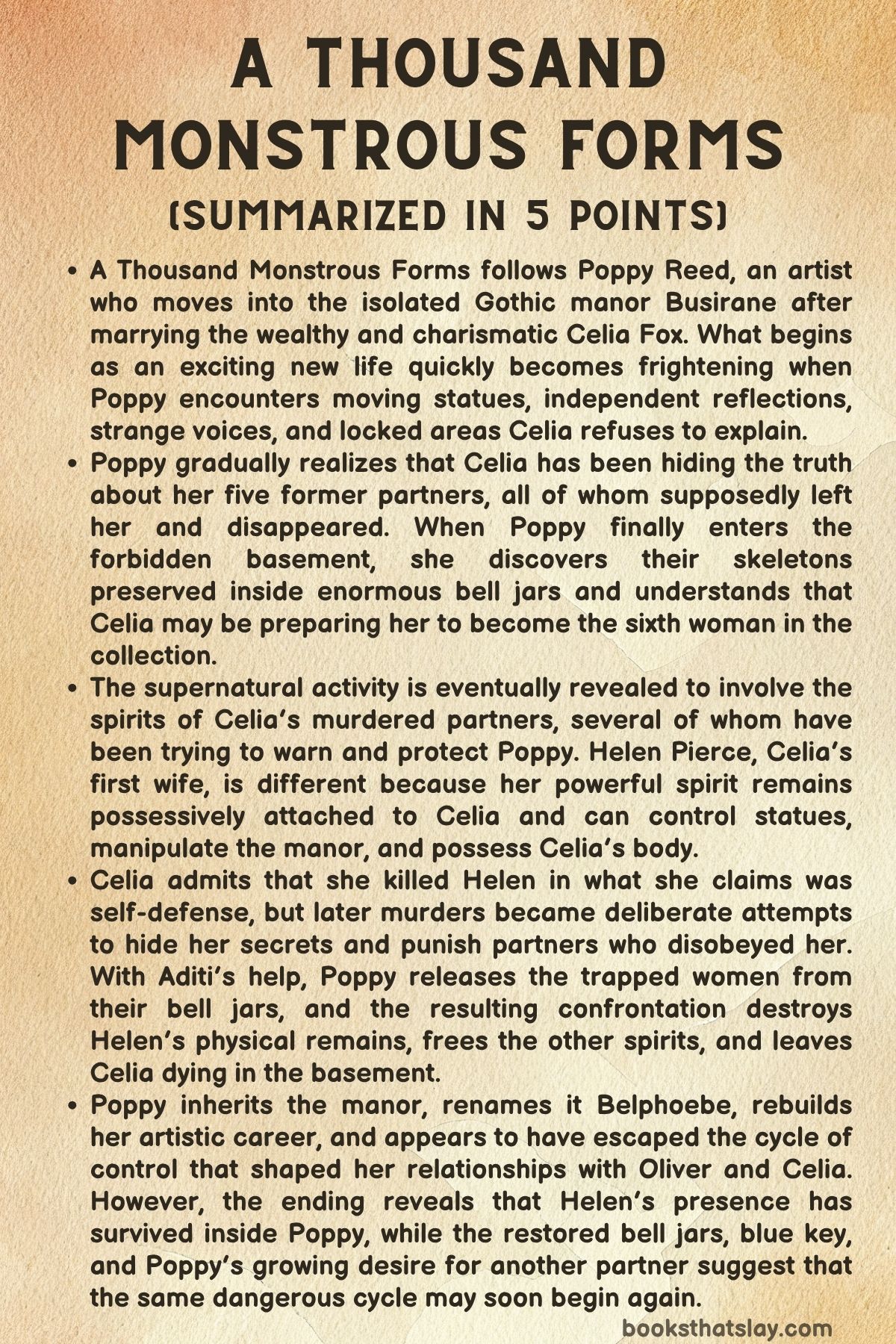
Summary
Poppy Reed arrives at Busirane convinced that she has finally found the kind of love she deserves. After surviving a destructive relationship with Oliver, she has fallen quickly and completely for Celia Fox, marrying her after only six months and agreeing to move across the country into Celia’s enormous ancestral home.
Her best friend Aditi is far less comfortable with the speed of the relationship. She worries that Poppy has abandoned too much of her independence, but Poppy sees Celia as the opposite of Oliver: generous, attentive, encouraging, wealthy, and deeply supportive of Poppy’s work as a ceramic artist.
Busirane immediately introduces unease into Poppy’s new life. Five faceless stone women stand beneath a gazebo in the courtyard, locked together in an eternal circle, while the manor itself appears almost aware of Poppy’s arrival.
Celia strengthens Poppy’s attachment by giving her an extraordinary pottery studio and filling it with professional equipment. For Poppy, whose damaged female sculptures have often been misunderstood by others, Celia’s ability to recognize the anger and vulnerability in her art feels like proof that her wife understands her more deeply than anyone ever has.
Yet disturbing events begin almost immediately. Poppy sees movements in windows and reflections that do not correspond with her own body, notices apparently lifeless objects behaving strangely, and hears unexplained noises throughout the house.
One night Celia sleeps with her eyes open and repeatedly tells Poppy to give her her skin. Celia later dismisses the episode as sleep-talking caused by childhood trauma, and Poppy accepts the explanation partly because she desperately wants the marriage to remain what she believes it to be.
Celia also reveals that the house is divided by color-coded keys. One blue key opens the basement, and Celia makes Poppy promise that she will never go down there.
The prohibition becomes increasingly suspicious as Busirane begins directly targeting Poppy. A portrait of her comes alive and tears away its own face, while Poppy later awakens with physical traces suggesting the experience was not merely a dream.
Celia’s work trips create another problem. Because Poppy sold her car and has little financial independence, Celia’s absences leave her effectively trapped at the remote estate.
During one trip, Poppy hears voices calling her toward the basement. Celia returns before she can investigate, and Poppy says nothing, afraid that describing what she heard will make her appear unstable.
Her fear is made worse by memories of Oliver. He repeatedly convinced Poppy to distrust her own perception during their abusive relationship, meaning that every unexplained event inside Busirane carries both supernatural danger and the psychological fear that she may once again be losing confidence in reality.
The house soon produces evidence that cannot easily be explained. One of the massive courtyard statues appears inside Poppy’s studio even though no reasonable person could have moved it without her noticing.
Celia claims that angry movers secretly brought it inside. Poppy recognizes that the explanation makes little sense, yet she accepts it because believing Celia is still easier than accepting the alternative.
When Celia leaves again, Poppy notices phrases carved above Busirane’s doors. Most entrances carry the command “Be bold,” while the basement warns, “Be not too bold.”
Her isolation becomes more frightening when a local taxi company refuses to service the property. The realization that even ordinary transportation cannot easily reach her makes the beautiful manor feel increasingly like a carefully designed prison.
Poppy invites Aditi and friends to Busirane for New Year’s Eve. During the party, Harley casually reveals that Celia has had several previous wives or serious partners.
Celia had spoken about former relationships, but Poppy had never fully considered how many women had come before her or why all of them seemed to vanish from Celia’s life so completely. She initially resists the implication because accepting it would force her to question the romantic narrative on which she has rebuilt her life.
Aditi becomes more alarmed after Poppy admits that the stone women appear to move. She encourages Poppy to use the blue key, but Poppy refuses, insisting that entering the basement would violate Celia’s trust.
Their argument exposes the deeper tension between them. Aditi believes Poppy has once again begun reshaping herself around a controlling romantic partner, while Poppy interprets Aditi’s concern as an unwillingness to respect her marriage.
Before leaving, Aditi reminds Poppy of the emergency phrase they created after Oliver: “melon balls.” If either woman uses the phrase in an unusual context, it means Poppy is in danger.
When Celia returns, she carefully checks the blue key. Soon Poppy hears Danse Macabre playing from the music room, the same piece Oliver used after abusive episodes, even though no one appears to be playing it.
Celia provides another technical explanation and gives Poppy an herbal sleeping tea. Poppy later discovers that the tea leaves her heavily sedated, while her reflections continue behaving independently and violently.
Celia finally tells Poppy more about her former partners. She claims her first wife, Helen Pierce, abused her, and she shows Poppy a scrapbook containing Helen and four later lovers: Eleanor, Isabel, Rosa, and Blanche.
Celia presents these women as people who betrayed or abandoned her. She tells Poppy that their marriage is different and that Poppy will remain permanently part of her life.
The statement initially sounds romantic, but the language of permanence becomes more threatening as Poppy recognizes how little freedom she now possesses. When Celia refuses to leave Poppy a car during another trip, Poppy fully confronts the extent of her dependence: she has little money, no nearby support network, no job outside her art, and no reliable transportation.
A snowstorm then isolates Busirane. The missing courtyard statue appears inside Poppy’s locked bedroom, and Danse Macabre begins playing again while Celia is away.
This time Poppy watches the piano move by itself. She finally stops accepting Celia’s explanations and recognizes that the supernatural events are real and that Celia knows far more about them than she has admitted.
Poppy takes the forbidden blue key and enters the basement. There she discovers enormous bell jars containing five human skeletons dressed in blue.
The plaques identify them as Helen Pierce, Eleanor Kask, Isabel Girgenti, Rosa Saleem, and Blanche Le Roux. Celia’s former partners never left her at all; their remains have been preserved beneath the house.
The discovery transforms every earlier warning. Poppy understands that she may be intended as the sixth woman in Celia’s collection.
She also begins realizing that several supernatural forces are operating inside Busirane. Four of the courtyard statues appear connected to Celia’s murdered partners, and objects associated with the women reveal that they have been trying to communicate with Poppy through music, artwork, and physical movement.
A fifth statue is different. It behaves aggressively toward Poppy, and the other spirits warn her to run from it.
Poppy attempts to escape but falls down the staircase and loses consciousness. When she awakens, Celia claims that a private doctor examined her and decided her concussion did not require hospitalization.
Poppy immediately knows the story is suspicious, especially when her phone and keys have disappeared. She nevertheless pretends to believe Celia because openly revealing what she knows could get her killed.
Celia later destroys four of the courtyard statues with a sledgehammer. Poppy hears the murdered wives screaming through the destruction, confirming their connection to the stone figures.
That night, Celia again speaks in an altered voice about Poppy’s bones. For one moment Celia appears terrified and begs Poppy to remove whatever has entered her, suggesting that a second consciousness can take control of her body.
Poppy eventually turns to the copy of The Faerie Queene that Celia had forbidden her to touch. An inscription reveals that Helen gave the books to Celia and once called her “Britomart,” showing that their relationship was more intimate and meaningful than Celia admitted.
The text also provides the phrase that clarifies Poppy’s entire experience: false love can take “a thousand monstrous forms.” Poppy realizes that domination can disguise itself as attention, generosity, rescue, desire, protection, or permanence.
Her understanding applies not only to Celia but also to Oliver. In both relationships, Poppy has repeatedly sacrificed pieces of herself in order to preserve someone else’s definition of love.
The house soon exposes another secret. The fifth statue appears carrying Poppy’s missing keys, including the blue key stained with blood from her basement experience.
Celia responds to the statue as though she already understands its nature. Even with overwhelming evidence before her, however, Poppy remains susceptible to Celia’s comfort because emotional attachment does not disappear simply because abuse becomes recognizable.
Poppy later discovers her cracked phone hidden in Celia’s study. Messages reveal that Celia intercepted Aditi’s attempts to reach her and pretended to be Poppy.
Aditi used their emergency phrase, but Celia failed to answer correctly. Poppy therefore knows that Aditi understands something is wrong.
The dead wives also finally communicate their intentions more clearly. They explain that the whiskey, music, moving statues, and other disturbances were attempts to use Poppy’s memories of Oliver to warn her about the danger surrounding Celia.
Poppy packs a bag and tries to leave, but Busirane itself inflicts crushing pain when she crosses the property boundary. She is forced back toward the house.
Escape will therefore require more than simply walking away. The house, its spirits, Celia, and the history beneath the basement have all become part of the same cycle.
Poppy finally confronts Celia and admits that she entered the basement. Celia does not deny what happened to the women.
Instead, another personality emerges through her body: Helen Pierce. Helen reveals that her spirit has remained attached to Celia and Busirane, strengthening the haunting and acting possessively toward the woman who killed her.
Helen wants Poppy eliminated because she sees her as a rival for Celia. Yet Poppy also learns that supernatural influence cannot excuse Celia’s behavior.
Celia has knowingly drugged Poppy, concealed bodies, lied to her, manipulated her, and participated in the repeated deaths of later partners. Helen may encourage violence, but Celia has made many of her worst decisions consciously.
The sedative in Poppy’s tea takes effect. She awakens tied to a chair in the basement beside the five occupied bell jars and a sixth empty one intended for her.
Celia finally explains the history of the murders. She claims Helen genuinely abused her and that she killed Helen in self-defense, then concealed the body because she feared professional scandal.
Eleanor later discovered Helen’s corpse. Celia pushed Eleanor down the stairs, killing her, and that second death transformed concealment into a repeated method of dealing with women who challenged her.
Celia forged documents, impersonated the dead, used wealth and influence to prevent investigations, and deliberately selected partners whose disappearances would attract less attention. Every relationship became a loyalty test.
She gave each woman access to the blue key, forbade her from entering the basement, and treated curiosity as betrayal. Her definition of love required complete obedience while allowing Celia herself unlimited secrecy.
Aditi arrives before Celia can kill Poppy. Celia attacks her, but Aditi survives and secretly begins freeing Poppy.
Helen explains more about Busirane, revealing that the manor intensifies spiritual power. Helen can possess bodies and statues, while the later murdered women have remained trapped there with weaker abilities.
Celia and Helen begin fighting for control of the same body. Poppy, meanwhile, overturns Eleanor’s bell jar after hearing the dead wives demand release.
Eleanor’s skeleton attacks Helen, proving that freeing the remains gives the murdered women greater power. Poppy and Aditi therefore open the other jars and release Isabel, Rosa, and Blanche as well.
Blanche reveals that she was responsible for several important warnings. Because she died most recently, her spirit retained greater strength than those of the women killed before her.
Helen eventually abandons Celia’s body and occupies her own skeleton. Celia then makes a final revealing choice: rather than helping Poppy, she breaks Helen’s jar and releases her completely.
The act destroys any possibility that Celia can blame everything on supernatural possession. Even after being freed from Helen’s direct control, Celia continues choosing the destructive bond between them over Poppy’s life.
A violent supernatural struggle follows. Aditi destroys Helen’s skull, causing her remains to disintegrate, while the other murdered wives are finally released from Busirane.
Celia lies dying amid the broken jars and asks Poppy to acknowledge that at least some part of their love was real. Poppy refuses to let sincerity erase abuse.
Celia may have experienced genuine affection, but she also drugged Poppy, isolated her, deceived her, and prepared to murder and preserve her. Love does not become harmless simply because the person causing the harm believes in it.
Poppy answers Celia with the truth she has finally learned: love can take a thousand monstrous forms. Celia dies without receiving the absolution she wants.
Afterward, the supernatural evidence conveniently disappears. Celia’s corpse no longer carries the injuries caused by the reanimated skeletons, and even the blood on the blue key vanishes.
The authorities therefore find no evidence that could support Poppy and Aditi’s real account. They report that Celia experienced a breakdown, attacked Aditi, damaged property, and later collapsed.
An autopsy attributes Celia’s death to a cardiac event. Because no physical evidence contradicts their explanation, the investigation ends without exposing the supernatural truth.
Poppy discovers that Celia changed her will shortly before dying and left her the entire estate. Busirane becomes quiet, and Poppy gradually attempts to rebuild her life.
Five months later, she has renamed the estate Belphoebe and restored her career. A new bronze sculpture in the courtyard depicts six women linked together but facing outward, transforming the original image of captivity into an apparent symbol of shared survival.
Poppy seems stronger and healthier, yet the final signs are deeply unsettling. Her reflection still moves on its own, she wears Celia’s jewelry again, and the broken bell jars in the basement have been restored.
Helen’s former jar now contains the headless stone statue, while its severed head sits beside Poppy’s bed. More disturbing still, Poppy senses Helen living inside her mind.
Rather than being destroyed, Helen appears to have transferred into Poppy during the final struggle. The presence numbs Poppy’s pain and subtly alters her desires.
Belphoebe also seems hungry for another occupant. When Poppy begins considering a new romantic partner, the blue key feels almost expectant, and the presence inside her responds with satisfaction.
Poppy has escaped Celia, but she may not have escaped the pattern Celia helped create. The final image leaves open the possibility that the cycle has merely changed hosts and is ready to begin again.
Characters
Poppy Reed
Poppy Reed is the central character of A Thousand Monstrous Forms, and her development depends on the gradual recovery of a self that she repeatedly allows romantic partners to reshape. She enters the novel believing that surviving Oliver has made her better equipped to recognize healthy love, yet Celia’s attention reaches the exact vulnerabilities Oliver created.
Poppy is an artist whose sculptures often depict wounded, angry, or distorted female bodies, making her creative work an external expression of experiences she has not fully resolved. Celia’s immediate understanding of that work becomes extraordinarily powerful because Poppy interprets artistic validation as proof of emotional safety.
Her greatest weakness is not simple gullibility. She is intelligent enough to recognize contradictions, but she has learned to preserve relationships by distrusting her own discomfort, so she continually produces explanations for behavior that frightens or restricts her.
The supernatural experiences inside Busirane therefore mirror a psychological problem that already exists within her. Moving reflections, changing paintings, and impossible statues repeatedly force Poppy to ask whether she can trust what she sees.
Her transformation begins when she stops treating certainty as something Celia must give her. Entering the basement is an act of disobedience, but it is also the moment Poppy chooses her own perception over the version of reality her wife has constructed.
By the climax, she understands that love cannot justify control, secrecy, drugging, isolation, or violence. Her refusal to absolve Celia at the moment of death demonstrates the emotional boundary she was unable to establish earlier.
Yet A Thousand Monstrous Forms denies Poppy a simple victory. The ending suggests that Helen has entered her mind and that the same forces she resisted may now be influencing her, leaving her growth real but dangerously incomplete.
Celia Fox
Celia Fox is simultaneously lover, manipulator, murderer, victim, and willing participant in the supernatural corruption surrounding Busirane. This combination makes her morally complicated without removing her responsibility for what she does.
Her relationship with Helen appears to have begun in genuine abuse, and Celia claims that Helen’s death occurred while she was defending herself. That origin matters because Celia initially occupies the same position of victimhood that Poppy later occupies.
The decisive difference is what Celia does afterward. Instead of confronting the killing honestly, she hides Helen’s body, then kills Eleanor when the secret is discovered and gradually turns concealment into a system.
Celia’s wealth allows her to transform violence into something organized. She forges documents, manipulates records, chooses isolated partners, creates plausible disappearance narratives, and builds relationships in which her control over money, property, transportation, and information gives her enormous power.
Her idea of romance depends heavily on possession. Expensive gifts, clothing, artistic equipment, declarations of permanence, and total emotional attention appear generous, but each gesture also increases Poppy’s dependence and draws her farther inside Celia’s world.
This contradiction is central to A Thousand Monstrous Forms. Celia may sincerely love Poppy, but sincerity does not prevent that love from becoming abusive when she believes she has the right to control whether Poppy stays, what she knows, and ultimately whether she lives.
Helen’s possession complicates Celia’s behavior, but the climax deliberately prevents possession from becoming an excuse. Once Helen leaves her body, Celia still chooses to free Helen and endanger Poppy.
Her final request for understanding reveals how desperately she wants intention to outweigh consequence. Poppy’s refusal rejects that logic and holds Celia responsible for the choices she made even while acknowledging that her history began in victimization.
Aditi
Aditi represents a form of love that does not require ownership. She challenges Poppy, becomes angry with her, and sometimes judges her decisions harshly, but she never attempts to erase Poppy’s independence.
From the beginning, she notices how quickly Poppy has reorganized her life around Celia. Her concern is based partly on what she witnessed during the relationship with Oliver, making her particularly sensitive to signs that Poppy is once again accepting restrictions in exchange for affection.
The conflict between the two women is important because the book refuses to make supportive friendship effortless. Poppy lashes out at Aditi, questions her understanding of romantic commitment, and temporarily distances herself from the person most willing to tell her an uncomfortable truth.
The emergency phrase “melon balls” reveals how seriously Aditi takes Poppy’s safety. When Celia impersonates Poppy over text, Aditi recognizes the failed code and acts rather than allowing uncertainty to become an excuse for inaction.
Her arrival at Busirane ultimately saves Poppy’s life. Even after Celia injures her, Aditi refuses to abandon her friend and helps release the murdered women.
Within A Thousand Monstrous Forms, Aditi provides the clearest contrast between protective love and possessive love. She risks losing Poppy rather than control her, and later risks her own life rather than leave her trapped.
Helen Pierce
Helen Pierce is both the first dead wife and the supernatural force that keeps the history of Busirane active. Her relationship with Celia establishes the original pattern from which the later violence develops.
According to Celia, Helen abused her physically and emotionally. Whether every detail of Celia’s account can be trusted remains uncertain, but the novel clearly presents their relationship as destructive enough that Celia’s later behavior cannot be understood without it.
Death does not end Helen’s possessiveness. Her spirit remains attached to Celia and gains unusual strength through Busirane, allowing her to manipulate reflections, inhabit statues, interfere with the house, and eventually possess Celia directly.
Helen therefore represents domination continuing beyond the limits of ordinary life. She does not merely want Celia; she wants permanent exclusive ownership of her.
Her hostility toward Poppy grows from jealousy. Poppy becomes a rival whose existence threatens Helen’s claim, so Helen attempts to frighten, destabilize, and ultimately eliminate her.
At the same time, Helen cannot be treated as the single cause of everything that follows. One of the strongest choices in A Thousand Monstrous Forms is its refusal to let Celia transfer responsibility to her dead abuser.
Helen amplifies cruelty and keeps the cycle alive, but Celia repeatedly participates willingly. Their bond becomes a relationship in which victim and abuser eventually help perpetuate a shared system of violence.
Blanche Le Roux
Blanche Le Roux is the most recently murdered of Celia’s later partners and therefore the strongest of the four spirits attempting to protect Poppy. Her relative supernatural strength gives the dead women their clearest means of communication.
Her connection to the piano makes music one of the spirits’ primary warning systems. She uses Danse Macabre because she learns that the piece carries a specific meaning for Poppy from her history with Oliver.
This detail demonstrates intelligence and compassion in Blanche’s haunting. Rather than simply creating frightening phenomena, she searches Poppy’s experiences for a language that the living woman will understand.
Blanche’s final direct communication explains that many of the seemingly hostile supernatural events were desperate attempts to warn Poppy. What looks like haunting gradually becomes a form of resistance by murdered women who have almost no other means of speaking.
Her farewell after Helen’s destruction gives emotional weight to the release of the spirits. Blanche is not only evidence of Celia’s crimes but a woman whose identity continues beyond the way Celia tried to preserve and categorize her.
Eleanor Kask
Eleanor Kask occupies a crucial position because her death marks the point where Celia’s first concealed killing becomes a repeatable pattern. She discovers Helen’s corpse and is killed when Celia pushes her down the basement stairs.
Unlike Helen’s death, which Celia frames as self-defense, Eleanor’s death cannot be justified in the same way. It represents Celia choosing secrecy over another human life.
Eleanor therefore exposes the weakness in Celia’s repeated attempts to describe herself primarily as someone shaped by Helen. Whatever happened in the first marriage, Celia becomes fully responsible when she kills again to protect herself from consequences.
Her skeleton also becomes the first one Poppy releases during the climax. That reversal is important: the woman whose discovery once threatened Celia’s secret becomes the first of the dead to physically fight back against the system created to silence her.
Isabel Girgenti
Isabel Girgenti is one of the later women caught within Celia’s increasingly deliberate pattern. By the time Celia reaches relationships such as Isabel’s, murder is no longer an improvised reaction to one disastrous situation but part of a controlled method.
Her presence in the basement demonstrates how Celia reduces individual women into repeated positions. Their lives, personalities, clothing, and relationships differ, but Celia places them into matching bell jars and dresses their remains according to an identity she chooses for them.
Isabel’s role therefore supports one of the book’s strongest concerns: the destruction of individuality through possession. Celia claims to preserve the women, yet what she actually preserves is her own preferred version of them.
When Isabel is released during the final confrontation, she regains the ability to act rather than simply remain an object in Celia’s collection. Her participation in the attack on Helen restores a measure of agency that death and display had denied her.
Rosa Saleem
Rosa Saleem is another of the murdered women whose physical remains have been incorporated into Celia’s ritualized understanding of romance. Her fate shows that Celia’s crimes eventually become systematic rather than exceptional.
Like Isabel and Eleanor, Rosa initially exists in Poppy’s understanding only through Celia’s scrapbook and false account of former relationships. Celia controls not only what happened to the women but also the stories told about them afterward.
The discovery of Rosa’s body therefore represents the recovery of truth from a narrative created by an abuser. The supposedly absent former lover becomes evidence that Celia’s romantic history has been rewritten to protect Celia herself.
Rosa’s return during the climax joins the individual victims into a temporary collective force. Once released from the glass structure that separated and displayed them, the women are able to fight the power that kept them silent.
Oliver
Oliver never physically enters Busirane, yet his influence remains present throughout Poppy’s experience. His emotional and physical abuse taught Poppy to distrust herself, accommodate partners, and interpret self-sacrifice as something necessary for maintaining intimacy.
Danse Macabre becomes the clearest symbol of that history. Because Oliver used the music after abusive incidents, the dead wives later choose it as a warning that Poppy is once again living beside someone dangerous.
Oliver also functions as the standard against which Poppy initially measures Celia. Because Celia appears kinder, more attentive, more generous, and more interested in Poppy’s art, Poppy assumes that the relationship must therefore be healthy.
The novel challenges that binary. Abuse does not need to repeat the exact methods Poppy already recognizes, and escaping one abusive person does not automatically teach someone to identify every different form of manipulation.
By forcing Poppy to compare Oliver and Celia, the story shows how A Thousand Monstrous Forms earns its title at a personal level. Harm can arrive through obvious cruelty or through extravagant devotion that gradually removes a person’s autonomy.
Harley
Harley has a relatively small role but triggers an important shift in Poppy’s understanding of Celia. During the New Year’s Eve party, Harley casually mentions Celia’s unusually large number of previous wives or serious partners.
The information unsettles Poppy because it introduces an outside perspective into a relationship whose history she has mostly learned through Celia herself. Harley does not uncover the murders, but the conversation plants the question that eventually becomes impossible for Poppy to avoid: what actually happened to all those women?
Harley therefore functions as an accidental disruptor of Celia’s controlled narrative. A casual social observation becomes significant because abusive systems often depend on isolating information that would appear suspicious if different people compared what they knew.
Trinity and Emma
Trinity and Emma belong to the wider social circle present at the New Year’s Eve gathering. Their presence briefly changes Busirane from an isolated Gothic environment into a house filled with ordinary conversation and social energy.
Although neither plays the decisive role that Aditi does, their presence matters because the party temporarily gives Poppy access to a world beyond Celia. The oppressive character of the manor seems less powerful when other people occupy it.
They help emphasize how isolation strengthens Celia and Busirane. The more Poppy is surrounded by friends and external perspectives, the harder it becomes for a single person or place to completely control her sense of reality.
Dr. Amoret
Dr. Amoret is the physician Celia claims has examined Poppy after her fall down the staircase. Poppy immediately recognizes something suspicious about the supposed medical treatment because an unconscious patient with a head injury would normally require more careful evaluation.
Whether Amoret knowingly participates in Celia’s deception or simply belongs to the network of private professionals Celia can summon through wealth and influence is not fully established in the material provided. His brief involvement nevertheless reinforces Poppy’s growing realization that Celia can produce apparently respectable explanations whenever dangerous events occur.
The uncertainty around him also strengthens the novel’s atmosphere of institutional unreliability. Poppy cannot easily determine which people outside the house might genuinely help her and which might accept Celia’s version of events.
Themes
Love, Possession, and Control
Love becomes dangerous when affection is treated as permission to possess another person. A Thousand Monstrous Forms repeatedly places loving gestures beside acts that reduce a partner’s freedom, forcing Poppy to reconsider what devotion actually looks like.
Celia’s gifts initially appear extraordinarily generous. She provides expensive clothing, an entire professional pottery studio, financial security, a magnificent home, romantic attention, and constant affirmation of Poppy’s talent.
Yet these gifts also create dependence. Poppy gradually loses transportation, employment, financial autonomy, privacy, and easy access to friends while becoming increasingly dependent on Celia for the conditions of everyday life.
The bell jars turn that possessiveness into a literal image. Celia refuses to accept abandonment, conflict, or disobedience, so she preserves dead partners in a form that guarantees they can never contradict or leave her again.
Her insistence that she loves Poppy therefore does not contradict her willingness to kill her. Within Celia’s distorted logic, murder becomes the ultimate method of guaranteeing permanent connection.
Poppy’s development depends on rejecting the idea that emotional sincerity automatically makes behavior loving. Celia may genuinely desire her and care about her, but genuine emotion cannot transform coercion into devotion.
The story therefore separates love from ownership. Aditi’s willingness to let Poppy make choices, even bad ones, becomes a healthier form of care precisely because it does not require possession.
Trusting One’s Own Perception
Poppy’s ability to trust herself has already been damaged before she enters Busirane. Oliver spent years manipulating her perception, which means every supernatural event inside the manor activates an old fear that her own mind may be unreliable.
Celia benefits from that uncertainty. Whenever something impossible happens, she supplies a rational explanation: movers relocated a statue, ventilation carried music through the house, a disturbing reflection was a dream, and frightening sleep behavior came from old trauma.
Individually, many explanations sound just plausible enough. Their cumulative effect, however, is to make Poppy repeatedly choose Celia’s version of reality over her own experience.
The supernatural elements intensify this psychological conflict because Poppy genuinely cannot rely on ordinary explanations. Reflections move, paintings change, voices speak through empty rooms, statues relocate themselves, and spirits manipulate objects.
Her breakthrough occurs not when she understands everything but when she accepts that incomplete understanding does not make her observations meaningless. She does not need Celia to validate what she has seen before she is allowed to act on fear.
Entering the basement becomes an important act of self-trust. Poppy finally chooses evidence over reassurance and discovers that her instincts were not only justified but had underestimated the scale of the danger.
The theme turns perception into a form of autonomy. Recovering confidence in her own senses becomes necessary before Poppy can recover control over her life.
Art, Identity, and the Female Body
Art functions throughout the novel as a way of shaping identity, preserving memory, communicating pain, and resisting control. Poppy creates damaged female forms because sculpture gives physical shape to anger and vulnerability that she struggles to express directly.
Celia’s early appreciation of that work becomes one reason Poppy trusts her so completely. Being artistically understood feels almost identical to being emotionally understood, which allows Celia’s support to reach unusually deeply into Poppy’s sense of self.
The novel later reveals the darker side of creation and display. Celia preserves murdered partners in bell jars, dresses their remains according to her preferences, and transforms living individuals into carefully arranged objects.
That behavior is the opposite of Poppy’s art. Poppy uses damaged bodies to explore experience and recover agency, while Celia turns actual bodies into possessions whose identities she can permanently control.
The stone women occupy the space between these two uses of art. They initially resemble disturbing decorative objects, but they eventually reveal themselves as vessels through which silenced women resist erasure.
The final bronze sculpture in A Thousand Monstrous Forms appears to revise the original stone circle. Six women remain connected, but they face outward, suggesting solidarity without total enclosure.
Yet the disturbing final developments prevent the image from becoming simple liberation. Art can preserve resistance, but it can also conceal unresolved forces beneath a beautiful new form.
Cycles of Abuse and the Difficulty of Escape
Abuse appears as a pattern that changes form while preserving its underlying logic. Poppy escapes Oliver but carries habits from that relationship into her marriage with Celia, particularly the tendency to minimize discomfort and reshape herself around a partner’s needs.
Celia follows another version of the same cycle. She describes herself as Helen’s victim, but rather than ending the pattern after Helen’s death, she reproduces domination in later relationships.
The novel therefore refuses the idea that suffering automatically makes someone compassionate. A person can be genuinely harmed and later choose to harm others.
Busirane gives this cycle a physical location. Each new partner enters the same house, receives access to the same blue key, hears the same prohibition, and becomes part of a loyalty test designed to produce betrayal.
Even Celia’s preserved collection repeats one visual structure: woman after woman placed in matching jars. Individual relationships become variations of the same destructive process.
Poppy initially seems to break the cycle by confronting Celia, freeing the dead wives, surviving the basement, and rebuilding the estate under a new name. Renaming Busirane as Belphoebe suggests an attempt to redefine both the place and Poppy’s relationship to its history.
The ending destroys the certainty of that transformation. Helen survives inside Poppy, the jars are restored, the stone figure remains in the basement, and Poppy begins imagining another romantic partner entering the property.
Escape, the novel suggests, is not simply surviving an abuser or changing the name of a house. Unless the forces sustaining the pattern are fully recognized and resisted, the same structure can return through a new person, a new relationship, and another form of love.