Prince of Swords Summary, Characters and Themes
Prince of Swords by Elise Kova is a dark fantasy novel centered on Clara, a gifted tarot wielder whose struggle for freedom grows into a battle over fate, memory, political power, and the structure of reality itself. The story combines magical conflict, family secrets, rebellion, romance, and questions about whether destiny can ever be separated from personal choice.
At its center is Clara’s determination to protect her sister Arina while confronting the rulers who have manipulated generations of Arcanists. Her alliance with Prince Kaelis gradually becomes equally important, especially when both discover that their histories have been altered by forces far larger than either of them understood. It’s the 2nd book of the Arcana Academy series.
Summary
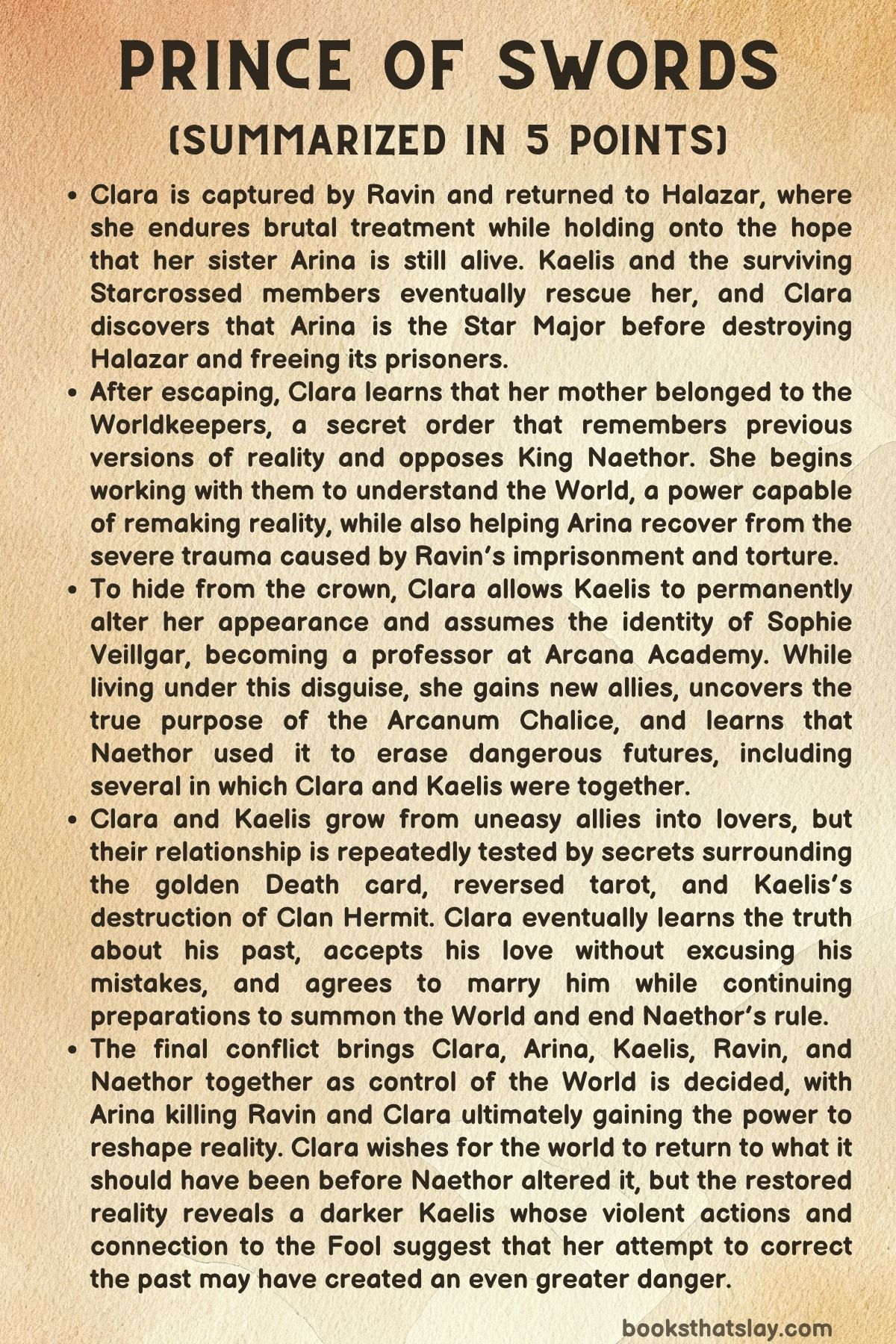
Clara is captured by Ravin after the destruction of the Starcrossed Club and the death of Bristara, but one discovery gives her reason to survive: Arina is alive and imprisoned in Halazar. Ravin reveals himself as the Major Arcana of Death, a terrifying power that allows him to kill people whose complete true names he knows, and he sends Clara back to the prison she once escaped.
Warden Glavstone, still enraged over the death of his son Eza, tortures Clara repeatedly while keeping her alive through healing magic. Clara refuses to beg despite the physical damage because she knows Arina is somewhere below her, and she secretly protects the genuine golden Death card she has stolen.
Kaelis eventually infiltrates Halazar with Gregor, Twino, Ren, and Jura and rescues Clara. Before killing Glavstone, Clara forces him to reveal Arina’s location, and another revelation follows: Arina is not merely a prisoner but the Major Arcana of the Star.
They descend into Halazar and find Arina starved, scarred, and psychologically shattered. Clara refuses to leave the remaining prisoners behind, so the group frees the inmates before Clara destroys Halazar itself with overwhelming earth and water magic.
Their escape leads into Eclipse City’s tunnels, where Emilia Ventall and the Stellis pursue them. Clara learns that her mother, Laylis Chevalyer, belonged to a secret organization known as the Worldkeepers, but their flight costs Jura her life when she reverses a Queen of Cups to save Clara.
The Worldkeepers reveal that King Naethor once used the World to remake reality and that members of their order retain memories when reality changes. Laylis had been one of them, and Clara may possess the knowledge necessary to create the vessel required to summon the World again.
Clara agrees to cooperate while keeping Arina’s safety under her control. Twino and Ren choose to leave the rebellion and build a peaceful life, while Gregor joins the Worldkeepers, showing Clara that grief can lead people toward very different futures.
Silas’s hidden journal later reveals that he was the Chariot Major and had originally worked for Ravin before becoming genuinely attached to Clara and the Starcrossed family. His betrayal helped lead to Arina’s capture, but his final efforts were intended to help Clara, protect his family, and bring about Ravin’s death.
Because Clara is being hunted everywhere, Kaelis physically reconstructs her appearance through painful healing and transformation magic. She becomes Sophie Veillgar and enters Arcana Academy as a professor, allowing her to protect Arina, investigate the academy, and operate directly beneath Ravin’s attention.
Her disguise works even when Ravin meets her face to face. Clara unexpectedly enjoys teaching, and she gains new allies among the Majors, including Sorza, whose Justice power allows her to recognize deception, and members such as Elorin and Alphos who secretly oppose Naethor.
Clara gradually discovers that the academy’s Arcanum Chalice is not simply a religious institution. Naethor has been using it to remove futures in which gifted Arcanists might challenge his authority, turning control of destiny itself into a political weapon.
Arina’s recovery proves far more difficult than Clara hoped. Thal, the Sun Major, can temporarily remove pain, but doing so does not heal trauma, and Clara eventually understands that Arina needs sustained care rather than magical erasure of everything she suffered.
At the same time, Clara and Kaelis grow increasingly close. Their relationship develops from mutual suspicion into emotional and physical intimacy, although Clara continues hiding the genuine golden Death card while growing suspicious that Kaelis has concealed his involvement with reversed tarot.
Kaelis eventually reveals another extraordinary truth. Naethor forced him, as a boy, to sacrifice three futures through the Chalice: one in which he met and loved Clara, one in which they summoned the World together, and one in which they ruled after defeating Naethor.
Clara experiences these stolen futures through the Hanged Man and realizes that Kaelis has spent much of his life carrying fragments of destinies that were deliberately erased. He also reveals that because the Chalice removed the future in which he successfully casts the World, Clara must ultimately be the one to make its wish.
Their growing love changes Clara’s understanding of Kaelis without eliminating her doubts about his methods. She successfully creates the vessel required for the World using material produced by reversed cards, but the Worldkeepers themselves disagree over what reality should replace Naethor’s.
Their plans collapse when the Stone Citadel is discovered and attacked. Ravin steals the vessel, Leigh Strongborn dies in battle, and Gregor is fatally wounded, leaving Clara devastated by the death of another person she considered family.
Afterward, Clara learns that Ravin did not exist in the original reality. Naethor’s wish created him as an alternative heir to Kaelis, explaining Ravin’s obsession with obtaining the World: another alteration of reality could erase him completely.
Clara then confronts Kaelis about Clan Hermit and reversed tarot. He admits that his power can reverse cards naturally and explains that, when he was young and traumatized by years of confinement and manipulation, he accidentally lost control and destroyed the entire Hermit bloodline.
Clara refuses to excuse those deaths, but she understands that Kaelis did not deliberately set out to murder innocent families. He agrees to seek surviving victims, preserve the memory of those who died, and accept responsibility rather than hiding behind his suffering.
Arina begins recovering enough to use her Star abilities voluntarily. During a reading for Clara, however, she sees ominous signs of death, deception, blood, and violet fire, warning Clara of something terrible approaching.
Another family secret soon emerges when Clara learns that High Lord Moreus Ventall is the biological father of both Clara and Arina. Emilia and Alor are therefore their half sisters, while Helena Ventall apparently arranged Laylis’s death after discovering Moreus’s relationship with her.
Clara eventually chooses not to kill Helena, realizing that vengeance would only leave Alor suffering the same losses Clara has endured. Her movement away from endless revenge demonstrates that destroying enemies is no longer enough; she wants to create conditions in which the cycle itself can end.
During a winter gathering with her surviving family, Kaelis proposes marriage without political conditions or strategic motives. Clara accepts and finally gives him the most dangerous secret she owns: her true name, Clara Chevalyer.
The danger surrounding that name remains because Clara’s former lover Liam also knows it. Liam, certain that Ravin will eventually torture the truth from him, asks Clara to kill him before that can happen, and she reluctantly grants his request.
Soon afterward, Clara’s Sophie Veillgar identity is exposed, and she becomes the target of an open pursuit through Eclipse City. Moreus confirms that he loved Laylis and had secretly tried to protect Clara, but Alor discovers Clara’s transformed identity and directs the crown’s forces after her.
Ravin eventually corners Clara, but Kaelis rescues her and openly turns against the forces of the crown. As Arcana Academy becomes a battlefield, Clara, Arina, the Worldkeepers, and Kaelis prepare for a final attempt to seize the World before Naethor can control it again.
Arina inks the golden Star while Clara creates a replacement vessel. Naethor arrives with Ravin, Cael, and Judgment, and Cael uses the Emperor’s power to control bodies, temporarily preventing Clara and Arina from fighting back.
Kaelis breaks the control with reversed magic, and the final battle begins. Arina ultimately kills Ravin, taking direct control over the fate of the man who tortured her, but before dying Ravin casts Death on Kaelis by speaking his true name.
Kaelis collapses and then inexplicably returns to life. During the chaos, Naethor gathers the golden Majors, but Clara reaches the vessel first and gains control of the World.
Instead of making the carefully prepared wish she once intended, Clara remembers Arina’s warning and asks reality to become what it should have been before Naethor ever altered it. The World responds, destroying and reconstructing everything around her.
Clara awakens in a restored reality where the Revisan dynasty was never displaced. She is already married to Kaelis and is about to be crowned beside him, but she soon discovers that although she remembers both realities, Kaelis does not remember everything they experienced together.
She initially believes their love will simply find its way back. During the coronation, however, Kaelis begins slaughtering nobles he considers enemies as violet fire consumes the hall, exactly matching the destruction Arina foresaw.
Clara realizes that restoring the world did not create the peaceful reality she expected. As she looks at Kaelis, she sees his shadow take the unmistakable shape of the Fool, revealing that the greatest danger was not simply Naethor’s altered world but something hidden inside the man Clara has chosen to love.
Characters
Clara Chevalyer
Clara is the emotional and moral center of Prince of Swords, and much of her development comes from the conflict between protection and control. She is fiercely devoted to Arina and repeatedly places her sister above strategy, political movements, romantic attachments, and even the possibility of reshaping reality.
Her greatest strength is survival, but survival has also distorted her understanding of responsibility. Clara becomes accustomed to believing that she must personally protect everyone she loves, which sometimes prevents her from recognizing that other people need autonomy rather than constant protection.
The destruction of Halazar demonstrates both sides of her personality. She is willing to use enormous destructive power against an institution she considers fundamentally cruel, yet her decision to free every prisoner shows that she refuses to assume the authority to decide who deserves death simply because she possesses greater power.
Grief continually reshapes her. Bristara, Jura, Silas, Gregor, Liam, and the suffering of Arina create enormous anger within her, but over time Clara begins questioning whether revenge can actually produce the freedom she wants.
Her decision not to kill Helena becomes especially important because it shows movement beyond retaliation. Clara recognizes that punishing Helena would also punish Alor, extending a chain of inherited grief that has already damaged both families.
Clara’s relationship with Kaelis develops alongside her struggle with control. Loving him requires her to accept uncertainty, disclose secrets, confront morally disturbing truths, and acknowledge that trust does not mean pretending the other person is harmless.
Her final decision concerning the World reflects both courage and impulsiveness. Clara rejects the plans other factions have prepared for her, but her desperate wish also demonstrates the danger of believing that restoring a supposedly correct past will automatically create a just future.
Kaelis Revisan
Kaelis is one of the most morally complicated figures in Prince of Swords because he can be compassionate, controlling, self-sacrificing, violent, guilty, and frighteningly powerful without any of those qualities canceling the others. Much of his life has been defined by Naethor’s attempt to remove futures in which Kaelis could challenge him.
The Chalice explains why Kaelis appears obsessed with Clara before their relationship seems capable of justifying that attachment. He has already experienced futures involving her, only to have those possibilities violently taken from him.
His love gradually becomes distinguished from possession because he repeatedly leaves crucial decisions to Clara. Most importantly, he acknowledges that she must choose what to do with the World rather than recreate one of the futures he lost.
His treatment of Clara during her physical transformation also reveals an important part of his character. Although he is capable of extreme violence, he respects Clara’s boundaries and carefully separates pain she has chosen for a purpose from cruelty inflicted for domination.
Clan Hermit remains the strongest moral stain on his past. Kaelis did not intend to destroy an entire bloodline, but his uncontrolled reversed magic killed innocent people, making guilt and accountability central to any honest assessment of him.
His reversed tarot also carries symbolic importance. Kaelis has spent years hiding a power others regard as unnatural, and Clara’s acceptance allows him to stop treating secrecy as the only possible response to fear.
The ending radically complicates his apparent growth. The restored Kaelis lacks the memories that helped shape his restraint, and the appearance of the Fool in his shadow suggests that the qualities Clara believed she understood may have been connected to a much larger supernatural danger.
Arina Chevalyer
Arina begins as the person Clara is trying to rescue, but the story gradually restores her position as an individual rather than merely an object of Clara’s protection. Her identity as the Star makes her extremely valuable to Ravin, yet the suffering inflicted on her also demonstrates the cruelty of treating a human being primarily as a magical resource.
Her trauma after Halazar is presented as something that cannot simply be removed through healing cards. Physical wounds can be repaired quickly, but fear, despair, memory, and the loss of personal agency require a much slower process.
Arina’s decision to begin reading tarot again is therefore particularly important. Ravin tried to make her ability belong to him, so choosing to use the Star voluntarily becomes a way of reclaiming ownership over the same power associated with her imprisonment.
Her relationship with Clara also changes as she recovers. Clara initially treats Arina almost entirely as someone who must be protected, but Arina gradually becomes capable of comforting Clara, making decisions, pursuing a connection with Thal, joining the Worldkeepers, and participating in the final struggle.
Arina’s prophetic readings give her an uncomfortable relationship with knowledge. She can see possible disasters before others understand them, yet she also learns that revealing everything immediately may not prevent those outcomes.
Her warning about violet fire ultimately becomes one of the novel’s most important pieces of foreshadowing. Arina sees the consequences of the altered world before Clara fully understands the danger contained in her wish.
Ravin
Ravin functions as Clara’s most immediate antagonist for much of the story. As Death, he has a horrifying ability to kill through true names, which makes knowledge itself dangerous whenever he possesses it.
His cruelty toward Clara and Arina is deliberate rather than accidental. Ravin treats torture, imprisonment, intimidation, and political violence as acceptable tools whenever they bring him closer to security or power.
His later origin gives his behavior additional psychological complexity. Because Naethor’s wish created Ravin in a reality where he did not previously exist, Ravin knows that another rewriting of reality could eliminate him entirely.
His pursuit of the World is therefore connected to an existential fear rather than ordinary ambition alone. He wants absolute control partly because his existence depends on preventing anyone else from deciding that reality would be better without him.
That fear does not excuse his actions, but it explains why he is so desperate to control the vessel. Ravin has built his identity around surviving a reality that created him artificially, making his obsession with permanence tragically understandable even while his methods remain brutal.
Gregor
Gregor represents loyalty shaped by personal loss. His younger sister Malie was taken for illegal tarot use, his father disappeared while attempting to rescue her, and his mother later died, leaving Gregor with a deep hatred of the system that destroyed his family.
His relationship with Clara gradually becomes sibling-like. He challenges her decisions, protects Arina, supports the surviving Starcrossed members, and refuses to treat Clara as someone who should be obeyed unquestioningly.
Joining the Worldkeepers gives Gregor a new sense of purpose after the collapse of the Starcrossed Club. Unlike Twino and Ren, who respond to loss by choosing peace, Gregor responds by seeking a cause large enough to transform grief into action.
His willingness to rescue Silas’s family demonstrates that his commitment is not abstract. Gregor risks himself for people he barely knows because fulfilling Silas’s final wish represents the kind of loyalty he believes people deserve.
His death is especially painful because he is one of the characters most excited about retaining his memories in the next reality. He dies fighting for a future he will never experience, making his absence an emotional reminder of what Clara’s larger mission has already cost.
Jura
Jura embodies courage expressed through deliberate sacrifice. Her experiences in Halazar make her deeply aware of the cruelty Clara is fighting, but she never becomes merely an extension of Clara’s anger.
Her defining moment comes when Clara offers herself to Emilia in exchange for Jura’s life. Jura refuses to allow Clara to sacrifice herself and instead reverses the Queen of Cups, knowing that using the card beyond safe limits will probably kill her.
The choice is important because Jura decides the terms of her own final act. She refuses to become another person Clara saves at the cost of herself and instead gives Clara the chance to continue.
Jura remains present after her death through the people she loved. Ren preserves her recipes, the surviving family honors her memory, and Clara carries the consequences of losing someone who chose her own sacrifice rather than having death chosen for her.
Twino
Twino offers an alternative answer to the question of what survival should eventually produce. After enduring enough loss, Twino decides that continuing the rebellion indefinitely would allow violence to define the remainder of life.
This choice does not make Twino less loyal or brave. Leaving the struggle becomes an act of self-preservation and a rejection of the idea that suffering creates an obligation to keep suffering.
The peaceful home built with Ren gives Clara a concrete example of life beyond rebellion. Twino demonstrates that ordinary stability, companionship, and domestic happiness can be meaningful victories rather than signs of retreat.
Ren
Ren understands earlier than Clara that endless resistance can become an identity trap. The question Ren asks Clara about what will remain of her when she stops fighting directly challenges the personality Clara has built around crisis.
Ren’s later life with Twino makes that question visible rather than theoretical. Gardening, books, shared meals, Gilly, and plans for a tea shop create the kind of future Clara has rarely allowed herself to imagine.
Ren also preserves Jura’s memory through food rather than vengeance. This becomes an important contrast with Clara’s instinct to honor the dead by destroying those responsible for their deaths.
Sorza
Sorza’s role as Justice makes her relationship with truth unusually complex. Her power allows her to detect deception, yet she ultimately chooses to protect Clara’s deception because she recognizes a difference between factual truth and political justice.
She risks herself during Clara’s interrogation by validating the Sophie identity. That decision confirms that her alliance is not casual rebellion but a serious rejection of the future Naethor intends to impose on her.
Sorza also becomes increasingly integrated into Clara’s chosen family. Her presence demonstrates that people raised within the structures Clara opposes can still reject those structures once they understand what obedience will require.
Thal
Thal introduces one of the story’s most mature ideas about suffering: pain cannot always be treated as a malfunction that should immediately be erased. As the Sun Major, Thal possesses the ability to remove emotional pain, yet personal experience has taught them how destructive that apparent gift can become.
Their mother became dependent on the relief supplied through the Sun, and Thal carries lasting guilt over believing repeated magical relief could substitute for healing. That history makes Thal initially reluctant to use the same power on Arina.
Thal eventually helps Arina in a more responsible way, using the Sun within a broader process rather than as permanent escape. Their developing closeness with Arina is appropriately cautious because both characters understand the danger of using another person to avoid unresolved pain.
Vaduin
Vaduin is committed to preserving the Worldkeepers and restoring a reality free from Naethor’s manipulation. He gives Clara essential information about Laylis, the vessel, the previous world, and the mechanisms through which reality can be rewritten.
His dedication also makes him capable of applying pressure to Clara and Arina. Because he sees the survival of an entire order at stake, individual hesitation can appear to him as an obstacle to collective necessity.
This creates genuine tension between Vaduin and Clara. They need one another, but Clara refuses to let the Worldkeepers claim ownership over Arina, the vessel, or the eventual wish simply because their cause is justified.
His warnings to Gregor about Kaelis also show the danger of letting legitimate concerns harden into predetermined conclusions. Vaduin is not presented as malicious, but he demonstrates how resistance movements can reproduce forms of control when their goals begin to outweigh individual choice.
Silas
Silas is defined by divided loyalty and delayed redemption. He begins as Ravin’s agent and contributes to the chain of events that leads to Arina’s capture, making his betrayal genuinely consequential.
Yet Silas also develops sincere affection for Clara and the Starcrossed family. Ravin’s threats against his own family trap him between people he has grown to love and people he is terrified of losing.
His hidden journal reveals that he understands the damage he caused. Rather than asking Clara to forgive him, he leaves practical assistance behind and identifies two goals he hopes she can accomplish: saving his family and killing Ravin.
His Chariot cards continue helping Clara after his death, while Gregor’s rescue of Silas’s family partially completes the redemption Silas could not achieve himself.
Emilia Ventall
Emilia is both an antagonist and a reflection of Clara. She is disciplined, dangerous, loyal to the crown, and increasingly driven by family loss.
Her pursuit becomes personal after the conflict with Clara and after Jura’s reversed magic permanently scars her. When Clara later kills Emilia, the act fulfills part of Clara’s desire for revenge while simultaneously becoming more troubling once their shared parentage is revealed.
Emilia is Clara’s half sister, although neither develops the relationship that knowledge might have made possible. Her death therefore illustrates one of the story’s central tragedies: people can inherit conflicts before they understand the family history beneath them.
Alor Ventall
Alor provides one of the clearest examples of how Clara appears from the perspective of those harmed by her actions. To Clara, Emilia is an enemy connected to her mother’s death; to Alor, Emilia is simply her sister, and Clara is the person who took her away.
Her grief parallels Clara’s own reactions to Bristara, Jura, and Gregor. This resemblance makes it increasingly difficult for Clara to treat Clan Tower as a collection of faceless enemies.
The revelation that Alor and Clara are half sisters adds another layer of tragedy. Alor has spent months hunting a woman who belongs to the same fractured family, while Clara has been fighting relatives whose connection to her was deliberately concealed.
Moreus Ventall
Moreus initially appears suspicious because of his connections to Laylis and his unusual interest in Clara. The later discovery that he is Clara and Arina’s biological father changes the meaning of many earlier interactions.
According to Moreus, his relationship with Laylis was consensual and loving, and he searched for her and their daughters after she disappeared. He also claims to have protected Clara secretly, including intervening when Ravin might otherwise have killed her.
These revelations do not erase his failures. Clara has lived without a father while suffering consequences connected to his household, and Moreus never creates the safety he says he wanted for her.
His decision to protect Clara and then provide Alor with information that exposes Sophie makes him especially difficult to read. Moreus seems caught between competing families, unresolved guilt, and obligations he has failed to reconcile.
King Naethor
Naethor represents systematic rather than impulsive cruelty. While Ravin often uses direct violence, Naethor redesigns institutions so that oppression appears normal, sacred, or necessary.
The Arcanum Chalice is his clearest weapon. By removing futures that could threaten his reign, he does not merely punish opposition after it emerges; he manipulates possibility so that opposition has less chance to exist.
His treatment of Kaelis follows the same pattern. Naethor removes Kaelis’s futures, undermines his trust in his own memories, and attempts to define psychological abuse as protection from a supposedly dangerous Revisan inheritance.
Even Ravin is ultimately connected to Naethor’s manipulation. By creating a new reality in which Ravin exists and Kaelis is displaced, Naethor produces another person whose survival becomes dependent on maintaining the altered world.
Bristara
Bristara functions as a source of belonging, knowledge, and resistance before her death. The Starcrossed Club becomes more than an organization under her influence; it becomes a home for people who have been rejected, criminalized, or damaged elsewhere.
Her death removes one of Clara’s remaining parental figures and destroys the stability of the Starcrossed family. The burning of the townhouse immediately afterward makes the loss physical as well as emotional.
Bristara’s revelations about Laylis and the Worldkeepers continue shaping Clara long after she is gone. Like several dead characters in the story, her influence survives because other people keep making choices based on what she taught them.
Warden Glavstone
Glavstone represents institutional cruelty made intensely personal. His hatred of Clara arises from the death of his son Eza, but he transforms grief into repeated torture rather than examining the system that produced the conflict.
His ability to heal Clara only so that he can injure her again makes his use of magic especially disturbing. Healing, normally associated with preservation, becomes part of the machinery of abuse.
Clara’s killing of Glavstone is one of her most direct acts of revenge. Unlike later moments when she questions retaliation, here she sees his death as necessary because he remains an immediate threat to both sisters and refuses any moral reconsideration.
Eza
Eza is largely present through the consequences of his death. Glavstone’s grief over losing his son becomes the justification he uses for his treatment of Clara.
His absence therefore demonstrates how grief can be manipulated into cruelty when responsibility is simplified into hatred of a single person. Eza becomes less a developed active figure than a symbol of the loss Glavstone refuses to process responsibly.
Leigh Strongborn
Leigh is one of the crown’s most dangerous physical combatants. Her skill places Clara at a disadvantage whenever magical superiority cannot compensate for experience with weapons.
Her loyalty to Ravin is particularly striking because his response to her death is almost nonexistent. That indifference reveals far more about Ravin than about Leigh, showing how little emotional value he places on even those closest to him.
Elorin
Elorin changes Clara’s understanding of the Majors by revealing that service to Naethor does not necessarily mean loyalty to him. As the High Priestess, she understands more about the forces surrounding fate and helps Clara recognize the instability of the Wheel.
Her explanation that Clara is unusually close to the principles governing the World helps frame Clara’s power as something more dangerous than ordinary spellcasting. Elorin also identifies freedom rather than revenge as the deeper direction of Clara’s struggle.
Alphos
Alphos initially appears to be a major threat because the Hierophant can detect other Majors regardless of physical disguise. Clara therefore travels to Fate Hearth intending to kill him before he can expose her.
Discovering that Alphos is willing to resist Naethor transforms a planned assassination into an alliance. His later silence during Clara’s interrogation proves that cooperation through trust can accomplish what violence would have permanently prevented.
Cael
Cael becomes dangerous primarily through the Emperor Major, which grants him the ability to command other people’s bodies. His power represents control in its most literal form because resistance becomes impossible when an enemy can directly override physical autonomy.
His appearance in the final battle therefore suits Naethor’s political philosophy. Naethor has spent years restricting possible futures, while Cael temporarily removes immediate bodily choice.
Helena Ventall
Helena becomes central to Clara’s family tragedy despite appearing comparatively late in Clara’s understanding of events. She is identified as the person responsible for arranging Laylis’s death after discovering Moreus’s relationship with her.
Clara’s decision not to kill Helena is more important than Helena’s individual complexity. Sparing her becomes Clara’s deliberate attempt to stop inherited revenge from producing another grieving daughter in Alor.
Liam
Liam represents Clara’s life before Kaelis and before she fully understood how thoroughly fate had been altered. Their earlier relationship was real to Clara even after she learns that other possible futures would have led her toward Kaelis.
His knowledge of Clara’s true name turns emotional history into a deadly vulnerability. Liam understands that Ravin may eventually force him to reveal it and concludes that death is the only way to guarantee Clara’s safety.
Clara grants his request only after resisting Kaelis’s earlier suggestion that Liam should simply be killed. His death therefore becomes one of her most painful compromises between compassion and necessity.
Luren
Luren demonstrates Clara’s growing ability to build alliances without threats or violence. Clara reveals her Sophie identity and offers Luren genuine assistance with Clan Star in exchange for retrieving the letters that could expose Clara’s true name.
The arrangement works because both women receive something they value. Luren’s strong tarot reading also shows that she is more than a convenient pawn in Clara’s plan and has abilities capable of advancing her own position.
Priss
Priss appears largely within Kaelis’s quieter personal life and helps humanize the environment Clara increasingly begins to regard as a refuge. Her presence contributes to the contrast between Kaelis’s feared public identity and the more domestic version Clara encounters in private.
Although Priss has far less influence on the central conflict than the major political figures, characters like her help demonstrate why Clara’s connection with Kaelis becomes associated with the possibility of home rather than strategy alone.
Queen Elari Revisan
Elari is central to Kaelis’s understanding of his stolen inheritance. Her death at Naethor’s hands becomes part of the history that has been hidden or rewritten to secure the Oricalis regime.
Kaelis’s refusal to use the World simply to recreate his mother is significant. His belief that a magically reproduced Elari would not restore the original person shows that his pursuit of the World is not merely an inability to accept bereavement.
Laylis Chevalyer
Laylis shapes Clara’s life even though much of her importance is reconstructed through secrets, memories, and other people’s testimony. She hides Clara’s true identity, teaches her unusual magical techniques, participates in the Worldkeepers, and leaves knowledge that eventually enables Clara to create the vessel.
As Moreus’s former lover and Helena’s victim, Laylis also becomes the point where the Worldkeeper conflict and the Ventall family conflict meet. Clara’s search for the truth about her mother repeatedly changes her understanding of who her enemies and relatives actually are.
Judgment
Judgment remains less individually developed than several other Majors, but the character contributes to the growing evidence that the Major Arcana are not a politically unified group. Suggestions that Judgment may sympathize with resistance weaken the assumption that possessing a Major automatically determines allegiance.
The character also reinforces a broader idea within the story: magical roles can influence identity, but they do not completely dictate moral or political choice.
Prince Belen
Belen appears mainly through his private conversation with Naethor, where Clara overhears information about Ravin, Kaelis, and the weakening Chalice. His significance lies less in an independent personal arc and more in providing access to the private logic of the ruling family.
Through that conversation, Clara sees how casually Naethor discusses sacrifice, manipulation, and the political usefulness of controlling the people closest to him.
Professor Armena
Professor Armena becomes a victim of the crown’s need to manufacture evidence of success. When the academy search fails to expose Clara, Armena is taken as a convenient suspect.
This treatment demonstrates how authoritarian systems preserve their appearance of competence. Innocence matters less than producing someone who can publicly absorb blame.
Sevan
Sevan catches Clara’s group while they are freeing prisoners from Halazar and is immediately killed by Kaelis. The brief encounter marks the moment when secrecy effectively ends and the rescue becomes open rebellion.
His death also demonstrates Kaelis’s willingness to use lethal force immediately when he believes hesitation could threaten Clara, Arina, or their allies.
Xora, Vacelle, and Ferier
Xora, Vacelle, and Ferier represent the wider support structure Clara has resisted depending upon. Their involvement in caring for Arina becomes necessary after Gregor can no longer manage her condition alone.
Ferier’s role as a healer particularly emphasizes that recovery requires continued attention rather than one dramatic magical solution. Together these Worldkeepers help Clara recognize that accepting assistance does not mean abandoning responsibility.
Malie
Malie never becomes an active participant in the central events, but her disappearance explains much of Gregor’s emotional foundation. Being taken for illegal tarot use destroys his childhood family and makes the crown’s persecution of Arcanists permanently personal.
Her absence therefore continues influencing Gregor’s decisions long afterward. His determination to rescue others can be understood partly as an attempt to become for them the protector he could never be for his younger sister.
Dristin
Dristin appears primarily within the academy’s social and clan politics. Clara manages interactions involving Dristin while maneuvering Luren toward Clan Star, showing how fully she has learned to operate inside noble systems she once understood mainly as oppressive forces.
The character’s limited role nevertheless contributes to the contrast between the academy’s ordinary courtship and clan rituals and the hidden struggle over reality occurring beneath them.
Themes
Fate, Choice, and the Ownership of the Future
In Prince of Swords, fate is not simply a mysterious force predicting what will happen; it is something powerful people actively attempt to control. Naethor’s use of the Chalice is the clearest example because he removes futures in which gifted Arcanists might challenge his reign, turning political repression into direct interference with possibility.
Kaelis’s stolen futures make the emotional cost of this system personal. He does not merely lose opportunities for wealth or authority but entire relationships, identities, and versions of himself, including several futures involving Clara.
This creates a difficult problem for Clara because learning that she and Kaelis repeatedly find one another does not automatically prove that loving him is a free choice. She must decide whether destiny invalidates personal agency or whether choice remains meaningful precisely because people can still determine how they respond to the possibilities placed before them.
The World extends the same question to reality itself. Clara eventually obtains the power to choose a new future for everyone, yet her final wish demonstrates that no individual can perfectly control what a supposedly correct reality should contain.
Her attempt to restore the world to what it should have been does not remove uncertainty. Instead, it proves that freedom cannot be guaranteed merely by replacing one person’s control of fate with another person’s judgment about how fate should operate.
Trauma, Pain, and the Limits of Magical Healing
Arina’s recovery challenges the idea that extraordinary power can solve every form of suffering. The characters possess cards capable of closing wounds, repairing broken bodies, suppressing pain, transforming appearances, and even altering reality, yet none of them can immediately return Arina to the person she was before Halazar.
Thal’s Sun makes this distinction especially clear. Removing pain can create temporary relief, but it can also separate a person from emotions that must eventually be processed, and Thal’s experience with their mother demonstrates how easily relief can become dependence.
Clara initially struggles to accept this because action is her natural response to suffering. Whenever someone she loves is hurt, she looks for a stronger card, a better plan, a more secure hiding place, or an enemy she can destroy.
Arina’s condition forces Clara to understand that some forms of care require patience rather than conquest. Recovery becomes meaningful when Arina begins choosing again: choosing to speak, choosing to read cards, choosing her relationship with Thal, and choosing to participate in the struggle surrounding the World.
Kaelis carries a different form of trauma through the futures Naethor removed and the abuse surrounding his memories. His healing similarly requires truth and accountability rather than pretending his suffering excuses what happened at Clan Hermit.
Power, Control, and the Corruption of Institutions
The institutions governing Arcanists repeatedly transform practices that might appear protective into methods of domination. Halazar claims the authority to imprison dangerous people but becomes a site where torture, exploitation, secrecy, and personal vengeance operate with official protection.
Arcana Academy presents the Chalice as an accepted ritual, yet Clara discovers that its actual function is political. Young Arcanists surrender possible futures so that Naethor can reduce the chances of anyone developing into a genuine challenge to his rule.
The Worldkeepers offer an intentional contrast to Oricalis, but they are not immune from similar pressures. Their cause may be legitimate, yet Vaduin and other members sometimes begin treating Clara, Arina, and the vessel as resources necessary for achieving a collective objective.
Clara repeatedly resists this logic because she has experienced what happens when institutions decide that individuals are less important than a supposedly greater purpose. Her insistence that Arina will make the Star only when ready is therefore a political principle as much as an act of sisterly protection.
The story ultimately suggests that the danger lies not only in possessing enormous power but in believing that a worthy goal automatically gives someone the right to control everyone else.
Love, Family, and the Meaning of Home
Family throughout the story is created through several different bonds: blood, romance, friendship, shared survival, and deliberate choice. Clara begins by centering almost her entire emotional life on Arina, but the Starcrossed Club gradually becomes another family whose members offer loyalty without requiring blood relation.
The deaths of Bristara, Jura, and Gregor therefore affect Clara as deeply as biological loss. Twino and Ren’s home later demonstrates that preserving love may sometimes require leaving conflict rather than dying for it.
Clara’s biological family complicates the meaning of kinship even further. Moreus is her father, while Emilia and Alor are her half sisters, yet hidden parentage does not automatically create trust, affection, or forgiveness.
Kaelis gradually becomes connected to the idea of home because Clara chooses him despite knowing the most disturbing parts of his history. Their relationship becomes meaningful not because fate repeatedly places them together but because they increasingly disclose truths, respect boundaries, forgive without erasing responsibility, and imagine an ordinary life alongside the struggle for political change.
The restored reality tests that understanding severely. Clara discovers that the person she loves can exist with the same name, history, and marital bond while lacking the memories that shaped the Kaelis she knew, raising the unsettling possibility that home is not a place or title but something created through shared choices that reality itself can erase.