Ransom by Daniel Silva Summary, Characters and Themes
Ransom by Daniel Silva is a contemporary espionage thriller that begins as a billionaire kidnapping case and expands into a conflict involving hidden money, Russian intelligence, political violence, and European security.
Gabriel Allon, the former Israeli intelligence chief who now prefers restoring paintings and living quietly with his family, is drawn back into dangerous work when socialite Alice Winter disappears. What first appears to be a conventional abduction soon becomes far less straightforward. Silva uses Gabriel’s investigation to examine deception, wealth, loyalty, corruption, and the consequences of choices made under fear, while steadily increasing the scale of the danger from one missing woman to an international crisis. It’s the 26th book of the Gabriel Allon series.
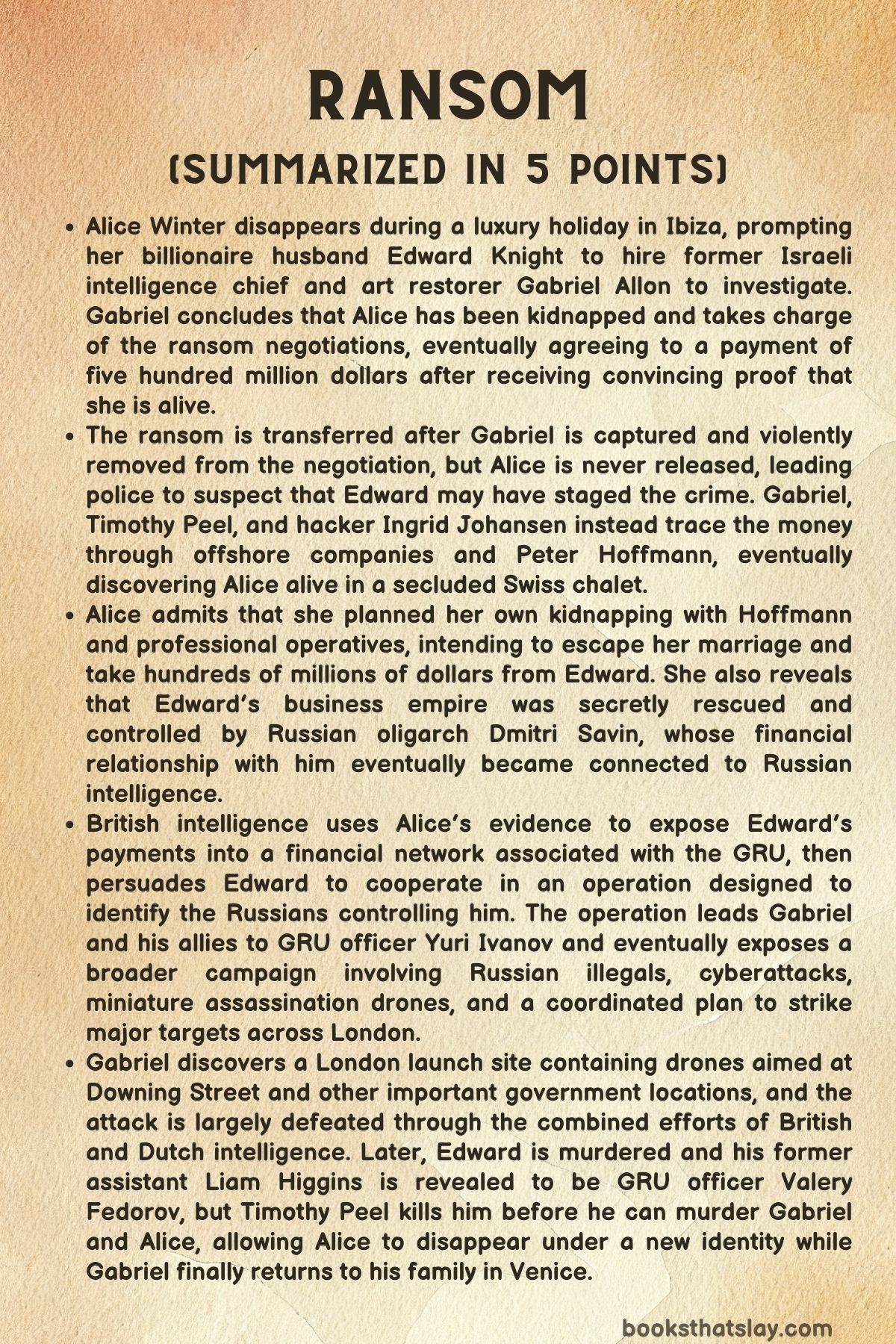
Summary
Phoebe Chadwick travels to Ibiza with her three closest Cambridge friends, Sophie Maxwell, Ella Burns, and Alice Winter. Their annual holiday has become far more extravagant than Phoebe expected because Alice, now married to billionaire property investor Edward Knight, has arranged a luxurious villa and a schedule filled with costly restaurants, clubs, and constant social-media activity.
The difference between Phoebe’s humanitarian values and Alice’s increasingly materialistic lifestyle creates tension. After a severe argument, Phoebe leaves Ibiza early, while Alice remains with Sophie and Ella; soon afterward, Alice disappears, her Mercedes is found at the bottom of a ravine, and one of her sandals is recovered from a beach.
At the same time, Gabriel Allon is trying to enjoy a quieter existence in Cornwall with his wife, Chiara, and their children. A former Israeli intelligence chief and highly respected art restorer, Gabriel reluctantly attends a fundraiser at Edward Knight’s Devon estate, where Alice is conspicuously absent and Knight suddenly leaves after receiving troubling news.
Knight later arrives at Gabriel’s Cornish home and reveals the truth. Alice is missing, the Spanish police have found no body, and Knight wants Gabriel to serve as a private investigator and negotiator if necessary; after resisting, Gabriel accepts and travels to Ibiza.
Gabriel works with Spanish police inspector Eva Aragón, who initially believes Alice may have been targeted by criminals because of her conspicuous wealth. Gabriel quickly notices details that do not fit a robbery, particularly the absence of blood in the wrecked Mercedes and Alice’s purchase of a white Louis Vuitton baseball cap even though she already owned another expensive cap.
Surveillance footage and witness interviews reveal that Alice secretly met Swiss banker Peter Hoffmann, a Cambridge acquaintance who manages Edward Knight’s wealth. Before Gabriel can determine why the meeting occurred, Knight finally receives a message from Alice’s captors, confirming that she has been kidnapped.
Gabriel assumes control of the negotiations and demands convincing proof that Alice is alive. The kidnappers provide a photograph showing her bruised and frightened, and hacker Ingrid Johansen examines the image for signs of artificial manipulation before concluding that it is probably genuine.
The captors demand one billion dollars. Gabriel begins a prolonged negotiation, gradually forcing the amount downward while Knight becomes increasingly desperate; after Alice herself calls Gabriel and begs for help, Gabriel agrees to a final ransom of five hundred million dollars.
The payment arrangements lead Gabriel through Zurich, Munich, and Salzburg. He insists that the money will not be transferred until Alice is physically released, but the kidnappers seize him in Austria, beat him, drug him, and contact Knight directly.
Terrified that both Alice and Gabriel will be killed, Knight ignores Gabriel’s rules and transfers the entire ransom. Gabriel later awakens abandoned beside a road and discovers that the kidnappers have taken the money without returning Alice, leaving everyone to assume that she may already be dead.
The disappearance becomes public, and Scotland Yard begins investigating Knight himself. Police suspect that his troubled marriage, his financial secrecy, and the movement of the ransom may indicate that the kidnapping was staged, while Phoebe also attracts attention because her humanitarian organization receives an anonymous donation of one million pounds shortly after the payment.
Gabriel and Detective Inspector Timothy Peel follow the charitable money through an anonymous-donation service. With Ingrid’s hacking skills, they discover that nearly all the ransom has passed through offshore companies and that twenty-five million dollars appears connected to Peter Hoffmann.
Gabriel, Ingrid, and Peel begin watching Hoffmann in Switzerland. Their surveillance eventually leads them to an isolated chalet in the Bernese Alps, where Gabriel expects to find either evidence of the kidnapping or perhaps a hidden hostage.
Instead, Alice Winter herself answers the door.
Alice admits that she created the kidnapping. Hoffmann arranged a security firm to carry it out, Sophie and Ella helped maintain the deception, and Alice voluntarily disappeared while the operatives staged the wrecked car, false evidence, proof-of-life photographs, and frightened telephone calls.
Alice kept roughly $460 million, while Hoffmann and the security company received smaller shares. Even the charitable donations were hers, including the large contribution to Phoebe’s organization, which Alice viewed as a form of apology for deliberately forcing Phoebe out of Ibiza because Phoebe was too honest to participate in the plan.
Yet Alice’s motives extend beyond money. She reveals that Edward Knight’s property empire was rescued after the 2009 financial crisis by Russian oligarch Dmitri Savin, whose money eventually gave him enormous control over Knight.
Alice learned that Knight was making massive payments through secret corporate structures connected to Russian interests. Her fear intensified after she overheard Knight trying to end his relationship with Savin and heard the Russian threaten both husband and wife, leading Alice to conclude that her marriage had become dangerous and that conventional escape might leave her financially vulnerable and physically exposed.
Gabriel recognizes that Alice’s evidence may reveal something much larger than financial corruption. With the help of Christopher Keller, Graham Seymour, and the British Secret Intelligence Service, Alice is covertly brought into Britain while Ingrid examines the Knight Group’s records.
Their investigation identifies Landmark Ventures, an offshore entity apparently connected to Russian military intelligence. Gabriel and British officials conclude that Knight has not simply accepted Russian investment but has been moving large amounts of money into structures serving the GRU.
Knight is confronted and finally confesses that Savin rescued his company with enormous investments and later forced him to transfer tens of millions of pounds into accounts that had no legitimate business purpose. After Russia’s invasion of Ukraine, the demands increased dramatically, and Knight continued paying because he believed resistance could lead to his death.
British intelligence offers Knight a choice: cooperate or face devastating criminal and financial investigations. He agrees to participate in Operation Sapphire, under which he will refuse future Russian demands and become bait for the people responsible for enforcing Savin’s financial arrangements.
Knight publicly announces an auction of his Old Master collection at Wickham House. During the event, Gabriel and the intelligence team identify a suspicious man posing as Walter Klein, who appears to be carrying a weapon concealed inside a cane and moves toward Knight.
The suspected assassin is allowed to escape so intelligence officers can follow him. He is identified as Yuri Ivanov, a GRU officer attached to Unit 29155, and surveillance follows him from Britain to Lisbon and eventually Copenhagen.
Investigators begin connecting Ivanov to unexplained drone incidents across Europe. When he travels to Denmark, Prime Minister Kalla Eriksen reluctantly agrees not to arrest him immediately, allowing Danish intelligence to continue watching him in hopes of discovering the larger network.
Ivanov is unexpectedly killed in Copenhagen by a miniature drone that sprays a nerve agent into his face. The unusual assassination convinces Gabriel that Russia may be eliminating him for a reason, while examination of Ivanov’s phone reveals connections to a mysterious Russian illegal living in London under the name Chloé Lamont.
Chloé’s real identity is Zoya Danilova. She knows MI5 has discovered her but is ordered to perform one final operation before escaping, and on the day Britain hosts the Ukrainian president and several European leaders at Downing Street, she manages to lose the surveillance officers following her.
Sarah Bancroft realizes that Ivanov’s visible activities in Denmark may have been designed to distract Western intelligence from the genuine target. Dutch intelligence simultaneously observes ten GRU drone operators taking their positions in Moscow, suggesting that a major coordinated attack is approaching.
Gabriel discovers a hand-drawn diagram on Ivanov’s phone containing ten lines extending from a single point in London. The lines lead to major sites including Downing Street, Parliament, Buckingham Palace, the American Embassy, MI5, SIS, and other government targets.
London’s communications suddenly fail in a major cyberattack. Gabriel, Sarah, and Ingrid race to the central location on the diagram, a property at 27 Wilton Crescent, where they discover ten large drones on the roof, several equipped with explosives.
Gabriel disables one, but the others launch. The assault nearly succeeds, although Dutch hackers who have already penetrated the GRU’s systems seize control of several aircraft and redirect them away from their targets, while Christopher Keller shoots down an explosive drone approaching Downing Street.
One drone destroys part of the Wilton Crescent property, but Gabriel, Ingrid, and Sarah survive. The attack exposes the scale of Unit 29155’s operations and confirms that the secret financial network first uncovered through Knight has been supporting far more dangerous activity than anyone initially understood.
Alice later meets Phoebe privately and reveals that she is alive, allowing the two old friends a chance at reconciliation. Gabriel assumes that the major crisis has ended, but Edward Knight is soon discovered murdered in his office at Wickham House.
Timothy Peel realizes that Knight’s killer may also be heading toward Gabriel’s Cornish home. Gabriel and Alice, unaware of the murder, encounter Knight’s former assistant Liam Higgins on the coastal path near Land’s End.
Higgins reveals that he is actually Colonel Valery Fedorov of the GRU. He had infiltrated Knight’s household on behalf of Russian intelligence, participated in preparing the drone operation with Zoya Danilova, murdered Knight, and has now been ordered to kill Gabriel.
Fedorov takes Alice hostage and prepares to execute Gabriel. Timothy Peel arrives just in time and kills Fedorov with a single shot, saving both Gabriel and Alice.
British intelligence conceals the full truth surrounding Fedorov’s identity and death. Alice disappears under a new identity, while Gabriel repairs the damage to his Cornish home and finally returns to Venice.
There, surrounded by Chiara and their children, Gabriel returns to the family life repeatedly interrupted by violence and secrecy. After a false kidnapping, a half-billion-dollar ransom, financial corruption, Russian intelligence operations, assassination attempts, and a coordinated drone attack on London, his final response to Chiara’s simple question about his journey is equally simple: everything is fine.
Characters
Gabriel Allon
Gabriel Allon stands at the moral and narrative center of Ransom, combining the instincts of an intelligence professional with the patience of an artist. He wants to define himself through restoration, family life, sailing, and the ordinary routines of Cornwall, yet his ability to recognize danger makes permanent retirement almost impossible.
His strongest quality is disciplined skepticism. Gabriel refuses to accept the first explanation offered by Spanish police, Edward Knight, Scotland Yard, Alice, or British intelligence, and many of the book’s major discoveries occur because he notices a detail that others dismiss.
His handling of the ransom negotiation also reveals the tension between professional judgment and human emotion. He understands that discipline is necessary to keep Alice alive, but the experience becomes personal once he speaks directly with her and later suffers because Knight breaks the rules Gabriel established.
Gabriel is also defined by an instinct to repair. That instinct applies to paintings, damaged institutions, compromised people, broken relationships, and even individuals who have committed serious crimes, which helps explain why he transforms Alice from a fugitive into an intelligence source rather than simply delivering her to the police.
Alice Winter
Alice Winter is the character whose apparent helplessness is most dramatically contradicted by reality. For a large portion of Ransom, she exists in the minds of others as a kidnapped woman whose wealth and public visibility have made her vulnerable, but the discovery in Switzerland reveals that she has controlled the central deception from the beginning.
Alice is intelligent, theatrical, manipulative, frightened, selfish, and unexpectedly purposeful at the same time. She provokes Phoebe into leaving Ibiza, recruits Sophie and Ella, uses Hoffmann to arrange the fake abduction, performs convincing hostage calls, and allows Edward to surrender an enormous fortune while believing her life is at risk.
Her motives prevent her from becoming a simple con artist. The money matters, especially because her prenuptial agreement leaves her with relatively little after years of marriage, but fear of Savin and knowledge of Edward’s Russian financial connections make escape a matter of survival as well as enrichment.
Alice’s deepest contradiction is that she repeatedly harms people she cares about while convincing herself that those injuries are necessary. Her eventual reunion with Phoebe and cooperation with British intelligence suggest a capacity for remorse, but they do not erase the scale of the deception she engineered.
Edward Knight
Edward Knight is introduced as a billionaire with enough wealth to control environments, influence authorities, and make problems disappear. His property empire, private aircraft, magnificent estates, and ability to suppress the investigation into Alice’s car crash initially make him appear almost untouchable.
Gradually, however, the story exposes how little control he actually possesses. Savin’s money saved his business but transformed that rescue into a long-term form of captivity, leaving Knight wealthy in public while privately obeying demands made by people he fears.
His love for Alice is complicated by secrecy and self-preservation. He conceals the Russian relationship from her and uses his influence after her crash, yet his panic during the kidnapping appears genuine, especially when he transfers the ransom against Gabriel’s instructions because he believes both Alice and Gabriel may die.
Knight is therefore neither an innocent victim nor a straightforward villain. His willingness to accept Russian money, ignore suspicious payments, and hide the truth helps finance a dangerous intelligence network, but his later cooperation with SIS represents a belated attempt to resist the system he enabled.
Chiara Allon
Chiara provides Gabriel with one of the few relationships in which he cannot hide behind professional authority. She understands his habits, recognizes the danger in Edward Knight’s request almost immediately, and is willing to question assumptions that Gabriel himself initially prefers not to confront.
Her suggestion that Knight should be investigated demonstrates her practical intelligence. Where Gabriel reasons that a guilty husband would never invite such a skilled investigator into his affairs, Chiara remembers that husbands are obvious suspects when wives disappear and insists that Gabriel examine the possibility.
Chiara also represents the domestic life Gabriel repeatedly risks losing. Her frustration near the end is not simple annoyance but the response of a woman who understands that her husband’s sense of duty will continue drawing him toward damaged situations even when he claims to have retired.
Ingrid Johansen
Ingrid Johansen combines technical brilliance with irreverence, criminal skill, and a refusal to behave like a conventional intelligence operative. Her hacking abilities repeatedly allow Gabriel to reach information inaccessible through ordinary legal or investigative methods.
She is essential to several major breakthroughs. Ingrid evaluates the proof-of-life image, traces the ransom through complex offshore structures, penetrates the Secret Sharer, attacks financial systems, steals phones, and helps expose the corporate network linking Knight’s money to Russian intelligence.
Her humor and compulsive appetite for theft create moments of relief, but the comedy never diminishes her effectiveness. Ingrid lives outside respectable institutional boundaries, yet British intelligence repeatedly depends on precisely the abilities that make her impossible to place inside a normal bureaucracy.
Timothy Peel
Timothy Peel begins as a local detective able to provide Gabriel with unofficial information about Edward and Alice, but he gradually becomes one of the story’s most dependable figures. His police instincts are practical, his judgment is generally sound, and he accepts Gabriel’s unusual methods without surrendering his own sense of duty.
Peel’s importance becomes especially clear because he receives little recognition for what he accomplishes. He helps investigate the charitable donations, travels internationally, participates in surveillance, discovers Alice’s survival, and later returns to ordinary police work while the intelligence services conceal most of what happened.
His final rescue of Gabriel and Alice gives him an especially significant role. The supposedly secondary local detective ultimately makes the decisive shot that prevents Fedorov from completing his mission.
Peter Hoffmann
Peter Hoffmann occupies an uncertain moral position for much of the story because his secret meeting with Alice and connection to the ransom make him look like a possible kidnapper. His financial knowledge, Cambridge connection, and burner phone deepen the suspicion surrounding him.
The truth is different but hardly innocent. Hoffmann helps Alice arrange the fake kidnapping, connects her with professionals capable of executing it, assists in laundering the proceeds, and receives millions for his role.
His participation shows how professional respectability can conceal serious criminal behavior. Hoffmann does not resemble the violent men Gabriel expects to find behind the abduction, yet his banking expertise makes the fraud possible.
Phoebe Chadwick
Phoebe functions as Alice’s moral opposite. Her humanitarian work, discomfort with conspicuous consumption, and frustration with Alice’s public lifestyle establish her as the member of the Cambridge group least willing to compromise her principles.
Alice understands this better than Phoebe initially realizes. The argument in Ibiza is deliberately intensified because Alice knows Phoebe cannot be trusted to lie convincingly about a fake kidnapping.
Phoebe’s exclusion therefore becomes an indirect compliment to her integrity, even though the method Alice uses is cruel. The anonymous donation and later secret reunion reveal that Alice values Phoebe’s judgment precisely because Phoebe represents the ethical standard Alice has violated.
Sophie Maxwell
Sophie Maxwell is more pragmatic than Phoebe and possesses legal knowledge that becomes central to Alice’s discovery of Edward Knight’s Russian connection. Through her work involving Dmitri Savin’s wife, she gains access to information indicating that Savin holds a hidden financial interest in Knight’s empire.
Her decision to alert Alice places friendship above professional caution. Sophie later agrees to assist with the staged kidnapping, demonstrating that she is willing to cross significant legal and ethical boundaries when she believes Alice faces a genuine danger.
Sophie therefore occupies a morally ambiguous position. She helps expose corruption, but she also helps construct a fraud that costs Edward hundreds of millions and misleads police forces across several countries.
Ella Burns
Ella Burns receives less individual attention than Sophie or Phoebe, but her financial background gives her an important supporting role. She independently confirms that major banks had stopped financing Knight, strengthening Alice’s suspicion that another source of money had become essential to his business.
Like Sophie, Ella chooses loyalty to Alice over obedience to the law. Her participation in Ibiza helps preserve the appearance that Alice disappeared unexpectedly rather than leaving voluntarily.
Ella represents the friend who accepts Alice’s reasoning without sharing Phoebe’s moral resistance. Her presence helps show how persuasive Alice can be when she frames deception as protection.
Eva Aragón
Inspector Eva Aragón begins as Gabriel’s skeptical counterpart in Ibiza. She possesses her own theory about Alice’s disappearance and initially views the case as a likely robbery involving a wealthy and highly visible target.
Her strength lies in her willingness to revise her thinking. Rather than defending her original explanation out of pride, Aragón follows Gabriel through the physical evidence and eventually accepts that the wrecked car was staged and Alice was deliberately taken.
Her history with child-abduction cases also gives the investigation personal significance. Aragón understands both the urgency of disappearance cases and the danger of allowing emotion to replace evidence.
Sarah Bancroft
Sarah Bancroft connects Gabriel’s artistic world with his intelligence world. A former CIA operative who now operates comfortably among collectors and dealers, she understands both the public image Gabriel is trying to build and the violent history he can never completely leave behind.
Sarah becomes increasingly important during the Russian investigation. Her analytical contribution is especially valuable when she challenges the obvious interpretations of Yuri Ivanov’s death and suggests that his movements may have been designed as a distraction.
That insight helps shift attention toward London at the crucial moment. Sarah proves that intelligence work depends not only on surveillance and technology but also on the ability to question the story an adversary appears to be presenting.
Christopher Keller
Christopher Keller is the operational figure Gabriel trusts when the investigation becomes too sensitive for normal channels. His background in the SAS and SIS gives him the practical skills required to move Alice secretly, train Knight, and participate in an operation against Russian intelligence.
Christopher balances aggression with professional discipline. He is capable of violence when necessary, but his most important contributions often involve preparation, security, and judgment rather than spectacle.
His defense of Downing Street during the drone attack is a natural extension of that character. When the crisis becomes immediate, he acts without hesitation and destroys one of the explosive drones before it reaches its target.
Graham Seymour
Graham Seymour represents institutional intelligence at its most pragmatic. As the head of SIS, he must consider law, politics, diplomatic consequences, and national security while dealing with people such as Gabriel and Ingrid who often operate beyond conventional boundaries.
His response to Alice demonstrates that pragmatism. He recognizes that she has committed serious crimes, yet her evidence may expose a Russian financial network connected to covert warfare across Europe.
Graham is willing to conceal information from other institutions when he believes secrecy is operationally necessary, a decision that later creates conflict with Amanda Wallace. His character illustrates the permanent tension between intelligence effectiveness and institutional accountability.
Liam Higgins / Valery Fedorov
Liam Higgins appears for most of the story to be Edward Knight’s polished and efficient personal assistant. His access to Knight’s household, communications, travel, and financial arrangements seems natural because he has successfully embedded himself at the center of the billionaire’s private life.
The final revelation transforms him into one of the most dangerous characters in the novel. He is actually Colonel Valery Fedorov, a GRU officer who has spent years operating under cover and maintaining access to Knight on behalf of Savin and Unit 29155.
His success demonstrates the depth of Russian penetration surrounding Knight. Fedorov does not merely observe events; he helps assemble the London drones, murders Knight, and attempts to eliminate Gabriel and Alice when they become threats to the network.
Dmitri Savin
Dmitri Savin rarely needs to appear physically because his power is expressed through money, threats, intermediaries, and fear. His investment rescues Knight’s business during a financial crisis, but the assistance is ultimately a mechanism of control.
Savin’s relationship with Knight demonstrates how financial dependence can become political leverage. Once Knight accepts the money, refusing later demands becomes dangerous because the arrangement is backed by people willing to use violence.
Savin consequently links personal corruption to state activity. What appears to be a private relationship between businessman and oligarch becomes a channel through which Russian intelligence operations receive funding.
Yuri Ivanov
Yuri Ivanov is a disciplined GRU operative whose movements help British and European services expose Unit 29155. His attempted assassination of Knight establishes him as a direct operational threat rather than merely a financial or administrative participant.
Yet his most interesting function begins after the attempt fails. Intelligence services follow him rather than arresting him, turning Ivanov into an unwitting guide through a larger Russian network.
His death by miniature nerve-agent drone demonstrates the ruthlessness of the organization he serves. Whether he is intentionally sacrificed or eliminated because his usefulness has ended, the manner of his death makes clear that loyalty offers little protection within the system.
Chloé Lamont / Zoya Danilova
Zoya Danilova represents the long-term intelligence threat posed by an illegal operative who has been given a carefully constructed Western identity. As Chloé Lamont, she builds an apparently ordinary life in Britain while remaining connected to Russian intelligence.
Her awareness that MI5 has detected her creates genuine fear. Ivanov’s death shows her that her own service is capable of eliminating operatives, yet she still completes the final mission because she believes escape from the GRU may be impossible.
Her role in preparing the Wilton Crescent drones makes her central to the London attack. She illustrates how modern espionage can depend on patient identity construction long before an operative receives a violent assignment.
Amanda Wallace
Amanda Wallace, the head of MI5, represents the domestic-security perspective that Graham Seymour sometimes sidelines. Her anger after discovering how much SIS has concealed is justified because her organization is responsible for threats operating inside Britain.
Her failure to maintain surveillance on Chloé becomes especially serious during the Downing Street summit. Yet Wallace’s reaction also shows how institutional failures can emerge from incomplete information rather than simple incompetence.
Her conflict with Graham highlights a larger problem in intelligence work. Agencies may share the same national objective while still weakening one another when secrecy becomes excessive.
Kalla Eriksen
Kalla Eriksen approaches Yuri Ivanov from the perspective of a political leader responsible for public safety. She does not have the luxury of treating Copenhagen as an intelligence laboratory when Russian drones have already threatened Danish territory.
Her disagreement with Gabriel is therefore principled rather than shortsighted. Gabriel wants time to exploit Ivanov as an intelligence opportunity, while Eriksen worries that continued surveillance could expose Danish citizens to preventable danger.
She eventually allows a limited observation period, showing flexibility without abandoning responsibility. After Ivanov’s murder, she chooses public confrontation and identifies Russia as responsible despite the intelligence risks of doing so.
Jonathan Lancaster
Prime Minister Jonathan Lancaster must make decisions based on incomplete information while balancing legal authority, national security, and political responsibility. His approval of Operation Sapphire allows the Knight investigation to become a formal counterintelligence operation.
Lancaster’s refusal to immediately evacuate Downing Street during the drone threat reveals both courage and stubbornness. His desire not to appear frightened is politically understandable, but it also places him in greater danger than necessary.
When the attack begins, however, he helps move others toward safety. That response turns his resistance from mere pride into an expression of personal responsibility toward the people around him.
Lars Mortensen
Lars Mortensen, the head of Denmark’s PET service, stands between Gabriel’s intelligence strategy and Prime Minister Eriksen’s security concerns. He understands why Ivanov should be watched, but he also understands the political consequences if that decision leads to an attack.
His role requires negotiation as much as investigation. By persuading Eriksen to permit continued surveillance, he creates the opportunity to learn more about Russian operations even though the result ultimately includes Ivanov’s assassination on Danish soil.
Anton de Graaf
Anton de Graaf and the Dutch intelligence service become crucial because their cyber penetration of GRU systems gives Western governments visibility into Russian preparations that no physical surveillance could provide. His information about the drone-control room transforms suspicion into an immediate warning.
The Dutch cyber operation later has a direct protective effect when hackers seize control of drones during the London assault. De Graaf therefore represents the defensive value of intelligence collection that remains invisible to the public but becomes decisive during a crisis.
Nigel Whitcombe
Nigel Whitcombe is a trusted intelligence aide whose usefulness lies in discretion and reliability rather than independent ambition. He replaces Liam Higgins after the latter is removed from Knight’s household, giving SIS direct oversight of Knight during Operation Sapphire.
His presence also demonstrates how thoroughly British intelligence must reconstruct Knight’s environment once it realizes that his existing circle may have been compromised. Whitcombe becomes part minder, part protector, and part mechanism for keeping Knight inside the operation.
Julian Isherwood
Julian Isherwood provides the art-world connection that indirectly brings Gabriel and Edward Knight together. His attempt to rescue a canceled Botticelli exhibition through an ambitious fundraiser seems unrelated to the later crisis, yet the event creates the setting in which Alice’s absence first becomes significant.
Julian also represents Gabriel’s continuing attachment to the world of paintings and restoration. Through him, the novel repeatedly contrasts the patient preservation of art with the destructive intelligence operations that keep reclaiming Gabriel’s attention.
Parish and Miss Coventry
Parish and Miss Coventry provide both practical support and understated humor at Wormwood Cottage. Their long association with the intelligence world makes the safe house feel like an institution with its own traditions, habits, and rules.
Parish’s curiosity about Alice eventually defeats his discipline when he identifies her through an Internet search. His reaction emphasizes the absurdity of the situation: one of the most famous missing women in Britain is quietly eating dinner inside an SIS safe house while the public assumes she is dead.
Miss Coventry helps maintain the domestic normality surrounding extraordinary secrecy. Together, the pair make Wormwood Cottage feel simultaneously ordinary and completely removed from ordinary life.
Mariella Cruz
Mariella Cruz plays a small but important investigative role because her memory of Alice’s meeting at Cala d’Hort allows Gabriel to identify Peter Hoffmann. Her description of the man, including his accent and appearance, turns Alice’s apparently casual excursion into evidence of a concealed relationship.
Her circumstances also briefly expose another side of Ibiza beneath the luxury experienced by Alice and her friends. The housing difficulties surrounding Mariella contrast sharply with the wealth displayed by the people Gabriel is investigating.
Karl Gruber
Karl Gruber appears briefly when he discovers Gabriel abandoned beside a road in Austria after the kidnappers drug and discard him. His encounter provides an almost comic interruption following an extremely dangerous episode.
More importantly, Gruber is the ordinary civilian who finds Gabriel after the negotiation has collapsed. His presence marks Gabriel’s return from the controlled environment of professional kidnapping negotiations to the humiliating reality that he has been beaten, bound, drugged, and left helpless.
Samantha Cooke
Samantha Cooke serves as an observer from outside the secret intelligence world. As a political journalist, she notices Amanda Wallace arriving unexpectedly at Downing Street and correctly senses that the official appearance of normality is concealing a crisis.
Her brief role reinforces one of the story’s recurring tensions: governments and intelligence agencies may keep operations secret, but unusual behavior still leaves visible traces. Skilled observers can recognize that something is wrong even without knowing why.
Themes
Deception, Identity, and the Problem of Knowing the Truth
Almost every major conflict in Ransom depends on someone successfully controlling what others believe. Alice presents herself as a kidnapping victim, Hoffmann appears to be merely a respectable banker, Liam Higgins lives inside Edward Knight’s household while secretly serving the GRU, and Zoya Danilova constructs an entire British existence under the identity of Chloé Lamont.
The result is a world in which appearances possess practical power. Alice does not need to be physically imprisoned if she can persuade Edward, Gabriel, the police, the press, and the public that she is a hostage; similarly, Fedorov does not need to dominate Knight openly when the identity of a loyal assistant gives him access no obvious Russian operative could obtain.
Gabriel succeeds because he treats certainty as dangerous. He repeatedly returns to small contradictions—the empty crashed car, the unnecessary baseball cap, Hoffmann’s secret phone, Ivanov’s movements, and the strange geometry of the London diagram—rather than allowing a persuasive story to substitute for evidence.
The theme therefore concerns more than lying. It examines how identity can be deliberately constructed, how institutions become vulnerable when they accept a convincing surface, and how difficult truth becomes when technology, money, intelligence tradecraft, and personal performance allow false realities to look completely authentic.
Money as Power, Dependence, and Control
Money repeatedly appears as something far more dangerous than personal wealth. Edward Knight seems powerful because he is a billionaire, yet the origin of his fortune reveals that money can create dependency just as effectively as debt, blackmail, or physical imprisonment.
Savin’s investment saves Knight during the financial crisis, but every later payment demonstrates the hidden cost of accepting rescue from someone whose objectives are not purely commercial. Knight owns properties, art, businesses, aircraft, and estates, yet his financial dependence leaves him frightened of refusing a man thousands of miles away.
Alice responds to this system by using money as her own path to independence. Her stolen ransom is morally and legally indefensible, but she sees financial autonomy as protection against a marriage, prenuptial agreement, and Russian threat that have left her with fewer genuine choices than her luxurious life suggests.
The offshore companies then extend the theme beyond individuals. Anonymous structures convert business profits into funds capable of supporting intelligence operations, assassinations, sabotage, and drone warfare, showing how apparently ordinary financial transactions can become instruments of geopolitical power.
Money in the story therefore measures far more than wealth. It determines who can leave, who must obey, who can remain hidden, which institutions can be manipulated, and how violence can be financed without leaving an obvious connection between the people providing the funds and those carrying out the operation.
Moral Compromise and the Possibility of Redemption
Few important characters operate from a position of complete innocence. Alice commits an enormous fraud, Edward accepts questionable Russian financing and continues suspicious payments, Sophie and Ella assist a criminal deception, Hoffmann enables the scheme, and intelligence officials repeatedly ignore ordinary legal boundaries when they believe national security demands it.
What distinguishes these characters is not whether they have compromised themselves but what they do once the consequences become impossible to ignore. Edward eventually agrees to cooperate against Savin, Alice turns over evidence capable of exposing Russian intelligence financing, and Gabriel repeatedly chooses to use compromised people rather than dismissing them as permanently corrupt.
That approach reflects Gabriel’s profession as a restorer. Restoration does not pretend that damage never happened; it begins by recognizing damage accurately and deciding what, if anything, can still be preserved.
Alice cannot undo the fear she caused Edward or the resources wasted on her fake kidnapping. Edward cannot erase years of payments that helped support dangerous Russian operations, yet both can provide information and cooperation that prevent additional harm.
The theme avoids presenting redemption as automatic forgiveness. Actions still carry consequences, Alice loses control of much of the stolen money, Edward remains exposed, and secrecy does not make their earlier decisions acceptable; redemption exists only as the possibility of choosing differently once the truth is known.
Private Choices and Public Consequences
The story repeatedly expands the consequences of decisions that initially appear personal. Alice wants to escape her marriage and secure money for herself, Edward wants to save his failing company, and Savin wants financial access to a successful British property empire.
Each choice eventually affects people far beyond the original relationship. Edward’s decision to accept Savin’s money helps create a financial channel connected to Russian intelligence, while Alice’s attempt to steal from Edward exposes that channel and gives Gabriel access to information that British intelligence had not possessed.
The kidnapping investigation consequently changes scale without abandoning its original cause. A marital crisis leads to financial discovery, financial discovery leads to counterintelligence, and counterintelligence uncovers assassins, illegals, cyber operations, and a coordinated drone attack against major political targets.
This progression emphasizes that national-security crises are not always created by dramatic decisions made inside governments. They may begin with private fear, ambition, greed, loyalty, or compromise, then remain hidden until enough individual choices accumulate into something much larger.
The drone attack on London becomes the clearest expression of that idea. What begins with a woman disappearing after a holiday in Ibiza ultimately helps reveal an operation threatening governments and civilians, showing how the boundary between private wrongdoing and public danger can disappear once money, intelligence services, and political violence enter the same chain of events.