Astarion by T. Kingfisher Summary, Characters and Themes
Astarion: Baldur’s Gate 3 by T. Kingfisher is a dark fantasy story centered on captivity, survival, identity, and the dangerous uses of rules. Its protagonist begins as an ambitious young elf who believes intelligence and social skill can secure the life he wants, only to become a vampire spawn trapped under the absolute authority of Cazador Szarr.
Moving between his earlier life and his long existence in servitude, the book shows how wit becomes both a shield and a weapon. A dangerous search for divine blood, an unlikely relationship with an undead-hunting paladin, and the possibility of freedom force Astarion to confront what centuries of exploitation have made of him.
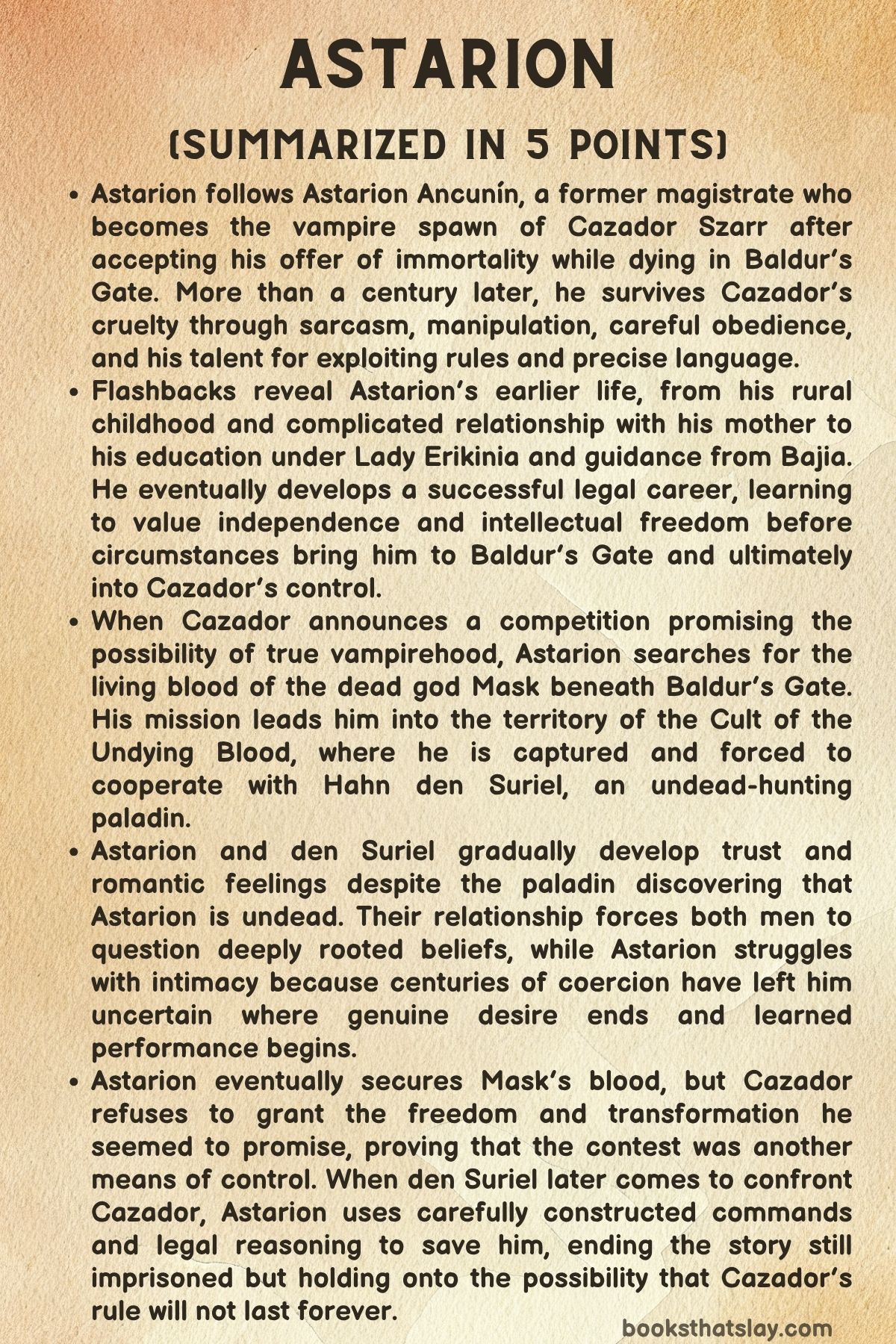
Summary
Astarion Ancunín’s transformation begins in an alley in Baldur’s Gate, where he lies dying after a brutal attack. He had previously served as a magistrate, and a decision to reduce the sentences of three poachers has placed him in danger, but the immediate reasons behind the violence matter less than what follows.
As death approaches, Cazador Szarr appears and offers to save him. Astarion accepts because the alternative is death, only to discover that Cazador’s gift of immortality has transformed him into a vampire spawn whose continued existence depends upon obedience to his creator.
More than a century later, Astarion survives within Szarr Palace by concealing his fears behind arrogance, humor, seduction, and calculated selfishness. Cazador controls his spawn physically and psychologically, using punishment, humiliation, sexual coercion, and uncertainty to prevent them from developing any lasting sense of independence.
Astarion regularly leaves the palace to procure victims. His existence has become a carefully managed performance in which charm is less a personal gift than a survival mechanism, although flashes of his former personality and buried conscience still appear when circumstances allow.
His past reveals how different his life once seemed. Raised on a vineyard in the Silver Marches, he dislikes rural work and dreams instead of sophistication, fashionable clothing, fine food, education, and city life.
His mother, Miriana, has concealed the fact that Astarion possesses a connection to a wealthy noble branch of the Ancunín family. When he finally learns that he has the right to choose whether to remain at home or spend time with his ancient great-grandmother, Lady Erikinia, he chooses the latter despite the emotional pain his decision causes his mother.
Life with Lady Erikinia gives Astarion much of what he desires. Tutors refine his speech, handwriting, manners, and education, while Bajia teaches him practical skills such as knife fighting and lockpicking.
His mother later returns and asks him to reconsider, but he chooses the noble household again. Although Miriana ultimately respects the decision, Astarion never sees her again, leaving the choice as one of the defining separations of his youth.
As he grows older, financial difficulties force him to think seriously about his future. A distant cousin named Lazlo recognizes Astarion’s excellent handwriting and employs him as a legal scribe, introducing him to a profession perfectly suited to his mind.
Astarion becomes fascinated by legal rules, precise wording, exceptions, and loopholes. His talent becomes clear when he discovers an unusual legal solution to an absurd dispute involving powdered troll that regenerates, and he eventually trains as a barrister.
The skills he learns in law survive long after his mortal career ends. Under Cazador, language and rules become some of the few tools he can still use against people stronger than himself.
In the present, Cazador announces a competition among his spawn. Each must obtain an extraordinary type of blood, and the possibility is raised that whoever succeeds may finally be elevated from vampire spawn to true vampirehood.
For Astarion, the promise represents far more than increased power. Becoming a full vampire seems to offer the possibility of escaping Cazador’s direct control, making the competition one of the few opportunities for freedom he has been permitted to imagine.
Dalyria, another spawn who secretly researches possible ways to overcome vampiric limitations, tells Astarion about the living blood of Mask, a dead god. The substance is hidden beneath Baldur’s Gate and guarded by the Cult of the Undying Blood.
Astarion accepts the danger because the potential reward appears worth almost any risk. Yousen agrees to guide him through the tunnels beneath the city, though Astarion quickly discovers that Violet, another of Cazador’s spawn, is following them in hopes of claiming the same prize.
The expedition goes disastrously wrong. Violet uses a thunderstone against Astarion, leaving him exposed to the cultists and the skeletons that protect their underground settlement.
Captured by the cult, Astarion is imprisoned beside Hahn den Suriel, an aasimar paladin belonging to the Argent Badger, an order devoted to Lathander and committed to hunting undead creatures. Recognizing the danger immediately, Astarion conceals his true nature and even gives Petras’s name instead of his own.
He also persuades den Suriel to swear a carefully worded oath promising to protect him until they escape and reach safety. The precaution reflects Astarion’s instinctive reliance on technical language whenever physical power lies with someone else.
The two escape together and prove unexpectedly effective companions. Den Suriel approaches danger with directness, conviction, and heroic enthusiasm, while Astarion prefers deception, stealth, opportunism, and sarcastic commentary.
Their contrasting personalities generate conflict, but they also develop trust and attraction. For Astarion, the connection is particularly dangerous because genuine affection requires vulnerability, something Cazador has trained him to regard as a weakness.
Their fragile alliance nearly collapses when they pass through a magical barrier that only living beings can cross. Den Suriel realizes that Astarion is undead and immediately confronts him.
Astarion admits that he is a vampire spawn. Den Suriel believes his religious duty requires him to destroy undead creatures, but Astarion reminds him of the oath he already swore to protect him.
The contradiction devastates the paladin. His moral identity depends upon the assumption that sacred duties reinforce one another, yet he now faces a situation in which one obligation appears to require the violation of another.
Astarion views the crisis more practically. He has survived too long under arbitrary power to believe that moral systems remain tidy when tested by reality, and he points out that den Suriel has technically broken neither vow.
Despite the revelation, they continue together. During their journey, den Suriel witnesses Astarion awakening from a nightmare about the mausoleum where Cazador once imprisoned him for a year, gaining a clearer understanding of the cruelty hidden beneath his companion’s theatrical confidence.
Astarion dislikes being pitied and insists that his greatest virtue is simply endurance. Nevertheless, den Suriel’s sympathy begins weakening the emotional defenses that Astarion has relied upon for generations.
With assistance from allies in Baldur’s Gate, Astarion returns to the cult’s territory and infiltrates its sanctuary by being transformed temporarily into a bat. He succeeds in reaching the altar and obtaining Mask’s blood, but the cult discovers him before he can escape safely.
Den Suriel and other adventurers create a diversion. When Astarion realizes that the paladin has been gravely wounded, he abandons the easiest route to safety and goes back for him, choosing another person over the cleanest path to his own survival.
Astarion manages to save den Suriel, and their relief turns into a kiss. After escaping the collapsing stronghold, the attraction between them becomes openly physical and emotional.
Their intimacy, however, exposes the lasting damage created by Astarion’s enslavement. Cazador has spent generations forcing him to seduce and manipulate targets, turning sexuality into labor, strategy, and coercion.
Even with a considerate partner, Astarion struggles to distinguish genuine desire from behaviors learned through abuse. Den Suriel gives him control and pays attention to his responses, but kindness itself becomes unsettling because it reveals how rarely Astarion has been allowed to make meaningful choices about his own body.
Before dawn, Astarion leaves. He secretly takes the divine blood and returns toward Szarr Palace because he refuses to draw den Suriel further into Cazador’s world.
Violet intercepts him and attempts to steal the blood. During their confrontation, one vial is destroyed, while Rooftop Henry, an enchanted seagull Astarion had previously encountered, unexpectedly helps save another.
The surviving sample becomes Astarion’s last hope of winning Cazador’s contest. Dalyria asks to use some of it for her research, but Astarion refuses, unwilling to gamble the possibility of his own freedom.
Dalyria takes part of the blood anyway. Feeling personally betrayed, Astarion exposes what she has done when Cazador judges the offerings, causing her to be taken away for punishment.
Cazador tastes Mask’s blood and experiences an extraordinary sensation of mortality. Yet despite Astarion accomplishing what seemed impossible, Cazador refuses to grant him true vampirehood.
The competition is revealed as another instrument of control. Cazador allowed his spawn to hope because hope could motivate them, but he never intended to surrender the power that their dependence gives him.
Astarion returns to the familiar despair of palace life. Cazador temporarily elevates him to favored status, but the privilege brings little comfort because favor from an abuser remains another form of control.
Dalyria eventually returns from severe punishment and offers Astarion the chance to hurt her in return. He refuses, still angry but unwilling to reduce their relationship to an exchange of suffering.
Then den Suriel arrives at the palace, demanding to confront Cazador. Astarion knows that Cazador will simply kill him unless another solution can be found.
Thinking quickly, Astarion persuades Cazador that killing an undead-hunting paladin could attract greater attention. He proposes that breaking den Suriel spiritually would be more entertaining and secures several precise commands from his master that allow him to construct another legal trap.
When den Suriel reaches the barred door leading toward Cazador, Astarion explains the arrangement. Cazador has commanded that the door remain closed for as long as Astarion lives, which means the paladin cannot continue without killing him.
Den Suriel searches desperately for another solution, but every alternative risks either failure or a massacre. Astarion finally tells him to leave and admits that he wants at least one person outside the palace to remain alive and remember him.
Den Suriel cannot kill him. He kisses Astarion goodbye and walks away, his certainty about himself and his faith profoundly altered.
The final memories of Astarion’s youth show Bajia leaving him outside Baldur’s Gate. At that time, he descends toward the city believing that he is finally beginning a life that will belong entirely to him.
The present provides a cruel contrast. Cazador remains in control, and the spawn continue to endure his violence, including the infernal symbols carved into their bodies.
Yet complete despair never wins. Aurelia reminds Astarion that even apparently eternal powers must eventually end, and their small moments of solidarity preserve the idea that captivity is not the natural order of things.
Elsewhere, a surviving trace of Mask’s divine blood travels toward the sea. The image leaves Astarion’s story suspended between continued enslavement and the possibility that actions whose consequences cannot yet be understood may eventually help transform his world.
Characters
Astarion Ancunín
Astarion is the emotional and psychological center of the book, a character whose intelligence has been shaped by two radically different lives. Astarion presents him first as a person who once actively pursued refinement, education, law, social status, and independence, making his later enslavement especially cruel because Cazador destroys precisely the autonomy he valued most.
His sarcasm, vanity, manipulation, flirtation, and apparent selfishness operate largely as survival strategies. He has learned that openly displaying fear, attachment, compassion, or uncertainty gives stronger people material they can use against him, so he turns personality itself into defensive armor.
His legal training is essential to understanding his behavior. He thinks in terms of precise language, technical obligations, loopholes, and enforceable promises because rules sometimes offer protection in situations where morality, strength, and kindness cannot be trusted.
The bargain he extracts from den Suriel demonstrates both his intelligence and his trauma. Rather than trust a stranger’s goodwill, he constructs a verbal mechanism that will protect him even if the stranger later becomes hostile.
Astarion’s relationship with intimacy exposes some of his deepest damage. Cazador has transformed seduction into compulsory labor, leaving him uncertain whether his own responses arise from personal desire or from habits developed to satisfy other people.
His return for the injured den Suriel becomes important because the choice cannot easily be explained as self-interest. Saving him shows that Astarion remains capable of attachment and sacrifice even after years spent insisting that survival must always come first.
His final decision regarding den Suriel is equally revealing. Astarion does not escape, defeat Cazador, or gain the transformation he wanted, but he succeeds in keeping someone he cares about beyond Cazador’s reach.
Cazador Szarr
Cazador is not merely a physically powerful antagonist; he is a specialist in psychological domination. In Astarion, his authority depends on making his spawn believe that obedience, competition, and personal favor are their only routes toward relief.
He uses unpredictable rewards and punishments to keep them divided. The competition for extraordinary blood illustrates his methods perfectly because he encourages hope without promising anything enforceable, allowing the spawn to risk themselves for a reward he can later deny.
Sexual coercion is also part of his system of domination. By treating Astarion’s body as something available for his purposes, Cazador attacks the distinction between private identity and enforced performance.
His cruelty often has a theatrical quality because humiliation matters to him as much as physical control. He wants his victims to participate in the structure that imprisons them, competing for his approval and repeating his values among themselves.
Cazador’s greatest vulnerability is ironically his dependence on absolute control. Because he assumes that his commands will always be obeyed, Astarion can occasionally turn the exact wording of those commands against his intentions.
Hahn den Suriel
Hahn den Suriel begins as the apparent opposite of Astarion. He is honorable, physically courageous, religiously committed, direct in his reasoning, and convinced that moral principles can provide clear answers.
Astarion uses den Suriel to test what happens when absolute morality encounters a person who does not fit comfortably into established categories. Astarion is undead, yet he is also enslaved, self-aware, capable of affection, and desperately trying to survive.
The oath crisis therefore becomes central to den Suriel’s development. His duty tells him to destroy undead beings, while another sacred promise commands him to protect the very vampire spawn standing beside him.
Astarion initially sees this contradiction as a technical puzzle, but den Suriel experiences it as a threat to his entire identity. His despair reveals how much of his confidence depends on believing that righteousness will always produce internally consistent instructions.
His attraction to Astarion further complicates the situation because emotional experience begins challenging abstract doctrine. He gradually responds to Astarion as an individual rather than merely as a category of creature.
By entering Szarr Palace to rescue or confront what has trapped Astarion, den Suriel demonstrates profound loyalty but also dangerous idealism. His inability to kill Astarion at the final barrier confirms that personal knowledge has permanently changed his understanding of moral obligation.
Dalyria
Dalyria represents intellectual resistance within captivity. In Astarion, she secretly investigates vampirism and possible ways of changing its conditions, making her research one of the few organized attempts within the palace to imagine a different future.
Her relationship with Astarion is built on cooperation but never becomes completely safe. He protects her research from Cazador, while she provides information that helps him pursue Mask’s blood.
Her theft of the divine blood exposes the corrosive effect of their circumstances. Both characters want freedom, but Cazador’s system encourages them to treat one another’s hopes as resources that can be sacrificed for personal escape.
Astarion’s decision to expose her demonstrates the same pattern. His anger is understandable, yet his retaliation strengthens Cazador’s authority by handing another captive back to the master for punishment.
Dalyria’s later offer to let Astarion break her leg is especially bleak because it shows how normalized violence has become. She imagines reconciliation through equivalent suffering, while his refusal suggests that he does not want their relationship to be governed entirely by Cazador’s logic.
Violet
Violet is one of Astarion’s most direct rivals among the spawn. She is competitive, resourceful, suspicious, and prepared to use violence when she believes it will improve her standing with Cazador.
Her pursuit of Mask’s blood reveals the desperation beneath that rivalry. Like Astarion, she understands that the contest may represent a rare chance to change her condition, so cooperation becomes difficult when every captive has been encouraged to believe there can be only one winner.
Her attack underground demonstrates her willingness to exploit moments of vulnerability. Rather than confront the dangers of the cult alongside Astarion, she tries to remove him as a competitor and seize the advantage for herself.
Yet Violet is not simply another version of Cazador. She remains one of his victims, and her hostility shows how abusive systems can redirect anger horizontally, causing people with a common oppressor to damage one another rather than unite.
Aurelia
Aurelia provides one of the quietest forms of resistance in Astarion. She cannot overthrow Cazador, but she refuses to accept his apparent permanence as a metaphysical truth.
Her observation that everything beneath the sun eventually dies gives Astarion a perspective unavailable within the immediate logic of captivity. Cazador may seem eternal to people who have spent generations under him, yet even his rule belongs to time.
Aurelia also represents solidarity among the spawn. Small acts of understanding cannot end their suffering immediately, but they preserve emotional connections that Cazador’s competitive structure constantly tries to destroy.
Her importance becomes clearest near the ending. When Astarion briefly allows himself to believe that their captivity may someday end, Aurelia has helped create a form of hope that differs from Cazador’s manipulative promises because it does not require submission to him.
Petras
Petras survives through a different kind of psychological defense. After Cazador refuses to reward any of the spawn, he claims that he always understood the competition was merely another manipulation.
The claim allows him to protect his pride. If he can persuade himself that he never truly hoped, then Cazador’s betrayal appears less capable of hurting him.
His behavior reveals the palace’s culture of constant performance. Even among fellow victims, admitting disappointment may feel dangerous because vulnerability can immediately become a source of ridicule or rivalry.
Yousen
Yousen initially appears useful because he possesses knowledge that Astarion lacks. His understanding of the underground routes beneath Baldur’s Gate makes him essential during the search for the Cult of the Undying Blood.
Astarion often responds to him with impatience and contempt, yet this reaction exposes his dependence on expertise he cannot replace. The journey forces him to rely on someone he considers frightened and socially inferior.
Yousen therefore plays a practical role while also challenging Astarion’s preference for controlling every situation himself. Intelligence alone cannot guide him through unfamiliar territory, and survival requires cooperation with people he would ordinarily underestimate.
Lady Erikinia
Lady Erikinia shapes the young Astarion’s understanding of possibility. Her household introduces him to the education, social refinement, and cultural life that he has imagined from afar.
Unlike Cazador, she presents Astarion with a genuine choice. When Miriana wants her son to return home, Lady Erikinia refuses to make the decision for him, insisting that Astarion himself must determine where he belongs.
That respect for autonomy becomes especially important when contrasted with his later existence. The freedom he experiences in her household helps explain why Cazador’s domination is not simply physically painful but also an assault on the identity Astarion spent years constructing.
Her decision to make him her heir also has unintended consequences. Financial complications following her death push Astarion toward Baldur’s Gate, linking one of the most loving periods of his youth indirectly to the city where his life will eventually be destroyed.
Miriana
Miriana is a loving but fearful mother whose attempts to protect her son lead her to withhold an important truth. She hides Astarion’s right to explore the Ancunín family’s noble heritage because she believes his existing life is safer and happier.
Her mistake lies in confusing protection with deciding on another person’s behalf. She does not intend to imprison Astarion, but her secrecy prevents him from making an informed choice about his own future.
The pain of his decision to stay with Lady Erikinia is therefore emotionally complicated. Miriana is hurt, yet she ultimately allows her son to choose rather than forcing him home.
Her final departure carries lasting sadness because Astarion never sees her again. The relationship becomes an early example of how freedom can involve painful separation even when no one is acting with deliberate cruelty.
Bajia
Bajia is mentor, protector, teacher, and guardian during Astarion’s youth. She trains him in practical skills such as knife fighting and lockpicking, giving him abilities that complement the formal education he receives in noble society.
Her concealed identity as a copper dragon adds another layer to their relationship. Astarion senses that she is more than she appears, but the full truth emerges only when an owlbear attack forces her to transform.
Bajia’s secrecy differs significantly from Cazador’s deception. She hides her nature without using that secrecy to dominate Astarion, and her actions repeatedly demonstrate concern for his survival.
Her eventual departure outside Baldur’s Gate marks the end of Astarion’s protected youth. From that point onward, he must construct a life for himself, making the scene especially painful in retrospect because readers know how completely that independence will later be taken from him.
Lazlo
Lazlo recognizes capacities in Astarion that others have not yet turned into a practical future. He notices his elegant handwriting and gives him work as a legal scribe, providing the bridge between aristocratic education and professional independence.
More importantly, Lazlo recognizes that Astarion’s attraction to technicalities is not merely cleverness. His ability to identify obscure legal solutions demonstrates a genuine aptitude for law.
The profession suits Astarion because it rewards precision, language, argument, and strategic thinking. Those qualities continue to define him long after his legal career has ended.
Rooftop Henry
Rooftop Henry, the enchanted and foul-mouthed seagull, initially seems like comic relief within a far darker story. His strange presence briefly allows Astarion to interact with someone outside the hierarchy and terror of Szarr Palace.
Astarion’s earlier treatment of Henry eventually produces an unexpected reward. When Violet attacks and one of the vials of divine blood is nearly lost, Henry saves the surviving sample.
The incident matters because it shows that not every consequence in Astarion’s life follows Cazador’s transactional system. A comparatively small act can generate loyalty without coercion, punishment, or a formal bargain.
Lief
Lief belongs to Astarion’s network outside the palace and becomes important when he needs practical support after escaping the cult complex. She helps connect him with resources necessary for the second attempt to obtain Mask’s blood.
Her role demonstrates that Astarion has not been completely isolated from the social world of Baldur’s Gate. Even after generations under Cazador, he retains contacts who can be persuaded to help him.
These relationships are often practical rather than openly emotional, which suits Astarion’s guarded personality. Nevertheless, they reveal that his existence extends beyond the identity Cazador has imposed upon him.
Boris
Boris is an abusive merchant’s son whose fate demonstrates Astarion’s morally ambiguous methods. Rather than confront him directly, Astarion manipulates him into approaching one of Cazador’s hidden entrances and leaves the palace’s defenses to deal with him.
The incident shows Astarion acting against someone who harms others, but his response is neither lawful nor conventionally heroic. He uses the lethal machinery of his own captivity as a weapon.
Boris therefore helps establish the ethical complexity of Astarion’s behavior. Astarion may punish cruelty, yet the methods available to him have themselves been shaped by a violent environment.
Godey
Godey represents the institutionalized machinery of punishment within Szarr Palace. His torture chambers are where Dalyria is taken after Astarion exposes her theft, and her damaged condition upon returning demonstrates the severity of Cazador’s retaliatory system.
Although Godey receives less individual development than the central characters, his function matters. Cazador’s power does not rely solely on his personal presence because the palace contains people, spaces, and routines designed to enforce obedience even when he is not directly administering punishment.
Themes
Freedom, Captivity, and the Meaning of Choice
Freedom in Astarion is defined less by physical movement than by the ability to make meaningful choices. The young Astarion repeatedly chooses his own direction: he stays with Lady Erikinia, pursues education, studies law, moves toward city life, and imagines adulthood as something he can design for himself.
That history makes his later enslavement particularly devastating. Cazador does not simply prevent him from leaving; he controls where he goes, whom he seduces, how his body is used, which hopes he may pursue, and whether any promised reward will ever be granted.
The contrast between Miriana and Cazador sharpens the theme. Miriana initially withholds a choice because she believes she is protecting her son, but when confronted with his decision, she ultimately respects it despite her pain.
Cazador does the opposite. He creates the appearance of choice through competitions and privileges while ensuring that every available option still reinforces his authority.
Even Astarion’s affection for den Suriel becomes meaningful because it involves choices that Cazador did not authorize. Returning for the wounded paladin, initiating genuine intimacy, and finally arranging for him to leave alive become small declarations that some part of Astarion’s will remains his own.
Rules, Oaths, and the Limits of Moral Systems
Rules offer both protection and danger throughout the story. Astarion’s legal education teaches him that wording matters, that systems contain gaps, and that obligations can sometimes be redirected through careful interpretation.
Under Cazador, those skills become survival tools. Physical rebellion is often impossible, so Astarion protects himself through promises, commands, technical definitions, and contradictions.
Den Suriel approaches rules from the opposite direction. He believes sacred duties are expressions of a coherent moral truth, making the conflict between his oath to protect Astarion and his duty to destroy undead beings psychologically devastating.
The contrast between them raises questions about whether morality can survive if rules are treated as absolute rather than interpreted through circumstances. Astarion may appear cynical, but his flexible reasoning sometimes produces more humane outcomes than den Suriel’s rigid doctrine.
The final confrontation at the palace turns the theme into strategy. Astarion cannot overpower Cazador, but he can ask for carefully phrased commands and construct circumstances in which obedience produces a result his master did not anticipate.
Trauma, Intimacy, and Reclaiming the Self
Astarion’s experiences show how prolonged exploitation can alter a person’s relationship with the body, affection, trust, and desire. Cazador has repeatedly forced him to use seduction as a tool, teaching him to perform emotions and physical responses according to what other people expect.
As a result, genuine intimacy becomes confusing rather than automatically healing. During his relationship with den Suriel, Astarion recognizes that he knows how to create the appearance of desire far more easily than he knows how to identify his own wants.
Den Suriel’s patience gives him room to make choices, but safety itself creates discomfort because Astarion has spent so long expecting intimacy to contain hidden demands. His difficulty is therefore not a simple fear of closeness but a damaged understanding of where performance ends and authentic desire begins.
The same trauma shapes his friendships. He protects Dalyria and later betrays her after she betrays him, demonstrating how easily captivity transforms potential solidarity into suspicion.
Recovery is presented as incomplete and uncertain. Astarion does not suddenly overcome generations of conditioning, but moments in which he chooses whom to trust, whom to save, and whom not to hurt suggest the gradual reappearance of a self that Cazador has never completely erased.
Hope, Survival, and Resistance
Hope is dangerous throughout Astarion because Cazador understands how easily it can be manipulated. His competition works precisely because the spawn desperately want to believe that exceptional service might earn them freedom, and their hope motivates them to take risks they might otherwise refuse.
When Cazador denies Astarion the promised transformation, the cruelty comes from more than disappointment. Astarion recognizes that even the imagined future he pursued was something his master temporarily permitted him to believe in.
The story therefore distinguishes manipulated hope from genuine hope. Cazador’s version demands obedience and promises rewards from above, while Aurelia’s version arises from solidarity and the recognition that no system of power is truly permanent.
Survival itself also becomes a form of resistance. Astarion sometimes dismisses endurance as the only virtue he has left, yet continuing to exist preserves the possibility of future choices that Cazador cannot completely predict.
The final image of divine blood continuing toward the sea reinforces this uncertainty. Neither Astarion nor the other spawn have achieved freedom, but unseen consequences remain in motion, leaving resistance defined not by immediate victory but by the refusal to accept captivity as eternal.