Big Bad Wolf Summary, Characters and Themes
Big Bad Wolf by Laurie Gilmore is a paranormal romance set in Maple Hollow, Maine, where old stories about enormous wolves turn out to contain more truth than most residents realize.
At its center is Ruby Bellerose, a guarded bartender whose life revolves around protecting her troubled twin sister, Lena, and Rafe, an isolated woodworker carrying the burden of a violent werewolf past. Their growing attraction develops alongside a mystery involving prophetic abilities, rival packs, inherited supernatural gifts, and dangerous family histories. The novel combines romance, small-town relationships, supernatural politics, and questions about whether love can survive fear, guilt, and the parts of oneself that seem impossible to accept.
Summary
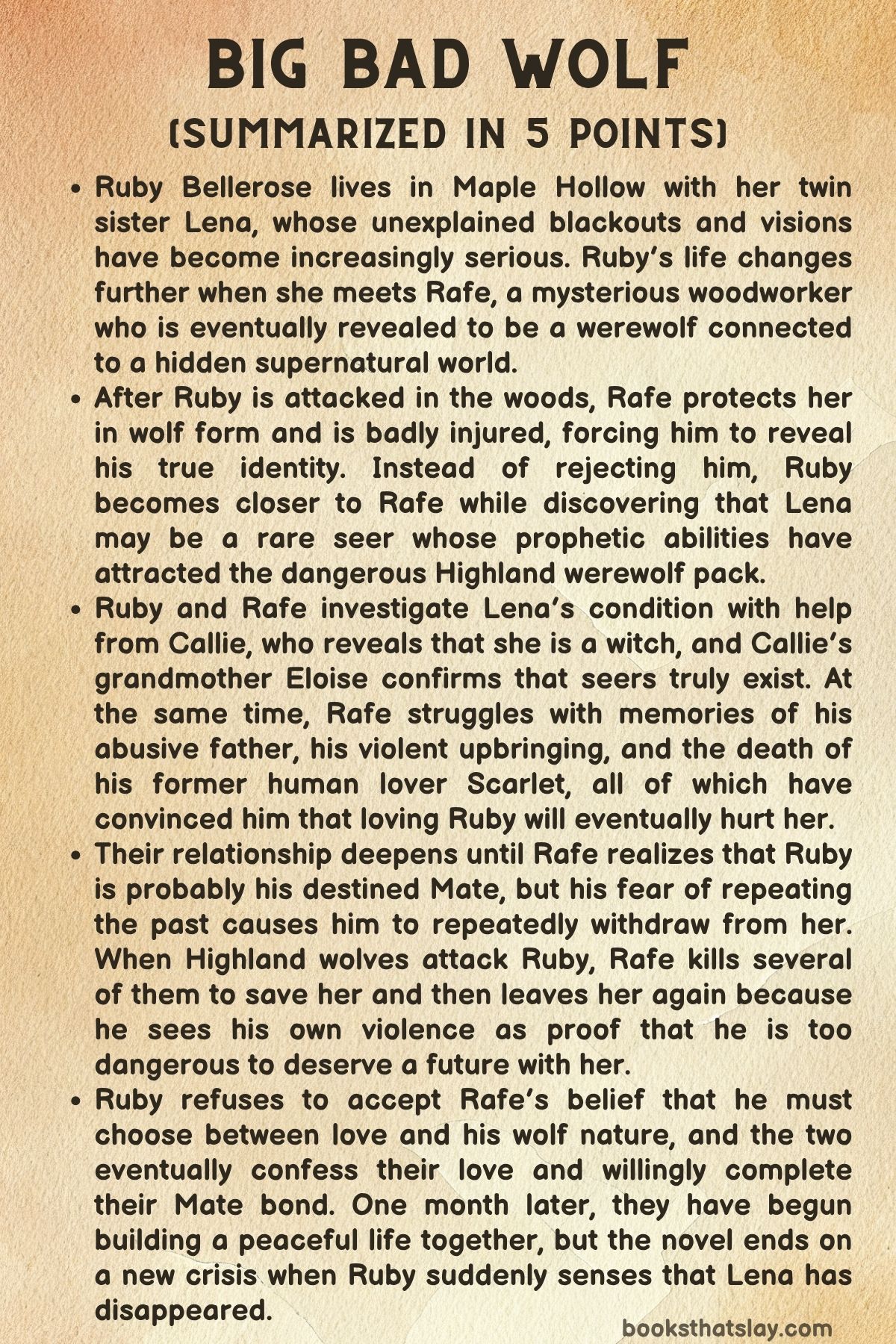
Ruby Bellerose has spent most of her life in Maple Hollow, a small Maine town where she and her twin sister Lena were raised by their great-aunt Millie after their parents died. Although decades have passed, Ruby still feels like an outsider, partly because of her guarded personality and partly because the town never lets anyone escape gossip, while her main concern has become Lena’s increasingly disturbing episodes of staring blankly into space and losing awareness of what is happening around her.
Ruby works at the town’s bar, where she meets Rafe, an enormous, silver-eyed stranger hired to build replacement furniture. His appearance suggests danger, but his shy behavior and unexpected career as a woodworker make him difficult to categorize, and Ruby soon develops a powerful attraction to him even though she senses that he is hiding something important.
Rafe is equally fascinated by Ruby, but attraction frightens him rather than encouraging him. He has deliberately isolated himself in a cabin after leaving his family and former life, and memories of a human woman named Scarlet have convinced him that becoming close to another woman could end disastrously.
As Rafe begins spending more time at the bar, Ruby slowly allows him into her routines. His protectiveness becomes obvious when an aggressive visitor behaves inappropriately toward her, and although Ruby resents being treated as someone who needs rescuing, she also notices that Rafe’s reaction seems deeper than ordinary jealousy.
The supernatural truth emerges when Ruby encounters a massive gray wolf with silver eyes in the woods. The animal behaves gently toward her until another wolf attacks, and her protector fights the stranger so fiercely that he is badly injured; Ruby refuses to abandon the animal and takes him home, only to discover the next morning that the wounded wolf has become a naked and injured Rafe.
Rafe admits that he is a werewolf and explains that werewolves are born rather than created through bites. He also reveals that the wolf who attacked Ruby belonged to the Highland pack, a rival group that should not be operating around Maple Hollow, turning Ruby’s frightening encounter into evidence of a larger territorial problem.
Instead of rejecting Rafe, Ruby becomes intensely curious about his supernatural life. Their trust increases as she discusses Lena’s unexplained episodes, and Rafe begins wondering whether those episodes are supernatural rather than medical, especially after learning that Lena sometimes speaks about things she cannot remember afterward.
The danger becomes more specific when Wyatt, the aggressive visitor Ruby previously encountered, returns to the bar and begins asking questions about Lena. Rafe recognizes him as a Highland wolf, making it increasingly clear that Ruby’s attack was not accidental and that the twins have attracted the attention of people who want something from them.
Meanwhile, Ruby and Rafe grow closer despite his attempts to keep emotional distance. He guards her home in wolf form, cooks breakfast in her kitchen, drives her to work, and becomes increasingly integrated into her everyday life, but memories of Scarlet and his violent upbringing repeatedly persuade him that wanting Ruby is incompatible with keeping her safe.
A breakthrough comes when Lena experiences another episode and apparently speaks about wolves. Rafe concludes that she may be a seer capable of perceiving future events, and the possibility becomes more believable when Ruby remembers a childhood dream connected to her parents’ fatal accident and Callie reveals that she herself is a witch with powers related to the atmosphere and weather.
Callie takes Ruby and Rafe to her grandmother Eloise, an experienced witch who confirms that seers exist and explains why such an ability would be valuable to powerful supernatural leaders. Eloise also points out that enemies unfamiliar with Ruby and Lena may have trouble distinguishing identical twins, suggesting that Ruby was attacked because the Highland wolves believed she possessed Lena’s abilities.
The investigation deepens Ruby and Rafe’s relationship, but Rafe continues believing himself unworthy of love. He finally explains that his father raised him and his brothers in a brutal culture based on strength and dominance, eventually forcing the brothers into violent competition; Rafe left after refusing to continue a system that might have required him to kill one of them.
Ruby interprets his refusal to participate as evidence of moral courage rather than weakness. Rafe cannot accept that interpretation easily because his earlier relationship with Scarlet ended tragically after his supernatural identity and his family’s violence entered her life, leaving him convinced that loving a human woman places her in danger.
Their attraction eventually becomes impossible to suppress, and an intimate encounter forces Rafe to confront an even more frightening possibility. The extraordinary pull he feels toward Ruby matches old stories about true Mates, supernatural partners whose bond goes beyond ordinary attraction, but rather than welcoming the discovery, Rafe fears that binding Ruby permanently to his world would be selfish.
The growing Highland threat forces Rafe to return to the County pack he abandoned. Ruby insists on accompanying him, and during their journey she pushes him to stop treating protection as permission to control her choices, while Rafe slowly tells her more about Scarlet, his father, his brothers, and the life he escaped.
At the pack camp, Ruby meets Nell, Rafe’s stepmother, and Knox, his older brother and current Alpha. Knox and Rafe remain divided by the violence of their upbringing, yet their confrontation also reveals that Knox carries guilt over what their father turned them into, showing that the brothers’ hostility rests partly on different responses to the same trauma.
Rafe eventually admits to Knox that Ruby may be his Mate. Knox questions whether hiding that truth from Ruby can genuinely protect her, forcing Rafe to recognize the contradiction in claiming that she belongs with him while refusing to give her enough information to choose that future for herself.
During the return journey, Rafe finally tells Ruby about the Mate bond. Ruby is relieved rather than frightened because the revelation explains the strange certainty she has felt around him, and she tells him plainly that she wants a life with him even though he remains afraid that fate has connected her to the wrong man.
The danger escalates almost immediately when Wyatt confronts Ruby near her home. He reveals that the Highland pack believes she is the seer they need to evaluate whether Knox’s proposal for cooperation between the rival packs can be trusted, because both groups face shrinking territory and may need to combine resources to secure land.
Ruby denies having the ability and protects Lena’s secret, but Wyatt eventually tries to take her by force. Rafe hears Ruby scream and attacks the Highland wolves with terrifying brutality, killing several of them as his fear of losing Ruby overwhelms his restraint.
For Ruby, Rafe’s violence proves how desperately he wanted to save her. For Rafe, it confirms every terrible belief he holds about himself, and after returning covered in blood, he interprets Ruby’s shock as fear of him and decides that their relationship must end before his nature destroys her as he believes it destroyed Scarlet.
Ruby follows him to his cabin and refuses to accept his reasoning quietly. She tells him that she never wanted him to erase the wolf or transform himself into something harmless for her, but Rafe remains trapped by guilt and allows her to leave despite being devastated by the separation.
Nell later visits Rafe and challenges his understanding of both the past and the Mate bond. She explains that she also suffered under his father’s control and tells him that genuine Mate bonds exist, giving Rafe evidence that supernatural partnership does not have to resemble the coercive relationships he witnessed growing up.
Ruby meanwhile returns to work and discovers that Maple Hollow has become a stronger support system than she realized. Her friends, sister, coworkers, and bar regulars recognize her unhappiness, while Lena begins accepting the possibility of her own powers and works with Callie to gain greater control over them.
Rafe cannot truly stay away. He begins accompanying Ruby home through the woods in wolf form every night, maintaining physical proximity while avoiding their human relationship, until the arrangement finally forces both of them to confront the obvious truth that distance is causing more suffering than closeness.
Ruby eventually tells Rafe that she loves him and makes clear that she accepts both the man and the wolf. Rafe finally stops treating his supernatural nature as something that must be hidden or softened for her, and their reconciliation becomes a conscious choice rather than mere surrender to fate.
Ruby invites Rafe to chase her through the woods, transforming an experience that once represented fear into one based on trust and mutual desire. When they finally complete the Mate bond, Ruby chooses it with full knowledge of what it means, and Rafe understands that accepting her decision is more loving than attempting to protect her by denying her agency.
Their relationship settles into a peaceful rhythm at Rafe’s cabin. He becomes comfortable existing simultaneously as craftsman, partner, and werewolf, while Ruby begins imagining a permanent future with him even though Lena’s powers and the political conflict between the packs remain unresolved.
One month after their bond is completed, Rafe considers the period the happiest of his life and prepares a handmade gift for Ruby. Their happiness is suddenly interrupted when Ruby awakens with supernatural certainty that something is wrong, and the story ends with her announcing that Lena is gone, shifting the unresolved conflict surrounding the seer abilities and rival packs into a new crisis.
Characters
Ruby Bellerose
Ruby is the emotional center of Big Bad Wolf, defined by fierce loyalty, defensive independence, and a habit of assuming responsibility for people she loves. Losing her parents as a child and later losing Aunt Millie have taught her that security can disappear suddenly, helping explain why Lena’s illness becomes something Ruby feels personally obligated to solve.
Her intimidating clothes, sharp humor, and preference for solitude function partly as defenses against Maple Hollow’s gossip. Beneath them, however, Ruby wants connection far more than she initially admits, and her relationships with Lena, Callie, the bar regulars, and eventually Rafe demonstrate how gradually she learns to accept support instead of treating dependence as weakness.
Her relationship with Rafe also highlights her strong belief in personal choice. Ruby repeatedly objects when he makes decisions about her safety or their relationship without consulting her, because she understands that protection becomes unhealthy when it denies another person agency.
Ruby’s acceptance of Rafe is especially important because she does not love an edited version of him. She accepts the woodworker, the lonely man, the werewolf, the fighter, and the Mate, forcing Rafe to confront the possibility that he can be loved without pretending half of himself does not exist.
Her developing seer abilities also connect her more deeply to Lena and to their family history. The childhood dream about their parents and her certainty at the end that Lena has disappeared suggest that Ruby’s instincts have always contained a supernatural element she simply lacked the framework to recognize.
Rafe
Rafe’s conflict in Big Bad Wolf is primarily internal: he wants intimacy while believing that intimacy with him inevitably creates danger. His enormous physical presence and capacity for violence contrast with his quiet occupation as a woodworker, making his character a study in someone trying to build rather than destroy.
His father trained him to equate power with domination and forced competition between his sons. Rafe’s rejection of that system proves that his moral identity has never been identical to the violent instincts he possesses, although he spends much of the novel unable to make that distinction for himself.
Scarlet’s death intensifies his guilt because he interprets tragedy as evidence that his love harms humans. Consequently, every step toward Ruby is followed by withdrawal, with Rafe convincing himself that emotional distance is a form of protection even when that distance clearly causes pain.
His Mate bond with Ruby forces him to question those beliefs. The real transformation is not that Rafe becomes less dangerous, but that he learns danger and goodness are not mutually exclusive qualities and that violence used to protect someone does not automatically make him identical to his abusive father.
By accepting Ruby’s informed choice, Rafe finally stops treating himself as the sole authority on what she should want. His final domestic happiness therefore represents psychological change as much as romantic fulfillment: he can be craftsman, wolf, partner, brother, and protector without reducing himself to any single identity.
Lena Bellerose
Lena plays a crucial role in Big Bad Wolf because the central supernatural conflict initially develops around her unexplained episodes. Once sociable and energetic, she becomes exhausted and withdrawn as visions interrupt her life, forcing her to leave her preschool job and making her dependent on Ruby in ways neither sister finds comfortable.
Her resistance to Ruby’s theories is not simple stubbornness. Lena has spent months being examined, worried over, and treated as a problem to solve, so rejecting the seer explanation becomes partly an attempt to preserve control over her identity.
The sisters’ conflicts expose the complicated effects of love when fear is involved. Ruby believes constant intervention is necessary to protect Lena, while Lena needs Ruby to understand that concern does not erase her right to decide when and how she faces what is happening.
Lena eventually becomes more willing to explore her abilities with Callie, marking an important move from avoidance toward self-knowledge. Her confession that she sensed danger before their parents died also establishes that her gift has deep roots rather than being a recent illness.
Her disappearance at the end turns her from someone being protected into the center of the next unresolved crisis. It also confirms that learning to understand her abilities is likely essential not merely to her personal health but to the balance of power among the supernatural groups around Maple Hollow.
Callie
Callie represents friendship, secrecy, and renewed trust in Big Bad Wolf. Her sudden disappearance initially hurts Ruby, but her return gradually restores one of the emotional relationships Ruby lost while becoming increasingly isolated through grief and responsibility for Lena.
The revelation that Callie is a witch transforms earlier mysteries surrounding her behavior. Her relationship with Sawyer also provides an important contrast to Ruby and Rafe because Callie has already experienced the fear of revealing a supernatural identity to someone she loves and discovered that acceptance is possible.
Her friendship with Ruby becomes stronger because both women eventually recognize that trust does not require immediate access to every secret. Their agreement to believe each other when the time for honesty arrives shows a mature form of loyalty based on patience rather than entitlement.
Callie also becomes important to Lena’s development. Once Lena begins acknowledging her powers, Callie offers guidance and companionship, helping shift supernatural ability from something experienced purely as illness toward something that can potentially be understood and controlled.
Knox
Knox is one of the most morally ambiguous figures in Big Bad Wolf because he exists simultaneously as Rafe’s former opponent, older brother, and leader of the County pack. Rafe initially remembers him primarily through the violent struggle their father engineered, but their reunion reveals that Knox has also spent time reconsidering the person he was under Devon’s influence.
As Alpha, Knox naturally thinks in terms of pack survival, territory, resources, and strategic advantages. That perspective explains both Rafe’s distrust and Knox’s interest in information about Lena, because supernatural abilities inevitably have political value within the uncertain circumstances facing the packs.
His proposal to cooperate with the Highland pack indicates that he may be trying to solve territorial problems differently from his father. Rather than treating conflict as the only answer, Knox appears willing to consider cooperation, although generations of hostility make his intentions difficult for others to trust.
Knox also becomes an uncomfortable mirror for Rafe. His questions about Ruby and the Mate bond expose contradictions in Rafe’s behavior, particularly the idea that hiding information from Ruby can somehow coexist with respecting her.
Theo
Theo is Rafe’s younger brother and one of the clearest sources of evidence that Rafe’s view of himself is distorted by guilt. While Rafe sees the violent conflict among the brothers as proof of his failure, Theo remembers that Rafe protected him by refusing to participate fully in their father’s deadly expectations.
His humor and teasing make him appear lighter than Rafe, but his history reveals that he survived the same destructive family system. His ability to reconnect with Rafe suggests that their brotherly attachment survived even when resentment and separation made communication difficult.
Theo also understands Ruby’s importance remarkably quickly. Once he realizes she is Rafe’s Mate, he challenges his brother’s insistence on deciding everything for her and becomes one of the voices encouraging Rafe to recognize that protection without honesty can become another form of control.
His relationship with Phoebe remains less developed but clearly carries emotional tension. That connection hints that Theo has his own unresolved questions about intimacy and belonging beyond his role in Rafe’s story.
Nell
Nell is Rafe’s stepmother and one of the characters who changes his understanding of his childhood. Rafe resents her for failing to protect him from Devon, but Nell reveals that she too lived under Devon’s domination and possessed far less freedom than Rafe assumed.
Her explanation does not erase the damage of the past, but it complicates Rafe’s habit of dividing people into those who failed him and those he must protect. Recognizing Nell as another survivor allows him to make room for compassion without pretending that everything between them has been repaired.
Nell also provides critical information about genuine Mate bonds. By telling Rafe about her sister’s experience, she gives him personal evidence that such relationships can exist outside coercive pack traditions and helps weaken his belief that his connection to Ruby must inevitably reproduce the destructive relationships he grew up observing.
Wyatt
Wyatt functions as the immediate face of the Highland threat. His first behavior toward Ruby is aggressive and disrespectful, but his later actions reveal that the danger goes beyond personal misconduct because he is actively searching for information about the Bellerose twins.
His repeated confusion between Ruby and Lena becomes an important clue. Because the sisters are identical, Wyatt and the Highland wolves initially appear to believe Ruby is the person with prophetic abilities, which explains why she becomes the target of an attack seemingly unrelated to her own actions.
Wyatt later reveals that the Highland pack wants a seer because its members distrust Knox’s proposed alliance. This disclosure makes him more than a simple attacker: he represents a group acting from political fear, territorial insecurity, and generations of hostility, even though his willingness to use force keeps him firmly positioned as an antagonist.
Scarlet
Scarlet never participates directly in the present-day events, but her influence over Rafe is enormous. She was the human woman he loved before Ruby, and the circumstances surrounding her death convinced him that becoming emotionally attached to a human leads to tragedy.
Rafe therefore remembers Scarlet not only as a lost lover but as evidence against his own capacity for healthy love. Every time he withdraws from Ruby, he is responding partly to the past rather than to the woman actually standing in front of him.
Her role becomes especially important because Ruby’s reaction to Rafe differs from Scarlet’s. Ruby knows what he is, witnesses his violence, understands the supernatural dangers around him, and still chooses the relationship, forcing Rafe to recognize that one tragic outcome cannot determine every future possibility.
Devon
Devon, Rafe’s father, represents the destructive model of masculinity and leadership that shapes much of Rafe’s self-hatred. He teaches his sons that strength requires dominance and deliberately creates competition between them, eventually pushing them toward violence against one another.
His influence survives long after Rafe physically leaves the pack. Whenever Rafe describes himself as naturally dangerous or interprets violence as proof of moral corruption, he is repeating assumptions formed under Devon’s authority.
The difference between father and son becomes increasingly clear as the story develops. Rafe possesses tremendous physical power, but unlike Devon, he repeatedly questions how that power should be used and ultimately rejects the idea that hurting others is necessary to prove strength.
Gert
Gert initially appears to be simply the protective owner of the local diner, but she gradually becomes evidence that Maple Hollow understands far more about its supernatural population than Ruby realizes. Her familiarity with werewolves and local supernatural history places her among the quiet guardians of knowledge within the community.
Her conversation with Rafe is important because she challenges his isolation directly. Gert understands that his determination to handle danger alone is not genuine strength and reminds him that Ruby already belongs to a network of people willing to help.
She therefore functions as one of the novel’s practical voices of wisdom. Instead of romanticizing Rafe’s self-sacrifice, she recognizes that his refusal to rely on others is partly another expression of fear.
Eloise
Eloise provides the historical and supernatural knowledge necessary to make sense of Lena’s condition. As Callie’s grandmother and an experienced witch, she treats the existence of seers as established reality rather than an impossible theory.
Her explanation transforms Lena’s episodes from an inexplicable medical problem into a potentially powerful inherited ability. She also immediately understands why another supernatural group would value someone capable of perceiving future events, connecting Lena’s personal struggle to the political conflict surrounding the packs.
Eloise’s books and guidance provide the first practical route toward understanding Lena’s abilities. In that sense, she represents knowledge replacing helplessness, giving Ruby something more useful than another failed attempt to find an ordinary explanation.
Sawyer
Sawyer is Callie’s longtime love and an example of acceptance without fear. Once he learns the truth about Callie’s supernatural identity, he does not reject her, which becomes deeply important to Callie after years of uncertainty about how others might respond.
His presence also provides Ruby with an alternative model of human-supernatural romance. While Rafe expects revelation to lead to rejection because of Scarlet, Sawyer’s relationship with Callie demonstrates that knowing the truth can strengthen intimacy instead of destroying it.
Sawyer is not as central to the supernatural conflict as Rafe or the twins, but he helps create the supportive group around Ruby. His calm inclusion in discussions about witches, werewolves, and seers makes the extraordinary increasingly feel like another accepted part of their shared lives.
Macy
Macy is Ruby’s manager and one of the quieter examples of Maple Hollow’s protective community. She takes Ruby’s concerns seriously, distrusts Wyatt when he returns to the bar, and helps prevent him from gaining easy access to Ruby or information about Lena.
Her role matters because Ruby initially thinks of herself as someone who largely stands alone. Macy’s behavior gradually undermines that assumption by demonstrating that everyday relationships can provide genuine safety and loyalty even without supernatural powers.
Sal
Sal represents Maple Hollow’s local memory and fascination with old stories. His tales about unusually large wolves initially seem like harmless folklore to Ruby, but they eventually prove to contain fragments of supernatural truth.
He also becomes one of the regulars who notices Ruby’s emotional state and shows concern when Rafe disappears. His presence reinforces the idea that the town’s gossip can be intrusive, but its close social structure can also produce genuine care.
Dolores
Dolores is an elderly local woman whose friendship with Rafe gives insight into the ordinary human life he has been trying to build. Their laundry routine is humorous, but it also reveals that Rafe has formed quiet connections despite describing himself as isolated.
When he withdraws after ending things with Ruby, even Dolores notices his disappearance. Her small role therefore demonstrates how thoroughly Rafe has become connected to Maple Hollow before he fully recognizes that the town has begun to function as another kind of pack.
Aunt Millie
Aunt Millie shapes Ruby and Lena’s lives even though she has died before the main events. She takes the twins in after their parents’ deaths and provides the closest thing they have to a stable parent during childhood.
Her unusual spiritual practices and occasional behavior resembling Lena’s episodes later gain new significance. What Ruby once regarded as eccentricity may have been evidence that supernatural abilities existed in the family long before either twin understood them.
The red cloak Ruby inherits from Millie becomes especially symbolic. Wearing it while searching for Rafe connects Ruby’s present courage and emerging instincts with the woman who protected her during childhood.
Phoebe
Phoebe appears primarily through her connection with Theo. Her presence immediately affects his behavior, suggesting an emotional history or attachment that remains unresolved within the current story.
Although she receives less development than Ruby, Lena, or Callie, her inclusion expands the emotional world of Rafe’s family. Theo is not merely the younger brother caught in an old family conflict; he also has relationships and vulnerabilities of his own.
Sinclair
Sinclair is the Highland Alpha and remains largely outside the immediate action, but his authority influences the conflict throughout the novel. The Highland pack’s desire for a seer appears connected to its uncertainty about whether Knox’s proposed cooperation can be trusted.
His position helps show that the danger is not simply a conflict between individual hostile wolves. Larger questions involving leadership, land, survival, and long-standing mistrust are shaping the decisions made by both packs.
Themes
Accepting the Whole Self
Much of Big Bad Wolf centers on the damage caused when people believe certain parts of themselves make them unworthy of love. Rafe divides his identity into the gentle woodworker he wants to be and the violent wolf he fears, treating one as authentic goodness and the other as evidence that he is fundamentally dangerous.
Ruby challenges that division because she never asks him to become less supernatural. She likes his woodworking, awkwardness, humor, protectiveness, physical power, and wolf form, and her acceptance forces him to reconsider the assumption that being loved requires disguising the parts of himself associated with violence.
The novel distinguishes self-acceptance from pretending harmful behavior does not matter. Rafe must still control his choices and confront the consequences of violence, but he eventually understands that possessing dangerous instincts is not the same as choosing cruelty.
Ruby and Lena undergo related developments. Ruby learns that her dark personality and fierce independence do not make her an outsider incapable of belonging, while Lena begins treating her visions not simply as evidence that something is wrong with her but as part of an inherited supernatural identity that may be understood.
Acceptance therefore becomes an active process rather than passive reassurance. Each character must learn to interpret unusual or frightening qualities without allowing fear to define the entire person.
Protection, Control, and Personal Choice
Rafe’s desire to protect Ruby repeatedly places him in conflict with Ruby’s determination to control her own life. His motives are usually loving, but his habit of deciding what Ruby should know, where she should go, and whether their relationship should continue demonstrates how easily protection can become controlling when one person assumes responsibility for another person’s choices.
Ruby consistently rejects that arrangement. She accepts practical help when danger becomes undeniable, yet she insists that recognizing a threat does not require surrendering her independence.
The same tension appears between Ruby and Lena. Ruby has spent so long protecting her sister that she sometimes treats Lena’s illness as a problem she personally must solve, while Lena increasingly resents being viewed as fragile and incapable of deciding how to respond to her own condition.
Both relationships improve when protection becomes collaborative rather than unilateral. Rafe eventually tells Ruby about the Mate bond and allows her to decide whether she wants it, while Ruby gradually understands that Lena needs assistance without being reduced to someone who must constantly be managed.
The story therefore treats meaningful love as something that preserves agency. Caring about another person may create responsibility, but it does not grant ownership over that person’s decisions.
Trauma and the Fear of Repeating the Past
Rafe’s present behavior is dominated by experiences that have already ended physically but remain active psychologically. Devon’s abusive leadership, the violent conflict between the brothers, and Scarlet’s death become a set of internal rules through which Rafe interprets every new relationship.
He believes violence proves he is becoming his father. He believes loving a human places her in danger because Scarlet died, and he believes leaving Ruby is responsible because isolation appears safer than risking another tragedy.
The weakness in this reasoning is that Rafe treats repetition as inevitable. Instead of asking whether his present choices differ from Devon’s or whether Ruby’s circumstances differ from Scarlet’s, he assumes similar elements must produce the same conclusion.
Other characters gradually disrupt this pattern. Theo remembers Rafe’s refusal to kill as courage, Nell reveals how Devon’s control affected others, and Ruby refuses to interpret Rafe’s violence through the same moral framework Rafe uses against himself.
Healing therefore depends on reevaluating the meaning of the past rather than erasing it. Rafe cannot change Scarlet’s death or his childhood, but he can stop allowing those experiences to dictate every possible future.
Belonging, Family, and Chosen Community
At the beginning of Big Bad Wolf, both Ruby and Rafe think of themselves as outsiders. Ruby has lived in Maple Hollow for decades yet still notices that some residents consider her someone who came from elsewhere, while Rafe deliberately lives in an isolated cabin after abandoning a pack whose idea of family was shaped by violence.
Their development gradually reveals that belonging does not depend entirely on origin. Ruby already has people around her who protect her, including Callie, Macy, Gert, Sal, Sawyer, and other residents, but she has become so accustomed to self-reliance that she initially fails to recognize them as a genuine support system.
Rafe goes through a similar realization. His biological and pack relationships are complicated, but Theo still cares for him, Nell seeks reconciliation, and even Knox offers him a path back toward family despite their unresolved anger.
Ruby eventually becomes another form of home for him, just as Rafe and Maple Hollow become places where Ruby can belong without changing herself. Their relationship succeeds partly because neither ultimately demands that the other abandon every previous connection.
The idea of community also shapes the supernatural conflict. Werewolf packs need territory, witches preserve inherited knowledge, and Lena requires help understanding powers she cannot manage alone, showing that survival itself often depends on accepting interdependence rather than treating isolation as strength.