Happier Here With You Summary, Characters and Themes
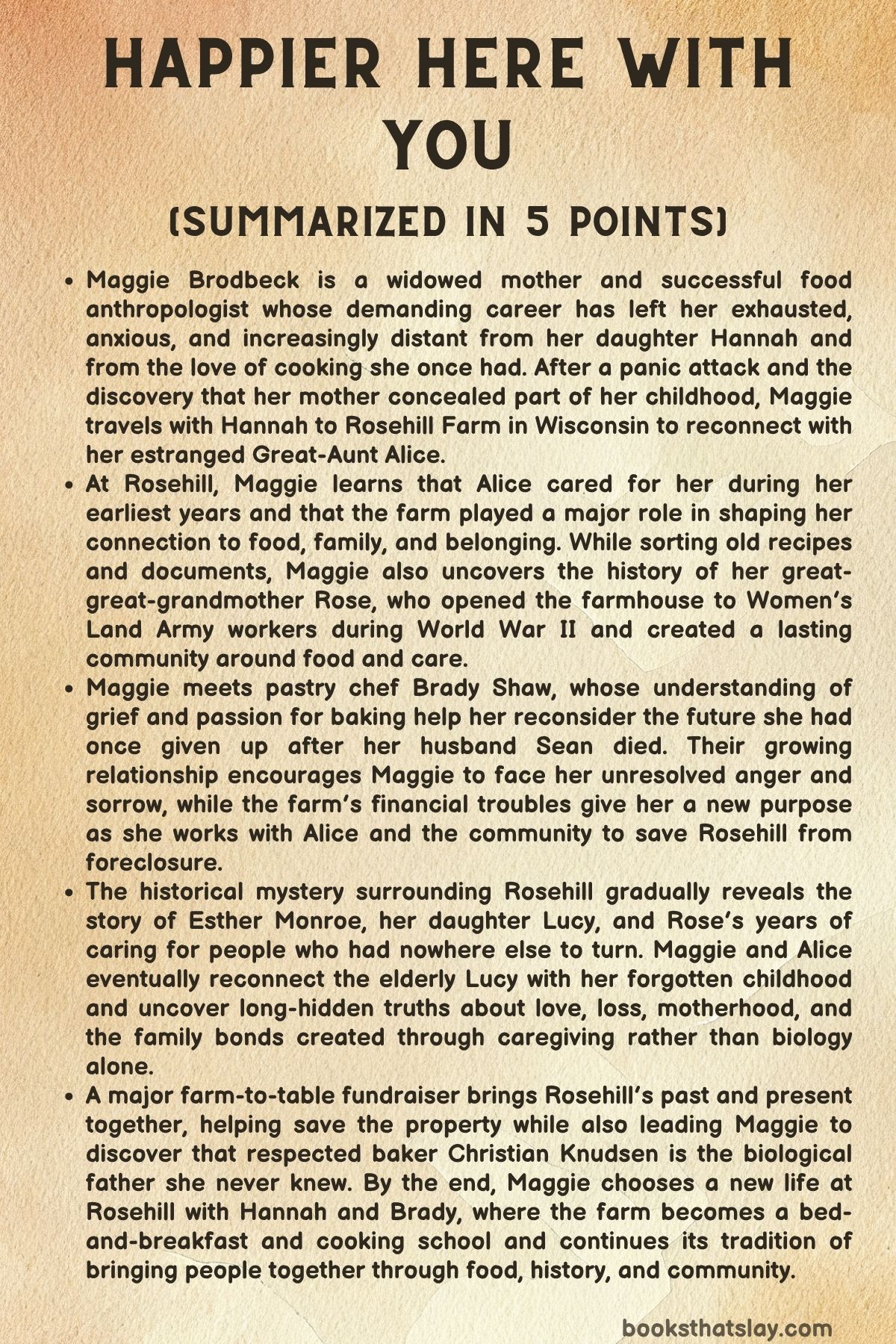
Happier Here With You by Amy Gail Hansen is a multigenerational novel about grief, family, food, belonging, and the courage required to reconsider the life one has built.
At its center is Maggie Brodbeck, a widowed mother whose professional success has come with exhaustion, anxiety, and an increasing distance from the person she once hoped to become. An unexpected invitation to Rosehill Farm reconnects her with a forgotten childhood, an estranged relative, a hidden family history, and the pleasures of cooking. Through Maggie and the women who lived at Rosehill before her, the book examines how places, traditions, and relationships can shape identity across generations.
Summary
Maggie Brodbeck is thirty-five, a food anthropologist, museum curator, assistant professor, widow, and mother to five-year-old Hannah. Her career appears successful from the outside, but the opening of an important museum exhibition forces her to miss Hannah’s kindergarten graduation, leaving Maggie painfully aware of how little space remains in her life for her daughter or herself.
Her husband Sean died before Hannah was born, and Maggie has spent the following years surviving through responsibility. Work has become both financial necessity and emotional shelter, while cooking, once central to her dreams, has almost disappeared from her daily life.
Everything begins to shift when Maggie receives a letter from her estranged Great-Aunt Alice, who lives at Rosehill Farm in St. John’s Ferry, Wisconsin. Alice invites Maggie and Hannah to spend the summer with her and calls Maggie by the unfamiliar childhood nickname “Magpie.”
Maggie’s mother, Diane, reacts strongly against the idea and dismisses Alice as eccentric. Soon afterward, Maggie suffers a severe panic attack when she cannot reach Hannah’s babysitter during an outing near Lake Michigan, the same lake where Sean drowned.
Forced to take time away from work, Maggie begins spending more meaningful time with Hannah. While researching Rosehill, she discovers an old recipe called Magpie’s Zucchini Bread and learns that she lived with Alice from infancy until approximately age three while Diane completed graduate school and established her career.
Diane finally admits that she concealed those years because she feared Maggie would consider them abandonment. She also intercepted decades of cards and letters that Alice continued sending, preventing Maggie from knowing that her great-aunt had never stopped caring about her.
The revelation transforms Maggie’s understanding of her own childhood. When Diane returns the unopened correspondence, Maggie realizes that a relationship she believed had never existed was deliberately removed from her life, so she calls Alice and decides to visit Rosehill with Hannah.
On the drive north, Maggie remembers Sean’s death in full. Seven months pregnant at the time, she watched him jump into dangerous water to save a child and then disappear beneath the waves, leaving Maggie unable to rescue him without risking both her life and their unborn daughter’s.
Sean’s death destroyed the domestic future Maggie had imagined. She had planned to step away from full-time employment, devote more time to motherhood and cooking, and possibly pursue culinary training, but financial necessity pushed her in a different direction.
Rosehill feels strangely familiar from the moment Maggie arrives. Alice welcomes both Maggie and Hannah without resentment, and daily life quickly settles around gardening, cooking, shared meals, conversation, and the rhythms of the farm.
Maggie learns that Alice cared for her during those first three years and that their strongest connection was formed in the kitchen and garden. Rosehill therefore begins to explain Maggie’s lifelong fascination with food and her instinctive sense that she had once belonged to a way of life she could no longer remember.
Alice gives Maggie a collection of recipes belonging to Rose Brodbeck, Maggie’s great-great-grandmother and a former owner of the farm. She asks Maggie to organize them, gradually turning the project into an investigation of the property’s forgotten history.
The story then reveals Rose’s life during the Second World War. Lonely after her family had scattered, Rose opened her large farmhouse to young women serving in the Women’s Land Army, transforming Rosehill into a boardinghouse for workers who had come to replace men absent because of the war.
Among the women were Peggy Kelley and Esther Monroe. Rose became particularly close to Esther, whose Swedish mother Lucia had died when Esther was young and whose traditions included a pause for coffee and sweets as well as a family lullaby about being happier in the company of someone loved.
In the present, Maggie also rediscovers cooking. A spontaneous batch of orange-rhubarb scones reminds her how absorbed and satisfied she feels when creating food, while a meeting with pastry chef Brady Shaw introduces a new person who immediately recognizes her culinary ability.
Brady owns a bakery and helps run a Scandinavian baking program nearby. He and Maggie are attracted to one another, and their connection grows through food, humor, shared experience, and an understanding of grief.
Maggie discovers that Brady’s twin brother Bryce died when they were children. Unlike many people in Maggie’s life, Brady does not attempt to solve grief or erase it, allowing her to feel that loss can remain part of a person without controlling every future choice.
Meanwhile, Alice reveals another reason she invited Maggie to Rosehill: the farm is facing foreclosure. A loan taken to build a commercial kitchen, combined with financial setbacks, has made the property increasingly difficult to sustain.
Maggie becomes determined to save it. Historical research reveals that twenty-two Women’s Land Army workers stayed at Rosehill during the war, suggesting that the property may qualify for historic recognition.
As Maggie works alongside Alice and Brady, she is forced to confront emotions she has avoided since Sean’s death. Alice helps her admit that beneath her admiration for Sean’s heroism lies anger that he risked his life despite having a pregnant wife and unborn daughter waiting for him.
Acknowledging this anger does not diminish Maggie’s love for Sean. Instead, it frees her from the belief that grief must remain emotionally pure and allows her to consider whether loving Brady would truly be a betrayal of the life she once had.
A fire at Brady’s baking camp accelerates the changes already underway. Brady is injured while rescuing three Scandinavian students, Katrine, Nora, and Johanna, and Maggie brings the young women to Rosehill while Alice offers the farm’s commercial kitchen as a temporary home for the program.
Once again, Rosehill becomes a refuge for young women displaced by circumstances beyond their control. The modern household begins resembling the community Rose created decades earlier.
Maggie increasingly recognizes that she is happier in this environment. She cooks, works with Brady, researches food history, shares responsibility for Hannah with people she trusts, and experiences forms of companionship that her life near Chicago had largely lost.
Historical discoveries continue alongside Maggie’s personal transformation. Photographs, ledgers, letters, hidden objects, and recipes reveal that Esther became pregnant during the war and later married the child’s father, Henry.
Esther dies from severe bleeding while giving birth prematurely. The devastated Henry brings the newborn to Rose, who names her Lucy after Esther’s mother Lucia and gradually becomes the child’s primary caregiver.
When the Women’s Land Army workers return, they help Rose care for Lucy collectively. Peggy in particular becomes deeply attached to the child, explaining why decades later she remembers Lucy as belonging emotionally to all of them.
Several years later, Henry arrives with his wealthy fiancée, Angelica Penderglass, and announces that he is taking Lucy to New York. Although Henry has the legal right to reclaim his daughter, Rose and the women experience the separation as a devastating removal of a child they had raised and loved.
Back in the present, Maggie and Alice initially do not know what happened to Lucy. Their search eventually leads to an elderly Peggy, whose fragmentary memory confirms Lucy’s identity but leaves them with more questions.
At the same time, Alice’s foreclosure deadline is unexpectedly moved forward. Maggie realizes she cannot continue treating Rosehill as a temporary escape and chooses to extend her stay, work remotely, help Brady with the baking program, and give their developing relationship a genuine chance.
Maggie and Brady devise a plan for a large farm-to-table fundraising dinner during the local Midsommar Festival. Their purpose is not merely to collect enough money to delay foreclosure but to demonstrate that Rosehill can have a sustainable future as a community, culinary, and hospitality space.
Preparing the event teaches Maggie another lesson about food. The meals people remember most are often not technically elaborate; they become meaningful because of the people, place, circumstances, and feelings surrounding them.
The fundraiser attracts local farmers, businesses, volunteers, festival organizers, and eventually the attention of celebrated chef Ruth Rivers. Media coverage expands its reach, tickets sell out, and Rosehill’s struggle becomes a wider community effort.
Maggie’s relationship with Brady also deepens. She gradually allows herself to accept intimacy, admit that she loves him, and understand that loving someone new does not erase Sean.
Another family mystery appears when Christian Knudsen, a respected Scandinavian baker, unexpectedly arrives to help with the fundraiser. His physical resemblance to Maggie and Diane’s shocked reaction eventually lead Maggie to suspect that Christian is the father she has never known.
Christian confirms her suspicion. He explains that he never knew Maggie existed until publicity surrounding the Rosehill fundraiser allowed him to recognize Diane in Maggie’s face and discover the daughter whose existence had been kept from him.
Soon afterward, the fundraising effort receives a major donation from an elderly woman named Lucia Penderglass. Maggie and Alice realize that the donor may be the long-lost Lucy.
Lucy arrives at Rosehill with her daughter and discovers the truth of her early childhood. Maggie and Alice explain that Esther was her biological mother, that Rose raised her after Esther’s death, and that Angelica was her stepmother rather than the woman who gave birth to her.
They show Lucy photographs, records, Rose’s letters, the recipe for Lucy’s Victory Cake, and a Christmas present hidden in the attic for decades. Inside is an apron Rose made for Lucy along with words connected to the lullaby passed through Esther’s family, confirming that Lucy’s earliest memories of being loved at Rosehill were real.
Rosehill’s history continues through Alice’s childhood. In the 1960s, Rose cared for six-year-old Alice when Alice’s parents were unable to provide stability, and the farm once again became a place where a young girl could grow through cooking, reading, exploration, and attention.
When Alice was taken back to California, Rose was devastated but did not permanently withdraw from others. She later began teaching cooking and household skills to local teenagers, continuing her pattern of creating community after loss.
Maggie eventually understands that this is Rosehill’s true legacy. Its importance lies not only in the building or its recipes but in the repeated willingness of its inhabitants to make room for people who need care, instruction, acceptance, companionship, or another chance.
By Christmas, Maggie has permanently changed the structure of her life. She, Hannah, and Brady live at Rosehill, while the farm operates as a bed-and-breakfast and cooking school and has been added to the National Register of Historic Places.
Brady has proposed, Maggie has accepted, Christian has become part of her life, her relationship with Diane has begun healing, and Alice remains surrounded by the community she once feared losing. Lucy also helps locate the remains of Rose’s missing son Hank, allowing one more unfinished part of the family’s past to find resolution.
Most importantly, Maggie is present for Hannah while also doing work that feels connected to her own abilities and desires. The apron passed down through generations becomes a final symbol of what Rosehill has preserved: not a fixed tradition, but a way of caring for others without abandoning oneself.
Characters
Maggie Brodbeck
Maggie is the emotional center of Happier Here With You, and much of her development comes from recognizing that competence and fulfillment are not the same thing. She has built a life that looks responsible and accomplished, yet the panic attack near the beginning exposes how much fear, exhaustion, grief, and self-denial have accumulated beneath that surface.
Her widowhood has shaped almost every decision she makes after Sean’s death. She becomes intensely protective of Hannah, financially cautious, professionally driven, and suspicious of desires that cannot be defended as practical necessities.
Food reveals the part of Maggie that has been suppressed. She can analyze food professionally, but cooking gives her something intellectual achievement cannot provide: physical concentration, creativity, sensory pleasure, memory, and the satisfaction of producing something that immediately nourishes another person.
Her development is therefore not a rejection of ambition. She learns instead to distinguish ambition chosen freely from achievement pursued because fear, obligation, or other people’s expectations have made alternatives seem irresponsible.
Maggie’s relationship with Sean also becomes more psychologically honest as the story progresses. She has idealized his final act for years because anger toward a dead husband who died saving a child seems morally unacceptable, yet admitting that she also feels abandoned allows her grief to become more complex and truthful.
Her relationship with Brady marks another important change. At first she demands guarantees before allowing herself to become emotionally vulnerable, but she eventually accepts that love cannot be made safe through perfect planning.
As a mother, Maggie moves from anxious control toward trust. Rosehill teaches her that being present for Hannah does not require doing everything alone and that accepting help can enrich a child’s life rather than diminish a parent’s importance.
By the end of the book, Maggie has not simply chosen a different address or profession. She has rebuilt her understanding of adulthood around presence, connection, creative work, shared responsibility, and the right to want a life that feels personally meaningful.
Hannah Brodbeck
Hannah initially exposes the cost of Maggie’s overworked existence without consciously criticizing her mother. Her disappointment at Maggie’s absence from kindergarten graduation becomes one of the clearest indications that Maggie’s effort to provide security has begun taking her away from the very relationship she is trying to protect.
At Rosehill, Hannah adapts with remarkable ease. She gardens, bakes, explores, spends time with Alice and the Scandinavian students, sleeps outdoors, develops independence, and becomes part of a larger household without carrying the fear that dominates Maggie.
Her openness makes her an important contrast to her mother. Maggie approaches unfamiliar situations through risk assessment, while Hannah often approaches them through curiosity, allowing Maggie to see how anxiety has narrowed her own relationship with the world.
Hannah also represents continuity. Her experiences in the kitchen, garden, and farmhouse connect her to Maggie’s forgotten childhood, Alice’s childhood, Lucy’s childhood, and the young women Rose once taught.
Her relationship with Brady matters because he treats her naturally rather than seeing her as an obstacle attached to Maggie. This helps establish that Maggie’s new romantic life does not have to compete with motherhood.
By the conclusion, Hannah is benefiting from something Maggie did not initially realize she could provide: a broad community of adults and young people who care about her. Her happiness at Rosehill confirms that Maggie’s decision to change her own life can also create a richer childhood for her daughter.
Alice Brodbeck
Alice is both Maggie’s lost maternal figure and one of the strongest advocates for personal choice in the novel. She loved Maggie during her first years, continued sending letters after their separation, and receives her decades later without demanding repayment for the pain caused by their estrangement.
Her affection is powerful because it does not depend on control. Unlike Diane, Alice rarely tells Maggie what decision she must make; instead, she asks questions that encourage Maggie to identify what she actually wants.
Alice understands the importance of Rosehill because the farm once rescued her as well. As a struggling child living amid parental instability, she found safety, practical learning, and acceptance with Rose, so preserving the property is inseparable from preserving the place where she first felt capable.
Her financial problems reveal an important limitation in her character. Alice is generous, independent, and community-minded, but pride makes it difficult for her to accept assistance even when the farm is in serious danger.
The prospect of foreclosure therefore forces Alice into the same lesson Maggie must learn: receiving care can be as necessary as giving it. The fundraiser succeeds because Alice finally permits the community she has supported to support her in return.
Within Happier Here With You, Alice also serves as a living link between Rose’s history and Maggie’s future. She inherited not merely the farmhouse but Rose’s habit of creating spaces where people can become more fully themselves.
Her late-life willingness to reconnect with Maggie and accept Lenny’s companionship demonstrates that she has not allowed previous loss to make connection impossible. Her courage lies less in avoiding heartbreak than in repeatedly deciding that love is worth the possibility of losing it.
Brady Shaw
Brady is initially introduced through food, but his importance extends far beyond his role as Maggie’s romantic interest. As a pastry chef who rejected a more conventional path expected by his father, he embodies the possibility of building a serious adult life around work one genuinely loves.
His relationship with Maggie is grounded in recognition. He sees her culinary ability before she is prepared to treat it as legitimate and understands the difference between studying food and experiencing the creative satisfaction of making it.
Brady is also marked by childhood grief because his twin brother Bryce died when they were five. That history gives him an understanding of lasting absence, but he never tries to compare his loss competitively with Maggie’s widowhood.
Instead, Brady demonstrates a healthier relationship with grief. He carries his brother’s memory through his tattoo and identity while continuing to pursue love, work, humor, friendship, and new experiences.
His response to Maggie’s emotional caution is significant. He does not demand that she forget Sean, but he refuses the idea that uncertainty is a sufficient reason never to risk attachment again.
The camp fire also shows Brady’s instinctive courage and generosity when he risks himself to rescue the students. Unlike Sean’s death, however, the incident does not result in irreversible loss, allowing Maggie to experience fear without having her worst expectations confirmed.
Professionally, Brady becomes Maggie’s partner rather than her instructor. Their collaboration on the baking program and fundraiser works because each respects the other’s knowledge, and their eventual relationship grows from shared values as much as attraction.
Rose Brodbeck
Rose is the historical foundation of the book and the person whose choices give Rosehill its enduring meaning. Although she lives through repeated separations, bereavements, and disappointments, she repeatedly responds to loneliness by making space for other people.
During the Second World War, Rose transforms a nearly empty farmhouse into a boardinghouse for Women’s Land Army workers. Her cooking, cleaning, organization, gardening, preservation, and attention to the women’s needs are presented not as background labor but as essential work that enables them to perform physically demanding agricultural jobs.
Rose’s strongest quality is her capacity for maternal care beyond biological boundaries. Esther, Lucy, Alice, the farmerettes, and later local teenagers all receive forms of guidance that Rose once hoped to give a daughter of her own.
Her relationship with Esther demonstrates her emotional sensitivity. Rather than interrogating the young woman when she suspects pregnancy, Rose waits, offers reassurance, and creates an atmosphere in which Esther can eventually speak honestly.
Her care for Lucy after Esther’s death reveals both the beauty and danger of attachment. Rose knows the child is not legally hers, but day-to-day caregiving makes that distinction emotionally irrelevant.
Losing Lucy devastates her, and losing Alice years later reopens the same wound. Yet one of Rose’s most important characteristics is that heartbreak never permanently convinces her to stop caring.
Her later cooking lessons prove that she continues turning private knowledge into shared knowledge. Rose therefore leaves a legacy not because she preserves everything unchanged but because she repeatedly passes skills, stories, hospitality, and affection to people who can carry them forward.
Diane
Diane is a complicated mother because many of her harmful choices arise from fear rather than simple cruelty. Sending infant Maggie to Alice allows Diane to complete graduate school and begin her career, but concealing the arrangement later transforms a difficult practical decision into a long-term breach of trust.
Her decision to intercept Alice’s letters is especially damaging. By controlling the information Maggie receives, Diane attempts to manage how her daughter will interpret the past instead of allowing Maggie to form her own relationship with Alice.
Diane also represents a model of adulthood centered on necessity, discipline, and professional achievement. Her philosophy that mothers sometimes become who they need to be rather than who they want to be profoundly shapes Maggie after Sean’s death.
The problem is not that Diane values responsibility. It is that she often treats desire as suspicious when it conflicts with a practical plan, contributing to Maggie’s belief that culinary aspirations require outside permission.
Diane nevertheless develops. She apologizes to Alice, attends the fundraiser, acknowledges Maggie’s happiness, and eventually admits that she failed to recognize and support her daughter’s culinary gifts.
Her relationship with Maggie does not heal because the past becomes acceptable. It improves because Diane finally begins surrendering her authority over what the past is allowed to mean.
Sean
Sean exists largely through Maggie’s memories, yet he remains psychologically present throughout the story. He was a loving husband who supported Maggie’s culinary and domestic aspirations and imagined a future in which they would build family life together.
His death is both heroic and devastating. He saves a child from drowning but dies in the process, leaving Maggie pregnant, financially vulnerable, and responsible for constructing an entirely different future.
For years, Maggie allows only admiration and sorrow to shape her memory of him. Because his final act was morally courageous, she feels ashamed of the anger she also carries toward him for making a choice that left her and Hannah behind.
Sean consequently becomes part of Maggie’s internal conflict about love after loss. She initially treats moving forward as though it could reduce the seriousness of what they shared.
The book ultimately allows Sean to remain loved without allowing his memory to govern Maggie’s future. Maggie’s growth does not require deciding that Sean’s choice was right or wrong; it requires accepting that love, admiration, anger, grief, and abandonment can coexist.
Christian Knudsen
Christian enters relatively late but changes Maggie’s understanding of her family almost immediately. A respected Scandinavian baker, he first appears as an unexpected volunteer whose knowledge, patience, and easy connection with Hannah seem unusually natural.
His resemblance to Maggie eventually reveals the deeper connection: Christian is her biological father. Importantly, he did not knowingly abandon her because Diane never told him about Maggie’s existence.
Christian’s response is therefore shaped by lost opportunity rather than deliberate absence. Once he learns that Maggie exists, he travels to Rosehill because he wants to meet her and makes clear that he intends to remain part of her life.
His profession also creates a meaningful connection between Maggie’s identity and a paternal history she never knew. Her attraction to food and baking can no longer be understood only through Rosehill and Alice; it also has an unexpected parallel in Christian’s life.
His tenderness with Hannah suggests that he is aware of what has been lost and does not want to repeat that distance with another generation. His emerging relationship with Maggie is cautious but hopeful because both understand that decades cannot be replaced, although a future relationship can still be created.
Esther Monroe
Esther begins as a shy young woman who rarely demands attention, yet her life becomes central to Rosehill’s history. Her quietness makes Rose particularly attentive to her, and their relationship gradually develops into one resembling that of mother and daughter.
Esther carries the memory of her deceased mother Lucia through food customs, songs, and cultural traditions. Her introduction of fika and the lullaby about being happier together ensures that her mother’s influence survives even after Esther’s own death.
Her pregnancy reveals both vulnerability and fear. She distances herself from Henry because she anticipates rejection, showing how strongly insecurity can influence decisions before another person has even been given the chance to respond.
Rose encourages Esther to trust rather than abandon the relationship preemptively. Esther eventually marries Henry, but her death during childbirth prevents her from building the family she hoped to create.
Her influence nevertheless survives through Lucy. Recipes, songs, memories, and the love Rose felt for Esther become part of Lucy’s inheritance even though Lucy grows up without knowing the truth about her biological mother.
Peggy Kelley Gibson
Peggy initially appears as confident, direct, energetic, and naturally suited to leadership among the farmerettes. Her strong personality complements Esther’s reserve, and she quickly becomes an important part of the temporary family created at Rosehill.
Her greatest emotional connection is ultimately to Lucy. After Esther dies, Peggy helps organize the women’s shared childcare responsibilities and comes to view the baby as belonging to the entire household in an emotional sense.
Peggy later learns that she cannot have biological children, making the possibility of adopting Lucy especially meaningful. Rose recognizes that Peggy and Robert could give Lucy a loving family and prepares herself for that possibility before Henry unexpectedly removes the child.
In extreme old age, Peggy’s dementia has damaged her memory, yet the emotional force of losing Lucy remains. Her claim that the girl was stolen is not legally precise, but it communicates the emotional reality experienced by those who had raised her.
Peggy demonstrates how caregiving creates family bonds that official categories do not fully describe. Her attachment to Lucy survives far longer than many factual details of her youth.
Lucia “Lucy” Penderglass
Lucy is one of the most important links between the historical and present-day narratives. Born prematurely and losing Esther during childbirth, she begins life amid grief but is immediately surrounded by Rose and the farmerettes.
Her earliest years are therefore filled with collective care. Rose becomes her primary maternal figure, while Peggy and the other women participate in raising her.
Henry’s decision to take Lucy to New York changes the course of her life. Angelica later convinces her that her memories of Rosehill are imaginary, leaving Lucy with images and feelings she cannot explain.
Her return to the farm in old age restores the truth of her own childhood. Recognizing Rosehill and learning about Esther confirms that the sense of being deeply loved in that farmhouse was not fantasy.
The hidden apron is particularly meaningful because it provides a physical connection to Rose. Lucy’s story demonstrates that early affection can leave lasting impressions even when memory is incomplete and later adults attempt to rewrite the past.
Henry
Henry is difficult to judge because his actions emerge from grief, immaturity, and changing circumstances rather than one consistent moral position. He loves Esther and marries her, but her death leaves him emotionally incapable of caring for their premature daughter.
Bringing Lucy to Rose may initially seem like abandonment, yet Rose provides the stable care Henry cannot offer at that moment. The deeper problem develops as his visits become less frequent and Rose’s temporary guardianship effectively becomes parenthood.
When Henry later returns with Angelica and removes Lucy, he acts within his rights as her biological father but fails to appreciate the depth of the child’s existing bonds. His decision treats legal parenthood as sufficient justification for an immediate break from the people Lucy experiences as family.
Henry therefore represents the tension between biological authority and lived caregiving. His choices are not presented as simple villainy, but their consequences demonstrate that adult decisions about children cannot be evaluated only through formal rights.
Angelica Penderglass
Angelica appears briefly but has an enormous effect on Lucy’s life. Her immediate possessiveness toward a child who is frightened of her reveals a tendency to define relationships according to the role she expects to occupy rather than the trust that has actually been built.
She intends to become Lucy’s mother almost by declaration. This attitude dismisses Rose, Peggy, and the years of care that shaped Lucy before Angelica arrived.
Later information makes her treatment more troubling because Lucy remembers Angelica as cruel. Angelica also encourages Lucy to dismiss memories of Rosehill as fantasy, effectively separating her not only from the people who raised her but from confidence in her own memory.
Through Angelica, the story shows how control over family narratives can become a form of power. Her behavior parallels Diane’s concealment of Maggie’s early years, although the circumstances and degrees of harm differ.
Katrine
Katrine is one of the Scandinavian students displaced by the camp fire and becomes particularly useful to Maggie’s historical research. Her curiosity and willingness to help turn her from temporary guest into an active participant in Rosehill’s recovery.
She also helps Maggie consider alternatives to the rigid timetable she has imposed on her life. The students’ discussion of gap years suggests that periods without predetermined outcomes can have genuine developmental value.
Katrine’s presence reinforces the novel’s idea that young adulthood does not have to be organized entirely around measurable productivity. She also forms a warm relationship with Hannah, contributing to the broader community of care that Maggie initially struggles to accept.
Nora
Nora contributes to the Scandinavian cultural atmosphere that changes daily life at Rosehill. Along with Katrine and Johanna, she introduces customs centered on intentional rest, shared food, comfort, nature, and companionship.
Her role is less individually developed than Maggie’s or Katrine’s, but she helps create the social environment in which Maggie begins questioning constant productivity. The value of Nora’s presence lies partly in the group dynamic: the students bring youth, movement, humor, and cultural exchange into the farmhouse.
She also participates in caring for Hannah, showing how meaningful relationships can develop quickly when people share work and domestic life.
Johanna
Johanna completes the Scandinavian Trio and participates in the same exchange of food traditions and ideas about well-being. Her presence helps transform the emergency created by the camp fire into an unexpected extension of Rosehill’s history as a refuge.
Together with Katrine and Nora, she makes communal living feel lively rather than burdensome. The students contribute rather than merely receive help, which is important to the story’s understanding of community as reciprocal rather than one-directional.
Johanna also helps normalize a slower, more relational approach to daily life for Maggie. Through these young women, Rosehill becomes internationally connected while remaining rooted in its local history.
Ruth Rivers
Ruth is introduced indirectly as the celebrated chef whose museum involvement contributes to Maggie missing Hannah’s graduation. She initially represents the kind of professional success Maggie has prioritized at considerable personal cost.
Her later role is very different. When Maggie asks for help with the fundraiser, Ruth responds generously and uses her public reputation to bring greater attention to Rosehill.
Ruth also notices that Maggie appears lighter and happier after her time in Wisconsin. Because Ruth belongs to the professional food world Maggie once allowed to dominate her identity, her observation carries particular weight.
Her presence at the fundraiser helps reconcile Maggie’s old professional life with her emerging one. The story does not require Maggie to reject respected culinary institutions; instead, figures such as Ruth can become allies within a more balanced future.
Elena
Elena is Maggie’s boss and one of the first people to recognize that Maggie’s condition has become unsustainable. After Maggie’s panic attack, she encourages genuine rest rather than allowing Maggie to treat recovery as another task to complete quickly.
Professionally, Elena represents the career opportunity Maggie initially believes she must protect at all costs because Maggie is positioned as a likely successor when Elena retires. Her existence therefore makes Maggie’s eventual choices more meaningful because Maggie is not leaving a failed career but reconsidering a successful one.
Elena’s willingness to approve remote work also shows flexibility. She gives Maggie room to explore Rosehill without forcing an immediate all-or-nothing decision.
Lenny
Lenny first becomes useful through his knowledge of local history and his assistance with the investigation into the Women’s Land Army. His familiarity with Rosehill and admiration for Alice make him a natural ally in the preservation effort.
His later romantic interest in Alice gives her personal storyline a gentle expansion beyond family and property. Alice has spent much of her life defined by the farm and by relationships she lost, so accepting a dinner and movie with Lenny shows that she remains open to new companionship.
Lenny’s importance lies partly in his ordinariness. He demonstrates that renewal need not arrive dramatically; sometimes it begins with local knowledge, practical help, affection, and the willingness to ask someone to dinner.
Hank Brodbeck
Hank is Rose’s son serving overseas during the Second World War. His disappearance becomes one of the greatest unresolved losses of Rose’s life and deepens the loneliness against which her relationships with the farmerettes develop.
Because he is missing rather than definitively mourned, Rose cannot achieve clear emotional closure. Her unsent letters to him become a private record of her thoughts and eventually provide Maggie with crucial historical information decades later.
Hank’s eventual identification in a German mass grave brings resolution long after Rose’s death. His burial beside family members shows how later generations can sometimes complete acts of remembrance that earlier generations were denied.
Albert Brodbeck
Albert, Rose’s other son, moves to California seeking an acting career. His departure contributes to the emptying of Rosehill before the arrival of the Women’s Land Army workers.
Although he receives less individual development, his choices help establish a recurring pattern in Rose’s life: people she loves repeatedly leave the farm for distant lives. The resulting emptiness explains why the arrival of twelve young women feels so transformative.
Albert also belongs to the branch of the family associated with California and the instability that later affects Alice, linking Rose’s wartime loneliness with the family circumstances of later decades.
April
April is Hannah’s babysitter and plays a small but important role in exposing Maggie’s psychological condition. When Maggie cannot reach her while she and Hannah are near Lake Michigan, Maggie immediately imagines catastrophe.
Nothing terrible has actually happened, but the episode produces a panic attack severe enough to require emergency medical attention. April therefore becomes indirectly connected to the moment when Maggie can no longer deny the effects of unresolved trauma.
Her presence also illustrates how dependent Maggie has become on paid childcare while simultaneously feeling guilty whenever she is absent from Hannah.
Jim
Jim, Elena’s husband, provides Maggie with practical financial advice when she initially considers using her own money to rescue Rosehill. His assessment makes clear that emotional urgency does not eliminate financial reality.
This intervention is important because Maggie’s first instinct is to solve the problem through personal sacrifice. Jim helps establish that saving Rosehill requires a sustainable strategy rather than another individual absorbing an impossible burden.
Gerry
Gerry is connected with Brady’s baking camp and responds constructively after the fire damages its facilities. He organizes transportation and agrees to pay Rosehill for housing Brady and the displaced students.
His cooperation helps turn the commercial kitchen into a functioning replacement site. Although a minor character, he represents the practical institutional support required for community solutions to work.
Art Cavanaugh
Art is the celebrity food personality expected to support the fundraiser before canceling close to the event. His withdrawal creates a significant practical problem because publicity has become essential to the plan for saving Rosehill.
His cancellation indirectly leads Maggie to contact Ruth Rivers. What initially appears to be a setback therefore produces a stronger opportunity and demonstrates Maggie’s growing ability to respond creatively under pressure rather than collapsing into anxiety.
Carol
Carol is Rose’s neighbor and an important link between Rosehill and the surrounding community. During the war, she brings Rose information about the Women’s Land Army’s need for local housing, effectively setting Rose’s boardinghouse project in motion.
Years later, her family connection to Judith creates another opportunity for Rose to teach. Carol therefore participates in two separate moments when Rose’s private abilities become useful to a larger group.
Doris
Doris is Alice’s mother and represents the instability from which Rosehill initially protects Alice. Focused on an acting career and troubled marriage, she tends to view her daughter’s academic and behavioral difficulties primarily as problems needing correction.
Her decision to leave Alice with Rose unexpectedly gives the child access to an environment in which she thrives. Yet Doris later reclaims Alice and repeatedly changes plans, preventing Rose from maintaining the relationship she desperately wants.
Doris is not explored deeply enough to become a simple antagonist, but her choices illustrate how adult priorities can cause serious emotional consequences for children even without an explicit intention to harm them.
Judith
Judith is one of the teenagers who enters Rose’s life after Alice leaves. She feels embarrassed by her lack of practical household skills after home economics disappears from her school.
Rose responds by treating those skills as valuable knowledge rather than outdated domestic expectations. Judith’s enthusiasm gives Rose a new opportunity to teach and eventually brings additional young women into the kitchen.
Her role confirms that Rose’s caregiving identity survives another major loss. Rather than preserving knowledge privately, she begins another community through instruction.
Robert Gibson
Robert is Peggy’s husband and shares her desire for a child. Rose observes his warmth with Lucy and begins considering whether Peggy and Robert might adopt the girl.
His presence matters because the possible adoption is based not on rescuing Lucy from an uncaring household but on giving her young parents who already love her and can provide long-term stability. Henry’s sudden return prevents that possibility from becoming reality.
Lynn
Lynn is Lucy’s daughter and accompanies her mother back to Rosehill. Her presence creates another generational layer in the restoration of Lucy’s history.
Through Lynn, the discovery does not belong only to an elderly woman looking backward. Information about Esther, Rose, and Rosehill can now become part of the family’s continuing knowledge rather than disappearing with Lucy.
Richard
Richard is Alice’s former college fiancé and represents the life she was expected to choose. Selling Rosehill, marrying Richard, and moving to New York would have appeared sensible by conventional standards.
Alice’s decision to remain at the farm costs her the relationship, but she does not ultimately view that choice as a mistake. Her experience becomes an important example for Maggie because it demonstrates that a decision can involve genuine loss and still be the right decision for the person making it.
Allen
Allen is the camp employee whose carelessness leaves a stove burner on and causes the destructive fire. His mistake has serious consequences for Brady, the students, and the baking program.
Narratively, however, the accident also moves several characters into Rosehill and creates circumstances in which Maggie becomes more deeply involved with Brady’s work. Allen therefore causes disruption rather than possessing a large personal arc of his own.
Bryce Shaw
Bryce is Brady’s twin brother, who died from a heart condition when the boys were five. Although he never appears directly, his absence remains part of Brady’s identity.
The Minnesota Twins tattoo Brady wears keeps the relationship symbolically present. Bryce’s memory helps Maggie recognize that Brady understands permanent loss while also demonstrating that grief need not prevent a person from building a full adult life.
Charles Brodbeck
Charles, Rose’s husband, is already absent from much of the active historical narrative, but his death contributes to Rose’s isolation at Rosehill. Her widowhood helps explain why the disappearance of her sons leaves the large farmhouse feeling especially empty.
His final resting place also becomes significant when Hank’s recovered remains are eventually buried beside Rose and Charles. The family grave becomes a place where one long unresolved absence is finally acknowledged.
Stan
Stan appears only indirectly as the man Doris becomes involved with when she abruptly changes Christmas plans. His personal characteristics are not developed, but his arrival demonstrates how easily Rose and Alice’s plans can be displaced by decisions made elsewhere.
The canceled visit becomes emotionally devastating for Rose because she had prepared herself to reconnect with Alice. Stan therefore functions less as an individual character than as part of the instability surrounding Doris’s choices.
Themes
Belonging, Home, and the Meaning of Place
Rosehill is more than a family property; it becomes a place where people repeatedly discover versions of themselves that were difficult to access elsewhere. Maggie arrives thinking she is visiting a relative and helping with a practical problem, yet her bodily sense of familiarity suggests that belonging can survive even when conscious memory has disappeared.
The same pattern exists across generations. Alice flourishes at Rosehill after struggling amid her parents’ instability, Lucy remembers the farmhouse long after she has been told her memories are imaginary, and the Women’s Land Army workers turn temporary bedrooms into a household they continue remembering decades later.
Home in Happier Here With You is therefore not defined mainly by ownership or permanence. It is produced through repeated acts of welcome: making meals, offering beds, noticing exhaustion, teaching skills, caring for children, preserving memories, and allowing people to occupy space without first proving that they deserve it.
This idea also explains why the possible foreclosure carries such emotional weight. Losing Rosehill would mean losing the physical setting in which several generations learned that they could be accepted during vulnerable periods of their lives.
Yet the novel avoids suggesting that belonging requires remaining physically unchanged. Rosehill survives precisely because Maggie, Alice, Brady, Lucy, volunteers, farmers, students, and neighbors imagine new purposes for it.
The B&B and cooking school preserve the farm not by freezing it in the past but by continuing its oldest function in a modern form: creating a place where people can gather, learn, eat, rest, and feel temporarily or permanently at home.
Grief, Memory, and the Decision to Keep Living
Loss touches nearly every major generation in the story. Maggie loses Sean, Brady loses Bryce, Rose loses her husband and fears she has lost Hank, Esther loses her mother and later dies herself, Lucy loses Esther before knowing her, and Rose repeatedly loses children and young people she has come to love.
The characters differ most clearly in what they do after loss. Maggie initially responds by controlling as much of life as possible, while Rose repeatedly responds by giving care to someone new.
Neither approach eliminates grief. Rose remains hurt by Lucy’s removal and Alice’s departure, while Maggie continues loving Sean even after admitting anger toward him and beginning a relationship with Brady.
The story therefore refuses the idea that healing means forgetting. Memories survive through recipes, photographs, letters, songs, tattoos, aprons, names, inherited habits, and physical places.
What changes is the relationship each person has with those memories. Maggie begins with the belief that loyalty to Sean requires preserving emotional distance from a new future, but she eventually understands that memory does not demand permanent self-denial.
Rose offers the clearest model of this principle. Every new attachment creates another possibility of heartbreak, yet repeated loss never permanently persuades her that caring was a mistake.
The characters who move forward most fully are not those who erase grief. They are those who allow grief to remain part of their history without granting it absolute authority over everything that can still happen.
Food as Identity, Memory, and Communication
Food functions throughout the story as a language characters use when ordinary explanation is insufficient. Maggie’s relationship with cooking reveals aspects of her identity that existed before she possessed the vocabulary or confidence to explain them.
Her professional work proves that she never truly abandoned food, but scholarship allows her to remain at a safe analytical distance. Baking at Rosehill changes that distance because measuring, touching, shaping, tasting, and serving require her to become a participant rather than an observer.
Recipes perform a similar function across generations. Lucy’s Victory Cake preserves Esther’s mother Lucia, Esther’s relationship with Rose, the war’s end, Lucy’s childhood, and Maggie’s later attempt to honor Rosehill’s history within one recurring dish.
The recipe box therefore operates as more than a collection of instructions. Each stained card, adaptation, ingredient choice, and handwritten title preserves information about who cooked, what resources were available, what people valued, and whom they wanted to remember.
Food also creates equality around shared tables. Farmerettes, widows, children, chefs, academics, farmers, international students, neighbors, and celebrities can all participate in preparing or eating the same meal.
Maggie ultimately recognizes that memorable food does not depend entirely on technical sophistication. Her most meaningful meals become memorable because they attach sensory experience to people and circumstances.
Cooking therefore becomes the means through which Maggie reconnects professional expertise with personal identity. She does not abandon food anthropology; she discovers that knowledge becomes more satisfying when connected to making, feeding, teaching, and belonging.
Motherhood, Caregiving, and Chosen Family
Motherhood in the novel is repeatedly separated from simple biological definition. Diane is Maggie’s biological mother, Alice cares for Maggie during crucial early years, Rose becomes a maternal figure to the farmerettes and Alice, Rose raises Lucy after Esther’s death, and Peggy develops a parental attachment to Lucy despite lacking a biological connection.
These relationships complicate any attempt to identify one correct form of motherhood. Diane loves Maggie but makes damaging decisions, Rose deeply loves Lucy without possessing legal parental authority, and Maggie herself initially believes good motherhood requires personally managing almost every risk affecting Hannah.
Her time at Rosehill gradually changes that belief. Watching Hannah flourish with Alice, Brady, Katrine, Nora, Johanna, and others teaches Maggie that allowing additional people to care for a child does not weaken the parent-child bond.
The novel also treats caregiving as work requiring intelligence, attention, time, and skill. Rose understands that feeding exhausted workers, maintaining a comfortable house, repairing clothing, preserving food, noticing emotional changes, and creating routines directly support the labor taking place outside the home.
At the same time, caregiving becomes unhealthy when it requires permanent self-erasure. Maggie’s early life demonstrates the danger of defining motherhood entirely through sacrifice and responsibility while excluding personal desire.
Her final arrangement at Rosehill offers a different model. She remains deeply present for Hannah while pursuing culinary work, accepting help, maintaining adult relationships, and participating in a community.
Family consequently becomes less about one person doing everything and more about people repeatedly choosing responsibility for one another.