Habits of the Sea Summary, Characters and Themes
Habits of the Sea by Shea Ernshaw is a speculative love story about a woman whose childhood encounter with an impossible drifting island shapes the rest of her life. It combines romance, folklore, survival, altered time, grief, and a slowly changing world while asking what makes a place—or another person—feel like home.
At its center is Ellie Mills, who must choose between the safe life she has built and the strange life that feels more truthful to her. Saltwell Island becomes both a physical mystery and a test of whether certainty is worth more than freedom, love, and self-trust.
Summary
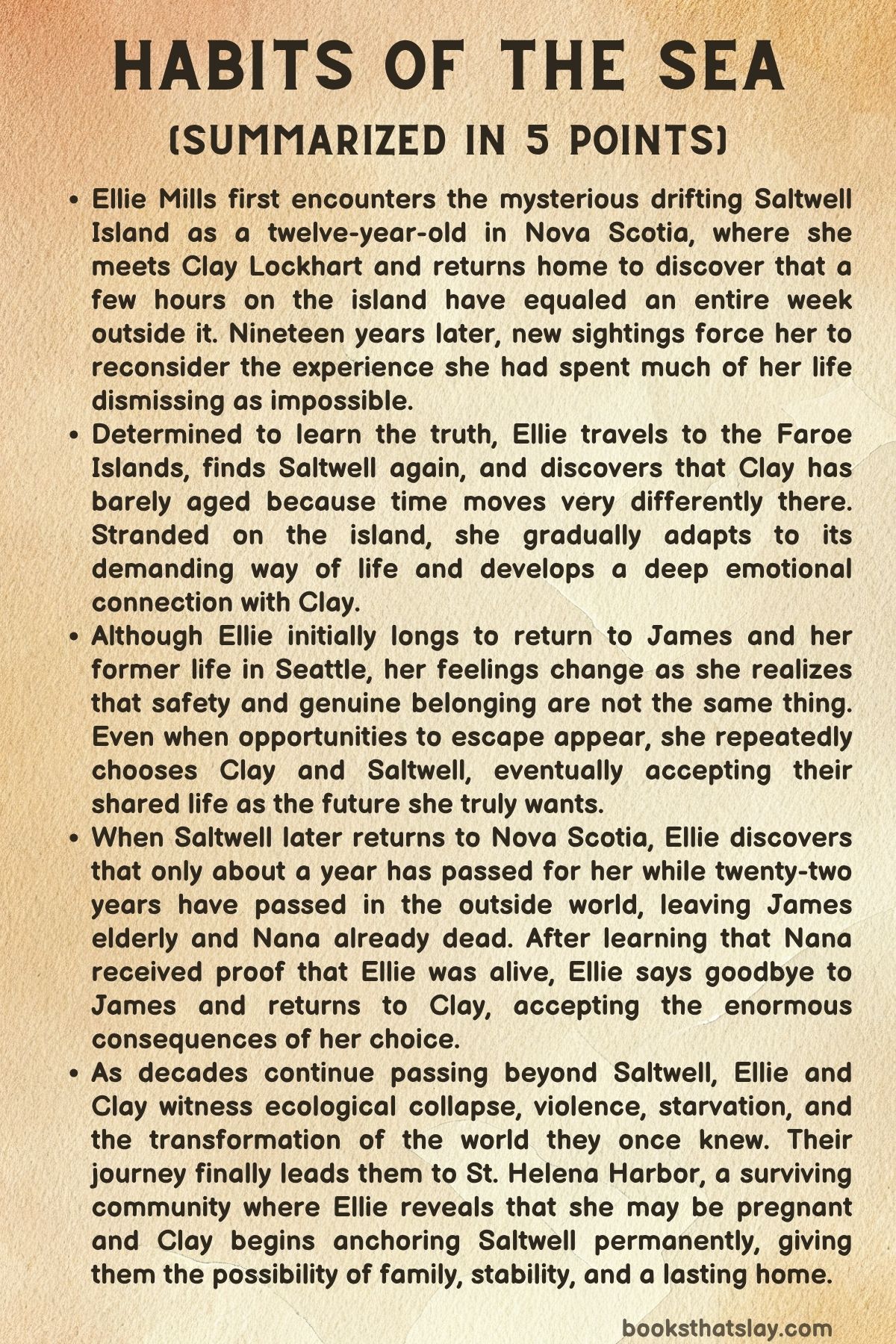
The story begins in 1952 on Scotland’s Outer Hebrides, where Clay Lockhart loses his wife, Alice, and their newborn twins during childbirth on a violent winter night. Overcome by grief, Clay buries them beside the sea, but by morning something impossible has happened: his white farmhouse and the surrounding piece of land have broken away from the coast and vanished into the Atlantic.
Stories develop around the missing land, which becomes known as Saltwell Island. Sailors occasionally claim to see it drifting across the ocean with Clay still living there, but over time the island passes into folklore and is dismissed by most people as an old maritime legend.
Decades later, twelve-year-old Eleanor Mills is sent to live with her grandmother, June, in Maylarch, Nova Scotia. Ellie’s mother initially presents the arrangement as temporary while she begins a new life in California, but Ellie gradually understands that her mother is moving forward without her and that Nana’s coastal house is now her real home.
One stormy night, Ellie sees a mysterious light beyond the harbor and assumes a vessel may have run aground. She takes Nana’s fishing boat into the rough water and discovers not a ship but an entire island pressed against the cape, with a white farmhouse standing on it.
Ellie explores the island and meets Clay, who appears to be a man in his thirties and seems uncertain about where the island has arrived. Inside his unusual farmhouse, Ellie finds a silver locket dedicated to Alice and impulsively takes it before Saltwell begins moving again.
Clay manages to recover Ellie’s boat and sends her back toward Nova Scotia. Ellie believes she has been away for only a few hours, but when she returns, she learns that an entire week has passed in the outside world.
Nineteen years later, Ellie is a child therapist in Seattle. She has built a respectable and apparently secure life with James Carmichael, a loving restaurant owner who wants to marry her, yet the engagement leaves Ellie uneasy because she cannot fully convince herself that the future before her is the one she wants.
Her buried memories return when mystery-podcast host Helen Ashcroft contacts her about Saltwell. Helen reveals that hundreds of cruise passengers have recently seen and recorded a floating island off Maine, and the available images appear to show both the farmhouse and a man standing onshore.
Ellie returns to Nana in Nova Scotia and finds the stolen silver locket still hidden in her childhood room. Its physical presence challenges years of being told that her experience was fantasy or hallucination, and when another sighting is reported near the Faroe Islands, Ellie decides she must find Saltwell herself.
In the Faroes, Ellie searches unsuccessfully for several days and nearly gives up. She puts James’s ring back on and prepares to return to Seattle, but after meeting Helen and following another report, she finally sees Saltwell in the distance.
Driven by instinct, Ellie swims toward the island despite the dangerous water. She reaches it badly injured and later awakens inside Clay’s farmhouse, where the greatest shock is not that Clay is still alive but that he appears almost unchanged.
The explanation lies in Saltwell’s relationship with time. Nineteen years have passed for Ellie since their first meeting, while Clay believes the girl who stole Alice’s locket visited him only around one year earlier.
Ellie returns the locket and realizes the danger of remaining on Saltwell. There is no reliable way to leave, and if time outside continues moving far faster than time on the island, every month she spends there could cost her years in the life she left behind.
As escape remains impossible, Ellie and Clay establish a shared routine. She learns to care for animals, cultivate crops, prepare food with limited supplies, harvest honey, and adapt to the daily work required to keep the isolated island functioning.
Clay gradually tells her about Alice, the twins, his past in Scotland, and the long loneliness of his drifting existence. Ellie, meanwhile, begins to compare his emotional honesty with the uncertainty she feels whenever she thinks about marrying James.
Their friendship develops into attraction. When a small rowboat eventually washes ashore, Ellie sees a chance to return to civilization, but Clay warns that attempting a long Atlantic crossing in such a vessel may kill her.
Even so, Ellie leaves. Once she discovers that Clay secretly made her a second oar to improve her chances of survival, she understands that he loved her enough to help her go even though he desperately wanted her to remain.
Ellie realizes that thoughts of James and Seattle bring her little emotional response, while the thought of losing Clay feels unbearable. She turns the boat around, fights her way back through worsening weather, and tells Clay that the life she wants is with him.
Their relationship becomes openly romantic, and Ellie eventually removes James’s engagement ring. When a freighter later passes close enough for Ellie to signal for rescue, she considers lighting a fire but ultimately chooses not to do so.
Clay will not ask her to stay, and he explains that he cannot simply return with her because Saltwell, the farmhouse, and his family’s graves are inseparable from him. Ellie therefore makes her first completely deliberate choice to remain, allowing the ship to disappear into the distance.
Ellie and Clay begin regarding themselves as husband and wife, even without a formal ceremony. Their life becomes increasingly settled until a devastating hurricane destroys much of the island’s garden, shelters, and food system and drives Saltwell against a tropical island containing an abandoned modern resort.
The resort offers valuable supplies and briefly exposes Ellie to remnants of the world she left behind. She secretly writes a message for Nana stating that she is alive, apologizing to James, and identifying herself as Ellie Wells-Lockhart before leaving the note where someone might someday discover it.
Saltwell eventually breaks free again. About a year after Ellie’s arrival, it drifts close to Maylarch, allowing Ellie to return to Nana’s house and discover the true cost of Saltwell’s altered time.
James answers the door, but he is now an elderly man. Twenty-two years have passed in the outside world, Nana died four years earlier, and Ellie’s message from the abandoned resort eventually reached her, allowing Nana to die knowing that Ellie had survived.
James listens as Ellie explains that Clay and Saltwell were real and that she chose to remain with him. Rather than condemn her, he asks whether she is loved and happy, and after she says yes, he lets her return to Clay.
After they leave Nova Scotia, Clay confesses that he had once possessed a small boat when Ellie first arrived from the Faroes. He hid it partly because he feared she would die trying to escape and partly because he did not want to lose the companionship she brought into his lonely existence.
Ellie is furious because Clay denied her the chance to decide for herself. Yet she also recognizes that she later had two separate opportunities to leave—the rowboat and the passing freighter—and independently chose him both times, allowing them eventually to forgive each other.
Time outside Saltwell continues racing forward, and signs of ecological and political collapse begin reaching the island. Three armed men arrive claiming that the year is 2062, but their violent behavior soon exposes them as dangerous marauders rather than trustworthy representatives of an organized society.
One of them attempts to abduct and assault Ellie, forcing Clay into a fight in which the men are killed and Clay is shot. Ellie treats his wound herself and keeps him alive, demonstrating how completely she has changed from the woman who once depended on the structures of modern life.
Saltwell later becomes trapped in Arctic ice, leaving Ellie and the recovering Clay close to starvation. When the ice finally releases them, they encounter abandoned boats and find a map showing a radically transformed planet in which rising seas have altered coastlines, countries, and the geography Ellie once knew.
Their food eventually disappears almost completely. Weak and exhausted, Ellie and Clay begin preparing themselves for the possibility that they will die together, finding comfort only in the fact that they have shared the life they consciously chose.
Their situation changes when Clay discovers a fresh peach. Saltwell has struck fertile land, and moments later Ellie sees a golden retriever followed by a young boy, proving that other human beings have survived.
The boy leads them toward St. Helena Harbor, a community of seventy-three people living through farming, fishing, foraging, barter, and shared responsibility. The settlement offers not a restoration of Ellie’s old civilization but a smaller society that has adapted successfully to the changed world.
Ellie then tells Clay that she believes she is pregnant. His joy is complicated by terror because Alice and the twins died during childbirth, but Ellie reminds him that experienced women in the community can help her and that they are no longer alone.
Clay begins securing Saltwell to St. Helena Harbor with a heavy anchor chain, finally giving the wandering island the possibility of becoming permanently attached to a home. Ellie worries that settling there means Clay may never return to Scotland, but Clay explains that geography no longer defines where he belongs because Ellie herself has become his homeland.
The closing perspective turns Saltwell into a story that may eventually disappear from human memory. Its meaning, however, survives in Ellie’s decision to trust the impossible, accept uncertainty, and choose the existence that feels genuinely hers rather than the one that merely looks sensible from the outside.
Characters
Eleanor “Ellie” Mills
Ellie is the emotional center of Habits of the Sea, and much of her development concerns the recovery of trust in her own perceptions. Her childhood encounter with Saltwell leaves her with physical evidence of something impossible, yet years of ridicule, therapy, and outside skepticism teach her to doubt a memory she once accepted without question.
That experience creates an adult who appears functional while remaining divided internally. She is professionally capable, compassionate enough to work as a child therapist, and loved by a good man, yet she has built much of her stability by suppressing the part of herself that is drawn toward risk, mystery, and instinct.
Her relationship with James exposes this division clearly. Ellie does love him, but her anxiety around marriage suggests that gratitude, safety, and affection are not the same as certainty about a shared future.
Returning to Saltwell forces Ellie to stop allowing other people’s definitions of reality to determine what she believes. The locket provides external confirmation, but her deeper transformation comes when she begins accepting that an experience does not become meaningless simply because it cannot be explained conventionally.
Life with Clay also changes Ellie practically. The therapist from Seattle becomes capable of farming, caring for animals, rationing food, surviving brutal weather, treating a gunshot wound, enduring hunger, and helping sustain an isolated household.
Her strongest development, however, involves choice. At first she is carried toward Saltwell by circumstances, but her later decisions—to return in the rowboat, ignore the freighter, return to Clay after meeting James, and remain beside him as the world changes—are increasingly conscious acts.
Ellie therefore becomes a character defined less by escape from ordinary life than by authorship of her own life. She learns that freedom does not necessarily mean having unlimited options; sometimes it means recognizing which choice remains true even after easier alternatives are available.
Clay Lockhart
Clay begins as a man preserved almost physically inside his grief. The loss of Alice and their twins occurs at the same moment Saltwell separates from Scotland, making his emotional isolation and geographical isolation almost impossible to separate.
His role in Habits of the Sea depends on contradiction. He is protective, gentle, resourceful, patient, and capable of deep loyalty, yet he is also capable of selfish choices when abandonment becomes too frightening for him.
That contradiction is most visible when he admits that he hid a boat after Ellie first became stranded. He tells himself that he is protecting her from a dangerous crossing, and that fear is genuine, but he also recognizes that he wanted to keep her because her presence ended a loneliness that had lasted far longer emotionally than Saltwell’s altered calendar suggests.
Clay nevertheless repeatedly demonstrates that his love can become selfless. When Ellie later tries to leave, he secretly builds her another oar rather than sabotage her departure, even though helping her survive could mean losing her permanently.
His relationship with Alice also prevents him from becoming a simple romantic replacement figure. Clay genuinely cared for his first wife and remains devoted to her memory, but he eventually distinguishes the affectionate, responsible marriage they shared from the more overwhelming emotional connection he develops with Ellie.
His fear after Ellie announces her pregnancy reveals how deeply old trauma remains active inside him. For Clay, childbirth is associated not with beginnings but with the night his first family disappeared, so the possibility of becoming a father again requires him to imagine that the past does not have to repeat itself.
By the end, Clay’s understanding of home has completely changed. Scotland once represented origin and Saltwell represented loyalty to the dead, but Ellie becomes the person through whom he can finally imagine a future rather than merely guard the remains of his past.
June “Nana”
Nana represents the rare kind of adult who gives Ellie belief without demanding proof. When Ellie returns after being missing for a week, the larger world treats her experience as something that must be corrected or explained away, but Nana never reduces her granddaughter to a frightened child inventing stories.
That faith becomes especially important when Ellie is an adult. Nana does not claim to understand Saltwell, yet she reminds Ellie that she was never someone who casually fabricated extraordinary events, allowing Ellie to reconsider the certainty with which she has dismissed her younger self.
Nana is also protective without becoming controlling. She clearly understands that pursuing Saltwell could reopen years of pain and directly questions whether finding it will heal Ellie or damage her further.
Even so, she recognizes that protecting Ellie from every dangerous choice would also prevent her from living freely. Her instruction to find her island and allow herself to be reckless becomes one of the most influential messages Ellie carries with her.
Nana’s death gains additional emotional force because of Saltwell’s distorted time. Ellie experiences roughly a year while decades pass outside, meaning she loses the possibility of returning to Nana even though their final goodbye feels relatively recent from her perspective.
The discovery that Nana eventually received Ellie’s message softens that loss without erasing it. Nana dies knowing Ellie is alive, which gives their relationship a final form of closure even though they never see each other again.
James Carmichael
James could easily have been written as an obstacle to Ellie and Clay’s relationship, but the book gives him considerably more dignity. He is generous, stable, loving, and serious about building a future with Ellie, which makes her inability to commit to him more complicated than a simple rejection of an unsuitable partner.
His relationship with Ellie reveals one of the story’s more uncomfortable truths about love. A person can be kind, compatible, trustworthy, and deserving of affection without necessarily being the person with whom someone wants to spend an entire life.
James also represents the future Ellie could have chosen. Marriage to him would probably have given her predictability, companionship, professional continuity, and social stability, yet Ellie increasingly recognizes that she is considering that life because it is sensible rather than because she actively desires it.
His finest characterization arrives decades later when Ellie finds him in Maylarch. Having aged while Ellie has barely experienced a year, James has lived with the consequences of her disappearance and has also cared for Nana, demonstrating loyalty that continues long after his romantic expectations become impossible.
Instead of demanding explanation or punishing Ellie when she finally returns, he asks whether Clay loves her and whether she is happy. His decision to let her go turns him from the representative of the life Ellie abandoned into one of the people most capable of respecting the life she has chosen.
James is therefore neither a failed partner nor a romantic loser. He represents mature love without possession, showing that genuine care may sometimes require accepting that another person’s happiness does not include you in the way you once hoped.
Alice Lockhart
Alice is dead before the main action begins, yet her presence influences almost every stage of Clay and Ellie’s relationship. Her grave, clothes, locket, home, and absence make her a continuing emotional presence rather than a character who disappears after the opening tragedy.
For Clay, Alice initially represents the life that ended when Saltwell left Scotland. Remaining on the island means remaining beside her grave, and his refusal to abandon Saltwell is inseparable from his belief that leaving would amount to abandoning the family he failed to save.
Alice also creates emotional discomfort for Ellie. As Ellie begins wearing her clothes, living in her house, and loving her husband, she becomes aware that her new life has developed inside spaces created by another woman.
Ellie’s visit to Alice’s grave is therefore important because it acknowledges rather than erases Clay’s first marriage. She does not ask Alice to disappear symbolically; instead, she promises that Clay will no longer be alone.
The blue heron Ellie sees afterward becomes meaningful because she interprets it as a form of release. Whether anything supernatural actually occurs in that moment matters less than Ellie’s sense that the past can be honored without being allowed to prevent a future.
Alice also remains present through Clay’s fear of Ellie’s pregnancy. His first experience of impending fatherhood ended in catastrophic loss, so the possibility of another child forces him to confront the trauma that has shaped his entire drifting existence.
Helen Ashcroft
Helen functions as the catalyst who brings Ellie’s suppressed past back into her adult life. By contacting Ellie about the recent sightings of Saltwell, she introduces evidence that challenges the explanation Ellie has spent years forcing herself to accept.
Her occupation as a mystery-podcast host also places her between skepticism and belief. Helen is interested in unexplained stories, but unlike Ellie, she approaches Saltwell initially as something that can be investigated, documented, discussed, and presented to an audience.
Ellie’s refusal to be interviewed creates an important distinction between them. To Helen, Saltwell is an extraordinary mystery; to Ellie, it is connected to humiliation, childhood trauma, lost time, and a lifelong crisis of self-trust.
Helen nevertheless becomes useful rather than exploitative. She provides information, follows reports, and helps Ellie reach the part of the Faroes where another sighting has occurred.
Her warnings when Ellie attempts to swim toward Saltwell also show that curiosity does not make her careless about Ellie’s safety. Once Ellie reaches the island, however, Helen largely disappears from the story because her narrative role has been fulfilled: she has helped move Saltwell from the category of buried memory back into physical possibility.
Ellie’s Mother
Ellie’s mother appears only briefly, but her choices have long-lasting consequences for Ellie’s emotional development. Sending Ellie to Nana while establishing a new life in California creates a situation that is initially presented as temporary but gradually becomes abandonment.
The important feature of this relationship is not open cruelty but distance. Ellie must slowly understand that promises of reunion are fading while her mother moves toward a new marriage and another life.
That early experience helps explain why belonging becomes such a sensitive issue for Ellie. Her childhood teaches her that a place or relationship that seems temporary can suddenly become permanent, and that people who are expected to return do not always do so.
Nana’s home gives her security after that rejection, while Saltwell later gives her something different: the opportunity to choose where she belongs rather than wait for someone else to decide where she should live. In this way, Ellie’s mother remains a small but psychologically important presence in the story.
Erol
Erol is a minor character, but her testimony serves an important practical purpose during Ellie’s search in the Faroe Islands. She reports seeing the unmistakable island and farmhouse near the northern Faroes, giving Ellie another reason to continue searching just as she is preparing to abandon the effort.
Her role also strengthens the growing body of external evidence surrounding Saltwell. Ellie’s childhood experience was easy for others to dismiss because it depended largely on the account of a frightened child, but repeated sightings by unrelated witnesses make that dismissal increasingly difficult.
Erol therefore acts less as a psychologically developed figure and more as a confirmation point in Ellie’s movement from doubt toward belief. Her report helps turn Saltwell from a private memory into a phenomenon that exists independently of Ellie’s own mind.
The Three Marauders
The three armed men who reach Saltwell later in the book embody the frightening transformation of the outside world. They initially present themselves as representatives of an American naval vessel and claim that the year is 2062, but their behavior quickly reveals coercion, violence, and predatory intentions.
Their arrival reverses the meaning civilization once held for Ellie. Earlier, a ship or stranger from the outside world could represent rescue, information, or a path home; now contact with outsiders can place both Ellie and Clay in immediate danger.
The attack also forces Ellie and Clay into a harsher form of survival than weather or hunger. Clay kills the men to protect Ellie and is shot in the process, while Ellie must treat his wound and dispose of the aftermath.
These men are not developed as complex individuals because their narrative function is different. They demonstrate that technological or political continuity does not necessarily mean moral order has survived, making Saltwell’s isolation feel less like deprivation and more like protection.
The Boy at St. Helena Harbor
The young boy who appears near the end carries enormous symbolic importance despite having little individual development. After Ellie and Clay have seen dead fish, abandoned boats, ruined geography, hunger, and signs of societal collapse, his appearance confirms that organized human life still exists.
His arrival immediately changes the emotional direction of the story. The peach Clay finds proves that the land can feed them, but the boy proves that their future does not have to consist only of food and physical survival.
He also leads them toward St. Helena Harbor, where Ellie and Clay find a functioning community rather than another ruined remnant of the past. His presence therefore marks the movement from isolation toward connection and from mere survival toward the possibility of family and society.
The St. Helena Harbor Community
The residents of St. Helena Harbor function collectively as an important human presence near the conclusion. Their society has adapted to a transformed environment through farming, fishing, foraging, barter, and shared work instead of attempting to recreate every institution of the lost world.
Their attitude toward the past distinguishes them from Ellie. She continues measuring the present against countries, technologies, cities, and people she remembers, while the community concentrates on harvests, weather, children, food, and the responsibilities that keep daily life functioning.
Their existence also changes the possibilities available to Ellie and Clay. For years, the couple have been each other’s entire human world, but the settlement offers medical knowledge, shared labor, social connection, and a safer environment in which to raise a child.
Most importantly, the community gives Saltwell an opportunity to stop wandering. By anchoring the island beside people who have learned to survive without depending on the lost structures of civilization, Ellie and Clay can finally imagine a future built around continuity rather than constant departure.
Themes
Choice, Freedom, and the Life One Claims
Ellie’s central struggle in Habits of the Sea concerns the difference between having a safe life and actively choosing a life. Seattle gives her a career, a loving partner, social stability, and an understandable future, yet her discomfort with James’s proposal reveals how easily security can become a substitute for desire.
Saltwell initially removes choice from her because she becomes stranded there with no reliable means of escape. That lack of freedom matters, which is why Clay’s later confession that he hid a boat is such a serious betrayal: by withholding an option, he made a decision about Ellie’s future without her consent.
What ultimately defines Ellie, however, is that genuine opportunities to leave eventually appear. She rows away and returns, refuses to signal the freighter, and later chooses Clay again after meeting the elderly James and discovering how much time she has lost.
Each decision makes her continued presence on Saltwell increasingly voluntary. The island stops representing a place where circumstances trapped her and becomes the place where she repeatedly decides to remain.
Freedom in the story is therefore not presented as unlimited mobility or constant access to alternatives. It becomes the ability to recognize what one wants, accept the consequences of wanting it, and make that decision without surrendering responsibility for the result.
Grief, Memory, and the Persistence of Love
Clay’s entire existence on Saltwell begins with bereavement. Alice and the twins die at the same moment his land separates from Scotland, making the island almost a physical expression of a man who has become detached from ordinary life because he cannot leave his dead family behind.
His grief is not presented as something that simply disappears when Ellie arrives. Alice remains present through her grave, clothes, possessions, locket, Clay’s memories, and his terror when Ellie later reveals that she may be pregnant.
Ellie also carries forms of grief that become more severe because of Saltwell’s altered time. She mourns the childhood in which she was not believed, the life she might have had with James, the years that disappear outside the island, and most painfully Nana, who dies while Ellie experiences only a short period away.
The story refuses to make new love dependent on forgetting old love. Ellie can love Clay without requiring him to erase Alice, and Clay can build a new family without treating his first family as emotionally disposable.
Memory therefore becomes something that changes function over time. It can imprison a person when it prevents any future from being imagined, but it can also preserve relationships while allowing life to continue beyond them.
Healing comes not through forgetting but through carrying loss without allowing it to dictate every remaining choice.
Time, Change, and the Fragility of Certainty
Saltwell’s distorted time destroys the ordinary assumption that everyone moves through life at roughly the same pace. Ellie spends only hours on the island as a child while a week passes outside, and later approximately one year for her becomes more than two decades for James and Nana.
This difference turns time into a source of emotional consequence rather than a scientific curiosity. Every day Ellie remains with Clay may cost her weeks, months, or years elsewhere, meaning that staying with the person she loves also means surrendering control over relationships beyond the island.
The outside world’s transformation makes this uncertainty even greater. Political structures change, environmental disaster alters geography, sea levels reshape the planet, familiar countries disappear or receive new names, and technology becomes scattered among abandoned remnants.
Ellie begins the story wanting proof because proof seems capable of restoring certainty. Once she finds Saltwell, however, she learns that confirming the impossible does not make existence more predictable; it reveals how little control human beings may actually possess.
The epilogue extends this idea beyond time itself by questioning the boundary between truth and remembered history. Something can happen even if later generations forget it, just as Saltwell can exist without fitting the categories through which people normally define reality.
Certainty therefore becomes less valuable than adaptability. Ellie survives because she gradually stops requiring the world to behave according to the rules she once trusted.
Belonging, Survival, and the Meaning of Home
Home repeatedly changes form throughout Ellie’s life. Her mother’s decision leaves her with Nana in Nova Scotia, Seattle later becomes the place where she constructs an adult identity, and Saltwell begins as the impossible location that disrupts every conventional idea she has about where she belongs.
Clay’s understanding of home is equally unstable. Scotland is his birthplace, but Saltwell contains Alice’s grave and the remains of the family life he once expected to have, making the island more emotionally important than the country from which it separated.
As Ellie and Clay survive together, home becomes less dependent on geography. Their farmhouse matters because of the routines, labor, trust, arguments, meals, danger, intimacy, and promises that accumulate there.
The later collapse of familiar civilization strengthens this idea. Maps can change, nations can vanish, shorelines can disappear, and modern infrastructure can become useless, but relationships and communities can still create continuity.
St. Helena Harbor expands the idea further by showing that belonging does not require restoration of the old world. Its residents build meaning through shared labor, practical cooperation, children, food, weather, and mutual dependence.
Clay’s statement that Ellie has become his homeland expresses the theme most clearly. A home can be inherited from geography, but it can also be created through the person or community with whom one chooses to face an uncertain future.