Blacktail by Scott Hawkins Summary, Characters and Themes
Blacktail by Scott Hawkins is a dark animal fantasy about rebellion, grief, divine power, and the violent relationship between humanity and the natural world.
At its center is Blacktail, a wolf whose personal loss develops into a struggle against human domination itself. His journey moves from vengeance to something far larger as animals, witches, gods, and supernatural forces begin treating him as the possible agent of a new natural order. The novel repeatedly questions whether civilization deserves its authority, whether love can cross the boundary between wild and domestic life, and whether justice remains justice when it grows into mass destruction.
Summary
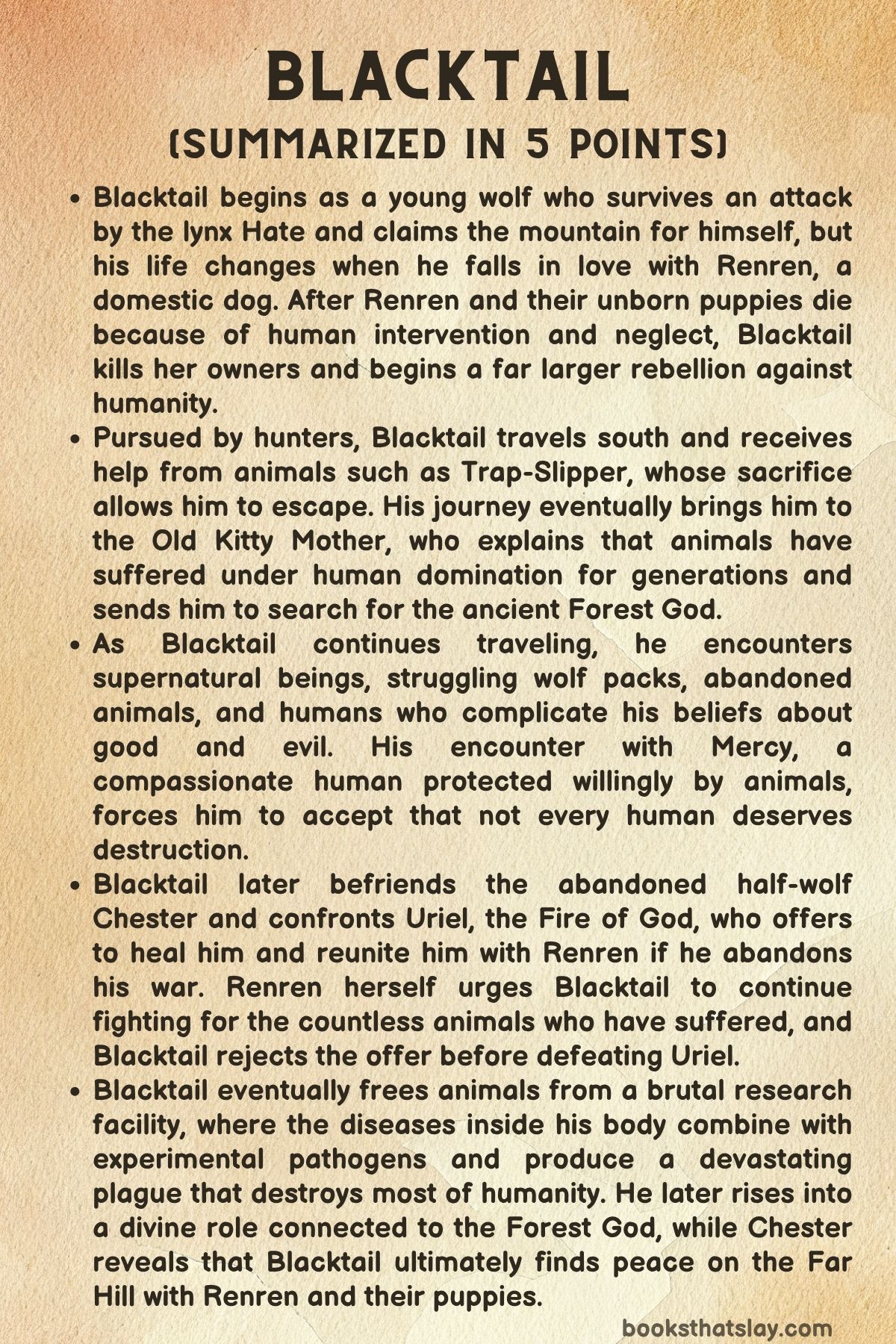
Blacktail begins before its central wolf has even chosen his name. Hate, a violent male lynx, learns that White-Eye, the wolf who has ruled the mountain for years, has apparently been killed by humans along with most of her litter. Hate has long resented living under White-Eye’s authority, and the news seems to offer him the chance to seize control of the mountain.
Hate’s bitterness is connected to deeper wounds. Humans destroyed the forest of his childhood, killed members of his family, and left him scarred, teaching him to see existence as a contest in which weakness invites destruction. When he discovers that one of White-Eye’s male pups survived, Hate decides that the young wolf must die before he can become a rival.
The lynx finds the pup beside his mother’s corpse and pretends sympathy before attacking. His plan fails because the young wolf is stronger and more intelligent than expected. During the fight, the pup learns from Hate’s tactics, overcomes him, and breaks his neck.
The victor claims the mountain and gives himself the name Blacktail. He defines himself through the death of Hate, establishing from the beginning that identity in his world is created through struggle, survival, and the power to claim one’s place.
Two years later, Blacktail has become a feared ruler. Stories about him spread far beyond what he has actually done, and even minor animals can exploit his reputation to intimidate strangers. Yet Blacktail himself remains isolated until he crosses a dangerous human road and encounters Renren, a black female dog chained outside a house.
Their first conversations expose the difference between wild and domestic existence. Blacktail considers her chain intolerable, while Renren initially sees his wild habits as strange and uncivilized. Attraction gradually replaces suspicion, and their relationship becomes the emotional center of Blacktail’s life.
Renren becomes pregnant, and Blacktail dreams of taking her and their puppies into the wilderness. Renren fears life beyond human protection, but she eventually begins imagining a future with him. That future is destroyed when her owner has her spayed, killing the unborn puppies.
Medical complications follow, but Renren’s humans do not recognize her internal bleeding in time. She dies before Blacktail can rescue her. For him, her death is not an accident but proof that humans possess terrifying control over animals whose lives they claim to manage.
Blacktail enters the house and kills the family responsible. During the slaughter, something supernatural seems to awaken in him. His violence attracts the attention of the ancient Old Kitty Mother, and his private revenge begins changing into a challenge against humanity’s entire place in the world.
A house cat named Snooky-Ookums warns Blacktail that humans will send hunters after him. He flees south while people deploy tracking dogs, vehicles, aircraft, and other resources against a single wolf. His survival increasingly depends on animals willing to assist him.
One of them is Trap-Slipper, an elderly fox who understands how to mislead human trackers. Slipper teaches Blacktail how to conceal his scent and exploit terrain while also telling him a story about a tiny creature that defied a powerful predator despite overwhelming odds.
When the tracking dogs Rex and Cephus finally close in, Slipper sacrifices himself by drawing them away. His death reinforces an idea that follows Blacktail throughout the novel: resistance becomes larger than any one individual when others willingly accept danger so that the struggle can continue.
Farther south, Blacktail meets the Old Kitty Mother, an ancient feline witch guarded by the cougars Anki and Enki. She explains that stories about him have spread across the animal world. Animals who had accepted human domination as permanent are beginning to imagine resistance.
She tells Blacktail that humanity once existed inside the older natural order but gained extraordinary power through reason and divine assistance. Humans then pushed other creatures aside through hunting, domestication, confinement, habitat destruction, and control over reproduction.
The Old Kitty Mother believes Blacktail must find the sleeping Forest God, an ancient power tied to hunting and the natural order. She also shows him the history of Karakaa, a sacred crow who once used forbidden supernatural power against invading humans before being removed by a celestial force.
Blacktail doubts that he has a destiny. He continues to understand himself primarily as a wolf whose loved ones were killed. Nevertheless, he agrees to travel onward and search for the divine power that may explain what is happening to him.
His journey becomes physically and psychologically harsher. He begins experiencing dreams filled with the suffering of animals trapped, abused, transported, experimented upon, or killed by people. These visions gradually transform distant suffering into something personal.
After being struck by a vehicle, Blacktail is rescued by a human he calls the Hider. The Hider is unlike the people Blacktail has known because he can understand the deeper language shared by animals and hunters. His abilities come through the God of the Lost, a strange deity associated with abandoned and damaged beings.
The Hider is himself a murderer shaped by childhood abuse and imprisonment, yet he treats Blacktail with reverence. He abducts a medical professional to repair the wolf’s damaged leg and later sacrifices the captive so that the God of the Lost can speak through the corpse.
The deity recognizes Blacktail and hints that he once knew Blacktail’s father. Rather than explain Blacktail’s ancestry, he directs him toward the Fire of God. He then rewards the Hider’s service by transforming him into a coyote, freeing him from the human identity he despised.
Continuing south, Blacktail encounters a starving wolf pack led by Fang. Human activity has damaged their hunting grounds, while a huge grizzly called Fatberry dominates much of what remains. Among the pack is Little One, a half-dog wolf despised because of his mixed ancestry.
Blacktail agrees to help Fang kill Fatberry. The attack becomes a disaster. Fatberry kills Fang and defeats Blacktail while most of the pack retreats.
Little One alone refuses to abandon him. Though badly wounded, he continues attacking the bear. His loyalty awakens another level of power within Blacktail, who rises transformed and kills Fatberry.
Blacktail appoints Little One the new leader of the pack, recognizing loyalty rather than ancestry as the quality that deserves authority. His developing powers and strange dreams increasingly suggest that his father may have possessed supernatural importance.
Later Blacktail enters a community organized around a human woman named Mercy. Dogs, cats, livestock, and other animals live peacefully near her and willingly protect her. Their devotion confuses Blacktail because it contradicts his belief that companionship with humans must always be based on domination.
A terrier named Milo and a war dog named Sarge defend Mercy, while the witch Larkspur explains that Mercy shelters and protects animals without treating them as possessions. The animals insist that chosen loyalty is different from slavery.
Blacktail still attempts to reach Mercy, but the courage of her defenders unsettles him. Larkspur then reveals that the magical healing used to protect Mercy has transferred disease into Blacktail’s body. He is already dying from illnesses he did not know he carried.
Blacktail kills Larkspur and reaches Mercy, yet Mercy refuses to save herself when doing so would mean abandoning a beloved dog. She shields the animal with her own body. The image reminds Blacktail of a mother protecting her young, breaking his absolute conviction that every human deserves death.
He leaves Mercy alive.
In the desert, Blacktail finds Chester, an abandoned half-wolf dog who has been rejected and injured by humans. Blacktail sees something familiar in Chester’s divided identity and teaches him that he does not need human masters to survive.
Their journey leads to a ritual fire in which Uriel, the Fire of God, appears. Uriel offers Blacktail an extraordinary bargain: his diseases can be healed, and he can be reunited with Renren and their unborn puppies if he abandons his rebellion.
Renren appears within the supernatural encounter, but instead of asking Blacktail to accept peace, she reminds him of all the creatures who have suffered as she did. Blacktail chooses continued struggle over personal happiness.
He enters the fire and fights Uriel, surviving a confrontation that confirms he is no longer an ordinary wolf. Chester receives part of the defeated angel’s body, gaining renewed strength, and Blacktail sends him away with the purpose of helping another abandoned creature.
As Blacktail approaches the source of the suffering that has haunted his dreams, animals gather in enormous numbers. Predators and prey stand together, offer gifts, and treat him as something divine. Although he has repeatedly rejected worship, his power has become undeniable.
He reaches an animal research facility filled with creatures that have been confined, infected, mutilated, and experimented upon. Their suffering has generated many of the visions he has experienced.
Blacktail frees the prisoners and uses his own blood to heal them. He understands that absorbing their diseases may kill him, but refuses to stop. His resistance has moved beyond personal vengeance; he now willingly takes suffering into himself for creatures he does not know.
One infected human researcher becomes the means through which the accumulated diseases inside Blacktail combine with experimental pathogens. The result is a catastrophic plague that spreads rapidly through humanity.
Most humans die. Those who possess genuine loving bonds with animals are more likely to survive, suggesting that the destruction is not entirely indiscriminate. Human dominion collapses, and the older natural order begins returning.
Much later, the Old Kitty Mother has become physically frail. She is confronted by a powerful canine ruler named Raze, who is revealed to be the aged Chester. Their meeting uncovers the Old Kitty Mother’s true name, Night Dancer, and the fear that has shaped her long existence.
As a kitten, Night Dancer was influenced by an ambitious mother whose actions ultimately condemned her soul to a demonic power. Her manipulations, magic, and cruelty have always existed beneath the certainty that damnation awaited her.
Chester tells her what became of Blacktail. The wolf ultimately confronted the powers of Heaven, restored Karakaa, challenged the celestial forces that had supported humanity’s dominance, and defeated the authority of the human god.
Blacktail eventually took the place associated with the awakened Forest God. The rebellious wolf who once insisted that he was merely an animal became the divine power around which the restored natural world could organize itself.
Yet his final existence is not defined only by war. Chester has visited the Far Hill, the peaceful afterlife of hunters, where Blacktail lives with Renren and the puppies they were never allowed to raise in the mortal world.
Blacktail sends Night Dancer a final message through Chester. Her damnation has been canceled, and a place awaits her on the Far Hill. Freed from the fear that controlled her for most of her life, Night Dancer chooses not to die immediately.
Instead, she continues living out of curiosity. The story therefore ends not simply with humanity’s fall or Blacktail’s victory, but with the possibility that beings shaped by violence, guilt, and fear can still enter a different future.
Characters
Blacktail
Blacktail is the central figure and the character through whom the novel examines grief, rebellion, power, and moral transformation. He begins as an orphaned wolf who survives Hate’s attempt to kill him and immediately defines himself through victory, but the confidence of that early moment hides how deeply later losses will affect him.
His love for Renren gives him a vision of life that is based on family rather than dominance. When humans destroy that future, his grief turns into mass anger, and the killing of Renren’s owners becomes the first step toward a rebellion that eventually changes the world.
In Blacktail, his greatest internal conflict is the tension between hatred and moral discrimination. He wants to believe humans form a single enemy, but Mercy’s behavior proves that individual humans can act from genuine love, forcing him to abandon a simpler worldview.
His growing supernatural abilities also change the meaning of his identity. Blacktail repeatedly insists that he is only a wolf, even as animals begin worshipping him and divine beings recognize powers that he cannot fully understand.
By healing the victims of experimentation even at personal risk, he eventually becomes more than a figure of revenge. He accepts responsibility for suffering beyond his own experience, turning rebellion into a form of guardianship.
Renren
Renren is Blacktail’s deepest emotional attachment and the source of the loss that changes the direction of his life. As a domestic dog, she initially represents everything Blacktail distrusts: dependence on humans, confinement, and acceptance of ownership.
Yet Renren is not passive. She argues with Blacktail, mocks his assumptions, fears the wilderness for understandable reasons, and gradually chooses the possibility of a new life with him.
Her pregnancy gives their relationship a future, making the destruction of her unborn puppies especially devastating. Her death demonstrates how human control over animals can become lethal even when it is presented as ordinary care.
Renren’s later appearance during the confrontation with Uriel is equally important. Rather than asking Blacktail to choose reunion with her, she tells him to remember the many others who have suffered, showing that her moral importance extends far beyond her role as his lost partner.
Hate
Hate is the first major antagonist and an early example of how suffering can produce cruelty instead of compassion. His childhood was devastated by humans, leaving him scarred both physically and psychologically.
Instead of directing that pain only toward its original cause, Hate becomes obsessed with dominance. White-Eye’s death appears to him primarily as an opportunity to seize power, and he decides to murder her surviving pup before the young wolf can threaten him.
In Blacktail, Hate functions as a warning about what Blacktail himself might become. Both characters suffer because of humans, but Hate allows injury to become an excuse for ambition and predatory violence without restraint.
His death at Blacktail’s hands establishes the novel’s harsh natural logic. Hate attempts to destroy a weaker rival but discovers too late that he has misjudged both the pup’s intelligence and strength.
Guile
Guile, Hate’s mate and the mother of his kittens, provides a quieter counterpoint to Hate’s obsession with power. She witnesses the consequences of his choices without sharing his hunger for domination.
When she encounters the wounded Blacktail after Hate’s death, she has the opportunity to seek revenge. Instead, she chooses the safety of her kittens, placing maternal responsibility above retaliation.
Her decision introduces an alternative to the cycle of vengeance that later controls much of the story. Guile demonstrates that survival does not always require answering violence with more violence.
White-Eye
White-Eye is largely absent physically, but her influence shapes the opening conflict. She ruled the mountain strongly enough that Hate spent years resenting her authority.
Her death at human hands creates the vacuum that allows Hate to act. More importantly, the survival of her son ensures that her lineage continues through Blacktail.
White-Eye therefore represents inherited authority and the destruction of the old order. Her corpse beside the surviving pup becomes the setting in which Blacktail’s new identity is born.
Apple
Apple is an irreverent chipmunk whose role illustrates the extraordinary growth of Blacktail’s reputation. He can frighten a visiting bear merely by exaggerating stories about what Blacktail has supposedly done.
Through Apple, the book shows how legends can become socially powerful before they become literally true. Blacktail’s reputation begins creating effects independent of his actual actions.
Apple also introduces humor into an otherwise severe narrative. His exaggerations make clear that myth is partly created by storytellers who enjoy enlarging reality.
Snooky-Ookums
Snooky-Ookums is a house cat connected to the Old Kitty Mother who understands the supernatural significance of Blacktail’s rebellion earlier than Blacktail himself does. He warns the wolf that human retaliation will be overwhelming.
His role places him between domestic life and the secret magical world of animals. Although he lives close to humans, his loyalties and knowledge extend far beyond household existence.
In Blacktail, Snooky-Ookums helps establish that Blacktail’s killing of Renren’s owners has consequences beyond ordinary revenge. Through him, the narrative begins widening from one wolf’s tragedy into a supernatural conflict.
Trap-Slipper
Trap-Slipper is one of Blacktail’s most important early allies. Elderly but highly skilled, he understands human hunters and teaches Blacktail practical methods of survival.
His story about a tiny creature resisting a powerful predator expresses the philosophy he lives by. Resistance has value even when the weaker side cannot reasonably expect victory.
Slipper ultimately sacrifices himself by drawing Rex and Cephus away from Blacktail. His death transforms his belief into action and teaches Blacktail that his survival now carries obligations created by the sacrifices of others.
Rex
Rex is one of the tracking dogs used by humans to hunt Blacktail. His presence complicates the apparent division between humans and animals because he is an animal working within human systems of control.
He also witnesses supernatural events connected to the Old Kitty Mother, giving him awareness that the hunt involves forces far beyond ordinary tracking. Rex represents animals whose abilities have been directed toward human objectives rather than independent animal interests.
Cephus
Cephus serves alongside Rex and occupies a similar position between animal instinct and human authority. As a tracking dog, he becomes part of the machinery used to pursue Blacktail.
His encounter with supernatural punishment expands his understanding of the world. Through Cephus and Rex, the book demonstrates that domesticated animals can become participants in human power even though they remain vulnerable to larger forces.
The Old Kitty Mother / Night Dancer
The Old Kitty Mother is one of the novel’s most influential and morally difficult characters. Ancient, powerful, secretive, and manipulative, she recognizes the potential meaning of Blacktail’s rebellion before almost anyone else.
She encourages him to search for the Forest God and frames his personal anger as part of a historical struggle between humanity and the rest of animal life. Her guidance is useful, but it is never presented as entirely selfless.
In Blacktail, her eventual revelation as Night Dancer changes how her earlier behavior can be understood. Her long existence has been shaped by the belief that her soul is destined for damnation because of choices made around her when she was young.
Her fear helps explain both her hunger for power and her willingness to manipulate others. Yet she eventually understands that magic itself carries terrible consequences and refuses to keep depending on it.
Blacktail’s final message that she has a place on the Far Hill offers her something she has never possessed: freedom from inevitable punishment. Her decision to continue living shows that hope can become meaningful even at the end of an extremely long and morally compromised life.
Anki
Anki is one of the powerful cougars who protect the Old Kitty Mother. His loyalty demonstrates how much authority she commands among dangerous predators.
Although his role is largely protective, he also represents the physical strength surrounding the witch’s more abstract magical power. His willingness to fight for her contrasts with her eventual decision not to rely on violence or magic when Chester confronts her.
Enki
Enki serves alongside Anki as the Old Kitty Mother’s protector. Together, the two cougars create an image of political and supernatural authority around her.
Enki’s presence also reinforces the alliances that cross species boundaries throughout the novel. Loyalty is repeatedly shown to be capable of overriding normal predator relationships when larger causes or personal bonds emerge.
Karakaa
Karakaa is a sacred crow whose history reveals that Blacktail is not the first animal to challenge human expansion. Centuries earlier, Karakaa accepted forbidden supernatural power and destroyed a human settlement in an effort to stop invasion.
His removal by a celestial force demonstrates that humanity’s dominance is supported by powers beyond human technology alone. The conflict is therefore spiritual as well as ecological.
Karakaa’s eventual restoration by Blacktail gives his earlier rebellion a delayed vindication. What failed in one age becomes part of the transformation achieved in another.
The Hider
The Hider is one of the book’s most disturbing human characters because he combines brutality with unusual spiritual understanding. Years of abuse, imprisonment, and violence have shaped him into a murderer, yet he possesses a connection to the language of animals and hunters that most people lack.
His treatment of Blacktail is reverential rather than exploitative. He abducts a medical professional to save the wolf’s damaged leg, showing genuine devotion through methods that remain horrifying.
His eventual transformation into a coyote fulfills his desire to escape humanity. Rather than being punished through death, he is granted membership in the natural world he understands better than human society.
The God of the Lost
The God of the Lost represents abandoned, broken, and displaced beings. Its relationship with the Hider suggests that divine attention in the novel is not reserved for morally pure individuals.
The deity recognizes Blacktail and hints at knowledge of his father, expanding the mystery surrounding Blacktail’s ancestry. It also directs him toward the Fire of God, acting as a guide rather than a final authority.
Its transformation of the Hider into a coyote reveals a form of mercy based on identity. The reward is not wealth or absolution but escape from the human condition.
Fang
Fang leads a starving wolf pack whose territory has been damaged by human activity and dominated by Fatberry. He represents a more conventional form of animal leadership than Blacktail’s emerging spiritual authority.
Fang is practical enough to seek Blacktail’s help against the bear. His death during the failed attack demonstrates the limits of courage when strategy and strength are insufficient.
His loss also creates the leadership vacancy that allows Little One to rise. The transition from Fang to Little One shifts authority away from inheritance or status and toward demonstrated loyalty.
Quickfoot
Quickfoot is a member of Fang’s struggling pack. Like the other wolves, Quickfoot lives with the consequences of habitat damage and reduced access to prey.
The character helps establish the collective desperation that makes challenging Fatberry necessary. Quickfoot also provides contrast with Little One when most of the pack retreats during Blacktail’s defeat.
Gray-Ear
Gray-Ear belongs to Fang’s pack and shares its precarious existence. The character is part of the broader representation of ordinary animals whose lives are destabilized by both human environmental pressure and powerful predators.
Gray-Ear’s presence emphasizes that Blacktail’s journey repeatedly brings him into communities already struggling before he arrives. His rebellion gains followers because the world is filled with creatures whose lives have become increasingly difficult.
Belly-Scar
Belly-Scar is another member of Fang’s wolves and contributes to the pack’s sense of collective hardship. The name itself suggests a history written physically onto the body.
Like Quickfoot and Gray-Ear, Belly-Scar helps distinguish Little One’s exceptional loyalty. When survival instinct causes others to withdraw, Little One remains beside Blacktail.
Little One
Little One is among the clearest examples of underestimated strength in the novel. As a half-dog wolf, he is mocked because his mixed ancestry makes him seem impure to the rest of Fang’s pack.
His devotion to Blacktail is not based merely on personal contact. He has already heard stories about him and sees him as proof that animals do not have to accept human dominance.
When Fatberry defeats Blacktail, Little One keeps attacking despite suffering devastating injuries. His refusal to retreat becomes the emotional force that awakens Blacktail’s greater power.
In Blacktail, Little One’s elevation to leadership rejects the idea that worth depends on bloodline. Blacktail chooses him because loyalty, courage, and action matter more than purity.
Mercy
Mercy is the human character who most directly challenges Blacktail’s hatred of humanity. She lives peacefully among animals who remain with her voluntarily and are prepared to risk their lives to protect her.
Blacktail initially assumes that their devotion must be another form of captivity. Yet Mercy’s actions reveal that her relationships with animals are based on care rather than control.
Her defining moment comes when she refuses to abandon a beloved dog even though doing so could save her life. By physically shielding the animal, she behaves exactly as Blacktail understands a protective mother should.
Mercy forces Blacktail to accept moral distinction. After meeting her, he can no longer honestly claim that every human relationship with animals is inherently abusive.
Milo
Milo is the small terrier who acts as the spiritual leader of Mercy’s animal community. His size contrasts with the seriousness of his responsibility.
He tries to prevent Blacktail from approaching Mercy because he understands that direct conflict could destroy the fragile coexistence she has created. His loyalty is voluntary and therefore becomes part of the evidence that unsettles Blacktail.
Milo represents faith grounded in lived experience. He trusts Mercy because her behavior has earned that trust.
Larkspur
Larkspur is a witch who once followed a path connected with the Old Kitty Mother but eventually chose Mercy’s vision of coexistence. Her decision shows that even those familiar with animal resistance do not necessarily accept total war against humanity.
She uses magic to protect Mercy, but her methods carry a hidden cost. Illnesses removed from Mercy have been transferred into Blacktail without his knowledge.
This makes Larkspur morally ambiguous. Her devotion to Mercy is genuine, but she preserves one life by secretly damaging another.
Blacktail’s killing of her reflects both his rage at manipulation and the larger danger of magical solutions that transfer suffering rather than eliminate it.
Sarge
Sarge is an experienced war dog devoted to Mercy. His willingness to die for her becomes especially significant because Blacktail initially assumes animals defend humans only because they have been conditioned into obedience.
Sarge’s courage suggests a chosen bond formed through trust and experience. He therefore serves as living evidence against Blacktail’s absolute beliefs.
As a war dog, Sarge also carries the complicated history of animals participating in human violence. Yet his loyalty to Mercy is represented as personal rather than institutional.
Chester / Raze
Chester begins as an abandoned half-wolf dog starving in the desert. Like Little One, he exists between categories and has suffered because neither humans nor wild animals fully accept him.
Blacktail gives him food and teaches him to survive without human masters. Under Blacktail’s guidance, Chester discovers both his predatory ability and a new sense of identity.
After receiving part of Uriel’s defeated body, Chester gains renewed strength and continues living beyond his time with Blacktail. He eventually becomes the legendary ruler known as Raze.
His later meeting with Night Dancer reveals how completely he has changed. The desperate abandoned animal has become an old, powerful leader capable of carrying Blacktail’s final message.
Chester’s life demonstrates one of the novel’s strongest ideas about transformation. Identity is not fixed by birth, breeding, abandonment, or the judgment of others.
Uriel
Uriel, the Fire of God, represents the heavenly power that attempts to end Blacktail’s rebellion through temptation rather than simple destruction. The offer given to Blacktail is almost perfectly designed to overcome him.
Uriel promises healing and reunion with Renren and the unborn puppies. The bargain therefore tests whether Blacktail’s struggle is still merely personal.
When Blacktail refuses, he proves that his motives have expanded beyond his own grief. His battle with Uriel also confirms that the conflict has moved from earthly resistance into direct confrontation with divine authority.
Nugget
Nugget is a tiny dog who appears among the crowds gathering around Blacktail. He brings a small offering despite possessing very little himself.
Blacktail notices how generations of human breeding have physically damaged Nugget. His restoration of the dog shows that Blacktail’s power can repair forms of suffering that are inherited rather than immediately inflicted.
Nugget therefore embodies the consequences of human control over animal bodies across generations. His healing also suggests the possibility of healthier future descendants.
Craft
Craft is one of the animals imprisoned in the research facility. Blacktail selects the dog to help lead the newly freed prisoners.
That choice turns Craft from a victim into a participant in rebuilding life after captivity. Leadership becomes part of healing because freedom requires more than simply opening cages.
Craft’s role also shows Blacktail’s growing willingness to distribute responsibility. He does not attempt to rule every liberated animal personally.
Joy-Hop
Joy-Hop is a supernatural companion who warns Blacktail about the danger involved in using his blood to heal diseased animals. The warning emphasizes that Blacktail understands the personal cost of what he is doing.
Joy-Hop serves as a voice of caution at a moment when Blacktail’s willingness to sacrifice himself is becoming extreme. Blacktail’s refusal to stop confirms how far he has moved beyond private vengeance.
The Forest God
The Forest God represents the ancient natural order of hunting, struggle, death, and survival. Unlike human systems of dominion, this order does not promise safety or equality.
Its importance lies in what it symbolizes: a world in which humans are participants in nature rather than masters standing above it. Blacktail’s search for this power gradually becomes inseparable from his own transformation.
By the end, Blacktail effectively assumes the divine position associated with the Forest God. The change completes his movement from orphaned survivor to supernatural guardian of a restored animal world.
Themes
Grief, Revenge, and the Expansion of Moral Purpose
Grief is the force that first turns Blacktail against humanity. Renren’s death and the destruction of their unborn puppies transform an intensely personal loss into murderous rage, and his killing of her human family initially offers revenge rather than any carefully considered philosophy.
What makes Blacktail more complicated is that revenge does not remain emotionally sufficient. As Blacktail travels, he encounters suffering far beyond his own experience: hunted animals, abandoned dogs, damaged habitats, research subjects, and creatures altered by human control.
The result is an expansion of motive. He begins by fighting because humans killed the family he wanted, but later risks his own life to heal animals he has never met before.
Mercy creates the crucial moral correction within this development. If grief alone defined Blacktail’s ethics, he would kill her simply because she is human, yet her willingness to sacrifice herself for an animal forces him to recognize that love and cruelty cannot be assigned to an entire species without distinction.
His later rejection of Uriel’s offer completes this movement. Blacktail could receive everything he personally lost, but Renren reminds him that accepting private happiness would mean abandoning countless others.
Revenge therefore develops into obligation. Blacktail does not stop being angry, but his anger becomes connected to responsibility for suffering outside himself.
Dominion, Freedom, and the Meaning of Choice
The novel repeatedly asks what makes authority legitimate. Humans claim power over animals through ownership, breeding, confinement, medicine, scientific experimentation, environmental transformation, and violence.
Yet the book does not treat every relationship between humans and animals as identical. Renren’s chain represents literal confinement, while Mercy’s community demonstrates voluntary companionship.
This distinction matters because Blacktail initially assumes that any animal living with a human must be enslaved. Milo, Sarge, and Mercy challenge that conclusion by showing that loyalty can be freely given.
The contrast appears elsewhere through characters such as Little One and Chester. Both are judged according to ancestry and human association, yet both become powerful once they are allowed to define themselves through action rather than imposed categories.
Freedom in Blacktail therefore means more than physical escape. It involves possessing meaningful choice over identity, loyalty, movement, reproduction, and belonging.
Even the Hider’s transformation into a coyote follows this idea. His reward is not domination over others but release from an identity he experiences as imprisonment.
The collapse of human civilization at the end overturns the largest structure of dominion in the story. Yet the novel repeatedly warns that replacing one form of unquestioned authority with another can reproduce the same problem.
Blacktail’s most admirable leadership appears when he recognizes autonomy in others, appoints figures such as Little One and Craft, and allows communities to develop without demanding personal control over them.
Sacrifice and the Creation of Community
Sacrifice repeatedly turns isolated resistance into collective purpose. Trap-Slipper willingly draws the hunting dogs away from Blacktail even though he knows the choice will probably kill him.
Little One follows the same moral pattern when he continues attacking Fatberry after stronger wolves retreat. His body is badly damaged, but his refusal to abandon Blacktail becomes more important than physical strength.
These sacrifices change Blacktail because they create debts that cannot be repaid through ordinary exchange. Survival becomes a responsibility to make another creature’s suffering meaningful.
Mercy’s willingness to shield a dog creates a parallel example on the human side. Her action affects Blacktail precisely because it resembles the protective behavior he respects among animals.
The research facility brings the theme to its largest scale. Blacktail uses his own blood to heal abused creatures even though he knows their diseases may enter his body.
This act reverses the earlier logic of Larkspur’s magic. Larkspur secretly transferred illness from one being into another, whereas Blacktail knowingly accepts suffering into himself.
Community therefore forms not merely through shared identity but through voluntary risk. Wolves, dogs, cats, foxes, humans, and supernatural beings are judged less by what they are than by what they are willing to endure for others.
The story suggests that solidarity becomes strongest when it is chosen in circumstances where self-preservation would be easier.
Myth, Divinity, and the Power of Belief
Blacktail spends much of the story denying the identity that others create for him. Animals repeat exaggerated tales about his victories, worshippers gather along his path, and supernatural beings recognize significance in him before he accepts it himself.
This gap between self-perception and public belief creates a continuing tension. Blacktail thinks of himself as a wolf shaped by love, loss, hunger, and anger, while the wider animal world increasingly treats him as a divine liberator.
Apple’s exaggerated stories show the earliest and most humorous form of this process. Reputation becomes power because other creatures act according to what they believe, regardless of whether every story is literally accurate.
Later, myth and reality begin converging. Blacktail develops supernatural abilities, survives encounters that should kill him, heals damaged animals, defeats Uriel, and eventually confronts celestial powers directly.
The transformation raises questions about whether divinity exists before belief or can partly emerge through it. Animals need a figure around whom resistance can gather, and their faith helps turn one wolf’s rebellion into a movement that crosses species boundaries.
Yet the novel does not present worship as uncomplicated. Blacktail repeatedly rejects claims that he is a god because he understands himself through ordinary desires and losses.
His final transformation therefore carries an irony. The creature who resisted being made into a symbol ultimately becomes the power that symbol anticipated, suggesting that myth can begin as exaggeration, become collective hope, and finally reshape reality itself.