Blood of Truth and Traitors Summary, Characters and Themes
Blood of Truth and Traitors by Aria Ashbrook is a fantasy novel centered on Rose Kultavaris as the discovery of her Issen ancestry transforms a mission to protect her younger brother into a struggle involving royal succession, ancient magic, political betrayal, divine prophecy, and war.
Rose enters the hidden kingdom of Isthyr believing she only needs answers about Issen markings and magic, but she soon learns that she is the lost granddaughter of King Magnus. Her new identity forces her to confront dangerous rituals, family secrets, divided loyalties, and the frightening possibility that the conflicts surrounding her are connected to a much older struggle among Gods and kingdoms. It’s the 3rd book in the Hirathean Path series.
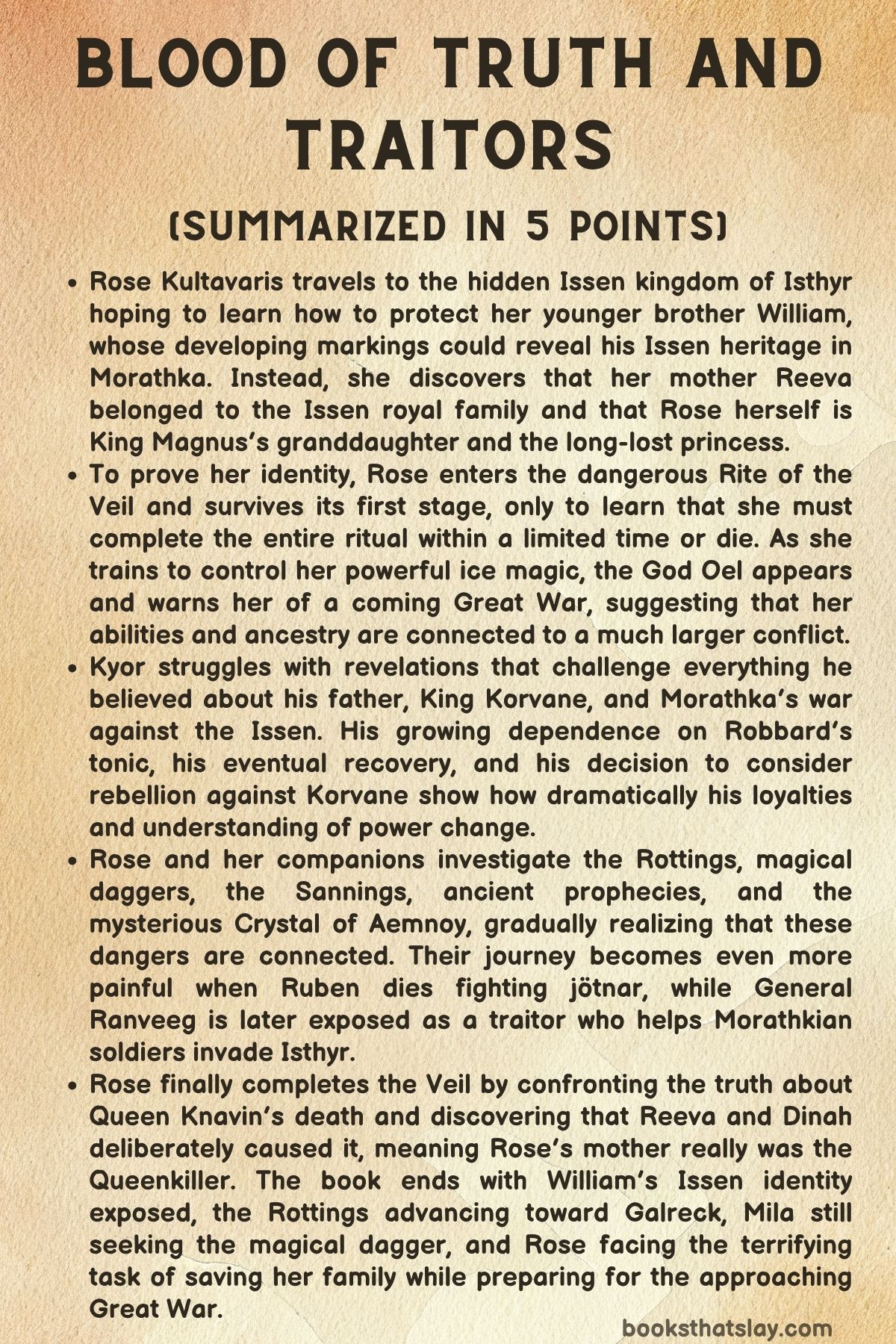
Summary
Rose Kultavaris travels into the hidden Issen lands with Kyor, Fen, Ruben, Benny, Caz, Thessa, Loch, and Elska because she desperately needs information about her younger brother William. Strange markings have begun appearing on William, and Rose fears they will reveal his Issen heritage in Morathka, where such a discovery could lead to his death.
Instead of finding the savage people Morathkian history taught her to expect, Rose discovers Isthyr, an advanced and beautiful city hidden among the mountains. The Issen guards immediately recognize the ring and dagger belonging to her mother, Reeva, and begin calling Rose their lost princess, though General Ranveeg rejects the claim and imprisons Rose and her companions.
King Magnus soon arrives and recognizes Reeva’s ring, creating the possibility that Rose is his granddaughter. Ranveeg invokes the Rite of the Veil, an ancient test capable of proving whether Rose possesses royal Issen blood, and Rose reluctantly agrees to face it after securing Magnus’s promise that her friends will be spared if she dies.
The Veil is revealed to be a wall of supernatural fire. Rose walks through it and survives, causing the flames to acknowledge her as an Issen heir and leaving strange markings on her hands, while a golden signal announces the return of the royal bloodline across Isthyr.
Her new status changes everything. Rose is welcomed into Magnus’s palace and introduced to warriors such as Stefan and Uzra, but tension immediately grows when Kyor’s identity as the son of King Korvane becomes known, since Korvane has spent years waging war against the Issen.
The Issen reveal that Morathka’s version of the conflict is deeply misleading. Kyor begins learning that his father knew far more about Isthyr than he admitted and may have betrayed people who once trusted him, forcing Kyor to reconsider the history on which his entire identity has been built.
A jötunn attack interrupts these political revelations. Rose refuses to remain protected in the palace and helps defend Isthyr, killing one of the enormous creatures with Fen’s assistance and proving that the returned princess is willing to fight beside the people who now claim her.
Rose begins training under Stefan to control the powerful Issen magic emerging within her. Her relationship with the warrior is complicated by Kyor’s jealousy, Stefan’s political importance, and Rose’s suspicion that different factions in Isthyr may want to use her position for their own purposes.
The danger surrounding the Veil then becomes far greater when Rose learns that passing through its first stage began a process she cannot abandon. She has only a limited number of days to complete the remaining stages, and failure will kill her.
Rose feels betrayed because Magnus never explained this consequence before she entered. During the confrontation, the God Oel possesses Toren and tells Rose that she is connected to a coming Great War, then greatly strengthens her Issen abilities, giving her even more power without explaining exactly what she is expected to do with it.
At the same time, Kyor’s injured shoulder and growing dependence on Robbard’s tonic become impossible to ignore. Rose confronts him about the addiction, and Kyor eventually admits that he needs help, allowing their relationship to develop beyond mutual protection into something based on vulnerability and trust.
Rose repeatedly attempts the Veil while also training, investigating ancient mysteries, and experiencing supernatural visions. The ritual continually forces her toward memories surrounding the death of Queen Knavin, Kyor’s mother, but Rose resists because the event destroyed her childhood and led to her family’s disgrace.
Political tensions inside Isthyr also become more dangerous. Someone deliberately suffocates Rose with magic, suspicious accidents occur, and Stefan behaves in ways that make Kyor believe he intends to kill Rose, while Ranveeg’s open hostility remains another obvious threat.
Meanwhile, Rose’s companions investigate the deeper history surrounding the Retterheld, the Sannings, the magical daggers, and the Gods. Magnus confirms that Thessa belongs to an ancient sentinel tradition, while further discoveries reveal that the Sannings once possessed magic before Sanrott stripped it from them.
These revelations make it increasingly clear that Rose’s experiences are not isolated events. The Retterheld, her dagger, the Rottings, ancient divine conflicts, and the mysterious prophecy all seem connected to a struggle that began long before the current war between Morathka and Isthyr.
Rose’s progress with her magic gradually improves. Meditation and Ruben’s calming techniques help her discover that her power responds far better to serenity than uncontrolled emotion, allowing her to create an enormous ice wolf and demonstrating the extraordinary scale of her abilities.
The fragile stability collapses when Stefan leads Rose, Ruben, Benny, and Fen into an isolated ravine. Rose suspects that he has deliberately placed her where her death could be explained as a training accident, but before his intentions can fully unfold, jötnar attack.
The battle becomes catastrophic. Rose transfers power into Ruben so he can strengthen his fire magic, while Benny uses his abilities to anticipate attacks, but Ruben is fatally struck while protecting those he loves and dies with his attention fixed on Benny.
Ruben’s death devastates the group. Rose loses one of the people who stood beside her through poverty and danger, while Benny loses the man with whom he had only recently allowed himself to imagine a future.
Even grief cannot stop the growing crises. Rose learns to control her visions more deliberately and discovers that Torailians have arrived in Isthyr, bringing knowledge of the Great War, an ancient prophecy, and the mysterious figure known as the Child of Four.
Kyor then nearly dies while attempting to break the magical vow tying him to Korvane. By deliberately stopping his own heart, he manages to free himself from the oath and can finally reveal secrets his father forced him to keep.
Kyor explains that Korvane knew about the Rottings and had been searching for the Crystal of Aemnoy. He also reveals disturbing information suggesting that the High Priestess and Mila may have wanted the undead threat preserved rather than destroyed, strengthening the belief that the Rottings, crystal, dagger, prophecy, and ancient powers belong to the same larger conflict.
Kyor’s political transformation becomes equally significant. After listening to Benny explain that Morathka cannot truly change while Korvane remains in power, Kyor accepts the possibility that rebellion against his own father may be necessary.
The danger soon reaches Isthyr directly when Morathkian soldiers demand Rose’s magical dagger. Someone has betrayed the hidden route through the pyrrhic, and Rose eventually discovers that the traitor is Ranveeg.
Ranveeg uses the same suffocation magic previously directed against Rose, confirming her involvement in the attempted murder. Rose fights through the attack and cuts Ranveeg with the magical dagger, whose strange power prevents the wound from healing.
Ranveeg dies, but her betrayal has already allowed hundreds of Morathkian soldiers to enter Issen territory. Rose, Kyor, Magnus’s forces, and their allies are drawn into a major battle in which Kyor ultimately unleashes a massive lightning attack against soldiers from his own homeland.
The victory comes at enormous cost, and the conflict permanently separates Kyor from unquestioning loyalty to Morathka under Korvane. Rose also refuses to condemn Brida for her mother’s crimes, showing that she will not repeat the same cycle of inherited hatred that has shaped relations between the kingdoms.
While unconscious after the battle, Rose experiences another vision and sees enormous numbers of Rottings advancing toward Galreck and the slums. She understands that thousands of ordinary people are now in immediate danger and that Mila’s pursuit of the dagger may be connected to the undead army.
Before Rose can lead the Issen toward Galreck, Magnus insists that she must complete the Veil. Rose finally understands why she has continually rejected the memory shown to her: completing the ritual means accepting that she may never again experience her mother through those visions.
Rose returns to the Veil and finally stops fighting what it wants her to see. She carefully observes the night Queen Knavin died and discovers that the accepted story of Reeva failing to save the queen is false.
Reeva and Dinah had deliberately conspired in the queen’s death. Rose is forced to accept that her mother was not simply blamed for a tragedy but was truly the Queenkiller.
The realization completes the Veil, removes the deadly markings from Rose, and saves her life, but it leaves her terrified of what the truth will do to Kyor. His mother died because of Rose’s mother, placing one of the darkest secrets imaginable between them.
Rose barely has time to process the revelation before another vision shows William in danger. His Issen heritage has finally been exposed in Wrohelm, meaning the secret Rose crossed the mountains to protect can no longer remain hidden.
The novel closes with every major threat converging at once. Rose must save William, reach Galreck before the Rottings destroy it, protect the dagger from Mila, understand the Crystal of Aemnoy and the prophecy, confront Dinah about Reeva’s actions, face the Great War promised by Oel, and eventually tell Kyor that her mother intentionally helped kill his mother.
Characters
Rose Kultavaris
Rose is the central force of Blood of Truth and Traitors, and her character is shaped by the conflict between who she believed herself to be and the identities suddenly imposed upon her. She begins as someone concerned primarily with protecting William, yet discovering that she is Magnus’s granddaughter transforms a private family mission into a political and supernatural responsibility.
Her strongest quality is loyalty. Rose repeatedly risks herself for William, Kyor, Fen, her companions, Isthyr, and even people she barely knows, but that loyalty also becomes one of her greatest weaknesses because she assumes responsibility for suffering she cannot always prevent.
Her relationship with power is especially important. Rose initially responds to danger through instinct and emotion, but her training teaches her that true control requires calmness, discipline, and an acceptance of power rather than constant attempts to dominate it.
The Veil forces Rose into a different type of courage. She can fight monsters and soldiers more easily than she can face the truth about Reeva, making her final acceptance of her mother’s guilt one of her most important moments of development.
Kyor
Kyor undergoes one of the largest ideological transformations in Blood of Truth and Traitors. He arrives in Isthyr as Korvane’s son, carrying assumptions about the Issen and his father’s war that have shaped his entire life, but evidence gradually destroys the certainty on which his loyalty depended.
His love for Rose is intense and often protective to the point of possessiveness. His jealousy toward Stefan sometimes makes him impulsive, yet his willingness to challenge his own behavior and support Rose through the Veil reveals increasing emotional maturity.
Kyor’s dependence on Robbard’s tonic exposes a vulnerable side that contrasts sharply with his reputation as a powerful warrior. Admitting that he needs help becomes an important act of courage because it requires him to abandon the belief that strength means enduring everything alone.
His decision to consider rebellion against Korvane completes his political evolution. By the end, he is no longer simply a prince waiting to inherit his father’s kingdom but a man prepared to oppose the king if doing so is necessary to protect Morathka and end a destructive system.
Fen
Fen is Rose’s closest supernatural companion and one of the most dependable presences in the story. Their bond allows him to sense her fear, frustration, and determination, giving Rose a relationship in which explanations are often unnecessary.
His personality frequently introduces humor, particularly through his appetite and blunt reactions, but his importance extends well beyond comic relief. Fen repeatedly helps Rose in battle, accompanies her into dangerous territory, and challenges her tendency to blame herself for events outside her control.
Fen’s loyalty is unusually uncomplicated compared with the political loyalties surrounding Rose. Kings, warriors, relatives, and allies may have competing motives, but Fen chooses Rose directly and consistently.
King Magnus
Magnus occupies an emotionally complicated position in Blood of Truth and Traitors because he is both Rose’s newly discovered grandfather and the ruler of a kingdom carrying generations of hostility toward Morathka. His initial recognition of Rose offers her the possibility of recovering a family connection she never knew existed.
He is portrayed as restrained, practical, and far less obsessed with ceremony than Korvane. His modest throne room, willingness to speak personally with Rose’s companions, and concern for his citizens distinguish his leadership from authoritarian rule.
His greatest failure is his handling of the Veil. By allowing Rose to enter without explaining that she would die unless she completed the Rite, Magnus damages the trust forming between them and proves that even a comparatively compassionate ruler can place tradition above personal honesty.
Magnus nevertheless shows an ability to reconsider assumptions. He refuses to allow Ranveeg’s hatred of Kyor to determine policy and increasingly recognizes the possibility of cooperation between Issen and Morathkian people.
Stefan
Stefan begins as one of Isthyr’s most skilled warriors and Rose’s primary instructor in Issen magic. His training is genuinely valuable because he teaches Rose that breathing, mental control, and precision matter as much as raw strength.
His relationship with Rose becomes increasingly ambiguous. He provokes her, challenges Kyor, makes inappropriate suggestions, and appears interested in the political consequences of Rose’s royal status.
Kyor views Stefan as a possible rival, assassin, and political opportunist, while Rose repeatedly resists condemning him without evidence. The ravine episode makes Stefan appear especially dangerous because the isolated location and positioning of Rose’s companions suggest deliberate planning.
General Ranveeg
Ranveeg is one of the clearest examples of hatred becoming self-destructive. From Rose’s arrival, she refuses to consider the possibility that Rose belongs in Isthyr and treats her Morathkian connections as evidence of danger.
Her opposition is partly political because Rose’s return threatens the existing succession and the ambitions of factions dissatisfied with Magnus’s restraint. Ranveeg’s hostility eventually becomes treason when she reveals the route through the pyrrhic to Morathkian forces.
Her use of suffocation magic confirms that she also attempted to kill Rose personally. By betraying the kingdom she claims to defend, Ranveeg demonstrates how obsession with an enemy can become more dangerous than the enemy itself.
Brida
Brida initially appears to share some of the hostility surrounding Rose’s arrival, yet she gradually emerges as a far more sympathetic figure than Ranveeg. Her aggression is tied to the expectations placed upon her by a demanding mother who values political strength and obedience over emotional support.
Rose’s growing understanding of Brida creates one of the story’s quieter examples of reconciliation. Rather than treating Brida as an extension of Ranveeg, Rose encourages her to form an identity separate from her mother’s ambitions.
After Ranveeg’s betrayal is exposed, Rose refuses to blame Brida for inherited guilt. Brida’s willingness to enter Morathkian territory with an urgent message suggests that she is capable of choosing loyalty to Isthyr over the ideology that destroyed her mother.
Ruben
Ruben is one of the emotional anchors of Blood of Truth and Traitors because his history with Rose stretches back to hardship long before royal bloodlines and prophecies entered their lives. He represents the kind of loyalty created through shared survival rather than politics or destiny.
His relationship with Benny reveals his insecurity and fear of allowing himself a future. Ruben clearly loves Benny, yet he struggles to believe that he deserves the relationship or can safely commit to it.
His ability to work with Rose’s transferred magic during battle demonstrates his trust in her and his willingness to place himself in danger for others. His death while protecting the people he loves becomes one of the most devastating losses in the book.
Ruben’s influence continues after death. Rose uses the meditation technique he taught her to gain better control over her visions, showing that his presence remains active in the choices and abilities of those who survive him.
Benny
Benny combines intelligence, humor, perceptiveness, and emotional defensiveness. His ability to absorb information quickly makes him invaluable when the group begins studying ancient languages, the Veil, the Sannings, and the forgotten history preserved in Isthyr.
His relationship with Ruben exposes an unusually vulnerable part of his personality. Benny wants Ruben to stop treating affection as something temporary, and his insistence on honesty reflects his desire for a relationship that is openly chosen rather than cautiously avoided.
Ruben’s death leaves Benny facing a future he had only just allowed himself to imagine. His grief is made especially painful by the fact that their relationship had barely begun to become secure.
Politically, Benny is also crucial because he is the person willing to tell Kyor that meaningful reform may require rebellion. His argument helps push Kyor toward accepting that removing Korvane from power may be necessary.
Caz
Caz is one of the group’s most dedicated investigators and intellectual problem-solvers. She repeatedly searches for connections among the magical daggers, the Retterheld, ancient history, the Sannings, the Rottings, and the Gods.
Her relationship with Thessa gives her a future that may not lead back to Wrohelm alongside Rose. This creates a subtle emotional change in their friendship because both women recognize that surviving their shared journey does not necessarily mean returning to the lives they once imagined.
Caz also carries complicated grief after Ruben’s death. Rose’s willingness to let Caz experience sorrow, guilt, anger, or even unwanted feelings without judgment strengthens their relationship.
Thessa
Thessa enters the story carrying grief over Stide, but her importance grows substantially when Magnus identifies her as a sentinel. She becomes a link between the immediate problems facing Rose and a much older history that most people have forgotten.
Her knowledge helps reveal the ancient conflict among divine powers and the truth about the Sannings losing their magic. This makes Thessa more than a companion; she becomes one of the people capable of interpreting the deeper history behind present events.
Her increasing closeness with Magnus also suggests that her future may become tied to Isthyr. Through Thessa, personal relationships and ancient historical responsibilities begin to overlap.
Loch
Loch’s abilities are both a gift and a source of constant strain. The suppression of magic inside the Issen prison initially gives him rare relief, showing how exhausting his supernatural sensitivity normally is.
Isthyr offers him access to healers and knowledge that may help manage his condition. His presence also remains relevant when the group investigates old traditions and unusual abilities, because his experiences do not fit neatly within ordinary categories of magic.
William
William may spend most of the story away from Rose, but he is one of the primary reasons the entire journey occurs. The Issen markings developing on his body threaten to reveal an identity that Morathkan society would treat as dangerous.
Rose’s discovery that adolescent Issen males naturally develop these patterns confirms that William cannot simply be cured. His problem is political rather than medical, because survival depends upon whether he can exist openly as someone connected to both peoples.
His eventual exposure at the end transforms Rose’s worst fear into an immediate emergency. William therefore represents the personal cost of the hatred dividing Morathka and Isthyr.
Kay
Kay remains central to Rose’s emotional life even while separated from her geographically. Rose’s visions repeatedly return to Kay because her sister represents home, family, and the ordinary life Rose is increasingly losing.
Kay’s miscarriage deeply affects Rose, who immediately responds with guilt because she was not present. Her developing magical abilities and training with Jonas also indicate that her role may become increasingly important in later conflicts.
Reeva
Reeva’s shadow lies over nearly every major revelation in Blood of Truth and Traitors. Her ring identifies Rose as part of the Issen royal family, while her unexplained departure from Isthyr creates one of the central mysteries surrounding Rose’s childhood.
For most of Rose’s life, Reeva exists as a beloved mother associated with sacrifice and unjust persecution. The Veil destroys that simple understanding by revealing that she deliberately participated in Queen Knavin’s death.
The revelation does not erase Reeva’s love for Rose, but it forces Rose to accept that love and terrible wrongdoing can exist within the same person. Reeva becomes a symbol of the dangerous distance between the stories children inherit about their parents and the truths those parents may have hidden.
Dinah
Dinah’s connection to Reeva becomes increasingly suspicious through the memories shown by the Veil. Their private conversations reveal that the two women were cooperating in secret long before Queen Knavin’s death.
The final revelation makes Dinah an active participant in the conspiracy surrounding the queen. Because she is still alive, she also becomes one of the few people who may be capable of explaining why Reeva committed the act and what larger plan motivated them.
Uzra
Uzra is one of Isthyr’s most knowledgeable and politically important figures. His early conversations with Kyor begin dismantling Morathka’s official version of the war by revealing information Korvane concealed from his own son.
He also helps Kyor train alongside Issen warriors, creating opportunities for former enemies to understand one another through direct experience. Uzra therefore functions as a practical bridge between two societies that have been taught to fear each other.
Oel
Oel is the Issen God of order and logic who possesses Toren in order to communicate directly with Rose. His appearance expands the scale of the story by confirming that Rose’s personal struggles are connected to divine conflict and an approaching Great War.
He strengthens Rose’s magic dramatically but offers frustratingly little guidance about how she is supposed to use it. This makes Oel both an ally and a source of pressure, since he gives Rose responsibility without giving her the full information necessary to understand it.
Aulia
Aulia is a Torailian closely associated with the prophecy surrounding Rose. Her persistent use of the name “Skakka” suggests that the Torailians understand Rose through a cultural or prophetic framework that Rose herself does not yet understand.
Rose is wary of Aulia because Torailian mind abilities make privacy difficult, yet she eventually trusts her enough to assign her responsibility for protecting the dagger if Rose falls. Aulia therefore occupies the uncertain space between intrusive outsider and necessary ally.
Mila
Mila remains physically distant for much of the story, but her influence becomes increasingly threatening. Evidence suggests that she wants Rose’s magical dagger and may understand far more about the Rottings and ancient objects than Rose’s group initially realizes.
The possibility that forces connected to Mila are preserving or directing the undead threat makes her more dangerous than a conventional political enemy. She appears linked to a plan whose goals may reach beyond control of any single kingdom.
King Korvane
Korvane is central to Kyor’s internal conflict even though much of his influence is exercised from a distance. He has shaped Morathkan history through propaganda, warfare, secrecy, and control over his son.
The magical vow imposed on Kyor shows how far Korvane is willing to go to maintain obedience. His concealed knowledge of Isthyr, the Rottings, and the Crystal of Aemnoy also indicates that he has withheld information with consequences far beyond his own family.
Kyor’s willingness to rebel against him is therefore both political and deeply personal. Opposing Korvane means rejecting not only a king but the father who defined Kyor’s understanding of duty.
Toren
Toren is one of the first Issen to believe that Rose truly is the missing princess. His willingness to accept the evidence of Reeva’s ring contrasts sharply with Ranveeg’s immediate suspicion.
He later becomes the vessel through which Oel speaks to Rose. Although Toren has no control over that possession, the event places him at one of the story’s most important supernatural turning points.
Nettie
Nettie serves as an Issen healer and represents the practical knowledge Isthyr possesses beyond warfare. Her examination of Rose after the Veil and involvement in the group’s medical problems demonstrate that the hidden kingdom has developed skills the Morathkian visitors never expected.
Her presence also helps establish Isthyr as a functioning society rather than merely an enemy stronghold.
Orla
Orla becomes crucial when Kyor deliberately stops his heart in his attempt to break Korvane’s magical vow. Although she fears that her healing may not work properly on a Morathkian, Rose persuades her to continue.
Her success in restarting Kyor’s heart saves his life and makes his eventual freedom from the vow possible. The moment also provides another example of Issen power being used to save a Morathkian rather than destroy one.
Jonas
Jonas appears primarily through Rose’s visions of Wrohelm. His role in helping Kay understand and train her developing powers suggests that he has become an important source of support while Rose is absent.
His presence reassures Rose that her family is not entirely alone, even though she remains frustrated that she cannot directly protect them.
Elska
Elska serves as both transportation and a dependable presence during some of the group’s most dangerous moments. She helps carry Ruben after the catastrophic jötunn battle and remains closely associated with the practical survival of the group.
Though less psychologically developed than the central human characters, Elska contributes to the sense that Rose’s companions function as an interdependent unit rather than a collection of isolated individuals.
Astrid
Astrid appears as one of the Issen defenders during the Morathkian invasion. Her role becomes particularly important when the Issen guards form defensive lines around Rose as the enemy crosses the pyrrhic.
She represents the soldiers who choose to defend both Isthyr and the newly returned princess despite the political uncertainty surrounding Rose.
Linnea
Linnea is associated with the refined, creative possibilities of Issen magic. Rose’s attempt to reproduce the ice-wolf sculpture first demonstrated by Linnea helps shift Rose’s understanding of her abilities away from purely destructive uses.
Linnea’s astonishment at the enormous wolf Rose eventually creates also confirms that Rose’s magical potential exceeds ordinary expectations even among experienced Issen.
Themes
Truth, Secrecy, and the Cost of Hidden Knowledge
Truth in Blood of Truth and Traitors rarely arrives as a simple source of freedom. Nearly every important revelation carries emotional or political damage with it, making knowledge both necessary and painful.
Rose’s identity as Magnus’s granddaughter overturns everything she believed about her mother and ancestry, while Kyor’s discoveries about Korvane force him to reconsider the father he admired and the national history he accepted. Both characters learn that inherited stories can protect people temporarily, but they can also imprison them inside false assumptions.
Secrecy is often motivated by love. Rose hides William’s identity because she wants to protect him, Kyor cannot reveal Korvane’s secrets because of a magical vow, and Reeva concealed the truth of Queen Knavin’s death from her daughter.
Yet these secrets create new dangers because they prevent people from making informed choices. Rose herself recognizes the contradiction when she demands honesty from Benny and Kyor while continuing to conceal William’s existence.
The Veil makes this theme personal by refusing to let Rose survive through denial. She can complete the Rite only when she stops resisting the memory of Queen Knavin’s death and accepts that Reeva was responsible.
Truth therefore becomes a form of maturity. Rose and Kyor cannot determine who they want to become until they are willing to separate love for their families from blind acceptance of what those families have done.
Inherited Hatred and the Possibility of Reconciliation
The conflict between Morathka and Isthyr is sustained by generations of fear, propaganda, and inherited resentment. Rose and Kyor enter Issen territory carrying assumptions formed by stories told in Morathka, while many Issen judge Kyor entirely through the crimes of his father.
Ranveeg represents the destructive end of this inheritance. Her hatred becomes so absolute that she betrays Isthyr itself rather than accept Rose and the possibility of cooperation with Morathkans.
Rose repeatedly chooses a different response. She refuses to treat Brida as responsible for Ranveeg’s betrayal and begins to recognize that hostility often hides personal pressure, fear, or pain.
Kyor undergoes a similar transformation. He initially reacts defensively whenever anyone challenges Korvane, but direct contact with Issen people eventually forces him to see them as individuals rather than enemies created by national mythology.
The growing cooperation between Kyor, Uzra, Magnus, and Issen soldiers suggests that reconciliation begins through shared experience rather than political declarations. Fighting beside one another makes old categories harder to maintain.
The book does not present peace as easy or immediate. Reconciliation requires people to confront genuine crimes without transferring guilt automatically from parents to children or from rulers to entire populations.
Power, Control, and Responsibility
Rose possesses enormous magical strength, yet much of her development concerns learning that strength alone is not mastery. Her early magic responds violently to fear, anger, desire, and panic, making power dangerous when it operates without emotional control.
Stefan’s breathing exercises, Magnus’s meditation, Ruben’s visualisation technique, and Rose’s eventual creation of the giant ice wolf all reinforce the same lesson. Her greatest achievements occur when she allows herself to become calm rather than forcing magic through desperation.
This idea extends beyond supernatural ability. Kyor possesses devastating lightning, Magnus commands royal authority, Korvane rules a kingdom, and Oel possesses divine power, but the moral value of each form of power depends upon how it is used.
Korvane turns authority into control by manipulating history and magically binding his son. Ranveeg turns military influence into betrayal because resentment becomes more important than duty.
Rose gradually learns to treat power as obligation rather than entitlement. She does not want the Issen throne, yet she repeatedly acts to protect Isthyr because people are already looking to her for leadership.
Her development therefore asks whether responsibility can exist without ambition. Rose’s reluctance to rule may actually make her more careful with authority because she understands what power can cost the people who depend upon it.
Identity, Family, and the Freedom to Choose
Blood of Truth and Traitors repeatedly challenges the idea that ancestry determines character. Rose discovers that she is Issen royalty, Kyor is the son of an increasingly tyrannical king, Brida is the daughter of a traitor, and William carries physical signs of a people Morathka has been taught to hate.
None of these identities provides a complete definition of the person involved. Rose may be a princess, but she remains shaped by poverty, friendship, survival, and her love for William; Kyor may be Korvane’s heir, but he eventually chooses to oppose the values his father represents.
Brida’s development makes the idea especially clear. Ranveeg attempts to shape her daughter through expectation and ideology, yet Rose encourages Brida to understand that being Ranveeg’s child does not require becoming Ranveeg.
Reeva’s revelation complicates Rose’s understanding of family even further. Rose must accept that her mother loved her while also committing an act with devastating consequences for Kyor.
The story therefore separates biological connection from moral inheritance. People may receive bloodlines, titles, magic, political burdens, and historical guilt from their families, but they still possess the ability to decide what those inheritances will mean.
Rose’s expanding idea of family supports this conclusion. Her deepest bonds include siblings, friends, animals, lovers, companions, and newly discovered relatives, suggesting that family is created as much through chosen loyalty and responsibility as through blood.