Crone by Keith Rosson Summary, Characters and Themes
Crone by Keith Rosson is a supernatural horror novel built around grief, addiction, buried violence, and the terrible consequences of protecting people who deserve accountability.
The story follows former detective Eli Lamp as a series of impossible killings forces him to reopen the disappearance of his daughter Hannah, who vanished thirteen years earlier. What begins as an investigation into a mutilated corpse gradually exposes corruption within Salt Point, the violent history of two motorcycle clubs, and a secret that powerful men deliberately concealed. At its center, the novel asks what happens when truth is suppressed for years and vengeance finally arrives in a form nobody can control.
Summary
Fifteen-year-old Hannah Lamp disappears on a rain-soaked night after leaving a party with her best friend, Avery Bryant. Hannah has severe visual impairment caused by optic nerve hypoplasia, making the dark highway especially difficult for her to navigate. When a blue van stops nearby, she sees it as a possible way home, while Avery distrusts the situation and refuses to approach it. Frustrated with her friend, Hannah goes toward the van alone. Someone inside suddenly grabs her and drags her in, leaving Avery behind and beginning a mystery that remains unresolved for thirteen years.
Thirteen years later, Hannah’s father Eli Lamp is almost unrecognizable from the man he once was. Formerly a sheriff’s detective, he became addicted to wire, a powerful drug that allows users to enter extraordinarily vivid dream states. Although he eventually stopped using it, his addiction, violence, and desperation after Hannah disappeared destroyed his career and placed him under the control of Trying Dave Novak, leader of the Crooked Wheel motorcycle club.
Eli now works as an enforcer, hurting dealers and carrying out Dave’s orders even though he despises what he has become. His existence is built around guilt. He preserves Hannah’s bedroom, remembers the people he has killed, and lives with the knowledge that his search for his daughter led him into acts from which he can never entirely return.
The present crisis begins when Dave’s eldest son, Anton Novak, is found horribly mutilated near Jesus Creek. Dave refuses to involve ordinary law enforcement and orders Eli to investigate because of his former detective experience. Anton’s body is so violently damaged that the crime appears deeply personal rather than practical, yet there is little usable evidence.
At roughly the same time, local seer Vicki Stubbs discovers a human heart wrapped in twine, covered in amaranth seeds, and pierced with blackthorn. Her occult research suggests that the arrangement is connected to resurrection, domination, and hostile magic. The heart later disappears, convincing her that something active and dangerous is operating around Salt Point.
Avery also returns to town. Her life since Hannah’s disappearance has been dominated by guilt, wire addiction, and an abusive relationship with Nico, a man associated with the rival Brother Night motorcycle club. She has fled California after stealing money connected to the organization, but her attempt to escape quickly collapses.
Avery contacts Nico, who follows her to Salt Point. He recovers the money, betrays her, and leaves her exposed to Brother Night punishment. Gordon White, an enforcer, later takes Avery to Bitter Rock and repeatedly stabs her when she cannot produce additional money that Nico falsely claimed she had stolen.
Instead of dying, Avery is rescued by an apparently monstrous pale woman with wings. The creature kills Gordon and carries Avery to a stone cottage, where it painstakingly treats her wounds. Avery is terrified by her rescuer’s appearance, yet the creature behaves with more care toward her than the human beings who have dominated and abused her adult life.
Eli’s investigation becomes impossible to explain rationally when Anton’s corpse disappears from its grave. Evidence suggests that the body escaped upward rather than being dug out. Eli and Terry Bishop eventually find Anton walking through the forest despite the catastrophic injuries that made survival impossible.
Bullets barely affect the reanimated body. Anton appears to respond momentarily to his name before being violently pulled backward through the woods as though controlled by an invisible force. Eli can no longer pretend that an ordinary killer is responsible.
Dave forces Vicki to explain what may be happening. She connects Anton’s condition to the ritual heart and to legends concerning an old crone associated with Salt Point. Before she can help further, Tyler Novak shoots her in the face, and Crooked Wheel members dismember her body for disposal.
Vicki’s murder convinces Eli that Dave will eventually dispose of him as well. He tries to flee town but is stopped by Deputy Adam Kingston. Before Kingston can arrest him, the winged creature attacks the cruiser and kills the deputy while deliberately sparing Eli.
The pattern becomes increasingly important. Anton, Gordon, and Kingston are killed, while Avery and Eli repeatedly survive encounters with the same supposedly murderous being. The creature is not simply slaughtering whoever crosses its path. It is choosing specific targets.
Kingston’s hidden history provides part of the answer. Gambling debts led him into dealings with both Dave and Amos Gray, the leader of Brother Night. He became compromised, betrayed people on both sides, and stole money from the scene where Gordon had attacked Avery. His death therefore belongs to a larger network of secrecy, corruption, and moral debt.
Eli’s own past also becomes essential. After Hannah vanished, he traced information to a Brother Night property where young girls were being exploited. Believing Hannah might be there, he entered armed and killed five members of the organization. Hannah was absent, but Dave later concealed Eli’s responsibility for the killings.
That protection trapped Eli. Dave spent thirteen years using the threat of Amos Gray’s vengeance to control him. Eli always wondered why Dave accepted such enormous risk simply to save him, and the reason becomes central to the mystery.
After Vicki’s murder, her dismembered corpse is itself reanimated. It appears inside Eli’s cell and gives him a damaged lens from Hannah’s old glasses. At last, Eli recognizes that Hannah—not himself—is the common connection between the supernatural deaths.
Meanwhile, Avery discovers Eli’s trailer after escaping from the winged woman’s cottage. There she encounters Terry and Dave. Once Avery explains that the creature saved and healed her, Dave becomes convinced that she can lead him to the mysterious witch.
Eli confronts Sheriff Mike Grinnell, suspecting that the longtime corrupt lawman knows more about Hannah than he has admitted. Before Eli can force a confession, violence drives him away. He eventually reaches the Crooked Wheel compound, where Dave openly betrays him and turns him over to Amos Gray.
Brother Night takes Eli back to his trailer. Amos intends to punish him for the five men killed thirteen years earlier and arrange the scene so that Eli appears responsible for the recent deaths. Eli is forcibly given wire in what is meant to become a fatal overdose.
The crone intervenes again. She kills Amos and his associates but saves Eli, carrying him to her cottage and treating him until he survives the drug. Tyler Novak soon arrives and attacks Eli, only to be killed by the crone.
Instead of running from her, Eli finally follows her. She leads him through the woods to a hidden burial ground, where he discovers Hannah’s red-and-white cane beside a grave. The discovery confirms what he has feared for years: Hannah is dead.
Terry arrives holding Avery hostage, but before he can control the situation, the crone takes Eli’s wrist and forces him into Hannah’s memories. Eli is no longer merely hearing an explanation. He experiences the night of her disappearance through Hannah herself.
The blue van belonged to people Hannah knew. Anton Novak was driving, Tyler Novak was with him, and Adam Kingston occupied the passenger seat. The boys had been drinking, and Anton refused to take Hannah home.
Tyler sexually harassed Hannah while the others allowed the situation to continue. After Hannah tried to escape from the moving van, she injured herself and ran into the woods. Anton chased her, mocked her disability, caught her, and sexually assaulted her while Tyler and Adam failed to intervene meaningfully.
A terrifying creature then appeared. It broke Anton’s leg, frightened the boys away, and carried Hannah to safety. That creature was Isabelle Stroup, the crone whom everyone in the present has interpreted as a monster.
Isabelle cared for Hannah in her stone cottage. Hannah eventually chose not to return home because Salt Point no longer felt safe. Her attackers remained protected within powerful families, while Eli’s addiction had already damaged her trust in him.
Hannah nevertheless continued loving both Eli and Avery. Months after disappearing, she secretly visited Avery’s home and left flowers inside an empty cigarette package as an act of forgiveness. The mysterious childhood gesture Avery had remembered was Hannah telling her, without revealing herself, that she was not blamed.
Hannah’s bond with Isabelle eventually became permanent. When traveling through the supernatural realm called “in between” nearly killed Isabelle, Hannah shared blood with her to save her. That act began Hannah’s own transformation into a crone.
Over the following years Hannah developed wings, claws, supernatural abilities, and perfect vision. She formed a genuine life with Isabelle and watched Eli from a distance, never understanding that his association with the Crooked Wheel resulted partly from the violent search he had conducted for her.
Eventually Hannah decided to reveal herself to her father. While racing toward Eli’s trailer, however, she struck the newly installed silver-coated razor wire protecting the Crooked Wheel’s hazeweed crop. Silver is lethal to crones, and the injury was fatal.
Before dying, Hannah gave Isabelle permission to take revenge on Anton, Tyler, Adam, and the adults who had protected them. She specifically ordered Isabelle not to kill Eli. Her final desire was that her father learn what had actually happened to her.
The entire supernatural campaign is therefore revealed as Isabelle’s fulfillment of Hannah’s final wishes. Anton was killed and resurrected as an instrument of punishment. Adam was executed for his part in the original crime. Tyler is killed, while corrupt adults who concealed the truth become additional targets.
Terry admits that Dave orchestrated the cover-up. Eli kills him, but Dave soon confronts Eli and confirms the larger betrayal. The blue van belonged to Terry, and Anton, Tyler, and Adam had taken it that night.
Dave knew what his sons had done. Sheriff Grinnell also knew, meaning the man officially responsible for helping solve Hannah’s disappearance actively helped bury the truth. Dave’s decision to protect Eli after the Portland killings was partly his warped attempt to compensate for what his sons had done.
Dave eventually leads the surviving Crooked Wheel members to Isabelle’s cottage. Isabelle kills them and fatally mutilates Dave, completing her vengeance against the man whose power made thirteen years of silence possible.
Afterward, Avery frees Eli. Because she has also experienced Hannah’s memories, Eli asks whether his daughter ever found happiness. Avery explains that Hannah suffered but eventually found safety, companionship, freedom, and love with Isabelle.
Most importantly, Avery tells Eli that Hannah never stopped loving him. Isabelle did not show him the past because he had another mission to perform. She did it because Hannah’s final request was simply that her father know the truth and understand that she loved him until the end.
Eli then encounters the silver razor wire and realizes the final cruelty of Hannah’s death. He helped install the barrier that accidentally killed his daughter when she was trying to return to him. The realization nearly destroys him, but memories of Hannah’s ordinary life prevent grief from becoming completely empty.
A year later, public explanations reduce the massacre to drug violence, gang conflict, and police corruption. Avery and Eli are both missing. Kendra, one of Avery’s old friends, drives through Salt Point and sees two pale winged women racing across the road while the strange radio spirit Howie shouts with delight.
The sight strongly suggests that Avery returned to Isabelle after the massacre and ultimately became a crone herself. The official world continues treating Avery as another disappearance, while the supernatural world quietly continues beyond what most people are willing to believe.
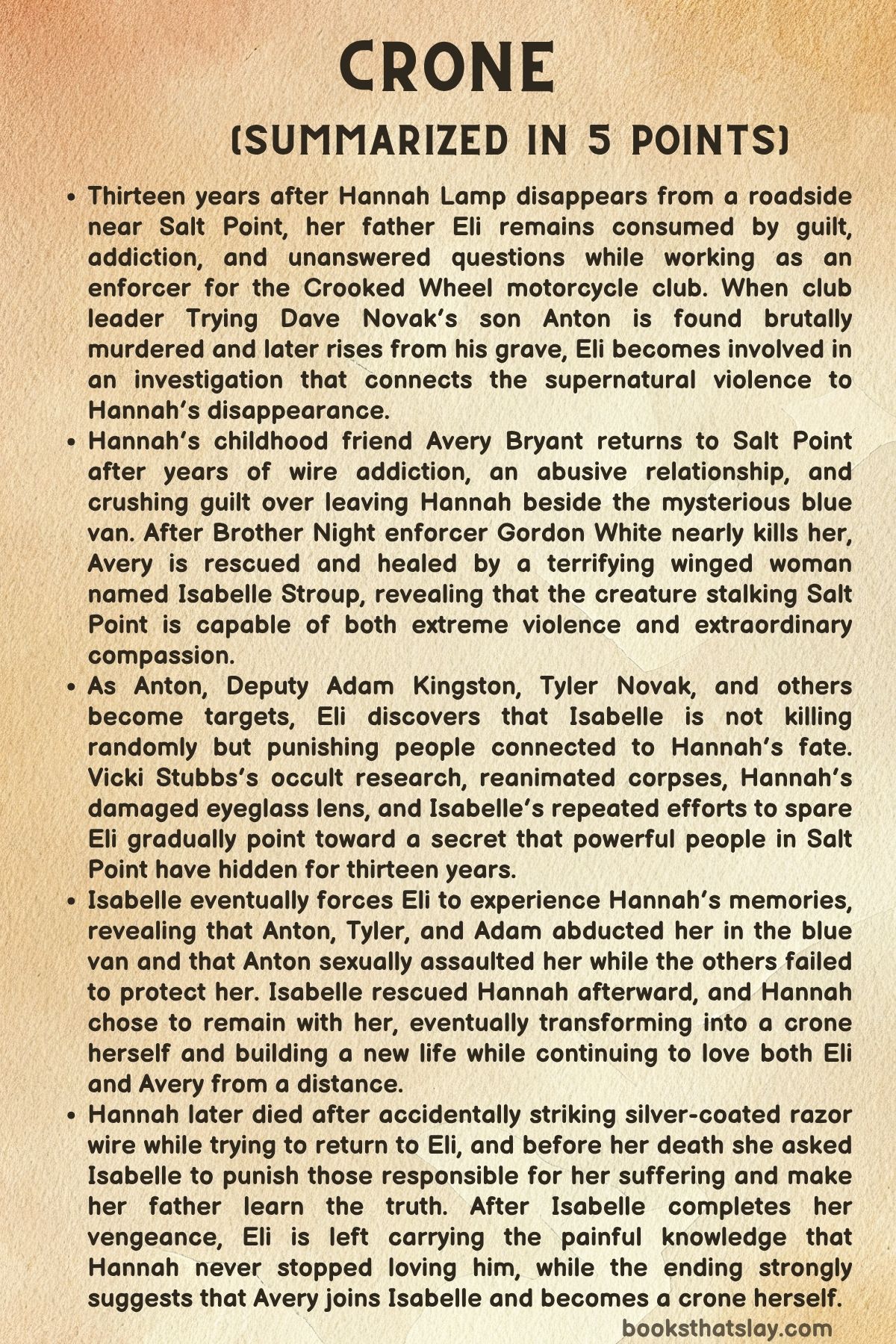
Characters
Eli Lamp
Eli is the emotional center of Crone, a man whose love for his daughter exists beside enormous personal failure. He was once a capable detective and a devoted father, but Melanie’s death, professional pressures, alcoholism, and especially wire addiction gradually made him emotionally unavailable to Hannah long before she disappeared.
His defining flaw is his tendency to convert grief into self-destruction and violence. After Hannah vanishes, he kills five Brother Night members while searching for her, an act born partly from desperation and partly from his inability to tolerate helplessness.
Eli spends thirteen years blaming Avery because blaming a frightened teenage girl is easier than fully acknowledging how badly he had already failed Hannah. His eventual willingness to protect Avery shows significant moral movement because he finally stops treating her as a substitute target for his guilt.
The supernatural revelations punish Eli without reducing him to a simple villain. He learns that Hannah survived, built another life, loved him from afar, and died while attempting to return to him. His final burden is not revenge but knowledge: he must live with both his failures and the fact that Hannah’s love endured them.
Hannah Lamp
Hannah is physically absent from much of Crone, yet nearly every major event ultimately originates with her. Her disappearance defines Eli and Avery, motivates the original cover-up, explains Dave’s unusual treatment of Eli, and eventually gives Isabelle the purpose behind her campaign of vengeance.
Her visual impairment has shaped how others treat her, often reducing her to vulnerability rather than recognizing her independence. Her decision to approach the van partly reflects that frustration: she wants to make her own choices rather than constantly being defined by what she cannot see.
Hannah’s response to violence becomes especially important. After Isabelle rescues her, she initially refuses to make revenge the purpose of her existence. She builds a new life instead, demonstrating that surviving harm does not require allowing the people responsible to determine every future choice.
Even after transforming into a crone, Hannah retains her emotional connections to Avery and Eli. She forgives Avery, watches Eli from afar, and finally attempts to reconnect with him. Her death turns the story’s vengeance into something more complicated because the violence is not Hannah’s entire legacy; her clearest final wish is that her father understand her life and her love.
Avery Bryant
Avery is one of the most damaged survivors in Crone, carrying responsibility for an event that was never actually her fault. As a teenager, she correctly senses danger and refuses to enter the blue van, yet Hannah disappears after walking toward it alone. The community then allows Avery’s survivor guilt to grow into a defining part of her identity.
Her adult addiction and abusive relationship with Nico reveal how deeply that guilt has shaped her choices. She repeatedly accepts pain, humiliation, and danger because some part of her seems convinced she deserves punishment for surviving when Hannah did not.
Returning to Salt Point begins the destruction of that belief. Nico betrays her, Gordon nearly kills her, and Dave mutilates her, yet Isabelle repeatedly offers forms of protection that challenge Avery’s understanding of who the real monsters are.
Avery’s eventual discovery that Hannah forgave and loved her releases the central emotional burden of her life. Her return to Isabelle at the end suggests that she chooses transformation over returning to an ordinary society that repeatedly failed her. Becoming a crone therefore functions not simply as supernatural corruption but as a radical departure from the identity others imposed upon her.
Isabelle Stroup
Isabelle appears throughout Crone as a terrifying physical presence, but the novel gradually overturns the assumptions created by her appearance. Her wings, claws, black eyes, supernatural strength, and ability to manipulate corpses make her resemble the obvious monster, yet her actions reveal a more complicated moral position.
She rescues Hannah after the assault, treats her injuries, offers her shelter, and never forces her to remain. Years later she saves Avery from Gordon and later saves Eli from Amos’s attempt to kill him with wire.
Isabelle’s vengeance is ferocious and frequently grotesque, but it follows a specific moral pattern. She does not indiscriminately murder everyone around her. Her central targets are the men who harmed Hannah, participated in the original crime, or protected those responsible.
Her strongest characteristic is loyalty. After Hannah dies, Isabelle carries out the requests entrusted to her even when doing so causes enormous physical suffering. Forcing Eli and Avery to experience Hannah’s memories is therefore less about torture than testimony: Isabelle ensures that Hannah’s life cannot remain buried beneath the version created by powerful men.
Trying Dave Novak
Dave is one of the most morally compromised figures in Crone because he repeatedly confuses protection with love. He cares deeply for his sons, particularly Anton, yet his response to their wrongdoing is to shield them from consequences rather than acknowledge the people they harmed.
His relationship with Eli is similarly distorted. Dave saves Eli from Amos Gray after the Portland killings and then uses that protection as leverage for thirteen years. What initially resembles mercy becomes a form of ownership.
The revelation that Dave knew about Hannah’s assault changes the meaning of his earlier actions. Protecting Eli was partly an attempt to reduce his own guilt without ever exposing his sons. He wants to compensate Eli while simultaneously denying him the truth he most desperately needs.
Dave’s inability to accept moral responsibility continues even after the supernatural violence begins. He treats Isabelle as the source of the tragedy rather than recognizing that her vengeance exists because he helped suppress the original crime. His death completes the collapse of a system built on paternal loyalty without accountability.
Vicki Stubbs
Vicki occupies the uncertain border between ordinary Salt Point life and the supernatural world. Although townspeople regard her as a witch, much of her practice involves folk remedies, divination, intuition, and limited contact with phenomena she does not completely understand.
The ritual heart frightens her because she immediately recognizes that it belongs to a form of power much more dangerous than her own practices. Her willingness to investigate shows curiosity but also responsibility, since she understands that knowledge can become necessary when something threatening is moving through the community.
Her earlier relationship with Eli gives their interactions emotional weight. She remains one of the few people able to speak to him outside the structures of the motorcycle clubs and corrupt law enforcement.
Vicki’s murder demonstrates the brutality of the Crooked Wheel more clearly than almost any criminal transaction. She is killed after being forced to help, simply because paranoid men decide she has become inconvenient. Her later reanimated body becomes an ironic reversal: the woman murdered to silence dangerous knowledge returns from death to deliver precisely the evidence Eli needs.
Terry Bishop
Terry initially appears to be one of the more approachable members of the Crooked Wheel. He has history with Eli, sometimes shows concern for him, and claims ignorance of some of Dave’s worst decisions.
That appearance gradually collapses. Terry knew more about Hannah’s disappearance than Eli realized and participated in maintaining the silence surrounding the boys involved. His ownership of the blue van also places him materially close to the original crime.
Terry represents passive complicity becoming active guilt. He may not have assaulted Hannah, but he belongs to the adult structure that decided protecting the Novak family mattered more than telling the truth.
His final attempt to use Avery as a hostage shows that years of compromise have left little meaningful distance between him and the people he claims not to resemble. Eli’s decision to kill him therefore comes after discovering that friendship and familiarity never prevented Terry from participating in the lie that shaped his life.
Anton Novak
Anton is the principal direct human aggressor in Hannah’s past. Arrogant, violent, and accustomed to protection, he treats Hannah’s disability as something he can exploit for amusement and control.
His assault becomes the foundational act behind much of the later violence. What makes Anton especially dangerous is not simply cruelty but entitlement: he behaves as though Hannah’s refusal, fear, injury, and vulnerability have no moral authority over him.
His reanimated corpse turns that history back upon the Crooked Wheel. The body that once imposed violence becomes a weapon controlled by another force, attacking the community that protected him.
Anton therefore becomes both perpetrator and grotesque symbol. His inability to remain properly buried mirrors the truth about Hannah itself. The past cannot remain underground simply because powerful people decided to cover it.
Tyler Novak
Tyler occupies a morally different position from Anton but is still deeply culpable. During Hannah’s abduction he sexually harasses her and remains present while Anton escalates the violence. His failure to intervene cannot be separated from his own participation.
As an adult, Tyler shows how little genuine moral development has taken place. He murders Vicki after she provides information to the Crooked Wheel, demonstrating a readiness to eliminate vulnerable people whenever they threaten the family’s security.
His violence against Eli at Isabelle’s cottage reinforces that pattern. Tyler responds to uncertainty through domination because force is the language his family has normalized.
His death at Isabelle’s hands completes a trajectory built on inherited privilege and personal choice. He was protected as a teenager, but that protection did not make him better; it merely allowed his capacity for violence to continue without accountability.
Adam Kingston
Adam is another example of complicity developing into corruption. As a teenager, he witnesses Hannah’s treatment and fails to stop what happens. His later career in law enforcement creates a sharp contradiction between the authority he possesses and the responsibility he once avoided.
He initially appears uncomfortable with Salt Point’s corruption and fears becoming like compromised officers around him. Yet gambling addiction gradually makes him vulnerable to exactly the kind of manipulation he condemns.
Adam accepts money from Amos, provides information on Crooked Wheel operations, considers theft, and eventually takes cash from a murder scene. His moral collapse is therefore gradual rather than sudden.
Isabelle’s decision to kill him connects his adult corruption to his adolescent silence. The story does not equate witnessing with committing Anton’s assault, but it refuses to treat doing nothing as morally meaningless when someone has the ability to act.
Sheriff Mike Grinnell
Grinnell represents institutional betrayal. As sheriff, he possesses the authority that should have protected Hannah, investigated her disappearance, and resisted criminal influence.
Instead, he accepts payments from the Crooked Wheel and participates in maintaining Dave’s power. His corruption is especially devastating because he once served as someone Eli respected professionally.
The revelation that Grinnell knew information about Hannah’s disappearance transforms him from merely corrupt into personally responsible for Eli’s thirteen years of uncertainty. He allows the official investigation to become a cold case while knowing that Anton, Tyler, and Adam were connected to the night she vanished.
Grinnell’s betrayal demonstrates how institutions can convert private violence into lasting injustice. Hannah’s attackers were dangerous, but their power became much greater once an authority figure helped suppress the truth.
Amos Gray
Amos Gray functions as Dave’s criminal counterpart. As the leader of Brother Night, he operates through violence, debt, intimidation, and transactional loyalty.
His long-standing anger toward Eli arises from the five Brother Night members Eli killed while searching for Hannah. Dave’s protection prevents immediate retaliation, but Amos never abandons the grievance.
He exploits Adam’s gambling debt, pressures him for information, and eventually accepts Dave’s decision to surrender Eli. His plan to kill Eli while manufacturing evidence around the scene demonstrates how easily organized crime and corrupt law enforcement can cooperate when their interests align.
Isabelle’s attack prevents Amos from controlling the narrative. Like Dave, he believes violence gives him the power to decide what story survives. His death proves that the supernatural reckoning operates outside the criminal structures both clubs have relied upon.
Nico
Nico embodies the abusive cycle that shapes Avery’s adult life. She repeatedly interprets his possessiveness and occasional concern as forms of love despite years of violence and drug-related exploitation.
When Avery steals the money and returns to Salt Point, Nico’s response exposes the relationship completely. He is primarily concerned with protecting himself from Amos and Brother Night.
His willingness to blame Avery for money she never stole is the final destruction of her illusions about him. He effectively offers her life in exchange for reducing suspicion against himself.
Nico’s death at Gordon’s hands is not presented as justice in any clean moral sense. Instead, it demonstrates the disposable nature of loyalty within the violent world Avery has spent years mistaking for belonging.
Gordon White
Gordon is frightening because of his calmness. Unlike characters whose violence erupts emotionally, he treats brutality as routine professional work.
He brings Avery to Bitter Rock, demands money she does not possess, and methodically stabs her when she cannot satisfy him. His behavior shows how organized violence strips victims of individuality and reduces suffering to enforcement.
His encounter with Isabelle establishes one of the novel’s central reversals. Gordon looks human and Isabelle looks monstrous, yet Gordon is the one torturing a helpless woman while Isabelle becomes her rescuer.
That reversal prepares the reader to question every simple division between human and monster that follows.
Melanie Lamp
Melanie’s presence survives primarily through Eli’s memory. Her death during Hannah’s birth becomes the first major loss that destabilizes his emotional life.
She represents the future Eli believed he had secured: marriage, family, ordinary happiness, and a home not organized around crime or addiction. Losing her leaves him vulnerable to grief that he never learns to process constructively.
Wire becomes especially dangerous because it allows Eli to experience memories of Melanie with extraordinary vividness. The drug does not merely offer pleasure; it offers counterfeit reunion.
Through Melanie, the novel shows why Eli’s addiction cannot be understood solely as weakness. His destructive choices remain his responsibility, but they arise from his desperate attempt to live inside a past that reality has permanently taken away.
Howie
Howie is one of the story’s strangest supernatural presences. He communicates through radios and appears to Vicki as the voice of a young boy whose exact nature remains uncertain.
His knowledge exceeds what ordinary characters understand. He recognizes the forces surrounding Isabelle and anticipates violence before most people realize anything supernatural is happening.
Unlike Vicki, however, Howie does not respond to the coming deaths with ordinary horror. His excitement suggests that he views the events as a long-delayed correction rather than a meaningless catastrophe.
His appearance during Kendra’s final encounter links the earlier supernatural events with the continuing existence of Isabelle and Avery. Howie becomes a reminder that the story’s supernatural reality extends far beyond the portion Eli and the others briefly experience.
Kendra Williams
Kendra is a relatively minor figure, but her role becomes important in the ending. She represents the life Avery once had outside Salt Point and one of the few relationships not primarily defined by manipulation or violence.
Avery’s earlier call to Kendra functions almost like a farewell when she believes Brother Night may soon find her. Kendra therefore becomes emotionally connected to Avery’s disappearance without knowing the supernatural truth behind it.
A year later, her journey through Salt Point provides an outsider’s view of everything that happened. Official explanations have converted the massacre into a confused criminal incident while Avery has become another missing person.
Seeing two pale winged women allows Kendra to glimpse the hidden reality. Her ability to continue building a good life afterward also prevents the ending from suggesting that witnessing the impossible must permanently destroy a person.
Themes
The Cost of Buried Truth
Silence in Crone is not passive. Every attempt to suppress what happened to Hannah creates additional damage, spreading responsibility far beyond the three boys who were present that night.
Dave hides the truth to protect his sons, Grinnell corrupts the investigation, Terry remains silent, and others participate in maintaining a version of events that leaves Eli and Avery trapped in uncertainty. Their decision may appear successful because thirteen years pass without exposure, but the consequences continue accumulating beneath the surface.
Eli cannot properly grieve because he does not know whether Hannah is alive. Avery cannot forgive herself because she never learns what happened after she walked away. Hannah herself builds a new life while believing that returning to Salt Point would place her back within a system that protected those who harmed her.
The supernatural events literalize the return of suppressed truth. Bodies rise from graves, murdered people reappear, hidden objects return, and memories become experiences that cannot be denied. The violence surrounding Isabelle is therefore connected to more than revenge. What was concealed insists on becoming visible.
The novel ultimately argues that protecting a lie does not erase the original violence. It extends its life. The adults who could have told the truth transform one terrible night into thirteen years of additional suffering.
Grief, Addiction, and the Desire to Escape Reality
Eli and Avery both use wire because reality has become emotionally unbearable. The drug’s power comes from its ability to create experiences that feel more compelling than ordinary consciousness, making it especially dangerous to people whose lives are dominated by regret.
For Eli, wire offers Melanie. His memories of his dead wife become places he can virtually inhabit, allowing him to substitute a reconstructed past for the painful responsibilities of the present.
That escape comes at an enormous cost. While trying to recover what he lost, Eli becomes increasingly absent from Hannah’s actual life. His desire to experience Melanie again helps create the emotional distance that Hannah later remembers when deciding not to return home.
Avery’s addiction functions differently but arises from similar pain. She lives with survivor guilt, public blame, abuse, and the conviction that she somehow deserves what happens to her. Wire becomes part of a broader habit of disappearing from herself.
Both characters eventually confront truths no drug can safely erase. The novel treats recovery not as the elimination of painful memory but as the willingness to exist alongside it. Eli’s final memories of Hannah hurt him terribly, yet they also give him a reason not to disappear completely into death or oblivion.
Monstrosity and Moral Appearance
One of the central reversals in Crone concerns the difference between looking monstrous and behaving monstrously. Isabelle appears designed to trigger fear: she is pale, winged, clawed, physically distorted, extraordinarily strong, and capable of horrific violence.
Yet many of the worst acts in the story are committed by ordinary-looking men. Anton assaults Hannah. Tyler murders Vicki. Gordon tortures Avery. Nico abuses and betrays her. Dave conceals his sons’ crimes. Grinnell corrupts the institution that should have protected Hannah.
Isabelle repeatedly performs actions associated with care. She rescues Hannah, treats her injuries, allows her freedom of choice, saves Avery, heals her, protects Eli, and honors Hannah’s final wishes even when fulfilling them leaves her badly wounded.
This does not make Isabelle conventionally gentle or harmless. Her revenge is brutal, and her treatment of the dead is deliberately horrifying. The point is instead that physical appearance provides no reliable moral category.
Hannah’s transformation strengthens that argument. Becoming a crone gives her wings, claws, altered features, and supernatural abilities, yet it also gives her sight, companionship, safety, and a life in which she possesses greater control over herself. The supposedly monstrous form becomes associated with liberation from a society whose respectable human institutions failed her.
Guilt, Responsibility, and Forgiveness
The novel carefully distinguishes between different forms of guilt. Anton’s responsibility is direct. Tyler and Adam carry responsibility as participants and witnesses. Dave, Terry, and Grinnell become responsible through concealment. Eli and Avery, however, carry forms of guilt that are far more complicated.
Avery spends thirteen years believing she abandoned Hannah. In reality, she recognized that the van was dangerous and refused to enter it. She was a frightened teenager placed in an impossible situation, yet community hostility and her own grief transform survival into something she experiences as a crime.
Eli’s guilt contains more genuine responsibility. His addiction harmed his relationship with Hannah, and his violence after her disappearance damaged many lives. Yet he also burdens himself with things he could not possibly have known, including the accidental role of the silver razor wire in Hannah’s death.
Hannah’s attitude toward both characters becomes crucial. She does not blame Avery and deliberately leaves her flowers as an expression of love. She also never stops loving Eli despite understanding his failures.
Forgiveness does not erase consequences. Eli still has to live with what he did, and Avery cannot simply recover the years lost to addiction and abuse. Instead, forgiveness changes what their pain means. By learning that Hannah loved them, both are given the possibility of carrying the past without allowing guilt to remain the sole definition of who they are.