Buried in the Woods Below Summary, Characters and Themes
Buried in the Woods Below by Daniel G. Miller is a psychological thriller built around memory, guilt, violence, and the frightening unreliability of personal perception.
Charlotte arrives on Big Island believing she is reconnecting with her childhood friend Olivia and temporarily escaping a professional crisis, only to become surrounded by threats, suspicious deaths, family tensions, and murder. What first appears to be an isolated-island mystery gradually turns inward, forcing Charlotte to question almost everyone around her before confronting the possibility that the greatest danger has always existed within herself. The story ultimately becomes an examination of trauma, denial, and the destructive consequences of repeatedly rewriting painful truths.
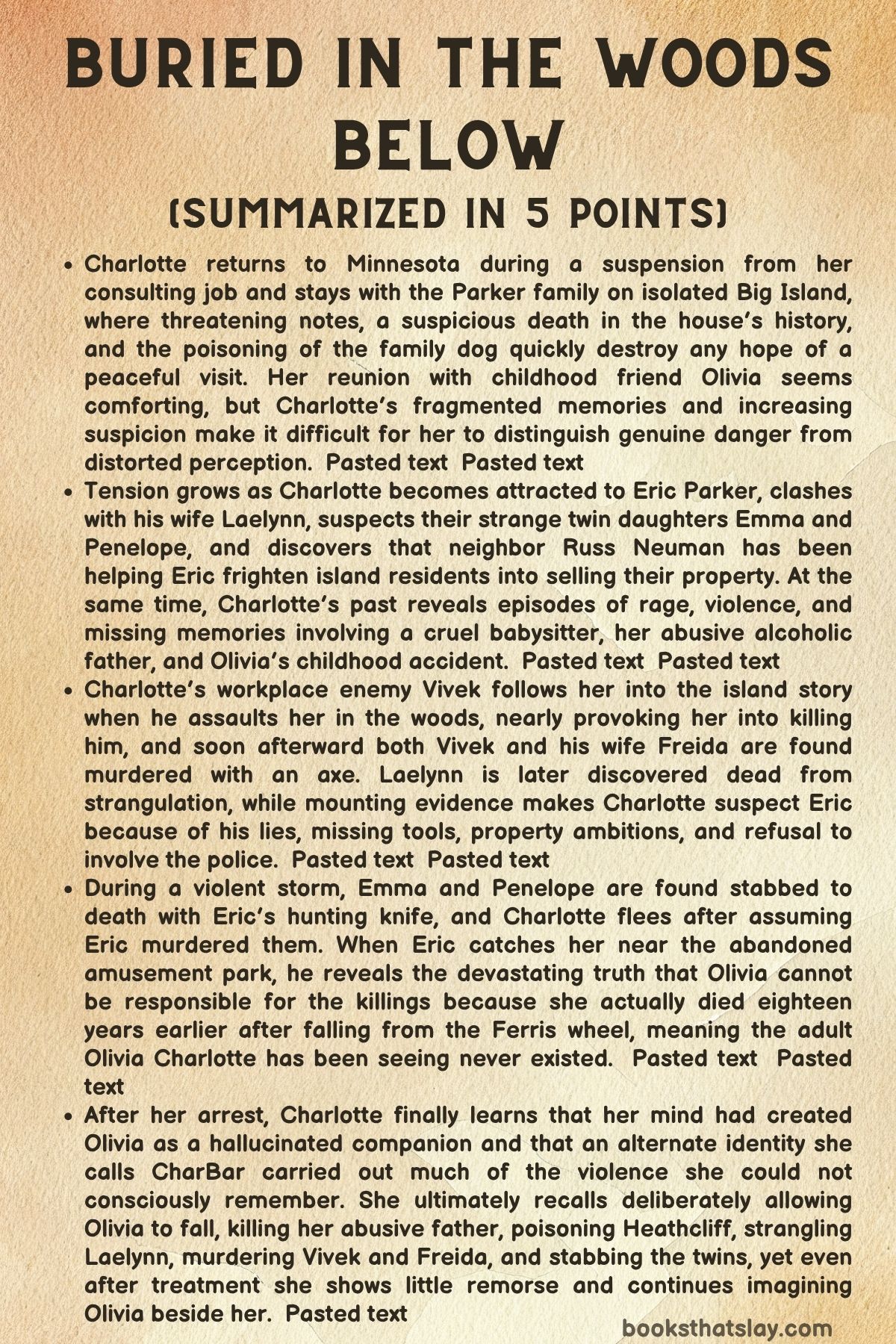
Summary
The story opens with Charlotte discovering two blood-covered bodies inside a bedroom at the Parker lake house. Hearing someone approaching, she flees barefoot into the woods, eventually reaching the abandoned amusement park on Big Island, where a man catches her near the ruined carousel and appears ready to kill her.
The narrative then moves back eighteen years to Charlotte’s childhood friendship with Olivia Parker. Twelve-year-old Charlotte is shy, insecure, and deeply admiring of Olivia, who possesses the confidence and popularity Charlotte wishes she had.
During a visit to the Minnesota State Fair, Olivia recklessly balances on the edge of a Ferris wheel gondola. When she slips, Charlotte reaches toward her but appears to freeze, after which her memory jumps directly to the arrival of emergency vehicles.
In adulthood, Charlotte has constructed a disciplined life as a consultant at Winthrop & Co. That stability collapses after an incident involving Vivek, an influential colleague whose confrontation with Charlotte leaves her with fragmented memories and results in both employees being suspended while the company investigates.
Charlotte sees the suspension as evidence that Winthrop is protecting a valuable senior employee rather than fully supporting her. Her mother, Julie, encourages Charlotte to use the month away from work to return to Minnesota and visit the Parker family on Big Island.
Charlotte has avoided Minnesota since Olivia’s accident because returning means confronting a past she has never properly understood. Nevertheless, after encouragement from Carlos, a bartender with whom she has developed a flirtatious relationship, Charlotte accepts the invitation.
Back in Minnesota, troubling memories of Charlotte’s father surface. He had once been loving but became increasingly unstable because of alcoholism, and even seemingly ordinary childhood experiences became overshadowed by his reckless and frightening behavior.
Charlotte’s reunion with the Parkers introduces another source of unease. Eric Parker remains charismatic and attractive, immediately reviving Charlotte’s childhood fascination with him, while his wife Laelynn treats Charlotte with unmistakable caution and restrained hostility.
The Parker house itself stands deep within Big Island’s woods, geographically isolated from ordinary life. Almost immediately, the family discovers a threatening note nailed to the door ordering them to leave, yet Eric dismisses the warning instead of involving the police.
Charlotte’s discomfort intensifies when she learns that the house once belonged to Marjorie Neuman, an elderly woman who died there from asphyxia under suspicious circumstances. Her son Russ Neuman resents the Parkers and believes property belonging to his family was unfairly acquired.
Charlotte also reunites with Olivia, who appears almost exactly as Charlotte remembers her. They quickly resume their old friendship, sharing conversations, jokes, memories, and excursions as though eighteen years have disappeared.
Olivia tells Charlotte that Big Island makes her uncomfortable and mentions strange noises and stories of ghosts connected with the abandoned amusement park. She even warns Charlotte to remain careful, reinforcing the idea that something dangerous exists beneath the Parker family’s outwardly comfortable life.
Soon the family’s Saint Bernard, Heathcliff, dies suddenly. Charlotte discovers grapes in the bedroom of Eric and Laelynn’s eight-year-old twins, Emma and Penelope, making her wonder whether the girls poisoned the dog either accidentally or deliberately.
Heathcliff’s death activates one of Charlotte’s buried memories. As a teenager, she confronted her violently alcoholic father during one of his abusive episodes, fought him while surrounded by broken glass, and regained awareness to find him dying from a severe wound caused by a broken vodka bottle.
Other memories suggest that Charlotte’s disturbing behavior began much earlier. At eight, after a babysitter named Beth locked her inside a closet, Charlotte retaliated by trapping Beth in the same space and calmly listening to her terror before eventually trying to release her.
Julie repeatedly responded to incidents from Charlotte’s childhood with the reassurance that whatever happened had been an accident and was not Charlotte’s fault. This pattern becomes crucial because Charlotte has grown accustomed to experiencing frightening events without fully accepting her responsibility for them.
Meanwhile, Big Island becomes increasingly threatening. Russ warns Charlotte that terrible things happen inside the Parker house, while Eric’s obsession with purchasing island property raises questions about whether the conflict is more than a simple disagreement between neighbors.
Charlotte discovers deeds showing that Eric has acquired several properties and bought the Neuman house cheaply. An antique fortune-telling machine in Eric’s collection produces a message warning Charlotte that someone she trusts is not what they seem, perfectly matching her growing suspicion of nearly everyone.
The danger also follows Charlotte from work. Vivek owns property nearby, and after Charlotte confronts him, he portrays her as an obsessed woman stalking him rather than acknowledging her accusations against him.
When Charlotte later encounters Vivek in the woods, he forcibly kisses her. Charlotte violently fights him off with a branch and then threatens him with Eric’s hunting knife, coming disturbingly close to killing him before the thought of Vivek’s wife, Freida, makes her stop.
Russ witnesses the scene, leaving Charlotte vulnerable if Vivek makes further accusations. More troubling to Charlotte, however, is the pleasure and power she briefly experiences while standing over him with the knife.
Charlotte’s attraction to Eric simultaneously becomes harder to control. With Laelynn temporarily away on a retreat, Charlotte and Eric spend more time together, though Eric rejects Charlotte when she attempts to kiss him because he remains married.
The twins contribute to Charlotte’s growing instability by telling disturbing ghost stories and later staging appearances by a dark-haired girl outside Charlotte’s room. When Charlotte discovers their prank, their laughter triggers intense rage connected to memories of childhood humiliation.
Before Charlotte can leave the island, Detective Gonzalez arrives with shocking news. Vivek and Freida have been murdered with an axe, immediately placing Charlotte under suspicion because of her history with Vivek and her recent confrontation with him.
Julie also appears suspicious because she had confronted the couple shortly before their deaths. Charlotte becomes alarmed when Julie rapidly contacts the same family attorney who assisted during previous crises, suggesting that her mother knows how dangerous Charlotte’s circumstances may become.
At the Parker house, another clue emerges: the axe normally kept at Eric’s woodpile is gone. Eric further unsettles Charlotte by declaring that some people deserve to die, causing her to consider him as a possible murderer.
Charlotte finally decides to escape Big Island, but Eric’s boat fails during an approaching storm. While walking with him near the shore, she sees a body floating in the water and realizes that it is Laelynn.
Rope marks around Laelynn’s neck prove that she was strangled. The discovery means she never safely reached the retreat as everyone believed and that the murderer has been operating close to the Parker family.
A violent storm cuts the house off from outside help. Olivia reacts to her mother’s death with an unsettling desire for revenge, while Charlotte notices that Olivia’s bedroom contains almost no evidence that anyone has actually been living there.
Russ then arrives and confesses that he wrote the threatening notes, but his explanation shifts suspicion toward Eric. Russ claims Eric hired him to frighten Big Island residents so they would sell their land cheaply and even ordered Russ to threaten the Parker house to make the family appear victimized.
Charlotte realizes that Eric’s refusal to contact the police now has an explanation. His property scheme makes him dishonest and manipulative, though it does not necessarily prove he committed the murders.
When Eric carries Laelynn’s body back to the house and places it inside a basement freezer, Charlotte mentally connects him with every suspicious detail. Eric handles ropes, uses an axe, desires surrounding properties, and has now locked the house against the storm.
Charlotte believes she may be trapped with a murderer. Yet other evidence continues pointing in conflicting directions because Russ, Eric, the twins, Olivia, Julie, and even Charlotte herself have all behaved suspiciously.
During the night, Charlotte awakens after hearing a scream and discovers Eric’s hunting knife missing. She enters the twins’ bedroom and finds Emma and Penelope brutally stabbed, with the missing hunting knife lodged in one child’s body.
Eric approaches carrying another knife, and Charlotte immediately concludes that he killed his daughters. She grabs the murder weapon, attacks him, and runs into the storm, recreating the opening sequence as Eric pursues her through the woods toward the abandoned amusement park.
When Eric finally catches Charlotte, each believes the other murdered Emma and Penelope. Charlotte desperately decides that Olivia must be responsible, remembering Olivia’s hostility toward the Parker family and her disturbing reactions to previous deaths.
Eric’s response changes everything. He tells Charlotte that Olivia could not have murdered anyone because Olivia died eighteen years earlier after falling from the Ferris wheel at the State Fair.
Charlotte refuses to believe him because she remembers speaking with Olivia, canoeing with her, sleeping beside her, and seeing her record documentary footage. Eric explains that nobody else has interacted with Olivia because she has never actually been on Big Island.
When Charlotte demands to know who murdered the twins, Eric silently indicates Charlotte. She then notices blood covering herself and scratches on her skin that resemble marks made by small fingernails during a desperate struggle.
After losing consciousness, Charlotte awakens surrounded by police and remains convinced that Eric and Olivia have framed her. Even when officers arrest her, she believes she can see Olivia hiding nearby and filming events.
In jail, attorney Tom Kim explains that Charlotte’s pajamas are saturated with the twins’ blood and that biological evidence beneath their fingernails will probably match the scratches on Charlotte’s body. He also produces Olivia’s death certificate, confirming that she died eighteen years earlier.
Julie finally enters and once again begins repeating the familiar assurance that she will fix everything. Her words unlock memories that Charlotte has spent most of her life refusing to integrate, connecting Olivia’s fall, her father’s death, and the murders on Big Island.
Six months later, psychiatric treatment has provided Charlotte with a clearer understanding of what occurred. She has been diagnosed with dissociative identity disorder and identifies the violent, assertive part of herself as CharBar, while Olivia was a hallucinated companion created around the guilt and trauma of Olivia’s death.
Charlotte finally remembers that she intentionally allowed Olivia to fall because she resented always living in her friend’s shadow. She later killed her abusive father during their violent confrontation, while Julie protected Charlotte and repeatedly taught her to understand catastrophic events as accidents rather than actions for which she carried responsibility.
On Big Island, CharBar poisoned Heathcliff with grapes, strangled Laelynn because Charlotte desired Eric, murdered Vivek and Freida with the missing axe, and stabbed Emma and Penelope after becoming enraged by their pranks and mockery.
The final revelation does not produce complete moral awakening. Charlotte acknowledges what happened but continues to treat violence as an efficient means of removing obstacles and remains romantically obsessed with Eric.
Even more disturbingly, Olivia still appears to Charlotte across the prison yard. Charlotte and her imagined friend wave to one another, showing that although Charlotte now knows much of the truth, knowledge alone has not restored a stable boundary between memory, fantasy, guilt, and reality.
Characters
Charlotte
Charlotte is the psychological center of Buried in the Woods Below, and almost everything the reader initially accepts as reality is filtered through her damaged perception. She presents herself as intelligent, organized, independent, and professionally successful, using routines, work, and analytical thinking to maintain control over a mind shaped by trauma and suppressed violence.
Her great contradiction is that she is exceptionally skilled at questioning other people’s motives while remaining almost incapable of accurately examining her own. Whenever something disturbing occurs, Charlotte immediately searches for external suspects because she has spent most of her life being protected from the possibility that she herself might be responsible.
Her memory gaps are therefore more than ordinary forgetfulness. They allow Charlotte to maintain a moral identity that cannot coexist with the actions committed by CharBar, while hallucinating Olivia provides companionship and emotional validation when reality becomes threatening.
Charlotte’s feelings toward others often contain resentment beneath affection. She loves Olivia but envies her, wants Eric while resenting Laelynn’s presence, fears Vivek while experiencing satisfaction in hurting him, and becomes furious when the twins humiliate her.
The ending makes Charlotte especially unsettling because recognition does not produce genuine remorse. She comes to understand her actions intellectually while continuing to view people as problems that can sometimes be permanently removed, leaving her self-awareness far ahead of her moral transformation.
Olivia Parker
Olivia occupies one of the strangest positions in Buried in the Woods Below because the adult Olivia experienced throughout most of the novel does not physically exist. She is a psychological creation shaped from Charlotte’s childhood memories, guilt, longing, jealousy, and need for reassurance.
As a child, Olivia is everything Charlotte believes she is not: beautiful, daring, socially confident, funny, and seemingly fearless. Charlotte adores her, but that admiration gradually becomes inseparable from resentment because Olivia constantly reminds Charlotte of her own insecurity.
The Ferris wheel incident exposes the dangerous side of that resentment. Charlotte does not merely fail to save Olivia; she eventually remembers deliberately allowing her to fall, turning Olivia’s death into the foundational secret around which much of Charlotte’s later psychological fragmentation develops.
The imagined adult Olivia functions almost like Charlotte’s ideal companion. She listens without condemning, questions institutions Charlotte distrusts, supports her anger toward Vivek, and encourages her when Charlotte feels threatened.
Yet hallucinated Olivia also becomes increasingly cold as the murders continue. Because she is produced by Charlotte’s mind, her disturbing comments reveal emotions Charlotte cannot consciously acknowledge, making Olivia both a comforting presence and an indirect expression of Charlotte’s hidden hostility.
Eric Parker
Eric serves as one of the most effective sources of misdirection in Buried in the Woods Below because he genuinely has serious secrets. His friendliness, charm, domestic talents, and emotional warmth coexist with manipulative behavior connected to his obsession with controlling property on Big Island.
Charlotte idealizes Eric partly because of her childhood crush and partly because he represents a kind of stable paternal masculinity absent from her own home. Her attraction makes it difficult for her to judge him objectively, especially once Laelynn leaves and Charlotte begins imagining a closer relationship.
Eric’s arrangement with Russ proves that Charlotte is correct to distrust him in some respects. He is willing to frighten neighbors with fabricated threats so he can acquire property cheaply, showing ambition, entitlement, and a willingness to manipulate vulnerable people.
Those faults nevertheless differ greatly from murder. Eric’s grief over Laelynn and his daughters reveals genuine attachment, while his pursuit of Charlotte through the storm results from his belief that she has slaughtered his children.
Eric is therefore morally compromised without being the killer Charlotte imagines. His real wrongdoing helps conceal Charlotte’s crimes because the truth about his property scheme makes the false conclusion about murder appear plausible.
Julie
Julie is one of the most consequential characters in Buried in the Woods Below because her maternal protectiveness gradually becomes a force that damages Charlotte rather than saving her. She loves her daughter intensely and repeatedly acts immediately whenever Charlotte is threatened, whether by her father, Winthrop, Vivek, or the police.
The problem lies in how Julie defines protection. Instead of teaching Charlotte to face difficult truths, Julie responds to childhood catastrophes by minimizing responsibility and repeatedly telling Charlotte that terrible events were accidents.
That pattern gives Charlotte emotional shelter in the short term but contributes to her inability to integrate guilt, violence, and memory. Julie effectively becomes an external reinforcement mechanism for Charlotte’s denial, assuring her daughter that consequences can always be controlled afterward.
Her intervention in Charlotte’s professional conflict reflects the same instinct. Even when Charlotte explicitly asks to handle matters independently, Julie contacts Winthrop leadership because she cannot tolerate remaining passive when Charlotte appears vulnerable.
Julie is therefore neither an uncaring mother nor a simple accomplice. She is a loving parent whose fear of losing her daughter becomes so powerful that she repeatedly chooses concealment over accountability, helping Charlotte survive individual crises while making her larger psychological collapse increasingly likely.
Laelynn Parker
Laelynn initially appears in Buried in the Woods Below as an obstacle to Charlotte’s comfort. She is controlling, severe, suspicious of Charlotte, highly protective of her children, and unwilling to dismiss potential threats as casually as Eric does.
Because events are filtered through Charlotte, Laelynn’s hostility initially seems excessive. Her sharp response when Charlotte nearly gives Heathcliff a grape, her anger over leaving the twins unsupervised, and her discomfort with Charlotte’s presence make her easy for both Charlotte and the reader to dislike.
Later developments make those responses more understandable. Laelynn senses danger even when she cannot identify its exact source, and her insistence on involving police regarding the threatening notes proves more sensible than Eric’s secrecy.
Her marriage is also strained by Eric’s obsession with Big Island property. She appears increasingly frustrated by his refusal to admit mistakes and by the atmosphere his ambitions have created around the family.
Charlotte eventually murders Laelynn because she views her as the primary barrier between herself and Eric. This revelation recasts their relationship tragically: Laelynn’s distrust was directed toward the very person who would eventually kill her.
Emma and Penelope Parker
Emma and Penelope initially seem deliberately sinister because Charlotte interprets nearly everything about them through suspicion. Their synchronized behavior, antique dolls, ghost songs, fascination with frightening stories, and unsettling comments make them appear connected to the deaths surrounding the house.
Their differences are nevertheless important. Penelope is more assertive and provocative, while Emma tends to be quieter and more observant, showing that they are individual children beneath the eerie image Charlotte constructs around them.
The twins genuinely behave badly at times. They stage ghost sightings, frighten Charlotte for amusement, tease her about Eric, and collect information they can use against her.
Their actions remain childish mischief rather than evidence of murderous intent. Charlotte’s unstable perception transforms their games into signs of supernatural or criminal danger, allowing her escalating anger to appear justified inside her own mind.
Their deaths reveal the full horror of Charlotte’s loss of control. When they mock and frighten her, CharBar responds not according to the scale of their behavior but according to the accumulated emotional force of Charlotte’s childhood experiences of bullying and humiliation.
Vivek Adwani
Vivek is a genuine antagonist whose behavior complicates the larger mystery because Charlotte’s fear of him is not imaginary. He benefits from status and professional influence at Winthrop, while Charlotte believes that the company is treating her complaints cautiously because Vivek is financially valuable.
His most disturbing characteristic is his ability to reverse accusations. He tells Freida and others that Charlotte is unstable and obsessed with him, effectively constructing a competing version of reality in which he is the victim.
The confrontation in the woods confirms that Charlotte’s fear has legitimate grounds when Vivek forcibly kisses her. Charlotte’s violent resistance is therefore initially an act of self-defense, although the intensity of her desire to continue hurting him reveals a separate danger within herself.
Vivek’s murder is especially significant because it becomes easy to imagine several possible killers. Charlotte, Julie, Eric, and even Russ appear capable of having reasons to harm him, which allows Charlotte’s responsibility to remain concealed.
Freida Adwani
Freida is one of the most innocent victims in the story. Her friendliness toward Charlotte reveals that she accepts the version of events Vivek has given her and genuinely believes that her husband was attacked by an unstable colleague.
That ignorance makes her death particularly cruel. Whatever Vivek has done, Freida has no meaningful involvement in Charlotte’s conflict with him and becomes collateral damage when CharBar murders the couple.
Freida also briefly influences Charlotte during the forest confrontation. When Charlotte considers killing Vivek, imagining Freida as the person who would suffer from his death helps Charlotte temporarily regain control.
Her later murder demonstrates how dramatically that control fails. The woman who once helped Charlotte stop herself from killing Vivek eventually dies beside him.
Russ Neuman
Russ is constructed to appear dangerous long before his true role becomes clear. His eccentric manner, hostility toward the Parkers, presence around the abandoned amusement park, knowledge of local deaths, and repeated warnings all encourage Charlotte to consider him capable of violence.
He is guilty of participating in intimidation, but not for the reason Charlotte assumes. Russ admits that Eric recruited him to create threatening notes designed to scare property owners into selling.
His involvement makes him morally compromised while also turning him into a useful source of truth. By revealing Eric’s scheme, Russ exposes the hidden financial conflict underlying much of the tension on Big Island.
Russ also witnesses Charlotte threatening Vivek with a knife, placing him closer to the truth about her capacity for violence than most characters. His warnings sound increasingly prophetic because he recognizes that something about the Parker property and the people surrounding it has become dangerous.
Carlos
Carlos represents the possibility of a normal adult relationship for Charlotte. He is attractive, affectionate, observant, and willing to travel to Minnesota because he believes Charlotte genuinely wants him there.
Unlike Charlotte’s fascination with Eric, her connection with Carlos exists in the present rather than being built upon childhood longing. That makes him potentially healthier for her, but Charlotte repeatedly pushes him away as her obsession with Eric and Big Island intensifies.
Carlos also notices that Charlotte’s behavior does not make sense. Her invitation, cancellation, anger at his unexpected arrival, and jealousy over Kenzie reveal contradictions that he recognizes even when Charlotte avoids confronting them.
His continued concern after the murders shows loyalty without the controlling protectiveness displayed by Julie. Carlos offers Charlotte an escape from the island, but by then she is too psychologically entangled in events to simply leave.
Charlotte’s Father
Charlotte’s father is essential to understanding the relationship between trauma and violence in her development. Her earliest memories of him include affection and companionship, but alcoholism gradually transforms him into an unpredictable and abusive presence.
His behavior teaches Charlotte that intimacy can shift suddenly into danger. The railroad incident, drunken outbursts, verbal cruelty, physical assault, and eventual attempt to strangle Charlotte create an environment in which violence becomes closely connected with survival.
Charlotte kills him during a brutal confrontation using a broken vodka bottle. Although the act occurs while she is being attacked, her fragmented memory and Julie’s later handling of the death prevent Charlotte from processing what actually happened.
His influence therefore continues long after his death. Charlotte repeatedly associates present anger with the violent emotional state she experienced around him, making his abuse part of the psychological foundation from which CharBar later emerges.
Beth
Beth appears only through childhood memory, yet her encounter with Charlotte provides important evidence that Charlotte’s disturbing psychological patterns began before her father’s death. Beth is dismissive and cruel toward the young Charlotte, eventually locking her inside a dark closet during an argument.
Charlotte’s reaction changes from terror to calculated retaliation. After being released, she tricks Beth into entering the closet, locks her inside, and listens while the older girl becomes increasingly frightened.
The incident matters because Charlotte experiences unusual calm while controlling Beth’s fear. It suggests that the assertive and punitive side later identified as CharBar already existed as a psychological response to humiliation and helplessness.
Julie’s reaction is equally significant. By emphasizing accident and reassurance rather than forcing Charlotte to confront her deliberate retaliation, she establishes the pattern through which Charlotte learns to separate herself from responsibility.
Tim Colby
Tim Colby represents the institutional caution of Winthrop & Co. He recognizes Charlotte’s successful career and strong professional record but still suspends both Charlotte and Vivek while the company investigates their confrontation.
From a corporate standpoint, Tim presents the action as neutral procedure. From Charlotte’s perspective, however, the equal treatment of both employees ignores the difference between the person making an accusation and the powerful employee she accuses.
His role is relatively limited, but he helps establish Charlotte’s growing distrust of systems that claim neutrality. That distrust later makes her more inclined to believe conspiratorial explanations when police and lawyers refuse to accept her version of events.
Tom Kim
Tom Kim is the family attorney who appears once Charlotte’s situation becomes impossible for Julie to manage privately. His long connection with the family implies that he has previously helped them through serious crises.
Unlike Julie, Tom eventually confronts Charlotte with evidence rather than reassurance. He explains the forensic case against her and produces Olivia’s death certificate when Charlotte insists that Olivia is alive.
His calm presentation of facts becomes one of the strongest external challenges to Charlotte’s constructed reality. Charlotte initially responds by absorbing Tom into her conspiracy theory, showing how difficult it has become for any factual evidence to penetrate her defensive system.
Heathcliff
Although Heathcliff is an animal rather than a human character, his role has major narrative importance. His death is the first unmistakable act of killing after Charlotte arrives at the Parker house and marks the point where threatening atmosphere becomes physical violence.
Charlotte initially considers several explanations for his poisoning, especially after finding grapes in the twins’ room. The suspicion directed at Emma and Penelope illustrates how quickly she projects responsibility outward.
The eventual truth is much darker. Charlotte herself poisons Heathcliff because she feels humiliated and irritated by him, showing that CharBar does not require a major threat before responding violently.
Heathcliff’s death therefore operates as an early warning of the scale of Charlotte’s psychological danger. What seems like a minor mystery is actually the first present-day evidence that the murderer Charlotte is searching for is already beside her at every moment.
Themes
Memory, Denial, and the Construction of Reality
Memory in Buried in the Woods Below is not presented as a reliable record of experience but as something that can be edited by fear, guilt, repetition, and psychological need. Charlotte’s entire adult identity depends on incomplete memories whose missing sections prevent her from recognizing herself as capable of deliberate violence.
The clearest example is Olivia’s death. Charlotte initially remembers reaching toward Olivia and freezing, while everything afterward disappears behind ambulance lights; only much later does she remember that resentment influenced her decision not to save her friend.
Julie strengthens this distorted reality through repetition. By continually telling Charlotte that incidents were accidents and that she was not responsible, Julie gives her daughter a ready-made interpretation that can replace unbearable memories.
The hallucinated adult Olivia represents the most extreme result of this process. Charlotte’s mind does not simply erase the fact that Olivia died but creates an ongoing relationship detailed enough to include conversations, canoe trips, jokes, filming, emotional support, and shared nights.
This theme makes the mystery dependent on perception rather than hidden evidence alone. Charlotte is capable of carefully investigating everyone around her while unknowingly excluding herself from suspicion because the version of reality she experiences has been designed to preserve that exclusion.
Responsibility and the Damage Caused by Protection
Julie’s instinct to protect Charlotte begins as an understandable expression of maternal love, yet the story repeatedly shows that protection becomes dangerous when it eliminates accountability. Every time Julie reassures Charlotte that something terrible was an accident, she reduces the immediate psychological pain while also preventing Charlotte from developing an honest relationship with her own actions.
That pattern matters because Charlotte learns that responsibility can be transferred away from herself. If an event becomes emotionally unbearable, it can be reclassified as an accident, misunderstood as someone else’s fault, or mentally removed altogether.
The same structure continues in adulthood. Charlotte wants Julie to stop intervening in her professional life, but Julie contacts Winthrop leadership anyway and later rapidly secures legal assistance when murder investigators become interested in Charlotte.
The irony is that Julie genuinely believes she is helping. She repeatedly responds to danger with action, money, influence, reassurance, and concealment because allowing Charlotte to face consequences feels to her like abandonment.
The novel therefore separates love from healthy responsibility. A person can care deeply for someone while still harming them through excessive protection, especially when protection teaches that painful truths should be escaped rather than understood.
Jealousy, Resentment, and the Desire to Remove Obstacles
Charlotte’s violence often grows from emotions that initially appear ordinary: jealousy, embarrassment, romantic longing, anger, and resentment. The frightening element is not the existence of those feelings but the way CharBar converts them into a belief that unwanted people are obstacles whose removal can solve a problem.
Olivia becomes the earliest example. Charlotte loves her best friend, yet years of feeling inferior beneath Olivia’s confidence and beauty produce resentment powerful enough to affect what Charlotte does during the Ferris wheel accident.
A similar pattern appears with Laelynn. Charlotte desires Eric and increasingly imagines that Laelynn is the person preventing that relationship, allowing resentment toward Eric’s wife to become homicidal justification.
The twins trigger a different form of humiliation. Their ghost prank and mockery reactivate Charlotte’s memories of childhood bullying, and their behavior becomes emotionally connected to years of feeling powerless and ridiculed.
Even Heathcliff becomes a target after causing irritation and embarrassment. These acts reveal that Charlotte’s hidden violence is not governed by justice but by convenience and wounded pride, making the distinction between serious threat and minor annoyance increasingly irrelevant once CharBar takes control.
Identity, Fragmentation, and the Hidden Self
The central horror of Buried in the Woods Below comes from Charlotte’s realization that the dangerous stranger she has been searching for cannot be separated from herself. Her diagnosis provides a framework for understanding CharBar as an alternate identity associated with aggression, confidence, and actions Charlotte’s ordinary consciousness cannot accept.
Throughout the story, Charlotte experiences moments in which anger suddenly feels stronger, colder, and strangely unfamiliar. These episodes stretch back to childhood, suggesting that psychological fragmentation developed as a response to fear, confinement, abuse, humiliation, and the need to survive situations in which ordinary Charlotte felt powerless.
CharBar possesses qualities Charlotte often believes she lacks. Where Charlotte hesitates, doubts herself, and seeks approval, CharBar acts decisively and treats violence as a direct solution.
Olivia represents a different kind of fragmentation. Rather than containing Charlotte’s aggression, the imagined Olivia provides companionship, affirmation, and an external voice through which Charlotte can express thoughts she cannot consciously claim as her own.
The ending refuses to present diagnosis as immediate recovery. Charlotte understands far more about her mind than before, yet she continues idealizing Eric, rationalizing murder, and seeing Olivia, showing that recognizing a divided identity is only the beginning of confronting what that division has allowed her to escape.