Call Off the Dark Summary, Characters and Themes
Call Off the Dark by Hallie Shepherd is a psychological horror novel about grief, guilt, isolation, and the dangerous forms that longing can take. At its center is Helen, a widow who has never recovered from the violent murder of her first husband, Tyler, and who has tried to escape the past by marrying Wade and retreating into an isolated off-grid life.
When Wade’s supposedly dead brother Isaac appears at their farmhouse, Helen’s unstable sense of reality begins to fracture. The story combines supernatural horror with a study of bereavement, destructive relationships, suicidal despair, desire, and the difficult choice to remain among the living.
Summary
Helen lives with her second husband, Wade, on an isolated property surrounded by Pacific Northwest wilderness. Nearly two years earlier, her first husband, Tyler, was murdered during a home invasion, and although Helen has physically survived the loss, she remains trapped inside grief, insomnia, fear, and an obsessive desire to know what Tyler was trying to tell her during his final moments.
Her life with Wade was supposed to represent escape. They abandoned Seattle for an off-grid existence involving gardens, wood fires, handmade clothing, limited electricity, rare trips into town, and almost no contact with the outside world, but Helen has gradually realized that the life she once viewed as romantic now feels restrictive.
Wade controls most transportation and seems increasingly comfortable deciding when Helen may leave the property. Helen performs domestic responsibilities she dislikes while privately recognizing that she married Wade only three months after meeting him, at a time when trauma had made her desperate for anything that might remove her from the places associated with Tyler.
Helen’s memories reveal how different her relationship with Tyler had been. They met at work, developed an immediate emotional and physical connection, and built a marriage based not merely on attraction but on friendship, humor, curiosity, and an ability to understand each other during difficult periods.
Their marriage was imperfect. Helen once suffered severe depression and career burnout that left her emotionally detached from Tyler and uncertain whether she still loved him, but rather than controlling her or demanding that she return to her former self, Tyler tried to understand the source of her unhappiness. Eventually Helen recognized that she hated the life circumstances surrounding their marriage rather than Tyler himself, and their closeness returned.
Everything changed when a masked intruder entered their apartment. Tyler was stabbed while protecting Helen, and although Helen desperately tried to keep him alive, she had to leave the bedroom long enough to retrieve a phone and call emergency services.
Before she left, Tyler began saying that he needed to tell her something. When she returned, he was dead. Helen subsequently became consumed by the belief that she had missed an essential final message, turning those unfinished words into another source of guilt.
The killer, Jack Franklin, was eventually identified. Learning that the attack was random freed Helen from one fear—that she had accidentally caused Tyler’s death by leaving the apartment unlocked—but it redirected her pain into rage.
When Franklin accepted a plea agreement rather than receiving the punishment Helen wanted, she planned to murder him outside the courthouse. She came close enough to aim a gun at him but froze after seeing his uncovered face and recognizing him as an ordinary human being rather than the masked monster preserved in her memory.
Helen escaped without firing and eventually discarded the gun. Soon afterward, Wade’s promise of a remote life seemed like an opportunity to abandon Seattle, Tyler’s murder, and her own unstable behavior.
In the present, however, grief remains stronger than distance. Helen begins attempting to communicate with Tyler through poetry, candles, photographs, and private rituals. During one desperate moment she presses Wade’s revolver against her head and nearly kills herself, stopping only because she imagines Tyler would be disappointed.
Angry that the dead will not answer her, Helen fires three shots into the sky. After the third shot, a raven falls from above with an inexplicably violent impact. Helen buries it, but the event marks the beginning of increasingly strange occurrences.
Soon afterward, a stranger arrives at the farmhouse and introduces himself as Isaac, Wade’s brother. Helen is immediately confused because Wade always claimed to be an only child, yet Isaac resembles him, knows details about his life, and behaves as though a difficult family estrangement explains his absence.
Wade’s reaction destroys that explanation. Rather than surprise or anger, he responds with terror because Isaac, according to Wade, has been dead for years.
Wade explains that the brothers grew up in an abusive household where their father normalized violence and forced competition between them. Their relationship became filled with resentment, jealousy, guilt, and physical conflict.
Years earlier, Wade and Isaac argued while working around farm machinery. Wade restarted a tractor while Isaac was dangerously close to its blades, and Isaac was pulled beneath the machine. Wade insists that he witnessed injuries no person could survive, attended Isaac’s funeral, watched him be buried, sold the farm, and fled Oregon afterward.
Helen assumes trauma has damaged Wade’s memory because Isaac appears completely physical. He eats, sleeps, talks, carries scars, touches objects, and possesses a large healed injury that could seemingly explain how Wade mistakenly believed him dead.
Isaac also treats Helen with an attention she has not received from Wade. He reads poetry, listens to her thoughts, notices her unhappiness, and recognizes how completely isolation has trapped her inside her own mind.
The attraction between them becomes increasingly intense. At the same time, Helen begins seeing disturbing apparitions, including Tyler’s bloody body, dead versions of herself, strange figures inside the house, and impossible movements of books and objects.
She cannot determine whether the visions are supernatural or symptoms of the bereavement hallucinations she experienced after Tyler’s death. Wade insists Isaac is responsible, but Helen increasingly suspects Wade instead.
Her suspicion grows when Isaac claims that Wade behaves normally with him while they work together away from the farmhouse. According to Isaac, Wade only performs terror in Helen’s presence, making himself appear heroic while manipulating her into remaining dependent on him.
Wade tells exactly the opposite story, insisting Isaac threatens him whenever Helen cannot hear. Each brother supplies a version of reality that makes the other appear dangerous.
Helen secretly begins crushing her old antipsychotic medication into Wade’s food because she assumes his guilt has produced a delusion. Her decision demonstrates how desperate she has become to establish control, but it also places Wade in danger because Helen is treating him without understanding what is actually happening.
Meanwhile, Isaac becomes more seductive. Helen kisses him and later sleeps with him after a terrifying encounter with wolves in the forest forces her to recognize that, despite months of suicidal thinking, she desperately wants to live when death becomes immediate.
Her sexual relationship with Isaac feels liberating because it releases desire, anger, aggression, and curiosity that Helen has suppressed for years. Yet Isaac’s behavior also becomes increasingly unsettling. He enjoys violence, speaks casually about disturbing subjects, manipulates information between Helen and Wade, and treats emotionally devastating events almost as entertainment.
Helen eventually understands that neither man offers the future she wants. Wade is controlling and incompatible with her, but Isaac is reckless, manipulative, and emotionally dangerous. She begins considering leaving them both.
Her uncertainty becomes unbearable when supernatural events intensify. A raven appears inside the farmhouse and vanishes, leaving a book of Edgar Allan Poe in its place. Helen begins wondering whether Wade, Isaac, Agnes, and perhaps everything around her are hallucinations created by her damaged mind.
Agnes, Helen’s closest nearby friend, has meanwhile investigated Isaac at Helen’s request. She brings documents proving that Isaac Farris died in the tractor accident, that Wade was investigated and cleared, and that Isaac was buried.
When Helen finally reads the documents, every rational explanation collapses. Isaac truly is dead. His unchanged facial hair, absence of bruising after Wade strikes him, immunity to medication, and other physical inconsistencies suddenly make sense.
Helen apologizes to Wade, realizing that she has been secretly medicating a man who was telling the truth. Isaac then abandons much of his friendly disguise and openly admits that he intends to kill Wade.
The farmhouse erupts into supernatural violence. Isaac controls objects, throws Wade across rooms without touching him, and turns the house itself into a weapon.
Helen refuses to stand by while another husband is murdered in front of her. She retrieves an ax and attempts to defend Wade, even though physical weapons have little effect on Isaac.
Isaac finally reveals why he appeared. Helen called him into the world.
Her desperate ritual, her demand that the dead answer, and the gunshots she fired into the darkness created an opening. Isaac responded to her invitation, attached himself to her grief, and then manipulated the fears and desires already living inside her.
Isaac reveals that many of Helen’s horrifying visions were created by him. He leads her to the human-sized grave he prepared and gives her the revolver, encouraging her to complete the suicide she has imagined repeatedly.
For a moment Helen considers it. Then Tyler appears.
Unlike Isaac’s cruel manifestations, Tyler feels safe, familiar, and unquestionably real. Helen finally asks what he was trying to tell her when he was dying, only to discover that there was never a hidden confession or secret revelation.
Tyler wanted to tell her that he loved her.
Helen realizes she has spent almost two years obsessing over unfinished words whose meaning she already knew. Tyler also makes her understand that she has allowed the worst moment of his life to overshadow the years of ordinary happiness that came before it.
He does not want her waiting for death so that they can reunite. He wants her to live, change, form new relationships, and become someone neither of them could have imagined during their marriage.
When Helen asks him to return again, Tyler refuses. His refusal becomes the final act of love she needs because remaining psychologically dependent upon visits from the dead would only continue the prison her grief created.
After Tyler disappears, Helen chooses life. She confronts Isaac and acknowledges that his arrival awakened genuine parts of her—desire, curiosity, anger, independence, and the feeling of being noticed—but she refuses to surrender herself to him.
Helen burns the Poe book and raven associated with Isaac’s influence and forces him into the flames. Isaac disappears, though the ending leaves uncertain whether he has truly been destroyed.
Helen then confronts the truth about Wade. Their shared survival cannot repair a marriage built largely from trauma, escape, dependency, and incompatible needs.
When Wade says he loves her, Helen asks whether he actually likes her. His inability to answer reveals the difference between attachment and companionship that Helen has finally learned to recognize.
She changes into Wade’s practical clothes, prepares to leave the farmhouse, and tells him that guilt over Isaac’s accidental death cannot remain the center of his identity forever. Just as Helen must stop reliving Tyler’s murder, Wade must eventually live with the past without allowing it to determine every future choice.
Helen also recognizes that Tyler’s family never abandoned her. Their continued letters represented love rather than pity, and she decides to reconnect with them.
At sunrise she leaves the property. Tyler’s name no longer repeats compulsively inside her thoughts, not because she loves him less, but because she no longer needs to summon him constantly in order to keep him present.
Agnes finds Helen walking along the road and offers her a ride. Helen decides to return to Seattle, rebuild her life, and even attend a concert with Agnes, reclaiming an experience she had previously considered impossible without Tyler.
During the drive, Isaac seems to appear once more in the back seat. Helen briefly takes his hand, acknowledging that the darkness, anger, danger, and desire he represented still exist within her.
She nevertheless understands that Tyler belongs to a future reunion that should not happen yet. Helen releases Isaac’s hand by choice, turning toward the uncertain living world rather than allowing either love or darkness from the realm of the dead to determine when her life ends.
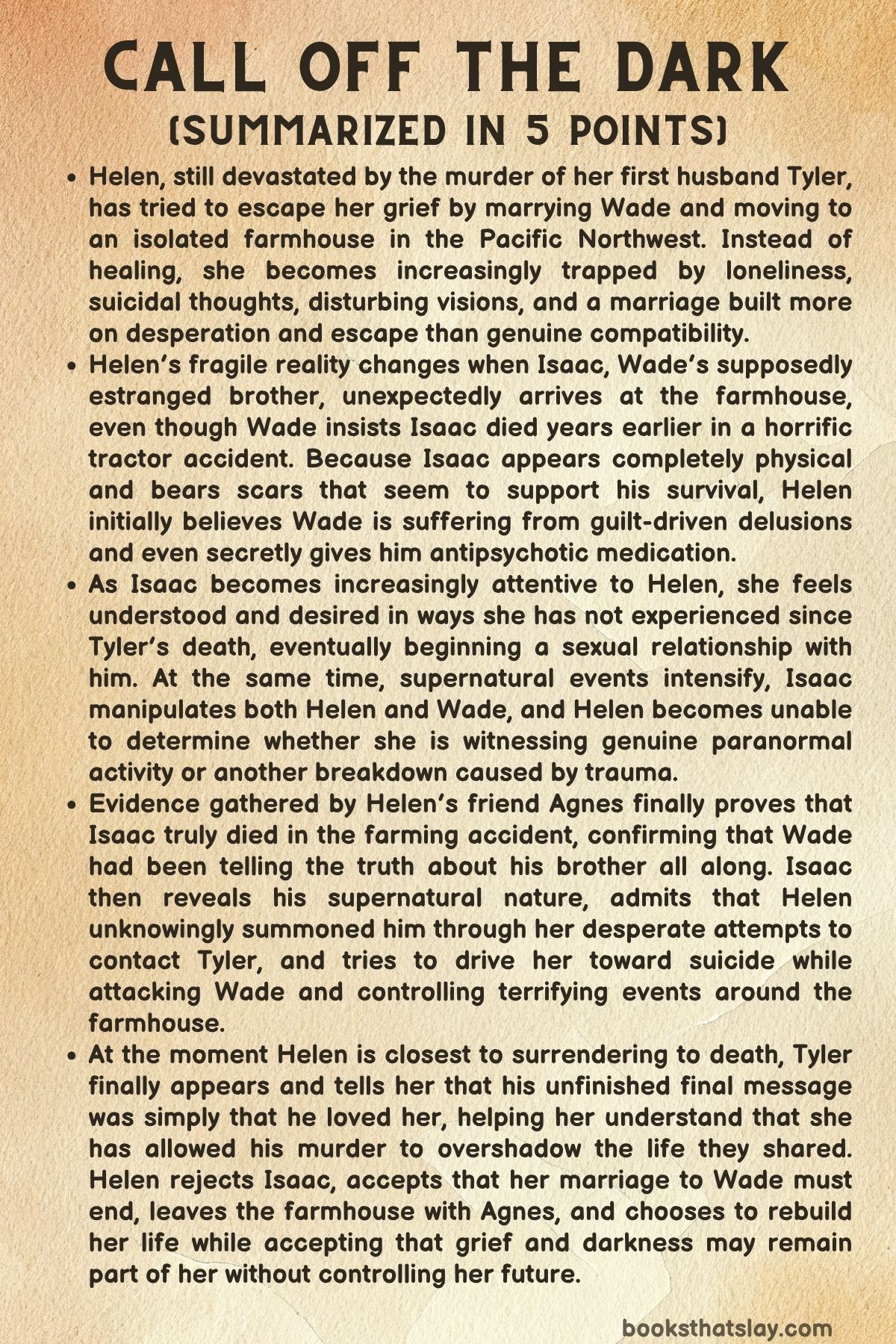
Characters
Helen
Helen is the emotional and psychological center of Call Off the Dark, and nearly every frightening event is filtered through her uncertainty about whether she can trust her own perceptions. Tyler’s murder has left her suffering from insomnia, intrusive memories, hallucinations, suicidal thoughts, guilt, anger, and a compulsive need to reconstruct the past.
Her most damaging belief is that Tyler died carrying some essential final message that she failed to hear. That missing sentence becomes symbolic of everything grief refuses to resolve, allowing Helen to imagine that understanding one unfinished moment might somehow make his death bearable.
Helen’s marriage to Wade begins as an attempt to escape rather than a genuine movement toward a new future. She mistakes isolation for healing and Wade’s decisiveness for security, only gradually recognizing that the farmhouse has reduced her world until she depends on him for transportation, social contact, and much of her access to ordinary life.
Isaac initially appeals to Helen because he reverses that emotional confinement. He notices her intelligence, responds to her interest in poetry, recognizes her loneliness, awakens her sexuality, and encourages qualities she has buried beneath grief and domestic routine.
Her attraction to him is therefore not simply physical infidelity. It expresses her desperate wish to feel unpredictable, curious, desired, angry, and alive again, although she eventually recognizes that liberation without responsibility can become another form of danger.
Helen’s greatest development comes when she stops treating death as the only possible reunion with Tyler. Her encounter with the wolves is especially important because an abstract wish to die disappears the moment she confronts violent death directly.
By the end of the novel, Helen does not achieve perfect psychological recovery. She instead reaches something more believable: the willingness to imagine that she may eventually become well, reconnect with others, return to ordinary pleasures, and carry Tyler’s memory without turning it into a reason to remain emotionally dead.
Tyler
Tyler represents the relationship against which nearly every other bond in Call Off the Dark is measured. His importance does not come from perfection but from the way he combines romantic love with friendship, humor, curiosity, patience, and genuine interest in Helen as a person.
The flashbacks prevent Tyler from becoming merely an idealized dead husband. His relationship with Helen contains misunderstandings, difficult family dynamics, sexual changes, emotional distance, career stress, and moments when Helen questions whether their marriage can survive.
What distinguishes Tyler is his response to those difficulties. When Helen becomes distant, he does not immediately make her unhappiness about himself; he encourages her to identify what is wrong and eventually supports her desire to change careers and imagine a different future.
His family relationships also reveal vulnerability beneath his confidence. Tyler carries anxieties about his father, stepmother Evelyn, brother Leo, and sister Gracie, and Helen often helps him respond to those tensions with greater generosity.
Tyler’s death transforms him inside Helen’s mind from a complete human being into the center of a traumatic memory. She remembers blood, the unfinished sentence, the intruder, and her inability to save him more powerfully than she remembers ordinary dinners, jokes, concerts, affection, and the quiet routines that actually formed most of their marriage.
His final appearance corrects that distortion. By telling Helen that his unfinished message was simply an expression of love, Tyler releases her from the fantasy that some unknown revelation has been waiting beyond death and reminds her that the meaning of their marriage was already present in the life they shared.
Wade
Wade is one of the most morally complicated figures in Call Off the Dark because he is simultaneously controlling, emotionally inadequate, traumatized, guilty, frightened, and capable of genuine tenderness. Helen initially sees him as strong and protective, but that strength gradually becomes indistinguishable from his belief that he should determine what is best for her.
His control appears through practical details rather than immediate cruelty. He manages transportation, leaves Helen behind during trips into town, expects her to maintain the domestic structure he prefers, dismisses parts of her emotional experience, and eventually tries physically to force her into his truck.
Yet Wade is not revealed to be the supernatural villain Helen begins imagining. His insistence that Isaac is dead is completely true, and much of his extreme behavior develops from the terror of seeing the brother whose death has shaped his life standing inside his home.
Wade’s deepest wound is guilt. He restarted the tractor too soon during an argument and caused Isaac’s death, meaning that even though the event was accidental, he has spent years wondering whether anger made him morally responsible.
His childhood explains why he struggles to process that guilt. He and Isaac were raised by a father who converted conflict into violence, encouraged competition, and forced Wade to hurt his younger brother, leaving both men without healthy ways of handling resentment.
Wade’s relationship with Helen fails not because he possesses no feelings for her but because love without emotional curiosity is insufficient. His inability to answer whether he actually likes Helen exposes how little genuine companionship exists beneath their roles as husband, wife, protector, and dependent partner.
Isaac
Isaac is the supernatural threat in Call Off the Dark, but his effectiveness comes from appearing first as a possible alternative to the life Helen hates. He arrives charming, observant, physically attractive, interested in poetry, and willing to listen to subjects Wade usually dismisses.
His ghostly nature allows him to exploit uncertainty. Because he can eat, touch, speak, display scars, and appear physically ordinary, Helen repeatedly chooses visible evidence over Wade’s apparently impossible claim that his brother was buried years earlier.
Isaac does more than deceive Helen about his identity. He studies the weaknesses already present in her marriage and encourages her to interpret every controlling action by Wade in the darkest possible way, while also manipulating Wade into greater fear and instability.
His sexual relationship with Helen reveals both his attraction to her and his moral emptiness. He helps awaken desires she has suppressed, but his fascination with pain, blood, aggression, danger, and emotional disruption shows that he experiences human boundaries very differently from Helen.
The revelation that Helen effectively summoned him gives Isaac symbolic importance beyond being a ghost. He emerges through the opening created by her suicidal despair and represents what can answer when someone demands contact with death without knowing what kind of presence might respond.
Even after Tyler helps Helen reject suicide, Isaac cannot be completely dismissed as meaningless. Helen admits that he awakened real parts of her personality, which explains why his apparent reappearance at the end still attracts her.
Her final decision to release his hand is therefore more important than simply defeating him. Helen acknowledges the darkness he represents without allowing it to govern her.
Agnes
Agnes provides one of the healthiest relationships in Call Off the Dark because her friendship with Helen is not based on possession, romance, guilt, rescue, or supernatural fascination. She simply visits, talks, jokes, listens, and offers companionship without demanding that Helen become a particular kind of person.
Helen’s written lists of subjects to discuss with Agnes reveal how starved she has become for ordinary conversation. Their friendship may appear secondary beside the dramatic relationships with Tyler, Wade, and Isaac, yet it represents exactly the kind of connection Helen needs if she is to rebuild a sustainable life.
Agnes is especially important when Helen becomes suicidal and sits outside holding an ax. Rather than trying to control or diagnose her, Agnes remains present and gives Helen the quiet companionship she asks for.
She also performs the investigation that proves Isaac is genuinely dead. By bringing external evidence into a household dominated by contradictory stories, Agnes becomes Helen’s connection to objective reality.
Her final act of giving Helen a ride toward Seattle reinforces her symbolic role. Agnes does not rescue Helen from the farmhouse; Helen has already chosen to leave, but Agnes gives that choice companionship and direction.
Evelyn
Evelyn initially appears confrontational and suspicious when Helen meets Tyler’s family. Her sharp comments reflect insecurity about her complicated position as Tyler’s stepmother and the history surrounding her relationship with his father.
Helen’s willingness to respond honestly instead of defensively changes their relationship. Once Evelyn realizes that Helen is not competing for authority over Tyler but genuinely wants a place within his family, the two women develop mutual respect.
Evelyn later becomes particularly important after Tyler’s death. She understands the depth of Helen’s marriage to Tyler and remains part of a family network that Helen mistakenly interprets as offering pity rather than continued love.
Helen’s later realization that Evelyn and the others have continued reaching toward her gives those family bonds renewed importance. Reconnecting with them means accepting that loving Tyler does not require isolating herself with his memory.
Leo
Leo, Tyler’s brother, initially appears through his drinking and the tension surrounding Tyler’s family. His behavior contributes to Tyler’s anxiety before bringing Helen home because Tyler expects disorder and conflict.
The wedding-day tsunami warning complicates the impression that Leo is merely irresponsible. His temporary disappearance causes panic, but he has actually remained behind to help a woman escape danger.
That action shows the difference between being unreliable in some parts of life and being devoid of courage or compassion. Like several supporting characters, Leo helps make Tyler’s family feel imperfect but recognizably human rather than idealized.
Gracie
Gracie is Tyler’s younger sister and plays an important role in demonstrating Helen’s ability to understand emotional situations before grief isolates her from others. When Gracie arrives with her girlfriend Adaline, Tyler initially responds from his own hurt because she had shared the relationship with others before telling him.
Helen recognizes that Gracie’s disclosure is not supposed to become a test of Tyler’s importance within the family. Her intervention helps Tyler move beyond his immediate reaction and support his sister.
The scene demonstrates the older Helen’s loss of social confidence by contrast. Before Tyler’s death, she could read difficult emotional situations clearly and help other people respond generously.
Adaline
Adaline has a relatively small role, but her presence during Helen’s introduction to Tyler’s family helps reveal the interpersonal pressures surrounding Gracie. She becomes part of a moment in which acceptance matters more than family pride.
Her relationship with Gracie also allows Helen to demonstrate her ability to protect another person’s emotional needs without turning the situation into conflict. That quality contrasts strongly with the isolated, suspicious Helen who later struggles to determine whether even the people around her are real.
Jack Franklin
Jack Franklin is the man who murders Tyler and therefore causes the trauma that reshapes Helen’s life. The randomness of his crime is especially devastating because it offers Helen no meaningful explanation, personal motive, or larger pattern she can understand.
For months, Helen mentally transforms him into an almost monstrous figure associated with the ski mask, knife, and moment of Tyler’s death. Her plan to kill him outside the courthouse gives her anger a temporary purpose when grief alone provides no reason to continue living.
Seeing Franklin without his mask interrupts that fantasy. He suddenly looks human, and Helen cannot pull the trigger, even though she remains furious about his sentence and the possibility that he may someday be released.
Franklin therefore represents the frustrating reality that justice cannot reverse loss. Killing him might satisfy vengeance, but it would not restore Tyler or answer Helen’s deeper emotional questions.
Detective Calhoun
Detective Calhoun connects Helen to the formal investigation of Tyler’s murder. He provides important information about the DNA identification of Jack Franklin and helps establish that the attack was random rather than the consequence of Helen leaving the apartment unsecured.
He also suspects Helen after her failed attempt to kill Franklin outside the courthouse. His careful questioning indicates that he understands more about her actions than she admits, but he does not immediately become another punitive force in her life.
Calhoun’s role is comparatively small, yet the facts he provides remove one version of Helen’s guilt. That matters because the novel repeatedly shows how uncertainty can become more psychologically destructive than painful truth.
Genessa
Genessa is Helen’s cousin and appears during the period when Helen is attempting to reenter ordinary social life after Tyler’s death. She is present when Helen meets Wade, indirectly connecting the darkest stage of Helen’s grief with the relationship that will eventually carry her into isolation.
Her limited role still serves an important structural purpose. Wade does not enter Helen’s life after she has healed; he meets her while she remains psychologically unstable and vulnerable to the promise of escape.
Stan
Stan is the abusive client whose demands contribute heavily to Helen’s earlier period of burnout while Tyler is alive. Helen becomes so emotionally depleted by work that the numbness spreads into her marriage and causes her to question feelings that were not actually the source of her unhappiness.
When Stan suffers cardiac arrest and is removed from her account, Helen experiences guilty relief. Her ability to admit that uncomfortable reaction to Tyler becomes a turning point because his nonjudgmental response reminds her that their marriage remains emotionally safe.
Stan therefore represents the kind of external pressure that can be mistaken for personal or romantic failure. Helen’s experience with him helps establish that she has survived a major identity crisis before, making her later belief that life after Tyler is impossible even more tragic.
Wade and Isaac’s Father
The brothers’ father is largely responsible for the violent pattern that shapes Wade and Isaac as adults. After their mother dies, he dominates the household and forces Wade to punish Isaac physically.
He also encourages the brothers to settle disagreements through fighting, teaching them that power and violence are legitimate ways to resolve emotional conflict. Those lessons survive long after childhood and help explain why affection, resentment, competition, and aggression remain inseparable in their adult relationship.
Although he is absent from the present-day events, his influence remains active through both sons. Wade reproduces control, while Isaac converts violence and psychological manipulation into entertainment and revenge.
Wade and Isaac’s Mother
The brothers’ mother exists primarily through memory and the emotional rivalry attached to her affection. Isaac appears to have received more open warmth from her, leaving Wade with feelings of rejection and resentment that continue long after her death.
Her favoritism does not explain everything that happens between the brothers, but it contributes to the emotional structure their father later makes far more destructive. The photograph of her in the farmhouse becomes one of the objects through which old family wounds return to the present.
Helen’s Parents
Helen’s parents represent a connection to ordinary security that she repeatedly pushes away. They support her after Tyler’s death, but Helen’s grief makes their concern feel restrictive because she is determined to remain close to Tyler’s belongings, memories, and eventually the apartment where he died.
They are also uneasy about how quickly she marries Wade. Although they do not prevent the marriage, their discomfort suggests that people outside Helen’s trauma can see dangers she is not yet prepared to acknowledge.
By the end, Helen intends to contact them after leaving the farmhouse. Returning to that relationship is part of her larger decision to stop treating isolation as strength.
Themes
Grief, Memory, and the Refusal to Let the Dead Go
Grief in Call Off the Dark becomes destructive when memory stops functioning as a connection to the past and becomes a substitute for living in the present. Helen does not simply remember Tyler; she reorganizes her entire identity around the circumstances of his death.
The unfinished sentence Tyler attempted to speak becomes the clearest example. Helen assumes those missing words must contain something extraordinary because accepting that she will never hear them feels intolerable, and this uncertainty keeps the final minutes of Tyler’s life permanently active in her imagination.
Her fixation gradually distorts the marriage she is trying to preserve through memory. Tyler becomes increasingly associated with blood, helplessness, the masked intruder, and Helen’s guilt rather than with the countless ordinary experiences that made their relationship meaningful.
Tyler’s final appearance reverses that process. His message is not a secret capable of explaining death but the simple declaration of love Helen already understood from years of shared life.
The revelation teaches Helen that mourning Tyler does not require eternal psychological proximity to the moment he died. She can remember him without repeatedly recreating his murder.
His refusal to promise another visitation is equally important. Genuine love from the dead does not ask Helen to remain at the boundary between worlds waiting for another encounter; it directs her back toward time, relationships, uncertainty, and change.
The novel therefore separates remembering someone from building a life around their absence. Helen’s recovery begins when memory becomes something she carries rather than somewhere she lives.
Isolation, Control, and the False Promise of Escape
Helen initially imagines that geographic escape can solve psychological pain. Seattle contains Tyler’s apartment, his murder, the courthouse, Jack Franklin, familiar streets, and countless ordinary places that have become unbearable, so Wade’s remote property appears to offer the possibility of beginning again.
The problem is that isolation removes not only reminders of trauma but also the relationships and experiences that might help Helen develop a new identity. Her world narrows until conversations with Agnes become rare events she prepares for in advance.
Wade’s control grows inside this environment because practical dependence can easily become personal dependence. He controls transportation, decides when town trips occur, expects Helen to organize her daily life around domestic work, and interprets his own preferences as reasonable structures she should accept.
Helen participates in creating the situation because she once wanted someone else to make the world smaller and safer. What begins as voluntary retreat therefore becomes difficult to distinguish from confinement.
Isaac initially appears to offer the opposite possibility because he brings unpredictability, attention, sexuality, and rebellion into the farmhouse. Yet his form of freedom is also deceptive because he manipulates Helen rather than respecting her autonomy.
Helen’s eventual escape requires rejecting both models. She does not choose Wade’s controlled safety or Isaac’s destructive freedom; she chooses the uncertain road back toward other people.
Choosing Life in the Presence of Darkness
Death appears throughout Call Off the Dark not only as an event but as an imagined solution. Helen repeatedly considers suicide because she believes death might end grief, reunite her with Tyler, or release her from a life that feels empty.
Her ideas about dying remain strangely abstract until the encounter with the wolves. When actual predators surround her and death becomes immediate, physical, painful, and beyond her control, Helen discovers a fierce desire to survive.
That instinct does not instantly cure her despair, but it exposes an important division inside her. One part wants suffering to stop, while another still wants experience, sensation, curiosity, relationships, and possibility.
Isaac recognizes this divided nature and deliberately appeals to the darker half. He offers danger, sexuality, violence, revenge, emotional intensity, and eventually suicide itself, presenting destruction as a form of liberation.
Tyler represents the opposite response to death. Although Helen desperately wants him to invite her toward reunion, he refuses and tells her that their eventual reunion belongs to another time.
The ending does not require Helen to deny darkness. Her brief contact with Isaac in the car suggests that dangerous impulses, grief, anger, and fascination with death may remain part of her.
Her victory lies in agency. She can touch that darkness without surrendering to it, recognize it without romanticizing it, and release Isaac’s hand because remaining alive has become her own decision.
Love, Friendship, and the Difference Between Attachment and Compatibility
The novel repeatedly asks whether loving someone is enough to sustain a relationship. Helen loves Tyler deeply, but what makes their marriage durable before his death is not emotion alone; they genuinely enjoy each other, remain curious about one another, communicate through difficult periods, and repeatedly recover their friendship.
Wade offers a very different form of attachment. He cares about Helen, worries about her safety, and ultimately risks himself during Isaac’s attack, yet his marriage lacks the mutual curiosity and companionship Helen once experienced.
His affection frequently expresses itself through authority. Because Wade thinks of himself as protector and provider, he often assumes that protecting Helen gives him the right to decide for her.
The decisive conversation comes after Isaac is defeated. Wade tells Helen that he loves her, but Helen asks whether he likes her, forcing attention away from duty and attachment toward friendship.
Wade cannot meaningfully answer because the two entered marriage while each needed something the other symbolized. Helen needed escape and stability, while Wade wanted a partner willing to inhabit his isolated vision of domestic life.
Isaac offers another incomplete version of connection. He sees qualities in Helen that Wade ignores and awakens genuine desire, yet fascination is not the same as care, and intensity is not the same as emotional safety.
Helen ultimately refuses to judge relationships only by how strongly they make her feel. Her future begins with quieter bonds—Agnes, her parents, Tyler’s family, and eventually unknown people—where connection can exist without captivity, worship, or destruction.