The Emperor’s Enemy Summary, Characters and Themes
The Emperor’s Enemy by Jasmine Mas is a dark fantasy centered on war, magical power, political deception, grief, and a dangerously obsessive bond between two people raised on opposite sides of an old conflict.
Zora Ravenal begins as a fiercely independent Northerner determined to defend ordinary people from the Draconis Empire, while Emperor Aleksander represents the immortal ruling power she has been taught to hate. What initially appears to be a story of captivity and manipulation gradually reveals several overlapping schemes in which both sides misunderstand how much the other knows. At its center is Zora’s refusal to surrender her freedom, even when love, magic, duty, and survival pull her toward competing loyalties.
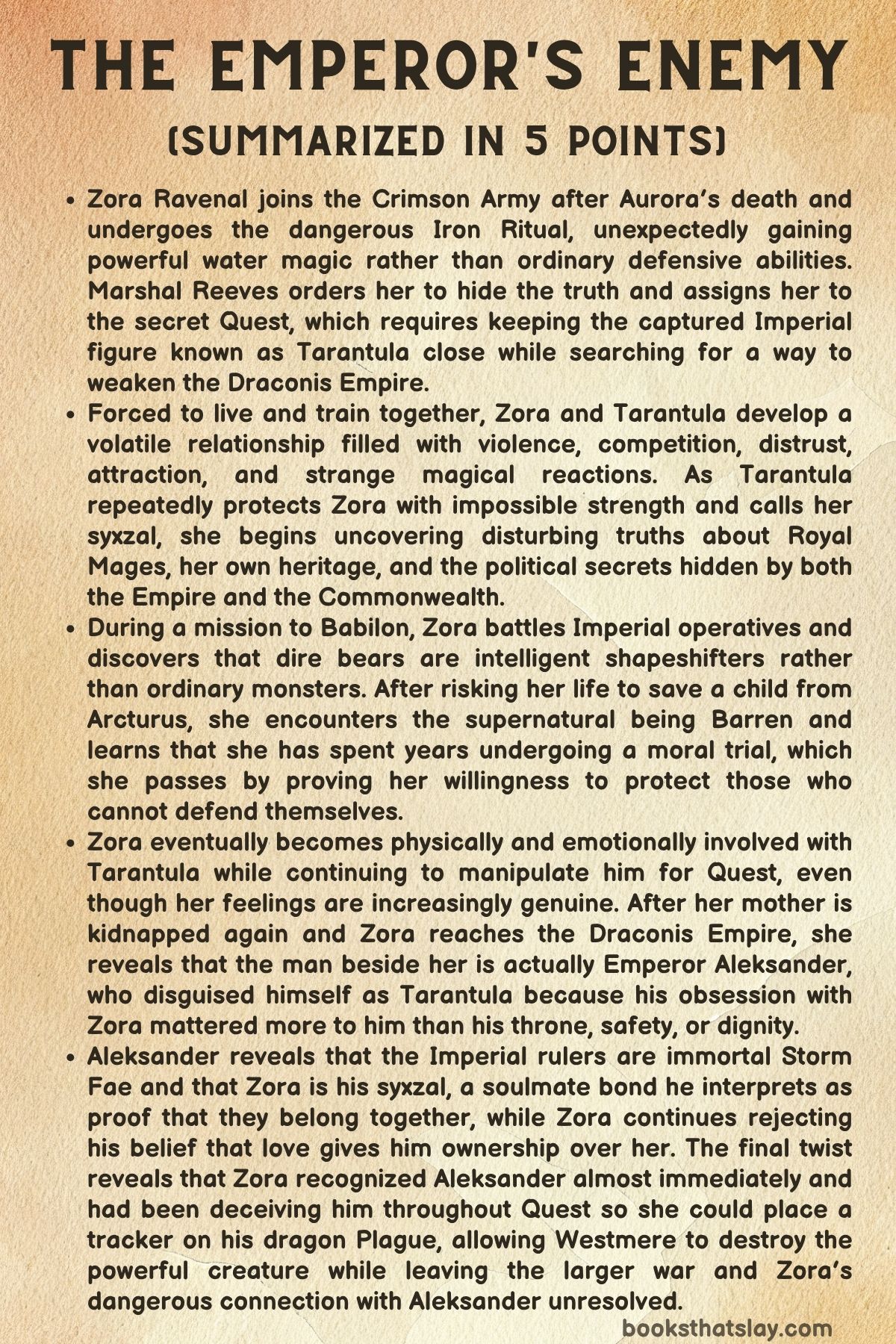
Summary
Zora Ravenal’s story is framed from the beginning by the suggestion that her life is being observed by forces far beyond ordinary politics. When she is ten years old, a mysterious council evaluates her violent instincts, fierce morality, lack of formal education, and willingness to endanger herself for what she believes is right, eventually deciding that she is suitable for an unknown test.
Years later, Zora has become a recruit in Westmere’s Crimson Army, driven by hatred of the Draconis Empire and by her determination to protect the impoverished Northern Commune. During a training run, she saves another recruit named Kane from a dire scorpion despite his earlier mockery, proving that her moral decisions are guided more by instinct than personal affection.
Her life changes after she volunteers for the Iron Ritual, an almost fatal procedure in which her blood is replaced with magically enhanced blood. The ritual is expected to turn her into a Knight Mage, but when Marshal Kalen Reeves secretly tests her afterward, Zora does something far more extraordinary: instead of merely defending herself against storm magic, she controls water.
That discovery means Zora has somehow become a Royal Mage, the kind of powerful magical being associated with the Empire rather than the Commonwealth. Marshal Reeves orders her to conceal this ability and introduces a secret operation called Quest, explaining that the captured Imperial figure known as Tarantula must remain close to Zora so that she can eventually use him to reach a far more valuable target.
Publicly, Zora is celebrated as a newly created Knight Mage and as the Northern hero who captured Tarantula. Privately, she is forced to live and train with the prisoner, whose arrogance, immense magical strength, and apparent immunity to ordinary limitations immediately make him terrifying.
Their relationship is built on mutual threats. Tarantula uses wind magic against Zora and her friends, while Zora controls the dial attached to his shock collar, yet neither possesses the straightforward power over the other that their situation suggests.
The story also returns to Zora’s earlier encounters with Emperor Aleksander. At fifteen, she meets the young prince near the Northern Commune, where his interest in her becomes disturbingly intense after he tastes her blood, and two years later he notices her again during an Imperial assault on the North.
Aleksander’s fascination remains incomprehensible to Zora, but she never responds with submission. Her defining desire is freedom, and his assumption that he can eventually claim her creates a conflict that becomes much larger than personal attraction.
Zora’s hatred of the Empire becomes deeply personal when her mother is kidnapped as part of a trap. She rushes into the Barren Forest to save her, only to discover that the true strategy was to draw her away while Aleksander’s forces seized Aurora, the person Zora loves like family.
Aurora is killed, and Zora retaliates against Tarantula with brutal determination. Although she wounds him badly and captures him, his strange ability to survive catastrophic injuries convinces her that Royal Mages are not what she has been taught to believe.
After bringing him south, Zora continues the hidden Quest while struggling with grief. Living beside Tarantula complicates everything because their hostility gradually develops into attraction, and physical contact between them causes unusual magical reactions that neither fully explains.
The greater problem is that Tarantula repeatedly behaves in ways that contradict the monster Zora expects. He can be cruel, possessive, and terrifyingly violent, yet he also protects her with extreme determination, tends her wounds, reacts emotionally to threats against her, and repeatedly chooses proximity to her even when doing so causes him pain.
Zora meanwhile becomes suspicious of her own government. Portraits of supposedly elected Marshals reveal suspicious family similarities, secret symbols appear around the military base, and the Commonwealth increasingly seems less democratic than its propaganda claims.
Her faith in both political systems begins to fracture. The Empire is unquestionably oppressive, but Westmere also hides information, manipulates public perception, and asks Zora to sacrifice parts of herself for strategic objectives.
The conflict intensifies when Imperial Royal Mages attack near Zora’s home. Tarantula demonstrates power far beyond what his restraints should permit and nearly loses control when Zora is buried beneath an avalanche, tearing the attackers apart after rescuing her.
During the crisis, he repeatedly calls her syxzal, a word connected with fate, duty, honor, and an inescapable bond. Zora does not yet understand what it means, but his reaction makes clear that his obsession with her is not merely physical desire.
Zora’s mission later takes her, Tarantula, Axel, and Ella to Babilon to eliminate Imperial operatives. There, the cultural differences of the southern Commonwealth expose Zora to another world, while public celebrations of the “Bear of the North” make her uncomfortable with being turned into a political symbol.
In Babilon, she also learns that dire bears are intelligent shapeshifters rather than ordinary animals. This revelation changes her understanding of the childhood attack that scarred her and prepares her for a far larger discovery about her own history.
While hunting the spy Sibrain Cortz, Zora nearly dies from suffocation magic before Tarantula intervenes and kills him with horrifying efficiency. His fascination with her blood, strange physical characteristics, supernatural resilience, and glowing magical markings strengthen Zora’s suspicion that he is not simply a human Mage.
The group later confronts Arcturus, who transforms into a dire bear. When the creature threatens a child, Zora sacrifices her own safety, fights him underwater with her concealed water powers, and kills him.
At the edge of death, Zora encounters the mysterious being who has appeared during her previous near-death experiences. The entity identifies itself as Barren and reveals that Zora was marked at ten years old and has been undergoing a moral trial ever since.
Her willingness to risk her life for a helpless child completes that test. She becomes a Keeper of the Barren Forest, a protector charged with defending those who cannot defend themselves, and learns that Barren rather than simple luck saved her during her childhood encounter with the dire bear.
Back at the military base, Zora deliberately intensifies her attempts to manipulate Tarantula. Their emotional and physical attraction has become genuine, but she repeatedly reminds herself that Quest demands deception and that Aurora’s death can never be ignored.
Tarantula finally admits that his hunger and emotional fixation are entirely centered on Zora. Their relationship becomes intimate, and his behavior reveals a reverence that sharply contrasts with his arrogance and violence.
For Zora, this closeness is dangerous because she is no longer pretending to desire him. She nevertheless chooses the mission, striking him and preparing to continue Quest even though betraying him causes genuine emotional pain.
Before she can complete the next stage, she learns that her mother has again been kidnapped by the Empire. Emperor Aleksander demands that Zora come to Port Crow, and Marshal Reeves tells her that the operation has reached its decisive point.
Zora travels toward the coast, where Tarantula eventually catches up with her. Although furious about her betrayal, he continues protecting her, and both are captured aboard an Imperial vessel that carries them across the Moor Ocean.
Their journey produces one of their most honest conversations. Tarantula admits that he no longer wants their relationship to be defined by hatred and asks Zora to imagine the possibility that they could someday stand on the same side.
When the ship reaches Azote, however, the apparent structure of their relationship collapses. Zora confronts the man she has known as Tarantula and reveals the clues connecting him to Emperor Aleksander.
The prisoner is not Tarantula at all. He is Aleksander himself, disguised as his subordinate and deliberately living beside Zora while allowing her to believe that his magical power had been restricted.
Aleksander admits that the collar, captivity, humiliation, injuries, and apparent vulnerability were largely part of his own strategy. His purpose was never simply escape; he wanted proximity to Zora.
Zora finally reveals her water magic openly and battles him. Aleksander then exposes an even greater secret: the Imperial ruling class are not human Royal Mages but immortal Storm Fae whose ancestors were once treated as gods.
His worldview is openly supremacist. He considers humans lesser beings and believes Imperial domination is justified by the natural superiority of his species, while Zora rejects the idea that power gives anyone the right to own others.
Aleksander later chains himself to Zora and takes her onto his dragon, Plague, believing that he has finally secured her. He also admits that some attacks against Zora occurred without his approval, including the bounty placed on her and actions committed by the real Tarantula.
Zora, however, has been working toward a different victory. She secretly attaches the Commonwealth’s tracking device to Plague, allowing one of Westmere’s final high-speed missiles to lock onto the dragon.
Aleksander chooses to fall with Zora rather than save himself by returning to Plague. The missile destroys the dragon, devastating him and apparently completing the objective toward which Quest has been moving.
The final revelation completely changes the meaning of much of Zora’s earlier behavior. She had recognized Aleksander almost immediately after surviving the Iron Ritual and had secretly informed Marshal Reeves that the prisoner pretending to be Tarantula was actually the Emperor.
Quest was therefore a counter-deception. Marshal Reeves understood that Aleksander’s fixation on Zora could provide access to Plague, one of the Empire’s most valuable military assets, and Zora agreed to maintain his disguise, encourage his belief that he was manipulating her, and ultimately place the tracker on the dragon.
What appeared to be Zora gradually discovering Aleksander’s identity was partly a performance designed for him. Both believed themselves to be the superior manipulator, and both knowingly accepted pain, emotional attachment, and danger to maintain their respective schemes.
The epilogue returns to Aleksander at fifteen and reveals the origin of syxzal. After observing Zora in the Barren Forest, he follows her, becomes jealous when he sees her with Blake, and eventually tastes her blood during their confrontation.
Her blood confirms that she is his syxzal, effectively his soulmate. Instead of understanding that bond as mutual responsibility, Aleksander immediately interprets it through possession, deciding that deception, suffering, and even global destruction are acceptable if they eventually give him Zora.
The revelation leaves their relationship unresolved. Zora has defeated a major Imperial asset without surrendering her independence, but Aleksander’s obsession remains alive, the larger Storm Wars continue, the truth of Zora’s heritage is still uncertain, and the conflict between love and freedom has become more dangerous than ever.
Characters
Zora Ravenal
Zora is the moral and emotional center of The Emperor’s Enemy, defined by a fierce instinct to protect vulnerable people even when doing so places her own life at risk. Her upbringing in the starving Northern Commune has made her practical, suspicious of privilege, physically resilient, and impatient with intellectual systems that value theory over survival.
Her morality is unusual because it is neither passive nor gentle. Zora can be violent, deceptive, reckless, and vindictive, yet she repeatedly distinguishes between aggression used for domination and aggression used to protect someone who lacks the power to fight back.
Aurora’s death gives Zora a personal reason to hate the Empire, but grief never fully destroys her capacity for independent judgment. She notices hypocrisy inside Westmere, questions the Marshal’s government, and gradually understands that opposing Aleksander does not require blindly believing Commonwealth propaganda.
Her relationship with Aleksander tests every principle she possesses. She experiences genuine desire, tenderness, anger, curiosity, and emotional dependence while still refusing his assumption that love grants ownership.
The Keeper revelation finally gives a supernatural name to something Zora has demonstrated throughout her life. Her defining quality is not magical strength but the repeated choice to place herself between danger and people who cannot defend themselves.
Emperor Aleksander
Aleksander is the central antagonist, romantic counterpart, and ideological opposite of Zora in The Emperor’s Enemy. His intelligence, magical strength, immortality, strategic patience, and capacity for disguise make him dangerous, but his greatest weakness is his inability to separate love from possession.
His decision to impersonate Tarantula demonstrates extraordinary discipline. He willingly tolerates imprisonment, electrocution, humiliation, stabbing, military surveillance, and emotional uncertainty because proximity to Zora matters more to him than ordinary Imperial dignity.
Aleksander is capable of genuine tenderness, particularly when Zora is injured or endangered, but that tenderness exists beside a deeply authoritarian worldview. He can care for her body with great attention while simultaneously refusing to recognize her right to choose a life without him.
The concept of syxzal intensifies this contradiction. Aleksander believes their bond is divinely significant, yet instead of treating fate as a reason to respect Zora more deeply, he treats it as evidence that she ultimately belongs with him.
His love therefore becomes morally dangerous because it permits almost anything. He can destroy enemies for her, endure suffering for her, and value her above political power while still being willing to manipulate nations and ruin lives in order to secure her presence.
Marshal Kalen Reeves
Marshal Reeves represents the morally ambiguous political machinery operating beneath The Emperor’s Enemy. She recognizes Zora’s unusual water magic, protects that secret, and understands almost immediately that Aleksander’s obsession can be converted into a military advantage.
Her creation of Quest shows formidable strategic intelligence. Rather than wasting the opportunity by exposing Aleksander, she constructs an operation in which Zora’s emotional importance to him becomes the route toward destroying Plague.
The Marshal nevertheless asks an enormous price from Zora. She expects a young woman grieving Aurora to live beside the man associated with that death, encourage his fixation, risk emotional intimacy, and maintain a deception that could end with torture or execution if discovered.
Her character therefore complicates Westmere’s claim to moral superiority. She fights against an authoritarian Empire, but her willingness to use Zora as a strategic instrument shows that democratic institutions can also reduce individuals to pieces on a military board.
Axel
Axel provides humor, friendship, and emotional relief within a story dominated by war and manipulation. His flamboyant personality, jokes, songs, and deliberately ridiculous behavior give Zora moments in which she can behave like a young woman among friends instead of a soldier carrying the future of Westmere.
Beneath the humor, Axel is loyal and brave. He repeatedly participates in dangerous missions, attempts to care for Zora when she is injured, and refuses to be intimidated by Aleksander even after witnessing how powerful the supposed prisoner actually is.
His interactions with Aleksander also expose the Emperor’s jealousy. Aleksander’s disproportionate reactions whenever Axel touches or assists Zora reveal how quickly his concern becomes possessiveness.
Axel therefore performs an important emotional function. He represents ordinary friendship without ownership, contrasting sharply with Aleksander’s belief that intense attachment gives him special rights over Zora.
Ella
Ella is one of Zora’s most reliable sources of companionship and practical emotional support. She comforts Zora during periods of grief, shares the dangers of military missions, and remains beside her even when Zora cannot explain the secrets governing her behavior.
Her bond with Axel gives the story another example of loyalty that does not depend on domination. Both twins care for Zora without demanding access to every hidden part of her life.
Ella is also perceptive about the instability surrounding Aleksander. She recognizes that his behavior toward Zora resembles the dangerous intensity associated with Royal Mages and understands before Zora openly admits it that their relationship has moved far beyond a simple prisoner-and-guard arrangement.
Her importance lies partly in normality. Through Ella, Zora briefly experiences friendship, shared embarrassment, physical comfort, meals, conversation, and companionship that exist outside the obsessive logic of war.
Zora’s Mother
Zora’s mother is one of the strongest influences on her daughter even though much about her remains mysterious. Her hidden journal, unfamiliar magical writing, connection to the man marked with an ouroboros, and unusual knowledge all suggest that she understands far more about Zora’s heritage than she has revealed.
Her repeated insistence that Zora is extraordinarily lucky gains new meaning after Barren explains the intervention that saved Zora as a child. What initially sounds like maternal optimism may therefore reflect concealed knowledge about the supernatural protection surrounding her daughter.
She also represents Zora’s emotional connection to the Northern Commune. Her refusal to abandon the starving North demonstrates the same stubborn attachment to home and community that defines Zora.
The repeated kidnappings of Zora’s mother show how effectively enemies can exploit Zora’s loyalty. Anyone who understands Zora knows that threatening someone she loves is one of the few reliable ways to force her into danger.
Aurora
Aurora’s death is one of the emotional foundations of The Emperor’s Enemy even though she is absent for much of the present action. She represents the personal cost of the Storm Wars and transforms Zora’s opposition to the Empire from political hostility into grief that cannot be reduced to strategy.
Zora repeatedly remembers Aurora whenever attraction to Aleksander threatens to weaken her resolve. The memory prevents intimacy from becoming an easy redemption narrative because affection cannot erase the consequences of Imperial violence.
Aurora also complicates Aleksander’s responsibility. He claims that her death was never intended and that Tarantula disobeyed him, but the distinction cannot absolve him because the kidnapping operation and larger system of violence existed under his authority.
Her absence therefore remains active within the story. Zora’s decisions about love, revenge, loyalty, and forgiveness are repeatedly measured against a person who can no longer speak for herself.
Squire
Squire, Zora’s tiny talking owl, is both companion and reminder of the unusual world surrounding her. His presence softens some of Zora’s harshest circumstances by giving her a familiar figure who remains connected to her through military training, dangerous travel, and the larger conflict.
He also reinforces Zora’s tendency to form strong attachments beyond conventional human relationships. She treats loyalty as something created through action rather than status, species, wealth, or political importance.
Unlike the powerful men and institutions seeking to direct Zora’s future, Squire does not represent control. His companionship belongs to the quieter network of relationships that help preserve Zora’s identity while larger forces attempt to turn her into a weapon, symbol, soulmate, or strategic asset.
Ryse
Ryse functions as a contrast to Aleksander’s dangerous intensity. His gentleness offers Zora the possibility of affection that does not immediately carry the weight of fate, Imperial politics, supernatural obsession, or unresolved grief.
Zora’s decision to kiss Ryse reflects her desire for something emotionally simpler. She wants proof that attraction can exist without becoming a battle for control.
Aleksander’s violent response to seeing them together reveals the limits of his supposed restraint. Rather than acknowledging Zora’s freedom to choose another person, he attacks Ryse, demonstrating that his concept of devotion remains inseparable from jealousy.
Ryse is therefore important less because he becomes a major romantic rival and more because of what Aleksander’s reaction to him reveals. His presence exposes the difference between wanting someone and accepting that the person being wanted still possesses complete agency.
Barren
Barren gives supernatural meaning to the moral structure underlying The Emperor’s Enemy. Rather than rewarding Zora for military success, magical talent, political loyalty, or obedience, Barren judges her according to what she does when someone weaker requires protection.
The long trial beginning in childhood suggests that Zora’s greatest battles have never truly been about strength. Her courage matters because she repeatedly chooses responsibility despite fear, hunger, anger, and personal danger.
When Zora sacrifices herself to save a child from the dire bear, Barren declares the test complete. The moment confirms that heroism in the story is measured by voluntary protection rather than conquest.
Barren also destroys Zora’s belief that luck alone explains her survival. By revealing that supernatural intervention has shaped parts of her life, Barren opens larger questions concerning Zora’s heritage, destiny, magical affinity, and connection to forces older than either Westmere or the Draconis Empire.
Tarantula
The real Tarantula remains a shadowy but crucial figure because much of the story’s hatred is initially attached to his identity while Aleksander is secretly wearing it. His reputation as the Emperor’s brutal right-hand man allows Aleksander to hide behind an already feared persona.
Later revelations establish that Tarantula possesses agency independent of the Emperor. Aleksander claims that Tarantula placed the bounty on Zora and was responsible for actions that exceeded or violated Imperial orders.
This distinction matters because it prevents Aleksander from being the sole source of cruelty within the Empire. The system contains powerful individuals capable of acting violently according to their own ambitions, loyalties, and interpretations of Imperial interests.
Tarantula also remains tied to Aurora’s death. Even if Aleksander did not directly command that outcome, the tragedy demonstrates the danger created when authoritarian rulers empower violent subordinates and then attempt to separate themselves from the consequences.
Plague
Plague is Aleksander’s dragon, military asset, companion, and one of the Commonwealth’s most important strategic targets. Her ability to carry Aleksander and participate in devastating attacks makes her central to the Empire’s military superiority.
For Aleksander, however, Plague is clearly more than a weapon. His devastation after the missile strike reveals emotional attachment, which makes her death a personal loss as well as a strategic defeat.
Zora’s decision to target Plague shows the harsh logic of Quest. She cannot defeat Aleksander directly, so she attacks something he values and something that materially strengthens the Empire.
Plague’s destruction also mirrors the wider tragedy of the war. Living beings repeatedly become military resources, and emotional bonds are transformed into vulnerabilities that enemies can exploit.
Blake
Blake belongs primarily to Zora’s earlier life and represents a version of adolescence that might have remained ordinary without Aleksander’s intervention. His romantic encounter with Zora beneath the bridge becomes significant because Aleksander witnesses it and experiences intense jealousy.
For Zora, Blake is not associated with destiny or supernatural ownership. Their interaction belongs to ordinary attraction and personal choice.
For Aleksander, however, Blake immediately becomes a rival because he demonstrates that Zora can desire someone outside the future Aleksander has imagined for her. His presence therefore helps establish the possessive nature of Aleksander’s fixation long before either Zora or Aleksander fully understands the syxzal bond.
Kane
Kane initially functions as an example of the prejudices Zora encounters because of her Northern upbringing and unconventional education. He mocks her background and trusts academic knowledge about the dire scorpion that proves dangerously inaccurate.
When Kane is poisoned, Zora saves him anyway. Her decision reveals that her ethics do not depend upon whether the endangered person has treated her kindly.
The incident establishes an important pattern in her character. Zora may dislike, threaten, or fight someone, yet when life and death are involved she remains capable of distinguishing personal resentment from moral responsibility.
Sibrain Cortz
Sibrain is an Imperial operative whose confrontation with Zora demonstrates the lethal danger hidden beneath the apparent glamour of Babilon. He attempts to suffocate her with wind magic while allowing her to believe she is controlling the encounter.
His defeat also reveals the terrifying scale of Aleksander’s violence while disguised as Tarantula. Aleksander does not merely stop Sibrain; he humiliates and kills him with excessive force before turning his attention immediately back to Zora.
Sibrain therefore becomes another example of the secret war operating beneath civilian life. His presence proves that both the Empire and Commonwealth are conducting covert operations far from conventional battlefields.
Arcturus
Arcturus radically changes Zora’s understanding of dire bears. His transformation proves that the creatures she once considered monstrous animals can actually be intelligent shapeshifters capable of choosing alliances and participating in political conflict.
His attack at the bathhouse forces Zora into one of her clearest acts of self-sacrifice. When a child is endangered, she places herself directly between the victim and the threat despite knowing she may die.
Killing Arcturus becomes morally complicated because Zora understands afterward that she has killed a person, not simply an animal. The encounter consequently expands the moral complexity of the war by showing how incomplete knowledge can shape judgments about who counts as human, monster, soldier, or enemy.
Moor and Glacia
Moor and Glacia belong to the mysterious council evaluating Zora from childhood. Their willingness to support her despite her aggression and lack of conventional refinement indicates that they judge potential differently from institutions such as the military.
They recognize that Zora’s apparent contradictions may be precisely what makes her useful. She is violent but protective, reckless but principled, poorly educated in formal terms but exceptionally intelligent in survival and moral decision-making.
Their early support also establishes that Zora’s life is being measured according to standards she does not yet understand. They help create the sense that her political conflict with Aleksander is only one part of a much older supernatural structure.
Themes
Freedom, Possession, and the Right to Choose
Freedom is the principle Zora protects most consistently in The Emperor’s Enemy, and this makes her relationship with Aleksander fundamentally unstable regardless of how genuine their feelings become. Aleksander believes fate has identified Zora as his syxzal, while Zora believes no supernatural bond can cancel an individual’s right to decide where she belongs.
The difference appears repeatedly in Aleksander’s behavior. He protects Zora, tends her injuries, accepts extraordinary suffering to remain near her, and appears willing to value her above his Empire, yet he also chains her, follows her, attacks perceived rivals, and assumes that enough time or pressure will eventually produce the outcome he wants.
Zora’s resistance is therefore not simply romantic reluctance. Accepting Aleksander without conditions would mean accepting his underlying idea that intense love creates entitlement.
The story repeatedly contrasts possession with voluntary loyalty. Axel, Ella, Squire, Barren, Aurora, and Zora’s mother matter to Zora because their bonds are rooted in care rather than forced ownership.
Aleksander’s tragedy is that his devotion could become meaningful if he accepted the possibility of rejection. His refusal to do so turns love into another form of empire, while Zora’s insistence on choice makes personal freedom inseparable from her larger political opposition to Imperial rule.
Deception, Manipulation, and Competing Versions of Truth
Almost every major power in the story relies on deception. The Empire uses propaganda, hidden identities, secret magical knowledge, covert operatives, and false assumptions about Royal Mages, while the Commonwealth constructs its own heroic narratives and hides uncomfortable truths about political leadership and military strategy.
Aleksander’s impersonation of Tarantula initially appears to be the dominant deception. He allows Zora to believe that he has been captured, restrained, humiliated, and gradually exposed, believing that proximity will eventually give him control over her.
The final revelation shows that Zora and Marshal Reeves have been conducting a second deception underneath his first. Zora already knows who he is and maintains his illusion because she needs him to lead her to Plague.
This creates a conflict in which knowledge itself becomes a weapon. The person who understands the opponent’s assumptions can manipulate choices without relying entirely on physical strength.
The political newspapers extend the same idea to society. Citizens receive competing narratives about who is winning, who is heroic, and which government deserves trust.
Truth becomes difficult to separate from usefulness. By making both Zora and Aleksander skilled manipulators, the story asks whether deception becomes morally acceptable when used against someone who is already deceiving others, and whether strategic necessity can excuse emotional betrayal.
Moral Responsibility and the Protection of the Vulnerable
The moral test at the center of The Emperor’s Enemy is ultimately much older than the Storm Wars. Barren has observed Zora since childhood not because of her political loyalty or magical potential but because of the choices she makes when power is unequal.
Zora repeatedly places herself in danger for people she does not need to save. She rescues Kane despite his insults, risks herself for her mother, fights for the starving North, and ultimately throws herself between a dire bear and a helpless child.
Her appointment as a Keeper confirms that moral worth is measured through action rather than reputation. Zora is violent, foul-tempered, deceptive, and capable of cruelty, yet Barren considers her worthy because her aggression repeatedly turns outward against predators rather than downward against the powerless.
This standard also exposes the moral failure of Aleksander. He may genuinely love Zora, but his willingness to dominate humans he considers inferior demonstrates that personal devotion cannot compensate for systemic cruelty.
The same problem reaches Westmere. A government fighting oppression can still behave immorally when it treats citizens as expendable resources.
The theme therefore rejects simple categories of hero and villain. What matters most is how people use power when they possess more of it than someone else.
War, Propaganda, and the Corruption of Political Systems
The Storm Wars have lasted so long that violence has become part of the identity of both societies. Zora grows up hungry in the Northern Commune, Aleksander is raised within an immortal ruling class that considers conquest natural, and nearly every young character is forced to understand life through military categories.
Propaganda helps maintain the conflict. Westmere transforms Zora into the Bear of the North and presents her capture of Tarantula as proof of Commonwealth strength, while Imperial newspapers dismiss opposing claims and portray Aleksander as permanently dominant.
Neither version gives ordinary citizens the whole truth. Zora herself becomes uncomfortable when Babilon residents celebrate an image of her that has been constructed for public morale.
Her growing suspicion of Westmere is therefore significant. The apparently democratic Commonwealth contains hidden structures, suspicious political dynasties, secret operations, and leaders willing to manipulate individuals for strategic advantage.
The Empire remains more openly oppressive because its rulers embrace hierarchy, immortality, and species superiority, but the novel refuses to make the opposing government automatically pure. Both sides justify secrecy and sacrifice by claiming that survival requires them.
War consequently corrupts not only battlefields but language, memory, relationships, and political legitimacy. As each society turns people into symbols and loved ones into strategic weaknesses, Zora’s struggle becomes a search for a moral position that belongs to neither government completely.