Empire by Sabaa Tahir Summary, Characters and Themes
Empire by Sabaa Tahir is an epic fantasy about the consequences of inherited violence, the burden of leadership, and the struggle to repair damage created long before the present generation was born.
Its central conflict begins as a war between the Kegari and the Empire, but the story gradually reveals that both societies are living with the effects of an ancient magical crime. Through Quil, S’rsha, Cero, Karinna, Ruh, Aiz, and their families, the novel examines what people owe to those they love, what rulers owe to their people, and whether redemption remains possible after terrible choices have already been made. It’s the 2nd book in the Heir Duology by the author.
Summary
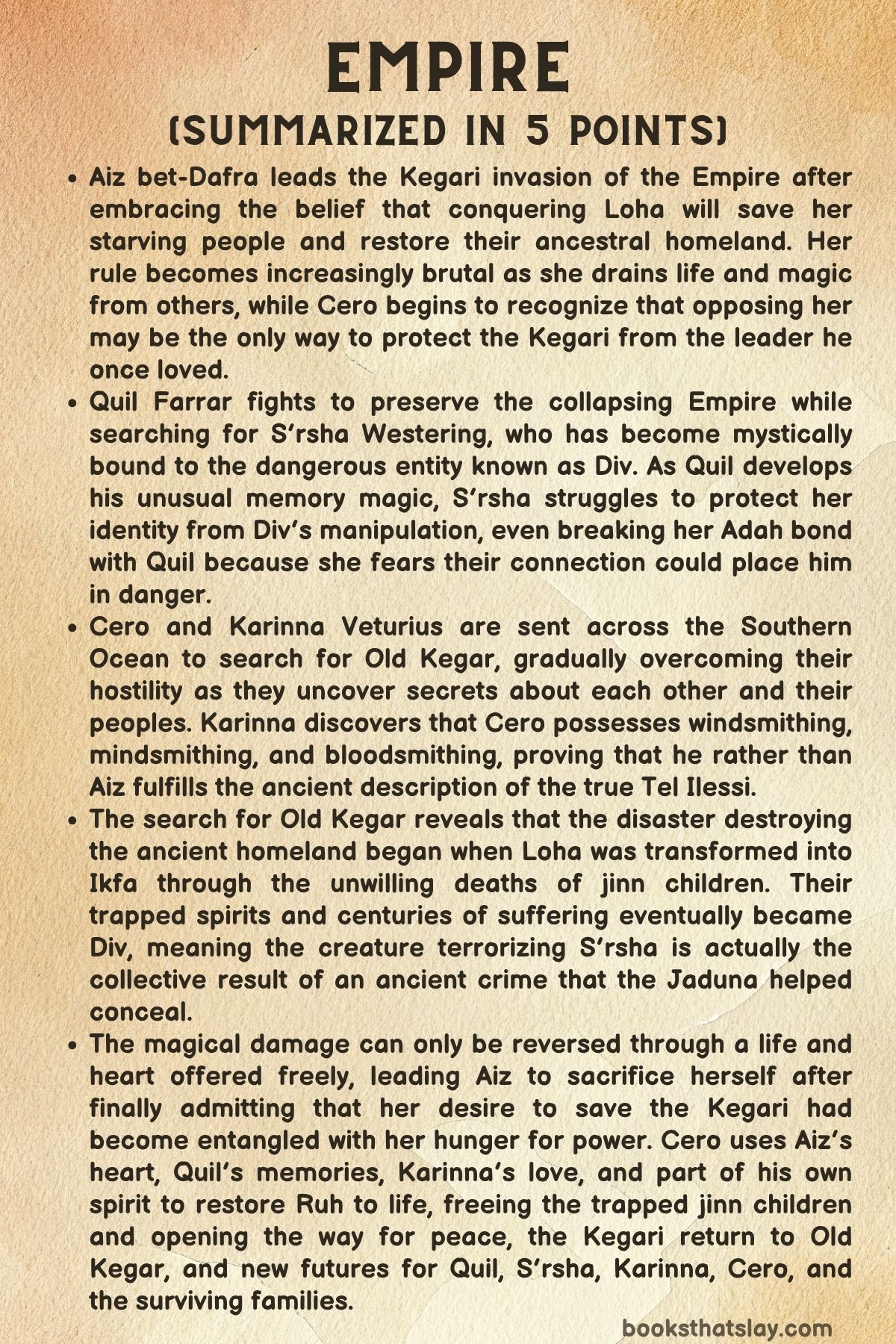
The story begins in the aftermath of Ruhyan Veturius’s murder, an event caused by Aiz bet-Dafra after she allowed the ancient entity known as Mother Div to shape her choices. Aiz had once entered the Empire under the identity Ilar of Ankana, earned the trust of Laia, Elias, their children, and Quil Farrar, then freed Div from the story that had imprisoned her.
Div tore out Ruh’s heart, strengthening Aiz and enabling the Kegari leader to return home as the self-proclaimed Tel Ilessi. Aiz then launched a war against the Empire, convinced that taking Loha would allow her starving people to reclaim their ancient homeland.
Ruh does not immediately pass into the afterlife. His grandmother, the Bani al-Mauth, discovers him in the Waiting Place, where the ancient power Mauth reveals that Ruh possesses an unusual ability to perceive possible futures.
Ruh chooses to remain rather than move on, determined to understand what happened and help the family he left behind. His new existence eventually allows him to influence dreams and guide living people toward choices whose importance they cannot yet understand.
Quil, meanwhile, is fighting beside Empress Helene as the Empire desperately tries to survive the Kegari invasion. Serra has been reclaimed, and Spiro Teluman has discovered how to forge Ikfa into weapons capable of neutralizing Kegari magic, offering the Empire one of its few realistic chances of resisting Aiz.
Quil is also consumed by uncertainty over S’rsha Westering, who disappeared after the confrontation with Div. Their Adah bond proves that she is alive, but Quil has no idea why she refuses to return to him.
S’rsha is hiding because Div has become mystically attached to her. The creature cannot act freely without her cooperation at first, yet its presence drains her strength, corrupts her tracking abilities, influences her emotions, and constantly tempts her with promises of power in exchange for human hearts.
S’rsha seeks answers from Kade and later from the Duranis, followers who regard Div as a savior. Instead of helping her, the Duranis attempt to turn her into the permanent Vessel through which Div can fully enter the world.
S’rsha escapes, but the experience shows how much Div has begun changing her. Her growing pleasure in violence frightens her, and the Adah bond with Quil becomes one of the few things capable of briefly restoring her magic to its natural state.
While S’rsha searches for Div’s weakness, Aiz’s rule grows increasingly brutal. She discovers that the separation from Div left her with the ability to drain vitality and magic from others, and she begins using that power to maintain the image of herself as the chosen Kegari savior.
Cero, once Aiz’s closest companion and protector, becomes horrified by what she is becoming. He secretly assists the Resistance and eventually tells Aiz that loving the Kegari people requires opposing her rather than obeying her.
Cero is rescued from General Ghaz by Karinna Veturius, Ruh’s fierce older sister. Karinna carries overwhelming anger and guilt over Ruh’s death, and her temper has caused others to compare her to Keris Veturia, but her father Elias taught her that inherited traits do not determine moral character.
The Resistance leader Musa assigns Karinna and Cero an extraordinary mission: cross the Southern Ocean and locate Old Kegar. If the Kegari can truly return to their ancestral homeland, there may be an alternative to endless occupation and war.
Their journey gradually changes their relationship. Karinna discovers that Cero possesses windsmithing, mindsmithing, and bloodsmithing, making him the person who actually fulfills the ancient description of the Tel Ilessi.
Cero has hidden these abilities since childhood. Years earlier, during a fire at Dafra cloister, he found Aiz apparently dead and instinctively used bloodsmithing to call her back to life, meaning the miracle that helped shape Aiz’s destiny had actually been Cero’s work.
Karinna and Cero travel through Jaduna territory searching for suppressed records about Old Kegar. They discover that the Jaduna have intentionally hidden ancient maps and historical documents and possess large quantities of Loha, despite refusing to allow others access to it.
Their suspicion grows when they learn that Jaduna magic was responsible for destroying the Empire’s newly forged Ikfa. Spiro dies because of this interference, and Quil realizes that the Jaduna have allowed others to suffer in order to protect secrets connected to their own past.
Quil therefore seeks assistance from the jinn. They teach him that his memory magic can do more than receive images: he can experience and transmit emotion, touch, love, grief, and other forms of memory stored within people.
The jinn agree that they can intervene against Div, but they give Quil a terrible choice. A wooden coin can summon them if S’rsha breaks it, yet their intervention may kill her.
Quil cannot bring himself to sacrifice S’rsha, even for the Empire. S’rsha later learns about the coin and decides that she will make the decision herself rather than force Quil to carry responsibility for her death.
Before that can happen, S’rsha is taken back to Kotama by her Jaduna family. Attempts to control Div end disastrously when the creature kills S’rsha’s sister R’zwana, leaving S’rsha burdened by grief and increasingly convinced that anyone connected to her will become a target.
Quil reaches Kotama and uses his developing memory powers to force the Raanis to experience the suffering caused by the war. His actions persuade several Jaduna leaders to help the Empire, but S’rsha then asks them to dissolve her Adah bond with Quil because she fears Div may eventually exploit it to reach him.
The bond is broken even though their love remains. S’rsha believes she is protecting Quil, but the decision also removes one of the strongest protections she possessed against Div’s corruption.
Elsewhere, Karinna and Cero finally cross the Southern Ocean and reach Old Kegar. They discover a ruined homeland poisoned by an ancient magical catastrophe and encounter the Queen of the Crossing, a mysterious figure associated with Kegari prophecy.
She confirms that Cero is the true Tel Ilessi and sends him into the Fount to experience the Ninth Sacred Tale. Karinna refuses to let him face it alone and enters with him.
The vision reveals the foundational crime connecting the Kegari and Jaduna peoples. Long ago, Loha was transformed into Ikfa through an immense act of death, poisoning Old Kegar and forcing the surviving Kegari to flee.
The victims were jinn children. Their stolen life and suffering did not disappear; their trapped spirits eventually became the collective consciousness called Div.
This revelation explains why Div has always seemed contradictory. The creature is not one wronged woman but many murdered children whose memories and pain have fused together across a thousand years.
The contamination also followed the Kegari into their new homeland, weakening their magic generation after generation. The misery Aiz believed justified conquest therefore originated partly in a crime deliberately hidden by others.
At the same time, Helene accepts a meeting with Aiz at Falcon’s Rest. The meeting becomes a battle and then a fire, with Helene remaining behind long enough to save others while Quil is forced to watch from outside the flames.
Unable to reach his aunt physically, Quil sends her his memories and love through magic. Helene returns one final memory of herself standing over the infant Quil and promising to protect him, after which Quil can no longer sense her mind and believes she has died.
S’rsha leaves camp intending to break the jinn coin herself, but Div finally succeeds in taking full control of her body. S’rsha understands too late how systematically Div has isolated her, weakened her, encouraged her to reject others, and separated her from Quil.
Using S’rsha’s body, Div breaks the coin and summons the jinn. The confrontation brings Quil, S’rsha, Cero, Karinna, Ruh’s preserved body, and the truth about Div together in the same place.
The jinn confirm that the trapped children must be freed, but undoing the ancient crime requires the opposite of the act that created it. The original transformation depended upon lives taken unwillingly, so restoring Ikfa to Loha requires a heart and life given freely out of love.
Quil, Karinna, and Cero are all prepared to sacrifice themselves. Before any can act, Aiz arrives, takes S’rsha hostage, and demands the restored Loha for herself.
Ruh finally reveals why he has been appearing to Aiz and guiding her. He has been leading her toward this moment because the heart required to repair the damage is hers.
Ruh forces Aiz to confront the truth that her campaign was never purely about saving the Kegari. Beneath her genuine concern for their suffering lay a hunger for control created by her childhood powerlessness.
Aiz finally admits this to herself. Knowing she cannot undo the people she murdered, she chooses one act that does not demand obedience, worship, or power in return and drives a blade into her own heart.
Cero receives Aiz as she dies and promises that he will remember her. He then uses bloodsmithing to place her freely offered heart inside Ruh’s preserved body.
Quil gives Ruh his memories, Karinna helps call her brother back through love and recognition, and Cero offers a piece of his own spirit founded upon hope. The magic succeeds.
Ikfa becomes silver Loha again, the ancient wound closes, and the trapped jinn children are finally released. Ruh opens his eyes and returns to life carrying Aiz’s heart.
Div disappears from S’rsha, leaving her alone inside herself for the first time in months. The war can finally move toward resolution because Cero now possesses proof that Old Kegar can be reclaimed and the authority to lead his people toward something other than conquest.
Cero assumes responsibility as the true Tel Ilessi and works with Quil, now Emperor after Helene’s apparent death, to end the occupation. Their peace must acknowledge Kegari suffering without erasing the crimes committed during the invasion.
Karinna and Cero separate despite the feelings that have developed between them. Their responsibilities seem to pull them toward different peoples and different futures, while Ruh secretly sees that their destinies remain connected.
S’rsha leaves for the Southern Isles and begins the quieter life she once dreamed about, working at an inn and bakery. She eventually realizes that freedom does not require abandoning love, and nearly a year later she returns to Quil and chooses a future with him without depending upon the old magical Adah bond.
Quil continues rebuilding the Empire and grieving Helene. At a statue dedicated to his aunt, he unexpectedly encounters signs suggesting Helene survived and deliberately chose to disappear from public life.
A mysterious message in Helene’s handwriting states, “I choose freedom.” Two years later, a scarred silver-haired woman called Mistress Harper is living anonymously as an innkeeper and baker in the Southern Isles, strongly indicating that Helene finally accepted the freedom she once urged Quil to choose.
Characters
Quil Farrar
Quil develops from an intelligent but uncertain heir into a ruler capable of combining strategy, compassion, and independent moral judgment. In Empire, his central struggle is not learning how to command armies but deciding what kind of authority he wants to represent after watching older leaders destroy themselves through unquestioning duty.
His memory magic reflects this development because it transforms personal feeling into political understanding. By allowing others to experience suffering rather than merely hearing about it, Quil discovers that empathy can become a form of power without necessarily becoming domination.
His love for S’rsha tests him repeatedly. He refuses to sacrifice her for the Empire even when the jinn present that choice as strategically reasonable, showing that he has begun rejecting the idea that rulers must automatically destroy whatever they personally value.
Helene’s apparent death completes his transition into leadership. When Quil accepts the throne, he carries her devotion with him but also understands her final lesson that loyalty must not eliminate the self.
S’rsha Westering
S’rsha is defined by resistance to control, which makes Div’s attachment to her especially cruel. She has spent much of her life fighting against Jaduna authority, exile, imposed obligations, and the expectations of other people, only to find herself sharing her body with a creature determined to erode her independence.
In Empire, her strongest quality is not physical or magical strength but the stubborn preservation of identity. Div attacks that identity through grief, isolation, temptation, manipulation, and eventually possession, making S’rsha’s survival a battle over whether pain can redefine who she is.
Her relationship with Quil also reveals her tendency to interpret love through sacrifice. She breaks the Adah bond not because her feelings vanish but because she believes hurting both of them is preferable to allowing Div access to him.
Her later decision to return to Quil is therefore important because she chooses the relationship freely rather than through magical obligation. S’rsha ends the story with greater control over her life precisely because she learns that independence and attachment do not have to be opposites.
Cero
Cero is one of the novel’s clearest examples of hidden identity becoming moral responsibility. He spends years concealing the fact that he possesses windsmithing, mindsmithing, and bloodsmithing because revealing himself as the possible Tel Ilessi would place enormous religious and political expectations upon him.
His devotion to Aiz initially prevents him from challenging her soon enough. He remembers the frightened girl he once saved and continues hoping that separating her from Div will restore the person he loved, even when evidence increasingly shows that Aiz is choosing cruelty for herself.
In Empire, Cero’s transformation occurs when loyalty to an individual gives way to loyalty to his people. His declaration that he loves the Kegari more than he loves Aiz becomes the moral foundation of his eventual leadership.
His bloodsmithing further distinguishes him from Aiz because his strongest acts of magic restore rather than consume life. He revives Aiz as a child, saves Abzi, and ultimately returns Ruh to life, making his power an expression of preservation rather than possession.
Karinna Veturius
Karinna begins as a young woman almost consumed by rage over Ruh’s murder. Her physical ability makes violence easy, while comparisons with Keris Veturia leave her afraid that anger may represent an inherited moral destiny.
Her parents give her a different interpretation of herself. Elias teaches that violent impulses do not determine character and that choices matter more than resemblance, while Laia’s fear of Karinna’s anger reveals how damaging those comparisons can become.
Karinna’s journey with Cero forces her to practice restraint, patience, trust, and curiosity. Her growing ability to communicate with animals and wights also challenges her belief that strength must always look like combat.
In Empire, Karinna becomes compelling because she never loses her fierceness; instead, she learns that fierceness requires direction. Her attraction to Cero further complicates her emotional defenses, forcing her to confront the possibility that vulnerability may demand more courage from her than battle.
Ruhyan Veturius
Ruh is simultaneously a victim, guide, manipulator, and returned child. His murder begins much of the story’s emotional conflict, yet death gives him access to knowledge and power that transform him far beyond the innocent boy his family remembers.
Mauth teaches him to perceive possible futures, and Ruh uses dreams to influence Quil, Cero, Musa, Helene, and eventually Aiz. He becomes an unseen strategist whose interventions help move separate characters toward the confrontation required to heal the ancient magical wound.
His treatment of Aiz is morally complicated. Ruh consciously exploits her guilt, loneliness, and desire to believe she remains a savior, ultimately directing her toward sacrificing the heart necessary for his resurrection.
In Empire, Ruh’s return is therefore not a restoration of childhood innocence. He comes back loving his family but carrying memories of death, suffering, vengeance, manipulation, and possibilities that he chooses not to reveal.
Aiz bet-Dafra
Aiz is one of the story’s most tragic antagonists because her original motive contains genuine compassion. She knows the hunger, humiliation, and desperation suffered by the Kegari, and her desire to give them a homeland begins as a response to real injustice.
Her corruption cannot ultimately be blamed entirely on Div. Once separated from the creature, Aiz continues choosing violence, drains life from others, kills children for power, terrorizes prisoners, and increasingly treats disagreement as betrayal.
The title of Tel Ilessi becomes essential to her identity because it transforms the powerless orphan she once was into someone others must obey. Her insistence that every atrocity serves the Kegari eventually hides the uncomfortable reality that authority itself has become something she cannot bear to surrender.
Her final sacrifice does not erase her crimes. It does, however, restore genuine choice to her character because she finally gives something without demanding worship, control, gratitude, or survival in return.
Div
Div initially appears to be a singular malicious entity capable of corrupting stories, memories, desires, and bodies. Her repeated accounts of betrayal encourage listeners to imagine an individual woman who suffered injustice and became monstrous in response.
The eventual revelation radically changes that interpretation. Div is the collective anguish of jinn children whose lives were taken to transform Loha into Ikfa, trapping their spirits inside centuries of pain.
This explains both the creature’s childlike emotional patterns and the instability of its identity. Its hunger for hearts, obsession with abandonment, contradictory stories, and attraction to wounded people all emerge from trauma that has lost its original context.
The story does not excuse Div’s later cruelty, particularly the murders and psychological torture inflicted upon S’rsha. Instead, Div demonstrates how unaddressed suffering can survive beyond the people who caused it and become destructive to generations that do not understand its source.
Helene Aquilla
Helene is shaped by a lifetime of service. Her identity as Empress, protector, warrior, aunt, and survivor has been built around the principle represented by the phrase “Loyal to the end.”
Her relationship with Quil allows her to question that principle. As she watches him become capable of ruling, Helene gradually recognizes how completely obligation has consumed her private self.
The confrontation at Falcon’s Rest seems to complete the pattern of her life because she remains in danger so that others can escape. Quil’s final memory exchange with her confirms that protecting him has been one of the deepest commitments of her adulthood.
The later evidence of her survival transforms her apparent death into something more significant. By becoming Mistress Harper and disappearing into the Southern Isles, Helene appears to choose a life that belongs to herself rather than to an empire.
Elias Veturius
Elias functions primarily as father, husband, warrior, and moral influence. Ruh’s death damages him deeply enough that he makes questionable choices, including imposing the oath that forces S’rsha to hunt the killer.
His conversations with Karinna reveal a more reflective side. Elias understands that violence can create immediate satisfaction while leaving consequences that last far beyond the moment of victory.
He refuses to define Karinna by her anger or by her resemblance to Keris. By insisting that choices determine what someone becomes, Elias gives his daughter a moral principle she repeatedly returns to when rage threatens to dominate her.
His willingness to accept S’rsha’s anger also matters. When she punches him after their reunion, he does not hide behind his grief but acknowledges that his decisions caused her real harm.
Laia of Serra
Laia’s importance extends beyond her role as mother because her earlier work as a storyteller accidentally helped preserve Div’s influence. Recording the tale created a path through which a corrupted narrative could survive for generations.
She does not defend herself when S’rsha seeks her out. Instead, Laia accepts responsibility and uses her knowledge of stories to help separate invention from truth.
Her key insight is that Div consistently imagines herself as an adult victim, even though the emotional core of the stories feels much younger. Recognizing that the original trauma involved children becomes an important step toward discovering Div’s true nature.
As a mother, Laia also struggles with Karinna. Her fear of her daughter’s anger shows how even loving parents can harm children when fear causes them to interpret personality as destiny.
Musa
Musa represents disciplined resistance and practical leadership. He understands that rebellion requires more than courage, which is why he repeatedly challenges Karinna’s impulsiveness and forces her to treat minor responsibilities as seriously as dramatic battles.
His decision to send Cero toward Old Kegar proves especially important. Rather than thinking only about defeating the Kegari militarily, Musa recognizes that ending the causes of the war may matter more than winning individual confrontations.
He also suspects that Cero possesses abilities connected to the Tel Ilessi prophecy and uses Karinna to investigate him. Although the decision contributes to tension between them, Musa’s broader judgment proves correct.
His death leaves a quieter absence than Helene’s because public recognition was never his goal. His burial reflects a man whose importance lies more in what he enabled others to accomplish than in personal glory.
R’zwana
R’zwana represents the painful family ties S’rsha lost through exile. Their relationship contains affection buried beneath resentment, duty, distance, and years of unresolved injury.
Her death is devastating because reconciliation remains unfinished. Div takes away not only S’rsha’s sister but also the possibility that the two women might have created a different relationship in the future.
This loss intensifies S’rsha’s belief that loving her places others in danger. It also makes her later willingness to reconnect with Quil more significant because she chooses attachment after experiencing what permanent separation actually costs.
Raani Sh’ban
Raani Sh’ban occupies an uneasy position between Jaduna authority and maternal concern. She participates in the society that exiled S’rsha but later chooses actions that quietly help her daughter rather than simply obeying institutional rules.
Her decision to restore Quil’s ability to sense S’rsha through the Adah coin is especially revealing. Instead of controlling her daughter directly, she gives someone who loves S’rsha the chance to reach her.
Sh’ban therefore represents a partial movement away from the rigid authority that damaged S’rsha’s childhood. Her actions cannot repair everything, but they show that family loyalty can evolve beyond obedience to tradition.
Raani U’qaya
U’qaya initially appears as a secretive Jaduna leader whose knowledge of S’rsha, Ikfa, Loha, and ancient records gives her enormous importance. She understands the seriousness of the Adah bond and provides Quil with information he cannot obtain elsewhere.
Her darker significance comes from the Jaduna effort to suppress historical truth. She possesses records connected to Old Kegar and is involved in actions meant to prevent outsiders from accessing dangerous magical knowledge.
Later revelations complicate her role further by showing her attempting to slow Ikfa contamination beneath Kegar. She is therefore not simply hiding history for selfish reasons; she is also dealing with the consequences of a disaster her people helped create.
General Ghaz
Ghaz embodies the militaristic and opportunistic side of Kegari power. He is willing to exploit Aiz politically, threatens religious figures, attacks Cero when his loyalty becomes questionable, and treats domination as a normal instrument of government.
His suggestion of marrying Aiz reveals that he sees sacred authority as something that can be converted into dynastic control. Even Aiz, despite her own growing brutality, recognizes the threat represented by his ambition.
Ghaz helps demonstrate how quickly a liberation movement can reproduce the structures of oppression it claims to oppose. His presence makes clear that removing Aiz alone would not automatically solve every problem within Kegari leadership.
Noa
Noa occupies an important moral position within the Kegari community. She remembers Cero and Aiz from their youth but eventually becomes involved in helping people harmed by the occupation.
Her cooperation with the Resistance shows that she distinguishes loyalty to the Kegari from obedience to Aiz. This distinction becomes one of the central political questions facing Cero as well.
Noa also carries knowledge connected to the Dafra cloister and the prophecy. Her early interpretation of Cero’s resurrection of Aiz as a miracle of Mother Div unintentionally helps conceal the truth about Cero’s powers.
Olnas
Olnas works alongside Noa and becomes part of the quieter opposition to Aiz’s rule. His role emphasizes that resistance exists within the Kegari population rather than being limited to Imperial enemies.
By supporting Cero’s journey toward Old Kegar, Olnas accepts the possibility that Kegari survival requires abandoning the path Aiz has chosen. His loyalty is therefore directed toward his people’s future rather than toward the regime claiming to represent them.
Kade
Kade serves as a keeper of dangerous stories and fragmented historical knowledge. His earlier exposure to Div’s tale makes him vulnerable to the creature, demonstrating how narratives themselves can become channels of magical influence.
His collection allows S’rsha and later Cero to connect scattered evidence that official histories have hidden. The discovery that “Div” may have meant “monster” rather than being a personal name becomes especially important.
Kade also illustrates the danger of possessing knowledge without protection from its psychological effects. He seeks truth, but truth in this world can carry the influence of the beings and crimes it describes.
Spiro Teluman
Spiro represents practical ingenuity in a war increasingly dominated by supernatural forces. His work with Ikfa offers the Empire a technological response to Kegari magic and briefly creates hope that conventional strategy might still matter.
His death becomes one of the clearest consequences of Jaduna secrecy. The destruction of his work is not merely a military setback but proof that powerful groups are willing to sacrifice outsiders to protect knowledge they consider forbidden.
Spiro’s fate therefore strengthens Quil’s determination to challenge political traditions that place secrecy above human life. His work fails as a weapon, yet the mystery surrounding that failure helps expose the deeper history of Loha and Ikfa.
Sufiyan
Sufiyan is one of Quil’s most dependable companions and provides emotional continuity during an increasingly unstable war. His relationship with Ruh gives Quil’s memory powers a deeply personal test when Quil shares an experience connected to the boy.
The memory forces Sufiyan to confront the ordinary moments he failed to appreciate while Ruh was alive. Through him, the story shows that grief often attaches itself not only to what happened but also to what people failed to notice beforehand.
His loyalty to Quil remains important because it is companionship rather than institutional obligation. Sufiyan stands beside Quil while still reacting honestly to the emotional cost of the prince’s choices.
Tas
Tas accompanies Quil into dangerous supernatural and political situations and remains part of the small circle surrounding the future Emperor. His presence helps reinforce the importance of chosen companions in a story where formal alliances repeatedly fail.
Although he receives less individual development than Quil or Sufiyan, Tas contributes to the sense that Quil does not become Emperor through isolation. His leadership is supported by relationships built before he possesses ultimate authority.
Arelia
Arelia combines courage with intellectual attention to magical inconsistencies. Her observation that ordinary destruction should not have reduced living Ikfa to mud becomes crucial in uncovering Jaduna interference.
She therefore contributes not only as a fighter but as someone willing to question an event others might accept as simple battlefield loss. This habit of examining how magic should behave helps Quil identify the relationship between Loha and Ikfa.
Arelia represents the value of expertise within a leadership group. Quil succeeds most often when he listens to people who notice what he does not.
Diriya
Diriya introduces Quil to the deeper nature of memory magic. She teaches him that memory exists throughout the body and emotions rather than functioning merely as stored images.
Her lessons allow Quil to develop the ability that later helps him reach Helene and persuade the Jaduna. At the same time, Diriya represents the unsettling moral distance of supernatural beings who think on scales larger than individual human lives.
The wooden coin embodies that tension. The jinn may possess the power necessary to contain Div, but their solution appears to require a sacrifice Quil cannot accept.
Mauth
Mauth represents the ancient structure underlying death, magic, and the Waiting Place. Its recognition that Ruh’s death has disrupted something fundamental establishes early that his murder is part of a much larger magical imbalance.
Rather than simply returning Ruh to life, Mauth requires him to learn within the Owa Khel. Ruh’s later ability to perceive possibilities and influence dreams grows from this education.
Mauth therefore functions less as an active ruler and more as a keeper of balances that human actions have disturbed. Its existence reminds the characters that magic operates according to consequences rather than personal intention.
The Bani al-Mauth
Ruh’s grandmother serves as his guide after death and acts as a bridge between the living world and the strange systems governing the Waiting Place. Her horror at discovering Ruh there confirms that his death has occurred outside the expected order.
She also protects information that living characters desperately want, particularly Elias and Quil. Her secrecy can feel cruel, yet it reflects the idea that knowledge about death and possible futures carries consequences when revealed too early.
Her connection with Ruh gives him emotional continuity during a period in which he might otherwise become detached from humanity. Even while learning powers beyond ordinary life, he remains someone’s grandson.
Queen of the Crossing
The Queen of the Crossing is the guardian of the Ninth Sacred Tale and the figure who finally directs Cero toward the full truth of Old Kegar. Her connection with ancient prophecy gives Cero’s name and journey an importance he had never understood.
She refuses to solve his problem through simple explanation. Instead, she requires him to enter the Fount and experience the history himself, making knowledge inseparable from the suffering that produced it.
Her statement that “Div” once meant “monster” dismantles one of the assumptions that has distorted the past. By redirecting Cero away from labels and toward history, she prepares him to become a leader grounded in truth rather than mythology.
Dolbra
Dolbra represents devotion corrupted by selective storytelling. As a leader among the Duranis, she accepts versions of Div’s history that present the creature as a wronged savior and builds religious certainty around them.
Her attempt to transform S’rsha into the Vessel demonstrates the danger of treating another person’s autonomy as expendable in service of belief. S’rsha’s suffering matters less to Dolbra than fulfilling the story she has decided must be true.
Her death during S’rsha’s escape also becomes part of S’rsha’s growing fear about Div’s influence. The moment exposes how easily righteous resistance can become pleasure in destruction when anger is being manipulated.
Themes
The Difference Between Leadership and Possession
Political authority repeatedly becomes dangerous when leaders begin treating people as extensions of their own purpose. In Empire, Aiz begins with the legitimate desire to save the Kegari from hunger, humiliation, and eventual disappearance, yet she gradually convinces herself that possessing authority over them is identical to serving them.
Her ability to drain life from others becomes the physical expression of this mistake. Instead of receiving strength through trust or freely given sacrifice, she literally takes vitality from vulnerable people and converts it into personal power.
Cero offers the clearest contrast because he possesses the abilities associated with the true Tel Ilessi but spends most of his life refusing to claim the title. When he finally accepts leadership, he does so because circumstances require him to help the Kegari confront their history, withdraw from occupied lands, and build a future in Old Kegar.
Quil undergoes a parallel transformation within the Empire. He learns from Helene’s sacrifices without copying her belief that loyalty must consume every private desire, gradually shaping a model of rule based on responsibility without total self-erasure.
The theme therefore distinguishes leadership from ownership. A ruler serves people by creating conditions in which they can survive and choose their futures, while a tyrant decides that other lives exist primarily to validate the ruler’s mission.
Trauma, Memory, and the Survival of Pain
Pain in the story does not disappear simply because the original victims die. It survives through stories, magic, family expectations, political institutions, environmental destruction, and emotional habits that later generations inherit without always knowing where those patterns began.
Div is the most extreme representation of this process. The murdered jinn children remain trapped for a thousand years, and their unresolved suffering becomes an entity capable of spreading pain far beyond the people responsible for the original crime.
Individual characters carry similar inheritances. Karinna fears that anger connects her to Keris Veturia, S’rsha carries wounds created by exile and family rejection, Aiz turns childhood powerlessness into an obsession with control, and Ruh returns from death with knowledge his family cannot understand.
Quil’s memory magic offers a different possibility. Instead of allowing memory to become a hidden force that unconsciously shapes behavior, his gift makes memory communicable, allowing people to experience another person’s fear, grief, love, and loss directly.
The novel therefore treats memory as both dangerous and necessary. Forgotten pain continues operating without explanation, but honestly remembered pain can create accountability, empathy, and the possibility of breaking cycles that secrecy allowed to continue.
Sacrifice, Consent, and the Moral Meaning of Power
The distinction between something taken and something freely given governs the deepest magical logic of Empire. The catastrophe that poisoned Old Kegar began when lives were unwillingly taken from jinn children so that living Loha could be transformed into Ikfa.
That original violation cannot be reversed through another forced death. The magic requires an opposite act: a heart offered voluntarily out of love rather than extracted through violence.
This rule gives Aiz’s final choice its meaning. Throughout most of the story she justifies taking from others because she believes their suffering can be converted into a better future for the Kegari, but her death becomes the first time she offers herself without controlling who must pay.
The same theme appears in S’rsha and Quil’s relationship. Quil refuses to deliberately sacrifice her even when supernatural beings claim her death may save countless others, while S’rsha attempts to claim control over that sacrifice by choosing it herself.
Cero’s magic also follows this moral distinction. His greatest acts involve sustaining or restoring life rather than consuming it, and Ruh’s resurrection finally requires contributions from several people who willingly give memory, hope, love, and spiritual strength.
Power is therefore not judged solely by its result. The story insists that how power is obtained, whether consent exists, and who is permitted to choose are essential parts of determining whether an act is just.
Freedom, Love, and the Right to Choose a Life
Many characters begin the story trapped by identities that other people or institutions have constructed for them. S’rsha is marked by exile and Jaduna expectations, Quil by imperial succession, Helene by absolute loyalty, Cero by prophecy, Karinna by comparisons to Keris, Ruh by his murder, and Aiz by the role of sacred savior she claims for herself.
Their different endings show that freedom does not necessarily require rejecting responsibility or relationships. Instead, freedom becomes the ability to choose those responsibilities rather than accepting them as permanent commands.
S’rsha’s decision to break the Adah bond initially treats attachment as a threat to independence. Her later return to Quil represents a more mature understanding because she can love him without needing magical certainty to determine what she owes him.
Helene’s fate gives the theme its clearest symbolic conclusion. After spending most of her life defined by the promise “Loyal to the end,” she apparently survives Falcon’s Rest, abandons imperial identity, and becomes Mistress Harper, choosing anonymity, ordinary work, friendship, and personal freedom.
Cero accepts the role he once feared because leadership becomes his choice rather than a prophecy imposed upon him. Karinna likewise learns that anger, family history, and grief may influence her but do not dictate who she must become, leaving freedom defined not as life without bonds but as the continuing ability to decide which bonds deserve to shape the future.