Mother Daughter Sister Stranger Summary, Characters and Themes
Mother Daughter Sister Stranger by Hank Phillippi Ryan is a psychological suspense novel exploring family secrets, mysterious disappearances, betrayal, and the complicated relationships between mothers, daughters, and sisters.
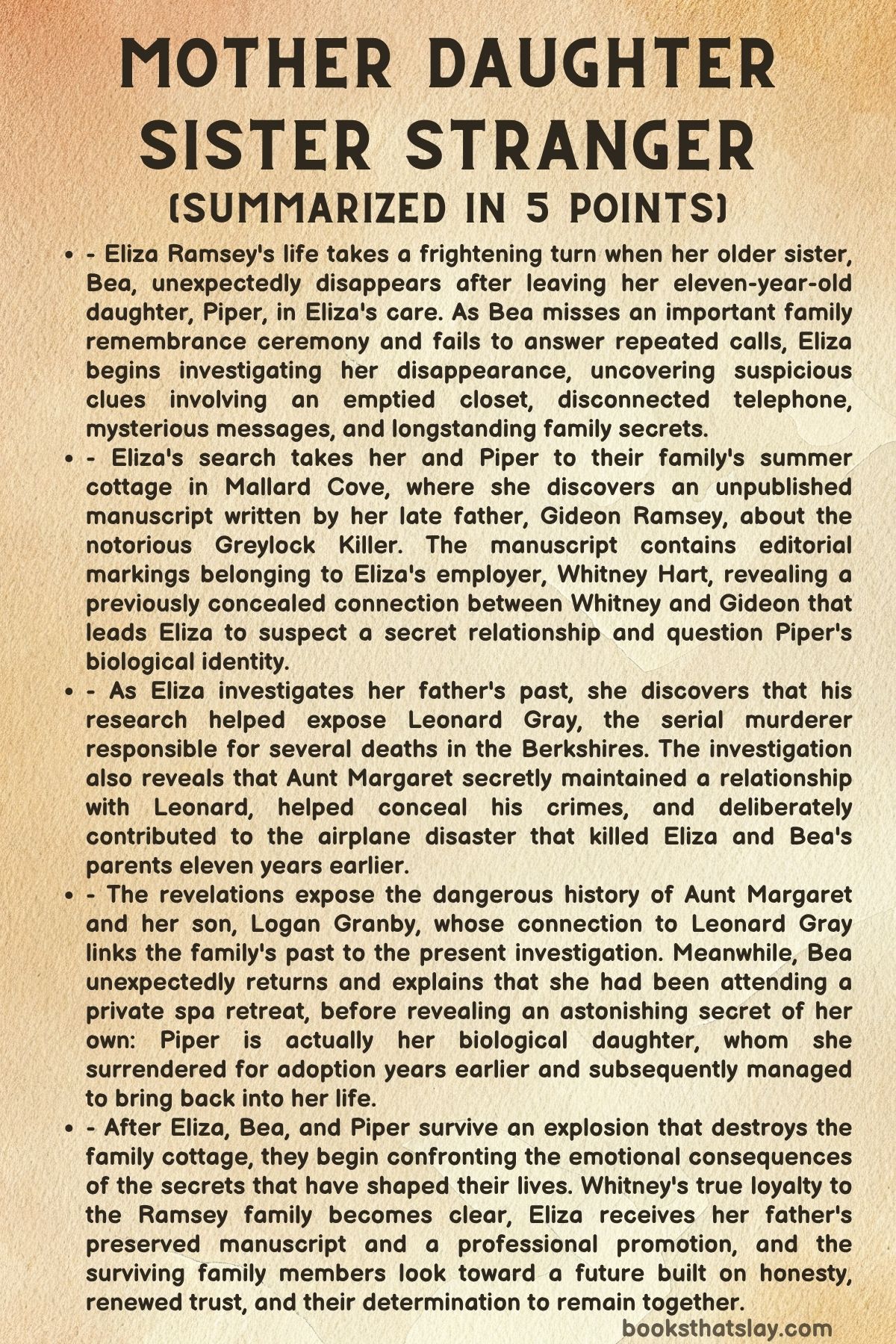
The story follows Eliza Ramsey, a Boston literary agent whose older sister suddenly vanishes, leaving her eleven-year-old daughter behind. What begins as a desperate search develops into an investigation of a tragedy that destroyed their family years earlier. Through unexpected discoveries, suspicious relationships, and long-concealed truths, the novel examines how easily trust can be manipulated and how the past continues influencing the present. It also explores the meaning of family, the responsibilities of parenthood, and the possibility of rebuilding relationships after devastating revelations.
Summary
Eliza Ramsey is a literary agent living in Boston whose carefully organized life changes when her older sister, Bea, fails to collect her eleven-year-old daughter, Piper, after a scheduled visit. Although Bea has never been particularly reliable about punctuality, her unexplained disappearance immediately troubles Eliza because she has always been deeply devoted to her daughter.
Eliza attempts to reassure Piper while repeatedly contacting Bea without success. Her concern becomes more serious when she realizes that the following day is Remembrance Day, the anniversary of the plane crash that killed their parents eleven years earlier.
The sisters established this annual tradition to honor their parents, and Bea has never missed the ceremony. Eliza finds it difficult to imagine that her sister would voluntarily abandon such an important family occasion without offering an explanation.
The tragedy remains a defining event in their lives. Their parents, Faith and Gideon Ramsey, died when their Piper Cherokee airplane crashed under mysterious circumstances, while Eliza and Bea survived.
Although authorities investigated the disaster, they never established a definitive cause. Both sisters continued suspecting that their parents’ deaths might have involved something more sinister than an ordinary aviation accident.
Meanwhile, Piper reveals that her parents have been arguing about her. Bea recently divorced Kyle Lennix, a controlling businessman whose apparent indifference toward his daughter has already disturbed Eliza.
Kyle claims to be in Japan on business and responds dismissively when Eliza asks whether he knows where Bea has gone. His unwillingness to help strengthens her suspicions that the divorce involved secrets neither former spouse has disclosed.
During the family’s cemetery visit, Eliza remembers Piper’s unexpected adoption several years earlier. Bea and Kyle introduced the girl as their daughter after completing a closed adoption without informing Eliza beforehand.
Bea insisted that Piper’s biological history was unimportant because she was already part of their family. Nevertheless, Eliza remembers questioning the secrecy surrounding the adoption and Bea’s reluctance to investigate the child’s origins.
Another troubling discovery emerges when Eliza realizes Bea packed Piper’s ceremonial white dress before leaving her with Eliza. This suggests Bea anticipated that Piper would remain away from home longer than their original arrangement required.
Determined to investigate, Eliza takes Piper to Bea’s Brookline house. Finding the doors locked and unable to locate a spare key, she breaks a basement window and enters, triggering the security alarm.
Police officers Thissell and Pierce arrive and begin examining the property. They discover that Bea’s extensive wardrobe has vanished from her closet and that the household safe is empty.
Although the house appears undisturbed, the missing belongings suggest that someone deliberately removed Bea’s possessions. The officers also discover a handwritten appointment accompanied by a telephone number, providing a possible lead.
Eliza becomes increasingly frightened when she finds a message in the mailbox instructing her to stop looking for Bea. Shortly afterward, the police locate Bea’s car at Logan Airport’s international terminal, suggesting she may have traveled overseas.
The mystery becomes more alarming when Eliza and Piper return to Eliza’s apartment and notice an unfamiliar figure moving inside. Fearing that someone is following them, Eliza immediately contacts the authorities.
With neither home feeling safe, Eliza turns to her demanding employer, Whitney Hart, who unexpectedly offers assistance. Whitney listens carefully to the circumstances of Bea’s disappearance and promises to use her professional connections to help.
During their conversation, Piper mentions that she and Bea frequently visited the Ramsey family’s summer cottage in Mallard Cove. Eliza is surprised because she believed the property had remained largely unused since their parents died.
Hoping Bea might be hiding there, Eliza drives Piper to the Berkshires. The journey brings back memories of her childhood and the Greylock Killer, a serial murderer whose crimes once terrorized the region.
Eliza remembers that her father had been fascinated by the killings and collected newspaper articles about the victims. She had never understood why Gideon became so interested in the investigation.
After arriving at the cottage, Eliza discovers that Bea has maintained the property and brought Piper there regularly. Although Bea is absent, the house contains evidence of a private family life Eliza never knew existed.
While searching the cottage, Eliza discovers a green storage box containing family documents. Among them is an unpublished manuscript written by Gideon Ramsey, titled Greylock Nights, which examines the serial murders.
Eliza is astonished to discover that her father had been writing a book about the killer. Even more surprising are the editorial annotations covering the manuscript, which she recognizes as Whitney Hart’s distinctive handwriting.
The discovery reveals that Whitney knew Gideon long before she employed Eliza. Recalling a local caretaker’s son, Logan Granby, mentioning that Gideon once brought an unfamiliar woman to the cottage, Eliza begins suspecting that Whitney and her father had a secret romantic relationship.
Her suspicions soon extend to Piper’s parentage. Eliza notices physical and hereditary similarities between Piper and the Ramsey family and imagines that Whitney might be Piper’s biological mother, with Gideon as her father.
If her theory is correct, Piper would actually be Eliza’s half sister rather than merely her adopted niece. The possibility makes Whitney’s recent interest in the child appear threatening.
Eliza begins fearing that Whitney gave Piper up for adoption and now wants to reclaim her. She even considers whether Whitney engineered Bea’s disappearance to remove the person responsible for raising the child.
These suspicions intensify when Whitney unexpectedly arrives at Mallard Cove. Eliza secretly arms herself with a kitchen knife, convinced that her employer may have dangerous intentions.
Aunt Margaret, who raised Eliza and Bea after their parents’ deaths, also arrives at the cottage. Initially, her appearance comforts Eliza because Margaret represents the family support that helped the sisters survive their childhood tragedy.
However, Whitney’s explanations begin overturning Eliza’s assumptions. She acknowledges working with Gideon but explains that their collaboration concerned the Greylock murders rather than a concealed attempt to claim Piper.
Whitney had personal reasons for supporting the investigation. One victim, Caroline Carretella, was the daughter of Whitney’s friend Gay, and the killing deeply affected everyone connected to her.
Gideon’s research eventually helped identify the Greylock Killer as Leonard “Leo” Gray, a man connected to the Mallard Cove community. Leo was imprisoned for his crimes and later died by suicide following an unsuccessful parole attempt.
The revelations become even more disturbing when Eliza discovers that Logan Granby is Leo Gray’s son. His mother is Aunt Margaret, who had secretly maintained an intimate relationship with the murderer.
Margaret had protected Leo by helping conceal evidence and providing false alibis. She resented Gideon’s investigation because his determination to expose the killer endangered Leo and threatened to reveal her involvement.
Eliza finally learns that the airplane disaster was deliberate. Margaret had attempted to eliminate the Ramsey family because Gideon’s investigation threatened to expose the crimes and the people responsible for covering them up.
The woman who became the sisters’ guardian had helped cause the tragedy that left them orphaned. This revelation destroys Eliza’s understanding of Margaret’s devotion and explains why the circumstances surrounding her parents’ deaths remained unresolved for so long.
Police arrive at the cottage and take Margaret and Logan into custody. Although Eliza finally understands the truth about her parents’ deaths, Bea remains missing.
Then, unexpectedly, Bea emerges from a police vehicle. She explains that she has been attending a private spa retreat and believed arrangements had been made for Eliza to care for Piper.
Her telephone had been unavailable, and failures of communication contributed to the misunderstanding. Eliza realizes that while she was uncovering a decades-old murder conspiracy, Bea had been away for reasons unrelated to the violent events she feared.
Their reunion leads to another extraordinary confession. Bea reveals that Piper is actually her biological daughter.
Years earlier, Bea had given birth to Piper and surrendered her for adoption. She subsequently searched for her daughter and eventually succeeded in bringing her back into her life through another adoption.
Kyle is not Piper’s biological father. His relationship with Bea and the disputes surrounding their daughter become more understandable in light of the secret Bea had concealed.
Before the family can fully absorb these revelations, a violent explosion destroys the Mallard Cove cottage. Eliza, Bea, and Piper escape, but the house and many of their childhood possessions are consumed by flames.
The explosion demonstrates that Margaret’s willingness to destroy the family did not end with the original airplane disaster. Nevertheless, this time the sisters survive together, protecting Piper and preserving the family bonds that remain.
In the aftermath, Whitney reveals that she knew the truth about Piper’s birth. Margaret had pressured Bea to surrender her daughter, while Gideon and Faith had intended to help reunite them before their deaths.
Whitney later used her professional connections to help Bea locate Piper without revealing her involvement. Her actions were therefore motivated by loyalty to Gideon’s family rather than the sinister intentions Eliza imagined.
Whitney also provides Eliza with another copy of Gideon’s manuscript, including an afterword expressing his love for his wife and daughters. Eliza chooses to preserve her father’s work rather than rewrite it.
Finally, Whitney offers Eliza a promotion to full-time literary agent, which she accepts. Although the family has suffered devastating losses, Eliza recognizes that the future remains open and that even the most painful endings can lead to unexpected beginnings.
Characters
Eliza Ramsey
Eliza Ramsey is the central protagonist of Mother Daughter Sister Stranger, a literary agent whose desperate search for her missing sister forces her to confront the hidden history of her family. Intelligent, observant, and emotionally sensitive, she approaches the mystery with determination, although her judgments are frequently influenced by fear and personal experience.
The mysterious deaths of her parents profoundly shaped her personality. Having experienced the sudden destruction of her childhood security, Eliza has developed a powerful fear of losing the people she loves.
Her devotion to Piper demonstrates her protective instincts. Although she has no children of her own, she assumes responsibility for her niece without hesitation and repeatedly places Piper’s safety above her career, comfort, and personal security.
However, Eliza’s determination sometimes becomes recklessness. Her decision to break into Bea’s house and drive through the night to Mallard Cove demonstrates how desperation can overwhelm her normally practical judgment.
As a literary agent, she possesses considerable experience interpreting stories, identifying inconsistencies, and questioning the motivations of others. These professional abilities help her recognize clues, but they also encourage her to construct explanations before gathering sufficient evidence.
Her suspicions about Whitney illustrate this weakness. After discovering the manuscript annotations, she develops an elaborate theory about Whitney’s relationship with Gideon and Piper’s parentage, treating speculation as increasingly convincing evidence.
Eliza’s greatest emotional challenge comes when she learns that Aunt Margaret helped cause her parents’ deaths. The revelation forces her to accept that someone she considered a source of love and protection was responsible for destroying her family.
Despite these betrayals, Eliza retains her capacity for trust and affection. Her relationship with Whitney ultimately strengthens, and she begins recognizing that the truth may be more complicated than her initial interpretations suggest.
By the conclusion, Eliza has developed a more mature understanding of family, loyalty, and uncertainty. She accepts that discovering painful truths does not erase love, but it allows her to move forward without depending on comforting illusions.
Bea Ramsey
Bea Ramsey is Eliza’s older sister and one of the most significant figures in Mother Daughter Sister Stranger. Her disappearance initiates the central mystery, while the revelations about her past transform the reader’s understanding of her decisions and relationships.
Bea initially appears glamorous, unpredictable, and somewhat irresponsible. Her career as a fashion influencer emphasizes presentation and personal image, qualities that contrast with Eliza’s more cautious and analytical nature.
However, beneath her polished appearance lies a woman who has endured considerable emotional suffering. Like Eliza, Bea survived the airplane disaster that killed their parents, leaving her dependent on the fragile security of their remaining family relationships.
Her experience with motherhood is especially complicated. After giving birth to Piper, Bea surrendered her daughter for adoption under circumstances influenced by Aunt Margaret’s pressure.
The loss of Piper became a defining experience in Bea’s life. Her eventual determination to locate and adopt her biological daughter demonstrates the strength of her attachment and her refusal to accept permanent separation.
Nevertheless, Bea’s tendency toward secrecy repeatedly damages her relationships. By concealing Piper’s origins from Eliza and allowing misunderstandings to develop, she creates unnecessary emotional distance between herself and those who care about her.
Her marriage to Kyle further exposes the difficulties created by these concealed truths. Their disagreements over Piper suggest that the family structure Bea worked so hard to establish has become vulnerable to resentment and conflict.
Bea’s unexplained spa retreat also reveals her occasional disregard for the consequences of her decisions. Although she does not intend to frighten Eliza, her poor communication causes enormous distress.
Yet portraying Bea simply as irresponsible would overlook her emotional complexity. Her secrecy often emerges from fear, shame, and the desire to protect a daughter she once lost.
By revealing Piper’s true parentage, Bea begins moving toward greater openness with Eliza. Her character demonstrates that love can motivate both extraordinary sacrifices and damaging decisions.
Piper Ramsey Lennix
Piper Ramsey Lennix is the eleven-year-old girl whose safety becomes the emotional center of Mother Daughter Sister Stranger. Initially introduced as Bea and Kyle’s adopted daughter, she is ultimately revealed to be Bea’s biological child, making her identity central to several of the novel’s most significant revelations.
Piper is intelligent, imaginative, curious, and unusually perceptive for her age. Her conversations with Eliza reveal a child who notices inconsistencies in adult behavior even when the adults believe they are successfully hiding their concerns.
Her interest in stories, science fiction, and imaginative games establishes a meaningful connection with Eliza. Their shared game of inventing alternative endings becomes a way of confronting frightening experiences without directly discussing every painful possibility.
Despite her outward composure, Piper is deeply affected by her parents’ divorce. She interprets their arguments as possible evidence that her father no longer wants her, revealing the emotional insecurity created by family conflict.
Bea’s disappearance intensifies these fears. Piper repeatedly seeks reassurance that Eliza will remain with her, demonstrating how quickly a child’s sense of safety can collapse when familiar caregivers become unavailable.
Her attachment to her stuffed animal Floppy provides another indication of her vulnerability. When the police take the toy into evidence, Piper loses a familiar source of comfort during an already frightening experience.
Piper also demonstrates courage and resourcefulness. She remembers household information, notices suspicious activity, and cooperates with adults even when their decisions frighten her.
Her biological relationship with Bea introduces another dimension to her identity. Although she has always known Bea as her mother, the revelation that they are biologically related exposes how much of Piper’s history has been controlled by adult decisions.
Ultimately, Piper represents the importance of emotional security over legal or biological definitions alone. Her relationships demonstrate that a child’s wellbeing depends on consistent love, honesty, and the reassurance that she will not be abandoned.
Whitney Hart
Whitney Hart is Eliza’s employer and one of the novel’s most carefully developed ambiguous characters. Initially portrayed as a demanding literary professional, she gradually emerges as a woman whose connection to the Ramsey family extends far beyond her professional relationship with Eliza.
Whitney possesses authority, intelligence, confidence, and considerable social influence. Her position within the publishing industry gives her access to writers, investigators, and influential individuals, making her a potentially valuable ally during Bea’s disappearance.
Her professional severity initially makes Eliza uncomfortable. However, when Eliza faces a family emergency, Whitney demonstrates unexpected kindness by offering practical assistance and welcoming Piper.
The discovery that Whitney edited Gideon’s manuscript dramatically changes how Eliza interprets her behavior. Her silence about knowing Eliza’s father creates legitimate questions about her motives and the origins of their professional relationship.
For much of the investigation, Whitney becomes the subject of Eliza’s increasingly elaborate suspicions. Eliza imagines that she may be Piper’s biological mother and that her assistance conceals an attempt to take possession of the child.
The truth reveals a different motivation. Whitney became involved with Gideon’s investigation because Caroline Carretella’s murder affected someone she cared about deeply.
Her editorial collaboration with Gideon reflected a shared commitment to uncovering the truth about the Greylock murders. Rather than threatening the Ramsey family, she had helped preserve knowledge that eventually exposed the crimes committed against them.
Whitney’s decision to help Bea reunite with Piper further establishes her loyalty. Although she conceals her involvement, her actions ultimately serve the interests of a family she has known for years.
Her preservation of Gideon’s manuscript reveals another compassionate dimension. By protecting his words, she gives Eliza an opportunity to reconnect with her father through the work he left behind.
Whitney embodies the difficulty of distinguishing genuine secrecy from malicious deception. Her character illustrates how incomplete information can make a trustworthy person appear dangerous.
Aunt Margaret
Aunt Margaret is one of the most disturbing characters in Mother Daughter Sister Stranger because her apparent devotion to her nieces conceals a history of manipulation, betrayal, and deliberate violence. For years, Eliza and Bea regard her as the woman who rescued them emotionally after their parents died.
Margaret initially occupies a respected position within the family. As Faith Ramsey’s sister, she assumes responsibility for raising the surviving girls after the airplane disaster and provides the practical stability they desperately need.
However, this familiar image conceals her relationship with Leonard Gray, the Greylock Killer. Margaret maintained an intimate connection with Leo and became involved in protecting him from the consequences of his crimes.
Her willingness to provide false alibis demonstrates how loyalty can become morally destructive. Rather than confronting the reality of Leo’s violence, Margaret chooses to preserve their relationship by helping conceal his wrongdoing.
Her resentment toward Gideon grows because his investigation threatens to expose Leo. When his research brings him closer to the truth, Margaret responds not with remorse but with a willingness to destroy the people standing in her way.
The revelation that she deliberately contributed to the Ramsey plane crash completely transforms her role in the family. Her subsequent guardianship becomes morally horrifying because she helped create the tragedy from which she appeared to save the sisters.
Margaret’s relationship with Logan introduces another aspect of her deception. By concealing her son’s connection to Leo, she maintains control over a family history that could expose her criminal involvement.
Her pressure on Bea to surrender Piper further demonstrates her desire to control the lives of younger family members. She repeatedly substitutes her own interests and judgments for the rights and emotional needs of others.
The destruction of the Mallard Cove cottage reinforces the extremity of her behavior. Even after years of concealment, Margaret remains capable of using violence to protect the secrets that define her life.
Her character represents the frightening possibility that affection and cruelty can exist within the same person. She demonstrates that the outward appearance of family devotion cannot excuse betrayal or erase responsibility for deliberate harm.
Gideon Ramsey
Gideon Ramsey, Eliza and Bea’s father, plays a central role in Mother Daughter Sister Stranger despite having died years before the main events. His scientific curiosity, interest in aviation, and determination to investigate the Greylock murders influence nearly every important revelation.
A physics professor and enthusiastic pilot, Gideon encourages his daughters to appreciate science, imagination, and the natural world. Eliza remembers him as an affectionate father who enjoyed explaining complex ideas and telling convincing stories.
His fascination with flight becomes especially significant because the family tragedy occurs aboard his own airplane. For years, the unexplained disaster leaves his daughters questioning whether their father made a fatal mistake.
The discovery of his unpublished manuscript reveals another dimension to Gideon’s personality. His detailed research into the Greylock murders demonstrates intellectual persistence and a strong commitment to establishing the truth.
Gideon refuses to accept the apparent limitations of the official investigation. By examining victims, reconstructing events, and identifying suspicious connections, he discovers evidence that threatens Leonard Gray and those who protected him.
His decision to continue investigating ultimately places his family in danger. Margaret’s determination to protect Leo transforms Gideon’s pursuit of justice into the motivation for the attack that kills him and Faith.
Although Eliza briefly suspects that Gideon’s connection with Whitney concealed an affair, the eventual explanation emphasizes their professional and investigative collaboration.
His concern for Bea and Piper also becomes important when Whitney reveals that Gideon and Faith intended to help reunite mother and daughter. This establishes that his devotion to family extended beyond the affectionate memories preserved by Eliza.
The manuscript’s afterword provides a final connection between Gideon and his surviving daughters. His words preserve his love and allow Eliza to understand that her father died while pursuing truth rather than abandoning the values he taught her.
Faith Ramsey
Faith Ramsey is Eliza and Bea’s mother, a successful legal professional whose death in the airplane disaster leaves a lasting emotional absence in her daughters’ lives. Although she appears primarily through memories, her personality and relationships contribute significantly to the family’s history.
Faith is remembered as intelligent, ambitious, and professionally accomplished. Her career requires extended travel, suggesting a woman committed to maintaining an independent identity alongside her responsibilities as a wife and mother.
Her relationship with Margaret is particularly important. As the older sister, Faith possesses a commanding personality and sometimes interferes in Margaret’s decisions, contributing to resentment between them.
These disagreements acquire darker significance once Margaret’s involvement with Leonard Gray becomes known. What initially appears to be ordinary sibling tension is revealed as part of a family relationship shaped by concealed dangers.
Faith’s apparent confidence and authority contrast with the vulnerability of her eventual fate. Despite her professional achievements and strong personality, she cannot protect herself from violence originating within her own family.
Whitney’s final revelations also indicate that Faith intended to help Bea reunite with Piper. This detail emphasizes her maternal commitment and suggests she recognized the importance of correcting the separation between her daughter and granddaughter.
Faith represents the stable family life Eliza and Bea lost during childhood. Her memory continues guiding their understanding of love, responsibility, and the kind of protection parents should provide.
Kyle Lennix
Kyle Lennix is Bea’s former husband and Piper’s adoptive father, whose controlling behavior and emotional distance initially make him a plausible suspect in Bea’s disappearance. His involvement in the family’s conflicts contributes to Eliza’s growing uncertainty.
Kyle is professionally successful and works in the insurance industry, but his relationships with Bea and Piper appear increasingly strained. His business commitments, including his trip to Japan, create additional physical and emotional distance from the family.
Eliza strongly dislikes him because she considers him controlling and insufficiently attentive to Piper’s needs. His dismissive responses when Bea disappears reinforce her negative opinion and make him appear suspicious.
Piper’s belief that Kyle may no longer want to be her father exposes the consequences of his behavior. Regardless of the precise causes of the marital conflict, his apparent indifference leaves the child feeling unwanted.
The revelation that Piper is Bea’s biological daughter but not Kyle’s gives additional context to their arguments. Questions of parentage and responsibility clearly contribute to the instability surrounding their relationship.
Kyle also functions as a misleading possibility within the mystery. His unpleasant behavior encourages Eliza to associate emotional cruelty with potential criminal wrongdoing, even though the principal danger originates elsewhere.
His character illustrates how parental responsibility extends beyond biology and legal arrangements. A child’s security depends on continuing emotional commitment, something Kyle struggles to demonstrate consistently.
Logan Granby
Logan Granby is a man connected to the Mallard Cove community whose family history becomes central to the investigation. Initially appearing as a familiar local figure associated with the cottage’s maintenance, he gradually emerges as someone concealing dangerous information.
Eliza remembers Logan from childhood, but their earlier acquaintance offers little certainty about his adult personality. His arrival at the cottage in the middle of the night immediately creates suspicion because his explanation and behavior seem incomplete.
Logan possesses contact information for Bea that Eliza does not recognize, suggesting he knows more about her activities than he initially admits. His guarded attitude toward his phone further strengthens the impression that he is concealing important communications.
His identity becomes particularly significant when Whitney reveals that he is Leonard Gray’s son. The additional discovery that Aunt Margaret is his mother connects him directly to the hidden relationships surrounding the Greylock murders.
Logan’s behavior during the confrontation demonstrates his determination to protect family secrets. He attempts to prevent Margaret from revealing information and challenges the accusations concerning her role in protecting Leo.
Although Logan did not create the original crimes committed by his father, his actions show how wrongdoing can influence later generations. His loyalty to Margaret becomes dangerous when it involves concealing evidence and obstructing the truth.
Through Logan, the novel examines the difference between inheriting a troubled family history and choosing to perpetuate its harmful patterns.
Leonard “Leo” Gray
Leonard Gray, the notorious Greylock Killer, is the criminal figure whose actions connect the historical murders with the Ramsey family’s tragedy. Although much of his story emerges through documents and recollections, his influence extends throughout the novel.
Leo committed a series of murders in the Berkshires, creating fear among residents and devastating the families of his victims. Caroline Carretella’s death becomes especially important because it motivates Whitney’s involvement in Gideon’s investigation.
His relationship with Margaret enables him to conceal aspects of his crimes. Her willingness to supply false alibis and protect him demonstrates how his violence affects people beyond the immediate victims.
Gideon’s investigation eventually exposes Leo’s wrongdoing and contributes to his imprisonment. However, the consequences of the crimes continue long after his conviction.
His relationship with Margaret produces Logan, connecting another generation to the hidden criminal history. Leo’s death by suicide after a failed parole attempt does not resolve the remaining secrets or eliminate the danger associated with those who protected him.
Leo represents the destructive reach of unchecked violence. His crimes harm not only the individuals he murders but also families and communities that suffer from intimidation, secrecy, and the actions of his accomplices.
Caroline Carretella
Caroline Carretella is a young cellist whose murder becomes central to the Greylock investigation. Although she dies before the main events, the injustice of her death provides an important emotional motivation for several characters.
Caroline travels to the Berkshires to attend the Tanglewood Music Center, representing a young person pursuing artistic development and personal ambition. Her murder destroys that promising future and leaves her family struggling with profound grief.
Her mother’s friendship with Whitney ensures that Caroline’s death is not forgotten. Whitney becomes personally invested in uncovering the truth, eventually supporting Gideon’s work on the murders.
Caroline’s story reminds readers that the Greylock investigation concerns real individuals whose lives were violently interrupted. She is not simply another name in Gideon’s research but a person whose absence continues influencing the decisions of those who loved her.
The eventual revelations about Margaret’s false alibis make Caroline’s death even more disturbing. They establish that people close to the murderer contributed to the concealment of his actions.
Gay Carretella
Gay Carretella is Caroline’s mother and a close friend of Whitney Hart. Her experience illustrates the enduring suffering of relatives who lose loved ones to violent crime.
Caroline’s murder creates a personal connection between Gay and the Greylock investigation. Through her relationship with Whitney, the case remains emotionally important even after years have passed.
Gay also represents the families who depend on investigators and witnesses to establish the truth. When evidence is hidden or false alibis are provided, their suffering is prolonged by uncertainty and the denial of justice.
Her connection to Whitney helps explain why the literary agent becomes involved in Gideon’s manuscript. The investigation is therefore rooted not only in professional curiosity but also in compassion for a grieving family.
Although Gay occupies a relatively small role in the narrative, her circumstances establish the human cost of the crimes and provide moral significance to Gideon’s determination to identify the murderer.
Officer Thissell
Officer Thissell is one of the police officers who investigates Bea’s disappearance and responds to Eliza’s increasingly alarming discoveries. His cautious, procedural approach contrasts sharply with Eliza’s emotional urgency.
Thissell initially refuses to assume that Bea has been harmed simply because she has failed to communicate. He considers alternative explanations, including voluntary travel and family conflict, while examining the evidence available.
This measured attitude frustrates Eliza, who believes the missing clothing, disconnected telephone, and unexplained note establish an immediate threat. However, Thissell’s caution demonstrates the distinction between suspicion and evidence.
As additional incidents occur, he continues communicating with Eliza and provides practical guidance concerning her safety. His involvement becomes increasingly important when suspicious activity extends beyond Bea’s house.
Thissell represents the investigative discipline that Eliza sometimes lacks. While her intuition helps identify unusual circumstances, his approach emphasizes the necessity of verifying conclusions before acting upon them.
Officer Pierce
Officer Pierce works alongside Officer Thissell during the investigation at Bea’s Brookline house. His observations contribute to identifying clues and considering alternative explanations for the apparent disappearance.
Pierce participates in examining the property and discovers the handwritten appointment that potentially connects Bea’s absence to an unknown individual. His attention to ordinary details demonstrates how seemingly minor evidence can become important.
He also considers whether Kyle might have removed Bea’s clothing during a marital dispute. This possibility emphasizes that suspicious circumstances do not automatically establish kidnapping or murder.
Pierce’s role reinforces the contrast between Eliza’s personal fears and the broader range of explanations that investigators must consider. His character contributes to the procedural realism of the early mystery.
Sara Kalinsky
Sara Kalinsky is a longtime neighbor of the Ramsey family whose practical kindness provides important support during Bea’s disappearance. She represents a connection to Eliza’s childhood and offers assistance when Eliza finds herself unable to enter Bea’s house.
Sara cares for Piper while the police investigate, giving the child temporary security during a frightening situation. Her willingness to help contrasts with Kyle’s lack of involvement.
She also recalls hearing arguments between Bea and Kyle concerning Piper. Although her knowledge is incomplete, these observations support the possibility that the couple’s conflicts involved hidden questions of parentage.
Sara’s character demonstrates both the usefulness and limitations of neighborhood familiarity. She knows the family well enough to recognize unusual circumstances but cannot fully explain the secrets concealed behind their apparently ordinary domestic lives.
Colleen
Colleen is Bea’s gardener, whom Eliza contacts while attempting to gain access to the locked Brookline house. Although her involvement is limited, she contributes to the practical difficulties surrounding Eliza’s investigation.
Eliza hopes Colleen might possess a spare key, allowing her to enter without damaging the property. When Colleen explains that she cannot provide one, Eliza loses another possible means of resolving her immediate concerns.
Colleen’s role helps establish the everyday barriers that frustrate the search before the larger family revelations emerge. Her inability to assist also reinforces Eliza’s growing sense that she must take matters into her own hands.
Themes
Family Secrets and the Destructive Nature of Deception
Family relationships throughout Mother Daughter Sister Stranger are shaped by information that individuals deliberately conceal from those closest to them. These secrets create emotional distance, encourage false assumptions, and allow earlier wrongdoing to influence later generations.
Aunt Margaret’s concealed relationship with Leonard Gray provides the darkest example. By protecting a murderer and hiding her involvement in the Ramsey plane crash, she transforms the family’s understanding of love and loyalty into an instrument of manipulation.
Her decision to become the sisters’ guardian after contributing to their parents’ deaths demonstrates how deception can become embedded within ordinary family life. Eliza and Bea grow up believing Margaret saved them, unaware that she helped create the tragedy from which they needed saving.
Bea’s secrecy surrounding Piper’s birth provides a different perspective. Her decision to conceal the child’s biological identity emerges from painful personal circumstances rather than malicious intentions.
Nevertheless, this concealment contributes to misunderstandings involving Eliza, Kyle, and Piper. The eventual revelation demonstrates that even secrets maintained for understandable emotional reasons can damage trust when they prevent honest communication.
Whitney’s undisclosed connection to Gideon further complicates the relationship between secrecy and deception. Her silence creates suspicion, although her intentions ultimately prove protective rather than harmful.
The novel therefore distinguishes between concealment intended to preserve personal privacy and deception designed to avoid moral responsibility. Both can influence relationships, but their consequences and ethical significance differ considerably.
By exposing these hidden histories, the story demonstrates that genuine family security cannot depend solely on preserving comforting appearances. Trust requires a willingness to confront difficult truths, even when those revelations challenge long-established beliefs about the people one loves.
Motherhood, Identity, and the Meaning of Family
Motherhood in the novel extends beyond biological relationships to include emotional attachment, responsibility, sacrifice, and the enduring desire for connection. Several characters illustrate different ways maternal identity can influence decisions, relationships, and moral judgment.
Bea’s history with Piper offers the clearest examination of this theme. After surrendering her daughter for adoption, Bea spends years searching for the child she lost and eventually succeeds in bringing her back into her life.
Her determination demonstrates that separation does not necessarily weaken the emotional bond between mother and child. The adoption becomes especially meaningful because it represents the restoration of an existing biological relationship rather than the beginning of an entirely new one.
However, Bea’s secrecy also reveals the difficulties of defining motherhood through love alone. Her desire to protect Piper from painful information leads her to conceal facts that eventually create tension within the family.
Eliza represents another form of maternal responsibility. Although she is Piper’s aunt, she becomes the child’s principal protector during Bea’s absence, providing reassurance, stability, and practical care without expecting anything in return.
Margaret offers a troubling contrast. As the sisters’ guardian, she performs responsibilities associated with motherhood while concealing her involvement in the deaths of their parents.
Her behavior demonstrates that occupying a caregiving role does not automatically establish genuine moral commitment. Providing material support cannot compensate for deliberate harm or the manipulation of a vulnerable person’s life.
Faith’s intention to help Bea reunite with Piper provides another positive example of maternal devotion across generations. Her concern shows that protecting children sometimes involves challenging decisions made by other family members.
Through these contrasting relationships, the novel suggests that family identity is neither exclusively biological nor determined by legal arrangements. Its deepest meaning emerges from sustained responsibility, honesty, and the willingness to place another person’s wellbeing above personal interests.
Memory, Trauma, and the Search for Truth
The unresolved plane crash shapes Eliza’s emotional life long after the event itself. Her childhood memories contain affection and security, but they are also marked by uncertainty about why her parents died and whether the disaster could have been prevented.
The annual Remembrance Day ceremony demonstrates how Eliza and Bea attempt to maintain a meaningful connection with their parents. By visiting their graves and recalling their lives, they preserve a sense of continuity despite the abrupt destruction of their childhood.
However, these rituals cannot provide the answers missing from the official investigation. The sisters continue living with the possibility that their parents’ deaths were deliberate, unable to confirm or dismiss their suspicions.
Eliza’s search for Bea activates these unresolved fears. The possibility of losing another family member causes her to interpret uncertainty through the emotional experience of her earlier loss.
This helps explain why she frequently assumes the worst and becomes increasingly suspicious of people whose actions she cannot understand. Her fears are emotionally reasonable, but they sometimes lead her toward incorrect conclusions.
The discovery of Gideon’s manuscript demonstrates the importance of preserving evidence beyond personal recollection. His research provides information that allows Eliza to reconstruct events she could never fully understand through childhood memories alone.
Learning Margaret’s true role in the plane crash also reveals the limitations of memory. Eliza remembers her aunt as a devoted guardian, but those recollections cannot account for the criminal intentions Margaret carefully concealed.
The destruction of the Mallard Cove cottage introduces another dimension to the theme. Although the building contains physical reminders of the family’s past, its loss does not erase the knowledge Eliza has gained.
Ultimately, the story portrays healing as a process that requires both remembrance and revision. Eliza must preserve the love she experienced while accepting that some of her most familiar explanations were incomplete or false.
Trust, Betrayal, and the Difference Between Appearance and Reality
Appearances repeatedly mislead the characters in Mother Daughter Sister Stranger, creating a world in which familiar relationships cannot be understood through reputation or outward behavior alone. The contrast between what people seem to be and what they actually do becomes essential to the novel’s suspense.
Margaret initially represents safety and devotion. Her years of guardianship establish her as a trusted family authority, yet the eventual revelations expose her as someone capable of extraordinary cruelty.
Whitney presents the opposite pattern. Her demanding professional manner initially makes her seem emotionally distant, and her concealed relationship with Gideon leads Eliza to suspect dangerous motives.
However, Whitney’s actions ultimately reveal compassion, loyalty, and a longstanding commitment to helping the Ramsey family. The contrast demonstrates that unfamiliarity or secrecy does not necessarily indicate malicious intentions.
Eliza’s mistaken theory about Piper’s parentage provides another example of appearances influencing judgment. She interprets hereditary similarities, manuscript annotations, and Whitney’s interest in Piper as evidence of a concealed biological relationship.
Each observation appears meaningful, but the explanation she constructs proves incorrect. Her experience demonstrates how easily separate facts can be arranged into a convincing narrative that does not reflect reality.
Bea’s disappearance operates through the same principle. The disconnected telephone, empty closet, parked car, and mysterious communications suggest an elaborate criminal conspiracy, while Bea’s actual absence involves a private spa retreat and serious communication failures.
Meanwhile, the genuine criminal danger originates with relatives whose familiar appearances have protected them from suspicion for years. The contrast between the apparent mystery and the real conspiracy challenges the reader to distinguish emotional certainty from reliable evidence.
This theme also reflects Eliza’s professional experience with storytelling. She understands how narratives are constructed, yet repeatedly discovers that a compelling explanation is not necessarily an accurate one.
By the conclusion, Eliza recognizes that trust should neither be granted automatically nor withdrawn solely because circumstances appear suspicious. Understanding people requires attention to their actions, careful examination of evidence, and acceptance that truth may contradict even the most convincing story.