Little Red Death Summary, Characters and Themes
Little Red Death by A.K. Benedict is a psychological crime thriller that combines fairy-tale horror, supernatural mystery, and questions about the power of storytelling.
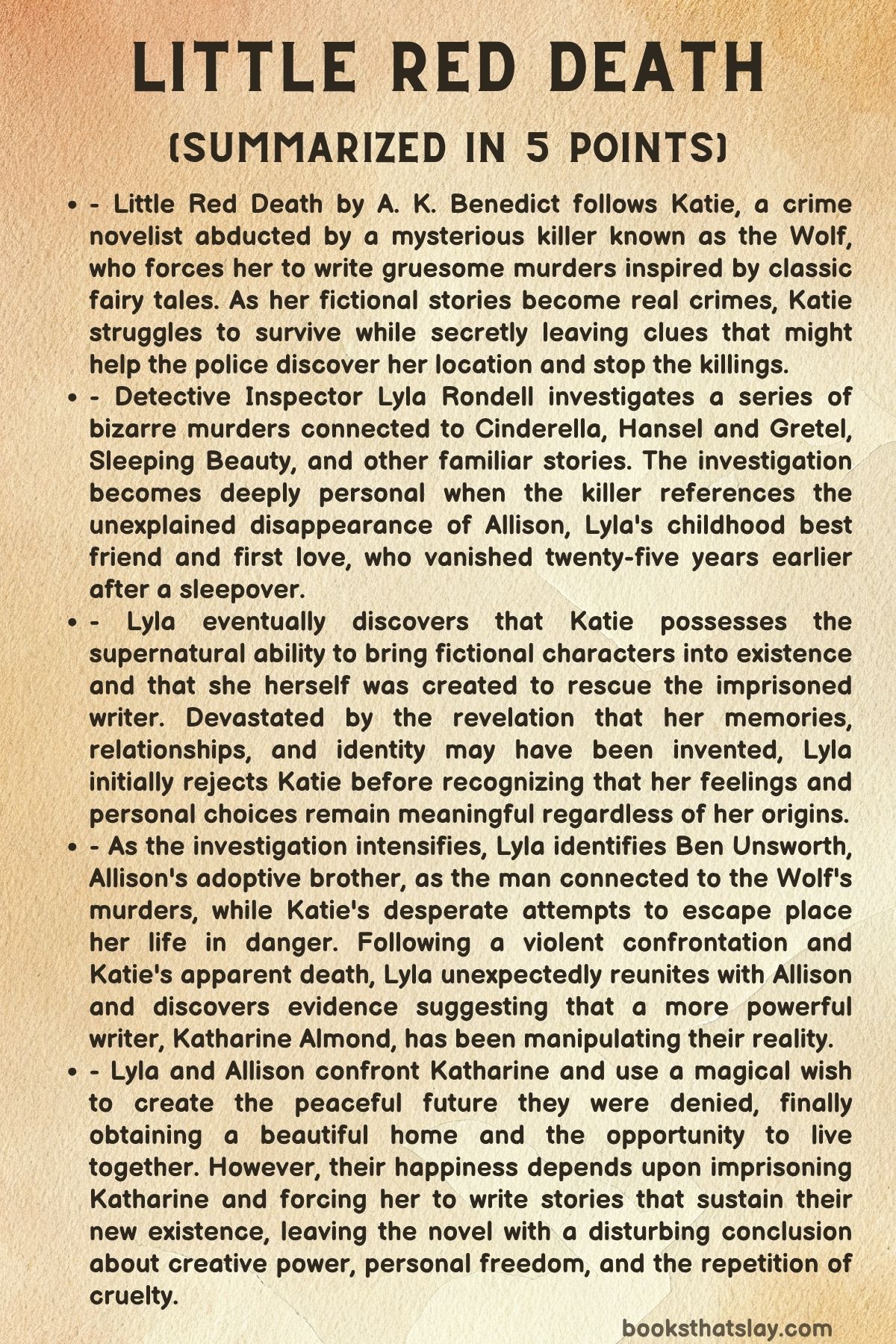
The novel follows Katie, a crime writer imprisoned by a masked killer who forces her to invent murders inspired by traditional fairy tales. As these fictional crimes become real, Detective Inspector Lyla Rondell investigates a series of deaths connected to her own painful past. What begins as a hunt for a serial killer develops into a disturbing exploration of identity, free will, and the relationship between writers and their creations. The book challenges the comforting belief that every fairy tale ends with justice.
Summary
Little Red Death begins with an unidentified villain addressing the reader directly, suggesting that anyone who enjoys fictional violence shares responsibility for the suffering it depicts. The speaker announces that a writer has been imprisoned and that people will die unless the mystery surrounding her captivity is solved.
Crime novelist Katie awakens in an unfamiliar attic, suffering from a headache and uncertain how she arrived there. As her memories return, she recalls being abducted after an evening with fellow writers and discovers that she is being held inside an isolated house surrounded by woodland and a moat.
Her prison contains a typewriter, bookshelves, a makeshift bed, and a barred window. A threatening letter reveals that her captor, known as the Wolf, intends to force her to write murders based on familiar fairy tales and then reproduce those murders in reality.
Katie initially considers resisting, but another imprisoned woman warns her about the terrible consequences of disobedience. When the Wolf appears outside wearing an animal mask, Katie understands that her survival depends upon cooperating with his demands.
She begins writing a modern interpretation of Cinderella, introducing Lady Ashley Agnelli, a wealthy young woman preparing for an evening in Southampton. Ashley purchases an inexpensive gold dress and matching shoes, receives an ominous warning to return before midnight, and is subsequently attacked in an underground car park.
Elsewhere, Detective Inspector Lyla Rondell is attempting to enjoy time away from work when her superior, DCI Rebecca Winton, calls about a suspected abduction at Blackwater Arboretum. Investigators have discovered a red cloak, a basket, and a mysterious postcard personally addressed to Lyla.
The postcard refers to Lyla’s childhood nickname, Little Red Rondell, and an event that has haunted her for twenty-five years. Her closest friend and first love, Allison, disappeared after a sleepover, leaving behind a poisoned apple associated with the story of Snow White.
Lyla became a detective partly because she never accepted the suggestion that Allison had simply run away. The new clues suggest that someone knows her private history and deliberately intends to draw her into the investigation.
A bloodstained gold shoe eventually establishes the crime’s connection to Cinderella. Fingerprints and missing-person reports lead the police toward Grace Montague, the real woman whom Katie’s fictional Ashley has been forced to represent.
Inside the house, Katie discovers that Grace has been imprisoned nearby. Their tentative friendship deteriorates when Grace learns that Katie’s writing helped determine her fate, even though the novelist acted under threat of death.
Katie tries delaying the inevitable by creating fictional opportunities for Ashley to escape. She also flatters the Wolf’s literary ambitions, hoping to persuade him that postponing the heroine’s death would improve the story.
The Wolf responds with increasing brutality. He murders another imprisoned writer and displays her removed heart, demonstrating that resistance will not be tolerated.
Meanwhile, Lyla investigates the woodland crime scenes and finds an old photograph of Allison deliberately positioned for her discovery. The photograph confirms that the killer possesses intimate knowledge of her past.
Her unauthorized return to the forest alarms Rebecca, who fears that the murderer is manipulating her detective’s unresolved grief. Although Lyla accepts the warning, she cannot abandon a case that might finally provide answers about Allison.
The investigation leads to Mellicent Farling, an eccentric woman whose cottage contains mushrooms and unusual botanical specimens. Her fingerprints connect her to evidence, while her observations about fungal networks suggest that life, consciousness, and imagination may be linked in extraordinary ways.
Katie’s next major fictional assignment reinterprets Hansel and Gretel through twins Harry and Gemma. Her story describes the siblings entering a dangerous forest, where they suffer terrible deaths involving roots, fungi, and woodland creatures.
When the twins’ bodies are subsequently discovered arranged among fungal growth, Lyla recognizes that the murderer is transforming fictional scenes into real crimes. Public attention intensifies, and the newspapers name the killer the Grimm Ripper.
Katie discovers that her imagination operates in ways she cannot entirely explain. Her writing sometimes arrives with an almost supernatural intensity, as though another intelligence were assisting her.
After gaining temporary freedom to explore the house, she falls into a flooded basement. There she finds writing materials and continues producing stories while searching desperately for a way to communicate with the police.
One new narrative concerns Red, an orphaned young woman who enters a woodland cemetery to investigate her ancestry. In the story, the forest itself destroys a threatening man, drawing him into the earth.
Lyla eventually recognizes that the unusual arrangements of the murder victims’ bodies may represent British Sign Language. Remembering that she practiced signing with Allison, she interprets the positions as references to a house and trees.
Following the clues, she reaches the isolated property associated with Katie’s imprisonment. There she makes an extraordinary discovery: Katie is not merely a missing writer whose stories predict murders, but the person who created Lyla herself.
Katie’s writing has brought a fictional detective into physical existence, complete with memories, relationships, and an elaborate personal history. Lyla realizes that even Allison’s disappearance may have been constructed to give her a compelling reason to pursue the killer.
The revelation devastates her. Refusing to accept that her life exists solely to serve Katie’s purposes, Lyla abandons her red cloak in the moat and flees.
Katie’s memories reveal the origins of her supernatural power. As a child, she used one of her baby teeth while writing about a tooth fairy named Terror, and the imagined being unexpectedly became real.
When the Wolf imprisoned her, Katie used the same magical object to create Lyla, hoping that an intelligent and determined detective could find and rescue her. However, she underestimated her character’s ability to act independently.
Lyla returns home and begins examining the supposed reality of her existence. When she opens her housemate Annie’s bedroom, she discovers an empty white space, revealing that portions of her ordinary life may never have been fully created.
Gradually, Lyla recognizes that being fictional does not necessarily make her feelings meaningless. Her love for Allison, her professional achievements, and her choices remain important because she experiences them as real.
Katie continues suffering under the Wolf’s control. He demands more fairy-tale murders, injures her when she cannot write quickly enough, and refuses to allow her any meaningful freedom.
Her Sleeping Beauty-inspired story produces another victim, a young woman with rose tattoos whose body is discovered near the Needles off the Isle of Wight. Lyla correctly anticipates the fairy-tale connection through fragments of communication from Katie.
Despite their extraordinary mental link, Lyla remains angry with her creator. Katie eventually acknowledges that she designed Lyla for a purpose without considering whether the detective would consent to it.
Overwhelmed by captivity, guilt, and physical suffering, Katie takes an overdose. Before losing consciousness, she warns Lyla about future crimes involving long hair and asks that her beloved pets be cared for.
Hearing Katie’s voice fade, Lyla returns to the house and rescues her. Her decision represents an important change: she helps Katie not because she has been commanded to, but because she independently chooses to save another person’s life.
The investigation subsequently develops around a Rapunzel-inspired crime and the disappearance of Rebecca. Lyla follows connections to Allison’s past, eventually identifying Ben Unsworth, Allison’s adoptive brother, as the man associated with the Wolf’s murders.
A confrontation unfolds around the waterfront, where Jimmy is seriously injured and Katie becomes caught in further danger. Her already weakened body begins failing, and Lyla desperately attempts to keep her alive.
When Katie appears to die, Lyla experiences a terrifying sensation of physical disintegration. She fears that her existence cannot continue without the woman who created her.
Yet Lyla eventually awakens aboard a boat. Investigating a locked room, she hears typing and discovers a red-haired woman working at a computer.
The woman is Allison.
Their reunion fulfills Lyla’s deepest hope, but further complications arise when evidence briefly suggests that Allison might have participated in the crimes. Lyla reluctantly tests the possibility before accepting that someone has manipulated the circumstances to make her beloved appear guilty.
Together, they investigate contradictions in their memories and discover a significant clue involving a novel by Katharine Almond. They gradually conclude that Katie was not the ultimate source of the strange reality surrounding them.
Katharine Almond is the more powerful writer who has been directing events from behind the apparent mystery. Lyla and Allison return to the forest to confront her, armed with the magical baby tooth associated with Katie’s earliest creation.
Rather than choosing a conventional violent ending, Lyla makes a wish that transforms their circumstances. She and Allison awaken together in a beautiful home, possessing the shared future they were denied for twenty-five years.
Their happiness, however, carries a disturbing condition.
Katharine has become their imprisoned writer, forced to produce narratives that sustain and improve their lives. Surveillance and painful punishments prevent her from writing openly about resistance or escape.
Although Lyla and Allison have apparently achieved freedom, they have reproduced the same system of domination that once controlled Katie.
The novel closes with Katharine searching for ways to conceal messages in her writing, hoping another detective or attentive reader will discover her predicament.
The apparent happy ending therefore remains incomplete. The person who once controlled the story is now trapped inside a new one, and the struggle between creation, freedom, and captivity continues.
Characters
Katie
Katie is the central imprisoned writer in Little Red Death, and her experiences establish the book’s disturbing examination of creativity and moral responsibility. As a crime novelist accustomed to controlling fictional events, she finds herself forced to confront the real suffering that her imagination can produce.
Her captivity exposes the difference between writing violence for entertainment and creating it under coercion. Although she initially obeys the Wolf to preserve her life, she becomes increasingly troubled by the knowledge that innocent people are dying because of her stories.
Katie is intelligent, observant, and capable of adapting her literary skills to dangerous circumstances. She attempts to manipulate her captor through flattery, carefully constructed plots, and fictional clues intended to assist the police.
However, she is also frightened, physically vulnerable, and sometimes dishonest. Her decision to conceal her involvement from Grace damages their relationship and demonstrates how fear can compromise even sympathetic people.
Her creation of Lyla introduces another moral complication. Katie imagines a detective capable of saving her but initially assumes that the person she creates should naturally obey her wishes.
As Lyla asserts her independence, Katie begins understanding that creative power does not justify ownership of another consciousness. This realization becomes central to her development.
Katie’s despair eventually leads her to attempt suicide, but Lyla’s intervention gives her another opportunity to resist. The relationship between them transforms Katie’s understanding of heroism, encouraging her to act rather than merely invent courageous characters.
Her tragedy lies in possessing extraordinary creative abilities without possessing comparable power over her own circumstances. She demonstrates that imagination can create both possibilities for liberation and terrible forms of exploitation.
Detective Inspector Lyla Rondell
Lyla Rondell is the principal detective in Little Red Death, serving as both the investigator of its murders and the character through whom the book questions the nature of existence. Her intelligence, determination, and emotional vulnerability make her more complicated than the conventional detective who simply follows evidence toward a solution.
The disappearance of Allison dominates her personal history. Their childhood friendship developed into romantic love, and Allison’s unexplained absence created a wound that influenced Lyla’s career and relationships.
Lyla approaches investigations with unusual intensity, finding meaning in details that other detectives might overlook. Her knowledge of fairy tales and British Sign Language becomes essential to interpreting the Grimm Ripper’s elaborate crime scenes.
Her neurodivergence also influences how she experiences the world. Restless thoughts, intense concentration, and difficulty disengaging from problems contribute both to her investigative strengths and to her personal exhaustion.
Lyla’s defining crisis occurs when she discovers that Katie created her. Everything she previously accepted as evidence of an independent existence suddenly becomes uncertain, including her memories, home, career, and emotional attachments.
Rather than immediately embracing her creator’s instructions, Lyla rejects the role assigned to her. Her resistance establishes that she possesses the capacity to make decisions even when her origins are controlled by someone else.
Her eventual rescue of Katie demonstrates the difference between obedience and freely chosen compassion. She saves her creator despite feeling betrayed, proving that moral agency does not necessarily depend upon having an independent origin.
Nevertheless, Lyla’s final transformation is morally troubling. After achieving the life she desired with Allison, she participates in imprisoning Katharine Almond, suggesting that liberation does not automatically prevent someone from becoming an oppressor.
Allison
Allison is the emotional center of Little Red Death, even though her physical appearance is delayed until the later stages of the novel. Her disappearance shapes Lyla’s identity, career, and understanding of love.
As children, Allison and Lyla shared an exceptionally close relationship that gradually became romantic. Their affection was accompanied by uncertainty about how to express feelings they were only beginning to understand.
Allison’s intelligence and sensitivity emerge through the school assignments Lyla later discovers. Her writing reveals that she loved Lyla deeply and imagined a future in which they would live together in a beautiful house surrounded by the New Forest.
Her disappearance interrupts that possibility and leaves Lyla searching for answers for twenty-five years. Because Allison remains absent for so much of the story, she initially functions as both a remembered person and an idealized figure representing everything Lyla has lost.
When Allison finally reappears, her character becomes more complicated. She possesses her own experiences, emotions, and knowledge, challenging the assumption that she exists only as part of Lyla’s memories.
The suspicion surrounding her possible involvement in the murders tests the reunited couple’s trust. Allison’s distress when Lyla investigates her demonstrates that their relationship must develop beyond idealized childhood memories.
Their discovery that they may be fictional creations gives Allison an opportunity to express a different understanding of existence. She believes that love remains meaningful regardless of the circumstances that brought them into being.
However, her participation in Katharine’s imprisonment complicates her apparent happy ending. Allison ultimately becomes both someone who suffered under another person’s narrative decisions and someone willing to control another writer to secure her own happiness.
The Wolf / Ben Unsworth
The Wolf serves as the immediate antagonist of Little Red Death, combining the recognizable menace of a fairy-tale predator with the calculated cruelty of a serial killer. His wolf mask transforms a familiar childhood symbol into an instrument of fear.
His treatment of Katie demonstrates his obsession with control. Rather than merely demanding particular stories, he dictates their outcomes, punishes creative resistance, and insists that fictional murders become physical realities.
The murder of another imprisoned writer establishes the extent of his brutality. By displaying the woman’s removed heart, he deliberately destroys Katie’s remaining confidence that negotiation or refusal might protect her.
His literary ambitions create an unusual relationship with his captive. He responds to attempts at artistic flattery but ultimately values obedience more than originality, revealing that his supposed interest in storytelling is inseparable from domination.
The eventual identification of Ben Unsworth connects the killer to Allison’s family and Lyla’s unresolved past. This revelation makes the murders more personal than an apparently random series of fairy-tale crimes.
Ben’s role also illustrates how the appearance of ultimate power can be misleading. Although he controls the captives and their immediate physical environment, the later revelation concerning Katharine Almond demonstrates that he operates within a larger structure of manipulation.
His character represents the terrifying possibilities of someone who regards other human beings as material for a story rather than individuals entitled to their own futures.
DCI Rebecca Winton
Rebecca Winton is Lyla’s superior officer and one of her most important sources of professional and emotional support. She represents the discipline, accountability, and cooperation necessary to investigate dangerous crimes.
Her relationship with Lyla extends beyond ordinary workplace authority. Rebecca understands the personal significance of Allison’s disappearance and recognizes that the Grimm Ripper is deliberately exploiting her detective’s history.
This concern creates disagreements when Lyla investigates alone or conceals important discoveries. Rebecca’s anger arises not merely from procedural violations but from her fear that Lyla may be placing herself in the killer’s hands.
At the same time, Rebecca recognizes Lyla’s exceptional abilities. Her decision to place Lyla in charge of the investigation demonstrates confidence in the detective’s judgment despite concerns about her impulsiveness.
Rebecca also provides an important contrast to the controlling figures elsewhere in the novel. She exercises authority through professional responsibility rather than demanding unquestioning submission.
Her disappearance later intensifies the urgency of the case and forces Lyla to confront the possibility of losing another person she cares about. Through Rebecca, the story emphasizes the importance of relationships grounded in loyalty, professional trust, and mutual responsibility.
Jimmy Cornick
Jimmy Cornick is Lyla’s colleague and investigative partner, providing practical assistance and a more openly optimistic presence within the police team. His temperament contrasts with Lyla’s tendency toward relentless questioning and personal isolation.
He participates in crime-scene examinations, interviews witnesses, and helps investigate the fairy-tale connections between victims. His involvement demonstrates that the case requires sustained cooperation rather than the abilities of a single brilliant detective.
Jimmy’s growing confidence becomes apparent when he takes responsibility for questioning witnesses such as Ellen, the tattoo artist. These moments establish him as a capable investigator developing his own professional identity.
His conversations with Lyla also provide moments of ordinary companionship amid disturbing discoveries. His attempts to remain positive offer a counterweight to her increasing emotional exhaustion.
During the confrontation involving Ben Unsworth, Jimmy suffers a serious injury. This event reinforces the physical danger facing investigators and reminds Lyla that her pursuit of the murderer has consequences for people working beside her.
Jimmy’s character represents loyalty, courage, and the importance of colleagues who continue supporting one another when an investigation becomes personally overwhelming.
Grace Montague / Lady Ashley Agnelli
Grace Montague is one of the first victims whose experience exposes the consequences of Katie’s forced writing. She becomes associated with Lady Ashley Agnelli, the Cinderella-inspired character created for the Wolf’s murderous performance.
Grace’s imprisonment is particularly disturbing because she has no meaningful control over the identity imposed upon her. Her captor treats her circumstances as details that can be manipulated to reproduce another person’s fictional narrative.
Her developing relationship with Katie initially offers a possibility of cooperation and escape. Both women understand that survival may depend upon sharing information, but their relationship is undermined when Grace discovers Katie’s involvement in selecting her fictional fate.
Grace’s anger is understandable because she has been denied essential information about the danger surrounding her. Although Katie acted under coercion, Grace must live with the consequences of decisions made without her knowledge or consent.
The circumstances surrounding Grace’s abduction and death also establish the investigative pattern that Lyla eventually learns to recognize. The gold shoe, distinctive clothing, and Cinderella imagery become evidence of a murderer who transforms identity into a theatrical performance.
Grace ultimately represents the human cost concealed beneath the Wolf’s elaborate literary games.
Mellicent Farling
Mellicent Farling introduces the novel’s most unusual scientific and supernatural possibilities. Living in an isolated New Forest cottage, she possesses extensive knowledge of fungi and appears fascinated by the networks connecting organisms beneath the ground.
Her fingerprints connect her to evidence recovered during the murder investigation, making her an important suspect or potential witness. Yet her cryptic behavior prevents Lyla from determining how directly she is involved.
Mellicent repeatedly suggests that individuality and consciousness may be less separate than people assume. Her explanations of underground fungal communication prepare the reader for the possibility that imagination and physical reality might share unexpected connections.
She also possesses knowledge of Lyla’s personal circumstances that seems difficult to explain through ordinary means. This makes her both unsettling and potentially valuable.
Her function extends beyond providing clues. By challenging Lyla’s commitment to conventional explanations, Mellicent encourages the detective to consider possibilities that initially appear impossible.
She represents the mysterious relationship between natural systems, imagination, and the boundaries of human perception.
Katharine Almond
Katharine Almond is the hidden controlling figure in Little Red Death, whose significance emerges after Lyla and Allison begin questioning the apparent origins of their reality. The discovery of her name in a book suggests that someone beyond Katie has been shaping the events surrounding them.
Her role transforms the novel’s apparent hierarchy of power. Katie initially seems to possess extraordinary authority because her writing can create living beings, but Katharine’s existence reveals that even Katie’s circumstances may belong to another person’s narrative.
Katharine represents the most disturbing implications of authorship. A writer who controls fictional lives may exercise enormous influence without acknowledging that those lives possess independent feelings or moral importance.
However, her eventual defeat reverses this relationship. Lyla and Allison force Katharine into captivity and compel her to write stories designed to preserve their happiness.
The punishments imposed upon her are severe. Surveillance software monitors her writing, and attempts to describe imprisonment or resistance trigger painful electric shocks.
Katharine’s suffering deliberately resembles Katie’s original situation. The person who once directed events becomes another imprisoned creator whose imagination is exploited for someone else’s benefit.
Yet Katharine refuses to surrender her agency completely. She searches for ways to conceal clues within her work, hoping that someone beyond her immediate captors will recognize her predicament.
Her character prevents the ending from becoming a simple celebration of justice. The supposed defeat of one oppressive writer produces another system of captivity, leaving the reader uncertain whether the cycle can ever truly end.
Terror
Terror is the tooth fairy Katie created during childhood, representing the earliest evidence of her extraordinary ability to bring fictional beings into existence. Although the character occupies relatively little narrative space, its importance to the supernatural mystery is considerable.
Katie creates Terror after discovering one of her baby teeth among her grandmother’s possessions. When the fairy unexpectedly becomes real, Katie learns that writing can possess consequences far beyond ordinary imagination.
Terror’s existence also suggests that fictional creations can develop a degree of independence. This becomes significant when Lyla refuses to obey Katie’s instructions and begins determining her own future.
The baby tooth associated with Terror later becomes essential to Katie’s attempt to create Lyla. Eventually, the same object allows Lyla to challenge Katharine Almond and transform the circumstances governing her existence.
Terror therefore connects the novel’s childhood magic with its adult questions about authorship, freedom, and responsibility.
Teresa
Teresa is a journalist whose connection to Lyla’s adolescence gives her a complicated role in the investigation. She once spread a damaging story about Lyla and Allison, motivated partly by jealousy and a desire for attention.
Her admission forces Lyla to confront another source of pain associated with Allison’s disappearance. Teresa’s regret cannot erase the consequences of her earlier behavior, especially because the relationship between Lyla and Allison remains emotionally important.
Despite this history, Teresa provides potentially useful information about the investigation. Her warning that someone within the police team may be leaking information introduces suspicion into an already dangerous situation.
Teresa’s character examines the possibility of change without suggesting that remorse automatically guarantees forgiveness. She demonstrates how past wrongdoing can continue shaping relationships even when the responsible person attempts to make amends.
Ellen
Ellen is a tattoo artist whose observational abilities become valuable during the Grimm Ripper investigation. Her familiarity with her clients and strong visual memory allow her to identify details that might otherwise escape police attention.
She helps Lyla and Jimmy investigate connections between tattoos, victims, and the killer’s elaborate symbolism. Her recollection of a man bearing rose tattoos eventually becomes particularly important.
By producing a sketch of the suspect, Ellen provides evidence that helps Lyla recognize Ben Unsworth. Her contribution demonstrates that useful investigative insight can emerge from artistic training as well as formal police work.
Ellen also provides a quieter parallel to Katie. Both women possess creative abilities, but Ellen uses hers to preserve visual information and help identify a criminal rather than being forced to create scenes of suffering.
Lionel
Lionel is a forensic expert whose professional knowledge assists Lyla in interpreting unusual evidence connected to the murders. His attention to fungal material becomes especially important as the investigation develops.
During their meeting at the Three Turns Inn, he encourages Lyla to consider connections between apparently unrelated discoveries. His scientific curiosity offers a useful contrast to her preference for explanations supported by immediately recognizable evidence.
The wild morel mushroom he identifies strengthens the connection between the crimes and Mellicent Farling. His contribution helps transform an eccentric investigative possibility into a more substantial lead.
Lionel also recognizes aspects of Lyla’s personality that she sometimes resists acknowledging. His observations encourage her to examine not only the evidence but also the assumptions influencing her interpretation of it.
Harry and Gemma
Harry and Gemma are teenage twins featured in Katie’s disturbing reinterpretation of Hansel and Gretel. Their story begins with resentment toward their financially struggling family and develops into a terrifying journey through the forest.
Their deaths demonstrate the Wolf’s willingness to exploit recognizable childhood stories through extreme violence. The twins’ bodies become physical objects arranged to communicate a hidden message.
Their relationship also affects Lyla because their closeness reminds her of the emotional bond she once shared with Allison. The crime consequently acquires personal significance beyond its immediate brutality.
Harry and Gemma represent the vulnerability of young people whose lives are transformed into fictional material by someone seeking control and spectacle.
Martha Cook and Carly
Martha Cook and Carly appear in the Rapunzel-inspired narrative that Katie writes under the Wolf’s direction. Their conflict begins during an appointment for hair extensions and develops into an act of possessive violence.
Martha is dissatisfied with her appearance and frustrated by the failure of the appointment to provide the transformation she desires. Her disappointment becomes aggression when she decides to take Carly’s long braid for herself.
Carly attempts to handle the disagreement professionally, offering practical compromises before Martha attacks her. Her vulnerability emphasizes how ordinary circumstances can become dangerous when another person treats her body as something to possess.
Together, the women demonstrate the novel’s transformation of fairy-tale symbols into disturbing expressions of jealousy, entitlement, and bodily control.
Themes
The Power of Storytelling and the Responsibility of Creation
Storytelling becomes a form of authority when imagined events can determine the circumstances of another person’s existence. In Little Red Death, the act of writing is no longer separate from physical reality because Katie’s stories can bring characters into the world and influence the suffering of living people.
Her imprisonment makes this responsibility impossible to ignore. Although the Wolf forces her to produce violent narratives, Katie must confront the knowledge that her words are connected to genuine injuries and deaths.
This creates a distinction between intention and consequence. Katie does not want innocent people to suffer, yet her desire to survive leads her to participate in a process that threatens others.
The creation of Lyla develops this problem further. Katie initially regards the detective as a solution to her captivity, imagining someone whose abilities and personal history will motivate her to rescue the writer.
However, Lyla experiences herself as an independent individual. Her memories, fears, relationships, and ambitions cannot simply be dismissed as tools belonging to her creator.
Katharine Almond’s eventual imprisonment extends the question of responsibility into the novel’s ending. Her new captors use writing to secure their happiness while imposing suffering upon the person producing their stories.
The book ultimately suggests that creative authority carries ethical obligations whenever the subjects of creation possess consciousness or the capacity to suffer. Artistic success cannot automatically justify the manipulation of another person’s life, even when the resulting narrative appears satisfying.
Free Will, Identity, and the Meaning of Existence
Lyla’s discovery that she is a fictional creation destroys the assumptions supporting her identity. She has spent her life believing that her experiences belong to her, only to discover that another person may have invented her memories, relationships, and personal history.
The revelation becomes particularly disturbing when she encounters the empty room supposedly belonging to Annie. This physical contradiction demonstrates that even familiar surroundings may be incomplete constructions rather than reliable evidence of an independent past.
Yet Lyla’s response challenges the idea that origins determine the value of existence. Although Katie created her, the detective refuses to accept that she must remain obedient to the intentions behind her creation.
Her decision to abandon Katie and later return to rescue her establishes the difference between programmed purpose and independent moral action. She chooses compassion after rejecting the expectation that she owes her creator unquestioning loyalty.
Allison develops a related argument through their reunion. She believes that the reality of love depends less upon its origin than upon the feelings and commitments experienced by those involved.
Their shared history may have been constructed, but their affection still shapes their decisions.
The novel therefore presents identity as something more complicated than a fixed collection of memories or an established origin. Personal meaning can emerge through present choices, relationships, and the willingness to accept responsibility for one’s actions.
However, the ending complicates this hopeful interpretation. Lyla and Allison exercise their newfound freedom by restricting Katharine’s, demonstrating that possessing agency does not guarantee using it ethically.
Power, Captivity, and the Repetition of Oppression
The Wolf’s imprisonment of Katie establishes a system in which one person’s survival depends entirely upon another person’s demands. He controls her movements, writing, physical safety, and access to the outside world, reducing her existence to the production of stories that satisfy his desires.
His punishments are designed to make resistance appear impossible. The murder of another captive and the injuries inflicted upon Katie reinforce his authority through fear.
Yet the novel gradually reveals that captivity extends beyond physical confinement. Lyla is initially imprisoned by the fictional history created for her, while Allison’s disappearance restricts the emotional possibilities of her adult life.
Even Katie’s extraordinary powers do not protect her from being manipulated within a larger narrative controlled by another writer.
These overlapping relationships challenge a simple division between powerful villains and powerless victims. A character may exercise authority in one situation while remaining vulnerable to exploitation in another.
The conclusion transforms this theme into a disturbing reversal. Lyla and Allison escape the roles imposed upon them but force Katharine Almond into the same kind of creative imprisonment that once defined Katie’s suffering.
Their newly established happiness depends upon surveillance, punishment, and the denial of someone else’s freedom.
This repetition suggests that oppression cannot be eliminated merely by changing who possesses authority. Without ethical restraint, victims may reproduce the methods of those who controlled them, especially when they believe their own suffering entitles them to compensation.
The novel leaves this contradiction unresolved, suggesting that genuine liberation requires more than escaping captivity. It also requires refusing to build personal happiness upon another person’s confinement.
Fairy Tales, Justice, and the Illusion of Happy Endings
Traditional fairy tales provide the structure through which violence and mystery operate throughout Little Red Death. Cinderella, Hansel and Gretel, Sleeping Beauty, Little Red Riding Hood, Rapunzel, and other familiar stories are transformed into modern narratives in which recognizable symbols become instruments of suffering.
The gold shoe associated with Cinderella no longer represents romantic recognition or a fortunate change in circumstances. Instead, it becomes evidence of assault and murder.
Likewise, the woodland setting of Hansel and Gretel becomes a place of mutilation and death rather than a dangerous environment from which children ultimately escape.
These transformations expose the disturbing elements already present in many traditional tales. Threats, cruelty, abandonment, and punishment frequently exist beneath their familiar promises of moral restoration.
Lyla’s investigation depends upon interpreting these symbols, but the murderer uses the same recognizable patterns to manipulate her expectations. Knowledge that helps her understand the crimes also becomes a means through which the killer directs her behavior.
The ending provides the strongest challenge to conventional fairy-tale justice. Lyla and Allison achieve the life they dreamed of sharing, apparently overcoming separation, danger, and manipulation.
Their happiness resembles the promise of living happily ever after, yet it exists only because Katharine Almond has been imprisoned and forced to maintain their chosen reality.
This contradiction exposes the limitations of endings that celebrate the happiness of selected characters while ignoring the suffering of others. The closing suggestion that Katharine may communicate through hidden clues leaves open the possibility that another story of resistance is already beginning.
The novel ultimately questions whether any ending deserves to be called happy when its resolution depends upon another person’s continued suffering.