Paper Ghosts Summary, Characters and Themes
Paper Ghosts by Sarah Addison Allen is a multigenerational novel about love, family secrets, grief, and the consequences of trying to protect others through control.
Set in the fictional town of Hen Town, North Carolina, the story follows Willamena Wester, a wealthy young woman whose tragic romance shapes her family’s future, and her granddaughter Bailey, who struggles to escape the same restrictive traditions decades later. Combining family drama, romance, mystery, and supernatural elements, the novel examines how unresolved suffering can influence successive generations. It also explores the possibility of breaking inherited patterns through forgiveness, personal independence, and the courage to accept an uncertain future.
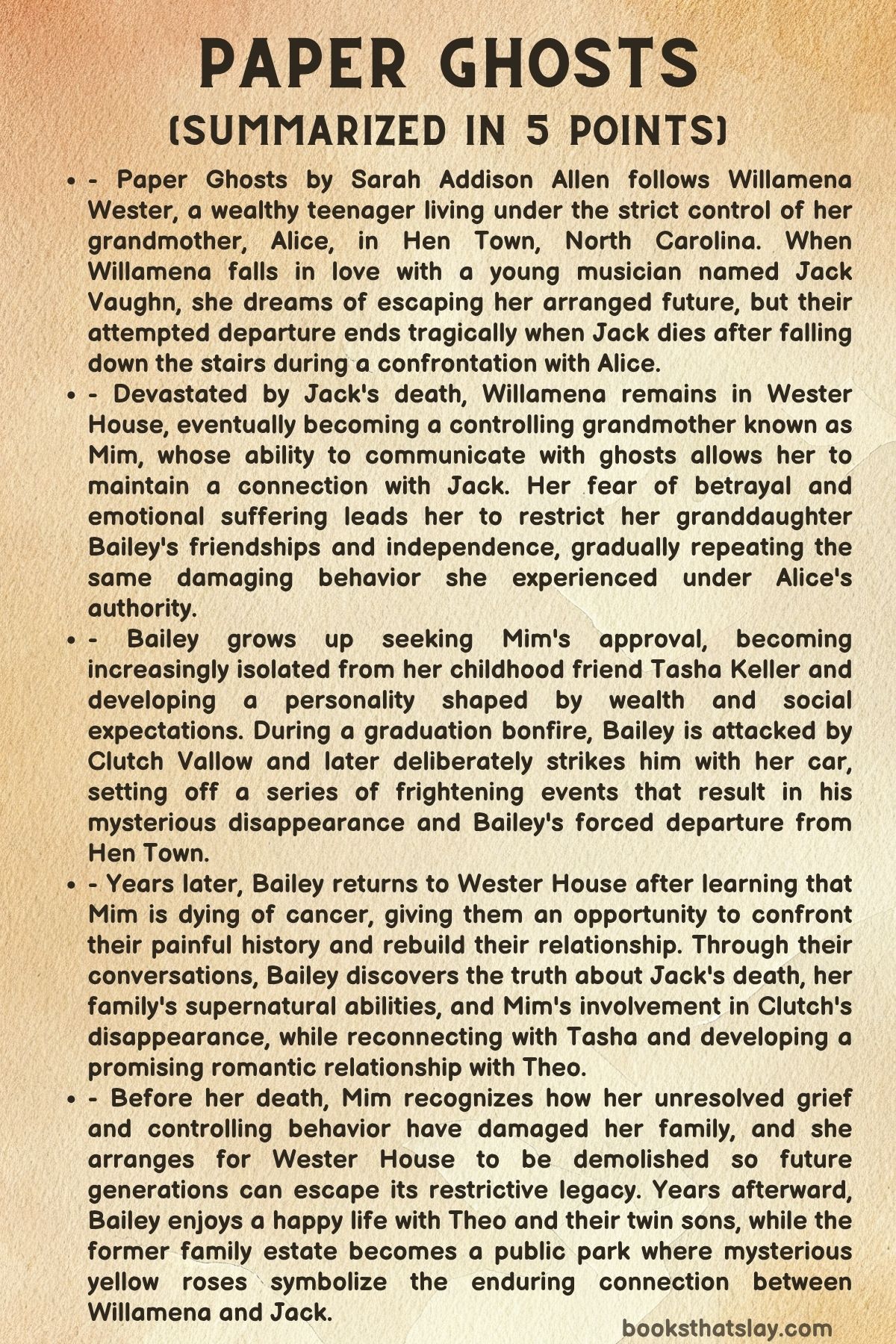
Summary
In 1976, eighteen-year-old Willamena Wester, affectionately called Wills, lives in Hen Town, North Carolina, under the strict authority of her grandmother, Alice Wester. The Wester family possesses extraordinary wealth and influence, much of which originated from Alice’s seemingly supernatural ability to uncover information about other people.
Although Wills enjoys considerable social privilege, she has little control over her future. Alice expects her to marry Terrence Wester, a distant cousin whose agreeable personality and respectable background make him an ideal choice for preserving the family’s position.
Wills belongs to a popular school friendship group called the Feathers, which includes Jani Keller and Dorothy Holloway. Beneath their fashionable appearances and social confidence, however, their relationships contain jealousy, resentment, and secrets.
Everything begins changing when Andy Smooth, a musician and former teacher, visits their school with his band. Wills becomes fascinated by a young guitarist named Jack Vaughn, whose confidence and unconventional lifestyle contrast sharply with her carefully regulated existence.
When Jack is unexpectedly stranded in Hen Town, he begins offering guitar lessons at the school. Despite Alice’s objections, Wills secretly visits him in the auditorium, one of several locations where she believes her grandmother cannot discover her activities.
Their conversations gradually develop into a romance. Jack reveals that he endured an abusive childhood and eventually escaped with the assistance of his loving grandmother, whom he called Mim.
Before leaving home, Mim gave Jack her savings and an umbrella, which became precious reminders of her encouragement. His experiences challenge Wills’s understanding of family loyalty because his grandmother expressed love by helping him escape, whereas Alice claims that love requires obedience.
Wills begins questioning the future prepared for her. Terrence remains considerate and supportive, even admitting that he would not prevent her from refusing their expected marriage, but she cannot imagine experiencing the same passionate connection with him that she feels toward Jack.
Their attraction intensifies during prom and subsequent secret meetings. With Dorothy’s assistance, Wills arranges a romantic evening with Jack near the Holloway property, where he openly expresses his devotion.
Their happiness proves temporary when Alice discovers their relationship. Photographic evidence reveals that the supposedly safe locations were not beyond her knowledge, and Wills learns that Dorothy disclosed information to Jani, who had been threatening her with a damaging family secret.
Alice confronts Jack, and Wills initially believes that he has accepted payment to abandon her. The apparent betrayal reinforces her grandmother’s warnings that trusting other people inevitably leads to suffering.
During a violent storm, however, Jack returns and asks Wills to leave Hen Town with him. He convinces her that their relationship matters more than the security offered by her inheritance, and she finally agrees to escape.
As they approach the staircase, Alice intervenes. A struggle involving Jack’s umbrella causes Alice to collide with him, sending him down the stairs and killing him.
The tragedy destroys Wills’s hopes for an independent future. Alice conceals the circumstances surrounding Jack’s death, and Willamena remains in Wester House, burdened by grief and guilt.
Decades later, the narrative introduces Willamena’s granddaughter, Bailey, and her son, Tug Wester. After Bailey’s mother dies, Tug brings his young daughter to live in the ancestral home, where Willamena, now known as Mim, has become an emotionally distant and mysterious figure.
Bailey quickly becomes fascinated by Wester House and its strange atmosphere. She senses an unusual presence and eventually encounters a figure named Jack, although she initially cannot understand his connection to her grandmother.
Mim gradually develops a relationship with Bailey through formal afternoon teas. When Bailey mentions Jack, her grandmother demands secrecy, strengthening the mystery surrounding the family’s past.
Meanwhile, Bailey befriends Tasha Keller, a girl whose unusual ability allows her to perceive emotions as smells. Tasha lives with her socially ambitious mother, Pam, who constantly hopes to improve their position through relationships with Hen Town’s wealthy residents.
The girls initially enjoy genuine companionship, but Mim interferes with their friendship. Drawing upon her own painful experiences, she believes emotional attachments make people vulnerable to betrayal.
At school, Mim arranges for Bailey and Tasha to be separated. Bailey gradually becomes associated with privileged classmates, while Tasha experiences isolation and bullying.
As the girls grow older, their friendship deteriorates. Bailey increasingly imitates Mim’s guarded personality and develops an identity based on family status, even as Tug encourages her to consider college and a future beyond Hen Town.
Bailey becomes curious about her grandmother’s youth after discovering photographs of the Feathers and evidence of Willamena’s relationship with a musician. Mim refuses to discuss these memories, revealing how firmly she remains attached to her suffering.
Approaching graduation, Bailey becomes interested in Clutch Vallow, a troubled young man whose hostility toward the town’s social hierarchy fascinates her. She arranges to meet him privately during a graduation bonfire organized by Tasha’s mother.
Their encounter in the woods becomes terrifying when Clutch attacks Bailey and attempts to sexually assault her. She manages to escape but remains overwhelmed by fear, anger, and humiliation.
Bailey encounters Tasha and drives away with her. When they see Clutch walking along the road, Bailey deliberately strikes him with her car, horrifying Tasha, who fears that she will also be implicated.
Although Clutch survives the collision, the incident destroys the remaining trust between the girls. Later that evening, he approaches Wester House carrying evidence connecting Bailey’s vehicle to his injuries.
Mim learns what happened and subsequently orders Bailey to leave Hen Town. She threatens to tell Tug about the incident if Bailey refuses, causing Bailey to interpret her actions as a devastating rejection.
Years pass before Bailey returns. Now living in Austin, she has established an independent existence and formed a close friendship with Justin, who supported her after leaving her family home.
Her return is prompted by Mim’s terminal bone cancer. Tug has been caring for his mother and hopes that Bailey’s presence might allow them to resolve their estrangement before her death.
During this visit, Bailey discovers that Tasha has married Gary Tillbury, a wealthy older businessman. Tasha’s life changed considerably after her mother suffered a serious accident, forcing her to abandon her plans temporarily and become Pam’s caregiver.
Despite their different circumstances, both women carry unresolved memories of graduation night. Their encounters remain uncomfortable, particularly because Clutch disappeared afterward.
Bailey also meets Theo, a teacher from Austin who has returned to Hen Town to settle his late grandmother Ruby’s affairs. Their growing connection offers Bailey the possibility of affection without the manipulation and social expectations that shaped her adolescence.
Meanwhile, Mim begins revealing her past through a series of afternoon conversations. She acknowledges that Alice controlled her life and that the betrayal by her friends left her deeply afraid of emotional intimacy.
Mim admits that her attempts to protect Bailey reproduced the same isolation she once suffered. By discouraging friendship and encouraging emotional restraint, she unintentionally made Bailey more vulnerable rather than stronger.
The family’s supernatural history also becomes clearer. Alice and Willamena never possessed genuine prophetic abilities; instead, they could perceive and communicate with ghosts, who provided knowledge unavailable to ordinary people.
The supposedly mysterious locations where Alice could not discover Wills’s activities were places without spirits to observe events. More importantly, Jack remained with Willamena as a ghost after his death, becoming her lifelong companion.
Although his presence offered comfort, it also prevented her from fully accepting his loss. She married Terrence and became a mother, but continued living emotionally within the tragedy of her youth.
Recognizing the approaching end of her life, Mim begins addressing her mistakes. She tells Tug that she has changed her will so Wester House will be demolished after her death, while he and Bailey will inherit the family’s financial assets.
Her decision shocks Tug, but Mim explains that the building represents generations of fear, disappointment, and restricted lives. Destroying it will prevent the family from remaining permanently attached to the past.
Bailey’s developing relationship with Theo is interrupted when possible human remains are discovered near the creek during Hen Town’s Shadow Fair. The discovery revives speculation about Clutch’s disappearance, and former classmates begin questioning Bailey’s involvement.
Tasha unexpectedly defends Bailey, although she remains reluctant to revisit their shared trauma. The two women eventually discuss their childhood friendship and acknowledge how deeply their separation affected them.
Mim finally reveals the full circumstances of Jack’s death. She explains that his loss was devastating, but her greatest regret was allowing grief to prevent her from embracing the opportunities that remained afterward.
She urges Bailey not to repeat that mistake. Their reconciliation allows Bailey to recognize that her grandmother’s cruelty originated partly in unresolved suffering, although it cannot be excused simply because Mim was afraid.
During another storm, Bailey investigates suspicious activity near the creek and nearly falls when the unstable bank collapses. Tasha rescues her, and their subsequent conversation exposes conflicting assumptions about what happened to Clutch.
The narrative finally reveals that Clutch arrived at Wester House and attempted to blackmail Mim after the bonfire. He threatened to expose Bailey’s actions and exploit the attempted assault unless the family paid him.
Determined to protect her granddaughter, Mim secretly drugged his whiskey with sleeping pills. Despite Jack’s ghost warning her against repeating the family’s destructive behavior, she dragged the unconscious Clutch outside and pushed him into the creek.
The current carried him away, leaving his ultimate fate connected to the family’s long history of secrecy and violence. Mim’s actions demonstrate how completely she reproduced Alice’s methods, even while believing that she was protecting Bailey.
After Mim’s death, Wester House is demolished according to her wishes. Its grounds become Wester Park, transforming a symbol of privilege and confinement into a welcoming public space.
Several years later, Bailey lives happily in Austin with Theo and their twin sons. Tug has also found happiness with his husband, Ash, while Tasha and Gary have a daughter.
Although Bailey and Tasha never fully recover their childhood friendship, their relationship becomes more peaceful. Bailey continues carrying uncertainty about Clutch, but she no longer allows it to determine her entire life.
Yellow roses mysteriously appear among the pink roses planted in Willamena’s memory, suggesting that her connection with Jack survives beyond death. Bailey ultimately understands that happiness depends not on escaping every painful memory but on choosing how to live despite them.
Characters
Willamena Wester (Wills/Mim)
Willamena Wester is the emotional center of Paper Ghosts, appearing both as a young woman desperate for independence and as an elderly grandmother whose unresolved trauma shapes the lives of her descendants. Her transformation from an affectionate, hopeful teenager into an intimidating family authority illustrates how grief can fundamentally alter a person’s personality.
As a teenager, Wills enjoys wealth, social recognition, and considerable material comfort, yet she is unable to make meaningful decisions about her own future. Her grandmother Alice determines her marriage prospects, social relationships, and acceptable behavior, gradually convincing her that security matters more than personal fulfillment.
Jack Vaughn’s arrival challenges these beliefs. His affection allows Wills to imagine herself as an individual whose value does not depend upon her surname, inheritance, or obedience.
His sudden death destroys that possibility before she can fully experience it. Instead of finding another way to build an independent existence, Willamena remains in Hen Town and gradually adopts the emotional defenses that once made Alice so controlling.
As Mim, she becomes a complicated mixture of genuine affection and psychological manipulation. She loves Tug and Bailey, but her fear of losing them prevents her from expressing that love without imposing conditions.
Her treatment of Bailey demonstrates this contradiction. Mim believes that discouraging friendships will protect her granddaughter from betrayal, yet her interference creates the loneliness and emotional insecurity she supposedly wishes to prevent.
Her ability to communicate with ghosts makes her especially unusual. Jack’s continued presence offers reassurance, but it also allows her to avoid confronting the finality of his death.
In her final days, Willamena recognizes that preserving the past has cost her family generations of happiness. Her decision to demolish Wester House represents an attempt to end the restrictions she helped perpetuate.
Her character ultimately suggests that recognizing one’s mistakes can become an important act of love, even when the consequences of those mistakes cannot be undone.
Bailey Wester
Bailey Wester represents the younger generation’s struggle against inherited expectations in Paper Ghosts. Her development demonstrates how a child seeking love and approval can gradually absorb the destructive attitudes of an influential adult.
Bailey arrives at Wester House after losing her mother, making her particularly vulnerable to emotional uncertainty. Although Tug provides affection and security, Bailey becomes fascinated by Mim’s mysterious personality and extraordinary social authority.
Her desire to receive her grandmother’s approval increasingly determines her behavior. She begins associating emotional restraint, privilege, and social superiority with strength, gradually distancing herself from people who might otherwise offer genuine friendship.
Her deteriorating relationship with Tasha reveals the consequences of this transformation. Bailey sacrifices a potentially meaningful bond because she has learned to value Mim’s judgments above her own feelings.
The encounter with Clutch exposes her underlying vulnerability. Her attempts to demonstrate independence lead her into danger, and the violent aftermath reveals how poorly prepared she is to manage experiences beyond her familiar social environment.
Mim’s subsequent rejection destroys Bailey’s belief that obedience guarantees affection. Leaving Hen Town becomes both a painful separation and an essential opportunity to discover herself.
As an adult, Bailey displays greater self-awareness and compassion. Her friendship with Justin and growing attraction to Theo suggest that she has learned to create relationships without treating every emotional attachment as a threat.
Returning to Hen Town requires her to confront guilt, resentment, and uncertainty. Her willingness to listen to Mim and reconsider Tasha’s experiences demonstrates significant personal growth.
By the end of the novel, Bailey has created a family founded upon affection rather than domination. She represents the possibility of acknowledging inherited suffering without allowing it to dictate the next generation’s future.
Jack Vaughn
Jack Vaughn is one of the most significant influences on Willamena’s development, representing freedom, emotional honesty, and the possibility of a life beyond inherited privilege. His relationship with Wills becomes the defining experience of her youth and continues influencing her long after his death.
Jack’s childhood was marked by abuse and instability. His father’s destructive behavior taught him that family relationships can become dangerous when authority is exercised without compassion.
His grandmother Mim offered a different understanding of love. By helping him escape and giving him the means to support himself, she demonstrated that genuine care sometimes requires allowing another person to leave.
Jack carries this philosophy into his relationship with Wills. He refuses to accept Alice’s assumption that wealth and protection justify controlling another person’s decisions.
His musical abilities and playful personality initially attract Wills, but his emotional openness becomes more important as their relationship develops. He encourages her to question the identity constructed for her by the Wester family.
Jack is not presented as morally flawless. His admission that he initially intended to take money from his guitar students without fulfilling his responsibilities reveals a capacity for selfishness and deception.
Nevertheless, his willingness to acknowledge his mistakes distinguishes him from characters who conceal wrongdoing to preserve their reputations. He becomes more responsible as his feelings for Wills deepen.
After his death, Jack remains present as a ghost, creating an unusual continuation of their relationship. His companionship supports Willamena, but his inability to persuade her to embrace life also reveals the limitations of love.
His warnings against harming Clutch demonstrate his continuing moral influence. Jack understands that protecting someone through violence and secrecy can create greater suffering.
The recurring yellow roses associated with his memory ultimately reinforce his symbolic importance as a figure of enduring affection and unrealized possibility.
Alice Wester
Alice Wester functions as the original source of the restrictive family traditions explored in Paper Ghosts. Her wealth, influence, and supernatural abilities allow her to exercise extraordinary control over both her household and the wider community.
Alice believes that maintaining authority is essential to preserving the family’s prosperity. She uses knowledge about other people’s secrets to secure advantages, discourage opposition, and prevent circumstances she considers threatening.
Her relationship with Wills reveals the difference between protection and domination. Although Alice genuinely fears losing her granddaughter, she treats independence as a danger rather than a natural part of growing up.
Her insistence that Wills marry Terrence demonstrates her preference for predictable relationships that will preserve the family’s inheritance. Personal compatibility matters less to her than security and continuity.
Alice’s supernatural ability reinforces this controlling mentality. By communicating with ghosts, she obtains information that others cannot access, making privacy almost impossible for the people around her.
Her treatment of Jack reveals how little she respects choices that contradict her expectations. She sees him primarily as a threat to the future she has arranged for Wills.
The staircase confrontation has devastating consequences, resulting in Jack’s death and Willamena’s lifelong suffering. Alice’s subsequent concealment of the incident demonstrates her determination to preserve control even after tragedy.
Her greatest influence, however, continues after her direct involvement ends. Willamena gradually reproduces Alice’s attitudes, showing that controlling behavior can survive through learned emotional habits.
Alice represents the danger of believing that affection grants unlimited authority over another person’s life.
Terrence Wester
Terrence Wester provides an important contrast to the controlling personalities surrounding Willamena. Although he is selected as her future husband because of family expectations, he possesses genuine kindness and a willingness to respect her decisions.
His relationship with Wills lacks the excitement and emotional intensity she experiences with Jack, but it is not entirely without affection. Terrence understands her circumstances and treats her with consideration rather than attempting to dominate her.
His refusal to accept money offered by Alice demonstrates personal integrity. He wants his relationship with Wills to possess some meaning beyond the financial interests of the Wester family.
Terrence also tells Wills that he would not oppose her decision to reject their expected marriage. This distinguishes him from Alice, who sees personal independence as a threat to family stability.
Although Terrence eventually becomes Willamena’s husband and Tug’s father, their marriage exists in the shadow of Jack’s death. His warm and affectionate personality contrasts with Willamena’s growing emotional distance.
Through Terrence, the novel presents kindness as a form of strength that does not require dramatic declarations or displays of authority. He represents the possibility of stability without coercion, even within an arrangement shaped by social expectations.
Tug Wester
Tug Wester is an essential bridge between Willamena and Bailey, offering both generations a model of affection based on patience and acceptance. His personality contrasts with the emotional restraint that dominates Wester House.
After Bailey’s mother dies, Tug assumes responsibility for helping his daughter adjust to a painful new environment. He attempts to make the ancestral home feel welcoming, despite its unusual rules and his own complicated relationship with his mother.
Tug recognizes that Mim’s influence may restrict Bailey’s development. He encourages her to pursue education and experiences outside Hen Town because he understands that independence is necessary for personal growth.
His relationship with Willamena contains affection but also considerable disappointment. Although she encouraged him to leave after high school, she later becomes increasingly possessive toward Bailey.
Tug’s continued care for his mother during her terminal illness demonstrates his loyalty. He does not allow their emotional differences to prevent him from supporting her when she becomes vulnerable.
His final conversations with Willamena allow them to acknowledge feelings that remained unspoken for years. Her decision to demolish Wester House offers him freedom from a family legacy that has shaped much of his life.
His later happiness with Ash reflects the novel’s belief that meaningful relationships can flourish when individuals are allowed to live according to their own identities.
Tasha Keller (Tasha Tillbury)
Tasha Keller provides one of the most important alternative perspectives in Paper Ghosts, exposing the consequences of wealth and social power for people who do not belong to Hen Town’s privileged families. Her unusual sensitivity to emotions also makes her an insightful observer of human behavior.
As a child, Tasha experiences social rejection because of her ability to perceive feelings as smells. Her classmates ridicule her, leaving her intensely aware of how quickly differences can become reasons for cruelty.
Her friendship with Bailey initially offers companionship and acceptance. However, Mim’s interference gradually separates the girls, turning a potentially supportive relationship into one marked by resentment.
Tasha’s relationship with Pam adds another source of emotional strain. Her mother’s social ambitions and unpredictable moods frequently force Tasha to manage situations beyond what a child should reasonably be expected to handle.
The graduation bonfire becomes a turning point. Bailey’s attack on Clutch with her car places Tasha in a frightening position, exposing the unequal consequences faced by individuals from different social backgrounds.
Tasha fears that Bailey’s family influence will protect her while leaving others vulnerable to punishment. This awareness contributes to her enduring distrust of the Wester family.
Her adult life introduces new responsibilities after Pam’s accident interrupts her education and independence. Marriage to Gary provides stability, although it does not erase her earlier disappointments.
Tasha’s later pregnancy forces her to reconsider the meaning of family and the kind of mother she wishes to become. Her decision to rescue Bailey near the creek demonstrates that compassion can survive even after years of bitterness.
Their eventual understanding does not restore their childhood friendship completely, but it allows both women to recognize the complexity of their shared past.
Pam Keller
Pam Keller is a socially ambitious woman whose fixation on wealth and recognition shapes her relationship with her daughter, Tasha. Her behavior illustrates how insecurity can manifest through an obsessive desire for acceptance by influential people.
Pam repeatedly seeks opportunities to associate with prestigious Hen Town families, particularly the Westers. She imagines that proximity to wealth will provide the dignity and security she feels her ordinary circumstances lack.
Her ambitions frequently overshadow Tasha’s emotional needs. Rather than recognizing her daughter’s discomfort with social hierarchies, Pam encourages involvement with the very people and institutions that have contributed to Tasha’s isolation.
Despite these shortcomings, Pam is not entirely indifferent to her daughter. Her enthusiasm while preparing the graduation celebration reveals her desire to create something memorable and successful.
Her encounter with Clutch after the bonfire brings her into the novel’s central mystery. The events near the creek become part of the uncertainty surrounding his disappearance.
Pam’s later car accident changes both her life and Tasha’s future. The reversal of responsibility forces Tasha to become her caregiver, demonstrating how family obligations can unexpectedly interrupt individual ambitions.
Pam represents the damaging effects of seeking external validation while neglecting relationships that might provide more lasting fulfillment.
Jani Keller
Jani Keller belongs to Willamena’s teenage friendship group, the Feathers, but her relationship with Wills contains jealousy and unresolved resentment. Her character demonstrates how apparent closeness can conceal competition and emotional manipulation.
The accidental death of Jani’s younger brother affects her family and contributes to the tensions surrounding the Keller and Wester households. Alice’s mysterious involvement in family matters also damages the trust between them.
Jani frequently expresses irritation toward Wills’s wealth and privileged position. Her disappointment over Buck Pringle and her romantic frustrations intensify her tendency to compare her circumstances with those of others.
When Wills begins secretly seeing Jack, Jani becomes involved in exposing the relationship. Her use of a damaging family secret to pressure Dorothy reveals a willingness to exploit vulnerability for personal advantage.
Her betrayal has lasting consequences because it reinforces Wills’s belief that friendship offers other people opportunities to cause harm. Jani therefore contributes indirectly to the emotional isolation that later defines Willamena’s life.
Dorothy Holloway
Dorothy Holloway is initially presented as a more dependable member of the Feathers, someone Wills trusts enough to involve in her secret relationship with Jack. Her position between loyalty and fear makes her a morally conflicted character.
When Wills needs an excuse to spend an evening with Jack, Dorothy agrees to help. Her willingness suggests genuine affection and an understanding of the restrictions Wills experiences at home.
However, Dorothy also possesses family secrets that make her vulnerable to pressure. Jani uses this knowledge to force her into revealing information about Wills’s activities.
Dorothy’s betrayal illustrates the difficulty of preserving loyalty when personal security is threatened. Although her actions are understandable in the context of coercion, they still cause serious emotional damage.
Her character demonstrates that harmful decisions do not always originate in deliberate cruelty. Fear, weakness, and social pressure can produce consequences as destructive as openly malicious behavior.
Clutch Vallow
Clutch Vallow represents the darker consequences of resentment, violence, and exploitation within Hen Town. His hostility toward the Wester family’s privilege initially attracts Bailey, who mistakes his defiance for emotional depth and independence.
Clutch understands that Bailey’s identity depends heavily on Mim’s approval and the family’s reputation. He uses this knowledge to challenge her sense of superiority and expose her insecurity.
His behavior becomes unmistakably violent when he attacks Bailey and attempts to sexually assault her. The incident reveals the danger concealed beneath his apparent rebelliousness.
Bailey’s subsequent decision to strike him with her car transforms the encounter into a wider crisis. Clutch later attempts to exploit the situation by threatening Mim and demanding money.
His disappearance connects the family’s present difficulties to Willamena’s history of secrecy. Mim’s decision to drug him and push him into the creek demonstrates how fear can encourage people to rationalize terrible actions.
Clutch’s character does not excuse Bailey’s retaliation or Mim’s conduct. Instead, his involvement creates a morally difficult situation in which victimization, responsibility, and wrongdoing coexist.
Theo
Theo represents the possibility of a healthier romantic relationship in Bailey’s adult life. His warmth, humor, and emotional openness contrast with the guarded interactions she experienced while growing up in Hen Town.
He returns to the town after the death of his grandmother Ruby, whose frozen tea business requires attention. His regret over not knowing her better creates common ground with Bailey, who is attempting to understand Mim before losing her.
Their conversations develop through ordinary activities rather than family arrangements or social pressure. This simplicity is particularly meaningful for Bailey because she has spent much of her life associating relationships with expectations and hidden obligations.
Theo listens without demanding that Bailey adopt a particular identity. His behavior encourages her to recognize that affection can exist without manipulation or control.
Their eventual marriage and twin sons demonstrate Bailey’s ability to create the stable, loving family life that once seemed unattainable. Theo symbolizes companionship founded upon mutual respect and personal freedom.
Gary Tillbury
Gary Tillbury is Tasha’s husband and an important source of stability after her difficult early adulthood. Their relationship develops during a period when Tasha is carrying significant responsibilities because of Pam’s accident.
His wealth and social position offer financial security, but his importance extends beyond material comfort. He becomes someone Tasha can rely upon after years of instability and disappointment.
Gary’s presence also complicates Tasha’s understanding of success. Although she has achieved the social position her mother once desired, her continuing anxiety reveals that prosperity cannot automatically resolve emotional suffering.
Tasha’s decision to share the news of her pregnancy with Gary reflects her willingness to embrace a changing future. Their daughter later represents the possibility of creating a family environment less dominated by insecurity and social comparison.
Justin
Justin is an important supportive presence in Bailey’s life after she leaves Hen Town. His friendship helps her establish an identity beyond the restrictions of Wester House.
During her difficult adjustment to independence, Justin offers companionship without requiring her to conform to her family’s expectations. This relationship provides a contrast to the conditional approval Bailey previously sought from Mim.
Although Justin does not dominate the central events, his role demonstrates the importance of dependable friendship in emotional recovery. Through his support, Bailey begins discovering that relationships can strengthen rather than diminish personal independence.
Andy Smooth
Andy Smooth serves as a catalyst for the events that transform Willamena’s life. As a former teacher turned musician, his return to Hen Town introduces Jack Vaughn into the closely regulated world of the Wester family.
His warning to Jack about Alice demonstrates his awareness of the family’s reputation and the potential consequences of challenging its authority. He understands dangers that Jack initially underestimates.
Although Andy does not remain central to the story, his association with Jack connects Willamena’s youthful romance to her later memories. His presence in old photographs and records eventually helps Bailey discover that her grandmother once experienced a life very different from the one she now represents.
Principal Penwell
Principal Penwell plays a smaller but consequential role by offering Jack temporary accommodation and facilitating his guitar lessons after his separation from Andy Smooth’s band. These decisions allow Jack to remain in Hen Town long enough to develop a relationship with Willamena.
His actions are not motivated by a desire to challenge the Wester family. Nevertheless, they create opportunities for Wills to encounter someone outside her established social circle.
The principal’s arrangements for Jack to perform at prom further strengthen their connection. Through these ordinary decisions, he unintentionally helps initiate events that transform the family’s future.
Olivia Grace Monty
Olivia Grace Monty represents the persistence of social memories and unresolved resentment in Hen Town. As a former classmate, she remembers the cruelty and hierarchies associated with Bailey’s teenage years.
When Bailey returns as an adult, Olivia Grace refuses to overlook her earlier behavior merely because time has passed. Her confrontation demonstrates that personal reinvention does not automatically erase the consequences of past actions.
Her accusations following the discovery near the creek intensify Bailey’s fears about Clutch’s disappearance. Although her suspicions are not a complete account of what happened, they force Bailey to acknowledge the possibility of public scrutiny.
Olivia Grace also provides an important contrast to Tasha, who unexpectedly defends Bailey. Their opposing responses show that people process shared histories differently and that forgiveness cannot be demanded.
Themes
The Cycle of Generational Trauma and Control
The effects of emotional suffering extend far beyond the individual who first experiences them. In Paper Ghosts, destructive family patterns pass from Alice to Willamena and eventually influence Bailey, demonstrating how fear can be inherited through behavior rather than deliberate instruction.
Alice exercises control because she believes that preserving her family’s wealth and safety requires restricting personal freedom. Her treatment of Wills establishes an environment where affection becomes inseparable from obedience and where independence is interpreted as disloyalty.
After Jack’s death and the betrayal of her friends, Willamena gradually adopts the same attitudes she once resisted. Although she understands the pain caused by Alice’s restrictions, her own fear of losing loved ones convinces her that emotional distance and control are necessary protections.
This contradiction becomes especially visible in her relationship with Bailey. Mim discourages friendship because she wants to prevent betrayal, yet her interference deprives Bailey of the support needed to develop confidence and independence.
Bailey consequently becomes dependent upon her grandmother’s approval and adopts attitudes that damage her relationship with Tasha. The emotional injury of one generation therefore creates vulnerabilities in the next.
The novel suggests that breaking such patterns requires more than recognizing that earlier generations behaved badly. Individuals must examine how their own actions reproduce the behaviors they condemn.
Willamena’s final acknowledgment of responsibility represents a significant turning point. By encouraging Bailey to choose her own future and ordering the destruction of Wester House, she attempts to prevent inherited fear from continuing to govern the family.
The theme ultimately presents personal freedom as something that must be actively protected from the emotional habits passed down through families.
Love, Grief, and the Difficulty of Letting Go
Love becomes destructive when the fear of losing someone overwhelms the willingness to allow that person an independent existence. The relationships between Alice and Wills, Willamena and Jack, and Mim and Bailey demonstrate different expressions of this conflict.
Alice believes that keeping Wills close will protect her from suffering. However, her possessiveness prevents Wills from making choices appropriate to her age and eventually contributes to the tragedy that defines her adulthood.
Jack offers a contrasting understanding of affection. He encourages Wills to pursue freedom even when doing so requires sacrificing the security of her family inheritance.
His death leaves Willamena unable to separate devotion from grief. Although she eventually marries Terrence and raises Tug, her emotional attachment to Jack remains central to her identity.
The supernatural element intensifies this conflict because Jack continues existing as a ghost. His presence provides companionship, but it also allows Willamena to remain psychologically connected to a moment that she never fully accepts as finished.
Rather than becoming a source of renewal, her love increasingly becomes a reason to withdraw from ordinary human relationships. She fears further loss and consequently limits the emotional closeness available to her son and granddaughter.
The novel distinguishes remembering someone from surrendering one’s entire future to their absence. Willamena’s greatest regret is not loving Jack but allowing his death to prevent her from embracing the life that remained.
Her final conversations with Bailey demonstrate a more generous understanding of love. She recognizes that genuine affection must provide encouragement instead of demanding emotional dependence.
The recurring yellow roses symbolize the possibility that love can remain meaningful without requiring the living to abandon their own happiness.
Secrets, Guilt, and Moral Responsibility
Secrets shape nearly every major relationship in Hen Town, creating an environment where knowledge becomes a form of power. Characters conceal painful experiences, exploit private information, and rationalize deception as a necessary means of protecting themselves or others.
Alice’s ability to communicate with ghosts gives her access to information unavailable to ordinary people. Rather than treating this unusual gift as a responsibility, she frequently uses it to strengthen her authority over the Wester family and the surrounding community.
Her secrecy prevents Wills from understanding the true nature of their abilities. The discovery that Alice has monitored supposedly private meetings with Jack demonstrates how deeply her surveillance violates personal boundaries.
The betrayal involving Jani and Dorothy reveals another dimension of secrecy. Dorothy’s vulnerability to blackmail shows how hidden information can destroy trust even between people who genuinely care about one another.
The concealment of Jack’s death establishes an especially destructive precedent. By hiding the tragedy, Alice protects the family’s reputation while preventing Willamena from confronting the event openly.
Years later, Mim repeats this behavior when Clutch threatens Bailey. Her decision to drug him and push him into the creek reveals how easily protective intentions can become excuses for violence.
Paper Ghosts refuses to present family loyalty as an automatic justification for wrongdoing. Bailey’s assault experience deserves compassion, but her decision to strike Clutch with her car and Mim’s subsequent actions raise separate questions about accountability.
Willamena’s final willingness to disclose her history suggests that honesty is essential to emotional change. Nevertheless, revealing the truth cannot erase the damage already done.
The theme emphasizes that moral responsibility requires acknowledging consequences rather than hiding behind good intentions, fear, or family reputation.
Identity, Freedom, and the Courage to Begin Again
The struggle to develop an independent identity shapes the lives of both Willamena and Bailey. Their experiences reveal how social expectations, inherited privilege, and the desire for approval can prevent individuals from discovering what they genuinely want.
As a teenager, Wills has almost every material advantage but little meaningful freedom. Her expected marriage, friendships, and future responsibilities have already been defined by Alice, leaving limited opportunities for personal exploration.
Jack challenges this arrangement by treating her as an individual rather than an extension of the Wester family. His affection introduces the possibility that she might find happiness through decisions that contradict her grandmother’s expectations.
Her attempted escape represents an important act of independence, even though it ends tragically. The greater tragedy emerges afterward, when Willamena allows guilt and grief to prevent her from pursuing another meaningful future.
Bailey experiences a similar struggle decades later. After losing her mother, she becomes determined to earn Mim’s approval, gradually constructing a personality based upon inherited privilege and emotional restraint.
Her separation from Hen Town initially feels like abandonment, but it also provides the distance needed to reconsider her identity. In Austin, she develops friendships and a life that are not determined by the Wester surname.
Returning to Hen Town tests her progress. She must confront uncomfortable memories without allowing them to destroy the confidence she has gradually acquired.
Her relationship with Theo demonstrates a healthier approach to independence because she can accept affection without surrendering her individuality. Their eventual family life represents a future built upon choice rather than obligation.
The transformation of Wester House into a public park reinforces this movement toward freedom. A private residence associated with exclusion and control becomes a shared space that welcomes ordinary human connection.
The novel ultimately argues that personal renewal does not require forgetting the past. It requires accepting what cannot be changed while refusing to let old suffering determine every possibility that lies ahead.