Hawk and Sparrow Summary, Characters and Themes
Hawk and Sparrow by Ayana Gray is a fantasy mystery set in Basalton, a city divided by wealth, gender, social position, and access to sorcery.
At its center is Vesper Evans, a nineteen-year-old journalist whose curiosity draws her into the murder of an inventor and a conspiracy surrounding a device that could make magic available to ordinary people. Her reluctant partnership with wealthy sorcerer Maximilian Kite develops alongside the investigation, forcing both of them to question assumptions about privilege, power, ambition, and one another. The book combines murder investigation, social criticism, magical technology, romance, and questions about who is allowed to possess knowledge.
Summary
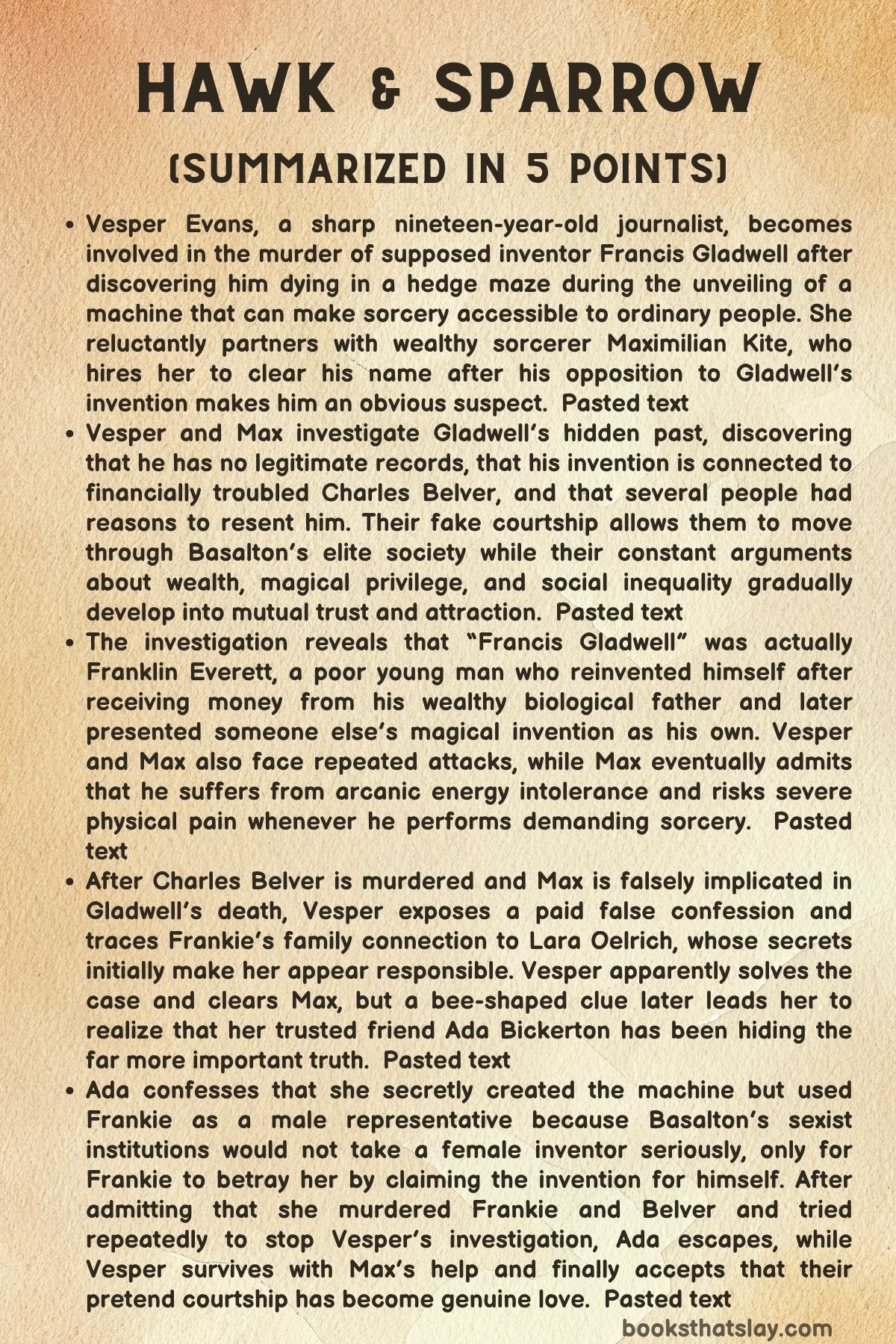
Vesper Evans arrives at the Basalton Museum of Art to report on an exclusive exhibition attended by the city’s wealthy elite. Because she publishes under the initials V. L. Evans, the guards initially doubt that the young woman standing before them could be the respected reporter they expected, forcing Vesper to prove herself through her sharp observational abilities.
Inside, Vesper learns that inventor Francis Gladwell is preparing to reveal the Gladwell Machine, while Maximilian Kite, wealthy heir to a prominent family, is hosting the evening. Before Vesper realizes his identity, she encounters Max near the desserts and finds him irritatingly confident, charming, and skilled with sorcery.
Gladwell announces that his machine can turn ordinary instructions into Thaumaric incantations. Because Thaumaric normally requires years of costly education, the invention could theoretically allow people without wealth or formal training to perform sorcery.
Max participates in the demonstration but becomes disturbed when Gladwell commands the machine to create a dragon of fire. The spell succeeds despite Gladwell’s poor pronunciation, convincing the audience of the device’s potential while alarming Max, who believes dangerous magical power should not be used without understanding the language and science behind it.
Vesper later confronts Max in the museum’s hedge maze and secures an interview. Their disagreement over the machine immediately exposes their conflicting perspectives: Vesper sees wider access to sorcery as a possible way to reduce inequality, while Max fears that powerful magic in untrained hands could cause disaster.
Soon afterward, Vesper discovers Gladwell in the center of the maze, confused, sweating, and convulsing. She leaves briefly to find help, but when she returns with Max, Gladwell has suffered a head wound and is dead. A champagne bottle Vesper previously saw near him has disappeared, and Chief Frederick Stettner declares the death a murder.
The following day, Vesper learns that the Gladwell Machine prototype is also missing. Her own red notebook has vanished as well, though Max soon reveals that he found it in the maze and deliberately kept it so that he could arrange another conversation with her.
Vesper regards Max as a plausible suspect because of his dislike of the invention, his presence near the murder scene, and his ability to use sorcery. Max argues that his open disagreement with Gladwell makes him too obvious a culprit and proposes hiring Vesper to identify the true murderer before suspicion ruins his reputation. She initially refuses, unwilling to become another person whose talents can simply be purchased by wealth.
Her position changes when she learns that the Basalton Globe, the newspaper that became her home after childhood tragedy and homelessness, is facing financial collapse. Desperate to save it, she accepts Max’s offer in exchange for thirty thousand gild.
To justify their constant appearances together among Basalton’s elite, Max spreads the story that he is courting Vesper. The false romance gives her access to suspects and social gatherings that would otherwise remain closed to a working-class female reporter.
Their first major search takes them to Gladwell’s hotel suite, where they find evidence that someone else has already searched the room. They discover sketches, a bee-shaped hatpin, and a letter from Charles Belver offering Gladwell ten thousand gild for rights connected to the machine.
When police arrive, Max helps Vesper escape by jumping from the sixteenth-floor balcony and using sorcery to slow their fall. Vesper notices afterward that the exertion has made him physically ill, though he refuses to explain why.
At the library, Vesper uncovers a more disturbing problem: Francis Gladwell apparently has no legal past. He is absent from normal inventor records and even from the magical Book of Vital Records.
The discovery indicates that Francis Gladwell is a fabricated identity. Vesper also realizes that members of the Thally Rousers, a criminal organization active in Basalton, have begun watching her.
Vesper and Max continue investigating while pretending to court. At a polo gathering, Ada Bickerton tells Vesper that Gladwell had been involved in a scandal with Elizabeth “Bess” Duxley, whose reputation suffered far more than his did.
Bess becomes a possible suspect because she had reason to resent Gladwell and was present in the museum maze on the night of his death. Yet Vesper also witnesses the restrictions placed on women when Ada admits that formal magical education remains largely closed to them.
A runaway winged horse nearly kills Vesper during the gathering, and Max saves her with sorcery at considerable physical cost. Later, Vesper confronts Bess about the maze, but although Bess is evasive, Vesper gradually comes to believe that she is hiding personal pain rather than murder.
Max remains convinced that Charles Belver is responsible. Belver had once served as trustee of Max’s inheritance and was dismissed after Max discovered financial misconduct, giving Max personal reasons to distrust him.
Vesper later believes she sees the supposedly dead Gladwell alive on the street. Her confusion deepens while she searches patent records and learns that Gladwell filed a patent for his machine and withdrew it the very next day—the same day he was murdered.
The discovery suggests that control of the invention changed immediately before Gladwell’s death. Meanwhile, Max apologizes for an earlier argument and takes Vesper to the opening of Belver’s private aviary.
There Vesper hears about the chestnut sparrow, a small but intelligent bird that survives through adaptability and resourcefulness. She sees herself in the description, while she associates Max with the powerful hawk, recognizing how differently the two move through their world despite their growing attachment.
Their investigation becomes dangerous when someone locks them inside the aviary and releases a giant predatory teratorn. Vesper develops a strategy based on the bird’s limitations while Max uses sorcery to help them escape.
Vesper later searches Belver’s office and finds evidence that he is nearly bankrupt. More importantly, she discovers the missing machine prototype hidden there along with a technical journal.
Belver catches enough of her intrusion to understand that she is investigating him. His apparent motive, possession of the prototype, financial desperation, and connection to Gladwell make him seem increasingly guilty.
Yet the case changes again when Belver is shot dead at a farmers’ market. His murder removes the strongest suspect and indicates that someone else may have been eliminating people connected to the machine.
Around the same period, Vesper learns more about the limitations imposed on wealthy women through Ada, whose father intends to force her into marriage with the much older Melvin Calhoun. Even Ada’s money cannot guarantee control over her life because marriage could transfer much of her property and independence to her husband.
Vesper finally catches the man she mistook for Gladwell and learns that he is Stanley Dawson, Gladwell’s older half brother. Stan reveals that the victim was actually Franklin, or Frankie, a poor young man from Shalescreek who suddenly began receiving large amounts of money and reinvented himself as a member of high society.
Stan also remembers Frankie associating with the Thally Rousers. Soon afterward, Vesper receives an anonymous death threat warning her to stop investigating.
Vesper and Max enter Shalescreek and deliberately attract the attention of the Rousers. They are captured and taken to the gang’s leader, Josephine Thalheimer, known as Thally.
Thally explains that Frankie approached the gang shortly before his death asking them to invest in the machine. She rejected him after realizing that he could repeat a polished sales pitch but could not explain the invention itself, proving that Frankie was almost certainly not its real creator.
A catastrophic factory fire interrupts their investigation. Workers, including women and children, are trapped because exits were locked by owners more concerned with discipline and profit than safety.
The disaster forces Vesper to relive memories of the childhood fire that killed her parents and younger sister Ethel. Max, despite his increasing physical weakness, performs powerful sorcery to help suppress the flames and protect people in danger.
During the resulting lockdown, Vesper stays at Kite Manor and discovers Max suffering from severe pain. He finally admits that he has arcanic energy intolerance, meaning that the powerful magic expected from him causes migraines, seizures, and other dangerous reactions.
Max has hidden the condition because he fears being judged as inadequate for the Kite name. He also reveals that his parents died during the disastrous maiden voyage of an experimental dirigible, explaining why uncontrolled innovation frightens him so deeply.
Vesper responds by sharing the story of her own family’s deaths and the survivor’s guilt she has carried since childhood. Their mutual vulnerability changes their relationship, and Max asks permission to give Vesper her first kiss.
Their growing romance is interrupted when Ada is attacked and the technical journal taken from her. The theft proves that someone still active in the conspiracy considers the document dangerous.
Soon afterward, Max is arrested after Nick Bartolucci claims Max paid him to kill Gladwell. Vesper questions Nick and quickly identifies contradictions in his account.
Nick admits that he was paid to confess because his infant son needs treatment for tuberculosis. He also reveals that Frankie’s true surname was Everett, allowing Vesper to discover through the Book of Vital Records that his father was John Everett Oelrich.
Vesper sets a trap for Lara Oelrich, whose husband fathered Frankie outside marriage. Lara appears to retrieve a supposedly recovered journal, confirming that she has something to hide.
Lara admits that Frankie had blackmailed John Oelrich for large monthly payments and that his death benefited the family. Her violent attack on Vesper seems to settle the case, and because Chief Stettner has been listening nearby, Lara is arrested while Max is cleared.
At a winter ball at Kite Manor, Max presents Vesper with a book containing every article she has written for the Globe. The gift reveals that he respects the part of her identity she values most: her work as a journalist.
Their romantic feelings become undeniable, but Vesper remains anxious about the gulf between their social positions. While speaking with Ada outside, she notices Ada’s honeybee bracelet and remembers the bee-shaped hatpin found in Frankie’s hotel suite.
Ada then reveals the final truth. Vesper solved Lara’s conspiracy but not Frankie’s murder.
Ada herself designed the machine, which she called the Illuminator. Knowing that a woman would struggle to obtain patents, investors, education, or respect, she used Frankie as a male public representative who could move through spaces closed to her.
Frankie eventually betrayed Ada by filing the patent under his own name and arranging a partnership with Belver. Ada poisoned him with paint thinner and, when the poison did not kill him quickly enough, struck him with the champagne bottle.
She also murdered Belver, caused the runaway horse, released the teratorn, and sent Vesper the threatening clipping. What initially seemed like separate dangers were attempts to frighten Vesper away from discovering Ada’s role.
Vesper understands the injustice Ada has experienced but refuses to treat discrimination as justification for killing people. Ada responds by forcing her onto the frozen lake at gunpoint, where the ice breaks beneath Vesper.
Max reaches her and uses sorcery despite the danger to his own body, pulling her from the freezing water. Ada escapes Basalton and becomes a wanted fugitive, while Max later establishes a foundation supporting innovators, particularly women, so that future inventors will have opportunities Ada was denied.
By early December, Vesper’s life begins to stabilize. Tom reveals that an anonymous benefactor has paid the Globe’s rent for five years, and Vesper correctly suspects Max.
Max later arranges to meet her at Guillermo’s Coffeehouse, where he gives her expensive fountain pens engraved with her initials and a raspberry tartlet that he learned to bake without sorcery because it reminds her of happier memories with her family. More importantly, he asks whether their false courtship can become real.
Vesper still worries that society will judge their differences in class and background, but Max tells her that the qualities she once feared would make her unacceptable are precisely the qualities he loves. She accepts him, they confess their love, and their investigative partnership becomes a genuine relationship founded not on the roles society assigned them but on the people they have learned each other to be.
Characters
Vesper Evans
Vesper Evans is the central character of Hawk and Sparrow, defined by intelligence, persistence, observational skill, and a refusal to accept social assumptions about what a young working-class woman should be capable of doing. Journalism is more than a profession for her because the Globe gave her security and purpose after the deaths of her parents and sister left her homeless.
Her strongest quality is her ability to notice details other people dismiss. The false diamond, Deakins’s allergy, inconsistencies in Nick Bartolucci’s confession, Frankie’s missing records, and Ada’s bee symbol all become meaningful because Vesper approaches investigation as a disciplined process rather than simply relying on intuition.
Vesper’s personal development also involves confronting survivor’s guilt. She has spent years believing that surviving the fire somehow created an obligation to remain strong, useful, and constantly productive, while memories of Ethel continue to shape her fears.
Her relationship with Max challenges her assumptions about privilege. She initially sees him primarily as an arrogant representative of the wealthy sorcerous class, but she gradually recognizes his compassion, vulnerability, and willingness to suffer for other people.
Maximilian Kite
Maximilian Kite initially appears to represent everything Vesper distrusts: inherited wealth, social authority, magical education, and effortless entry into elite spaces. Yet Hawk and Sparrow gradually reveals that these advantages coexist with grief, responsibility, fear, and serious physical limitations.
His suspicion of the Gladwell Machine first appears elitist because he believes people should not wield extraordinary magical power without understanding it. The death of his parents in an experimental dirigible disaster later reveals that his position is partly shaped by traumatic experience rather than simple contempt for ordinary people.
Max’s arcanic energy intolerance is especially important to his characterization. He has built an image of effortless magical competence while privately enduring severe physical consequences whenever he performs demanding sorcery.
The repeated occasions on which he risks those consequences for Vesper, factory workers, and strangers demonstrate that his courage is not the absence of vulnerability. His relationship with Vesper also encourages him to abandon the belief that strength depends on appearing invulnerable or living up perfectly to the Kite family legacy.
Ada Bickerton
Ada Bickerton is one of the book’s most complex figures because she begins as Vesper’s sympathetic friend and ultimately emerges as the murderer. In Hawk and Sparrow, Ada embodies both the genuine injustice inflicted on talented women and the moral danger of deciding that suffering grants permission to harm others.
Ada possesses the intelligence required to create the Illuminator, yet her society gives her little realistic possibility of being recognized as its inventor. Even her privileged social status cannot free her from gender restrictions, as demonstrated by her father’s intention to marry her to Melvin Calhoun and the possibility that marriage will reduce her independence.
Her use of Frankie as a male representative is therefore understandable as a response to structural exclusion. The moral break occurs when betrayal turns her resistance into violence.
Ada murders Frankie and Belver and repeatedly endangers Vesper rather than accepting the loss of control over her invention. Vesper’s refusal to excuse her is crucial because it acknowledges that injustice can explain Ada’s desperation without making murder ethically acceptable.
Francis Gladwell / Franklin “Frankie” Everett
Frankie is the victim around whom much of Hawk and Sparrow is constructed, but the investigation steadily dismantles the identity of “Francis Gladwell.” What initially appears to be the story of a successful inventor becomes the story of a poor man who reinvented himself through money, performance, secrecy, and access to other people’s work.
Born Franklin Everett, Frankie grows up with limited opportunity and later receives payments from his biological father, John Oelrich. That money allows him to construct the image of Francis Gladwell and enter social circles that previously would have excluded him.
His relationship with Ada is central to his moral failure. Ada needs a respectable male representative because society denies her recognition, but Frankie eventually treats the invention as his own property, filing the patent in his name and negotiating with Belver.
Frankie is therefore both someone shaped by inequality and someone willing to exploit another disadvantaged person once he gains access to power. His fabricated identity makes him a fitting figure in a novel concerned with the difference between social appearances and hidden realities.
Charles Belver
Charles Belver appears for much of the investigation to be the obvious villain. He has financial difficulties, a history of stealing from Max’s inheritance, an interest in acquiring rights to the machine, possession of the missing prototype, and a hostile reaction when Vesper searches his office.
His role is important precisely because the evidence against him is persuasive without proving that he killed Frankie. Belver demonstrates how a person can be corrupt, selfish, and deeply involved in suspicious dealings without being responsible for every crime associated with those dealings.
His decision to pursue a partnership involving Ada’s machine nevertheless helps create the conflict that leads to his own death. Ada sees him as part of Frankie’s betrayal, and his murder ultimately reveals that the conspiracy is larger than Vesper’s early theory can explain.
Lara Oelrich
Lara Oelrich functions as a convincing false solution to the murder because she truly does possess damaging secrets. Her husband John fathered Frankie outside their marriage, and Frankie later demanded substantial financial support from him.
Lara’s hostility toward Frankie and willingness to attack Vesper prove that she is capable of violence and desperate to protect her family’s reputation. Her behavior makes Vesper’s accusation reasonable even though Lara is not the person who actually killed Frankie.
Her arrest also demonstrates one of the investigation’s central lessons: solving one hidden relationship does not necessarily explain an entire crime. Lara has something serious to conceal, but Ada’s secret exists beneath hers.
Chief Frederick Stettner
Chief Stettner represents professional law enforcement and serves as both an ally and obstacle to Vesper. He recognizes her intelligence and occasionally shares information with her, but he also repeatedly insists that she stop interfering with official police work.
His frustration is justified because Vesper breaks into restricted places, questions suspects independently, and sometimes withholds important evidence. Yet the investigation also shows why Vesper keeps acting outside formal channels: she notices connections the police miss and can move through social spaces inaccessible to conventional investigation.
Stettner is therefore not presented simply as an incompetent authority figure. His relationship with Vesper is based on tension between procedure and unconventional intelligence, and their temporary loss of trust after her questioning of Nick demonstrates the cost of her methods.
Tom
Tom is one of the emotional anchors of Vesper’s life. He represents the Globe not merely as an employer but as the institution that gave her belonging when she had nowhere else to go.
His concern for the newspaper and for Vesper explains why she becomes so desperate to save it. Late in the story, his memory of discovering her sleeping outside the Globe as a homeless child reveals how long their bond has existed.
Tom also respects Vesper as a journalist rather than treating her only as someone in need of protection. That acceptance matters because much of the wider society repeatedly underestimates her because of age, gender, and class.
Elizabeth “Bess” Duxley
Bess initially appears suspicious because she was present in the maze when Frankie died and had been publicly humiliated by her association with him. Her damaged reputation gives her an obvious motive in a society that punished her far more harshly than it punished the man involved.
Vesper’s treatment of Bess reveals an important difference between investigation and judgment. Rather than assuming scandal equals guilt, Vesper observes Bess carefully and eventually recognizes that her secrecy comes from personal vulnerability.
Bess illustrates the gendered double standard that shapes Basalton. Frankie can continue moving through fashionable society after their scandal, while Bess becomes an object of ridicule, particularly from women such as Sarah Levant.
Stanley Dawson
Stanley Dawson provides the breakthrough that destroys the invented history of Francis Gladwell. As Frankie’s older half brother, he remembers the poverty from which Frankie emerged and witnesses his mysterious transformation after their mother’s death.
Stan does not share Frankie’s ambition to reinvent himself through elite society. His account gives Vesper access to the victim before the expensive clothing, invented identity, and Gladwell persona existed.
His information about the Thally Rousers also redirects the investigation toward Basalton’s criminal world. Most importantly, his existence explains why Vesper repeatedly believes she has seen the dead man alive.
Josephine “Thally” Thalheimer
Thally is an unusual parallel to Ada in Hawk and Sparrow because both women resist the restricted futures offered to them, but they choose radically different paths. Born into privilege, Thally escapes an unwanted marriage by accepting disinheritance and constructing power outside respectable society.
As leader of the Thally Rousers, she occupies a position women are rarely permitted to hold in Basalton’s legitimate institutions. Her criminal authority is morally complicated, yet she is perceptive enough to recognize almost immediately that Frankie does not understand the machine he is attempting to sell.
Her rejection of his proposal provides Vesper with decisive evidence that someone else created the invention. Thally therefore demonstrates how intelligence and authority can emerge outside socially approved institutions when those institutions refuse to accommodate unconventional people.
Nick Bartolucci
Nick Bartolucci initially threatens Max by confessing to Frankie’s murder and claiming that Max hired him. His story is deliberately designed to exploit existing suspicion against Max.
Vesper discovers that Nick is not motivated by hatred or criminal ambition but by desperation. His baby Walter has tuberculosis, and Nick accepts money to provide a false confession because he believes the payment could save his child.
His decision is dishonest and dangerous, but the circumstances prevent him from becoming a simple villain. Nick represents the way poverty makes vulnerable people available for exploitation by those with enough money to manipulate them.
Mrs. Cauble
Mrs. Cauble is the longtime housekeeper at Kite Manor and one of the people who knew Max before he became the controlled public figure Vesper encounters. Her presence gives Vesper access to a more domestic and vulnerable side of him.
Although she refuses to reveal the private story of Max’s parents because she believes it should come from Max himself, her restraint demonstrates loyalty rather than secrecy for its own sake. She respects his right to control his own painful history.
Mrs. Cauble also provides Vesper with comfort when she is stranded at the manor after the factory fire, creating a temporary sense of safety at a point when Vesper’s childhood trauma has been intensely reawakened.
Ida
Ida, the librarian, quietly becomes essential to Vesper’s investigation. By giving her access to the Book of Vital Records, she allows Vesper to establish first that Francis Gladwell has no recorded legal existence and later that Franklin Everett is connected to the Oelrich family.
Her role emphasizes the investigative power of records, archives, and people willing to help others obtain knowledge. While sorcery produces some of the novel’s most spectacular moments, several of Vesper’s most important breakthroughs come from patient research.
Ida therefore supports the book’s respect for intellectual work that is less dramatic but equally powerful.
Cliff Owen
Cliff Owen is a union leader whose assistance allows Vesper to reach records that Harold Deakins tries to keep beyond her reach. His willingness to help demonstrates that Vesper’s connections to working people are just as important to her investigation as Max’s access to wealthy society.
Cliff also belongs to the wider labor conflict running through Basalton. Through figures like him, the story shows organized workers trying to challenge institutions that treat them as disposable while reserving wealth and magical advantages for a small social class.
Sarah Levant
Sarah Levant represents the cruelty of elite social judgment. Her hostility toward Bess reinforces a culture in which women participate in policing other women’s reputations even when those standards ultimately restrict them all.
Her resentment toward Vesper is also connected to Max, whom Sarah had previously courted. Vesper’s confrontation with Sarah at the polo gathering demonstrates how observation and confidence allow her to defend herself and Bess without relying on wealth or magical status.
Richard
Richard serves as one of the principal representatives of the Thally Rousers before Vesper and Max meet Thally herself. His refusal to reveal information about Frankie, even when offered a valuable opportunity involving Max’s ruby brooch, demonstrates the gang’s caution and internal discipline.
His participation in capturing the investigators also reminds Max that family status and wealth cannot protect him in every part of Basalton. Richard helps move the investigation outside respectable society and into a world where different forms of authority operate.
Harold Deakins
Harold Deakins is a minor but revealing antagonist. His open contempt toward Vesper and deliberate obstruction of her patent-record request demonstrate how bureaucratic systems can reinforce prejudice without needing dramatic violence.
Vesper defeats him not through official influence but by understanding his weaknesses and improvising. Her use of his cat allergy to remove him from the archive is humorous, yet the larger situation is serious: someone with administrative power can deny a capable woman access to information simply because he does not respect her.
Elmer
Elmer is the custodian arranged by Cliff Owen to help Vesper enter City Hall. His assistance reflects the informal networks that allow working people to help one another when formal institutions refuse them fair treatment.
Although his role is small, he contributes to one of Vesper’s most important discoveries by helping her reach the patent archive where she learns that Frankie withdrew his application on the day he died.
Lloyd
Lloyd nearly exposes Vesper while she is disguised as a male cleaner inside City Hall. Their shared Calidan background and recognition of a familiar cultural story persuade him to protect her instead.
His brief appearance shows how identity and community can create trust across otherwise dangerous circumstances. For Vesper, that connection becomes another example of support emerging from people outside Basalton’s powerful institutions.
Melvin Calhoun
Melvin Calhoun is less important as an individual personality than as the future Ada fears. At fifty-seven, he is the banker Ada’s father intends her to marry despite her lack of desire for the match.
The proposed marriage demonstrates that wealth does not automatically give women autonomy. Ada faces the possibility of choosing between inheritance and independence, and Melvin therefore represents the socially approved structure from which she feels increasingly desperate to escape.
John Everett Oelrich
John Oelrich is the biological father of Frankie and the connection that eventually leads Vesper toward Lara. His affair with a poor Shalescreek woman creates a secret that the wealthy Oelrich family later pays heavily to conceal.
By financing Frankie after the death of Frankie’s mother, John unintentionally provides the money that allows his son to reinvent himself as Francis Gladwell. His secrecy demonstrates how the wealthy can use money to conceal consequences while people with fewer resources live openly with theirs.
Ethel Evans
Ethel, Vesper’s younger sister, is dead before the central events of the novel, but her presence remains powerful through Vesper’s memories. Vesper’s inability to save Ethel during the childhood fire becomes the center of her survivor’s guilt.
Memories of Ethel help explain why fire is so psychologically destructive for Vesper and why she feels such a strong obligation to protect other people. Her eventual willingness to speak openly about the tragedy with Max marks an important movement away from carrying that grief entirely alone.
Themes
Inequality, Privilege, and Access to Power
The struggle over who is allowed to possess sorcery drives much of Hawk and Sparrow. Thaumaric education requires money, time, and institutional access, meaning that magical ability is not simply a natural talent but something controlled by social structures.
Vesper therefore sees the Gladwell Machine as potentially revolutionary. If ordinary people can create incantations without years of expensive schooling, workers and poorer citizens may gain access to powers previously reserved for wealthy sorcerers.
Max sees the same invention differently because he understands the technical complexity behind sorcery and has experienced the consequences of failed experimentation through his parents’ deaths. His fears are not entirely wrong, yet Vesper correctly recognizes that safety arguments can also become convenient reasons for privileged people to preserve their monopoly.
The novel refuses to reduce the issue to a choice between unrestricted access and permanent elite control. Ada’s Illuminator genuinely could challenge inequality, but the circumstances surrounding its creation show what happens when talented people are excluded until secrecy and resentment become part of innovation itself.
Power also appears through money, bureaucracy, journalism, criminal networks, and personal relationships. The story repeatedly asks whether powerful tools should remain concentrated among supposedly responsible elites or become accessible even when wider access creates new risks.
Gender and the Struggle for Autonomy
Women across different social classes face restrictions that shape nearly every part of the story. Vesper is dismissed by guards, obstructed by Deakins, and treated as an unusual presence in spaces dominated by wealthy men, yet she continually proves that institutional exclusion says nothing about actual ability.
Ada’s situation reveals that privilege does not eliminate gendered control. She has money and education but cannot freely build a career as an inventor, secure recognition for her work, or reject the marriage her father intends without risking her financial future.
Bess experiences another version of the same inequality. Her relationship with Frankie damages her reputation while he remains socially mobile, demonstrating that sexual scandal carries dramatically different consequences depending on gender.
Thally represents resistance through rejection of respectable society. She gives up inheritance rather than accept an unwanted marriage and constructs authority in the criminal world, suggesting that women sometimes obtain freedom only by leaving legitimate structures altogether.
These women respond differently to limitation. Vesper challenges restrictions through journalism, Thally chooses independence outside conventional society, Bess endures public judgment, and Ada eventually turns to manipulation and murder. Their different choices prevent oppression from becoming an excuse that automatically determines morality.
Identity, Performance, and Hidden Truth
Almost every major figure maintains some kind of constructed identity. Francis Gladwell does not legally exist at all; he is Franklin Everett presenting himself as a wealthy inventor so convincingly that Basalton society accepts the performance.
Max performs effortless confidence while hiding a condition that makes powerful sorcery physically dangerous. Vesper publishes under initials that cause strangers to assume the journalist behind her articles must be a man, revealing how readers construct identities from their own expectations.
Their fake courtship adds another layer. What begins as a strategic performance gradually becomes emotionally genuine, creating a situation in which a lie expresses feelings before either participant is prepared to acknowledge them openly.
Ada performs friendship while secretly monitoring Vesper’s investigation and attempting to frighten her away. Lara appears to be the murderer because the secrets she hides are real even though they conceal a different wrongdoing.
The mystery therefore depends not only on discovering evidence but on separating appearances from underlying motives. Vesper succeeds because she repeatedly asks whether the story presented to her actually fits the facts. Identity becomes something people construct for survival, status, protection, manipulation, or love, and the moral significance of those performances depends on what they are intended to hide.
Trauma, Trust, and Choosing a Future
Both Vesper and Max carry past losses that affect how they interpret the present. Vesper survives the fire that kills her family and develops survivor’s guilt centered on Ethel, while Max loses his parents in an experimental dirigible disaster and becomes deeply suspicious of powerful innovations whose consequences cannot be controlled.
Their disagreements over the Illuminator are therefore partly arguments between two people whose beliefs have been shaped by different catastrophes. Vesper associates unequal access with vulnerability because poverty once left her with almost nothing, whereas Max associates uncontrolled technological power with irreversible loss.
Their relationship changes when they stop debating only through ideology and begin revealing the experiences beneath those beliefs. Max admits the truth about his arcanic energy intolerance, and Vesper speaks about the fire, homelessness, and guilt she has carried for years.
That mutual honesty transforms the false courtship into genuine intimacy. Neither character fixes the other’s trauma, but each creates a relationship in which weakness no longer has to be hidden.
By the conclusion of Hawk and Sparrow, hope comes through deliberate choices rather than the disappearance of pain. The Globe survives, Max supports innovators excluded by existing institutions, and Vesper begins imagining a future beyond constant survival. Their romance matters because both decide that inherited expectations, class boundaries, old grief, and fear do not have to dictate what their lives become.