Die for Me Summary, Characters and Themes
Die for Me by Shirlene Obuobi is a supernatural romance centered on Dr. Sean Sullivan, an accomplished cardiologist whose carefully controlled life changes after she meets the charismatic Julian Conrad.
What begins as an intense attraction gradually becomes stranger as dreams, illness, physical dependence, and unexplained aging reveal that Julian is far from ordinary. The novel combines romance, medical drama, psychological tension, and supernatural mythology while asking difficult questions about consent, mortality, trust, and personal freedom. At its center is a woman who has survived controlling love before and must decide whether extraordinary devotion can exist without costing her the independence she fought to regain.
Summary
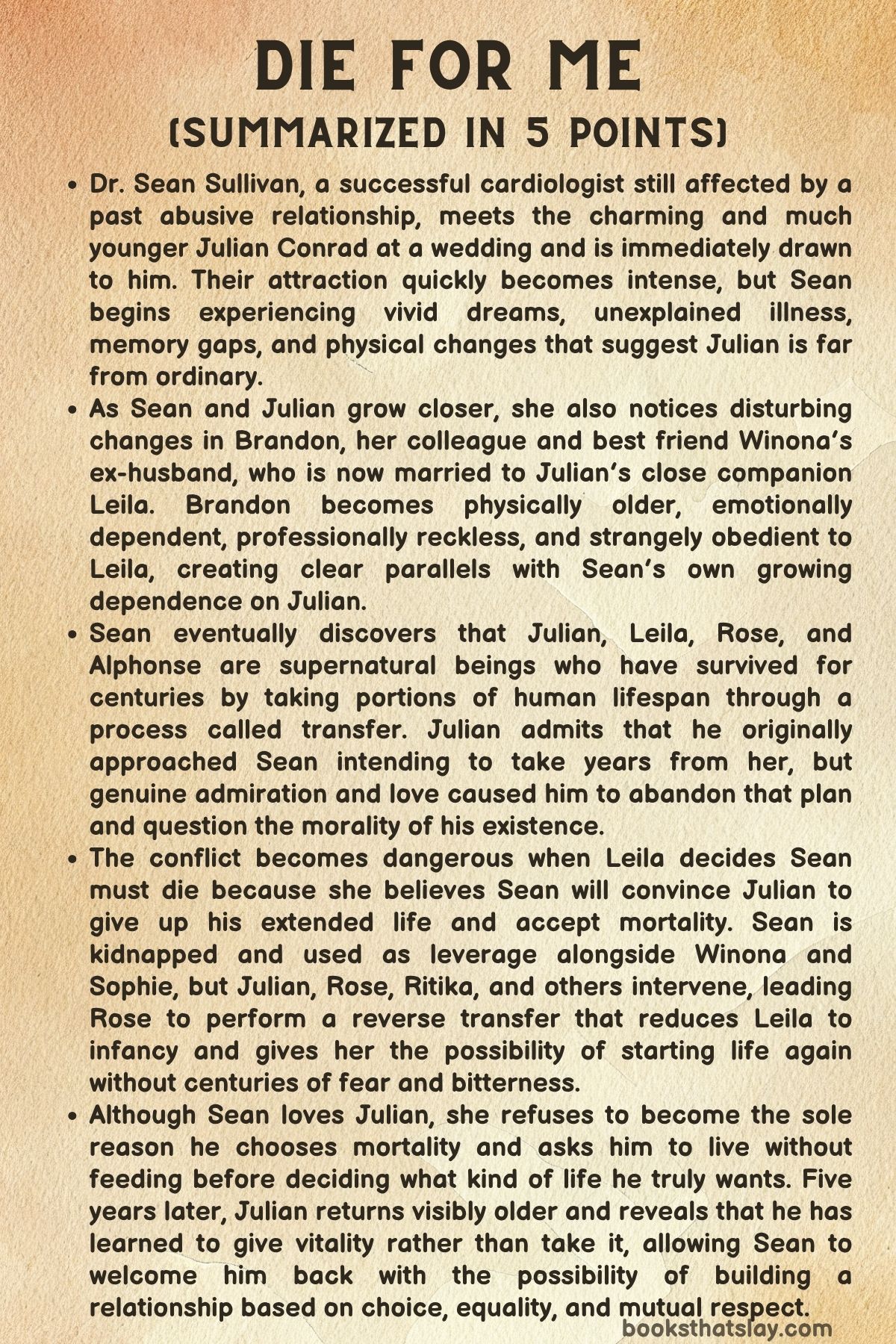
Dr. Sean Sullivan is a thirty-eight-year-old interventional cardiologist attending the wedding of her colleague Brandon Pendersen and his second wife, Leila. The event is uncomfortable because Brandon’s ex-wife, Winona, is Sean’s closest friend, and Sean remains angry about the affair that ended their marriage; however, she attends for the sake of Brandon and Winona’s daughter Sophie, whose godmother she is.
At the reception, Sean notices Julian Conrad, Leila’s strikingly attractive man of honor. Julian impresses her not only through his appearance but through the sensitivity he shows toward Sophie, openly recognizing that Leila’s marriage to Brandon cannot erase Sophie’s loyalty to her mother.
Later, Sean escapes to a quiet room and begins playing a neglected piano. Julian joins her, improvising beside her with an ease that makes their connection immediate, and the encounter nearly ends in a kiss before Sophie interrupts them.
Sean resists Julian partly because he is eleven years younger, but he refuses to treat the age difference as significant. She also worries that becoming involved with Leila’s closest friend could somehow betray Winona, yet Winona dismisses the concern and encourages Sean to enjoy a connection that clearly excites her.
Soon Julian begins appearing in Sean’s dreams with disturbing regularity. These dreams feel unusually vivid, and dream-Julian sometimes seems aware that Sean is asleep, creating the first indication that their attraction is operating beyond normal physical reality.
When Sean encounters Julian again at the hospital coffee shop, he finally obtains her phone number and invites her to an art-gallery opening. At the same time, Brandon’s behavior becomes increasingly alarming: he cancels his honeymoon, works compulsively, appears exhausted, and makes a dangerous mistake during a cardiac procedure that forces Sean to intervene.
Seeking distraction, Sean accepts Julian’s invitation. At the gallery she discovers that he belongs to a wealthy, influential family, supports artists and entrepreneurs, and possesses a sophisticated understanding of people.
One painting particularly disturbs Sean: “The Recurring Nightmare,” depicting a beautiful man looming over a distressed woman. The exhibition’s interest in mortality and immortality seems merely artistic at first, but it later becomes an important clue to Julian’s true nature.
Sean and Julian’s physical attraction becomes increasingly difficult to control. Yet Sean remains cautious because her former fiancé, Eric, subjected her to years of emotional manipulation, infidelity, and control, leaving her determined never again to lose herself inside a relationship.
Julian initially appears to respect that independence. He listens when Sean challenges his privilege, accepts her decision not to have children, and agrees that she should not have to sacrifice her career or identity for a partner.
Their relationship gradually becomes serious. Julian learns Sean’s daily routines, brings her food during difficult shifts, exercises with her, supports her after painful medical cases, and responds compassionately when an encounter with Eric’s brother Jared triggers memories of Sean’s abusive past.
Sean eventually tells Julian the full story of Eric, including the psychological damage of their eight-year relationship and the devastating personal losses surrounding its end. Julian, in turn, speaks of Claire, a woman he loved long ago and supposedly lost tragically.
Although Sean increasingly feels safe with Julian, unsettling signs continue. His eyes sometimes appear unnatural, physical intimacy produces distorted sensations and memory gaps, and Sean periodically becomes inexplicably ill when separated from him.
When Julian abruptly distances himself after an intimate conversation, both he and Sean become severely sick. Medical tests cannot explain Sean’s symptoms, but she rapidly recovers after visiting Julian and touching him again.
Their reunion ends in sex, during which Sean simultaneously experiences Julian physically and inside the strange dream-space that has followed their relationship. Dream-Julian repeatedly urges her to say that she belongs to him, and Sean eventually does so without understanding the significance of the surrender.
Soon afterward, Sean sees Julian apparently influence a woman named Melody into surrendering her phone and obeying his instructions. She cannot explain what she has witnessed, and further warning signs follow when Leila similarly commands Brandon and he obeys with an eerily vacant expression.
Sean then discovers that her hair has grown abnormally quickly and turned white. She begins to suspect that her relationship with Julian is changing her body in ways that cannot be explained through ordinary medicine.
Despite her fears, Julian continues behaving as a devoted boyfriend, and Sean consciously commits to the relationship. Three months later, however, their sexual relationship has nearly stopped because Julian repeatedly refuses physical intimacy.
When Sean confronts him, Julian admits that the problem is not lack of attraction but overwhelming desire. They begin having sex, but he suddenly stops and ends the relationship with an explanation about age, marriage, and children that Sean finds devastating and unconvincing.
After the breakup, Sean’s health deteriorates so severely that the symptoms resemble drug withdrawal. She recognizes that every separation from Julian has produced illness while renewed contact has brought rapid recovery.
Meanwhile Brandon has aged dramatically and developed increasingly dangerous personality and professional changes. A hospital evaluation reveals a frontal-lobe tumor, but Brandon also confesses that he became obsessed with Leila before leaving Winona, dreamed constantly about her, and felt that he needed her in a way he could not control.
Sean immediately recognizes the similarities between Brandon’s relationship with Leila and her own relationship with Julian. Her investigation eventually leads her back to “The Recurring Nightmare” and the mythology of incubi and succubi, supernatural beings associated with dreams, seduction, and the draining of human vitality.
Searching for proof, Sean enters the private collection of Julian’s family gallery. There she discovers recurring images of Julian, Leila, their friend Rose, and the supposedly dead Alphonse appearing in artwork created across hundreds of years.
The evidence confirms that they have existed far beyond ordinary human lifespans. Julian’s assistant Ritika secretly gives Sean an invitation from Rose, who wants Sean to find Julian.
At Rose’s exhibition, Sean discovers that the artist Margaret West is actually Rose herself. Rose openly confirms that beings such as herself and Julian survive by taking life from others.
Violence then erupts when a man attacks Rose. Sean watches Rose drain his life within seconds, becoming younger while he ages and dies.
Julian rescues Sean and finally reveals the truth. He, Leila, Rose, and Alphonse have survived for centuries by performing what they call transfers, taking portions of human lifespan in order to remain young and alive.
Julian explains that intimacy, emotional attachment, and willing surrender make transfers more powerful. He also admits that his kind can cultivate intense devotion and influence people, although their abilities do not amount to simple mechanical mind control.
Sean is horrified by the ethical implications because a person can agree to intimacy without knowing that years of life are being taken. Julian admits that the practice is morally compromised and says he has spent years limiting the amount he takes.
More painfully, Julian confesses that he originally approached Sean intending to exploit her. She appeared independent, childless, and unlikely to leave behind people who would notice the theft of a few years.
His plan changed after he came to know her. Her music, intelligence, loyalty to Sophie, professional passion, and resistance to his charm turned predatory interest into admiration and eventually love.
Sean also learns that Alphonse once chose a different path. Rather than continually extending his existence, he stopped feeding, aged beside his human partner Mary, raised a family, and died an ordinary old man.
Julian reveals that he once intended to make the same choice with Claire, the human woman he loved centuries earlier. Her murder destroyed that future and convinced him that remaining detached from ordinary human life was safer.
Sean has changed his thinking again. Julian now wants to stop feeding and accept mortality because a finite life with her feels more meaningful than centuries without her.
Sean admits that she loves him, but their problem is not solved. Leila sees Julian’s willingness to become mortal as a betrayal of their supernatural family and decides Sean must die.
Julian attempts to buy Sean’s safety with an enormous financial offer, while Sean hides at Alphonse’s former cottage with Ritika. Leila nevertheless finds them, injures Ritika, kidnaps Sean, and reveals that Brandon has died.
Leila uses Winona, Sophie, and Sean’s dog Onix as leverage. Sean agrees to surrender herself in order to protect them but secretly retains a hidden tracking device Julian gave her.
At a remote cabin, Leila explains that killing Sean is ultimately about saving Julian from mortality. She believes that choosing an ordinary lifespan is equivalent to suicide and cannot understand why her brothers would abandon centuries of existence for human love.
Sean rejects that logic. As a doctor who has spent her life watching people die too young, she believes growing old is a privilege rather than a tragedy.
Sean fights Leila, but Leila heals herself by draining life from another devoted follower and threatens to kill Sophie and Winona. Julian arrives before Sean can be murdered, yet Leila retains control of Sophie.
The final intervention comes from Rose. Pretending to support Leila, Rose persuades her to release the humans and then performs a reverse transfer, sacrificing years from her own body while reducing Leila to infancy and erasing the memories that shaped her into the person she had become.
Rose intends to give her sister a genuine new beginning.
Although Sean survives, she does not immediately reunite with Julian. She refuses to become the sole reason he abandons centuries of supernatural life, because that would place the meaning of his existence on her shoulders.
She asks Julian to experience ordinary vulnerability and mortality for himself before deciding what he truly wants. He accepts her decision, and they separate despite loving one another.
Five years later, Sean is living in Massachusetts near Winona and Sophie. Her life is peaceful and fulfilling, but she has never stopped loving Julian.
Then Julian appears at her door visibly older, proving that he has spent five years without extending his life. More remarkably, he has learned Rose’s reverse transfer and can now give vitality instead of taking it.
Julian has therefore made his choice independently rather than as an immediate sacrifice for Sean. She invites him inside, opening the possibility of a life together in which love no longer requires either person to surrender autonomy, morality, or years stolen from someone else.
Characters
Dr. Sean Sullivan
Sean Sullivan is the emotional and moral center of Die for Me. She is an accomplished interventional cardiologist whose professional confidence contrasts with the caution she carries into her private life after surviving years of emotional manipulation and control in her relationship with Eric.
Her medical career is essential to her characterization because it has trained her to value evidence, bodily autonomy, and the preservation of human life. That worldview makes the supernatural truth particularly difficult for her to accept and later makes Julian’s method of survival ethically impossible for her to ignore.
Sean is fiercely independent, but her independence is not presented as an inability to love. She wants intimacy while retaining her profession, routines, friendships, decisions about motherhood, and fundamental sense of self.
Her relationship with Julian therefore becomes a test of whether she can distinguish devotion from possession. Eric taught her that declarations of love can hide manipulation, and Julian’s supernatural influence makes that fear much more complicated because his affection is genuine even though his power can compromise another person’s freedom.
Sean’s strongest quality is her refusal to surrender moral judgment simply because she is in love. Even after Julian is willing to give up his extended life for her, she rejects a resolution that would make herself responsible for his entire reason for becoming mortal.
Her final decision demonstrates substantial growth. She allows herself to love Julian without either returning to the emotional isolation created by Eric or accepting a relationship in which love excuses ethically troubling behavior.
Julian Conrad
Julian is both romantic partner and supernatural threat, which makes him one of the most morally complicated figures in Die for Me. For centuries, he has survived by taking portions of human lifespan, and his enormous wealth, social skill, cultural knowledge, and sophisticated charm are products of an existence far longer than Sean initially understands.
His attraction to Sean begins dishonestly. He deliberately identifies her as someone who appears relatively safe to exploit, intending to charm her, take several years from her, and disappear before the consequences become obvious.
What changes Julian is not simply attraction but Sean’s resistance to being absorbed into his world. Her music, intelligence, medical commitment, loyalty to Sophie, and willingness to challenge his privilege force him to see her as a complete person rather than a convenient source of life.
His love consequently produces a moral crisis. Continuing his existing way of life means eventually harming Sean or other people, while abandoning it means accepting aging and death after centuries of avoiding both.
Julian’s protectiveness also remains deliberately ambiguous. He can be attentive, nurturing, and respectful of Sean’s stated boundaries, yet his supernatural abilities and intense possessiveness mean that care can easily approach control.
His final transformation requires more than choosing Sean. By spending five years experiencing mortality and learning how to give life rather than take it, he begins constructing an ethical identity that exists independently of romance.
Leila
Leila initially appears as Brandon’s younger second wife and Julian’s closest companion, but she eventually becomes the story’s principal antagonist. Her beauty, charm, and apparent warmth conceal a supernatural existence built around feeding on human attachment and extracting life.
Her relationship with Brandon demonstrates what Sean and Julian’s relationship could become without restraint. Brandon loses health, judgment, professional competence, independence, and eventually much of his physical youth while remaining unable to resist Leila.
Yet Leila is not motivated purely by cruelty. Her actions are shaped by centuries of fear, survival, and fierce loyalty toward the small supernatural family she has known for far longer than any ordinary human relationship can last.
Her hostility toward Sean ultimately comes from terror of losing Julian. Having already watched Alphonse choose mortality, she interprets Julian’s similar choice as another abandonment and sees Sean as the human influence leading him toward death.
This makes Leila’s understanding of love profoundly possessive. She wants her family to survive forever but refuses to accept that survival without freedom may become another kind of imprisonment.
Rose’s decision to reduce her to infancy is therefore significant. Rather than simply killing Leila, Rose attempts to free her from centuries of accumulated fear and give her the possibility of becoming someone different.
Winona
Winona serves as Sean’s emotional anchor and clearest example of lasting, nonpossessive love. Her marriage to Brandon has ended painfully, yet she remains capable of separating her anger toward him from her responsibility to Sophie and her affection for Sean.
She is particularly important because she encourages Sean to stop treating loyalty as a system of rigid restrictions. When Sean fears that dating Julian might somehow betray their friendship because of his connection to Leila, Winona gives her permission to pursue happiness without turning friendship into ownership.
Winona also understands the psychological damage Eric left behind. At times, she correctly reminds Sean that past abuse can cause a person to interpret ordinary uncertainty as evidence of hidden danger, even though Sean eventually discovers that some of her fears about Julian are justified.
Her support following Sean’s breakup shows the reciprocity of their relationship. Sean has previously supported Winona through Brandon’s betrayal, and Winona later uses Sean’s own wisdom to help her survive heartbreak.
By the ending, Winona has rebuilt her own life and remains part of Sean’s chosen family. Their friendship provides a stable emotional foundation against which the novel’s more dangerous forms of devotion can be measured.
Sophie Pendersen
Sophie represents the human consequences of the adults’ romantic and supernatural choices. As Brandon and Winona’s daughter and Sean’s goddaughter, she occupies the emotional center of several relationships without possessing control over the decisions that reshape her family.
Her response to Brandon’s marriage shows maturity and vulnerability at once. She is capable of developing genuine affection for Leila while remaining deeply loyal to her mother, demonstrating that emotional bonds do not have to function as replacements for one another.
Sophie also reveals Sean’s nurturing side. Sean does not want children of her own, yet her commitment to Sophie is profound, proving that rejecting motherhood as a personal life path does not make her emotionally detached from younger people.
During Brandon’s illness, Sophie’s fear forces Sean to confront the limits of medical certainty. Rather than promising that everything will be fine, Sean teaches her that hope can exist without guarantees.
Leila’s willingness to use Sophie as leverage later exposes the sharpest difference between protective and possessive love. For Sean, protecting Sophie means risking herself; for Leila, affection never prevents another person from becoming a tool.
Brandon Pendersen
Brandon begins as a man Sean resents because his affair with Leila destroyed his marriage to Winona. His behavior initially seems to support that judgment, especially as he becomes distracted, professionally reckless, emotionally distant from Sophie, and increasingly unstable.
The later revelations substantially complicate his moral position. His brain tumor offers a medical explanation for some of his personality changes, while his confession about compulsive dreams and overwhelming need for Leila reveals that he has also been subjected to supernatural influence.
Brandon therefore becomes a warning against interpreting every personal failure as evidence of simple moral weakness. Sean is disturbed when she realizes that colleagues, friends, and family judged his decline without recognizing how seriously ill he had become.
His relationship with Leila is also the darkest example of supernatural dependency. He becomes physically aged, psychologically submissive, and unable to recognize the danger posed by the person he loves.
Brandon remains responsible for choices made before the full extent of his decline, but the book refuses to reduce him to an unfaithful husband. His death turns him into one of the clearest examples of what unchecked supernatural desire can consume.
Rose Callahan / Margaret West
Rose is introduced under the public identity of Margaret West, an acclaimed artist fascinated by mortality, transformation, and perception. Her artwork quietly preserves supernatural history long before Sean understands that the recurring faces in those works belong to beings who have lived for centuries.
Unlike Leila, Rose possesses a more developed moral awareness about feeding. She still takes human life and is capable of terrifying violence, but she prefers predatory or violent men as targets and shows greater willingness to question the ethics of endless survival.
Her affection for Julian leads her to help Sean discover the truth rather than treating Sean simply as a threat. She recognizes that Julian’s love might offer him something meaningful enough to make mortality desirable.
Rose is also deeply loyal to Leila. This creates a conflict because she understands Julian’s wish to change but cannot simply abandon the sister who has protected their supernatural family across centuries.
Her reverse transfer resolves that conflict in an unexpected way. Rose gives Leila another childhood rather than another death, making sacrifice an act of creation rather than destruction.
Alphonse
Alphonse is dead before Sean learns the truth, yet his choices influence nearly every major supernatural conflict. He belonged to the same species as Julian, Leila, and Rose but ultimately rejected indefinite existence.
His relationship with Mary proves that their kind can stop feeding, age naturally, build a human family, and die. The photographs of Alphonse growing old beside Mary transform mortality from an abstract possibility into something Julian can realistically choose.
To Julian, Alphonse represents precedent and hope. To Leila, however, his decision represents abandonment, explaining why she reacts so violently when Julian begins considering the same path.
Alphonse therefore functions as evidence that immortality is not destiny. His ordinary aging becomes radical precisely because he chooses limitation after possessing the power to avoid it.
Ritika Ghoshal
Ritika initially appears as Julian’s capable professional assistant, but she gradually becomes one of Sean’s most important human allies. Her family has known Julian’s secret for generations, allowing her to interact with him without the fear or romantic obsession that shapes many other human relationships with supernatural beings.
Her connection to Julian demonstrates that informed consent is possible within his world. Members of the Ghoshal family knowingly exchange limited amounts of lifespan and years of service for financial security, creating a relationship that remains morally complicated but is fundamentally different from secretly taking years from uninformed partners.
Ritika also proves personally courageous. She helps Sean obtain information, protects secrets, accompanies her to the safe house, and suffers a severe injury when Leila discovers them.
Her friendship with Sean grows because she treats both Sean and Julian as people capable of making difficult choices rather than romantic symbols. She becomes an important bridge between the human and supernatural worlds.
Aditya Ghoshal
Aditya is less prominent than Ritika but reinforces the significance of the Ghoshal family’s long relationship with Julian. His involvement shows that knowledge of Julian’s true nature has been preserved across generations rather than remaining the burden of a single individual.
He also participates in the effort to protect Sean and support Ritika after Leila’s attack. His presence broadens the moral picture of Julian’s history by showing that some humans can know exactly what he is and still choose continued association with him.
Eric
Eric never dominates the present-day action, but his influence over Sean is extensive. Their eight-year relationship became emotionally abusive as he lied, cheated, manipulated her perception of events, and encouraged her to accept responsibility for his cruelty.
The relationship teaches Sean to associate intense romantic attachment with the gradual loss of personal autonomy. This history explains why Julian’s overwhelming charm frightens her even during moments when he appears kind and attentive.
Eric’s importance lies in the standards Sean develops after surviving him. She knows that affection cannot justify control and that forgiveness does not require renewed access to the person who caused harm.
His legacy therefore shapes Sean’s greatest strength and one of her greatest vulnerabilities. It helps her identify genuine threats, but it also makes trusting healthy affection much harder.
Jared
Jared, Eric’s brother, appears briefly but has an important psychological function. His unexpected presence triggers Sean’s memories of the abusive relationship, making the continuing effects of trauma visible even after Eric himself has left her life.
Julian’s response to this encounter matters more than Jared’s direct actions. Rather than forcing Sean to explain herself or treating her distress as irrational, Julian recognizes that she needs distance and helps her leave.
Jared later contacts Julian regarding artistic opportunities and speaks positively about Sean. His limited role therefore connects Sean’s painful past with the possibility that not every person associated with Eric must remain permanently defined by that history.
Claire
Claire is the human woman Julian loved centuries before meeting Sean. Her existence initially appears as part of a romantic tragedy from Julian’s distant past, but her history eventually explains why he has resisted mortality for so long.
Julian once intended to stop feeding, age naturally, and build a finite life with Claire. Her murder destroyed that future and reinforced his belief that attachment to humans could produce unbearable loss.
Claire therefore represents both Julian’s capacity for genuine love and the emotional wound that allowed him to rationalize centuries of detachment. Sean does not simply replace her; instead, Sean forces Julian to confront the fear created by Claire’s death and decide whether love remains worth the risk of mortality.
Mary
Mary is Alphonse’s human partner and provides the clearest historical model for the future Sean and Julian might eventually build. Through her relationship with Alphonse, supernatural longevity gives way to ordinary aging, parenthood, family, and death.
Her importance comes from the life she and Alphonse actually completed rather than from dramatic actions in the present. The photographs of their years together prove that choosing mortality does not merely mean choosing death; it means choosing all the human experiences that become meaningful because time is limited.
Robbie
Robbie is one of Leila’s devoted human followers and demonstrates the dangerous extreme of supernatural influence. A former Navy SEAL, he becomes both weapon and source of life for Leila, carrying out her orders while appearing completely committed to her.
His role shows how devotion can erase ethical independence when power is used without restraint. Leila not only directs his violence but also drains his lifespan when she needs to heal, reducing him to something useful rather than treating him as an autonomous person.
Julian eventually kills Robbie while rescuing Sean. His death then becomes part of Sean’s moral reckoning because she understands that a future with Julian cannot simply ignore the human lives lost in the process of protecting her.
Melody
Melody is a relatively minor character whose confrontation with Julian provides Sean with one of the first undeniable demonstrations of supernatural power. After mocking Sean’s age and photographing her, Melody is touched by Julian and becomes unnaturally compliant.
The incident matters because it breaks Sean’s ability to explain Julian entirely through charm or social skill. Watching another person’s will seemingly disappear confronts her with the possibility that attraction and consent around Julian may be much more complicated than she believed.
Alicia
Alicia’s brief flirtation with Julian serves primarily to reveal how completely his attention has shifted toward Sean. Julian responds coldly and clearly identifies Sean as his date, reducing Sean’s uncertainty about whether he is casually pursuing multiple women.
The episode also shows that Sean’s jealousy and insecurity are not entirely products of Julian’s behavior. Part of her emotional struggle comes from learning how to trust a relationship after years in which Eric repeatedly made trust unsafe.
Krause
Krause is an older colleague whose conversation with Sean at Brandon’s wedding exposes some of the gendered attitudes surrounding relationships and aging. His condescending assumptions about older women, marriage, and second chances provoke Sean because she immediately recognizes the hypocrisy behind standards applied differently to men and women.
His small role helps establish the social environment against which Sean later faces ridicule for dating a younger man. The supernatural conflict may be extraordinary, but the judgment Sean receives for being an older woman with a younger partner is entirely ordinary.
Matt
Matt is an employee at Harrison & Conrad Galleries whom Sean persuades to let her access the closed special collection. His assistance gives Sean the opportunity to discover artistic evidence that Julian, Leila, Rose, and Alphonse have existed across centuries.
He functions mainly as an unsuspecting facilitator. Unlike Ritika, he does not appear to understand the supernatural truth behind the gallery’s collection.
Harold
Harold is a friendly retired man Sean encounters at Rose’s exhibition. His death during the violence at the gallery gives the supernatural conflict an immediate human cost.
He is not part of the centuries-old rivalries or romantic relationships driving the larger story. His death therefore emphasizes how ordinary people can become casualties when powerful beings treat secrecy and survival as justification for violence.
Steve
Steve appears in the later portion of the story as Winona’s new partner. His presence is brief, but it confirms that Winona has been able to rebuild her romantic life after Brandon’s betrayal and death.
He also contributes to the final image of a chosen family that has moved beyond the events in Chicago. Winona’s ability to love again parallels Sean’s continuing openness to Julian without suggesting that either woman must erase what came before.
Onix
Onix, Sean’s dog, is part of the ordinary domestic life Julian gradually enters. Julian walking him, remembering his needs, and later worrying about his safety helps Sean judge Julian not only through dramatic romantic gestures but through everyday acts of attention.
Onix also becomes one of Leila’s hostages, demonstrating how carefully Leila identifies everything Sean values. His eventual death during the five-year separation from Julian reinforces the passage of ordinary human time and the unavoidable losses Sean has chosen to accept.
Copper
Copper is the dog Sean owns five years later after Onix’s death. Although Copper has only a small role, his presence quietly signals that Sean has continued living rather than freezing her life around Julian’s absence.
He belongs to the stable Massachusetts existence Sean has built for herself. This matters because Julian returns to a woman who has remained emotionally connected to him without suspending her own life while waiting.
Themes
Mortality, Time, and the Meaning of a Finite Life
Mortality is treated not simply as an unavoidable ending but as one of the conditions that gives human experience its value. Julian, Leila, Rose, and Alphonse possess the ability to postpone aging by taking portions of other people’s lives, yet centuries of survival do not automatically produce wisdom, happiness, or emotional freedom.
Alphonse becomes crucial because he voluntarily abandons extended life and grows old beside Mary. His choice demonstrates that death can be accepted not because life has lost value but because a limited life shared meaningfully with other people may possess a form of completeness that endless survival cannot guarantee.
Sean’s medical career gives the issue a specifically human perspective. She spends her professional life fighting to give patients more time, so she cannot romanticize death; nevertheless, she also understands that aging is something many people never receive the opportunity to experience.
This distinction shapes the moral argument of Die for Me. Sean does not ask Julian to die for her but to discover whether he can value ordinary life without making her responsible for that decision.
Julian’s five years of natural aging finally transform mortality from a romantic promise into a personal choice. When he returns with visible signs of age, he has learned that accepting limitation does not make life smaller; it makes the use of one’s remaining time a matter of conscious responsibility.
Love, Consent, and Personal Autonomy
Romantic desire repeatedly raises questions about whether affection can remain meaningful when power is unequal. Julian can influence emotions, enter dreams, create dependency, and benefit physically when another person surrenders to him, which means ordinary assumptions about romantic consent are no longer sufficient.
Sean recognizes the central ethical problem once she learns how transfers work. A person may willingly agree to physical intimacy without agreeing to lose years of life, so apparent consent cannot be considered fully informed when one partner conceals the true consequences.
This concern extends beyond supernatural mechanics. Sean’s past relationship with Eric trained her to recognize how emotional manipulation can gradually replace a person’s independent judgment even without magical abilities.
Leila and Brandon present the most destructive version of this dynamic. Brandon’s devotion becomes so overwhelming that his personality, health, professional judgment, and ability to resist Leila deteriorate, turning love into dependency.
Sean and Julian’s eventual relationship can succeed only after both reject that model. Sean refuses to lose herself inside Julian’s devotion, while Julian must learn to want her without treating possession, surrender, or sacrifice as proof of love.
The final relationship therefore depends on two people remaining distinct. Love becomes ethical not when boundaries disappear but when both individuals retain the freedom to choose, refuse, change, and exist outside one another.
Trauma, Trust, and the Difficulty of Recognizing Safety
Sean’s history with Eric affects nearly every stage of her relationship with Julian. Years of lying, betrayal, emotional control, and psychological manipulation have taught her that affection can coexist with cruelty and that apparent intimacy may conceal motives she cannot immediately see.
This makes trust unusually difficult because Julian actually does possess secrets and manipulative abilities. Sean’s suspicion cannot simply be dismissed as a trauma response when many of the instincts she questions eventually prove correct.
The story therefore avoids presenting healing as the complete disappearance of caution. Sean must instead learn how to examine fear without automatically obeying or rejecting it.
Winona plays an important role in this process. She reminds Sean that Eric should not be allowed to define every future relationship, but she never demands that Sean abandon her independence in order to demonstrate that she has healed.
Julian also differs from Eric in significant ways. He can be possessive and initially deceives Sean about his nature, but he is repeatedly willing to hear boundaries, apologize, alter his behavior, and eventually accept Sean’s decision to separate even though it causes him immense pain.
Trust ultimately becomes something earned through repeated choices rather than granted because attraction feels intense. Sean’s later willingness to invite Julian back into her life is meaningful precisely because she does so after five years in which both have existed separately and proven that love does not require constant access.
Power, Identity, and the Ethics of Transformation
Supernatural power gives the characters extraordinary opportunities to shape themselves and other people, but the story repeatedly asks whether the ability to do something creates any moral right to do it. Julian and his family can influence devotion, alter appearances, enter dreams, extend their lives, and manipulate the physical transfer of vitality.
Leila uses these abilities primarily to preserve herself and the supernatural family she fears losing. Her identity has become so closely tied to survival that change feels threatening, and she treats centuries of continued existence as proof that survival itself must remain the highest goal.
Julian initially expresses the same entitlement in a subtler form. He identifies Sean as a convenient target and assumes that taking several years from her is acceptable because he intends to take only a limited amount.
Sean’s presence forces him to confront the fact that moderation does not erase exploitation. Taking less without informed consent remains taking.
Rose’s reverse transfer provides a radically different use of the same basic power. Instead of extending herself through another person’s loss, she accepts aging in order to give Leila another chance at life.
Julian’s eventual ability to give vitality rather than take it completes this transformation. Power itself has not disappeared; what changes is the direction in which it is used, shifting from possession and extraction toward generosity, responsibility, and freely chosen limitation.