Dominion by Jean Kwok Summary, Characters and Themes
Dominion by Jean Kwok is a fantasy novel built around hidden identity, political conflict, magical bonds, and a world threatened by the weakening barriers between mortals and demons.
At its center is Rubi Morningtail, an apparently powerless Azure refugee whose forgotten past becomes increasingly difficult to separate from the fate of four rival dominions. Her unexpected Bond with a sacred tygress carries her from poverty into royal politics, military training, rebellion, romance, and divine warfare. What begins as one young woman’s search for her memories gradually becomes a much larger struggle over power, loyalty, inherited hatred, and the secrets surrounding a catastrophe that changed the world.
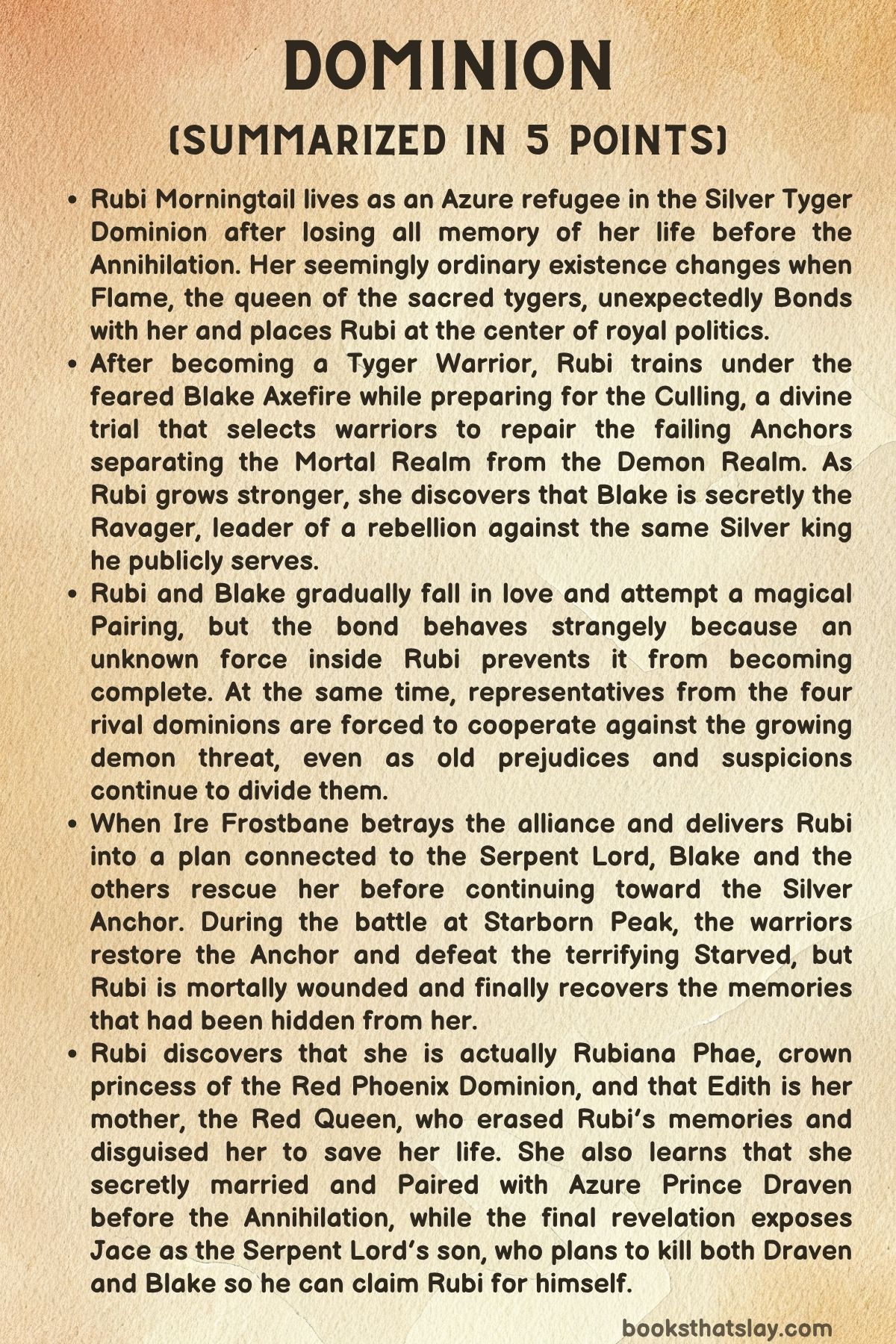
Summary
Rubi Morningtail has spent three years living as an Azure refugee in the Silver Tyger Dominion after awakening aboard a refugee ship with no memories of her previous life. She survives by working as a ribbon dancer and lives with Edith, the older woman who found and cared for her, while strange dreams repeatedly suggest that Rubi’s forgotten past involves a prophecy, a mysterious woman, and forces connected to the four dominions.
Although Rubi believes she possesses almost no useful magic, her singing and dancing have an unusual effect on the people around her. This attracts the attention of Blake Axefire, the feared Ambush Master of the Silver Dominion, who suspects that Rubi is hiding abilities even she does not understand.
Blake is one of the strongest Silver warriors and serves King Uzar as a legendary Twin Blade. His distrust of Azures is tied to the Annihilation, the disaster that destroyed the Azure Dragon Dominion and killed his twin brother Zayden, yet Rubi challenges his belief that ordinary Azure refugees should be blamed for a catastrophe that destroyed their homes as completely as it damaged the other kingdoms.
Rubi’s life changes when Flame, the young queen of the Silver tygers, escapes and appears outside Rubi’s home. Edith is injured while protecting Rubi, and Rubi draws Flame away from her, only to be arrested after injuring the tygress while defending herself.
Instead of executing Rubi immediately, Blake forces her to participate in the Silver Dominion’s Bonding ceremony, where powerful warriors attempt to form magical connections with tygers. Rubi is expected to die because she is an Azure yin with supposedly weak magic, but Flame enters the ceremony, heals Rubi after she is gravely wounded, and deliberately Bonds with her.
The event shocks the Silver court because Flame is the only breeding tygress and queen of the entire ambush. Rubi’s Bond means that a poor Azure refugee suddenly possesses a connection to one of the most politically and magically valuable creatures in the kingdom, making her both indispensable and threatening to King Uzar.
Rubi is brought into palace life and made a Tyger Warrior under Blake’s command. She learns that her survival depends partly on proving that Flame’s choice should be respected, while King Uzar, Princess Malissa, the ambitious Ire Frostbane, and other nobles struggle over what Rubi’s position could mean for the future of the Silver Dominion.
A Diviner soon arrives with news that makes those political struggles seem small. The magical Anchors separating the Mortal Realm from the Demon Realm are failing, and the destruction of the Azure Anchor during the Annihilation has accelerated the collapse of the remaining barriers.
Unless all four Anchors are restored, the Serpent Lord and his demons may enter the Mortal Realm freely. Warriors from the four dominions must therefore survive a divine selection called the Culling and then cooperate during the Raveling, even though their peoples have spent generations distrusting one another.
Rubi agrees to participate because the gods promise a boon to those who survive, and she hopes to use that reward to recover her memories. Her decision strains her relationship with Edith, who insists that Rubi should value the life she has created instead of risking everything to uncover the life she lost.
Blake begins training Rubi as a warrior, forcing her to transform her ribbon dancing into a combat style while she learns to ride and fight beside Flame. Rubi also reunites with her Azure friends Quinn and Calla, but she increasingly feels trapped between communities because the Silvers still judge her as an Azure while some Azures begin to view her association with the Silver military with suspicion.
Her relationships with Blake and the friendly Captain Jace further complicate her new life. Jace treats her with easy respect, whereas Blake remains demanding and frequently infuriating, yet Rubi gradually discovers tenderness, regret, and vulnerability beneath Blake’s violent reputation.
Her understanding of Blake changes completely during an attack on a public festival. Men dressed as Ironstorm rebels slaughter civilians while demons join the violence, but Rubi discovers that the real leader of the Ironstorm rebellion is Blake himself, operating secretly as the masked Ravager while publicly serving the king.
Blake explains that the massacre was staged by forces trying to discredit the rebellion. His double life allows him to undermine King Uzar from within, and Rubi begins to understand that his loyalty has never been as simple as it appeared.
Their attraction develops into love as Rubi sees the man beneath Blake’s military role. They eventually become lovers and attempt a magical Pairing, but the connection behaves strangely because something within Rubi resists the bond even as enormous hidden power begins emerging from her.
Rubi survives the Culling by confronting emotions buried beneath her missing memories, particularly guilt over having survived when others suffered. Flame helps her understand that survival itself is not something she must continually apologize for, and Rubi joins the chosen warriors traveling to the Haven of the Gods.
At the Haven, representatives of all four dominions gather to prepare for the Raveling. Their old accusations immediately threaten cooperation, especially because many still believe the Azure royal family may have caused the Annihilation, yet repeated demon attacks gradually make it harder to ignore the possibility that all four peoples share the same true enemy.
Rubi’s own mystery also grows. She unexpectedly speaks the language of the Red Phoenix Dominion fluently, responds instinctively to customs she does not remember learning, and sees fragments of childhood memories through a magical mirror tree.
Her supposedly weak magic becomes increasingly impossible to explain. Flame insists that a tygress queen would never have chosen an insignificant mage, while Blake discovers that intense emotional contact can release enormous reserves of power from Rubi.
When the warriors return to the Silver Dominion to repair its Anchor, Ire betrays them. Obsessed with power and resentful of Blake, he drugs Flame, abducts Rubi, and reveals that he has allied himself with servants of the Serpent Lord.
Ire also shows Rubi that Edith has been captured by the Starved, the terrifying demon responsible for much of the horror surrounding the Annihilation. More disturbing still, Ire knows the prophetic song from Rubi’s dreams, proving that Rubi herself is important to the Serpent Lord’s plans.
Although a magical collar blocks many of Rubi’s abilities, she manages to contact Blake through the network created by her Pairing with him and his Bond with Kingsolver. Blake and the tygers rescue her, and Rubi and Blake combine their magic to destroy the demonic collar, although their attempt to deepen their Pairing fails in a way neither can understand.
The coalition nevertheless chooses to remain united rather than surrender Rubi to the Serpent Lord. Armed with weapons strengthened by materials and magic from several dominions, they climb Starborn Peak, repair the Silver Anchor, rescue Edith, and confront the Starved.
The battle proves that cooperation between the dominions is not merely idealistic but necessary. Their different forms of magic work together against the demons, and Rubi uses her transformed ribbons and mysterious voice while Blake and the others fight beside her.
Rubi and Blake finally destroy the Starved, but Rubi is mortally wounded. As she approaches death, the barriers around her memories collapse, revealing that nearly everything she believed about herself was incomplete.
Rubi remembers that she is actually Rubiana Phae, crown princess of the Red Phoenix Dominion. She grew up with extraordinary fire magic, learned royal languages and customs from childhood, and fell in love with Prince Draven of the Azure Dragon Dominion.
Rubiana and Draven became magical Pairs, lovers, and eventually husband and wife. Their famous political wedding was supposed to unite the dominions, but they had secretly married before the public ceremony because they wanted one moment in which their relationship belonged to them rather than their kingdoms.
Edith then reveals the rest of the truth. She is not simply Rubi’s adoptive guardian but the Red Queen and Rubi’s biological mother, while Auron is Rubi’s brother.
During the Annihilation, Edith saved Rubi by erasing her memories, suppressing her enormous magical power, changing her appearance, and hiding her among Azure refugees. The Starved killed Rubiana’s body double and mistakenly believed it had destroyed the princess.
The revelation explains Rubi’s hidden abilities, her knowledge of the Red language, and her failed Soul Pair with Blake. Rubiana had never stopped being magically bound to Draven, whose survival she can now feel once the spells suppressing her identity disappear.
This truth devastates both Rubi and Blake. Their love is genuine, but Rubi has also recovered memories of loving Draven, and her obligations now extend to two thrones, the continuing Raveling, and a husband she once believed dead.
Blake is heartbroken but ultimately promises to remain beside her while she searches for Draven. Rubi therefore ends this stage of her journey with her identity restored but her future more complicated than ever, because reclaiming her past has not erased the person she became while living without it.
The final revelation shifts attention to Jace, whose friendly identity has been a deception from the beginning. The real Jace was murdered during the Annihilation, and the man Rubi trusts is actually the son of the Serpent Lord and the White Bone Demon, using inherited powers to disguise himself.
Jace helped organize the false Ironstorm attack and has remained close to Rubi because his father needs her for a larger plan. Yet Jace has ambitions of his own: he believes his matching bracelet proves that he and Rubi are destined for one another, and he intends to kill Draven and Blake so that nothing remains between him and the woman he wants.
The story therefore closes with Rubi having uncovered the truth of her birth while remaining unaware that one of her closest companions has been manipulating events from inside her circle. Her restored identity answers the central mystery of her past, but it also reveals that the prophecy, the Serpent Lord, Draven, Blake, and Jace are still moving toward a much larger confrontation.
Characters
Rubi Morningtail / Rubiana Phae
Rubi is the emotional and narrative center of Dominion, and nearly every major conflict passes through the question of who she believes herself to be. She begins as a poor Azure refugee with no memory, minimal social power, and apparently insignificant magic, so the identity she possesses has been created almost entirely through the relationships and choices of the previous three years.
Her courage exists long before she discovers her royal birth or magical strength. She protects Edith from Flame, risks herself for weaker competitors during the Bonding, fights demons to protect Blake’s family, and repeatedly refuses to treat survival as more important than the lives of people she loves.
Rubi’s central struggle concerns identity rather than simple memory recovery. She believes that recovering her past will make her complete, only to discover that the truth creates a division between Rubi Morningtail, the woman formed through hardship, and Rubiana Phae, the princess shaped by royal duty, love, and immense inherited power.
Her relationships reveal different parts of her personality. Edith represents belonging and maternal love, Flame reflects instinct and hidden strength, Blake represents the life Rubi chose in the present, while Draven represents the life that existed before her memories were taken from her.
The revelation of her true identity does not invalidate the woman she became while living as Rubi. Instead, her development suggests that identity can contain both memory and experience, and her future challenge will be accepting that neither Rubi nor Rubiana must disappear for the other to survive.
Blake Axefire
Blake is built around contradiction. Publicly, he is King Uzar’s brutal Ambush Master and one of the strongest defenders of Silver authority; secretly, he is the Ravager, leader of a rebellion working to weaken the same ruler he appears to serve.
His violence is real rather than a false reputation, and the book never removes that disturbing side of him. He can execute prisoners without hesitation and nearly tortures Ire to death, yet that capacity for brutality exists beside loyalty, grief, tenderness, and a strong desire to protect those discarded by Silver society.
The death of his twin brother Zayden shapes much of Blake’s early hostility toward Azures. His prejudice reflects unresolved grief and the political story he has accepted about the Annihilation, but his growing relationship with Rubi forces him to distinguish between personal loss and collective blame.
His love for Yvonne and Poppy reveals another side of his values. Silver culture measures worth through magical strength, but Blake remains fiercely devoted to a sister whom that culture considers weak, suggesting that his rebellion is rooted partly in his experience of seeing the people he loves harmed by the values he is expected to defend.
His relationship with Rubi becomes transformative because she repeatedly refuses to fear or obey him simply because he possesses power. By the time her true identity is revealed, Blake has moved from seeing Azures as a problem to risking his life and position for a woman connected to both the Red and Azure thrones.
His final response to Rubi’s marriage to Draven shows the painful limit of his possessiveness. He wants her desperately, yet when faced with a truth that cannot be overcome through force, he chooses to remain loyal without demanding that love give him ownership.
Edith / The Red Queen
Edith initially appears to be Rubi’s adoptive mother, a poor older woman who found a confused refugee and built a home with her. That identity allows her to provide Rubi with love and security without revealing the political and magical danger surrounding her real heritage.
Her physical abilities, knowledge, responses to Rubi’s prophetic song, and frequent concern about the recovery of Rubi’s memories gradually indicate that she knows far more than she admits. The eventual revelation that she is the Red Queen transforms nearly every earlier interaction between them.
Edith saved her daughter’s life through extraordinary measures, but her actions also raise difficult moral questions. She erased Rubi’s memories, suppressed her power, disguised her identity, and allowed her to live in poverty without her informed consent.
Her choices come from maternal fear rather than cruelty. She knew Rubiana would attempt to return to Draven if she remembered him, and she believed hiding her daughter completely was the only way to keep her beyond the Serpent Lord’s reach.
The conflict between Edith and Rubi therefore becomes a conflict between protection and autonomy. Edith succeeds in keeping Rubi alive, but survival comes at the cost of Rubi losing years of knowledge about herself, her family, her marriage, and her responsibilities.
Flame
Flame is far more than Rubi’s mount. As queen of the Silver tygers, she possesses authority over the entire ambush and carries a spiritual connection to the queens who preceded her.
Her decision to Bond Rubi overturns assumptions about gender, ethnicity, magical strength, and political worth. Silver society considers Rubi almost disposable, whereas Flame recognizes something extraordinary in her before any human authority understands what she is.
Flame often functions as Rubi’s clearest source of instinctive truth. She repeatedly tells Rubi that she deserves to live, recognizes her hidden strength, rejects Rubi’s attempts at self-sacrifice, and treats their Bond as a relationship between equals rather than ownership.
Her protective fury can also become dangerous. Because the other tygers respond to their queen, Flame’s emotions carry consequences beyond Rubi alone, making Rubi’s ability to communicate with and calm her an important part of becoming a responsible rider.
Draven
Draven is absent physically from most of the story but becomes essential once Rubi’s memories return. He was the Azure prince who met Rubiana as a child, became her friend and training companion, and eventually developed a relationship with her based on affection rather than royal negotiation.
Their love complicates the romance between Rubi and Blake because Draven is not merely an arranged husband from a forgotten political life. Rubi remembers genuinely choosing him, privately marrying him, and creating a magical Pairing with him before the Annihilation separated them.
His continued survival explains why Rubi’s deeper Pairing with Blake cannot fully form. Even when Rubi consciously forgets Draven, part of her magical identity remains connected to him.
Draven therefore represents the power of a past that cannot simply be dismissed because a new life has developed in its absence. His eventual return is likely to force Rubi to decide how memory, marriage, present love, and royal responsibility can coexist.
Jace
Jace initially appears to be one of the kindest Silver warriors around Rubi. He protects her from humiliating comments, trains her without Blake’s severity, treats her with warmth, and repeatedly presents himself as a trustworthy friend.
The epilogue radically changes that interpretation and makes Jace one of the most dangerous figures in Dominion. The man Rubi knows murdered the real Jace, stole his identity, and has spent years living inside the Silver military while secretly serving purposes connected to the Serpent Lord.
His apparent affection for Rubi nevertheless seems to have developed into something personally obsessive. He views their matching bracelets as proof of destiny and imagines freedom not as allowing Rubi to choose her own future but as removing everyone who might prevent her from becoming his.
That contradiction exposes the flaw in Jace’s philosophy. He claims to reject kings, gods, borders, and systems of control, yet his plan for Rubi is itself profoundly controlling because he intends to murder Blake and Draven before claiming her.
His friendly persona also makes him especially threatening. Unlike an obvious enemy such as Ire, Jace occupies a place of emotional trust, giving him access to Rubi precisely because she does not yet recognize him as a danger.
Quinn
Quinn represents continuity with Rubi’s life before the palace. As an Azure wolf shapeshifter and one of her closest friends, he protects her without treating her unusual circumstances as a reason to redefine who she is.
His presence becomes particularly important when Rubi begins feeling divided between her Azure background and her role among the Tyger Warriors. Quinn reminds her that relationships formed before status and royal recognition remain part of her identity.
He is also willing to enter the Culling and the Raveling despite the enormous risks involved. His loyalty becomes part of the wider movement from ethnic division toward cooperation because he continues supporting Rubi even when her political and magical connections become increasingly complicated.
Calla
Calla provides Rubi with another strong connection to the Azure community. Her presence alongside Quinn creates a sense of familiarity during a period when Rubi is increasingly surrounded by Silver customs, military expectations, and palace politics.
She is a capable shapeshifter and warrior in her own right, and her survival through the Culling establishes that she has the internal strength required by the gods as well as physical skill. Her loyalty during Rubi’s captivity also shows that the bond among the Azure friends is not weakened by Rubi’s changing status.
Calla contributes to the broader idea that chosen family can remain stable even when personal identity changes dramatically. Rubi’s eventual discovery that she is not actually Azure does not erase the genuine relationships she formed while believing she belonged to that displaced community.
Princess Malissa
Malissa is initially positioned as a rival and source of hostility toward Rubi, but her character also exposes the deep sexism of Silver society. She is a skilled yin tyger rider and the king’s daughter, yet the law denies her the right to inherit because she is not male.
Rubi’s Bond with Flame threatens Malissa on several levels. It challenges her uniqueness as a female rider, attracts political attention that once belonged to the princess, and complicates expectations surrounding Blake.
Her resentment therefore comes from jealousy and social conditioning, but she is not simply an antagonist. She repeatedly demonstrates intelligence, military ability, and greater political awareness than her father, particularly when she recognizes that cooperation between dominions matters more than King Uzar’s fantasies of conquest.
Malissa represents a woman who has gained status without escaping the limitations built into her society. Her harshness toward Rubi can partly be understood as the response of someone forced to compete within a system that grants women only narrow spaces in which to prove their worth.
King Uzar
King Uzar embodies the political corruption of the Silver Dominion. He accepts Azure refugees largely because their magic benefits Silver agriculture, revealing that apparent mercy can conceal exploitation.
His response to the divine mission further exposes his values. Rather than focus primarily on preventing the destruction of the Mortal Realm, he immediately imagines using the crisis to establish Silver dominance over the other kingdoms.
Uzar also treats his daughter violently and dismisses her political judgment because of rigid gender expectations. His authority depends not merely on power but on preserving structures that determine worth according to birth, magical strength, ethnicity, and gender.
His rule helps explain why Blake believes reform from within is impossible. The Ironstorm rebellion emerges not simply from personal ambition but from a kingdom in which the ruler treats people, alliances, and even sacred responsibilities as tools for expanding his control.
Ire Frostbane
Ire is driven by entitlement. He believes that his strength, birth, and ambition should naturally place him above other people, particularly Rubi, whose Bond with Flame seems intolerable to him because it violates his assumptions about who deserves power.
His resentment of Blake is equally important. Ire measures himself against Blake and Zayden, convincing himself that the recognition given to them was stolen from him rather than earned through qualities he lacks.
His alliance with the Serpent Lord reveals the final form of that insecurity. He is willing to betray his dominion, endanger the Raveling, imprison Rubi, torture Flame, and threaten millions because he imagines supernatural power will give him the status he believes the world owes him.
Ire therefore contrasts sharply with Blake. Both men are violent and ambitious in different ways, but Blake earns loyalty through responsibility and sacrifice, whereas Ire attempts to obtain obedience through fear, cruelty, and promises of personal advancement.
Auron
Auron initially appears as a representative of the Red Phoenix Dominion and later becomes far more personally significant when Rubi learns that he is her brother. His interactions with Rubi before the revelation carry an unintended irony because he is standing beside a lost member of his own family without knowing her identity.
He also contributes to the political effort to overcome distrust between the dominions. His willingness to explain Red history and acknowledge the losses shared by different kingdoms helps challenge narratives that treat suffering as belonging exclusively to one people.
When the coalition discusses surrendering Rubi to save others, Auron rejects the sacrifice. His response gains additional significance after the truth emerges because his instinct to defend Rubi exists before either sibling understands their relationship.
Lian
Lian plays an important role in exposing the first clear evidence that Rubi’s assumed background cannot explain her abilities. She recognizes Rubi’s fluent use of the Red Phoenix language and understands immediately how unusual it is for an outsider to possess that knowledge.
Through Lian, language becomes evidence of identity rather than simply communication. Rubi may have lost conscious memory, but deeply learned cultural knowledge remains embedded within her and appears before she can understand its meaning.
Lian also belongs to the Red delegation whose participation is crucial to the Raveling. Her presence reinforces the importance of Red knowledge and fire in fighting demons and repairing a world whose kingdoms can no longer afford isolation.
Yvonne Axefire
Yvonne reveals the private consequences of Silver society’s obsession with magical strength. Born with weak magic, she is treated as socially inferior despite belonging to a powerful family.
Her husband’s abandonment of her for a woman with stronger magic shows how prejudice operates inside intimate relationships as well as public institutions. Blake and Zayden’s devotion to Yvonne therefore becomes evidence that both brothers learned early how damaging Silver standards of worth could be.
Yvonne also allows Rubi to see Blake outside his military identity. Through his affection for his sister and niece, Rubi discovers that tenderness is not an occasional exception to his personality but an essential part of the man hidden beneath his public role.
Poppy
Poppy is Yvonne’s young daughter and one of the clearest symbols of Blake’s softer private life. His playfulness and affection around her sharply contrast with the image of the feared Ambush Master.
Her danger during the festival attack gives Rubi a direct reason to fight beside Blake’s family rather than merely observe them. Protecting Poppy also helps move Rubi emotionally closer to Blake because she becomes invested in people who matter deeply to him.
Although Poppy does not control political events, her presence reminds the reader what political violence threatens. Wars between dominions and rebellions may be discussed in terms of rulers and armies, but children and families remain among the people who pay for those conflicts.
Zayden Axefire
Zayden is dead before the main story begins, yet his absence strongly influences Blake. His death during the Annihilation becomes one of the emotional foundations of Blake’s prejudice against the Azures and his continuing obsession with preventing another catastrophe.
Memories shared by Blake and Yvonne portray Zayden as more than a fallen warrior. He belonged to a close family unit, protected Yvonne alongside Blake, and formed part of a twin bond whose loss left Blake carrying grief that has never fully healed.
His death also connects personal tragedy to the larger political mystery. Because bodies from the Azure royal family were never recovered, the circumstances surrounding Zayden’s death help sustain suspicions that eventually shape years of hostility between displaced Azures and their Silver hosts.
Kingsolver
Kingsolver is Blake’s powerful silver tyger and one of the clearest reflections of Blake himself. Battle-scarred, disciplined, and formidable, he carries the same sense of dangerous control associated with his rider.
His relationship with Flame becomes significant both emotionally and magically. Their closeness mirrors Rubi and Blake’s growing attraction, while their ability to communicate through the tyger network becomes essential when Rubi is captured.
Kingsolver helps demonstrate that magical Bonds are not private connections existing in isolation. His Bond with Blake, combined with Flame’s Bond with Rubi, creates a network powerful enough to overcome Ire’s attempt to sever Rubi from her allies.
Nelly
Nelly enters Rubi’s life as an attendant responsible for helping her prepare for court. His knowledge of clothing and presentation gives Rubi practical support during a moment when she is being forced into an unfamiliar social world.
His importance extends beyond appearance. He treats Rubi with care during her transition from imprisoned refugee to recognized Tyger Warrior, helping make palace life less hostile and impersonal.
By the time Rubi leaves for the Raveling, Nelly’s concern for her shows that their relationship has developed into genuine affection. He represents one of the quieter forms of belonging Rubi creates inside the palace.
Thyme
Thyme serves Rubi after she enters formal Tyger Warrior training. Like Nelly, he becomes part of the ordinary network of people surrounding Rubi during a period dominated by warriors, rulers, and magical threats.
His presence also illustrates how rapidly status changes social treatment. Rubi notices that people who might once have dismissed an Azure refugee behave differently when she carries the authority associated with Flame.
Through characters such as Thyme, the story shows how hierarchy shapes daily interactions. Rubi has not fundamentally changed as a human being, yet the response she receives changes because other people now associate her with power.
The Diviner
The Diviner serves as the intermediary between divine authority and mortal politics. Her announcement regarding the failing Anchors forces the dominions to recognize that their rivalries have become secondary to a threat capable of destroying them all.
She does not remove mortal choice from the story. Instead, she gives the warriors knowledge, establishes the rules of the Culling and Raveling, and repeatedly reminds them that cooperation is necessary.
Her role is therefore both spiritual and political. She introduces a standard of responsibility that stands above the ambitions of rulers such as King Uzar and challenges warriors to prove themselves through internal resolve as well as magical strength.
Vidor
Vidor represents the distrust and selfish reasoning that continue to survive inside the coalition. His crude treatment of Rubi and willingness to consider surrendering her demonstrate how quickly collective fear can turn one person into an acceptable sacrifice.
His argument that giving Rubi to the Serpent Lord might save millions has superficial practicality, but the others recognize that such a bargain cannot be trusted. Vidor therefore helps dramatize the moral problem of sacrificing an individual when the supposed benefit depends entirely on the promise of an enemy committed to destruction.
Couscous
Couscous, though only a cat, carries considerable emotional significance. He belongs to the small domestic world Rubi shares with Edith before palace politics and divine missions reshape her life.
The fact that Couscous originally led Edith to Rubi connects him unexpectedly to the beginning of Rubi’s second identity. His presence around their modest home also symbolizes the ordinary comfort Rubi repeatedly risks losing.
Couscous reminds the reader that Rubi’s idea of home is built from small attachments as much as royal heritage. Recovering a throne cannot erase the meaning of the simple life in which she learned to feel loved again.
The Serpent Lord
The Serpent Lord is the larger supernatural threat behind many of the story’s conflicts. His imprisonment depends upon the Anchors, and their deterioration creates the conditions that allow demons to enter the Mortal Realm.
His power is not limited to direct destruction. He influences mortals through ambition, fear, and temptation, using figures such as Ire and manipulating circumstances around Rubi.
His interest in Rubi is especially important because the prophecy suggests that her existence is connected to his ability to enter the Mortal Realm completely. This makes the conflict deeply personal even though the consequences extend across every dominion.
The Serpent Lord represents domination disguised through promises of liberation or power. His son Jace may claim to desire freedom, but both father and son repeatedly treat other lives as instruments for achieving their own visions.
The White Bone Demon
The White Bone Demon is revealed as Jace’s mother and possesses the ability to steal identities. Her power explains the origin of Jace’s talent for changing his appearance and makes his long infiltration of the Silver Dominion possible.
Although she remains largely outside the direct action described so far, her existence expands the threat beyond the Serpent Lord alone. The demonic forces opposing the Mortal Realm possess intelligence, inherited abilities, strategic planning, and methods of deception that allow them to operate inside human institutions.
The Starved
The Starved is one of the most terrifying physical manifestations of the demonic threat. It destroyed lives during the Annihilation, consumed the soul of Rubiana’s body double, killed Zayden, and later returns to pursue Rubi directly.
Its connection to soul consumption gives it particular symbolic weight. While other enemies threaten bodies or kingdoms, the Starved attacks identity itself by consuming the essence of its victims.
The creature also becomes central to the recovery of Rubi’s memories. Its final attack nearly kills her, but that confrontation breaks the barriers suppressing her past and indirectly leads to the return of Rubiana Phae.
Its defeat therefore produces both victory and transformation. Rubi survives the creature that once helped destroy her first life, but surviving it forces her to confront the identity that had been hidden in order to protect her.
Themes
Identity, Memory, and the Question of the Self
Rubi’s missing memories create a fundamental distinction between knowing one’s history and possessing a meaningful identity. For most of the story, she assumes that the person she was before the Annihilation is the complete version of herself and that recovering those memories will solve the emptiness she feels.
Her experience gradually complicates that belief. The woman called Rubi has built friendships, fallen in love, formed a Bond with Flame, learned to fight, survived prejudice, and developed moral convictions that cannot simply be dismissed once Rubiana Phae returns.
The eventual revelation therefore creates a difficult question rather than a simple answer. Rubiana is a princess, wife, powerful mage, daughter, and future queen, while Rubi is a refugee, dancer, Tyger Warrior, friend, lover, and survivor.
Both identities are authentic because both contain experiences that shaped her. Memory explains where she came from, but it does not have exclusive authority over who she has become.
Edith’s decision to erase Rubi’s memories sharpens the moral dimensions of this theme. Saving someone’s life by removing the knowledge that defines her may be understandable, but it also denies that person the right to determine what risks she is willing to accept.
Dominion ultimately treats identity as something that grows from memory, relationships, choices, culture, and lived experience together. Rubi’s challenge is not to decide which version of herself is false but to discover how the lives of Rubi Morningtail and Rubiana Phae can exist within the same person.
Power, Social Hierarchy, and Worth
The Silver Dominion repeatedly equates magical strength with human value. Strong mages receive status and opportunity, while people with weak magic are treated as burdens, unsuitable partners, or socially inferior individuals.
Yvonne’s experience makes the cruelty of this system especially visible. Her husband abandons her partly because her magic is weak, demonstrating how deeply the hierarchy reaches into relationships that should depend on affection rather than magical usefulness.
Rubi experiences another version of the same prejudice. As an impoverished Azure with apparently weak Marks, she can be harassed, imprisoned, or dismissed, yet once Flame Bonds with her, many of the same people suddenly treat her with respect.
Nothing about Rubi’s compassion or intelligence changes during that transition. What changes is the amount of power other people believe she can command, exposing the artificial nature of the social value assigned to her.
The theme also extends into gender. Malissa is a royal Tyger Warrior with exceptional ability, but Silver law prevents her from inheriting because she is yin, proving that strength alone cannot overcome systems designed to preserve particular forms of authority.
King Uzar and Ire demonstrate what happens when social hierarchy becomes personal entitlement. Both men assume power should naturally belong to them and view other people primarily according to usefulness, obedience, birth, or magical capacity.
Rubi’s rise challenges those standards because the person society labels weakest becomes the rider chosen by the strongest tyger. The story repeatedly suggests that courage, loyalty, restraint, and willingness to protect others provide a better measure of worth than inherited rank or magical force.
Love, Loyalty, and the Limits of Possession
Love appears in several forms throughout the story, and each form raises questions about whether caring for someone means protecting, trusting, controlling, or releasing them. Edith loves Rubi enough to sacrifice almost everything to keep her alive, but that same love leads her to take control of Rubi’s memories and identity.
Blake’s relationship with Rubi explores a similar tension. He begins as a commanding figure who frequently speaks as though authority gives him a claim over her, but Rubi continually rejects any suggestion that she belongs to him or that Flame belongs to anyone.
Their romance develops as Blake slowly learns that loyalty cannot depend upon possession. The strongest evidence of his love comes not when he protects Rubi physically but when he learns that she is married to Draven and chooses to remain beside her without demanding that she erase the part of herself that still loves her husband.
Draven complicates the idea that one love must automatically invalidate another. Rubi’s feelings for Blake are real, but so are the recovered emotions connected to the man she married before losing her memories.
Jace provides the darkest version of the theme. He interprets desire as destiny and assumes that removing Blake and Draven will make Rubi available to him, turning supposed love into an excuse for control.
Across these relationships, genuine loyalty increasingly becomes associated with respecting another person’s agency. Love may inspire protection and sacrifice, but when protection removes choice or desire becomes ownership, affection can become another form of domination.
Prejudice, Collective Grief, and Cooperation
The four dominions carry historical resentment so deeply that suffering becomes a reason to distrust anyone associated with another people. Blake initially blames Azures because his brother died during the Annihilation, while many Silvers treat refugees as though displacement itself makes them suspicious.
The Azures, meanwhile, remember losing their homeland and being treated as useful outsiders rather than equal citizens. The Reds and Onyxes carry losses and accusations of their own, creating a political world in which every community views its grief as evidence against someone else.
The Raveling forces these groups into circumstances where isolation becomes impossible. No single form of magic can restore the Anchors, and no dominion possesses everything required to defeat the demons.
Their survival depends on exchanging materials, strategies, knowledge, and trust. Silver thundervein, Red fire, Azure healing, shapeshifting abilities, tygers, and other forms of magic become most effective when used together rather than guarded as symbols of national superiority.
The struggle is difficult because cooperation requires more than standing on the same battlefield. The warriors must question inherited stories about the Annihilation and recognize that shared suffering does not automatically reveal who caused it.
Rubi becomes especially important to this theme because she appears to cross the boundaries everyone else treats as fixed. She lives as an Azure, Bonds the Silver tygress queen, falls in love with a Silver rebel, and eventually discovers that she is the Red crown princess and Azure queen through marriage.
Her existence makes rigid divisions increasingly difficult to defend. The larger conflict suggests that collective grief can either harden into prejudice or become the basis for recognizing suffering in others, and the survival of the Mortal Realm depends upon choosing the second possibility.