Ember by Naima Simone Summary, Characters and Themes
Ember by Naima Simone is a dark crime romance centered on inheritance, power, family betrayal, obsession, and a woman’s fight to reclaim the identity that has been denied to her.
Ember Cross is the hidden biological daughter of crime lord Marcus Cross, a gifted scientist whose work secretly fuels the family empire even while she is treated as an outsider. After Marcus dies, his will places her fortune and authority partly under Asad Prince, the ruthless man she has hated since childhood. What follows is a dangerous relationship shaped by coercion, attraction, old wounds, murder, loyalty, and an increasingly complicated understanding of love. It’s the 2nd book of the Hunted Kingdom series.
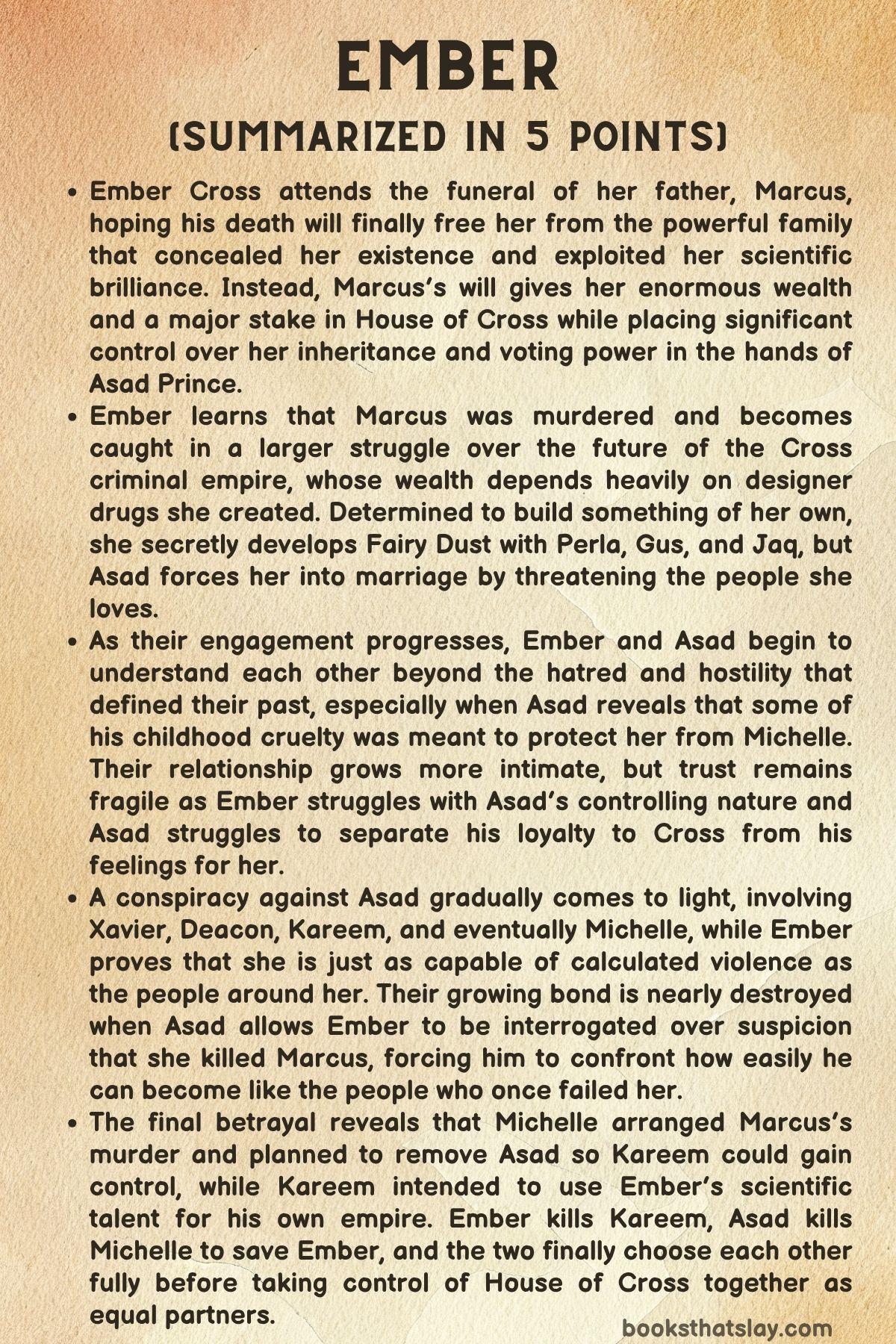
Summary
Ember Cross attends the funeral of her father, Marcus Cross, with anger overpowering whatever grief she might have felt. Although she is Marcus’s only biological child and therefore the true Cross heir, she has spent most of her life hidden while her stepmother Michelle and stepbrothers Asad and Kareem publicly occupied the places associated with the Cross family.
Marcus neglected Ember for thirteen years, while Michelle subjected her to sustained cruelty. Asad was one of the people Ember associated most strongly with her painful childhood, yet her hatred for him is complicated by an attraction she neither welcomes nor understands.
At the cemetery, Ember secretly places the Cross family crest ring in Marcus’s coffin, intending the act as her personal rejection of the family structure that excluded her. She believes Marcus’s death will finally allow her to leave House of Cross permanently, but Asad immediately begins pulling her back into family affairs.
The will makes that escape far more difficult. Michelle receives money, property, and a share of House of Cross, while Kareem also receives substantial wealth and ownership.
Ember inherits the enormous trust left by her mother, an additional fortune from Marcus, and thirty-four percent of House of Cross. The insult lies in Marcus naming Asad trustee of Ember’s trust and giving him proxy authority over her voting shares, effectively allowing the man she resents to exercise power over money and influence that belong to her.
Asad fares even better. He receives most of Marcus’s estate, becomes CEO, obtains forty-six percent of House of Cross, and assumes control over the Cross organization.
Ember later meets privately with her godfather, Sam Chavis, and learns that Marcus’s death was almost certainly murder. The medical examiner found that Marcus had received a massive heroin injection despite having no history of drug use and a strong dislike of needles.
The revelation exposes the dangerous reality surrounding the Cross family. House of Cross may appear publicly to be a luxury fashion business, but its products are used as part of an international drug-trafficking operation.
Ember herself is central to that criminal success. A brilliant scientist, she created Glass Slipper, a designer drug that became one of the organization’s most profitable assets.
Despite her importance, Ember wants independence rather than a larger position inside the family that mistreated her. Working secretly with Perla, Gus, and Jaq, she develops a new drug called Fairy Dust, intending eventually to establish a competing organization and create a future in which her talent belongs to her rather than the Cross empire.
Asad has other plans. He enters Ember’s apartment without permission and announces that she will marry him within a month.
He argues that marriage will allow Ember to obtain immediate access to her inheritance and promises that he will relinquish his role as trustee. His motives are also practical because House of Cross depends heavily on Ember’s scientific expertise, and losing her could seriously weaken the criminal organization he has just inherited.
Ember refuses. As the confrontation becomes emotionally overwhelming, her intermittent explosive disorder begins affecting her ability to remain controlled, and Asad unexpectedly guides her through the 5-4-3-2-1 grounding technique.
His knowledge reveals that he has paid far greater attention to Ember’s condition than she believed. Yet any tenderness in the moment is destroyed when Asad threatens Perla, Gus, and Jaq unless Ember agrees to marry him.
Knowing that Asad is capable of carrying out the threat, Ember accepts the engagement to protect the people she considers her real family. For her, the decision is not romantic but another form of imprisonment.
Asad soon becomes the target of an armed attack. He survives and begins investigating people within his own organization, convinced that someone with inside access helped arrange the shooting.
Security footage from the night of Marcus’s murder then appears to implicate Ember. She is shown entering Marcus’s building in disguise, while no footage records her leaving through the main entrance.
Asad nevertheless orders the evidence buried. Even if Ember killed Marcus, he privately believes Marcus’s treatment of her might have justified her actions, although he remains unwilling to dismiss the possibility that she could be involved in the attempt on his own life.
During a formal dinner with powerful criminal associates, Asad publicly announces that Ember is Marcus Cross’s only daughter and that she is his fiancée. For Ember, the declaration carries enormous emotional significance because it is one of the first occasions on which the family openly recognizes the identity Marcus spent years concealing.
Ember also discovers that Asad has withheld important information. An addition to Marcus’s will requires the new head of Cross to marry within sixty days, meaning the marriage benefits Asad’s claim to leadership as much as it helps him retain Ember.
The dinner becomes even darker when Carter, a Cross associate, is exposed as one of the people involved in the attempt on Asad. Ember participates willingly in the interrogation, demonstrating that her scientific brilliance and emotional wounds coexist with a capacity for calculated violence.
Carter identifies Xavier Holloway and Deacon Martins as conspirators. Asad then orders savage punishment, showing the gathered criminal leaders exactly what kind of ruler he intends to be.
Ember later negotiates formal conditions for her marriage rather than accepting unlimited control. She and Asad agree that she can seek an uncontested divorce after three years, that she will surrender her House of Cross shares while retaining her inheritance, and that she will receive significant profits connected to the drugs she created.
Their negotiations establish an important change in their relationship. When Ember can bargain rather than simply obey, she and Asad begin behaving less like captor and captive and more like two formidable people testing each other’s limits.
Their physical relationship soon becomes intimate, and Asad learns that Ember has never had sex before. His attachment to her becomes even stronger, while Ember begins experiencing feelings she does not want to interpret as emotional dependence.
Asad also changes the Cross leadership structure. Women and trusted associates receive positions of authority, established traditions are discarded, and anyone openly challenging his decisions is dealt with violently.
Most importantly for Ember, Asad gives her the opportunity to present her scientific work directly to the organization’s leadership. Instead of taking credit for her achievements, he publicly identifies her as the mind responsible for much of Cross’s success.
The experience gives Ember something Marcus consistently withheld: recognition. She is no longer merely the hidden daughter whose work enriches other people.
Michelle reacts with fury to Asad’s support of Ember and believes Kareem is being overlooked. At the same time, Asad reveals more about his own childhood, including his belief that Michelle murdered his biological father, Khalil Prince, after becoming involved with Marcus.
The admission allows Ember to see the pain beneath Asad’s brutality, but she still believes his loyalty to Michelle will eventually outweigh whatever he feels for her. Her inability to trust him becomes one of the greatest obstacles between them.
Asad tracks down Xavier, who admits participating in the attempt to remove him because he believes Asad lacks the biological right to lead Cross. Xavier also warns that the larger conspiracy involves someone much closer to Asad, although he refuses to reveal everything before Asad kills him.
Deacon is already dead when Asad reaches him. His household has been destroyed through a sophisticated chemical attack, and Asad immediately recognizes that the method carries Ember’s scientific signature.
Rather than condemning her, Asad is delighted when he realizes she killed Deacon because Deacon participated in the attempt on his life. Ember later admits that she wanted the man who betrayed Asad to suffer, revealing how far her feelings have shifted from hostility toward protectiveness.
The emotional relationship between Ember and Asad develops further when they finally discuss their childhood. Ember explains how her treatment for intermittent explosive disorder once left her feeling mentally dulled and deprived of control, leading her to rely instead on therapy, grounding exercises, yoga, and cannabis.
Asad reveals that he researched her condition when they were younger and even consulted her therapist because Marcus showed little interest in understanding what Ember needed. He then gives Ember a radically different interpretation of several memories she has always understood as examples of his cruelty.
According to Asad, some occasions when he locked Ember away were attempts to hide her from Michelle. Other actions that appeared deliberately cruel were intended to remove Ember from dangerous situations without revealing that he cared about her.
He believed openly protecting Ember would have increased Michelle’s hostility toward her. Although Ember refuses to pretend that Asad’s methods caused no damage, she is forced to reconsider the idea that he had spent their entire childhood trying to hurt her.
Their growing trust collapses when Michelle publicly produces the security footage placing Ember at Marcus’s building on the night of his murder. Under the rules governing Cross, killing its leader without authorization carries a death sentence.
Asad allows Ember to be taken to a torture chamber and questions her before members of the organization. He even injures her already damaged finger while demanding the truth, but he eventually realizes that he cannot kill her and chooses her life over his position.
Only then does Ember explain that she did not murder Marcus. She went to his apartment to tell him she was leaving and secretly hoped that, for once, her father might ask her to stay.
Marcus never answered the door. Ember left through another exit, which explains why the security footage showed her entering but not leaving.
For Ember, Asad’s eventual decision to save her does not erase the betrayal. At the crucial moment, he doubted her and allowed the organization that had already hurt her to take priority over the trust she had finally started giving him.
She leaves his home and spends a week away from him. During that period, she concentrates on Fairy Dust and makes Perla, Gus, and Jaq equal partners, further establishing that the independent future she wants will be built through chosen loyalty rather than inherited hierarchy.
At the engagement ball, Ember sees Asad again. He makes no attempt to deny that he misses her and publicly places himself between Ember and Michelle when Michelle attacks her verbally, showing Ember that he may finally be willing to choose her where others can see it.
Kareem approaches Ember while pretending to be concerned about her treatment. He tries to convince her that Asad remains involved with Aryn, but Ember begins recognizing that Kareem’s apparent gentleness has hidden jealousy, ambition, and manipulation.
Before she can return to Asad, Kareem attacks and kidnaps her. Asad discovers her missing and finds one of her glass shoes outside, immediately realizing that she has been taken.
Ember awakens in a cage and learns the full truth. Michelle murdered Marcus by arranging the heroin overdose and worked with Xavier and Deacon to eliminate Asad so that Kareem could take control of Cross.
Kareem, however, has his own ambitions. He intends to kill Asad, take Ember to Europe, and use her scientific ability to establish his own criminal empire rather than remaining under Michelle’s control.
Ember pretends to be weaker than she is until Kareem comes close enough for her to use a concealed needle hidden in her specially designed shoe. She injects him with a modified botulinum toxin, and he dies from rapid paralysis.
Michelle then threatens Ember with a gun. Asad arrives after discovering communications that confirm Michelle and Kareem’s betrayal.
Michelle attempts to use Ember as protection and accuses Asad of caring more about Ember than his own mother. This time, Asad makes his choice without hesitation and shoots Michelle to save Ember.
The decision answers Ember’s deepest fear about him. When forced to choose between Michelle and Ember, Asad chooses Ember openly and immediately.
Ember finally understands him as both her protector and the person with whom she wants to build a future. Asad tells her he loves her, and Ember returns the declaration.
One month later, they have already eloped. Their marriage has not transformed them into conventional or morally restrained people; instead, they have accepted the violent and possessive parts of each other.
Together, they break into Aryn’s townhouse after Aryn ignores Asad’s warning to stay away. Ember kills her with a substance of her own creation while Asad assists, demonstrating how completely the former opponents now operate as partners.
More significantly, Ember has finally claimed the position she was denied throughout Marcus’s life. She no longer works anonymously, allows others to control her inheritance, or permits the Cross name to belong publicly only to men.
She rules House of Cross beside Asad as his equal. The woman Marcus kept hidden has become one of the people controlling the empire, not because her father ultimately recognized her worth, but because she claimed authority for herself and found a partner who recognizes both her brilliance and her capacity for darkness.
Characters
Ember Cross
Ember is the central emotional and psychological force of Ember, and nearly every major conflict surrounding inheritance, family, identity, violence, and love is filtered through her struggle for autonomy. She begins the book as Marcus Cross’s hidden biological daughter, someone whose intelligence has been exploited by the family while her legitimacy has been deliberately concealed.
Her anger is therefore more than a personality trait. It is the result of years of abandonment, abuse, humiliation, and the repeated experience of powerful people deciding what she deserves without consulting her.
Her intermittent explosive disorder contributes to her fear of losing control, but the story refuses to reduce her identity to the condition. Ember has actively built methods for managing herself through therapy, grounding exercises, yoga, and other routines because personal control has become almost sacred to someone who spent childhood with very little of it.
Her scientific ability is equally important to understanding her. Glass Slipper makes her economically indispensable to House of Cross, while Fairy Dust represents something more personal: proof that she can create power outside the system that used her.
Ember is morally dark in her own right rather than becoming dangerous simply because of Asad. Her calculated killing of Deacon and later Kareem shows that she can convert scientific knowledge into lethal force whenever she decides that violence is justified.
At the same time, loyalty matters profoundly to her. She protects Perla, Gus, and Jaq, shares ownership of her future enterprise with them, risks herself for Asad, and responds strongly whenever someone recognizes her without trying to diminish her.
Her relationship with Asad succeeds only after she stops functioning entirely as the object of his decisions and becomes an active negotiator of their shared life. By the conclusion, her greatest achievement is not marriage or inherited wealth but public ownership of the Cross identity and authority that Marcus spent years denying her.
Asad Prince
Asad is the dominant male figure in Ember, but his importance comes from the contradiction between his brutality and the intense loyalty he has directed toward Ember for years. He is controlling, violent, possessive, and accustomed to using fear as an instrument of leadership, which makes many of his actions toward Ember genuinely harmful even when he believes he is protecting her.
His desire for power is explicit. Marcus’s death gives him control of House of Cross, but Asad has already spent years preparing himself to command a criminal organization in which weakness can invite betrayal or death.
He understands leadership largely through force, visible dominance, and decisive punishment. His willingness to kill subordinates, enemies, and even people close to him demonstrates that he does not maintain power through moral legitimacy.
Ember exposes another part of him. His knowledge of her mental health, his childhood efforts to shield her from Michelle, and his respect for her scientific talent reveal a capacity for attention and commitment that contradicts Ember’s earlier understanding of him as nothing more than a tormentor.
That does not excuse the coercion he uses against her. Threatening Perla, Gus, and Jaq to force Ember into marriage is an extreme violation of her autonomy, and his decision to participate in her interrogation after Michelle produces evidence against her becomes his greatest emotional failure.
His development depends on recognizing that protecting Ember is not the same thing as controlling her. He moves closer to being worthy of her trust only when he becomes willing to lose his authority, oppose Michelle openly, and finally choose Ember without demanding proof that she deserves his loyalty.
Asad’s love remains possessive and violent at the end, but it has changed from unilateral ownership toward partnership. He does not make Ember gentle, and she does not reform him; they ultimately accept one another as people whose devotion and darkness exist together.
Marcus Cross
Marcus is dead before most of the central action occurs, yet his decisions control the lives of nearly everyone left behind. As Ember’s biological father and leader of the Cross empire, he possessed the power to protect and publicly acknowledge his daughter but repeatedly refused to do so.
His neglect becomes one of the deepest sources of Ember’s pain. She does not merely resent that he hid her; she is wounded by the possibility that she was never important enough for him to choose openly.
Even after death, Marcus continues exercising control through his will. Giving Ember immense wealth while placing Asad in authority over part of it reflects the same pattern that defined their relationship: Marcus recognizes Ember’s value materially while withholding complete personal agency.
The final truth about Ember’s visit to his home gives his failure even greater weight. She went there intending to leave but still carried the hope that he might ask her to stay, and his absence leaves that desire permanently unanswered.
Marcus also leaves behind a damaged family structure in which questions of blood, inheritance, legitimacy, and leadership become deadly. His empire survives him, but the secrecy and favoritism he encouraged help create the conditions for the succession crisis that follows.
Michelle
Michelle represents sustained hostility toward Ember and serves as one of the primary sources of corruption inside the Cross family. Her cruelty is not limited to occasional jealousy; she has spent years treating Ember as a threat whose existence challenges the family position Michelle wants to preserve.
Her behavior is strongly connected to power. Ember’s biological relationship to Marcus gives her legitimacy that neither Michelle nor Kareem can erase, so hiding and humiliating Ember becomes a means of protecting Michelle’s preferred hierarchy.
Michelle is also capable of far greater violence than Ember initially understands. The revelation that she arranged Marcus’s fatal overdose and participated in the plan to kill Asad shows that her loyalty to family is subordinate to her desire to control what happens after Marcus’s death.
Her greatest miscalculation is her understanding of Asad. She assumes that being his mother gives her an authority over him that Ember cannot overcome, but Asad has carried his own suspicions and resentments concerning her for years.
The final confrontation forces the choice Michelle has repeatedly tried to prevent. When she uses Ember as a shield and demands that Asad prioritize his mother, he kills Michelle instead, ending both her conspiracy and the emotional power she once held over him.
Kareem Cross
Kareem initially appears far less threatening than Asad or Michelle because he presents himself as sympathetic, restrained, and comparatively harmless. That appearance makes his eventual betrayal more effective because Ember has been conditioned to interpret him as the least dangerous member of the household.
His apparent kindness gradually reveals itself as another method of influence. He encourages Ember’s distrust of Asad and offers escape in ways that initially seem supportive, but his behavior is motivated by jealousy and ambition rather than concern for her freedom.
Kareem is also resentful of Asad’s succession. His resentment becomes sharper when Asad elevates Ember and other figures within Cross while Kareem fails to receive the authority he believes should belong to him.
The kidnapping exposes his real character. He does not merely assist Michelle’s plan; he intends to betray her as well, kill Asad, take Ember abroad, and use her scientific talent to create an empire of his own.
In this sense, Kareem resembles the people Ember has spent her life resisting. He sees her brilliance as something to possess and exploit, which makes his claim that he wants to free her deeply hypocritical.
His death at Ember’s hands is therefore fitting within the logic of the story. He underestimates the woman he intends to control and enters her cage believing he possesses the advantage, only to discover that Ember has already prepared the means of killing him.
Sam Chavis
Sam functions as one of Ember’s few trustworthy older figures and serves as a contrast to Marcus’s failure as a father. As her godfather, he listens to her, gives her important information, and responds to danger by trying to protect her rather than by questioning whether she deserves protection.
He is the person who tells Ember that Marcus was murdered, making him crucial to the transition from family conflict into the larger criminal conspiracy. His willingness to provide security also reflects his understanding that Ember’s position makes her vulnerable.
Sam’s significance is emotional as well as practical. He helps preserve Ember’s connection to her mother and later escorts her to the engagement ball while giving her jewelry that belonged to her mother.
These actions give him a role associated with care, continuity, and chosen family. In a story filled with relatives who use blood relationships as excuses for control, Sam demonstrates that loyalty can be defined by actions rather than inheritance.
Perla
Perla belongs to the small group Ember considers her genuine family. Her importance comes from being part of a life Ember has created outside the emotional boundaries of House of Cross.
She works with Ember on Fairy Dust, which means she participates directly in Ember’s attempt to transform scientific talent into independent power. The project is not simply a business venture; it represents the possibility of a future in which Ember chooses her associates and determines the conditions of her own work.
Perla also becomes one of the people Asad threatens when forcing Ember to accept marriage. That threat succeeds because Ember values Perla’s life more than she values immediate freedom, demonstrating the depth of their connection.
Later, Ember makes Perla an equal partner in the Fairy Dust enterprise. The decision reveals that Ember does not intend to reproduce Marcus’s hierarchy once she possesses power; at least within her chosen circle, she wants loyalty to be rewarded with ownership rather than dependence.
Gus
Gus is another member of Ember’s chosen inner circle and works beside her in the secret development of Fairy Dust. Like Perla, he represents the possibility of belonging to a community that values Ember for more than her name, inheritance, or usefulness to Cross.
His significance becomes particularly clear when Asad threatens him during the marriage confrontation. Ember’s willingness to surrender her immediate independence rather than risk Gus’s death shows that he occupies a genuine emotional place in her life.
Gus also benefits from Ember’s later decision to make the Fairy Dust team equal partners. Through that choice, the story distinguishes the relationships Ember builds voluntarily from the family relationships imposed upon her.
Jaq
Jaq completes the group of collaborators who help Ember develop Fairy Dust and imagine a future beyond House of Cross. Although Jaq receives less individual attention than the central characters, the role remains important because Ember consistently defines Perla, Gus, and Jaq collectively as family.
Jaq therefore represents trust without the emotional violence attached to Ember’s biological relatives. Ember does not have to hide her intelligence or prove her legitimacy within this group.
When she later gives Jaq equal participation in the profits and future of their enterprise, she converts emotional loyalty into material equality. That decision reveals the kind of power structure Ember prefers when she is allowed to design one herself.
Aryn Murray
Aryn initially exists as Asad’s convenient sexual partner, but her larger narrative purpose is connected to Ember’s jealousy and the possessive nature of Ember and Asad’s relationship. Asad does not treat his involvement with Aryn as emotionally meaningful, yet Ember cannot remain indifferent once her own feelings for him intensify.
Aryn also becomes a source of misunderstanding. Ember incorrectly assumes that Asad has been intimate with her after their engagement, reinforcing Ember’s belief that Asad can demand loyalty without offering it himself.
Asad eventually ends the arrangement and makes it clear that Aryn no longer has a place beside him. Her refusal to respect that boundary later becomes fatal.
The conclusion, in which Ember kills Aryn with Asad’s assistance, confirms that the central couple has not developed toward conventional moral behavior. Their union includes jealousy, punishment, and violence, and Aryn ultimately becomes the final demonstration of how fully they have accepted that aspect of each other.
Eli
Eli is one of Asad’s trusted associates and survives the armed attack on the vehicle carrying Asad. His continued presence indicates that Asad operates through a carefully selected group of people whose usefulness is measured through loyalty and competence.
Asad later elevates figures such as Eli within the restructured Cross organization. This suggests that Eli has earned a degree of trust during a period when Asad is increasingly suspicious of older members connected to Marcus.
Eli therefore represents Asad’s attempt to replace inherited organizational loyalty with personal loyalty. In an environment where betrayal can come from friends, mentors, and relatives, trusted associates become central to Asad’s survival.
Makeda
Makeda is another member of Asad’s trusted circle and participates in handling sensitive evidence connected to Marcus’s murder. When footage appears to implicate Ember, Asad orders Makeda and Eli to suppress the information rather than allow it to become an immediate threat to her.
Makeda’s role demonstrates the level of confidence Asad places in her discretion. She later gains greater authority under his leadership, placing her among the people who benefit from his rejection of some traditional Cross hierarchies.
Her advancement also supports the broader shift in the organization toward giving women access to positions from which they had previously been excluded. Although she is not developed as deeply as Ember or Michelle, her presence reinforces the institutional changes occurring under Asad.
Rochelle
Rochelle serves as a technical specialist whose work gives Asad access to crucial security evidence. She finds footage showing Ember entering Marcus’s building on the night he died, a discovery that temporarily makes Ember appear capable of being Marcus’s killer.
Her contribution illustrates the importance of surveillance and information within the Cross world. Physical violence may dominate many conflicts, but knowledge can be equally dangerous because a single piece of evidence can alter alliances, create suspicion, or threaten someone’s life.
Rochelle herself is not presented as manipulating the footage or the investigation. She functions primarily as a competent information source whose discovery forces Asad to decide whether institutional rules matter more to him than Ember.
Tre
Tre is the driver present during the attack on Asad’s vehicle. His role is brief, but his death reveals a great deal about Asad’s approach to leadership and survival.
After the attack, Asad kills Tre because he considers two possibilities unacceptable: either Tre participated in the betrayal, or he performed so poorly under pressure that he could no longer be trusted. There is no meaningful attempt at due process or certainty.
Tre therefore becomes an example of the ruthless standards governing Cross. In Asad’s world, uncertainty itself can become dangerous enough to justify death, which helps establish why Ember has reason to take his threats seriously.
Carter
Carter is important because his exposure transforms suspicion into evidence of a broader conspiracy against Asad. Once identified as having helped arrange the attack, he is interrogated in front of major criminal figures.
His interrogation also becomes a public test for Ember. By participating rather than withdrawing from the violence, she demonstrates that she possesses the ruthlessness expected from someone associated with Cross leadership.
Carter eventually gives up Xavier and Deacon, making him the connection between the first attack and the larger network behind it. His fate also demonstrates Asad’s belief that betrayal should produce consequences extending beyond the individual offender.
Xavier Holloway
Xavier is especially significant because he is not simply an outside enemy. He helped teach Asad the criminal business and occupied a position close enough to resemble that of an uncle or mentor.
His betrayal therefore damages Asad on a personal level as well as threatening his leadership. Xavier’s objection is partly ideological: he does not believe Asad should inherit Cross because Asad is not biologically a Cross.
That belief highlights the contradiction at the center of the succession conflict. Ember possesses the strongest biological claim but has historically been denied recognition, while Asad possesses practical authority but lacks the bloodline that traditionalists consider essential.
Before dying, Xavier warns that the conspiracy reaches closer to Asad than he understands. His warning prepares the eventual revelation that Michelle and Kareem are central to the effort to remove him.
Deacon Martins
Deacon, like Xavier, is a senior figure whom Asad once trusted and regarded almost as family. His involvement in the assassination attempt demonstrates how little protection long relationships provide in a world governed by ambition.
His most important function, however, comes through the circumstances of his death. Ember kills him through an engineered chemical method that immediately allows Asad to recognize her involvement.
Deacon’s death marks a major turning point in Ember’s relationship with Asad. She does not attack him because she is ordered to, because Cross requires it, or because her own life is in immediate danger.
She kills him because he betrayed Asad. That motive reveals that Ember’s attachment has become powerful enough to influence how she directs her intelligence and capacity for violence.
Khalil Prince
Khalil Prince, Asad’s biological father, is an absent but psychologically significant figure. Asad believes Michelle killed Khalil after betraying him with Marcus, leaving Asad with unresolved grief and suspicion toward his own mother.
His memory helps explain why Asad’s relationship with Michelle is more complicated than simple filial loyalty. Ember initially assumes Asad will always choose his mother, but his belief concerning Khalil shows that trust between mother and son has been damaged for years.
Khalil therefore contributes indirectly to Asad’s emotional development. The uncertainty surrounding his death helps explain why betrayal within the family is not an abstract possibility for Asad but something he has suspected since childhood.
Themes
Identity, Recognition, and the Right to Belong
Ember’s struggle is shaped by the difference between possessing an identity and being allowed to claim it publicly. She is Marcus Cross’s biological daughter, yet the family behaves as though that fact can be erased through silence, while people with weaker claims occupy the positions that should naturally have included her.
In Ember, recognition therefore becomes a form of power. Ember already has extraordinary intelligence and enormous financial value, but those qualities cannot compensate for the emotional damage of being treated as someone who must remain invisible.
Marcus’s behavior makes the wound especially severe because he benefits from Ember’s scientific abilities while refusing to give her the uncomplicated public status of daughter. She is useful enough to enrich the empire but apparently too inconvenient to acknowledge fully.
Asad’s public announcement that Ember is Marcus’s only daughter matters because it reverses this pattern. Later, allowing her to present her own scientific work gives her professional recognition as well as familial recognition.
The conclusion completes that movement by placing Ember beside Asad in control of House of Cross. She does not receive legitimacy as a final gift from Marcus, nor does she merely inherit a title after everyone else disappears.
Instead, she claims a place that had always been hers but was systematically denied to her. Her final authority changes recognition from something she once begged to receive into something no one has the power to withhold.
Control, Autonomy, and the Meaning of Freedom
Control shapes nearly every important relationship in Ember’s life. Marcus controls her public identity, Michelle tries to control her place within the family, Asad controls access to parts of her inheritance, and Kareem eventually attempts to control her scientific ability for his own ambitions.
This explains why Ember reacts so strongly whenever someone makes decisions for her. Her desire for independence is not simple rebelliousness; it comes from years of experiencing control as a method through which other people reduce her humanity.
Her response to medication reflects the same concern. She rejects treatments that make her feel mentally dulled because dependence on decisions made by doctors and Marcus reminds her of a life in which authority over her own mind and body was repeatedly placed elsewhere.
Fairy Dust becomes a practical expression of autonomy. Through it, Ember intends to create an enterprise that belongs to her and her chosen partners rather than continuing to produce wealth for the family that exploited her abilities.
Her relationship with Asad becomes viable only when control begins giving way to negotiation. The marriage starts through coercion, but Ember later establishes contractual conditions, protects her financial interests, and demands the possibility of leaving.
The story ultimately presents freedom less as escape from every attachment and more as the ability to choose one’s attachments. Ember does not end alone or separated from Cross; she ends inside both a marriage and an empire, but with authority she has consciously claimed.
Family, Loyalty, and Betrayal
Blood relationships repeatedly fail to provide safety. Marcus abandons Ember emotionally, Michelle abuses and conspires against her, Kareem manipulates and kidnaps her, and even Asad’s relationship with his mother is poisoned by his suspicion that she murdered his biological father.
The criminal organization intensifies this instability because family bonds and business loyalty constantly overlap. Xavier and Deacon are almost parental or avuncular figures to Asad, yet they participate in an attempt to kill him when they reject his right to inherit power.
Against these betrayals, chosen relationships gain unusual importance. Ember considers Perla, Gus, and Jaq family because they have earned her trust through shared work and personal loyalty rather than because biology requires her to accept them.
Sam serves a similar function. His protective behavior offers Ember a form of dependable adult care that Marcus failed to provide.
Asad and Ember’s relationship also becomes a test of what loyalty actually requires. Asad fails that test when he allows organizational rules and public suspicion to override his trust in Ember during the interrogation.
He begins repairing the damage only when he demonstrates that loyalty has consequences for the person offering it. By choosing Ember over Michelle and over the expectations of Cross, he proves that his devotion is no longer merely possessive language.
The story therefore treats family as something measured through choices under pressure. Shared blood creates claims, but only repeated acts of loyalty determine who truly deserves emotional belonging.
Love, Violence, and Moral Compatibility
The relationship between Ember and Asad rejects the idea that love necessarily makes dangerous people gentler. Both characters possess the capacity for extreme violence before their emotional bond reaches its mature form, and neither becomes conventionally moral because of romance.
Their attraction initially exists alongside resentment, coercion, fear, and competition. Asad threatens the people Ember loves to force her into marriage, while Ember continually resists the assumption that his desire gives him ownership over her.
As emotional intimacy develops, violence begins functioning as a disturbing form of loyalty between them. Ember kills Deacon because he helped attack Asad, and Asad responds not with horror but with gratitude and recognition.
That response matters because Ember has often been treated as strange, useful, or dangerous. Asad’s acceptance tells her that he understands the parts of her other people might demand she conceal.
The same principle works in the opposite direction. Ember does not deny Asad’s ruthlessness or imagine that loving him will transform him into a harmless man; what changes is her understanding of where his violence is directed and whether he will ultimately protect or betray her.
Their final partnership demonstrates moral compatibility rather than moral rehabilitation. By acting together against Aryn and ruling Cross side by side, they show that their bond rests partly on accepting qualities that ordinary relationships might find intolerable.
The ending therefore presents love as recognition without sanitization: Ember and Asad choose each other after seeing not only the damaged and vulnerable parts of one another, but also the capacity for possession, vengeance, and violence that each carries willingly.