Destination Funeral Summary, Characters and Themes
Destination Funeral by Paige Harbison is a contemporary novel about grief, family resentment, first love, friendship, and the strange ways people protect themselves from being hurt. At its center is Didion Bennett, a celebrated New York chef who returns to Mercy Island after the death of her mother, Babe, carrying years of anger toward almost everyone waiting for her there.
What begins as an uncomfortable funeral weekend becomes something impossible when Saturday starts repeating. The extra time forces Didion, her sister Sammie, Austin, and Matt to confront the relationships, regrets, misunderstandings, and memories they have spent years avoiding.
Summary
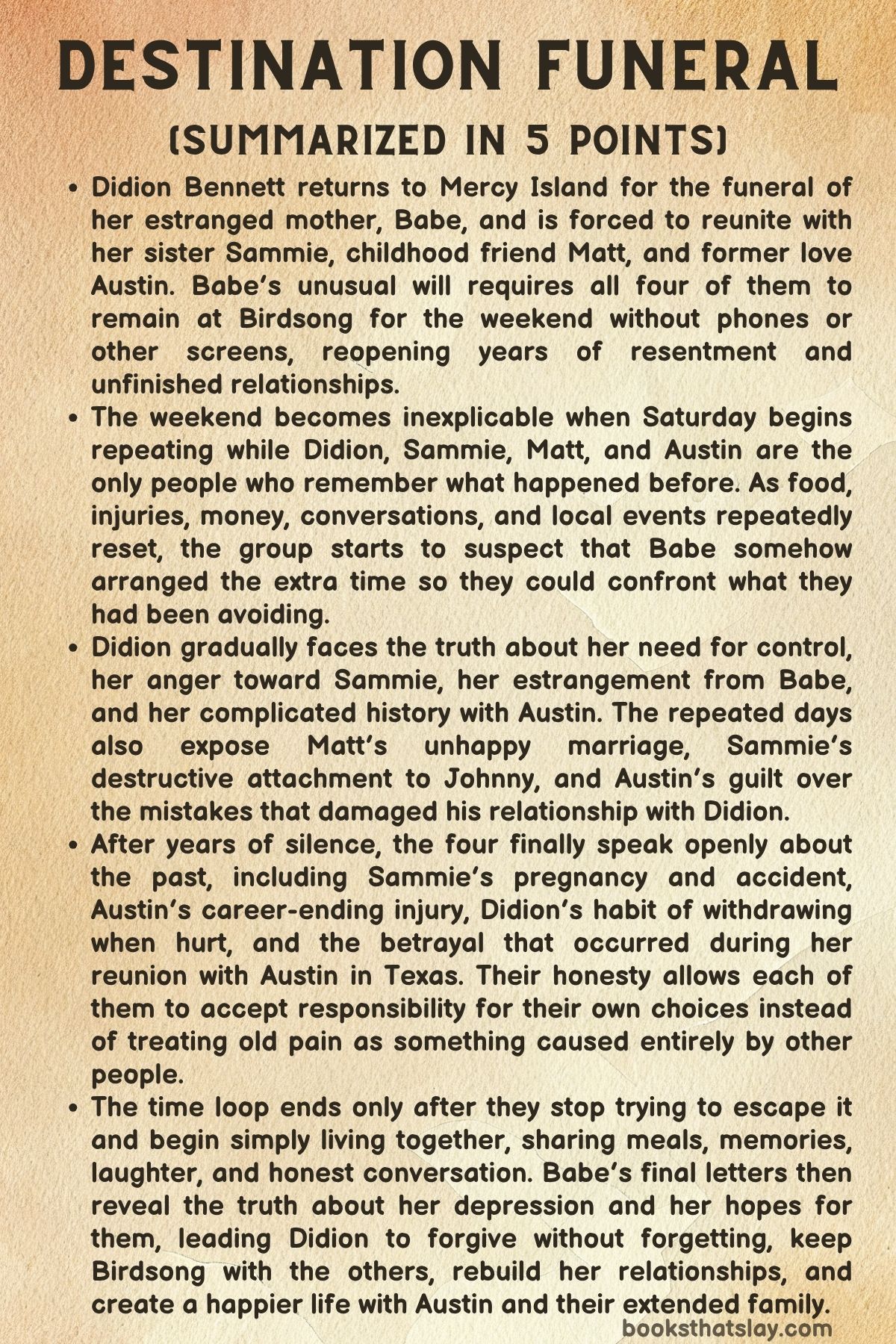
Didion Bennett returns to Mercy Island for the funeral of her mother, Babe, already wishing she could leave. She has built a disciplined life in New York as an acclaimed chef, and the island represents everything that discipline has allowed her to avoid: her estranged sister Sammie, her childhood best friend Matt, her former love Austin James, and the complicated memory of Babe herself.
Birdsong, Babe’s pink beach house, remains filled with the objects and memories of Didion’s childhood summers. Sammie still feels at home there, while Matt has remained close to the family and now acts as executor of Babe’s estate; Austin has also continued visiting and maintaining the house during Didion’s years of absence.
The reading of Babe’s will immediately complicates the weekend. Birdsong has been left jointly to Didion, Sammie, Matt, and Austin, but they can inherit it only if all four remain there until Sunday and surrender every phone, computer, and other screen.
Babe’s letter asks them to treat Saturday, the summer solstice, as borrowed time and rediscover who they once were. Didion dislikes the forced intimacy and quickly argues that selling Birdsong would be the practical solution, while Sammie sees the house as part of the family itself.
Their strange weekend becomes stranger when a pink casket unexpectedly appears inside the house. A confusing message from Babe’s Swiss friend Giulia leaves them uncertain whether Babe’s body is actually inside, forcing Didion closer to the grief she has been resisting.
As Didion moves through Birdsong, smaller discoveries begin weakening her certainty that Babe had stopped caring about her. She finds a printed copy of the newspaper profile that established her reputation as a chef, along with carefully prepared foods labeled in Babe’s handwriting and a refrigerated Key Lime MoonPie connected with her childhood.
These discoveries remind Didion that Babe helped create the person she became. During their first summer at Birdsong, Babe taught her to identify herbs by smell and taste and casually predicted that she might someday become a talented chef.
Meanwhile, Austin’s presence continually unsettles her. Their attraction has survived years of resentment, even though Didion has convinced herself that the relationship belongs entirely to the past.
The four spend an uncomfortable Saturday reopening old habits and disagreements. Didion struggles inexplicably with cooking, Sammie resents her sister’s constant judgment, Matt reveals little about his supposedly perfect life, and Austin keeps trying to speak with Didion about their history.
Johnny Hart, Sammie’s destructive former partner, also appears at the house. His arrival immediately alarms the others because he is connected with one of the most damaging events of their youth.
Then something impossible happens. Didion wakes expecting Sunday and discovers that it is Saturday again.
Everything has reset. Her injured hand is healed, food has reappeared, money she spent has returned, and people outside Birdsong repeat conversations without remembering the previous version of the day. Gladys delivers the same basket, local routines occur exactly as before, and Mr. Kelly arrives with the identical seafood, including oysters whose natural irregularities prove they are literally the same oysters.
Eventually even Didion, whose instinct is to reject anything she cannot explain, accepts that they are trapped in a repeating Saturday. Unlike everyone else on Mercy Island, Didion, Sammie, Matt, and Austin retain their memories each time the day begins again.
At first they concentrate on escaping. They investigate the island, alter routines, stay awake past midnight, compare evidence, and consider whether the loop might be connected with Babe’s eccentric beliefs about intuition and magic.
Didion remembers Babe once telling her daughters that the women in their family possessed a special intuitive inheritance and that each Bennett woman could make one enormous request during her lifetime. Didion begins wondering whether Babe used that request to create the repeating day.
The repeated Saturdays gradually become less frightening because they provide opportunities the four have not had in years. Didion and Austin begin spending time alone, and Didion learns that Austin’s professional tennis career never recovered from the knee injury that ended his original ambitions.
Austin also learns why Didion stopped speaking to Babe. Babe developed multiple sclerosis and eventually chose medically assisted death in Switzerland, while Didion opposed the decision so strongly that she withdrew from their relationship.
The loop also forces Didion to remember the earlier versions of herself. She recalls falling in love with Austin as a teenager, caring for Sammie when their mother was emotionally unavailable, repeatedly assuming responsibilities no child should have believed were hers, and gradually developing the conviction that being useful and competent was the only safe way to live.
Her relationship with Austin contains its own unresolved wound. Two years earlier, after years without contact, Austin invited her to Texas, where their connection immediately returned.
Didion quit a miserable job and spent an extraordinary week with him, even adopting a golden retriever puppy named Birdie with him. She began imagining that they might finally build a life together, only to discover messages on Austin’s phone from a woman named Aliana, who appeared to be his girlfriend.
Humiliated, Didion left without confronting Austin and blocked him. She called Babe instead, and Babe brought her back to Birdsong, cared for her quietly, surrounded her with familiar food, and gave her room to recover.
That memory becomes important because Didion has spent years concentrating on Babe’s failures while overlooking moments when her mother understood exactly how to love her.
As repeated Saturdays continue, each member of the group tries a different method of breaking the loop. Didion attempts to cook her way through Babe’s old recipe journal, Sammie stages an improvised séance, and Austin chooses the simplest approach of all: he organizes a party and tries to make everyone enjoy themselves.
During the séance, an improvised Ouija board produces the phrase “family meal.” To Didion, those words have private significance because Babe once used the restaurant tradition of family meal as a symbol of reconciliation: people could sit together, eat, and temporarily put conflict aside when ordinary conversation had failed.
Still, none of their deliberate solutions ends the loop. Instead, their attempts expose problems they have avoided.
Matt admits that his marriage to Beau is deeply unhappy and that constant arguments are recreating the childhood home he once wanted to escape. Sammie confronts her continuing attachment to Johnny, while Didion begins admitting that her prestigious restaurant career no longer makes her happy.
Austin and Didion also become physically and emotionally close again. Yet before their relationship can genuinely recover, years of anger must finally be spoken.
The confrontation comes after a karaoke night when an old acquaintance tells Didion that Austin once had serious commitment problems. The warning activates every grievance Didion has carried against Austin, Sammie, Matt, and Babe, and she runs into a storm.
This time, however, the others follow her. Instead of disappearing completely, Didion allows herself to be found.
Back at Birdsong, Didion finally tells everyone what she has resented for years. She tells Sammie that after Babe left their father, Didion effectively became her parent and then watched helplessly as Sammie repeatedly chose Johnny despite the danger he brought into their lives.
Sammie answers that Didion’s protection often felt like control. When people failed to make the choices Didion considered correct, Didion punished them by withdrawing her affection and presence.
Matt then tells Didion something she desperately needs to hear: she has spent years interpreting every event according to what other people’s actions did to her. Nobody asked teenage Didion to become responsible for everyone, and nobody required adult Didion to keep carrying that role forever.
Sammie acknowledges what her sister sacrificed and explains that Didion’s caretaking allowed her to remain a child longer. The tragedy is that Didion herself never received the same freedom.
Once Didion stops defending herself, everyone begins taking responsibility. Sammie admits that Johnny makes her miserable, Matt admits his life needs to change, Austin apologizes for his failures, and Didion finally acknowledges that she hates the person her workaholic life has made her.
Austin then explains Texas. Aliana really was his girlfriend, and Austin admits without excuse that he cheated on her with Didion.
His hesitation when Didion offered to stay, however, was not because Didion meant nothing to him. Having already watched his own dream disappear after his tennis injury, he panicked at the idea that Didion might abandon her career for him while he was behaving selfishly and dishonestly.
Austin finally tells Didion that he has always loved her. Rather than demanding a promise about their entire future, he asks her simply to put her hand in his, and she chooses to trust him enough to do so.
Even after these confessions, Saturday continues repeating. Eventually the four stop trying to defeat the loop and simply begin living inside the strange gift of extra time.
They spend days talking, swimming, eating, playing games, reconnecting, and learning about the years they missed in one another’s lives. Sammie grows closer to Harrison Ennis, Matt becomes more present with Nora, and Didion and Austin rediscover the ordinary companionship beneath their romantic history.
Then Didion finally wants to cook again, not because she needs to prove herself or accomplish something but because cooking once again feels enjoyable. Everyone joins her in the kitchen, and she recreates Babe’s food almost instinctively.
They share a genuine family meal, and Didion even teaches Nora to smell herbs as Babe once taught her. That night Didion sleeps beside Sammie in Babe’s bed, and only after the four have stopped trying to escape their borrowed time does Saturday finally end.
Sunday brings the funeral. Babe’s final letters reveal that she had asked the universe to give the four young people whatever they needed to become happy again, but Didion receives an additional letter containing the truth her mother had never managed to tell her.
When Didion was fifteen, Babe attempted suicide during a period of severe depression. Moving to Mercy and reducing her daily parenting responsibilities were not simply acts of selfish abandonment; they were part of Babe’s attempt to survive.
Babe apologizes for the ways she hurt Didion and admits that she placed unfair expectations on her eldest daughter. She explains that every year following the suicide attempt felt like borrowed time and that those summers with Didion, Sammie, Matt, and Austin helped give her reasons to keep living.
At the funeral, another of Babe’s eccentric arrangements is finally explained. The mysterious casket falls open and proves to be empty except for a package containing an urn with Babe’s ashes.
The resulting confusion turns into laughter when they learn that a Swiss craftsman had prepared the casket without realizing Babe would be cremated. The accident suits a funeral that gradually becomes less a solemn ritual and more a celebration of Babe’s imperfect, generous life.
Didion abandons the bitter eulogy she prepared before arriving and speaks from her changed understanding of her mother. She recognizes Babe not as either the selfish mother she resented or the magical figure everyone else celebrated, but as a complicated woman who struggled, failed, loved people, and found a community that helped her survive.
The inheritance Babe leaves also gives Didion and Sammie financial freedom. Didion realizes she no longer needs to remain at Baccarat merely because she is afraid of losing everything she has built.
Sammie finally rejects Johnny without Didion rescuing her, proving that she is capable of ending the destructive relationship herself. Didion, in turn, relinquishes the belief that loving her sister requires managing her choices.
The four decide to keep Birdsong. Instead of racing back to their old lives immediately after the funeral, they choose to stay together longer, and when Sammie asks what they should do next, Didion gives Babe’s simplest answer: they should eat dinner.
Five years later, the consequences of that extraordinary weekend are visible throughout their lives. Didion and Austin are married with a daughter named Audra and have chosen Birdsong as their permanent home while preparing to open a restaurant.
Sammie has married Harrison and is about to have a baby, while Matt has left his unhappy marriage, moved south with Nora, and chosen more meaningful work. Didion has reconstructed Babe’s recipes, changed her relationship with cooking, and finally created a life in which love, family, ambition, pleasure, and imperfection are allowed to exist together.
Characters
Didion Bennett
Didion is the emotional center of Destination Funeral, and much of the book’s conflict comes from the enormous distance between how competent she appears and how frightened she actually is. She has built an identity around discipline, professional excellence, cleanliness, responsibility, and self-sufficiency because those qualities once helped her survive a childhood in which the adults around her seemed unreliable.
Her strongest flaw is not simply that she wants control; it is that she has confused control with love. When Sammie makes dangerous decisions, Didion tries to manage her, and when other people disappoint her, Didion often disappears rather than risk explaining that she is hurt.
Professionally, her success as a chef reflects both genuine talent and emotional defense. Cooking originally connected her with Babe, but adulthood turns it into another standard Didion uses to prove that she can never fail, which is why her inability to cook properly during the repeated Saturdays becomes psychologically important.
Her development depends upon accepting that competence cannot eliminate grief, rejection, uncertainty, or dependence. By the end of the story, she has not become careless; instead, she has learned that accepting help and risking disappointment are necessary parts of belonging to other people.
Babe Bennett
Within Destination Funeral, Babe initially exists through conflicting memories. Didion remembers a mother who left the family, behaved irresponsibly, imposed unfair standards, refused to understand her objections to assisted death, and ultimately died while they were estranged.
Yet other characters remember a generous, joyful woman who gave people food, shelter, friendship, encouragement, and a place where they could feel accepted. Birdsong itself reflects that side of her personality, functioning as a home not only for her daughters but also for Matt, Austin, neighbors, and generations of friends.
Her final letter dramatically complicates Didion’s judgment. Babe’s decision to move away followed a suicide attempt and years of severe depression, meaning that many choices Didion interpreted as rejection were connected with Babe’s attempt to stay alive.
Babe remains imperfect even after this revelation. The book does not erase the harm she caused, but it allows Didion to understand that a parent can love a child deeply while also carrying psychological burdens that affect how that love is expressed.
Sammie Bennett
Sammie begins as Didion’s apparent opposite. Where Didion values structure and caution, Sammie is spontaneous, emotional, romantic, and more willing to accept uncertainty, which made her better able to adapt to Babe’s unconventional life at Birdsong when they were young.
Her greatest weakness is her repeated return to Johnny Hart. She possesses an enormous capacity for loyalty and compassion, but that generosity becomes dangerous when she continues giving it to someone whose instability repeatedly damages her.
Her conflict with Didion reveals an important distinction between being loved and being controlled. Sammie appreciates everything Didion did for her when they were young, yet she also resents the adult assumption that Didion has the right to determine which choices she should make.
Her eventual rejection of Johnny matters because nobody performs it for her. She makes the decision herself, proving both to Didion and to herself that independence means accepting responsibility for one’s own mistakes as well as one’s own future.
Austin James
Austin is presented first through Didion’s mixture of attraction and resentment. He was her first serious love and a brilliant young tennis player whose expected professional future disappeared after Johnny injured his knee.
The loss of tennis profoundly affects Austin because athletic success had defined the future everyone assumed he would have. His later work as a coach may be respectable and meaningful, but he still carries the private conviction that he failed because he did not become the champion he once expected to become.
His history with Didion exposes genuine moral failures. In Texas, he cheats on Aliana, lies about his circumstances, and allows Didion to believe their renewed relationship exists outside any competing commitment.
What makes his eventual reconciliation with Didion convincing is that he does not pretend the betrayal never happened. He accepts responsibility, explains his fear without using it as an excuse, and approaches Didion with smaller requests for trust rather than demanding instant forgiveness.
Matt
Matt begins as the apparently stable member of the old group. He is a lawyer, a father, an executor trusted by Babe, and the person most inclined to approach the impossible time loop with rational evidence rather than instinct.
His composed exterior conceals a life that has become painfully similar to the childhood he wanted to escape. His marriage to Beau is dominated by resentment over parenting, work, and responsibility, leaving Matt aware that his daughter is growing up around the kind of conflict that once hurt him.
Matt also becomes the person willing to challenge Didion most directly. His statement that she is not the main character forces her to recognize that every person around her has experienced private losses, fears, motives, and failures that do not exist merely as explanations for how they affected her.
He functions as both friend and corrective mirror. Because he loves Didion enough to refuse her preferred version of events, he helps move the group from mutual accusation toward mutual responsibility.
Johnny Hart
Johnny represents destructive repetition long before the supernatural repetition begins. His relationship with Sammie survives because she repeatedly hopes that love, patience, or another opportunity will finally transform him.
He is associated with some of the worst events in the friends’ shared history. His aggression causes Austin’s career-ending knee injury, and the motorcycle crash involving him and Sammie results in the loss of her pregnancy.
Importantly, Johnny does not need to be depicted as constantly monstrous for his influence to be harmful. His instability, cheating, aggression, and ability to draw Sammie back into chaotic situations make him the embodiment of a cycle that continues because nobody decisively ends it.
His final significance comes through Sammie’s refusal. When she turns him away herself, the story makes clear that healthy change cannot permanently depend upon Didion standing between Sammie and her mistakes.
Harrison Ennis
Harrison initially appears as a nervous contrast to Johnny. Around most people he can function normally, but his lifelong feelings for Sammie make him unusually awkward because he has convinced himself that she prefers men who are more unpredictable and dangerous.
His affection is characterized less by possession than by patience. Even when he openly admits how strongly he feels, he does not demand that Sammie immediately become the person he wants her to be.
That quality becomes essential to their later relationship. After Sammie separates herself from Johnny and spends time developing her own life, Harrison becomes someone she can choose freely rather than someone used as an escape route from another man.
The epilogue confirms the stability of that choice when they are married, expecting a child, and preparing a home together.
Nora
Nora, Matt’s young daughter, brings a child’s directness into a group of adults who are skilled at avoiding uncomfortable truths. Her willingness to say that Didion’s badly cooked dinner tastes bad is funny, but it also contrasts with adults who have spent years disguising far more serious feelings.
She gives Matt’s choices additional emotional stakes. His dissatisfaction with Beau is no longer merely a marital question because he recognizes that Nora is being raised around arguments similar to those he experienced as a child.
Nora also becomes part of Birdsong’s continuing family structure. When Didion teaches her to smell herbs the way Babe once taught Didion, knowledge and affection pass naturally from one generation to another.
Gladys
Gladys represents the Mercy Island community that embraced Babe. Her repeated deliveries during the loop show that Babe’s relationships extended well beyond her immediate family, and the local refusal to accept payment for gifts demonstrates how frequently Babe had helped other people.
Because Gladys resets along with everyone outside the central four, she also becomes one of their earliest pieces of evidence that Saturday is truly repeating. Her complete lack of memory makes the difference between the four friends and the rest of Mercy impossible to ignore.
Gladys’s larger role is almost maternal without becoming intrusive. She feeds, advises, organizes, and eventually helps with the funeral, embodying the community care that Didion had forgotten existed around Birdsong.
Miranda Collie
Miranda serves as the practical representative of Babe’s estate and initially appears to be the person responsible for explaining an unnecessarily complicated will. Her professional seriousness makes Babe’s eccentric conditions seem even stranger.
She becomes especially amusing during the casket mystery. While everyone else has spent repeated Saturdays wondering whether Babe’s body is inside the pink coffin, Miranda eventually reveals that she understood Giulia’s confusing message well enough to know Babe had been cremated.
Miranda’s ordinary relationship with time after the loop ends is equally important. From her perspective, only a weekend has passed, emphasizing how private and impossible the experience of Didion, Sammie, Matt, and Austin really was.
Mr. Kelly
Mr. Kelly appears as an elderly fisherman connected to Babe through years of island friendship. His delivery of seafood becomes one of the strongest pieces of physical proof that the repeated Saturday is real.
Didion can dismiss repeated conversations as coincidence more easily than she can dismiss identical oysters. Because her professional knowledge tells her that naturally formed oysters cannot reproduce the same irregular shapes, Mr. Kelly’s cooler finally defeats her attempt to explain the loop rationally.
His character also adds to the picture of Babe’s community. Like many Mercy residents, he treats helping her family as something personal rather than commercial.
Wyatt Bennett
Wyatt, Didion and Sammie’s father, is dependable but emotionally distant. After Babe leaves, he provides the formal stability of a household, yet that stability never prevents Didion from feeling that she must handle practical and emotional responsibilities herself.
His death becomes another turning point in Didion’s resentment. She takes responsibility for funeral arrangements and legal details while everyone else seems unable or unwilling to help, reinforcing her conviction that she can rely only on herself.
Wyatt therefore influences the story significantly even after his death. The contrast between his dependability and Babe’s emotional unpredictability helps explain why Didion values order while still longing for the warmth and freedom associated with Birdsong.
Anne
Anne, Wyatt’s second wife, represents a form of order that offers little emotional comfort to young Didion. Her household appears quiet, rigid, and restrained compared with Babe’s chaotic but lively world.
Her presence helps establish why the sisters experience their parents’ separation so differently. Didion notices the tension and emotional absence surrounding the adults, while Sammie adapts more easily and continues seeking pleasure wherever it appears.
Anne remains a relatively minor figure, but the atmosphere around her contributes to Didion’s early association between responsibility and emotional deprivation.
Beau
Beau is Matt’s husband and is primarily understood through Matt’s account of their troubled marriage. Beau did not initially want a child, eventually agreed, and later became resentful in the role of stay-at-home parent.
The relationship demonstrates that apparently successful adult lives can contain hidden unhappiness. Matt has legal success, marriage, and fatherhood, yet his home reproduces the hostility he feared as a child.
Beau is not treated simply as the villain of Matt’s marriage. Their conflict reflects incompatibility, unspoken resentment, and decisions made without sufficient honesty, which is why separation ultimately becomes healthier for the family.
Aliana
Aliana is central to the truth about Didion and Austin’s week in Texas even though she appears mostly through messages and Austin’s later explanation. Didion initially experiences her existence as proof that Austin regarded their reunion as meaningless.
Austin’s confession reveals something more ethically uncomfortable. Aliana was his actual girlfriend, and he lied to her and cheated on her with Didion, making her an innocent person harmed by Austin’s confusion.
Her role prevents the romance from being simplified into a misunderstanding. Didion misread Austin’s feelings toward her, but she did not misread the fact that he behaved badly, and reconciliation requires both truths to exist together.
Felix
Felix is Didion’s college-era boyfriend and represents the kind of relationship she believes she should prefer. He is intelligent, kind, attractive, and comparatively uncomplicated, appearing to offer a calmer alternative to her intense history with Austin.
Yet Didion’s continued emotional responsiveness to Austin makes it clear that choosing a suitable person cannot automatically eliminate unresolved attachment. Even while dating Felix, jealousy and private signals continue connecting Didion and Austin.
Felix therefore highlights one of Didion’s recurring tendencies: she tries to reason herself into emotional certainty, only to discover that feelings do not always obey the rules she establishes for them.
Giulia
Giulia is Babe’s friend in Switzerland and one of the people involved in the arrangements surrounding her death. Her confusing English creates the misunderstanding that leaves the group uncertain whether Babe’s body is inside the casket.
The eventual explanation reveals that Babe had been cremated and that the casket was sent because a craftsman had begun making it under mistaken assumptions about American funeral traditions.
Although Giulia remains physically distant from most of the action, she connects Babe’s final decisions in Switzerland with the family gathering at Mercy.
Taylor Rae
Taylor Rae connects Didion’s teenage summers with present-day Mercy. She belongs to the network of people who remained on or connected to the island while Didion withdrew into New York.
Her comments about Babe’s pride in Didion challenge the daughter’s assumption that estrangement erased maternal affection. Because Didion hears those sentiments during more than one version of Saturday, she is repeatedly confronted with evidence that her mother spoke proudly about her even when they were not communicating.
Taylor Rae later contributes to the funeral and encourages Didion to think seriously about keeping Birdsong. She represents the continuity of local community that Didion slowly realizes she still has access to.
Eva
Eva functions as an accidental trigger for Didion’s final emotional crisis. During karaoke, she tells Didion that she once dated Austin and remembers him as having serious commitment problems.
Eva does not claim complete knowledge of Austin, and her warning is not deliberately malicious. The importance lies in how quickly Didion uses limited information to reconstruct her oldest fear that Austin never truly chooses her.
Her brief appearance therefore demonstrates that Didion’s unresolved wounds remain active even after days of reconnection. One comment can reopen years of resentment because the underlying pain has not yet been spoken.
Chef Garza
Chef Garza represents the harsher side of the restaurant world Didion once idealized. Working under him leaves her professionally capable but emotionally exhausted because his management style relies on humiliation and pressure.
His treatment helps explain why Austin’s unexpected call during that period has such power over Didion. She is already reaching a breaking point when the possibility of escape appears, making her impulsive decision to quit and travel to Texas understandable even though it contradicts her usual caution.
Garza’s role also anticipates Didion’s later realization that professional prestige does not automatically mean professional happiness.
Charlie and Boomer Rucker
The Rucker brothers belong to the wider Mercy community and contribute energy, humor, and familiarity to gatherings around Birdsong. Their presence during parties and karaoke reinforces the sense that Babe’s life was surrounded by people who participated naturally in one another’s celebrations.
Boomer’s most memorable moment comes at the funeral when he accidentally drops Babe’s casket. What initially appears to be a horrifying disaster becomes the event that reveals there is no body inside and leads to the discovery of Babe’s urn.
Their role fits the book’s refusal to treat grief as purely solemn. Even mourning contains accidents, embarrassment, laughter, and stories that become part of how a community remembers someone.
Birdie
Birdie, Austin’s golden retriever, carries emotional significance far beyond being a pet. Didion and Austin originally choose her together during their Texas reunion, and the name connects her directly with Birdsong and the future Didion briefly imagined they might share.
When Didion discovers Aliana’s messages, losing Birdie becomes part of the emotional devastation because the puppy had symbolized a shared domestic life.
In the present, Birdie’s continued presence links that failed imagined future with the relationship Didion and Austin eventually build for real. She becomes a quiet reminder that some pieces of the life Didion wanted were never as completely lost as she believed.
Migla
Migla, the black cat associated with Birdsong, adds a subtle sense of continuity and mystery. Didion remembers the cat from her teenage years, yet Migla appears almost unchanged many years later.
The animal’s strange longevity fits naturally beside Babe’s stories about intuition, ancestry, storms, and magic without providing any definite explanation. Migla therefore strengthens the feeling that Birdsong operates according to emotional rules that ordinary logic does not fully capture.
At the end of the loop, the cat simply continues moving through the house as though nothing remarkable has occurred. That calm presence makes the supernatural event seem almost ordinary within Birdsong.
Audra
Audra is Didion and Austin’s daughter in the epilogue and represents the future that neither parent could have imagined while trapped inside resentment. Her combination of Didion’s red hair and Austin’s features makes her a living continuation of both families.
Her conception during the repeated Saturday adds one final mystery to the supernatural event. Nobody can scientifically explain what it means for a child to have been conceived during a day that technically occurred again and again.
More importantly, Audra shows the practical result of Didion’s willingness to trust. The woman who once believed safety required avoiding dependence eventually creates a family rooted in the very place she originally wanted to sell.
Themes
Time as a Chance to Repair What Avoidance Has Preserved
The repeating Saturday in Destination Funeral turns time into something more meaningful than a supernatural puzzle. At first, the characters treat repetition as a problem to solve because they assume progress means reaching Sunday, completing the funeral, returning to work, and restoring ordinary life.
What they gradually discover is that ordinary forward movement allowed emotional problems to remain untouched. Years passed after the motorcycle crash, Austin’s injury, Didion’s estrangement, Matt’s troubled marriage, Babe’s illness, and the Texas betrayal, yet the passage of time alone repaired almost nothing.
The loop changes this because escape loses its effectiveness. Didion can leave a conversation, but she will wake beside the same people on another Saturday; Sammie can return to Johnny, but she receives endless opportunities to reconsider that choice.
The turning point arrives when the group stops treating time as an enemy. They spend repeated days eating, swimming, talking, laughing, remembering Babe, and discovering details about one another’s lives that ordinary adulthood had pushed aside.
Only then does Sunday arrive. The implication is that healing depends less upon receiving unlimited time than upon becoming willing to use the time already available for honesty, attention, and connection.
Control, Responsibility, and the Fear of Depending on Others
Didion’s need for control grows from childhood rather than simple perfectionism. When Babe left the family home, Didion noticed practical gaps around Sammie and began filling them herself, gradually convincing herself that responsibility belonged to whoever was capable enough to carry it.
That belief follows her into adulthood. She becomes a highly disciplined chef, works obsessively, manages her environment, judges Sammie’s decisions, withdraws when people disappoint her, and treats needing somebody as a dangerous weakness.
The repeated cooking failures are therefore psychologically important. Didion is not merely upset because dinner tastes bad; she is frightened because competence has functioned as proof that she can survive without depending upon anyone.
Her relationships follow the same pattern. Rather than tell Austin why she is hurt, she disappears; rather than allow Sammie to make dangerous choices, she attempts to control them; rather than tell Babe how terrified she is of losing her, she cuts off communication.
The book gradually separates responsibility from control. Didion can care about Sammie without choosing for her, love Austin without receiving guarantees, mourn Babe without resolving every contradiction, and cook without transforming every meal into a test of professional worth.
Her final growth comes from accepting that dependence creates risk but also creates belonging.
Parents as Imperfect People Rather Than Fixed Roles
Didion’s anger toward Babe comes partly from seeing her almost entirely through the category of motherhood. A mother, in Didion’s understanding, should remain available, protect her children, make sacrifices, attend funerals, communicate clearly, and continue living when her children need her.
Babe repeatedly violates those expectations. She leaves the family home, behaves unpredictably, expresses regret about early motherhood, places unusual pressures on Didion, refuses to attend Wyatt’s funeral, and eventually chooses medically assisted death despite Didion’s opposition.
The final letter does not erase those injuries. Instead, it gives Didion information that allows motherhood and personhood to exist simultaneously: Babe was also a woman living with severe depression who once attempted suicide and made drastic changes because she was trying to remain alive.
Her years at Birdsong therefore acquire a different meaning. The woman Didion believed had abandoned responsibility had also been constructing circumstances under which she could survive, build community, cook, love people, and continue being present in her daughters’ lives.
At the funeral, Didion finally speaks about Babe as neither saint nor villain. Accepting a parent as a complete human being allows her to acknowledge both love and damage without requiring one truth to cancel the other.
Family Meal, Food, and the Creation of Belonging
Food repeatedly expresses emotions that the characters struggle to communicate directly. Babe teaches Didion about herbs, saves her professional profile, prepares food during the painful week after Texas, fills freezers with carefully labeled ingredients, and develops the private phrase “family meal” as a way of calling a temporary truce.
Didion inherits this language but initially turns it into a system of achievement. Cooking becomes associated with reviews, reputation, technical control, career anxiety, and proving that she deserves the success she has earned.
Her repeated failures at Birdsong expose how far she has moved from the pleasure that originally attracted her to food. Even her attempt to cook every recipe in Babe’s journal becomes another excessive project until she understands that reproducing her mother’s dishes perfectly cannot restore her mother.
The genuine breakthrough occurs much later when Didion simply wants to cook. She buys ingredients because they look good, accepts help, allows the kitchen to become messy, recreates Babe’s flavors from memory, teaches Nora about herbs, and sits down with everyone she loves.
Food then becomes communal rather than performative. The final answer “We eat dinner” carries the larger idea that relationships survive not through perfect explanations but through returning to the table, making room for one another, and choosing to remain present.