Deadly Does It Summary, Characters and Themes
Deadly Does It (Mason & Mann #2) by Abbi Waxman is a murder mystery with sharp humor, complicated friendships, addiction recovery, family tension, and amateur detective work at its center.
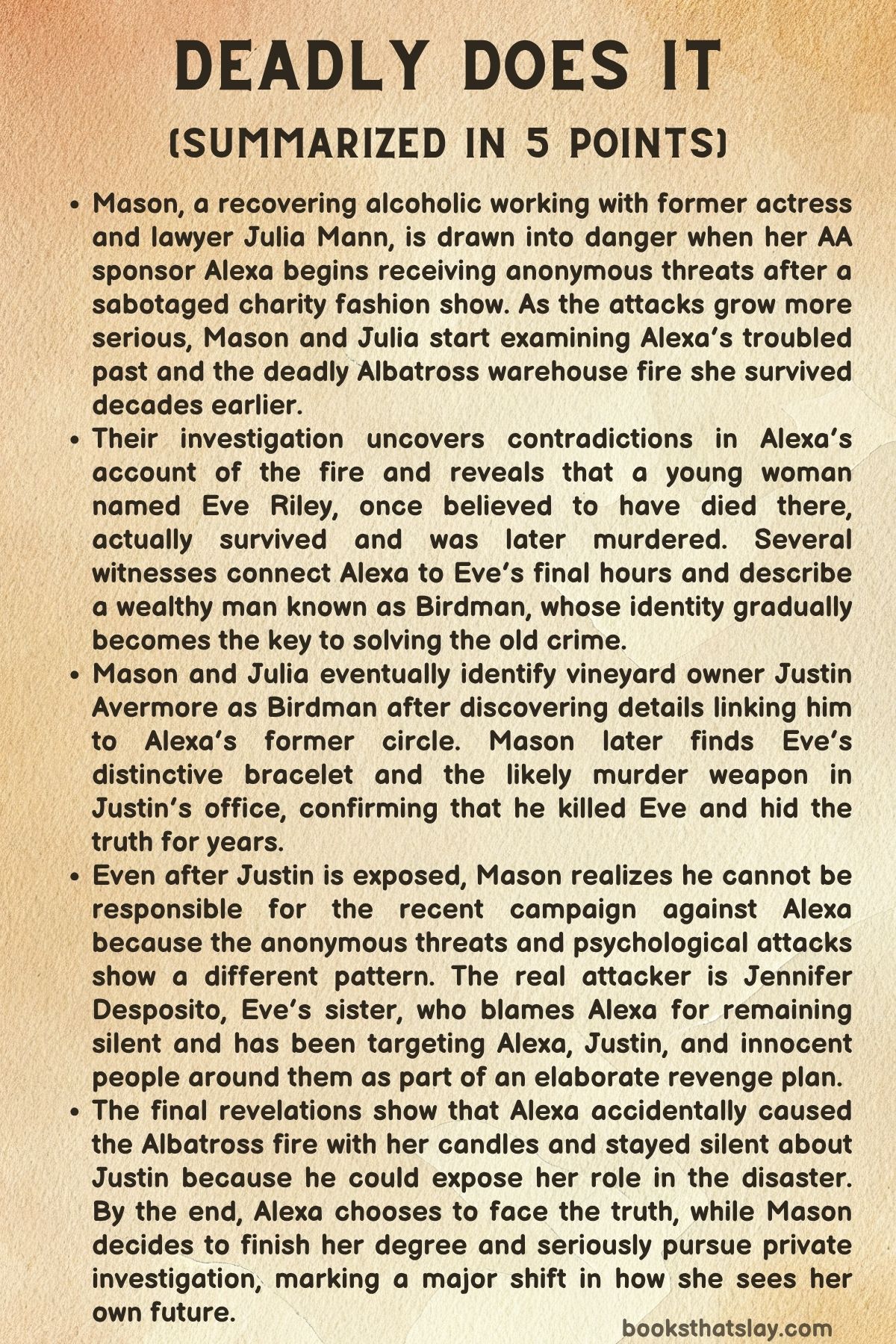
The story follows Mason, a tough, impulsive recovering alcoholic who works alongside former actress and lawyer Julia Mann. What begins as an investigation into threats against Mason’s AA sponsor, Alexa, gradually exposes secrets tied to a deadly warehouse fire decades earlier. At the same time, Mason is forced to reconsider her family relationships, her career, and her ideas about trust. The book balances danger with comedy while examining how old guilt can shape present choices.
Summary
Mason begins the story in circumstances that perfectly display both her courage and her recklessness. While fighting a violent thief named Halloran in a Los Angeles warehouse, she refuses to surrender despite being badly injured, and she survives largely because her employer, Julia Mann, arrives at the right moment and knocks Halloran unconscious.
Their relationship is unusual but deeply established. Julia is a former actress who was once convicted of murdering her husband, later became sober, earned a law degree in prison, and now handles legal and investigative cases, while Mason has grown from someone helping Julia with sobriety into her assistant, investigator, and trusted companion.
Mason’s personal life is less stable. Her father, Doug, suffers a minor heart attack, forcing Mason to think about returning to Berkeley and facing her mother Barbara and older sister Louise, both of whom have long treated her as the difficult member of the family.
Her AA sponsor, Alexa Rousso, encourages her not to react entirely from resentment. Alexa has been sober for more than twenty-five years and has become one of the most reliable figures in Mason’s life, although Mason notices that she seems unusually tired and unsettled.
At the same time, Julia begins pushing Mason toward a more ambitious future. She suggests that Mason finish her abandoned university degree and obtain the experience required to become a licensed private investigator, even offering to pay her tuition.
Mason is touched by Julia’s confidence because she is accustomed to feeling judged rather than encouraged. Teddy Kettleman, Claudia’s longtime romantic partner and an experienced private investigator, also begins teaching Mason how professional investigation actually works.
The central mystery begins during a charity fashion show organized by Alexa. Huge artificial fruits and vegetables suspended above the venue suddenly begin dropping, and an enormous artificial corn cob strikes Alexa.
Will Maier, Julia’s brilliant legal assistant, determines that the accident was probably deliberate because someone appears to have electronically disabled the support systems in sequence. Soon afterward, Alexa reveals that she has received anonymous threatening messages warning her to remain silent.
Julia formally becomes Alexa’s lawyer and begins investigating her past. Alexa admits that before becoming sober she had two disastrous marriages, cheated, stole, used drugs heavily, and lived for a time in an illegal Oakland warehouse community called the Albatross.
The Albatross later burned during a party, killing thirty people. Although Alexa survived and eventually entered recovery, Julia suspects that something from those years may explain the current threats.
Julia, Mason, Will, and Teddy begin tracing people from Alexa’s past. Mason and Julia interview Alexa’s first husband Richard, her former partner Dave McGann, former employer Jane Perdian, Lisa Rawlings, and eventually Michael “Fuzzy” Jones.
Their accounts establish that Alexa was once dishonest and destructive while addicted but later made sincere attempts to repair the harm she had caused. More importantly, their memories repeatedly conflict with Alexa’s version of what happened during the Albatross fire.
Meanwhile, danger spreads through Alexa’s present life. Guests at Jennifer Desposito’s new restaurant become seriously ill after drinking wine supplied by Justin Avermore’s vineyard, while Alexa receives additional threatening messages and becomes increasingly unstable.
Someone apparently enters Alexa’s home and places miniature vodka bottles in her purse. Because vodka was Alexa’s former drink of choice, Mason interprets the act as a deliberate attempt to attack her sobriety, although she is also forced to consider the disturbing possibility that Alexa obtained the alcohol herself.
The situation becomes deadly when Mason checks on Iris, one of Alexa’s newer sponsees, and finds her dead with a syringe nearby. At first the scene appears to show a relapse and fatal overdose, but forensic evidence later suggests that the syringe was staged.
Iris has also left a message blaming Alexa for damaging her confidence. Then Alexa receives another anonymous message declaring that Iris is only the first victim and that Jennifer and Mason will be next.
The threat becomes immediate when someone shoots at Mason outside Julia’s home. Archie, who has become romantically involved with Mason, runs into danger and is shot in the shoulder.
The police now understand that someone is not merely trying to murder Alexa. The attacker wants to frighten her, destroy her relationships, weaken her sobriety, and force her to confront something she has hidden.
Research increasingly points toward the Albatross fire. Alexa finally admits that a wealthy man called Birdman had been around the warehouse and had been involved with young sex workers associated with Lisa.
A retired fire investigator identifies Alexa as the mysterious woman who appeared after the fire and drew an extremely accurate floor plan for investigators before disappearing. Survivor Darren Olvera then remembers hearing Alexa arguing inside her room shortly before the fire, contradicting her original claim that she had already been outside.
Another shocking discovery concerns Eve Riley, a young sex worker believed to have died in the fire. Years later, Eve’s actual body was discovered buried in Tilden Park, proving that she survived the warehouse disaster and was murdered afterward.
Alexa admits that she had been with Eve shortly before the fire and had seen her with a male client. She continues to claim, however, that she cannot remember the man’s identity.
Julia and Mason begin searching for Birdman. Fuzzy remembers that he came from money, had connections to agriculture near Petaluma, carried expensive sparkling wine, and treated women badly.
Those details eventually point toward Justin Avermore, the successful vineyard owner who has recently become romantically interested in Julia. Jennifer then reveals that Justin and Alexa actually recognized each other when they met at a wedding shortly before the anonymous threats began.
Julia and Mason investigate Justin’s vineyard and discover several connections to the mysterious Birdman. Justin came from a wealthy agricultural family, his mother kept aviaries, and an old sparkling-wine bottle is prominently displayed in his office.
Mason and Teddy later break into Justin’s office to obtain a sample from his typewriter. While inside, Mason discovers that the decorative object wrapped around the old bottle is actually Eve Riley’s distinctive bracelet.
The bottle itself is unusually heavy and matches the type of object that could have caused Eve’s fatal head injury. Mason realizes that Justin is Birdman and that he kept both the murder weapon and Eve’s bracelet as trophies.
Justin returns before Mason can escape. Confronted with the evidence, he admits enough to expose his responsibility for Eve’s death, insisting that her killing was an accident even while revealing that he deliberately silenced and buried her.
He prepares to kill Mason with a shotgun and invent a story about mistaking her for an intruder. Teddy intervenes, Mason throws a heavy typewriter at Justin, and a violent chase follows through the vineyard.
Teddy is shot, Mason is wounded, and Justin pursues her through the vines. Teddy ultimately uses Julia’s enormous Rolls-Royce to run Justin down before he can kill Mason.
Although Justin is exposed as Eve’s murderer, Mason realizes he cannot be responsible for the entire campaign against Alexa. His typewriter does not match the threatening letters, and several of the attacks required a level of patient psychological manipulation that does not fit him.
The real answer emerges when Mason recognizes a California poppy design connected with Eve in Jennifer’s tattoo. Jennifer Desposito is Eve Riley’s sister.
Jennifer had deliberately chosen Alexa as her sponsor because of Alexa’s connection to the Albatross. After seeing Alexa recognize Justin at the wedding, Jennifer realized that Alexa had known information about Eve’s final hours and had kept silent for decades.
Jennifer therefore began attacking both Justin and Alexa. She poisoned Justin’s wine, damaged his vineyard, sent Alexa threatening messages, sabotaged the fashion show, planted vodka, secretly drugged Alexa with stimulants, manipulated Iris, shot at Mason, and even injured herself so that she would appear to be another victim.
Jennifer eventually gets Alexa drunk and attempts to push her down a hillside near Griffith Observatory. Mason, Julia, and Archie arrive in time, and Mason tackles Jennifer before she can kill Alexa.
The final secret concerns Alexa herself. Her candles accidentally caused the Albatross fire, and Justin knew enough about her responsibility to blackmail her into keeping quiet about Eve.
Alexa’s long silence came from fear that admitting what she knew would also force her to confess her role in a disaster that killed thirty people. Her decision to protect herself, however, allowed Eve’s murderer to escape justice for decades and eventually contributed to Jennifer’s campaign of revenge.
Jennifer confesses, but the legal case against her is uncertain because she has left surprisingly little physical evidence and quickly retracts her statements. Justin faces a much stronger case because investigators possess Eve’s bracelet, the probable murder weapon, Mason’s photographs, his own statements, and Alexa’s eventual cooperation.
Alexa begins recovering from her relapse and decides that making amends now requires telling the full truth regardless of the consequences. Mason also emerges changed, deciding to finish her degree and seriously consider becoming a licensed private investigator.
Her family relationships begin improving as well. Louise acknowledges that she has unfairly judged Mason for years, and the sisters eventually cooperate when Mason and Teddy investigate Roger Eberling, the colleague attempting to force Doug from his university position.
Using surveillance and carefully gathered evidence, Mason stops Eberling’s campaign and discovers that she genuinely enjoys investigative work. By the end of Deadly Does It, she has not solved every problem in her life, but she has finally begun choosing a future that reflects her abilities rather than the limited identity other people once assigned to her.
Characters
Mason
Mason is the emotional and investigative center of Deadly Does It, a woman whose physical courage is immediately obvious but whose deeper development concerns judgment, trust, discipline, and self-definition. She is fearless enough to fight dangerous criminals and pursue armed attackers, yet that same willingness to act before thinking repeatedly places both herself and others at risk.
Her history with alcoholism gives her unusual sensitivity toward addiction and recovery. She recognizes warning signs in Dave, understands why the vodka planted in Alexa’s purse is psychologically threatening, and takes Iris’s apparent overdose personally because sobriety is not an abstract issue for her but a daily reality shaped by experience.
Mason’s greatest weakness is impulsiveness. She contaminates potential evidence, pursues a shooter rather than waiting for the police, breaks into Justin’s office, and confronts him when escape would have been safer, demonstrating that her instincts are often excellent while her procedures remain undeveloped.
Her growth therefore does not require her to become less courageous. Instead, the book gradually shows her learning that bravery becomes more useful when supported by patience, evidence, planning, and professional training.
Family history has also shaped Mason’s self-image. Barbara and Louise have spent years treating her as difficult, aggressive, or irresponsible, and Mason has partly internalized their expectations even while aggressively rejecting them.
Julia’s belief in her creates an alternative identity. For perhaps the first time, qualities Mason has been taught to regard as defects are reframed as independence, determination, unconventional intelligence, and loyalty.
Her eventual decision to complete her degree and consider becoming a private investigator marks an important psychological shift. Mason is no longer simply reacting against other people’s expectations; she is beginning to decide deliberately what kind of life she wants.
Julia Mann
Julia Mann is one of the defining presences in Deadly Does It, combining elegance, intelligence, humor, authority, and personal experience of disgrace and recovery. Her history as a famous actress, convicted prisoner, recovering alcoholic, and lawyer makes her exceptionally difficult to intimidate because she has already survived several complete transformations of identity.
Julia often appears more controlled than Mason, but she is not passive. She knocks Halloran unconscious with a crowbar, orchestrates investigations, manipulates conversations, confronts lies directly, and is willing to place herself in uncomfortable situations when doing so can produce information.
Her strongest quality is her ability to recognize potential in people without sentimentalizing their weaknesses. She sees Mason’s reckless tendencies clearly, yet she also recognizes that Mason possesses courage, curiosity, observational ability, and determination that could make her an excellent investigator.
The offer to fund Mason’s education reveals how seriously Julia takes her responsibility as a mentor. She is not merely offering encouragement but constructing practical conditions in which Mason can succeed.
Julia also understands shame better than most characters. Because she has lived through public condemnation, addiction, imprisonment, and suspicion, she can comprehend why Alexa might hide something terrible even when Mason finds the dishonesty unforgivable.
Her relationship with Mason is therefore both affectionate and corrective. Julia frequently mocks her, challenges her conclusions, and sets boundaries, but she also defends Mason fiercely when her family reduces her to an old stereotype.
Julia’s sophistication never eliminates her vulnerabilities. Memories of Jonathan still affect her, prison remains emotionally disturbing, and her brief attraction to Justin demonstrates that intelligence does not make anyone immune to deception.
Alexa Rousso
Alexa occupies one of the most complicated moral positions in the book because she is simultaneously a source of genuine strength for others and a person whose decades of silence have serious consequences. Mason knows her primarily as an experienced AA sponsor who has maintained sobriety for more than twenty-five years and helped many women rebuild their lives.
That identity is real rather than fraudulent. Alexa is disciplined, generous, attentive to the needs of her sponsees, and capable of giving Mason measured advice that discourages impulsive thinking.
However, her earlier life reveals a radically different version of the same person. Addiction once made her dishonest, selfish, sexually reckless, financially destructive, and capable of stealing from people who trusted her.
Her recovery required acknowledging much of that behavior and making amends, but one secret remained beyond what she was prepared to confess. Her candles accidentally contributed to the Albatross fire, leaving her burdened by guilt connected to thirty deaths.
That guilt made Alexa vulnerable to Justin’s silence and intimidation. Because exposing what she knew about Eve might also expose her own responsibility, she chose self-protection, allowing a murder to remain hidden for decades.
Alexa’s moral failure therefore comes less from deliberate cruelty than from fear. Yet the story does not excuse the consequences simply because her motives are understandable.
Her eventual relapse is especially significant because Mason has treated her sobriety as nearly indestructible. Seeing Alexa drunk forces Mason to abandon the comforting belief that long-term recovery makes a person permanently safe from addiction.
By the end, Alexa’s willingness to cooperate with investigators suggests that genuine amends cannot depend on preserving one’s reputation. She must finally accept that honesty may involve legal, social, and emotional consequences.
Jennifer Desposito
Jennifer initially appears to represent successful recovery. After losing her family, experiencing homelessness, addiction, and repeated setbacks, she becomes sober and builds a respected restaurant career.
Her talent, discipline, and loyalty make her seem like another example of the positive influence Alexa has had on people. That impression is precisely what allows her to operate without serious suspicion for so long.
Jennifer’s hidden identity as Eve Riley’s sister completely changes the reader’s understanding of her actions. Her choice of Alexa as a sponsor was not accidental; she deliberately placed herself close to someone connected with her sister’s disappearance.
Her discovery that Alexa recognized Justin transforms old grief into calculated revenge. Jennifer does not simply want legal justice for Eve but wants Alexa and Justin to experience personal destruction.
Her methods reveal extraordinary patience and emotional intelligence used destructively. She understands sobriety well enough to attack Alexa through alcohol, manipulation, shame, fear, and the deaths or injuries of people Alexa feels responsible for protecting.
Jennifer’s treatment of Iris marks the clearest point at which her desire for justice becomes morally indefensible. Iris has no responsibility for Eve’s death, yet Jennifer treats her vulnerability as a tool for punishing Alexa.
Even Jennifer’s own injury demonstrates how completely she has committed herself to controlling the narrative. By arranging to appear as another victim, she uses pain inflicted on herself as evidence supporting a false story.
Jennifer therefore becomes a warning about the difference between justice and revenge. Her grief is understandable, and Alexa’s silence genuinely contributed to decades without answers, but Jennifer ultimately reproduces the same disregard for innocent lives that made Eve’s murder so terrible.
Justin Avermore
Justin Avermore is initially presented as charming, successful, cultured, and confident. His vineyard, education, professional reputation, and easy social manner allow him to present himself as someone whose youthful mistakes belong safely in the past.
That respectable identity conceals Birdman, the wealthy young man remembered by Alexa’s former associates. Even in his youth, Justin was protected by money, treated vulnerable women badly, and operated with a sense that consequences applied differently to him.
His murder of Eve exposes the extreme form of that entitlement. He attempts to describe her death as accidental, yet his language quickly reveals that he believed silencing her was more important than respecting her life.
Keeping both the heavy bottle associated with the killing and Eve’s bracelet demonstrates something colder than panic. The objects become trophies, suggesting that he privately preserved evidence of the power he exercised over her.
Justin’s confrontation with Mason further reveals his moral character. Rather than showing remorse after decades, he immediately begins constructing another convenient story that would justify killing her.
His downfall occurs because the privileged identity that protected him for years encourages overconfidence. He assumes that people will believe his version of events, just as earlier legal troubles disappeared and Eve’s death remained unnoticed.
Teddy Kettleman
Teddy is introduced through the comic surprise of Mason discovering that Claudia has maintained a twenty-year romantic relationship without telling her. Behind his easy charm, however, he is a highly experienced investigator whose practical understanding of surveillance becomes essential to Mason’s development.
He does not romanticize private investigation. Teddy explains that the work often involves deception, uncomfortable discoveries, hidden relationships, and difficult decisions about what information should be revealed.
His response to Mason’s discomfort is particularly important. Rather than telling her to suppress her conscience, he argues that ethical unease can make her more thoughtful about how investigative power is used.
Teddy also teaches Mason to distinguish intuition from evidence. He respects her ability to notice patterns but insists that real investigation requires timelines, cataloging, cross-referencing, documentation, and patience.
Their relationship evolves from instruction into genuine friendship. At Justin’s vineyard, Teddy risks his life to protect Mason, while Mason’s thrown typewriter prevents him from being shot more directly.
His willingness to joke while seriously wounded reflects the book’s larger combination of danger and comedy. It also makes him a suitable mentor for Mason because he shares her appetite for risk while possessing the discipline she still needs to learn.
Claudia
Claudia occupies an unusual place in Julia’s household because she is technically the housekeeper but functionally belongs to the family. She is observant, confident, private, funny, and far less predictable than Mason initially assumes.
Her secret relationship with Teddy proves that Claudia controls what others are permitted to know about her. Mason, despite living close to her, has no idea that an important romance has existed for twenty years.
Claudia also contributes a grounded understanding of addiction. When Mason instinctively rejects the idea that Alexa might be hiding a relapse, Claudia reminds her that addicts can deceive both other people and themselves.
Her secret feeding of Phil offers a lighter example of the same independent streak. Claudia knows exactly what Julia thinks about the cat and quietly ignores her, creating a harmless conspiracy that repeatedly interrupts darker events.
Behind the comedy is considerable loyalty. Her devotion to Teddy becomes particularly visible after he is wounded, while her affection for Mason and Phil reinforces the sense that Julia’s household has developed into a chosen family.
Archie
Archie initially serves as another source of humor through his sarcastic attraction to Mason. Their attempts to define a date as something more casual reveal two people who are interested in one another but reluctant to become emotionally exposed.
His feelings become far more serious once Mason is threatened. When the gunman attacks Julia’s property, Archie runs toward danger and is shot, demonstrating that his attachment to Mason is no longer merely flirtation.
Mason’s guilt after the shooting shows the difficulty she has accepting that other people may willingly take risks for her. Archie, however, does not use the injury to demand emotional repayment.
He remains supportive even when the investigation becomes increasingly dangerous. His presence near the conclusion, when the group searches for Alexa and confronts Jennifer, confirms that he has become part of Mason’s wider network rather than remaining a temporary romantic subplot.
Will Maier
Will is Julia’s intellectual and research specialist. Brilliant, systematic, and somewhat socially awkward, he provides the careful factual work that balances Mason’s instinctive approach.
His research repeatedly turns vague memories into usable leads. He traces people from Alexa’s past, studies the Albatross fire, investigates Justin’s background, examines the threatening letters, and identifies contradictions that would otherwise remain scattered observations.
Will also represents the form of investigation Mason has yet to master. He values documentation, chronology, verification, and evidence rather than relying on dramatic intuition.
His occasional mistakes are important because they prevent him from becoming an unrealistic source of perfect information. The failure to identify Justin’s alarm system before Mason and Teddy enter the house has serious consequences.
Will nevertheless remains essential because the investigation succeeds through combined strengths. Mason notices unusual details, Julia interprets people, Teddy understands fieldwork, and Will builds factual connections between them.
Louise
Louise initially embodies almost everything Mason dislikes about returning home. Controlled, accomplished, and certain that she understands situations better than her younger sister, she repeatedly treats Mason as the irresponsible child of the family.
The important change occurs when Louise recognizes that she has been reproducing the same behavior she dislikes in their mother. Her apology is significant because she does not merely ask Mason to forget the past; she identifies specific ways in which she has judged and diminished her.
Louise’s admission that she envies Mason also reverses the sisters’ assumed hierarchy. Mason has spent years believing Louise represents successful adulthood, while Louise privately values Mason’s independence, sobriety, authenticity, and unconventional life.
Their eventual cooperation over Doug’s university problem suggests that reconciliation does not require them to become similar. Louise can work through formal channels while Mason uses investigation, and their different methods become complementary rather than competitive.
Barbara
Barbara is Mason’s mother and one of the main forces behind Mason’s long-standing sense of inadequacy. Her attention quickly returns to Mason’s injuries, fighting, and childhood behavior, revealing how easily she continues to interpret the adult Mason through an older identity.
Her stories about Mason’s aggression may contain factual truth, but the problem lies in repetition and framing. By continually presenting Mason as the difficult daughter, Barbara leaves little room for the possibility that the same traits have developed into courage, protectiveness, and resilience.
Barbara is not portrayed as malicious. Her behavior appears to arise from habit, worry, and a deeply established family structure in which everyone has been assigned a role.
Julia’s defense of Mason forces Barbara to encounter an outside perspective. The characteristics that appear unacceptable within the family are precisely the characteristics that make Mason valuable in another environment.
Doug
Doug, Mason’s father, is a psychiatrist and academic whose habit of interpreting family behavior intellectually has contributed to Mason’s frustration. Mason often feels that her parents studied or explained her instead of simply responding to her as a daughter.
His heart attack initially appears to be the reason Mason must return home. The more serious problem, however, is Roger Eberling’s attempt to force him out of his university position through claims of inappropriate behavior and cognitive decline.
Doug’s reluctance to retire reveals pride, professional identity, and fear about losing a career central to his sense of self. The situation also gives Mason an opportunity to protect the father whose parenting has often frustrated her.
By the conclusion, Mason’s investigation of Eberling becomes an indirect act of family loyalty. She does not need to resolve every childhood grievance before deciding that her father deserves defending.
Scott
Scott, Alexa’s husband, appears less frequently than many central characters, but his presence establishes that Alexa has built a stable adult life very different from her chaotic youth. He is concerned enough about the threatening messages to bring Alexa to Julia and wants the danger taken seriously.
His reactions also expose how much Alexa has been withholding from the people closest to her. She does not initially tell him about the anonymous threats, demonstrating that secrecy remains one of her instinctive responses even decades into sobriety.
Scott therefore represents the domestic security Alexa risks losing because of her hidden past. The attacker understands that destroying Alexa means threatening not only her physical safety but the relationships and stability she spent decades creating.
Iris
Iris is one of the book’s most vulnerable figures. Early in sobriety, emotionally connected to an addicted former boyfriend, and uncertain of herself, she depends heavily on Alexa’s guidance.
Her vulnerability makes her particularly useful to Jennifer. Because everyone already fears that Iris could relapse, her apparent overdose initially seems tragically believable.
The discovery that the scene was manipulated changes Iris from an apparent victim of addiction into a victim of someone who understood exactly how her history could be used against her. Jennifer exploits both Iris’s insecurity and the assumptions others make about people in early recovery.
Iris’s death also destabilizes Alexa. As a sponsor, Alexa immediately interprets the tragedy as a possible personal failure, which is exactly the emotional response Jennifer wants to create.
Richard Streppo
Richard, Alexa’s first husband, offers an important contrast between old damage and present resentment. His marriage to Alexa involved drugs, betrayal, infidelity, and chaos, giving him obvious reasons to remain angry.
Instead, sobriety has allowed him to view those years with a mixture of regret and perspective. He acknowledges Alexa’s behavior without turning her into a permanent villain.
His willingness to reconnect and possibly make amends demonstrates one version of recovery that the story values. Richard does not deny the past, but he also refuses to organize his entire present identity around revenge for it.
Dave McGann
Dave represents what Alexa’s life might have become without sustained recovery. Still drinking heavily and living in poor conditions, he demonstrates the physical, emotional, and social damage of prolonged addiction.
Yet the book avoids reducing him entirely to his alcoholism. His care for his cat, despite neglecting himself, reveals continuing tenderness and responsibility within an otherwise deteriorated life.
Dave’s memories become crucial because they contradict Alexa’s claim about being outside when the Albatross fire began. Although his addiction makes him an imperfect witness, later testimony confirms that his uncertainty about Alexa’s story was meaningful.
Mason’s decision to buy him groceries rather than treating him only as a source of information also reveals her own compassion. She understands that investigation does not require ignoring another person’s suffering.
Lisa Rawlings
Lisa is another survivor of Alexa’s chaotic Oakland years who eventually constructs a stable adult life. Her past includes sex work, crime, intoxication, and later legal trouble, but she now runs a successful legal brothel and is sober.
Her direct manner makes her valuable because she refuses to sentimentalize her relationship with Alexa. She describes them as people who used drugs together rather than pretending that their shared past automatically constituted meaningful friendship.
Lisa’s memory of Eve introduces one of the investigation’s most important clues. She believed Eve died in the Albatross fire and independently confirms that Alexa was not outside with her, Dave, and Fuzzy when the blaze began.
Her testimony demonstrates how several imperfect witnesses can collectively reveal a truth that none possesses completely.
Michael “Fuzzy” Jones
Fuzzy initially exists in other characters’ memories as a dangerous figure connected with drugs, stolen cars, prostitution, and crime. When Mason and Julia finally meet him in prison, however, he is friendlier and more reflective than his reputation suggests.
His account becomes essential because he remembers Alexa running out of the Albatross and warning people immediately before the fire spread. This places her inside the building at the critical moment.
Fuzzy also provides the details that allow Birdman to become identifiable. He remembers wealth, agriculture near Petaluma, expensive sparkling wine, good cars, and an unusual distance from the dependency affecting everyone else.
His character illustrates the danger of assuming that credibility can be judged simply from social respectability. A convicted prisoner remembers crucial truths that respectable people have successfully concealed.
Eve Riley
Eve is dead long before the present-day action, yet she is the hidden center around which much of the mystery develops. Initially counted among the Albatross victims, she was actually alive after the fire and was later murdered and buried in Tilden Park.
The discovery of her body turns an old disaster into a separate homicide investigation. Her distinctive bracelet, decorated with poppies and her initial, eventually becomes the physical clue that identifies Justin as her killer.
Eve’s importance extends beyond solving her murder. Her death shaped Jennifer’s adult life, provided Justin with a secret he believed permanently buried, and became part of the silence Alexa maintained for decades.
Through Eve, the story emphasizes how unresolved violence continues affecting the living. Her absence becomes powerful because other characters make radically different moral choices in response to what happened to her.
Detectives Brooks and Wilson
Brooks and Wilson provide the official investigative counterweight to Julia’s unconventional team. They repeatedly remind Mason that suspicion, pattern recognition, and intuition cannot substitute for admissible evidence.
Their investigation of Iris’s death transforms the case by identifying the unnatural fingerprints on the syringe. They also recognize the psychological structure of the campaign against Alexa, concluding that the attacker wants punishment and fear rather than merely a quick death.
Their frustration over the team’s failure to disclose evidence immediately highlights one recurring weakness in Julia and Mason’s approach. Private loyalty and attorney-client concerns may be understandable, but withholding information can complicate police work.
The detectives therefore embody procedural discipline. Their presence shows why solving a mystery intellectually is different from proving criminal responsibility legally.
Detective Karneeva
Karneeva is defined by his inability to forget Eve Riley. Years after investigating the discovery of her body, he continues reviewing the file because the absence of a solution remains personally troubling.
His dedication humanizes cold-case investigation. Eve is not merely an old file to him but a young woman whose killer continued living freely because crucial information never reached investigators.
Karneeva’s photographs allow Mason to see Eve as a person rather than simply a victim. They also provide the details of the bracelet that eventually enables Mason to recognize the object in Justin’s office.
His persistence is ultimately rewarded not by luck alone but by his refusal to discard unanswered questions simply because time has passed.
John Hare
John Hare, the retired fire investigator, provides one of the strongest links between Alexa and the Albatross investigation. He remembers the unsafe building conditions clearly and explains why the warehouse had long been considered a potential disaster.
Most importantly, he remembers a young woman appearing after the fire and drawing an extraordinarily accurate floor plan. When shown Alexa’s photograph years later, he immediately recognizes her.
His testimony demonstrates the strange endurance of memory. A detail that once seemed almost unreal becomes important decades later when new questions allow investigators to understand its significance.
Darren Olvera
Darren is an Albatross survivor whose memories directly challenge Alexa’s version of events. Initially reluctant to cooperate, he eventually recalls hearing Alexa arguing inside her room shortly before the fire.
He also remembers the distinctive scent of her jasmine candles and incense. That sensory detail becomes important because it connects Alexa’s room with a possible source of open flame.
Darren does not know the full truth, but his testimony places Alexa inside the warehouse at the exact period when she claimed to have been outside. His account therefore forces Alexa closer to admitting what she has hidden.
Dr. Jane Perdian
Jane offers an important perspective on Alexa’s ability to lie during active addiction. She remembers Alexa as intelligent, charismatic, talented, and capable of stealing while convincingly protecting her deception.
At the same time, Jane also remembers the sober Alexa returning years later, apologizing, repaying what she had taken, and attempting to repair the damage. Her account therefore prevents Mason from choosing a simplistic interpretation of Alexa as either entirely trustworthy or fundamentally dishonest.
Jane’s memories reinforce one of the book’s central ideas about identity. Recovery can produce genuine change without erasing the reality of what someone previously did.
Jade Solomon
Jade occupies a relatively small role but contributes to the comic tone surrounding the fashion-show disaster. While enormous artificial vegetables collapse around the audience, she remains composed enough to record what is happening and immediately recognizes the value of the footage.
Her calmness contrasts with the panic surrounding her. It also reflects the celebrity environment in which Julia and several other characters operate, where extraordinary events can almost instantly become entertainment and public spectacle.
Jade does not drive the mystery, but her presence adds social texture to Mason’s world and prevents the investigation from existing in a purely grim atmosphere.
Roger Eberling
Roger Eberling represents a different kind of antagonist from Justin or Jennifer. Rather than relying on physical violence, he attempts to remove Doug from his university position through accusations and institutional pressure.
His actions activate Mason’s protective instincts and provide her with an opportunity to test the investigative methods Teddy has been teaching her. Surveillance exposes Eberling’s private behavior with young sex workers and gives Mason leverage against him.
The way Mason handles the confrontation is deliberately morally uncomfortable. She does not follow a clean formal process, yet she succeeds where Louise’s conventional methods have failed.
Eberling therefore becomes part of Mason’s final professional test. The case forces her to accept that private investigation often operates in spaces where legality, ethics, privacy, and practical justice do not align perfectly.
Phil
Phil, Mason’s three-legged cat, provides recurring comic relief but also reveals important aspects of the household’s relationships. Julia loudly complains about him, while Claudia secretly feeds him elaborate meals and encourages his presence.
His injury after fighting a coyote exposes the affection hidden beneath Julia’s irritation. She immediately offers to pay his veterinary expenses despite years of pretending that she wants nothing to do with him.
The final image of Phil sitting on Julia’s lap confirms what everyone else has already understood. The cat has become part of the same unconventional family that has formed around Mason.
Themes
Guilt, Silence, and the Cost of Avoiding Truth
Guilt in Deadly Does It does not remain safely attached to the past. Alexa survives the Albatross fire and constructs decades of sobriety, service, marriage, and professional success, yet one concealed truth continues determining her choices because admitting what she knows about Eve would also require confronting her role in the fire.
Her silence begins as self-protection, but time changes its consequences. Justin remains free, Eve’s family never receives justice, Jennifer’s grief hardens into obsession, and Alexa becomes increasingly dependent on preserving the very secret that prevents her from fully making amends.
The story therefore separates guilt from accountability. Feeling terrible about something does not repair the damage caused by it, particularly when shame becomes a reason to withhold information that other people need.
Alexa is not portrayed as morally equivalent to Justin. She did not intentionally cause the deaths at the Albatross, while Justin deliberately killed Eve and hid her body.
Nevertheless, the difference between their actions does not make Alexa’s silence harmless. Her fear of exposure creates conditions in which another person escapes responsibility.
Jennifer represents the destructive opposite response. Rather than hiding the past, she becomes consumed by it and attempts to punish everyone connected to her sister’s death.
Both women allow the past to control the present because neither initially accepts a disciplined form of truth and justice. Alexa hides from consequences, while Jennifer appoints herself judge and executioner.
The eventual resolution suggests that truth may arrive late without becoming meaningless. Alexa cannot undo the fire or restore Eve’s life, but she can finally stop protecting herself through silence and accept whatever follows from telling the truth.
Recovery, Addiction, and the Fragility of Identity
Sobriety is treated as an ongoing practice rather than a permanent achievement. Mason, Julia, Alexa, Jennifer, Richard, Lisa, Dave, and Iris all occupy different relationships with addiction, allowing the story to show recovery through multiple stages and outcomes.
Alexa initially appears almost invulnerable because of her decades of sobriety. Mason has built part of her own emotional security around believing that Alexa represents proof that recovery can become completely stable.
The attacks against Alexa expose the danger in that assumption. Jennifer understands that sobriety can be targeted psychologically, which is why the planted vodka, stimulants, fear, guilt, and eventually alcohol itself become more damaging than ordinary physical intimidation.
Alexa’s relapse after twenty-eight years is therefore important precisely because she has been sober for so long. The event does not erase those decades, but it proves that past success does not eliminate vulnerability.
Dave offers another possibility. He remains trapped in active alcoholism, physically deteriorated and socially isolated despite possessing traces of tenderness and decency.
Richard and Lisa demonstrate more successful forms of long-term change. Neither denies the damage of earlier addiction, but both have constructed lives that are no longer governed entirely by it.
Iris represents the vulnerability of early sobriety. Because relapse is plausible for someone in her position, Jennifer is able to manipulate that expectation and disguise violence as self-destruction.
Mason gradually learns that recovery should not require idealizing other sober people. Alexa can be a valuable sponsor and still lie; Jennifer can be sober and still become dangerous; Mason herself can remain sober while making serious mistakes.
The theme therefore treats recovery as human rather than heroic. Sobriety creates the possibility of change, but character continues to depend on honesty, responsibility, relationships, and repeated choices.
Family Roles and the Struggle to Redefine the Self
Mason’s family has spent years defining her through childhood behavior. She is remembered as aggressive, noncompliant, difficult, impulsive, and disappointing, and every return to Berkeley threatens to place her back inside that fixed identity.
The problem is not simply that these descriptions are false. Mason genuinely is argumentative, physically fearless, unconventional, and resistant to authority, but her family interprets those characteristics almost entirely as defects.
Julia offers a radically different interpretation. She sees the same resistance to authority as independence, the same aggression as courage, and the same unwillingness to conform as evidence that Mason can think and act independently.
That contrast demonstrates how identity is partly shaped by the social environment interpreting it. A quality can become a weakness or a strength depending on how it develops and where it is applied.
Louise’s apology becomes especially meaningful because she recognizes her own participation in the family pattern. Instead of continuing to approach Mason as someone who needs correction, she admits that she has envied the very qualities she has criticized.
Their eventual cooperation suggests a healthier model of family relationship. Neither sister has to surrender her personality for them to become closer.
Mason’s changing relationship with her father also reflects this process. She remains angry about being treated like a psychological subject rather than simply a daughter, yet she still chooses to defend Doug when his colleague tries to remove him from his position.
Growth therefore does not require Mason to pretend that her childhood wounds never existed. She begins moving forward when she stops allowing those wounds to determine every present interaction.
By choosing education, investigative work, reconciliation with Louise, and continued connection with Julia’s household, Mason begins constructing an identity based on present decisions rather than inherited family labels.
Justice, Revenge, and Moral Responsibility
The mystery repeatedly asks who has the right to punish wrongdoing and what happens when personal grief replaces legal or ethical restraint. Eve’s murder goes unsolved for decades, giving Jennifer an understandable reason to feel that ordinary systems have failed her family.
Her anger becomes morally dangerous when she decides that suffering itself will serve as justice. Alexa must lose her sobriety, relationships, peace, and possibly her life because Jennifer believes decades of silence make her deserving of destruction.
That logic steadily expands the number of acceptable victims. Iris has no responsibility for Eve’s death, Archie knows nothing about the Albatross, and Mason was not even present when the original events occurred.
Once revenge becomes the governing principle, innocence stops offering protection. People become instruments through which another person can be punished.
Justin represents another corruption of responsibility. He repeatedly treats his own interests as more important than other people’s lives, first killing Eve and later preparing to kill Mason while constructing a version of events that would protect him.
Mason herself is not entirely outside this moral uncertainty. Her investigation of Eberling relies on surveillance and implied blackmail, methods that succeed but sit uneasily beside conventional ideas of justice.
The story therefore refuses to make morality completely clean. Police procedure may fail, evidence may disappear, guilty people may avoid punishment, and unconventional investigators may achieve useful results through ethically questionable methods.
The crucial distinction lies in purpose, proportion, and treatment of innocent people. Mason’s methods can be challenged, but she is trying to stop harm; Jennifer deliberately creates new victims in order to satisfy her need for punishment.
Justice becomes meaningful only when responsibility remains tied to what a person has actually done. Once punishment is allowed to spread beyond that boundary, the desire to answer one wrong can easily become another wrong of equal or greater cruelty.