Definitely Thriving Summary, Characters and Themes
Definitely Thriving by Kerry Clare is a comic and observant novel about starting over after a life has been deliberately broken. At its center is Clemence Lathbury, a woman who leaves her marriage in the messiest possible way and arrives in Toronto determined to live differently.
What begins as self-imposed exile becomes an uneasy, funny, and revealing experiment in independence. Through a shabby attic room, a strange bookstore, complicated friendships, family pressure, illness, and an unexpected romance, Definitely Thriving explores what it means to rebuild a life without pretending that reinvention is tidy, noble, or simple.
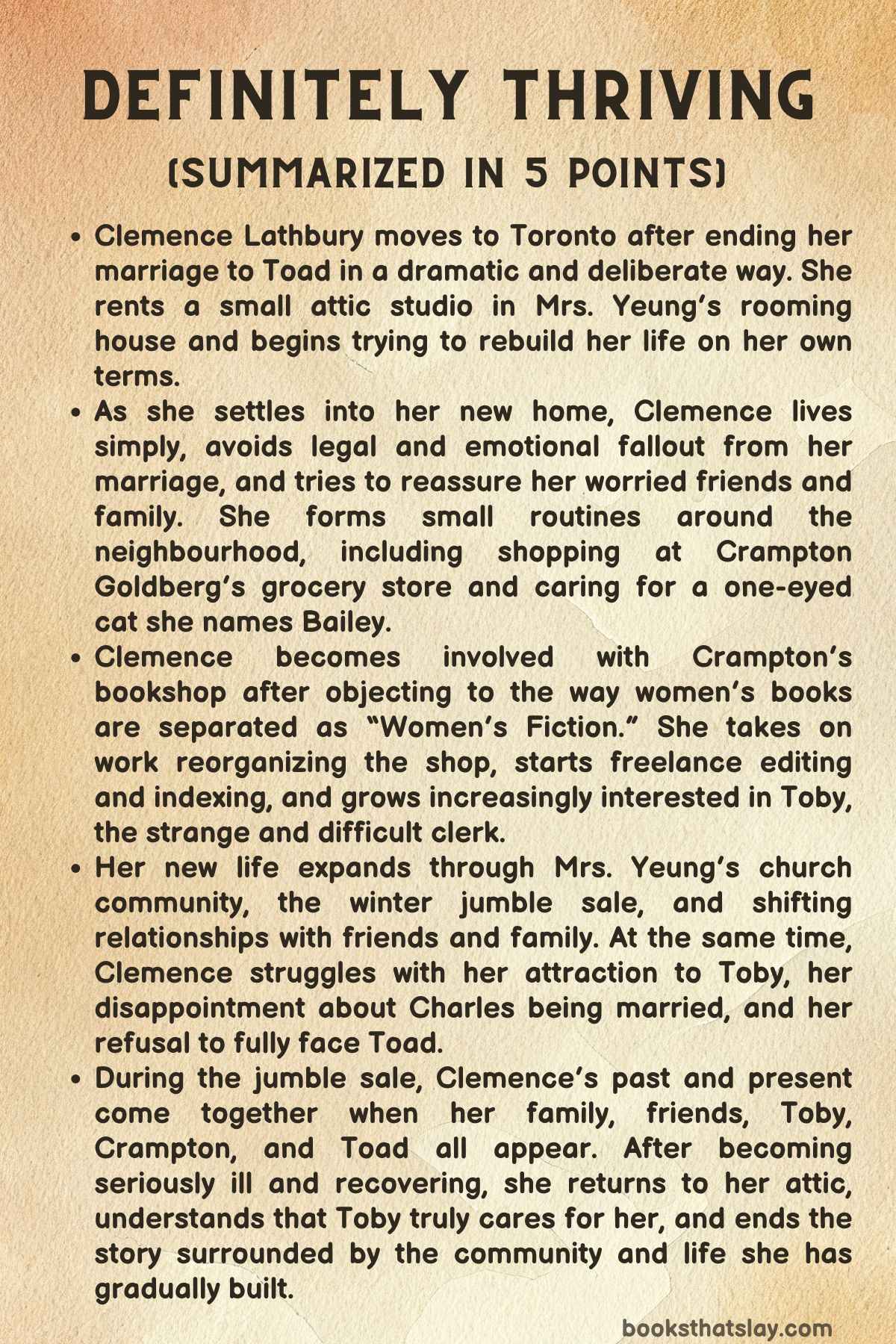
Summary
Clemence Lathbury comes to Toronto after bringing her marriage to an explosive end. Instead of asking for a separation or quietly leaving Toad, she arranges for him to find her in bed with their neighbours, Larry and Lisa.
The act is deliberate, theatrical, and cruel, but to Clemence it feels like the only way to make escape final. She arrives in the city wanting a new beginning, though it is clear that she has not fully dealt with what she has done or what she has left behind.
She rents an attic studio in a rooming house owned by Mrs. Yeung. Clemence expects the apartment to be grim, bare, and suitable for the punishment she seems to believe she deserves.
Instead, the room has an unexpected charm. It is shabby, but it has French doors, a balcony, and a maple tree outside.
Her friend Jillian helps her move in and immediately worries that Clemence is choosing hardship as a form of self-discipline. Clemence insists she is not punishing herself.
She says she wants simplicity, distance, and the chance to begin again without the old markers of married life.
At the rooming house, Clemence meets Mrs. Yeung’s son, Charles. He is handsome, kind, and easy to talk to, and Clemence quickly notices him.
Their early exchanges are playful, and when he brings her an air conditioner, the gesture feels intimate even though the machine ends up blowing a fuse. Clemence is drawn to him, but she also senses danger in that attraction.
She has just left a marriage and is not ready to enter another complicated emotional situation, even if part of her wants to.
Clemence begins building a small life in her attic. She shops at Crampton Goldberg’s grocery store, a dusty and old-fashioned place that becomes part of her new routine.
She lives on plain food such as sardines, bread, and tea. She slowly gathers odd household items and tries to make the room functional.
She also befriends a one-eyed cat, whom she names Bailey. The cat becomes part of her fragile domestic world, a sign that Clemence is not as detached from comfort and companionship as she pretends.
Although she tells people she is fine, Clemence avoids the practical consequences of leaving Toad. Letters from his lawyer arrive, but she does not open them.
She avoids dealing with the townhouse they shared. She lets the legal and financial parts of her old life remain suspended while she concentrates on the smaller tasks of living day to day.
Her family and friends are not convinced by her performance of calm. Her parents, Roger and Bonnie, and her sisters, Prudence and Grace, worry about her.
Jillian and Naomi also keep checking in, urging her to think about work, stability, and connection.
Clemence eventually finds her way to Crampton’s bookshop, where she buys a used bookshelf and notices something that irritates her. Books by women are shelved separately under “Women’s Fiction,” as though women’s writing is a special category instead of part of literature as a whole.
She complains to Toby, the pale, awkward clerk working in the shop. Toby is not especially friendly.
He is rude, strange, physically unwell, and difficult to read. Still, Clemence is intrigued by him.
Clemence later brings her complaint to Crampton herself. Instead of simply changing the shelving system, Crampton hires Clemence to help reorganize the shop and to deal with Toby.
This gives Clemence work, purpose, and regular contact with the bookstore. She also begins taking freelance indexing and editing jobs, slowly rebuilding a working life.
The bookstore becomes one of the places where her new identity starts to form.
Toby increasingly occupies Clemence’s thoughts. He is not charming in any ordinary way, but that is part of his appeal to her.
Clemence decides that he is an “unsuitable attachment,” which makes him feel safer than someone like Charles. Toby’s oddness, emotional distance, and rough manners make him seem like a relationship that cannot become too conventional or dangerous.
Charles, by contrast, seems too attractive and too possible until Clemence learns from Mrs. Yeung that he is married to a doctor. That news forces her to reconsider the fantasies she has allowed herself to build around him.
At the same time, Clemence becomes involved with Mrs. Yeung’s church and the planning of a winter jumble sale. What begins as a small volunteer commitment grows into a larger project.
Clemence promotes the sale, collects donations, organizes books, and draws local vendors into the event. The work gives her a sense of usefulness and a place within a community.
She is no longer just hiding in an attic; she is becoming known.
Her new life, however, is not free of embarrassment or conflict. A profile about her “spinster” existence attracts online backlash, making her private attempt at reinvention into public commentary.
Clemence is unsettled, but she keeps going. Around her, other relationships are also under strain.
Jillian confesses that she has been having an affair with a therapist she found online. Her marriage to Jeremy is damaged, though they are trying to repair it.
Clemence sees that everyone around her has private disorder, even those whose lives appear more settled.
Clemence’s family relationships also shift. She argues with Prudence, then apologizes.
She accepts editing work through Sandro, which helps her feel less adrift professionally. She does not become instantly healed or fully responsible, but she begins taking steps that reconnect her to other people and to the world beyond her failed marriage.
Her relationship with Toby develops in strange, awkward stages. After he suffers a head wound, there is a kiss, and their intimacy becomes more physical.
They begin meeting secretly in the dark closet under the bookstore stairs. Their encounters are furtive and odd, but they also reveal Clemence’s hunger for being wanted without having to explain herself.
She invites Toby to dinner, trying to bring him into her own space. The meal does not go smoothly.
Her cooking is poor, and there is even a caterpillar in the food, but Toby endures it to save her from embarrassment. His cat allergy then flares because Bailey has been in the apartment, making the evening even more uncomfortable.
Despite their closeness, Clemence remains uncertain. She does not know whether Toby is right for her or whether she is using him as a way to avoid larger questions.
She wonders what might have happened with Charles if he had been available. She also knows she has been avoiding Toad and the unfinished business of her marriage.
Her new life is growing, but the old one has not disappeared.
The winter jumble sale becomes the point where everything comes together. Clemence’s family and friends arrive, bringing their concern, judgments, and affection into the same space.
Toby appears with Crampton. Then Toad arrives unexpectedly, having crossed the country to confront Clemence.
His presence makes it impossible for her to keep pretending that the past can be managed by ignoring letters and staying busy. Overwhelmed by the collision of her old life and her new one, Clemence tries to keep working through the event, but she becomes seriously ill.
Clemence later learns that she has bacterial pneumonia. Her body has failed after weeks of strain, avoidance, overwork, and emotional pressure.
She spends time in the hospital and then recovers at her parents’ house over Christmas. This period of illness forces her to accept care from others.
It also interrupts the performance of independence she has been trying to maintain. Clemence has wanted to prove she can survive alone, but recovery shows her that needing people is not the same as failure.
When Clemence returns to her attic, Charles helps her. He gives her notes that Toby has left behind.
The notes contain drawings of Clemence, and they show that Toby has been paying close attention to her. For Clemence, this matters deeply.
Toby’s drawings suggest that he truly sees her, not as a role, a scandal, a wife, or a problem to be solved, but as herself. This realization changes the way she understands their connection.
Moved by the drawings, Clemence goes to the bookshop in the snow. It is an act of return, but not to the life she abandoned.
She returns to one of the places where her new life has taken shape, and to a person who has become important to her in a strange but real way.
The story closes with a wedding, though not Clemence’s. Mrs. Yeung marries Tom, and the event gathers the community that has formed around Clemence since her arrival in Toronto.
Clemence walks down the aisle with Charles, while Toby waits at the front. The ending does not present Clemence as completely fixed or neatly transformed.
Instead, it shows her living among people, work, books, friendship, family, and love. She has not simply escaped her old life; she has made a new one, imperfectly and with help.
Definitely Thriving ends with Clemence no longer just surviving the wreckage of her choices, but beginning to belong somewhere again.
Characters
The characters in Definitely Thriving are shaped by rupture, reinvention, loneliness, humour, and the slow building of community. Each person reflects a different version of adulthood, whether through marriage, work, family duty, friendship, aging, desire, or the search for a more honest life.
Clemence Lathbury
Clemence Lathbury is the central character of Definitely Thriving, and her journey is built around deliberate disruption and gradual renewal. At the beginning of the book, she has destroyed her marriage in a shocking and theatrical way by arranging for Toad to discover her in bed with their neighbours.
This act is not presented as simple cruelty or recklessness; it reveals Clemence’s desperation to escape a life that has become emotionally suffocating. Her move into Mrs. Yeung’s attic studio becomes both punishment and liberation.
She wants austerity, discomfort, and distance from her old self, but the room’s unexpected charm suggests that her new life may offer more possibility than she expected. Clemence is stubborn, evasive, witty, self-conscious, and often unwilling to face practical consequences, especially when she avoids Toad’s lawyer’s letters and refuses to deal with the townhouse.
Yet she is also deeply observant and capable of forming meaningful attachments. Her work in the bookshop, her care for Bailey, her involvement in the jumble sale, and her growing connection with Toby show that she is not merely running away from marriage; she is slowly learning how to belong to the world again on different terms.
Her illness near the end of the story also exposes how fragile her performance of independence has been. Clemence’s growth comes not through becoming perfectly self-sufficient, but through accepting help, being seen, and allowing an imperfect community to gather around her.
Toad
Toad is Clemence’s estranged husband and one of the most important offstage presences in the book. For much of the story, he exists through letters, memory, avoidance, and the emotional weight Clemence carries from their marriage.
His nickname gives him a slightly comic or diminished quality, but his role is serious because he represents the life Clemence has rejected and the consequences she refuses to confront. Toad is not simply a villain, nor is he presented only as a victim.
The fact that Clemence engineers such a painful betrayal to end the marriage suggests that their relationship had reached a point where ordinary honesty felt impossible to her. His eventual appearance at the jumble sale brings the unresolved past into the middle of Clemence’s new life.
By coming across the country to confront her, Toad becomes the embodiment of everything she has been postponing. His presence forces the story to acknowledge that reinvention cannot be complete if it depends entirely on avoidance.
Toad’s character matters because he complicates Clemence’s freedom; he reminds the reader that leaving a marriage is not only an emotional escape, but also a moral, legal, and relational reckoning.
Jillian
Jillian is Clemence’s close friend, and she functions as both a source of support and a mirror of marital instability. She helps Clemence move into the attic and immediately senses that Clemence may be punishing herself rather than simply beginning again.
Jillian is caring, practical, and emotionally alert, but she is also flawed and secretive. Her affair with an online therapist reveals her own dissatisfaction and confusion, showing that she is not merely the stable friend observing Clemence’s chaos from a safe distance.
Jillian’s strained marriage to Jeremy broadens the book’s treatment of domestic life by showing that marriage can fracture in quieter, less dramatic ways than Clemence’s. Unlike Clemence, Jillian appears to move toward repair rather than escape, and this contrast makes her an important counterpoint.
Her friendship with Clemence is sometimes anxious and imperfect, but it is grounded in genuine concern. Jillian represents the kind of friend who worries, interferes, listens, and continues showing up even when she does not fully understand another person’s choices.
Mrs. Yeung
Mrs. Yeung is Clemence’s landlady and one of the figures who helps transform Clemence’s exile into community. At first, she seems connected mainly to the rooming house, but her role expands as Clemence becomes involved in church life and the winter jumble sale.
Mrs. Yeung is warm, capable, socially rooted, and quietly influential. She is also the mother of Charles, which places her at the edge of Clemence’s romantic imagination, since Clemence is initially drawn to him before learning that he is married.
Mrs. Yeung’s presence offers Clemence a model of everyday stability that is not dull or lifeless. Through her, Clemence is pulled into practical tasks, shared responsibilities, and local networks.
Mrs. Yeung does not rescue Clemence in a sentimental way; instead, she creates conditions in which Clemence can become useful and connected. Her later wedding to Tom also gives the ending a gentle sense of renewal.
It suggests that love and companionship are not limited to youth, conventional romance, or dramatic reinvention, but can emerge through steadiness and shared life.
Charles Yeung
Charles Yeung is Mrs. Yeung’s handsome son, and he initially appears as a tempting possibility for Clemence. His charm, humour, and practical helpfulness make him attractive, especially when he brings up the air conditioner and jokes with her.
For Clemence, Charles represents a fantasy of desirable normalcy: he is kind, handsome, and connected to the new domestic space she is entering. However, the revelation that he is married to a doctor turns him into an unavailable figure, forcing Clemence to reconsider the nature of her attraction.
Charles is important because he shows Clemence’s vulnerability to romantic projection. She is newly separated, lonely, and eager to imagine alternative lives, and Charles becomes one of the first people onto whom she can project possibility.
Yet he is not reduced to a fantasy. By the end, he remains present as a helpful and friendly figure, particularly when he assists Clemence after her illness and gives her Toby’s notes.
His character ultimately shifts from potential romantic escape to a sign of the supportive community Clemence has gained.
Toby
Toby is one of the most intriguing and unusual characters in the book. He is pale, awkward, rude, sickly, socially strange, and difficult to read, but Clemence becomes fascinated by him precisely because he does not fit ordinary expectations of romantic suitability.
She initially frames him as an “unsuitable attachment,” which suggests that she sees him as safer than more obvious or socially acceptable desire. Toby’s strangeness makes him both comic and vulnerable.
He can be blunt and unpleasant, yet his actions often reveal tenderness beneath his discomfort. His willingness to endure Clemence’s failed dinner, including the caterpillar in the food, shows a quiet kindness that he does not express smoothly.
Their secret encounters in the dark closet under the bookstore stairs are awkward and intimate, reflecting a relationship built less on polished romance than on secrecy, curiosity, and mutual oddness. Toby’s drawings of Clemence become one of the most important signs of his emotional depth.
They show that he has been paying attention to her, not as an idea or projection, but as a person. Through Toby, the book explores the possibility that being truly seen may matter more than being conventionally chosen.
Crampton
Crampton is the owner of the bookshop and a practical, sharp presence in Clemence’s new life. She is associated with the shop’s odd filing system, especially the separation of books by women into “Women’s Fiction,” which irritates Clemence and draws her into the life of the store.
Crampton does not respond to Clemence’s complaint in a purely defensive way; instead, she hires her to help reorganize the shop and speak to Toby. This makes Crampton a catalyst for Clemence’s renewed sense of usefulness.
She recognizes Clemence’s energy and turns it toward work, giving her a place to apply her intelligence and opinions. Crampton’s character is brisk and unsentimental, but she is not uncaring.
Her presence at the jumble sale with Toby also connects the different parts of Clemence’s new world. Crampton represents the value of work, books, and eccentric local institutions in helping a person rebuild a life.
Bailey
Bailey, the one-eyed cat Clemence befriends, is a small but meaningful figure in the book. As an animal companion, Bailey reflects Clemence’s need for attachment during a period when she is trying to appear detached and self-sufficient.
Naming and caring for Bailey allows Clemence to form a bond that is simple, domestic, and emotionally revealing. Bailey also adds humour and complication, especially when Toby’s cat allergy flares because Bailey has been in the apartment.
The cat’s presence shows that Clemence’s life is becoming less empty and less controlled than she intended. She moves into the attic imagining austerity, but Bailey helps make the space feel inhabited.
In this way, Bailey symbolizes the accidental tenderness that enters Clemence’s life despite her attempts to keep things spare and severe.
Roger
Roger, Clemence’s father, represents family concern and the pull of the life Clemence has temporarily left behind. Along with Bonnie, he worries about her and remains part of the family structure that Clemence cannot fully escape.
Roger’s role is not as dramatically foregrounded as Clemence’s friends or romantic interests, but he helps show that Clemence’s choices affect more than her marriage. Her parents’ concern places her crisis within a wider emotional network.
Roger’s presence during her recovery after pneumonia is especially important because it shows Clemence being returned to care when her independence collapses. He represents the steady, parental form of love that may not always understand but still provides shelter.
Bonnie
Bonnie, Clemence’s mother, is another figure of family anxiety, care, and continuity. She worries about Clemence’s choices and helps represent the emotional pressure Clemence feels from her family.
Bonnie’s concern is likely shaped by conventional expectations about marriage, stability, and well-being, but it is also rooted in genuine maternal love. When Clemence becomes seriously ill and recovers at her parents’ house over Christmas, Bonnie’s role gains emotional weight.
Clemence’s return to her parents’ care suggests that even an adult attempting a radical reset may still need the protection of family. Bonnie’s character helps soften the story’s treatment of crisis by showing that support can come from familiar places as well as newly formed communities.
Prudence
Prudence is one of Clemence’s sisters, and her relationship with Clemence reveals the tensions that can exist within family concern. Prudence worries about Clemence but also clashes with her, suggesting that their bond includes judgment, frustration, and old patterns of misunderstanding.
The argument and later apology between Clemence and Prudence are important because they show Clemence learning to repair relationships rather than simply flee from discomfort. Prudence’s character brings out Clemence’s defensiveness.
She is the kind of family member whose concern may feel intrusive because it comes wrapped in criticism or expectation. Yet the fact that Clemence apologizes indicates that Prudence is not merely an antagonist.
She is part of the family world Clemence must renegotiate as she rebuilds herself.
Grace
Grace, Clemence’s other sister, is part of the family circle that watches Clemence’s upheaval with worry. Though she is less central than Prudence, her presence helps establish Clemence as someone embedded in a family system rather than isolated in her personal crisis.
Grace contributes to the sense that Clemence’s choices are being observed, interpreted, and emotionally processed by others. She helps fill out the family dynamic around Clemence, showing that a person’s attempt to begin again rarely happens privately.
Grace’s role is quieter, but she matters because she reinforces the book’s interest in the social consequences of personal reinvention.
Naomi
Naomi is one of Clemence’s friends who checks in on her, gossips, and encourages her to think about work and companionship. She belongs to the network of women who help keep Clemence connected to everyday life when Clemence might otherwise withdraw too completely.
Naomi’s presence suggests friendship as a form of monitoring, encouragement, and social continuity. She may not transform Clemence’s life in one dramatic gesture, but she contributes to the steady pressure that keeps Clemence from disappearing into isolation.
Through Naomi, the story shows how friends can help someone survive a crisis through conversation, curiosity, and ordinary attention.
Jeremy
Jeremy is Jillian’s husband, and his importance comes mainly through the strain in his marriage. His relationship with Jillian serves as a parallel to Clemence and Toad’s failed marriage, but it develops differently.
While Clemence ends her marriage through rupture, Jillian and Jeremy appear to be working toward repair after betrayal and tension. Jeremy therefore represents the possibility that damaged marriages do not all end in the same way.
His presence helps widen the book’s view of intimacy by showing that relationships can be hurt, compromised, and still not entirely abandoned. He also reveals more about Jillian, whose role as Clemence’s concerned friend becomes more complex once her own domestic life is shown to be unstable.
Larry and Lisa
Larry and Lisa are Clemence and Toad’s neighbours, and their role is brief but crucial because they are part of the staged betrayal Clemence uses to end her marriage. They are less developed as independent characters and more important as instruments of Clemence’s drastic decision.
Their involvement shows the extremity of Clemence’s need to make the marriage impossible to continue. Because they are neighbours, the betrayal also has a humiliating social dimension.
Clemence does not choose a distant or secret affair; she chooses people close enough to make the rupture undeniable. Larry and Lisa therefore represent the messy, public, and morally uncomfortable means by which Clemence forces a private life to collapse.
Sandro
Sandro is connected to Clemence’s return to work, especially through editing opportunities. His role is practical but meaningful because work becomes one of the ways Clemence reconstructs her identity.
After leaving her marriage, Clemence needs more than emotional distance; she needs purpose, income, and a way to use her skills. Sandro’s connection to editing work helps move her toward that steadier life.
He represents the professional network that remains available to Clemence even after personal upheaval. Through him, the book shows that recovery is not only romantic or emotional, but also material and vocational.
Tom
Tom becomes especially significant near the end through his wedding to Mrs. Yeung. Although he is not one of the central figures for most of the story, his role in the ending is symbolically important.
His marriage to Mrs. Yeung shifts the conclusion away from a conventional focus on whether Clemence herself will marry or be romantically settled. Instead, the wedding celebrates community, later-life love, and the interconnected world Clemence has entered.
Tom’s character helps create an ending that is warm without being simplistic. He represents the possibility of companionship continuing to emerge unexpectedly, not only for the young or the central heroine, but for those around her as well.
Themes
Reinvention After Self-Destruction
Clemence’s new life in Toronto begins not with a clean, graceful separation, but with a shocking act meant to end her marriage beyond repair. Her decision to humiliate Toad and herself reveals how desperate she is to escape a life that has become unbearable.
Yet her move into the attic studio shows that reinvention is not instantly empowering. It is messy, lonely, and often shaped by avoidance.
She wants austerity because she believes discomfort will prove that she is serious about starting over, but the rooming house gives her something gentler: charm, privacy, and the possibility of belonging. Her simple meals, second-hand furniture, unopened legal letters, and refusal to face practical consequences show a woman trying to control life by reducing it to small, manageable rituals.
In Definitely Thriving, reinvention is not shown as a dramatic transformation, but as a slow process in which Clemence learns that beginning again requires more than leaving a marriage. It requires facing what she has done, accepting help, and allowing a new self to form without pretending she is already healed.
The Difference Between Independence and Isolation
Clemence repeatedly insists that she is fine, but her actions show how easily independence can become a form of hiding. She wants to live alone, eat cheaply, work quietly, and answer to no one, but this desire is complicated by her unwillingness to open legal letters, confront Toad, or speak honestly with people who care about her.
Her family and friends sometimes interfere, judge, or misunderstand her, yet their concern also exposes the limits of self-sufficiency. Clemence’s attachment to Bailey, her growing involvement with Mrs. Yeung, her work at the bookshop, and her role in the jumble sale slowly pull her out of emotional retreat.
The attic begins as a place of escape, but it becomes healthier only when it connects her to others. The theme suggests that freedom is not the same as cutting every tie.
True independence allows Clemence to make her own choices while still accepting that she needs affection, practical support, and honest relationships. Isolation protects her from pain for a while, but community gives her a way to live.
Seeing and Being Seen
Clemence spends much of the story trying to manage how others perceive her. She wants friends and family to believe she is stable, wants her new life to look deliberate rather than broken, and even accepts the idea of herself as a “spinster” before the public reaction makes that label uncomfortable.
Her attraction to Toby is tied closely to this theme because he is not socially polished, flattering, or easy to understand. At first, she treats him as an unsuitable attachment, someone who seems safer because he does not fit the usual romantic script.
Yet his strangeness also allows a different kind of intimacy to develop. Their relationship is awkward, secretive, and uncertain, but it becomes meaningful because Toby observes Clemence without forcing her into a simple role.
His drawings matter because they show that he has been paying attention to her real presence, not only to the story she tells about herself. Clemence’s movement toward Toby suggests a deep need to be recognized beyond scandal, performance, failure, or reinvention.
Work, Books, and Community as Forms of Recovery
Clemence’s recovery is not built only through romance or personal reflection; it also takes shape through work, books, and local community. Her complaint about the bookstore’s “Women’s Fiction” section begins as frustration, but it leads to a job, a renewed sense of competence, and a place where her opinions matter.
Indexing, editing, organizing shelves, promoting the jumble sale, and helping with church activities give structure to days that might otherwise be swallowed by uncertainty. These tasks are ordinary, but they restore Clemence’s confidence because they show her that she can still contribute, solve problems, and be useful.
The jumble sale is especially important because it gathers many parts of her new life into one public space: family, friends, neighbours, work, and unresolved emotional conflict. Even her illness afterward shows that recovery cannot be forced through constant activity.
The theme presents healing as both practical and social. Clemence does not rebuild herself through one grand revelation.
She does it by showing up, taking responsibility, making connections, and slowly becoming part of a living world again.