Daughter of Egypt Summary, Characters and Themes
Daughter of Egypt by Marie Benedict is a historical novel that connects the life of Lady Evelyn Herbert in postwar England with the legacy of Hatshepsut, one of ancient Egypt’s most powerful female rulers. The novel follows Eve as she resists the narrow future expected of an aristocratic woman and finds purpose in archaeology, especially in the mysteries of Egypt’s past.
Through her work with Howard Carter and her father, Lord Carnarvon, Eve becomes part of the search that leads to Tutankhamun’s tomb. At the same time, the story reflects on women, power, empire, memory, and the question of who has the right to claim history.
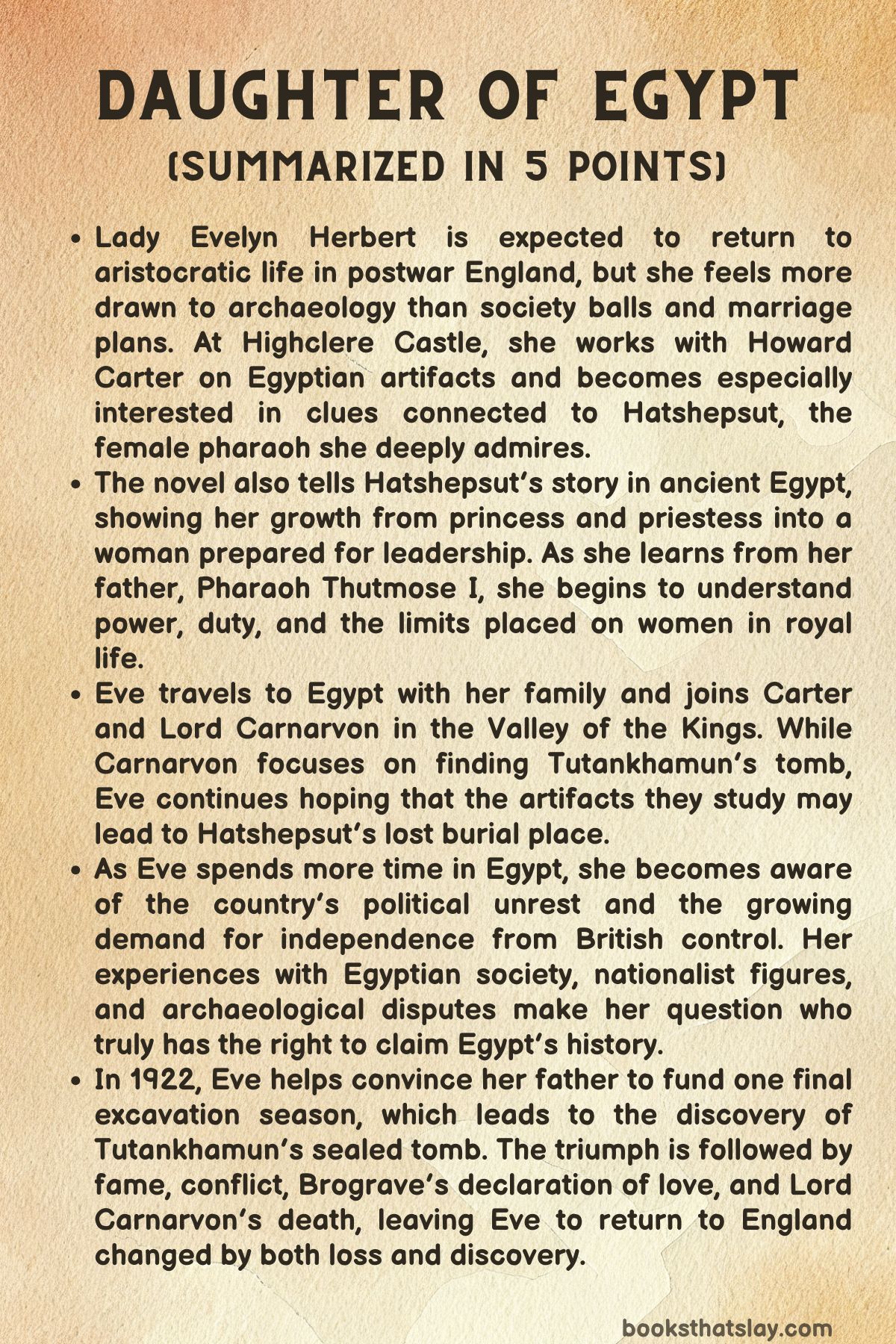
Summary
Daughter of Egypt begins in England after the First World War, when Lady Evelyn Herbert is expected to resume the duties of her class and gender. Her mother, Lady Almina, wants her to return to the rituals of aristocratic society, complete the Season, attend balls, and prepare herself for a suitable marriage.
At Highclere Castle, where a postwar ball is being held, Eve finds herself restless and out of place amid the dancing, gossip, and performance of social success. Rather than accept the role laid out for her, she slips away from the crowd and meets Howard Carter, the archaeologist supported by her father, Lord Carnarvon.
Carter has been helping Eve study small Egyptian objects from her father’s collection. One object, a blue scarab, holds special interest for her because it may be connected to Hatshepsut, the female pharaoh Eve deeply admires.
Hatshepsut represents a kind of power and freedom that Eve has rarely seen in her own world. The possibility that the scarab may have belonged to such a ruler excites her, and she and Carter begin examining overlooked objects from earlier excavations.
They hope these neglected pieces might offer clues to Hatshepsut’s lost burial place.
Alongside Eve’s story, the novel moves into ancient Egypt and follows Hatshepsut as a royal daughter. She is not only a princess but also God’s Wife of Amun, a sacred role that places her at the center of religious life.
She performs rituals, observes court politics, and learns from her father, Pharaoh Thutmose I. As deaths within the royal family change the line of succession, Hatshepsut becomes increasingly important. Though Egypt’s system expects a male ruler, her father recognizes her intelligence and begins preparing her to understand authority, ceremony, and rule.
Her life becomes a path from sacred service to queenship and, eventually, a form of power that challenges what others believe a woman can hold.
In 1919, Eve and Carter continue studying artifacts that seem to point toward Hatshepsut. Some fragments appear to contain markings that may connect to her name.
Eve becomes convinced that Hatshepsut’s tomb might still be waiting somewhere in Egypt. Her father, however, is more interested in Tutankhamun.
Lord Carnarvon believes that the young king’s tomb offers a better chance of a major discovery and public attention. To him, Hatshepsut seems unlikely to have left behind the kind of spectacular burial that would justify the expense and risk of a search.
Eve is hurt by her father’s dismissal, but Carter does not entirely abandon her idea. He reassures her that a search for Tutankhamun does not have to erase Hatshepsut from their minds.
The two searches can exist together, even if one must remain unofficial. This promise gives Eve hope and strengthens her connection to the work.
Archaeology becomes more than a hobby for her; it becomes a way to resist the limits of her expected life.
At Christmas, Carnarvon gives Eve a ticket to Egypt, and she travels there with her parents. Cairo opens a world far removed from the drawing rooms of England.
Eve sees luxury hotels, British gatherings, crowded markets, and the daily life of Egyptians living under the shadow of colonial rule. She experiences the excitement of Shepheard’s Hotel and the energy of the souk, but she also begins to understand that British society in Egypt exists apart from, and often above, the people whose history it studies and removes.
During this time, Eve meets Brograve, a young officer with whom she feels an immediate attraction. Their relationship grows gradually, shaped by warmth, uncertainty, and the question of whether he can accept the life she wants for herself.
Eve is not interested in a marriage that would confine her to parties, estates, and social duties. She wants a life that includes Egypt, excavation, study, and discovery.
When Eve reaches Luxor, she joins Carnarvon and Carter in the Valley of the Kings. The work is physically demanding and often frustrating.
Sand, heat, stone, and uncertainty define the excavation. Eve contributes to the search and helps uncover objects of importance, though none reveal Hatshepsut’s tomb.
Finds connected to other pharaohs, including Merneptah, prove that the valley still holds secrets, but Eve remains drawn to the possibility of Hatshepsut’s hidden resting place.
Over the following seasons, Eve moves between competing pressures. Her family still expects her to behave as a young aristocratic woman should.
Her mother wants marriage and social acceptance for her. Her father values her presence but often treats archaeology as a masculine field of leadership and authority.
Carter respects her intelligence but is also driven by his own ambitions and frustrations. Brograve offers affection, yet Eve must decide whether love can fit into the life she is building.
At the same time, Egypt itself is changing. Nationalist movements demand independence and challenge British power.
The question of antiquities becomes political. Who owns the objects found in Egyptian soil?
Should they belong to foreign sponsors, museums, and collectors, or to Egypt itself? Eve encounters figures connected to the independence movement, including Safiya Zaghloul, and begins to see that archaeology is not separate from empire.
The treasures she longs to uncover are part of a living country’s identity, not only relics for foreign admiration.
By 1922, Carnarvon is close to ending his support for Carter’s work. Years of searching have cost money, patience, and reputation.
Carter believes one final chance may lead them to Tutankhamun, and Eve helps persuade her father to fund another season. Carter returns to an area near the tomb of Ramses VI, where earlier clues suggested that something might still be hidden.
The decision proves crucial.
Carter soon sends word that he has found something significant. Eve, Carnarvon, and the others rush back to Egypt.
At the site, they uncover a sealed entrance. The discovery confirms that they have found an undisturbed tomb, and anticipation builds as they move carefully through the chambers.
Eve becomes one of the first people to look inside. Crawling through a small opening, she sees golden shrines, statues, and a wealth of objects preserved for thousands of years.
The tomb of Tutankhamun has been found.
The discovery changes everything. Reporters flood the story with attention, and the world becomes fascinated by the treasures.
Fame brings pressure, conflict, and competition. Carter and Carnarvon disagree over control, access, credit, and the demands of officials.
Egyptian authorities and nationalists also challenge the old assumptions that foreign excavators can decide the fate of Egypt’s past. Eve, who once saw discovery mainly through the lens of wonder, now understands the burden attached to it.
Brograve declares his love for Eve and promises that he will support her life in archaeology rather than force her into a conventional role. His love offers partnership instead of restriction, giving Eve the possibility of a future that does not require her to give up her mind, interests, or work.
Soon afterward, Carnarvon falls seriously ill after a mosquito bite. His condition worsens, and his death casts a shadow over the triumph of the tomb’s discovery.
Eve must leave Egypt with her father’s body and return to England. Before she goes, she returns the Hatshepsut scarab to Egyptian soil.
The act honors both Hatshepsut and Egypt itself. It also marks Eve’s growth from a young woman seeking personal escape into someone who understands that the past belongs not only to those who uncover it, but also to the land and people from which it came.
Daughter of Egypt ends with Eve changed by Egypt, by loss, by love, and by the knowledge that history is never neutral. Through Eve and Hatshepsut, the novel presents two women separated by thousands of years but connected by ambition, intelligence, and the desire to be remembered on their own terms.
Characters
Lady Evelyn Herbert
Lady Evelyn Herbert, often called Eve, is the central modern character in Daughter of Egypt, and she is portrayed as a young woman caught between inherited aristocratic expectations and her own intellectual hunger. In postwar England, she is expected to return to the familiar rituals of upper-class life: balls, social appearances, the Season, and eventually a suitable marriage.
Yet Eve’s inner life is shaped less by society’s demands than by curiosity, restlessness, and a deep attraction to Egypt’s ancient past. Her interest in small, overlooked artifacts reveals her instinct for detail and her desire to uncover stories that others have dismissed.
The blue scarab connected to Hatshepsut becomes especially important because it reflects Eve’s own search for a female model of power, intelligence, and independence.
Eve’s character grows through her movement between England and Egypt. At Highclere Castle, she feels constrained by expectations of elegance and obedience, but in Egypt she begins to imagine a wider life for herself.
Her work at the excavation site allows her to step into a world usually dominated by men, and her participation in archaeological discovery shows her courage and seriousness. She is not simply fascinated by treasure or fame; she wants to understand the past and give meaning to the lives hidden beneath history.
Her admiration for Hatshepsut is also personal, because she sees in the female pharaoh a version of womanhood that is powerful, learned, and politically capable.
Eve is also emotionally complex because she must balance devotion to her father, loyalty to Carter’s archaeological work, attraction to Brograve, and growing awareness of Egypt’s political reality. At first, she views Egypt largely through the excitement of discovery, but over time she begins to understand that archaeology is tied to questions of ownership, colonial power, and national identity.
Her encounters with Egyptian nationalism deepen her moral perspective and complicate her earlier assumptions. By the end of the story, Eve has been changed by wonder, grief, love, and responsibility.
Returning the Hatshepsut scarab to Egyptian soil shows that she has developed a more respectful understanding of the past and of Egypt itself.
Hatshepsut
Hatshepsut is one of the most powerful and symbolically important figures in the book. Her story in ancient Egypt mirrors Eve’s modern struggle, creating a connection between two women separated by thousands of years but linked by ambition, intelligence, and resistance to the limits placed on them.
As a princess and God’s Wife of Amun, Hatshepsut begins her life within sacred and royal structures that both elevate and confine her. She is trained in ritual, religion, politics, and court life, and her closeness to her father, Pharaoh Thutmose I, helps shape her understanding of leadership.
Even before she gains greater authority, she is shown as observant, disciplined, and unusually prepared for power.
Hatshepsut’s importance grows after the deaths of her brothers, when she becomes the most significant child of her parents’ royal line. Her position is unusual because she is clearly capable of ruling, yet the traditions of monarchy favor male succession.
This tension gives her character emotional and political depth. She is not presented merely as a royal woman with ambition, but as someone who understands duty, dynasty, religion, and survival.
Her rise from princess and priestess toward queen and eventual power shows how carefully she must move within a system that does not easily allow a woman to stand at its center.
Hatshepsut also functions as a figure of inspiration for Eve. To Eve, she represents a woman whose significance has been obscured, underestimated, or forgotten by male-dominated history.
The search for traces of Hatshepsut is therefore not only an archaeological pursuit but also an act of recovery. Hatshepsut’s character gives the novel a broader meaning because she embodies the struggle to be recognized on one’s own terms.
Her presence reminds the reader that women’s power has always existed, even when history has tried to bury it.
Howard Carter
Howard Carter is portrayed as a serious, driven, and sometimes intense archaeologist whose life is defined by excavation and discovery. He serves as both mentor and collaborator to Eve, helping her study artifacts and encouraging her curiosity.
His willingness to examine ignored objects from earlier excavations shows that he values patient observation as much as dramatic discovery. Carter’s relationship with Eve is important because he treats her mind with respect, allowing her to participate in intellectual work that society might otherwise deny her.
Through him, Eve gains access to a world of scholarship, fieldwork, and historical possibility.
Carter is also a character shaped by professional pressure. He depends on Lord Carnarvon’s funding, and this dependence creates tension between archaeological curiosity and the demand for a spectacular result.
While Eve is drawn to Hatshepsut, Carter must also pursue Tutankhamun because that search has the potential to justify years of work and financial support. His determination is admirable, but it can also make him rigid and strained, especially once the discovery brings global attention.
Carter’s conflict with Carnarvon after the tomb is found suggests that success does not free him from pressure; instead, it exposes him to fame, politics, and competing claims.
As a character, Carter represents the discipline and obsession behind archaeological discovery. He is not simply a romantic adventurer; he is methodical, ambitious, and deeply invested in being proven right.
His work opens the past, but it also places him at the center of modern disputes over control, credit, and ownership. His partnership with Eve reveals his more generous side, while his conflicts reveal the cost of ambition.
He is essential to the story because he connects private curiosity with one of the most famous archaeological moments of the twentieth century.
Lord Carnarvon
Lord Carnarvon is Eve’s father and the financial sponsor of Howard Carter’s archaeological work. He is an aristocrat whose wealth and status allow him to participate in the search for ancient treasures, but his motivations are mixed.
He has genuine interest in Egyptology, yet he is also drawn to the prestige and spectacle that a major discovery could bring. His preference for searching for Tutankhamun rather than Hatshepsut shows his practical and status-conscious nature.
He believes Tutankhamun is more likely to produce the kind of discovery that would justify the expense and attract public attention.
As Eve’s father, Carnarvon is both supportive and limiting. He brings her into the world of Egypt and archaeology, but he does not always fully recognize the seriousness of her intellectual ambitions.
His dismissal of Hatshepsut disappoints Eve because it reflects the broader tendency to underestimate women’s historical importance. Even so, his relationship with Eve contains affection and trust.
When Eve persuades him to allow one final excavation season, it shows that she has influence over him and that he is capable of listening, even if reluctantly.
Carnarvon’s illness and death add a tragic dimension to his character. After the great discovery, he becomes associated not only with triumph but also with loss.
His death forces Eve to confront the cost of the life she has entered, where wonder and grief are closely linked. He represents aristocratic privilege, ambition, paternal love, and the fragile human body standing before the vastness of history.
His character is important because he makes the excavation possible, but he also reminds the reader that fame and discovery cannot protect anyone from mortality.
Lady Almina
Lady Almina is Eve’s mother and a representative of aristocratic social expectations in postwar England. She wants Eve to reenter society, complete the Season, and make a suitable marriage, which shows her belief in traditional roles for women of their class.
To Lady Almina, social performance is not trivial; it is part of duty, reputation, and family continuity. She sees Eve’s future through the lens of marriage, status, and proper behavior, and this creates tension between mother and daughter.
Lady Almina is not simply an obstacle, however. Her expectations come from the world she knows and the values she has been trained to preserve.
In her view, Eve’s place in society must be secured, especially after the disruptions of the Great War. This makes her a character connected to continuity and tradition.
She represents the pressure that Eve must resist in order to define herself differently. Her presence helps show how difficult it is for Eve to pursue archaeology, not only because men dominate the field, but because her own social world expects her to choose domestic and aristocratic success instead.
As a mother, Lady Almina reveals the emotional weight of family duty. She may not fully understand Eve’s longing for intellectual independence, but her influence helps define the stakes of Eve’s choices.
Eve is not rebelling against strangers; she is pushing against the hopes of her own family. Lady Almina’s character therefore gives the story a grounded social conflict, showing that Eve’s journey toward selfhood begins at home.
Brograve
Brograve is Eve’s romantic interest and an important figure in her emotional development. As a young officer, he enters the story through the world of British colonial society in Egypt, but his connection with Eve becomes more personal and meaningful over time.
Their immediate attraction suggests warmth and possibility, yet his role is not only romantic. He becomes a test of whether Eve can imagine love without surrendering her independence.
In a society where marriage often means conformity, Brograve’s importance lies in his willingness to support Eve’s archaeological life.
Brograve’s declaration of love is significant because it offers Eve a future that does not require her to abandon her ambitions. He promises to stand beside her rather than pull her away from the work that gives her life meaning.
This makes him different from the more conventional expectations surrounding her. His love is not presented as a trap but as a potential partnership.
Through him, the story explores whether romance can coexist with intellectual freedom and personal purpose.
At the same time, Brograve is connected to the British presence in Egypt, which makes his character part of the story’s larger colonial setting. His position places him within the structures of empire, even as his relationship with Eve is intimate and sincere.
This gives his character a subtle complexity. He offers emotional stability and affection, but he also belongs to the political world that Egypt’s nationalists are challenging.
His character helps connect Eve’s private life with the broader historical tensions around her.
Safiya Zaghloul
Safiya Zaghloul is a significant political presence in the story because she represents Egyptian nationalism and the struggle for independence. Her character helps Eve recognize that Egypt is not merely a place of ancient tombs, beautiful objects, and British social life.
It is a living nation with people fighting for control over their future and their heritage. Through Safiya, the political background of the story becomes personal and morally urgent.
Safiya’s presence challenges the colonial assumptions surrounding archaeology. The discoveries in the Valley of the Kings are not neutral events; they raise questions about who has the right to excavate, interpret, display, and own Egypt’s past.
Safiya helps bring these questions into focus. She represents dignity, resistance, and national pride, and her role expands Eve’s understanding of what is at stake.
Eve’s growing awareness of Egyptian nationalism is one of the key signs of her maturity.
As a character, Safiya is important because she gives voice to the Egyptian perspective in a story that also follows British aristocrats and archaeologists. She reminds the reader that the past belongs not only to scholars and collectors, but also to the people whose history is being uncovered.
Her presence adds moral depth to Daughter of Egypt, making the story not just about discovery, but about power, identity, and rightful inheritance.
Pharaoh Thutmose I
Pharaoh Thutmose I is Hatshepsut’s father and a major influence on her development. He is portrayed as a ruler who recognizes his daughter’s intelligence and potential, even though the political system around him favors male rule.
His decision to prepare Hatshepsut to help guide Egypt shows both political wisdom and paternal confidence. He understands that leadership requires training, observation, and strength, and he gives Hatshepsut access to knowledge that will shape her future.
Thutmose I’s character is important because he helps establish Hatshepsut’s legitimacy. By involving her in court life and recognizing her importance after the deaths of her brothers, he places her closer to the center of power.
He does not completely overturn the expectations of his world, since another boy is still expected to become pharaoh, but he creates space for Hatshepsut to grow into authority. His support becomes one of the foundations of her later rise.
As a father and ruler, Thutmose I represents both tradition and possibility. He operates within the structures of dynastic Egypt, yet he sees something exceptional in his daughter.
His belief in Hatshepsut gives her confidence and preparation, making him essential to her journey. Through him, the ancient storyline shows that power is not only inherited; it is also taught, recognized, and cultivated.
Tutankhamun
Tutankhamun is less of an active character in the story and more of a powerful historical presence around whom the modern excavation turns. For Lord Carnarvon and Howard Carter, his tomb represents the possibility of a spectacular discovery that could change their lives and reputations.
Although he does not act within the modern plot, his hidden burial chamber shapes the decisions, hopes, and conflicts of the characters. The search for his tomb becomes the practical center of the excavation seasons.
Tutankhamun’s significance also contrasts with Hatshepsut’s. While Eve is emotionally and intellectually drawn to Hatshepsut, Carnarvon sees Tutankhamun as the more promising figure because his tomb might contain the dramatic treasures that would capture the world’s attention.
This contrast reveals how history often values spectacle over complexity. Tutankhamun becomes famous because of the astonishing survival of his tomb, while Hatshepsut’s story must be pieced together through fragments, clues, and persistence.
In the story, Tutankhamun represents the grandeur and mystery of ancient Egypt, but also the way discovery can become entangled with fame, journalism, politics, and ownership. His tomb brings wonder, but it also brings conflict.
Through him, the book shows that uncovering the past is never just about the past; it changes the lives of the people who find it and intensifies the struggles of the present.
Ramses VI
Ramses VI appears mainly through the archaeological setting, particularly because the search near his tomb becomes important to Carter’s work. His presence in the story is connected to location, clues, and the layered nature of the Valley of the Kings.
Even when he is not a developed personal character, his tomb helps shape the physical and historical landscape through which the modern characters move.
Ramses VI represents the crowded and complex inheritance of ancient Egypt. The Valley of the Kings is not a simple place where each ruler’s story stands alone; it is a layered world where one tomb, one pathway, or one overlooked area may conceal another history beneath it.
The connection between his tomb and the search for Tutankhamun shows how archaeology often depends on reading the landscape carefully and noticing what previous generations missed.
His role also emphasizes the humility required in excavation. The modern characters are surrounded by the remains of powerful rulers, yet they do not fully control what the earth will reveal.
Ramses VI’s presence reminds the reader that every discovery exists within a wider network of kings, dynasties, burials, and forgotten clues. He contributes to the story’s sense of historical depth.
Merneptah
Merneptah is another ancient figure connected to the excavation finds. His role is not as personally developed as Hatshepsut’s, but he contributes to the archaeological richness of the story.
Objects connected to him show that the dig produces meaningful discoveries even when it does not immediately fulfill Eve’s hope of finding Hatshepsut. His presence reminds the reader that archaeology often reveals history in unexpected ways.
Merneptah’s significance lies in how he broadens the ancient world of the book. The excavation is not limited to one ruler or one mystery; it opens traces of multiple lives, reigns, and historical periods.
For Eve, however, these discoveries are also complicated because they do not answer the question that matters most to her. This creates a tension between professional success and personal longing.
A find may be important, but it may still feel incomplete if it does not uncover the story one is seeking.
Through Merneptah, the book shows that the past does not always reveal itself according to human desire. His artifacts are valuable, but they also redirect attention and remind the characters that history is vast.
His presence strengthens the sense that Eve and Carter are working within a world much larger than any single ambition.
Hatshepsut’s Brothers
Hatshepsut’s brothers are not developed as central characters, but their deaths are crucial to her path. Their absence changes the political and emotional future of the royal family.
In a dynasty where male heirs are expected to carry power forward, the loss of her brothers makes Hatshepsut’s position far more important. She becomes the most significant royal child of her parents’ line, and this shift alters how her father views her future.
Their role in the story shows how succession, gender, and mortality shape power. Hatshepsut does not rise simply because she desires authority; she rises partly because history and family tragedy create an opening.
The deaths of her brothers reveal the instability behind royal power. Even dynasties that seem divinely ordered are vulnerable to loss, accident, and uncertainty.
Although they remain mostly in the background, Hatshepsut’s brothers help explain why she must be prepared for influence. Their absence gives urgency to Thutmose I’s decision to educate and guide her.
In this way, they are important not because of what they do, but because of how their deaths reshape the future of Egypt and Hatshepsut’s place within it.
Themes
Women Claiming Power in Male-Dominated Worlds
Daughter of Egypt presents female power as something that must be earned, defended, and often hidden behind acceptable roles. Hatshepsut is born into a world where authority is formally reserved for men, yet her intelligence, religious position, royal blood, and political training make her capable of leadership.
Her rise shows that power is not only inherited through title but also built through discipline, vision, and public legitimacy. Eve faces a different but related struggle in postwar England, where aristocratic expectations push her toward marriage, manners, and social obedience rather than scholarship or excavation.
Her interest in archaeology is treated as secondary to her duty as a daughter and future wife, but she continues to study, question, and participate in fieldwork. Through both women, the narrative shows how patriarchal societies limit ambition by calling it improper, unnatural, or inconvenient.
Their determination becomes a quiet resistance against the belief that history, politics, and discovery belong mainly to men.
The Search for Identity and Purpose
Eve’s journey is shaped by her need to define herself outside the roles assigned by family and class. At Highclere, she is expected to become a polished aristocratic woman whose future depends on marriage and social success, but these expectations leave her restless.
Archaeology gives her a sense of purpose because it allows her to think, investigate, and contribute to something larger than herself. Her admiration for Hatshepsut is not only academic; it reflects Eve’s longing for a model of womanhood based on courage, intellect, and authority.
Hatshepsut’s own path also centers on identity, as she moves from priestess and daughter to queen and ruler. She must understand who she is in relation to religion, family, nation, and power.
The connection between the two women suggests that identity is not discovered all at once. It is shaped through choices, losses, loyalties, and the courage to accept a life that may not match society’s expectations.
Ownership of History and Cultural Heritage
The excavations in Egypt raise serious questions about who has the right to uncover, interpret, and possess the past. Eve first approaches archaeology with wonder, seeing artifacts as clues that can restore forgotten lives, especially Hatshepsut’s.
However, her time in Cairo and Luxor exposes her to the political reality surrounding these discoveries. British aristocrats, archaeologists, officials, and journalists often treat Egyptian antiquities as objects of prestige, scholarship, or personal glory, while Egyptians are fighting for control over their nation and its heritage.
The growing nationalist movement makes it clear that ancient treasures are not detached from modern politics. They belong to a living culture, not merely to foreign collectors or museums.
Eve’s awareness develops as she begins to see that excavation is not only an intellectual pursuit but also a moral responsibility. Her final act of returning the scarab to Egyptian soil shows her recognition that respect for the past must include respect for the people whose history is being uncovered.
Love, Loyalty, and Personal Sacrifice
The novel presents love as a force that both strengthens and tests the characters. Eve’s loyalty to her father draws her into the world of excavation, but it also places her in conflict with his ambitions and priorities.
She wants to honor him while pursuing her own belief in Hatshepsut’s importance, and this tension makes her growth more painful and meaningful. Her relationship with Brograve offers another form of love, one based not on possession or social convenience but on emotional support and respect for her ambitions.
His promise to stand beside her archaeological life matters because it contrasts with the restrictive expectations of aristocratic marriage. Hatshepsut’s life also reflects sacrifice, as personal desires are often subordinated to duty, dynasty, and Egypt’s stability.
Across both timelines, love is never simple escape. It requires courage, compromise, and sometimes loss.
The death of Carnarvon deepens this theme by showing that devotion to discovery can bring glory, grief, and irreversible change.