They Never Learn Summary, Characters and Themes
They Never Learn by Layne Fargo is a dark campus thriller about violence, justice, trauma, and the dangerous appeal of revenge.
Set at Gorman University, the book follows Dr. Scarlett Clark, an English professor who secretly murders men she believes have abused women, and Carly Schiller, a shy freshman trying to survive her first year of college. As the two storylines move closer together, the novel examines how institutions protect predatory men, how victims are silenced, and how rage can become identity. It is a sharp, disturbing story about power, punishment, and the cost of taking justice into one’s own hands.
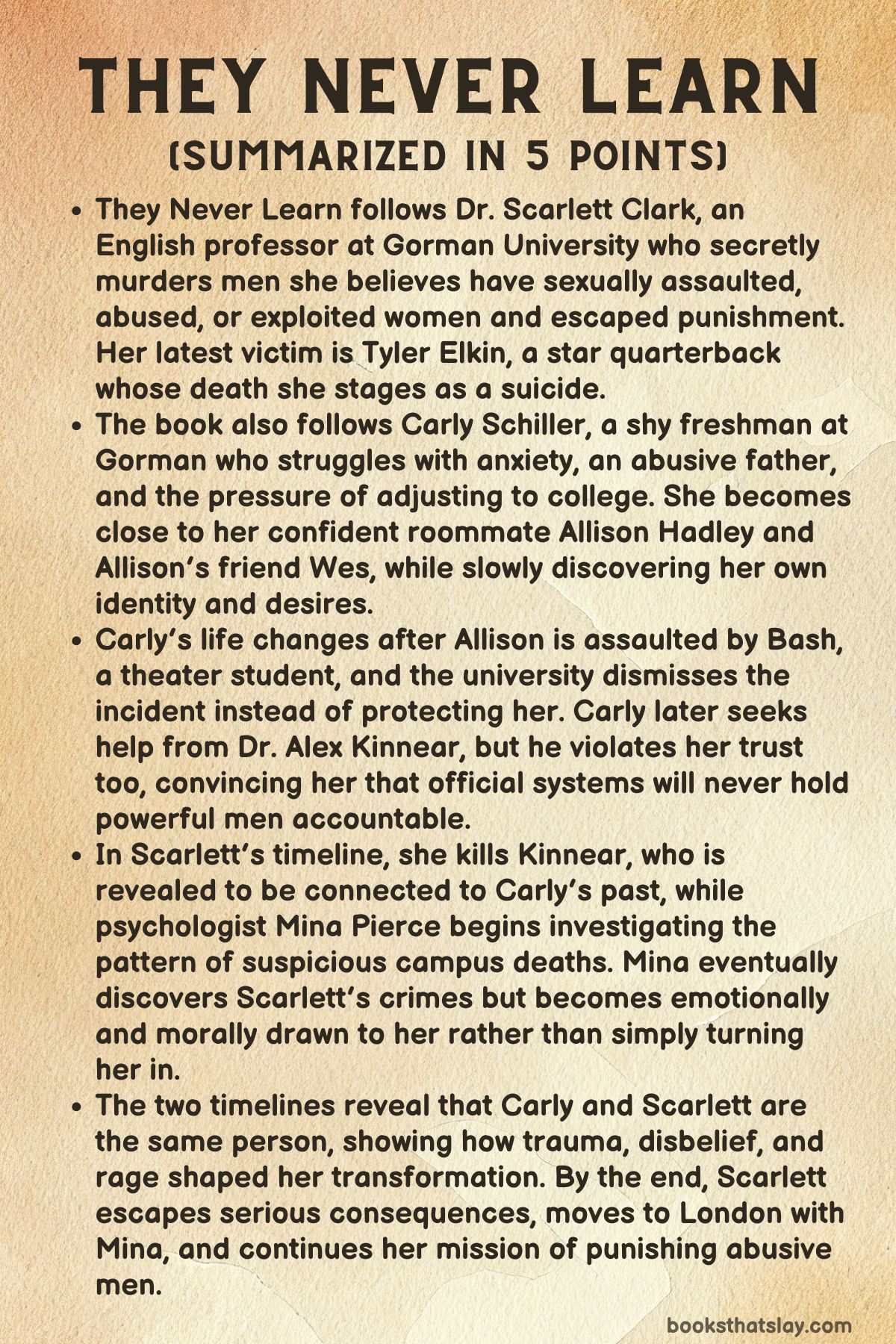
Summary
They Never Learn begins at Gorman University, where Dr. Scarlett Clark, an English professor, enters the private gym of Tyler Elkin, a star quarterback with a polished public image and a history of sexual violence.
Tyler was one of the students involved in assaulting Megan Foster at a fraternity party, and Scarlett has decided he deserves to die. She poisons his energy drink with strychnine, hides while he drinks it, and watches as he dies. Afterward, she uses his phone to post a staged suicide note, making the death look like another tragedy on campus rather than murder.
The story then shifts to Carly Schiller, a nervous freshman arriving at Gorman with her parents. Carly is eager to escape her father, a controlling and emotionally abusive man, and begin a new life away from home. Her roommate, Allison Hadley, seems confident, stylish, and socially fluent in every way Carly is not. Carly quickly becomes fascinated by Allison, who introduces her to the social life of campus and to Wes Stewart, Allison’s longtime friend from high school.
Scarlett’s life as a professor continues with apparent calm, though she is already thinking about her next target. She sits through faculty meetings, listens to colleagues discuss Tyler’s supposed suicide, and observes the casual sexism and arrogance of men like Dr. Alex Kinnear and Dr. Stright. Scarlett has killed before, targeting men connected to campus abuse, and she trusts Gorman’s weak systems to miss the truth.
Her confidence wavers when the university launches a deeper investigation into student suicides, led by Dr. Mina Pierce, a psychology professor and Kinnear’s ex-wife. Mina is intelligent, careful, and far more perceptive than the police.
Carly slowly adjusts to college life. She joins an advanced writing seminar taught by Alex Kinnear, whose youth and relaxed style make him seem approachable. She spends more time with Allison and Wes, developing feelings that confuse and excite her.
Allison is openly bisexual and flirtatious, and Carly begins to admit her own bisexuality. Their closeness grows through private moments in the dorm, on the roof, and while preparing for parties. Yet Allison is also drawn to Bash, a theater student cast opposite her in Cabaret, despite his coldness and predatory behavior.
Scarlett is meanwhile focused on the Women’s Academy fellowship, which would allow her to research in London. She learns that Kinnear has also applied, even though he has already stolen ideas connected to her work. Her hatred of him is personal and professional.
Kinnear represents every form of male entitlement she despises: theft, arrogance, exploitation, and social charm used as cover. She begins planning to kill him, especially after he invites her to his home under the pretext of showing her rare research materials.
At a Halloween party, Carly’s life changes. Allison drinks heavily, and Carly becomes worried. Later, Carly finds Bash in a bathroom with Allison unconscious, partially undressed, and unable to consent. Carly screams, and Bash backs away, but the damage has already been done.
At the hospital, the doctor dismisses Carly’s belief that Allison was drugged and treats Allison with condescension. When Carly and Allison try to report the assault to campus officials, Dean Bowman minimizes what happened and suggests Allison’s clothes and flirting invited the situation. Allison feels ashamed and humiliated, while Carly becomes furious at a system that refuses to protect her friend.
That same night in the present timeline, Scarlett goes to Kinnear’s house intending to kill him. She drugs his whiskey, waits for him to become weak, and lures him into the bedroom.
When she confronts him, he recognizes her as Carly, the former student he harmed years earlier.
Scarlett’s current identity is a reinvention created after college, but Kinnear’s recognition brings her past into the room. He fights back harder than expected, escapes his restraints, strikes her, and tries to run. During the struggle, he blames her for what he did to her.
Scarlett grabs a knife and kills him, then sets the house on fire to destroy evidence. She also steals Viola Vance’s diary, a rare red text that Kinnear owned.
After Kinnear’s death, the police treat the fire as a possible murder cover-up. Scarlett’s colleague Jasper Prior, her graduate assistant and lover, gives her a fake alibi, not out of kindness but to place her in his debt. Their relationship is charged with attraction, cruelty, and power games.
Scarlett senses that Jasper understands her violence, though she does not yet know how dangerous he truly is. Mina, shaken by Kinnear’s death, grows closer to Scarlett. Their connection becomes intimate, but also risky, because Mina is investigating the pattern of deaths on campus and beginning to suspect that the supposed suicides are killings.
In Carly’s timeline, Allison retreats after Bash’s assault. She refuses to pursue justice, tries to act normal, and even continues interacting with Bash during the production of Cabaret. Carly cannot understand this response.
Her anger grows as she watches Allison deny what happened and as Wes alternates between support and possessiveness. Carly writes a story about a woman killing her harasser, sparking conflict in her class.
Kinnear encourages her to write about her pain, but when she later seeks comfort from him, he kisses and touches her despite her refusal. When she screams no, he stops, but then threatens her by saying no one will believe her. This moment plants the seed for the identity she will later become.
Scarlett’s present begins to unravel when Mina connects the deaths and forms a theory: the victims were all men rumored to have abused women. Mina is horrified but also partly admiring, sensing that the killer has been punishing people the university protected. Scarlett is tempted to confess because Mina seems to understand the motive, but she remains cautious.
The stolen Viola Vance diary becomes the key mistake. Mina recognizes it as a book she once bought for Kinnear and realizes Scarlett must have been at his house the night he died. When Mina accuses her, Scarlett tries to justify everything she has done as justice for women whom the institution abandoned.
At the same time, Carly tries to punish Bash. She dyes her hair red, dresses in Allison’s clothes, and lures him to the dorm roof with help from another girl. Her plan is to scare and humiliate him, but when Bash kisses and touches her, Carly freezes.
Allison and Wes arrive before the situation turns worse. Allison misunderstands Carly’s actions and believes she is trying to seduce Bash. Bash leaves, and Allison turns against Carly. Wes then tries to comfort Carly, but his comfort shifts into entitlement. He kisses her after she resists, becomes angry when she rejects him, and insists she has no right to refuse him when he is there for her.
Carly sees that Wes, too, believes access to her is something he has earned. In her rage and fear, she pushes back, and Wes falls from the roof to his death.
The incident is treated as a tragic accident because the roof has long been considered unsafe. Allison, however, knows Carly killed him and screams the truth. Carly remains at school briefly, then returns home for Thanksgiving, abandoned by Allison and still trapped under her father’s anger. Her final thought is directed at him: he is next.
The past reveals the origin of Scarlett Clark. Carly did not become a killer overnight; she was shaped by abuse, betrayal, disbelief, and the repeated failure of every authority figure around her.
In the present, Scarlett prepares to flee after Mina discovers the truth. Before she can leave, Mikayla Atwell arrives at her house terrified. Mikayla has been coerced into a relationship with an instructor and believes she injured him while defending herself.
Scarlett assumes Dr. Stright is the predator and decides to kill him before escaping. On campus, Scarlett meets Mina again. Mina has not turned her in because her horror is mixed with fascination and understanding. Their conversation is interrupted by Jasper, whose bloodied nose reveals that he, not Stright, abused Mikayla.
Jasper admits his involvement with Mikayla and reveals that he followed Scarlett on the night Kinnear died. He is angry that she never trusted him with her secret and imagines himself as her partner in murder.
A violent fight breaks out among Jasper, Scarlett, and Mina, with Mikayla also pulled into the chaos. Jasper wounds Scarlett, and Mina tries to protect her. Mikayla ultimately stabs Jasper to save Scarlett’s life. Scarlett prepares to take responsibility, but Mina acts quickly. She places the knife in Jasper’s hand and calls the police, making it appear that he attacked them.
The police cannot prove who killed Jasper, and evidence from his phone places him near Kinnear’s house, allowing suspicion to shift away from Scarlett. In the end, Scarlett and Mina move to London, where Scarlett has taken up the fellowship. Mina, once the investigator who nearly exposed her, now helps her plan future murders.
The novel closes with Scarlett not reformed or punished, but more prepared than ever, her mission transformed from secret compulsion into a shared life.
Characters
Dr. Scarlett Clark / Carly Schiller
Dr. Scarlett Clark is the central force of the book, and her character is built around rage, intelligence, trauma, and control.
As Carly Schiller, she begins as a frightened freshman desperate to escape her abusive father and find a place where she can belong. She is shy, anxious, observant, and deeply sensitive to humiliation, especially when it comes from people who hold power over her. Her first year at Gorman teaches her that charm often hides danger, and that institutions prefer quiet victims over uncomfortable truth. As Scarlett, she has remade herself into a poised professor who uses scholarship, beauty, and social performance as shields.
Her murders are not impulsive in the beginning; they are planned, selective, and framed as justice. In They Never Learn, Scarlett is terrifying because her logic is understandable even when her actions are extreme.
She targets men who have harmed women and escaped consequences, but her sense of justice becomes inseparable from her desire for power. She is both victim and predator, both protector and threat. The book refuses to make her simply heroic or simply monstrous. Instead, she becomes a portrait of what can happen when pain hardens into purpose and when revenge becomes a person’s clearest sense of self.
Allison Hadley
Allison Hadley is one of the most important emotional influences in Carly’s life. She appears at first as everything Carly wishes she could be: confident, stylish, magnetic, and socially fearless.
Allison’s boldness gives Carly permission to explore parts of herself she has kept hidden, especially her bisexuality and her desire for intimacy outside the expectations of her family. Yet Allison is also unstable in ways Carly does not initially understand. Her charm can become carelessness, and her need to be desired often places her near people who do not deserve her trust. After Bash assaults her, Allison responds through denial, avoidance, and self-blame.
Her refusal to report the assault or name it directly is not weakness; it reflects the damage done by a culture that teaches victims they will be judged before they are believed. Her anger at Carly comes from shame, fear, and the loss of control over her own story. In the book, Allison is neither a simple love interest nor a symbol of victimhood.
She is complicated, sometimes selfish, sometimes generous, and often wounded. Her relationship with Carly shows how trauma can distort affection, turning care into conflict and protection into resentment.
Wes Stewart
Wes Stewart begins as a seemingly safe presence. He is friendly, attentive, and appears to understand Carly’s discomfort in social situations. Because he knows Allison from high school, he also acts as a bridge between Carly and Allison’s world. At first, his kindness seems genuine. He drives Carly, talks with her, listens to her, and offers support after painful moments. But the book gradually reveals that Wes’s niceness contains entitlement.
He believes his patience, loyalty, and emotional availability should earn him Carly’s romantic attention. This makes him a quieter but no less dangerous version of the predatory men around her. Unlike Bash, Wes does not look immediately threatening. His danger lies in his belief that rejection is unfair when he has decided he deserves someone. His final confrontation with Carly exposes the truth beneath his gentle image. He responds to her refusal not with respect but with anger, pressure, and resentment.
Wes’s death is shocking because it marks the moment Carly fully recognizes that male entitlement can wear many faces. In They Never Learn, Wes represents the socially acceptable form of coercion: the man who calls himself good while still refusing to accept a woman’s no.
Dr. Alex Kinnear
Dr. Alex Kinnear is one of the book’s clearest examples of academic power used for exploitation. In the past, he presents himself to Carly as young, approachable, and concerned. He notices her distress, offers sympathy, and gives her special attention at a time when she feels isolated and vulnerable. That apparent kindness becomes a trap.
When Carly turns to him after Bash’s assault and Allison’s unraveling, he crosses a boundary and then tries to protect himself by intimidating her. His threat that no one will believe her shows his real understanding of power: he knows the institution will favor him over a frightened student. In the present, Kinnear remains arrogant and self-serving. He steals intellectual work, competes for a fellowship that means far more to Scarlett, and surrounds himself with the same casual misogyny that defines Gorman’s culture.
His death is personal for Scarlett because he is not only another predator; he is the man who helped create her transformation. Kinnear’s character exposes how mentorship can become manipulation when admiration, authority, and dependency are abused. He is polished enough to be praised in public and rotten enough to deserve Scarlett’s hatred.
Dr. Mina Pierce
Dr. Mina Pierce is one of the most intellectually and morally complex characters in the story. As a psychology professor asked to examine the campus suicides, she brings the careful attention that Scarlett most fears.
Mina notices patterns others overlook, especially the connection between the dead men and allegations of abuse. Her intelligence makes her a threat, but her own history with Kinnear gives her a personal understanding of manipulation and male entitlement. Mina is not naïve about cruelty. She has survived enough to recognize it, and this recognition draws her toward Scarlett even before she knows the full truth.
Her attraction to Scarlett is partly emotional, partly intellectual, and partly moral confusion. When she discovers that Scarlett is the killer, she is horrified, but not wholly repelled. That tension defines her role in the book. Mina begins as the investigator who might restore order, yet she ends as Scarlett’s partner.
In They Never Learn, her shift is disturbing because it shows how easily justice and complicity can begin to resemble each other when the official system has failed too many people. Mina’s final choice suggests not innocence corrupted, but conviction redirected.
Jasper Prior
Jasper Prior is Scarlett’s graduate assistant, lover, and eventual threat. At first, he appears to be someone who matches Scarlett’s emotional coldness and appetite for danger. Their relationship is sexual, competitive, and hostile, built on power rather than tenderness. Scarlett suspects that Jasper might understand her violence, but she underestimates his own desire to control and possess.
His false alibi after Kinnear’s death is not an act of devotion; it is leverage.
He wants Scarlett indebted to him and seems excited by the possibility that she is more dangerous than she admits. Jasper’s abuse of Mikayla reveals the full hypocrisy of his character. He is not a partner in justice or a man capable of respecting Scarlett’s mission.
He is another predator who uses status, intimacy, and manipulation to exploit a younger woman. His anger at being excluded from Scarlett’s secret life shows that he does not simply want her love or trust; he wants access to her power. Jasper’s death is fitting within the moral structure of the story because he becomes exactly the kind of man Scarlett has trained herself to destroy.
Bash
Bash represents the open, careless face of campus predation. He is charismatic enough to attract attention but cold enough to treat women as objects for his pleasure. His assault on Allison is central to Carly’s transformation because it exposes not only his violence but also the indifference surrounding it. When Carly finds him with Allison unconscious and partially undressed, his response is not terror or remorse but calculation.
Later, his ability to continue moving through social spaces without consequence deepens Carly’s rage. Bash benefits from a culture that minimizes assault unless it fits a narrow and undeniable form.
Dean Bowman’s response to Allison helps protect him by framing the situation as incomplete or ambiguous. Bash also knows how to use flirtation, performance, and party culture as cover. He becomes more than one bad man; he becomes proof to Carly that the world will keep offering predators second chances while victims carry the damage. His confrontation with Carly on the roof shows how little he has learned. Even when lured there, he still assumes access to her body and ignores her fear. That assumption is the exact violence the book keeps returning to.
Mikayla Atwell
Mikayla Atwell is Scarlett’s favorite student, and her role grows from brilliant observer to direct participant in the violence around her. She is outspoken, sharp, and willing to challenge moral complacency in class. Her reaction to discussions of revenge and punishment suggests that she understands more about rage than her professors may realize. Yet Mikayla is also vulnerable because she is a student inside the same hierarchy that has damaged Carly, Megan, Allison, and others. Her relationship with Jasper shows how abuse can hide behind intellectual admiration and academic closeness.
When she comes to Scarlett terrified, carrying a knife and believing she has injured him, she becomes a living reminder that the cycle Scarlett fights has not ended. Mikayla’s stabbing of Jasper is not framed as calculated murder; it is an act of desperate protection.
She saves Scarlett, but she also crosses into the same moral territory that defines Scarlett’s life. Her character shows the next generation facing the same dangers and the same terrible question: what should a woman do when every proper channel leaves her exposed?
Dr. Stright
Dr. Stright is a secondary character, but he helps establish the everyday misogyny of Gorman University. Unlike Kinnear or Jasper, his danger is less developed through one major act and more through a pattern of behavior.
He leers at students, speaks crudely, and treats women as objects while expecting his professional status to protect him from consequence. His anger when Scarlett calls attention to his wife in front of a female student reveals his fear of public embarrassment more than any sense of guilt.
Stright’s presence matters because he shows how predatory culture is maintained not only by major offenders but also by men who normalize disrespect in social and professional settings. He belongs to the network of faculty who look away, laugh along, or treat women’s discomfort as unimportant. Scarlett’s desire to kill him demonstrates how broad her definition of punishable harm has become.
To her, Stright is not merely unpleasant; he is part of the machinery that makes worse violence possible. His character adds texture to the university’s corruption by showing that abuse thrives in atmospheres built from jokes, glances, rumors, and silence.
Tyler Elkin
Tyler Elkin dies at the beginning, but his role shapes the moral terms of the story. Publicly, he is a celebrated athlete, admired for his discipline, popularity, and image.
Privately, he is connected to the assault of Megan Foster, which makes him one of the men Gorman has allowed to continue his life without meaningful consequence. Scarlett chooses him as a target because his public success stands in violent contrast to the harm he has caused. His staged suicide also shows Scarlett’s understanding of the university’s habits.
She knows people are ready to accept another tragic death more easily than they would investigate the possibility of murder, especially when doing so might expose sexual violence tied to campus prestige. Tyler is not given the chance to explain himself or seek redemption; that is part of the book’s discomfort. Scarlett has already judged him, sentenced him, and erased him.
His character forces the reader to confront the difference between legal justice and moral vengeance. His death begins the story with a question that never fully disappears: what happens when the guilty escape the system but not the person watching them?
Dean Bowman
Dean Bowman embodies institutional betrayal. When Allison and Carly report Bash’s assault, Bowman responds not with care but with skepticism, minimization, and blame.
Her role is especially painful because she is a woman in authority, someone Carly and Allison might expect to understand the seriousness of what happened. Instead, she protects the university’s comfort by narrowing the definition of harm and implying that Allison’s behavior contributed to the assault.
Bowman’s reaction teaches Carly a brutal lesson: official systems can speak the language of safety while practicing abandonment. She is not a villain in the same dramatic way as Bash or Kinnear, but her damage is immense because she represents the door victims are told to walk through. When that door leads to humiliation, silence begins to look safer than truth. Bowman’s character also helps explain Carly’s movement toward revenge.
Carly does attempt to use the proper channels. She tries to help Allison report. She seeks adult intervention. Each attempt fails. Bowman’s failure is therefore one of the story’s turning points because it confirms that justice, at Gorman, is managed as a public relations problem.
Carly’s Parents
Carly’s parents reveal the emotional background that makes college both an escape and a danger for her.
Her father is domineering, cruel, and emotionally abusive. He controls the home through anger and intimidation, especially toward Carly’s mother. His affair with a younger woman exposes his hypocrisy and deepens Carly’s disgust. He is the first model of male power Carly knows, and that model shapes how she recognizes later forms of control. Her mother, by contrast, is sympathetic but weak in the face of his dominance.
When Carly tells her about the affair, her mother refuses to believe it, choosing denial over confrontation.
This family dynamic teaches Carly that truth can be rejected even by those who need it most. Her return home after Wes’s death is therefore not a retreat into safety but a return to the original source of her rage.
Her thought that her father is next shows how her violence has expanded beyond campus. The abuse she grew up with and the abuse she witnessed at Gorman become part of one continuous pattern in her mind.
Themes
Vigilante Justice and Moral Corruption
Revenge in They Never Learn is presented as both seductive and corrosive. Scarlett’s targets are not innocent men; they are abusers, manipulators, and predators who have benefited from silence or institutional protection.
This makes her violence emotionally tempting to understand, especially when the university repeatedly fails victims. The book places the reader in an uncomfortable position by showing why Scarlett believes murder is justice before showing how that belief distorts her.
Her actions begin with a clear moral pattern: punish men who harmed women and escaped accountability. Yet the more she kills, the more murder becomes tied to identity, pride, and control. She is not only correcting failures; she is feeding a private sense of power.
The theme becomes more complex because the official alternatives are so inadequate. Reporting leads to dismissal. Authority protects itself. Victims are doubted. In that environment, Scarlett’s violence appears to answer a real absence.
Still, the story does not allow revenge to remain clean. Innocent people are pulled into danger, truth is manipulated, and justice becomes dependent on Scarlett’s personal judgment. The book asks whether punishment can remain moral when it is carried out in secrecy by someone who is also addicted to the act of punishing.
Institutional Failure and the Protection of Predators
Gorman University is not merely a setting; it is a system designed to preserve reputation over truth.
The school’s failures appear in many forms: dismissive faculty, careless police assumptions, administrative blame, social tolerance of predatory behavior, and academic hierarchies that let powerful people exploit vulnerable students. When Allison reports Bash’s assault, the dean’s response is not protection but damage control.
When Tyler dies, the university quickly frames the event as suicide because that explanation is easier to manage. When Kinnear behaves inappropriately, his charm and position shield him.
These failures do not happen by accident. They reveal an institution more invested in order than justice. The book shows how predators survive because many people around them benefit from not seeing clearly.
Some look away to protect careers. Some blame victims to protect comfort. Some reduce violence to ambiguity so no action is required. This theme also explains Scarlett’s extremism. Her murders grow from a world where official processes repeatedly fail.
The tragedy is that the university’s neglect creates the very monster it would later condemn. By refusing to confront abuse honestly, Gorman becomes part of the violence it claims to oppose.
Trauma, Reinvention, and the Making of Identity
Carly’s transformation into Scarlett is rooted in trauma, but the book treats that transformation as an active construction rather than a sudden break. Carly begins as a young woman shaped by fear: fear of her father, fear of social judgment, fear of desire, fear of not being believed.
Each betrayal changes her. Allison’s assault teaches her that women can be harmed in public and still be blamed. Kinnear’s violation teaches her that trusted mentors can become predators. Wes’s entitlement teaches her that even “nice” men may believe affection is owed to them. By the time Wes falls, Carly has begun to see the world through a harsh and simplifying lens.
Later, as Scarlett, she creates a new name, appearance, career, and code. Reinvention gives her power, but it also seals her inside the logic of her pain. She does not heal from trauma; she organizes her life around it. Her intelligence and discipline become tools for survival, then tools for killing. The theme is disturbing because Scarlett’s strength is real.
She refuses helplessness, builds authority, and masters the world that once endangered her. Yet the identity she builds is inseparable from violence, making her recovery look less like freedom than permanent war.
Desire, Consent, and Power
The story repeatedly examines the difference between desire and entitlement. Many relationships in the book are charged with attraction, but attraction becomes dangerous when one person ignores fear, refusal, or imbalance. Allison and Carly’s early closeness is tender but confusing because Carly is still learning how to name what she wants.
Bash’s behavior toward Allison is a direct violation, made worse by the way others minimize it. Kinnear’s conduct toward Carly is shaped by his authority as her professor, which makes his attention manipulative even before it becomes physical. Wes reveals another version of the same problem: he believes emotional support gives him a claim over Carly’s body and affection. Jasper repeats the pattern through academic and sexual power, especially in his treatment of Mikayla. Across these relationships, the book insists that consent is not only about the presence or absence of a spoken no.
It is shaped by power, fear, intoxication, dependency, and pressure. The repeated violations teach Carly and Scarlett that danger often hides inside admiration, mentorship, friendship, and romance.
Desire in the story is rarely simple because it exists in spaces where status and vulnerability are uneven. The result is a world where intimacy can offer comfort, but also becomes one of the main ways power is abused.