Dig by J.H. Markert Summary, Characters and Themes
Dig by J.H. Markert is a Southern horror novel set on Crow Island, a place haunted by old secrets, strange folklore, and violence that never fully stayed buried. The story follows Amy Barnes, a writer with deep personal scars tied to the island, and Nathanial Dodd, the son of a dead preacher whose family history holds the key to the island’s curse.
Mixing supernatural terror, murder, family trauma, and local legend, Dig builds a world where honey, bees, red crows, and buried bones point toward something ancient and hungry beneath the land.
Summary
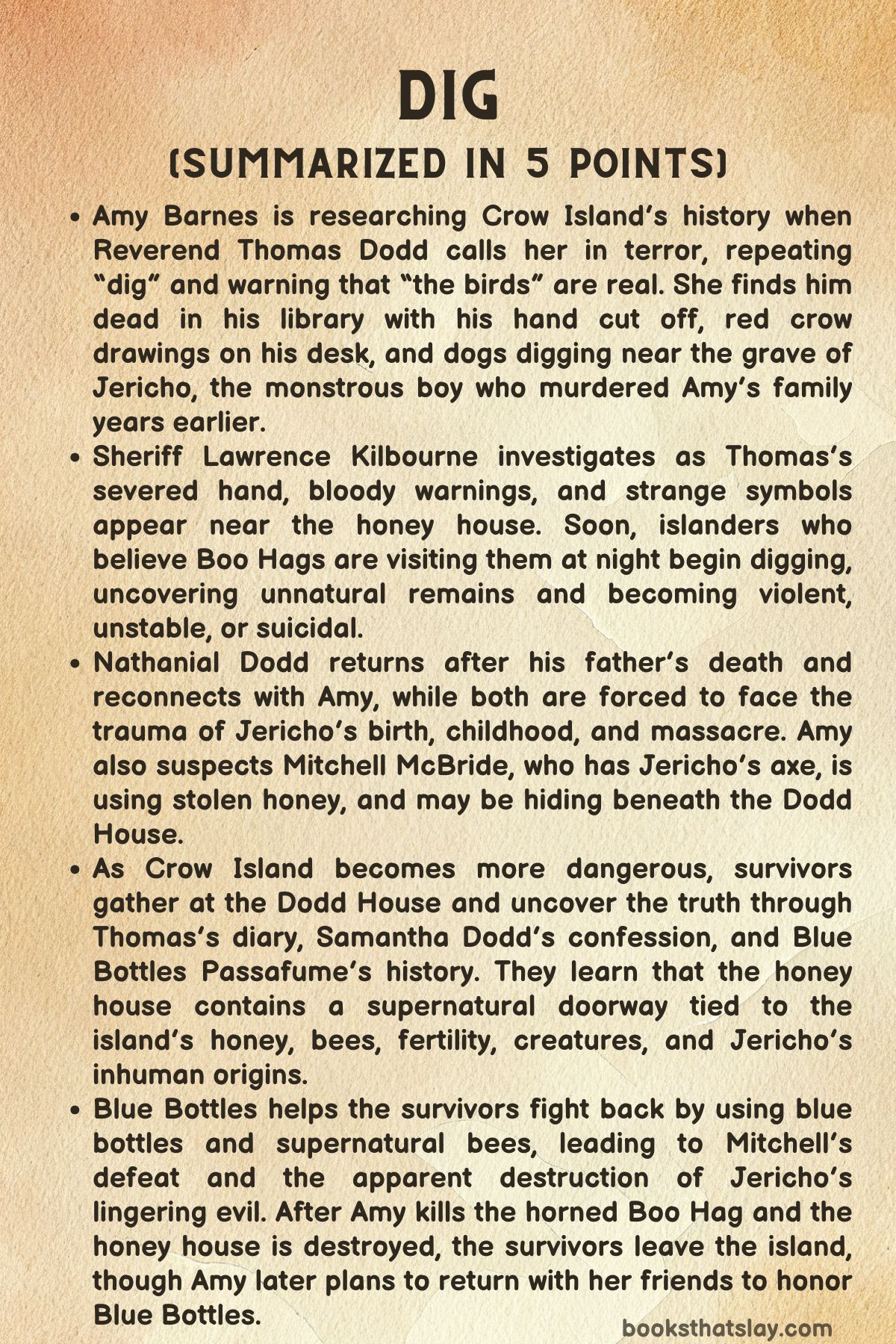
Amy Barnes lives on Crow Island, where she owns a house and works on a history of the place. The island is already tied to deep pain for her.
Eight years earlier, Jericho Dodd, the monstrous younger son of Reverend Thomas Dodd, murdered Amy’s parents, her twin sister Bridget, and many others. Jericho was buried on the island, but his death did not bring peace.
Since then, the land has suffered strange tremors, and Amy has carried both grief and fear from what happened.
The story begins when Amy receives a disturbing phone call from Reverend Thomas Dodd. His voice sounds weak and terrified.
He keeps repeating the word “dig,” asks her to tell Nathanial, and says that “the birds” are real. Alarmed, Amy goes to the Dodd House and finds Thomas dead in his library.
His right hand has been cut off, his infected stump has honey smeared on it, and his desk is covered with drawings of red crows. Outside the house, dogs have torn open dozens of holes in the yard near the place where Jericho was buried.
Sheriff Lawrence Kilbourne begins investigating Thomas’s death. Soon, he finds the severed hand nailed to a tupelo tree near the honey house.
The scene is marked with words written in blood and Spanish moss, including “DIG,” “JERICHO,” and warnings about Boo Hags. The discovery confirms that Thomas’s death is not an ordinary murder.
Something is spreading across the island, and the command to dig seems to be affecting people in a frightening way.
Around Crow Island, residents who believe Boo Hags have visited them at night begin digging compulsively. Some dig in yards, some in hidden places, and some uncover remains that should not exist, including enormous bones.
Their behavior grows unstable. Steven Delacroix murders Jesse Torrence and reveals that he has been drinking stolen tupelo honey while digging up something monstrous.
Patrick Winslow also begins digging before hanging himself. The tremors on the island grow stronger, as if something beneath the ground is waking or pushing its way upward.
Nathanial Dodd returns from Atlanta after learning of his father’s death. His return brings him face-to-face with Amy, who reminds him strongly of Bridget, the girl he once loved.
Nate is forced to revisit the horror surrounding his family, especially the memories of Jericho’s strange birth, his unnatural childhood, and the massacre that destroyed so many lives. As Nate and Amy reconnect, they begin to understand that Jericho’s burial may not have ended anything.
Instead, it may have started a new stage of the island’s nightmare.
Amy also becomes suspicious of Mitchell McBride, the mayor’s troubled son. Mitchell had recently helped her escape from her cracked and draining swimming pool, but his behavior had already seemed strange.
Amy learns that Mitchell has Jericho’s axe, has been using stolen honey, and may be hiding beneath the Dodd House. These discoveries make him a major threat, especially as the island becomes more violent and unstable.
The supernatural signs grow worse. The air turns toxic, animals behave in disturbing ways, and red crows appear.
Creatures connected to Amy’s childhood nightmares begin crossing into the real world. The old stories about Boo Hags no longer feel like folklore.
They appear to be part of a larger truth about Crow Island, the honey house, and a hidden doorway connected to another place Amy once called Lalaland.
As danger spreads, Amy, Nate, Lauren, Sheriff Kilbourne, his family, Blue Bottles Passafume, and other survivors gather at the Dodd House. There, they find writings left behind by Thomas Dodd and Samantha Dodd.
Samantha’s confession reveals that Thomas once entered the honey house and returned changed. It also suggests that Jericho was conceived through something inhuman connected to the doorway.
The Dodd family’s tragedy was not only the result of madness or evil within one person. It was tied to a force that had been present on the island for generations.
Blue Bottles Passafume then reveals the deeper history of Crow Island. He was born long ago to Adeline Drew near a supernatural doorway in the swamp.
He was raised by the Passafume family and has lived far beyond a normal human lifespan. His life has been devoted to guarding the doorway inside the honey house.
The island’s unusual fertility, its honey, its animals, and its horrors all come from that opening. Even the bees come from the other side.
The same source that gives the island richness also feeds its corruption.
To protect the survivors, Blue Bottles organizes an old defense. He has thousands of blue bottles hung in the trees to trap evil spirits.
The plan gives the remaining people a chance, but Mitchell soon attacks the Dodd House. Wearing a mask stitched from human skin and carrying Jericho’s axe, he becomes a living symbol of the old violence returning.
He kills several people and takes Sheriff Kilbourne’s son David hostage.
The attack nearly overwhelms the survivors, but Blue Bottles enters covered in supernatural bees. He directs the bees against Mitchell, and they swarm him until he collapses.
This act shows Blue Bottles’ deep connection to the island’s forces and his willingness to sacrifice himself to protect the others. At sunrise, the blue bottles along Oak Alley explode, apparently destroying the lingering presence of Jericho.
Amy is badly injured by the flying glass, but the explosion seems to mark a turning point.
Help arrives after flares and earlier earthquake warnings bring ferries, the Coast Guard, Marines, and evacuation teams to Crow Island. Nate takes a private moment to scatter his father’s ashes on his mother’s grave, closing one part of the Dodd family’s painful history.
But Amy knows the threat is not fully over while the honey house and its doorway still stand.
Amy slips away to the honey house with a Marine named Charlie. There, she faces a horned Boo Hag emerging from the doorway and kills it.
She then has Charlie destroy the honey house with gunfire. This is a direct strike against the source of the island’s horrors.
The survivors finally leave Crow Island, escaping the place that has taken so much from them.
Blue Bottles secretly boards the ferry, even though he knows he cannot survive away from the island. Before dying peacefully, he gives Amy letters intended for important officials.
His death marks the end of his long duty as guardian, but it also leaves Amy with responsibility for what remains known about Crow Island.
Three months later, Amy, Charlie, Nate, and Lauren reunite in Savannah. Crow Island has been sealed off, and scientists continue to monitor it.
Strange creatures and altered landscapes still remain there, proving that the island has not become ordinary, even after the destruction of the honey house. Nate believes Jericho is finally gone.
Amy plans to return someday to scatter Blue Bottles’ ashes at the place where the honey house stood, and her friends promise to go with her.
By the end, Dig leaves Crow Island as both a place of survival and a place of warning. The buried past has been exposed, the main evil has been broken, and the survivors have escaped.
Yet the island still holds mysteries, scars, and dangers that cannot be fully explained or erased.
Characters
Amy Barnes
Amy Barnes is the emotional center of Dig, and much of the horror of the book is filtered through her grief, memory, and determination. She is not simply a survivor of past violence; she is someone who has been forced to build an identity around loss.
The murder of her parents and twin sister Bridget left her emotionally scarred, and her return to the island’s history shows how deeply she needs to understand the place that destroyed her family. Amy’s role as a writer is important because she tries to make sense of Crow Island through research, memory, and language, but the events around her prove that some truths cannot be neatly recorded or explained.
Her courage grows throughout the story, especially as she moves from being haunted by the past to actively confronting the evil beneath the island. By the end, Amy becomes a figure of endurance and moral strength, someone who has suffered deeply but refuses to let fear or trauma define her completely.
Nathanial Dodd
Nathanial Dodd is a character shaped by family guilt, unresolved love, and the burden of returning to a place he tried to escape. His father’s death forces him back to Crow Island, but his return is also a confrontation with everything he has avoided: Jericho, the Dodd family secrets, and his lingering feelings for Bridget, which become complicated by Amy’s resemblance to her.
Nathanial is important because he represents the human cost of buried truth. His family has been connected to the island’s darkness for years, and he must face the fact that his father, mother, and brother were all tied to forces far beyond ordinary evil.
His grief over Thomas is mixed with anger and confusion, and his relationship with Amy gives him a chance to reconnect with life after years of emotional distance. In the book, Nathanial’s journey is one of painful acceptance, as he learns that survival requires facing the past rather than running from it.
Jericho Dodd
Jericho Dodd is one of the most terrifying figures in the story because he is both a human murderer and a sign of something much older and more unnatural. His monstrous nature begins before his crimes, making him feel less like an ordinary villain and more like the result of a corrupted birth and a poisoned environment.
Even after his death, Jericho’s influence continues to infect Crow Island through tremors, violence, digging, red crows, and the islanders’ growing madness. He represents evil that refuses to stay buried, both literally and symbolically.
Jericho’s massacre of Amy’s family and others makes him a source of personal trauma, but his connection to the honey house and Lalaland expands him into a supernatural threat. His presence in the novel shows how hidden corruption can survive beneath the surface until it erupts again with even greater force.
Thomas Dodd
Reverend Thomas Dodd is a tragic and frightened figure whose death opens the central mystery of the book. As a religious man, he should represent faith, order, and moral authority, but by the time Amy hears from him, he is broken, terrified, and desperate to communicate the truth.
His repeated command to “dig” suggests both a literal need to uncover what is buried and a symbolic demand to expose the secrets hidden beneath Crow Island’s respectable surface. Thomas’s severed hand, infected wound, honey-smeared stump, and red crow drawings show that he has been consumed by the very forces he may have tried to understand or contain.
His diary later becomes crucial because it helps the survivors understand the deeper horror surrounding Jericho and the island. Thomas is important because he shows that knowledge can be both necessary and destructive, especially when it comes too late.
Samantha Dodd
Samantha Dodd is one of the most sorrowful characters in the book because her confession reveals the domestic and supernatural roots of the Dodd family tragedy. Her writing suggests that she understood something was terribly wrong with Thomas after his encounter in the honey house, and her account of Jericho’s conception gives the story one of its most disturbing revelations.
Samantha’s role is not physically active in the present action, but her voice from the past changes the meaning of everything that happens. She represents silenced knowledge, especially the kind of truth that women in horror stories often recognize before others are willing to believe it.
Her confession makes it clear that Jericho was not merely born into evil but was connected to something inhuman from the beginning. Through Samantha, the novel deepens its sense of generational dread and family tragedy.
Blue Bottles Passafume
Blue Bottles Passafume is one of the most mysterious and heroic characters in Dig. At first, he seems like an eccentric island figure connected to folklore, superstition, and strange local knowledge, but his true history reveals him as a guardian of the supernatural doorway inside the honey house.
His unnaturally long life gives him a mythic quality, making him feel like someone who belongs partly to the human world and partly to the island’s hidden realm. Blue Bottles understands Crow Island more deeply than anyone else because his own birth and survival are tied to its secrets.
His use of blue bottles to trap evil spirits connects folk belief with real supernatural power, showing that the island’s legends are not empty stories. His final actions, especially his sacrifice and peaceful death after leaving the island, make him one of the most noble figures in the story.
He protects others not because he is untouched by darkness, but because he has lived close to it for a very long time.
Sheriff Lawrence Kilbourne
Sheriff Lawrence Kilbourne represents practical authority trying to survive in a situation that grows far beyond ordinary law enforcement. At the beginning, he investigates Thomas Dodd’s death as a crime, looking at evidence such as the severed hand, blood messages, and disturbed ground.
However, the more the island deteriorates, the more he is forced to accept that Crow Island’s danger cannot be solved through normal policing alone. Kilbourne’s strength lies in his responsibility to the community and to his family, especially his son David.
His fear becomes more personal when Mitchell takes David hostage, forcing him to face helplessness despite his position of authority. In the story, Kilbourne is important because he shows how human systems of order collapse when confronted by ancient, supernatural chaos, yet he continues to act with courage and duty.
Mitchell McBride
Mitchell McBride is a deeply disturbing character because he shows how Crow Island’s evil can infect and distort an already unstable person. His possession of Jericho’s axe, his use of stolen honey, and his possible life beneath the Dodd House connect him directly to the island’s buried horror.
Mitchell’s earlier rescue of Amy from the cracked swimming pool makes him unsettling because he is not presented as purely monstrous at first; there are moments when he seems helpful or human. That ambiguity makes his later violence even more frightening.
When he attacks the Dodd House wearing a stitched human-skin mask, he becomes a living extension of Jericho’s legacy. Mitchell represents the way evil can imitate, repeat, and continue itself through vulnerable or corrupted people.
His collapse under the swarm of supernatural bees is fitting because he is destroyed by the same strange island forces he tried to use.
Lauren
Lauren is an important supporting character because she helps form the emotional and social circle of survival around Amy and Nathanial. While she is not as closely tied to the island’s oldest secrets as Amy, Nate, or Blue Bottles, her presence matters because the horror of Crow Island affects ordinary people as well as those with direct family connections to the past.
Lauren’s survival shows that the story is not only about confronting supernatural evil but also about preserving human bonds under extreme pressure. She contributes to the sense of community among the survivors, especially when they gather at the Dodd House.
Her reunion with Amy, Charlie, and Nate three months later gives the ending a warmer and more hopeful quality, suggesting that healing is possible when survivors remain connected to one another.
Charlie
Charlie, the Marine who accompanies Amy near the end, represents outside intervention and grounded courage. Unlike the islanders, he is not shaped by years of local legend, family trauma, or inherited fear, which makes his presence feel different from that of the Crow Island residents.
However, he quickly becomes involved in the final confrontation when Amy goes to the honey house and faces the horned Boo Hag. Charlie’s role in destroying the honey house with gunfire is significant because he helps physically close the place that has allowed so much horror to enter the world.
He also becomes part of Amy’s life after the evacuation, which suggests that her future is not limited to grief and memory. Charlie’s character gives the ending a sense of protection, renewal, and movement beyond the island.
Bridget Barnes
Bridget Barnes is central to the emotional pain of the story even though she is dead before the main events unfold. As Amy’s twin sister and the girl Nathanial once loved, Bridget remains a powerful absence.
Her death is one of the wounds that defines Amy’s life, and Amy’s resemblance to her complicates Nathanial’s return because it forces him to confront both love and loss at once. Bridget represents innocence destroyed by Jericho’s massacre, but she also functions as a reminder of the life Amy might have had if the island’s violence had not shattered her family.
Her presence in memory deepens the emotional stakes of the book, because the horror is not abstract; it has taken specific people who were loved and cannot be replaced.
David Kilbourne
David Kilbourne is important because his kidnapping turns the island’s supernatural crisis into an intensely personal test for Sheriff Kilbourne and the other survivors. As the sheriff’s son, David represents innocence caught in the middle of adult secrets, inherited violence, and supernatural corruption.
Mitchell’s decision to take him hostage shows the cruelty and instability that have overtaken the island. David’s danger also raises the emotional stakes inside the Dodd House, because the survivors are not only trying to understand the horror but also trying to protect a child from becoming another victim.
His survival matters because it shows that the next generation does not have to be consumed by Crow Island’s past.
Steven Delacroix
Steven Delacroix shows how the island’s corruption spreads through obsession, violence, and addiction to the supernatural honey. His murder of Jesse Torrence reveals how quickly ordinary people can become dangerous once they fall under the influence of the island’s forces.
Steven’s digging and his discovery of something monstrous suggest that he has become part of the same pattern affecting others across Crow Island. He is not merely a murderer; he is also a symptom of a larger infection.
His character helps show that the horror is not confined to the Dodd family or to Jericho’s grave. It is spreading through the community, turning private fear into public violence.
Jesse Torrence
Jesse Torrence is a victim whose death helps reveal how serious the island’s madness has become. His murder by Steven Delacroix shows that the danger on Crow Island is no longer hidden in the past or limited to supernatural signs.
It has entered daily life and turned people against one another. Jesse’s role may be brief, but it is important because his death marks a shift from mystery to escalating chaos.
Through him, the story shows that the island’s evil does not only haunt people through visions and legends; it produces real bodies, real grief, and real consequences.
Patrick Winslow
Patrick Winslow is another example of how the island drives people toward obsession and self-destruction. His suicide after digging shows that the compulsion affecting Crow Island is not only violent toward others but also inwardly destructive.
Patrick’s death suggests that whatever people are uncovering is mentally and spiritually unbearable. He represents the despair caused by contact with hidden truth.
His character also broadens the crisis beyond one family or one crime, showing that the whole island is being pulled into a shared breakdown. Patrick’s fate reinforces the idea that some buried things damage people simply by being found.
Mayor Winslow
Mayor Winslow is important mainly through his connection to Mitchell and the larger social structure of Crow Island. As the mayor, he belongs to the island’s public face of leadership and respectability, but his troubled son’s actions reveal that corruption has reached even the families associated with authority.
His presence helps show the contrast between the island’s official surface and the horror beneath it. The fact that Mitchell becomes one of the story’s most violent figures suggests that status and power cannot protect anyone from Crow Island’s darkness.
Mayor Winslow’s role also adds to the sense that the island’s institutions are helpless against what has been buried there.
Adeline Drew
Adeline Drew is a key figure in the deeper mythology of the story because she is connected to Blue Bottles’ strange birth near the supernatural doorway in the swamp. Her role reaches far into the past, giving the island’s horror a history older than the present crisis.
Through Adeline, the story suggests that Crow Island’s relationship with the other world has existed for generations. She is important because she links human life, birth, and motherhood to the supernatural forces beneath the island.
Her connection to Blue Bottles gives his character emotional and mythic depth, showing that he was marked by the island’s mystery from the beginning.
Themes
The Buried Past Returning to Punish the Present
Crow Island is shaped by crimes and secrets that were never truly laid to rest. The repeated command to “dig” becomes more than a literal instruction; it represents the island being forced to uncover what its people tried to hide, ignore, or explain away.
Thomas Dodd’s death begins this process, but the deeper truth reaches back through Jericho’s burial, the massacre, Samantha’s confession, and Blue Bottles’ long guardianship of the supernatural doorway. The holes dug by dogs and frightened residents show that the ground itself has become a record of guilt.
People are not simply finding bones or monstrous remains; they are facing the consequences of silence, denial, and buried violence. In Dig, the past is not dead, passive, or harmless.
It waits beneath homes, yards, memories, and family histories until pressure breaks the surface. The island’s destruction suggests that hidden evil grows stronger when it is left unnamed.
Grief, Memory, and Survival
Amy and Nathanial carry grief that has shaped their adult lives, even before the island’s horrors return. Amy lost her parents and twin sister in a massacre, while Nate carries the burden of belonging to the family connected to Jericho and the Dodd House.
Their reunion is not only emotional but also painful because Amy’s resemblance to Bridget forces Nate to face memories he never fully escaped. Survival in the story is therefore not just about escaping monsters, tremors, poisoned air, or violence.
It is also about enduring memory without being destroyed by it. Amy’s decision to keep moving, investigate the island, and later return one day to scatter Blue Bottles’ ashes shows that healing does not mean forgetting.
Nate scattering his father’s ashes also reflects a need to make peace with a damaged inheritance. The survivors are marked by trauma, but their bond suggests that grief becomes bearable when it is shared rather than hidden.
The Corruption of Nature
Nature on Crow Island is both beautiful and terrifying. The tupelo honey, bees, swamp, animals, birds, trees, and soil all seem connected to forces beyond ordinary life.
At first, these natural elements may appear local, even familiar, but they slowly become signs of corruption. Honey becomes addictive and dangerous, dogs dig as if controlled, red crows appear as warnings, and the island itself begins to shift under supernatural pressure.
The honey house, which should be a place of work and sweetness, becomes the center of contamination and horror. This theme shows how easily beauty can become threatening when its source is poisoned.
The bees are especially important because they are not simply insects; they are linked to the other side and to Blue Bottles’ power as a guardian. Nature is not presented as innocent scenery.
It becomes a living system influenced by hidden evil, showing that corruption spreads through everything connected to it.
Faith, Folklore, and the Struggle Against Evil
The story uses religious fear, folk belief, and supernatural tradition to explore how people understand evil. Reverend Dodd’s final warnings, the mention of Boo Hags, the blue bottles hung in the trees, and the doorway in the honey house all point to a world where old beliefs are not superstition but survival knowledge.
The islanders may not fully understand what is happening, but folklore gives them a language for dangers that science and law cannot immediately explain. Sheriff Kilbourne’s investigation begins like a criminal case, yet ordinary authority proves limited when the threat is ancient and supernatural.
Blue Bottles becomes central because he understands the rules of this evil and knows how to fight it through rituals, memory, and sacrifice. The blue bottles symbolize human resistance against forces that feed on fear and corruption.
The theme suggests that evil can take physical form, but it can also be opposed through courage, inherited wisdom, and communal action.