Handle with Care Summary, Characters and Themes
Handle with Care by Marybeth Mayhew Whalen is a character-driven novel set in the small coastal town of Sunset Beach, North Carolina. The story follows several women who arrive at a post office carrying ordinary packages and extraordinary private burdens.
What begins as a routine errand turns into a life-changing crisis when an armed man takes them hostage. Through fear, confession, courage, and unexpected connection, the novel explores marriage, grief, motherhood, regret, second chances, and the quiet strength people discover when they are forced to face what they have been avoiding.
Summary
Handle with Care begins in Sunset Beach, North Carolina, a peaceful beach town where the day appears ordinary on the surface. Several women are making their way to the local post office, each carrying something far heavier than the package or envelope in her hands.
Their errands seem simple, but each woman is in the middle of a private turning point.
Sylvie, an older retired woman, leaves her husband Robert at home while she goes to mail a large envelope. Robert’s memory has been failing, and Sylvie is quietly facing the painful question of what their future will look like.
The envelope she carries is tied to that decision. She loves Robert, but she is tired, frightened, and unsure how much longer she can manage the life they have built together.
Nadine is working behind the counter at the post office. She is new to the job and has been left alone when her coworkers, Stacy and Martha, sneak out to buy hot dogs.
Nadine is already under strain because her marriage to Tommy is falling apart. She has taken legal steps toward separation, but Tommy is not ready to accept that their relationship may be ending.
Hope, a former Philadelphia detective, now works as a local police officer. She has moved to Sunset Beach after a traumatic event in her past and is trying to begin again.
Her marriage to Alex is also under pressure. On this day, she receives birthday flowers from him, but the gesture only reminds her of how much distance has grown between them.
At the post office, Sylvie joins a line with Blythe, Morrow, and another woman who is speaking on the phone. Blythe is preparing to mail a package connected to Bryan, an old boyfriend.
She is engaged to Aaron, but doubts about her future have begun to trouble her. The package represents a link to her past and to a version of herself she has not fully released.
Morrow is also carrying a package, and hers is tied to her daughter, Maya. She and Maya have argued about a tattoo, but the disagreement has uncovered a deeper secret.
Morrow is shaken by what she has learned and is struggling with how to respond as a mother. She wants to protect her daughter, but she also knows their relationship has changed.
The ordinary rhythm of the post office is broken when Tommy arrives. He has just been served separation papers and confronts Nadine at the counter.
Angry and hurt, he demands that she tear them up. Nadine refuses.
Tommy leaves at first, but his anger does not fade. He goes to his truck, drinks bourbon, takes a gun from the glove compartment, and returns to the post office.
When Tommy comes back inside, the situation becomes dangerous. He threatens Nadine and the women in the building, insisting that the separation papers be destroyed.
A woman enters carrying a gift basket, but Tommy chases her out and blocks the front door. The woman who had been on the phone manages to escape through the back, but when Nadine, Sylvie, Blythe, and Morrow try to follow, Tommy fires a shot near them.
They are forced back inside.
The police arrive outside, and what began as a marital confrontation becomes a hostage crisis. Tommy has no clear plan, and that makes him more dangerous.
He is emotional, drunk, and increasingly paranoid. He uses the women to communicate with the police and keeps trying to control a situation that is quickly moving beyond him.
Inside the post office, fear slowly gives way to connection among the women. At first, they are strangers trapped together by another person’s rage.
But as time passes, they begin to notice one another’s pain. Sylvie’s health becomes a concern when her blood sugar drops and she faints.
The others help her, and in that moment the group begins to function less like strangers and more like people responsible for one another.
Morrow secretly texts Maya to tell her that she loves her. The message is simple, but it carries everything Morrow has been unable to say clearly.
Facing danger makes her realize that pride, anger, and confusion matter less than making sure her daughter knows she is loved.
Blythe also begins to rethink what she has brought to the post office. Her package contains the ashes of Murphy, her beloved dog.
She had planned to send them to Bryan, her former boyfriend, but during the crisis she understands that she does not want to hand over that part of her life to him. In a burst of courage, she fights Tommy to get the package back.
The act helps her see that she is ready to stop letting the past decide her future.
Nadine is forced to confront Tommy in front of the others. Her mother calls, and when Nadine puts the call on speakerphone, her mother scolds Tommy directly.
The moment is tense, but it also shows Tommy that Nadine is not as alone as he may have imagined. Tommy finally tears up the legal papers, but Nadine tells him that it no longer matters.
What he has done is far more serious than any argument about their marriage. Tearing up papers cannot erase the damage he has caused.
Outside, Hope becomes involved because of her past experience with hostage negotiation. She interviews witnesses, gathers information, and begins speaking with Tommy through the post office phone.
She knows the situation requires patience. She tries to keep him talking, because every minute of conversation gives the hostages a better chance of surviving.
Hope learns that Tommy is grieving his father’s death. She also learns about his drinking, his fear of losing Nadine, and his attachment to his father’s dog, Covey.
Tommy is not simply angry; he is broken by grief, shame, and fear. Hope does not excuse his actions, but she understands that reaching the hurt beneath his rage may be the only way to bring the crisis to an end.
As county negotiators and SWAT officers arrive, Hope is pressured to step back. She resists being pushed aside because she has already built a fragile connection with Tommy.
She keeps working to calm him and eventually suggests bringing Covey into the post office. Her plan is risky, but she believes the dog may reach a part of Tommy that reason and authority cannot.
Hope enters the building with Covey. Her arrival changes the atmosphere.
Tommy softens when he sees the dog, and the tension in the room shifts. The women are still afraid, but there is now a chance that the situation may end without more violence.
Hope speaks carefully, guiding Tommy toward surrender rather than cornering him.
Then Nadine reveals that she is pregnant. The news breaks through Tommy’s anger.
He begins to understand not only what he has done, but what he might lose forever if he continues. He sees that he is about to become a father, and that his child’s life could be shaped by this terrible day.
The realization overwhelms him.
With Hope’s steady guidance, Tommy agrees to give himself up. The hostages are released safely.
The women leave the post office alive, carrying the same packages they brought in, but no longer feeling like the same people. Before Tommy is taken away, Sylvie gives him a final thought: a life can still have a “PS,” something added after what seemed like the end.
Her words suggest that even after terrible mistakes, a person may still choose what comes next.
After the crisis, the women give statements at the police station. They exchange numbers and say goodbye, bound now by an experience none of them will forget.
Their separate lives resume, but each has changed.
Nadine drives home alone and speaks to her unborn baby. She knows her future will not be simple, but she also knows she has the strength to face it.
Morrow keeps her package and makes peace with Maya, choosing love over judgment. Blythe reunites with Aaron and her mother, deciding not to send Murphy’s ashes to Bryan.
She begins to accept that her life belongs with the people who are present for her now, not with someone from her past.
Hope reaches out to Alex and invites him to bring her mail in person. It is a small gesture, but it shows that she may be ready to stop avoiding him and begin repairing what has been damaged between them.
Sylvie returns home to Robert. Instead of mailing the envelope, she tears it up.
She decides that she and Robert are not ready to give up their life together yet.
By the end, Handle with Care shows how one frightening day forces several women to face the truths they have been carrying in silence. The hostage crisis becomes a turning point, not because it solves every problem, but because it makes each woman see what matters most.
The story ends with survival, renewed courage, and the possibility that even after fear and loss, life can still continue in a different and more honest way.
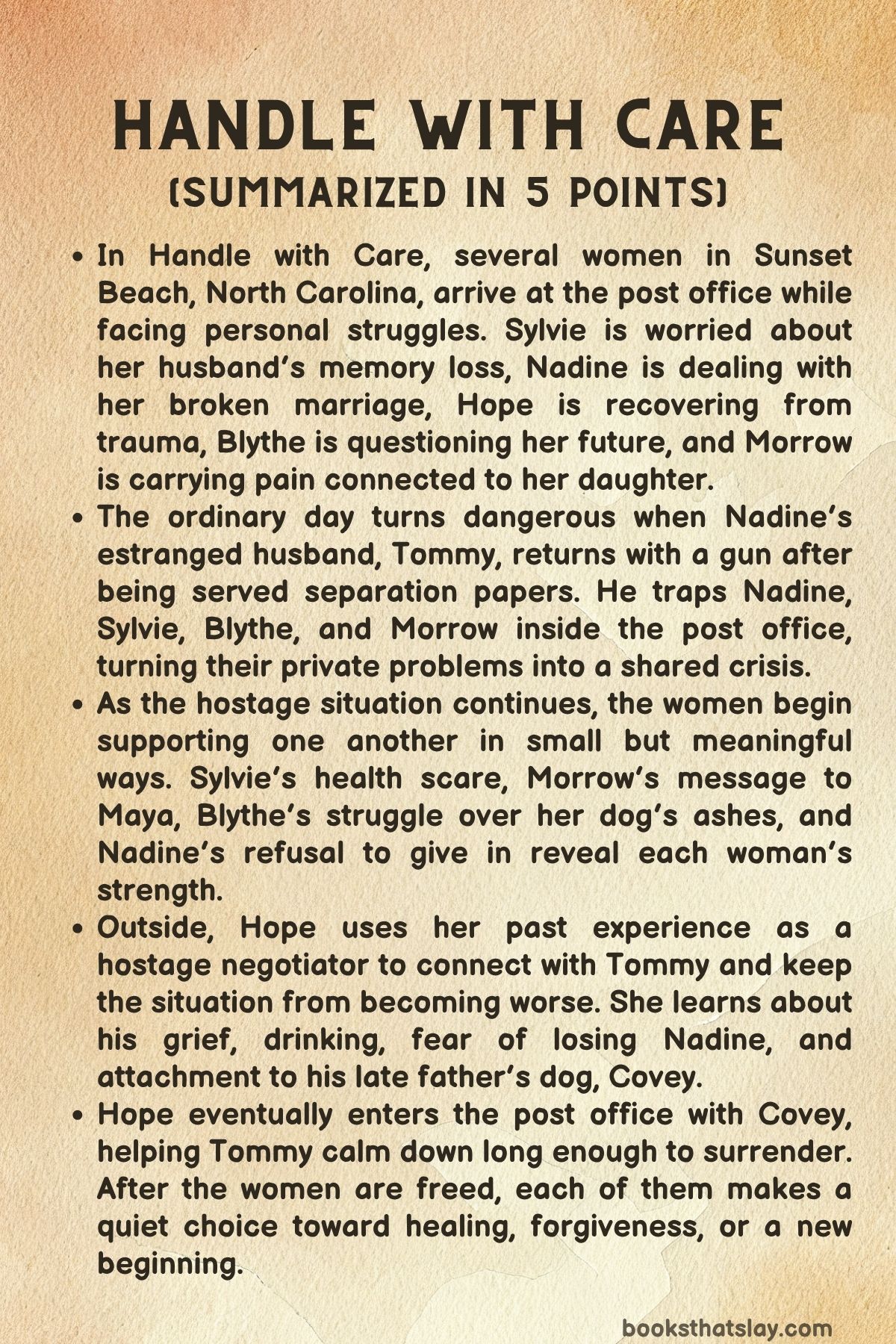
Characters
The characters in Handle with Care are shaped by fear, grief, regret, love, and the need to make difficult choices under pressure. Each person carries a private struggle before the hostage situation forces those hidden conflicts into the open, making the story less about one violent event and more about how people respond when their carefully protected lives are suddenly exposed.
Sylvie
Sylvie is one of the most emotionally grounded and quietly powerful figures in the book. As an older retired woman, she enters the story carrying the burden of her husband Robert’s declining memory and the painful question of what their future should look like.
The large envelope she plans to mail represents more than paperwork; it represents fear, exhaustion, and the possibility that she may have to accept a life very different from the one she once imagined. Sylvie’s strength is not loud or dramatic.
It appears in the way she endures uncertainty, in the way she observes others, and in the wisdom she offers even while she herself is physically weakened.
Inside the post office, Sylvie becomes a symbol of endurance and compassion. Her hypoglycemia makes her vulnerable, but it also allows the other women to come together around her, turning a room full of strangers into a small community of care.
Her final words to Tommy about life having a “PS” show her belief that people are not necessarily finished just because they have made terrible mistakes or reached what feels like an ending. By the end of the story, her decision to tear up the envelope shows that the hostage crisis has changed how she sees her own life.
Instead of surrendering to fear about Robert’s decline, she chooses to remain present with him, at least for now, and to believe that their life together still has meaning.
Robert
Robert is important even though he does not take part directly in the central hostage situation. His declining memory shapes Sylvie’s emotional conflict and gives her journey its quiet heartbreak.
Robert represents the fear of losing the person one loves little by little, not through sudden absence, but through gradual change. His condition forces Sylvie to confront the limits of devotion, the exhaustion of caregiving, and the frightening possibility that love alone may not be enough to preserve the life they once shared.
At the same time, Robert is not merely a problem in Sylvie’s life. He is the person whose presence continues to matter deeply to her.
Her return to him at the end shows that he remains central to her sense of home and identity. Through Robert, the story explores aging, memory, marriage, and the emotional weight of deciding when to hold on and when to let go.
His character deepens Sylvie’s arc by showing that some crises happen quietly inside homes long before they become visible to anyone else.
Nadine
Nadine is one of the most central and emotionally tested characters in the novel. As a new postal worker, she begins the story in an ordinary workplace situation, but her private life quickly becomes the source of public danger when Tommy confronts her over the separation papers.
Her refusal to tear up the papers shows that she has reached a point where she can no longer allow fear, guilt, or habit to control her choices. Nadine’s courage is especially meaningful because she is not presented as fearless.
She is frightened, cornered, and emotionally exhausted, yet she still understands that destroying the papers would not truly repair her marriage.
Nadine’s pregnancy adds another layer to her character. She is not only trying to separate from a troubled husband; she is also trying to protect a future life.
When she finally reveals the pregnancy to Tommy, the truth changes the emotional direction of the crisis. Her revelation is not used as a simple solution, but as a moment that exposes everything Tommy stands to lose and everything Nadine has been carrying alone.
By the end, Nadine driving home and speaking to her unborn baby shows her movement toward independence, responsibility, and a future defined by her own decisions rather than Tommy’s desperation.
Tommy
Tommy is the most dangerous character in the story, but he is also written with emotional complexity. He enters the post office angry, drunk, armed, and unwilling to accept that Nadine is leaving him.
His actions are violent and terrifying, and the book does not excuse the harm he causes. He threatens innocent women, traps them inside the post office, fires his gun, and turns his private pain into a public crisis.
At his worst, Tommy is controlling, unstable, and unable to separate love from possession.
Yet Tommy is not portrayed as a flat villain. His grief over his dead father, his drinking, his attachment to the dog Covey, and his desperate need to keep Nadine reveal a man collapsing under unresolved pain.
This complexity makes him morally troubling rather than simple. He is responsible for his choices, but those choices come from a broken emotional state rather than from careful cruelty.
His surrender becomes possible when he is forced to face the reality of what he has done and the possibility that he may still have a future if he stops causing harm. Tommy’s arc shows how grief, addiction, fear, and control can become destructive when a person refuses to seek help before reaching a breaking point.
Hope
Hope is one of the strongest figures in the book because she brings professional skill and personal vulnerability into the same space. As a former Philadelphia detective now working as a local officer, she is trying to rebuild herself after trauma.
Her past has made her cautious, wounded, and emotionally distant, especially in her relationship with Alex. However, when the hostage crisis begins, the very experience she has been trying to survive becomes the reason she is able to help others.
Hope’s strength lies in her ability to listen. She does not treat Tommy only as a threat, even though he is one.
She understands that negotiation requires patience, emotional intelligence, and the ability to find the human wound beneath the violent behavior. Her decision to enter the post office with Covey is brave not because she ignores danger, but because she understands the emotional key to reaching Tommy.
Through Hope, the story explores recovery after trauma and the possibility that a wounded person can still become a source of rescue for others. Her final call to Alex suggests that she is also ready to reopen a door in her own life.
Alex
Alex is significant because he represents the part of Hope’s life she has been avoiding. His birthday flowers show that he still cares for her and wants connection, even though she has created distance between them.
He is not central to the physical action inside the post office, but he is central to Hope’s emotional conflict. Through Alex, the story shows how trauma affects not only the person who experienced it, but also the relationships around that person.
Alex’s role is quiet but important. He represents patience, love, and the possibility of reconciliation.
Hope’s decision to invite him to bring her mail in person is a small but meaningful gesture. It suggests that after facing danger again and using her strength to save others, she may finally be ready to stop shutting him out.
Alex’s character helps complete Hope’s emotional arc by showing that healing is not only about surviving the past, but also about allowing someone trustworthy to come close again.
Blythe
Blythe is a character caught between the past and the future. She enters the post office with a package connected to Bryan, an old boyfriend, and her dead dog Murphy.
Her uncertainty about marrying Aaron reveals that she has not fully released the emotional attachments and doubts that belong to an earlier part of her life. The package is not just an object; it is a symbol of unfinished grief, unresolved love, and hesitation about committing completely to the life waiting for her.
Blythe’s struggle with the package becomes one of the most revealing moments in the story. When she fights to retrieve it, she realizes that sending Murphy’s ashes to Bryan is not what she truly wants.
This decision shows emotional growth. She begins to understand that honoring the past does not mean giving it control over her future.
By reuniting with Aaron and her mother, Blythe moves toward acceptance and clarity. Her character shows how a crisis can force someone to recognize the difference between nostalgia and love, memory and commitment, grief and self-sabotage.
Aaron
Aaron represents stability and the future Blythe is afraid to fully accept. Though he does not dominate the action, his presence matters because Blythe’s uncertainty about marrying him is one of her deepest internal conflicts.
Aaron is connected to the life she could choose if she stops measuring the present against the emotional weight of the past. He stands for commitment, steadiness, and the possibility of moving forward.
By the end, Blythe’s reunion with Aaron suggests that she has made an important emotional decision. She no longer needs to send part of herself backward to Bryan in order to understand who she is.
Aaron’s importance lies in what he reveals about Blythe: that her fear is not necessarily about him, but about whether she is ready to release old attachments. His character helps show that love sometimes requires not a dramatic rescue, but the patience to wait while someone becomes honest with herself.
Bryan
Bryan is Blythe’s former boyfriend and a figure from her past who continues to influence her present. He is not physically central to the hostage situation, but the package meant for him shows that he still occupies emotional space in Blythe’s mind.
His connection to Murphy’s ashes suggests that Blythe associates him with a time in her life that still feels tender, unfinished, or difficult to release.
Bryan’s role is less about who he is directly and more about what he represents. He stands for memory, old love, and the temptation to keep returning to something that may no longer belong in the present.
Blythe’s decision not to send the ashes to him is therefore a quiet act of emotional independence. Through Bryan, the story shows that people from the past can remain powerful not because they are still right for us, but because we have not yet decided what to do with the memories attached to them.
Murphy
Murphy, Blythe’s dead dog, is important as a symbol of grief, loyalty, and emotional attachment. Even though Murphy is no longer alive, the dog’s ashes carry enormous meaning for Blythe.
The package containing those ashes becomes a physical representation of her unresolved feelings about Bryan, her past, and her uncertainty about the future. Murphy represents a kind of love that is pure, loyal, and deeply personal.
Murphy’s presence in the story also reveals Blythe’s tenderness. Her intense reaction to the package shows that she is not simply indecisive; she is grieving and trying to understand where that grief belongs.
By choosing not to send Murphy’s ashes away, Blythe reclaims that love as her own instead of using it to maintain a connection to Bryan. Murphy’s role may be symbolic, but it is emotionally powerful because it helps Blythe recognize what she needs to keep and what she needs to release.
Morrow
Morrow is a mother struggling with fear, control, and the painful discovery that her daughter Maya has a life beyond what Morrow fully understands. Her conflict begins with an argument about a tattoo and a secret she has discovered, but beneath that conflict is a deeper parental anxiety.
Morrow wants to protect Maya, but she is also forced to confront the fact that protection can become control if it leaves no room for trust.
Inside the post office, Morrow’s fear for Maya becomes sharper because she does not know whether she will survive to repair what has gone wrong between them. Her secret text telling Maya that she loves her is one of the most intimate emotional moments in the story.
It shows that when faced with possible death, Morrow’s need to be right becomes less important than her need to make sure her daughter knows she is loved. By the end, her reconciliation with Maya suggests growth on both sides.
Morrow learns that motherhood is not only about guiding a child, but also about listening, forgiving, and allowing space for the child to become her own person.
Maya
Maya is central to Morrow’s emotional journey even though she is not trapped in the post office. She represents youth, independence, secrecy, and the natural distance that can grow between a mother and daughter.
Her argument with Morrow over the tattoo and the secret Morrow discovers suggest that Maya is trying to claim ownership of her identity, while Morrow is struggling to accept that her daughter’s choices may not always align with her expectations.
Maya’s importance lies in how she changes Morrow’s understanding of love. The crisis makes Morrow realize that control is not the same as closeness.
The possibility of never speaking to Maya again forces her to express love without conditions. Their reconciliation at the end suggests that Maya is not simply a rebellious daughter, but a young person who needs to be seen more fully.
Through Maya, the story explores the fragile, evolving bond between parent and child.
Stacy
Stacy is one of Nadine’s coworkers at the post office, and her early action helps create the circumstances that leave Nadine alone at the counter when Tommy arrives. By sneaking out for hot dogs with Martha, Stacy contributes indirectly to Nadine’s vulnerability, even though she does not intend harm.
Her role shows how ordinary carelessness can become significant when events suddenly turn dangerous.
Stacy is a minor character, but she helps establish the normal rhythm of the workplace before that normality is shattered. Her absence makes the post office feel more exposed and leaves Nadine without immediate support at a critical moment.
Stacy’s character also highlights the randomness of the crisis. She steps away for something casual and ordinary, while Nadine and the women in line are left to face something life-changing.
Martha
Martha, like Stacy, is a minor but functional character whose decision to leave the counter area contributes to Nadine being isolated when Tommy returns with the gun. She is part of the ordinary world of routines, coworkers, breaks, and small workplace choices.
Her presence at the beginning helps make the setting feel real and everyday before the story turns tense.
Martha’s importance comes from her absence during the crisis. Because she is not there, Nadine must face Tommy without the buffer of coworkers beside her.
This makes the confrontation more frightening and personal. Martha’s role reminds readers that major events often unfold not because every person makes a dramatic choice, but because small ordinary decisions happen at exactly the wrong time.
Nadine’s Mother
Nadine’s mother is a small but memorable character because of the way she confronts Tommy over the phone. Her scolding of him on speakerphone briefly disrupts his control and reminds him that Nadine is not completely alone.
Even from a distance, she brings the force of family, judgment, and emotional history into the room.
Her role also reveals more about Nadine’s situation. The phone call suggests that Tommy’s behavior is not occurring in isolation; other people know enough about the marriage to be angry, worried, or protective.
Nadine’s mother represents a voice from outside the hostage situation that refuses to treat Tommy’s actions as acceptable. She adds emotional pressure to the scene and reinforces the idea that Nadine deserves support beyond the walls of the post office.
Covey
Covey, Tommy’s father’s dog, plays a surprisingly important role in the emotional resolution of the crisis. To Tommy, Covey is more than a pet.
The dog is connected to his dead father, his grief, and the part of him that still responds to love and memory. Hope recognizes this and uses Covey not as a trick, but as a way to reach the wounded part of Tommy that is still capable of softness.
When Covey enters the post office with Hope, the atmosphere changes. Tommy’s reaction to the dog reveals that beneath his rage and violence there is grief he has not properly faced.
Covey becomes a bridge between Tommy’s destructive present and the emotional pain that helped create it. The dog’s presence helps make surrender possible by reminding Tommy of attachment, loss, and the person he might still choose to become.
Themes
Female Solidarity in Crisis
The hostage situation in Handle with Care forces women who begin as strangers to recognize one another’s pain, fear, and unfinished struggles. Before the crisis, each woman is locked inside her own private burden: Sylvie is facing the slow loss of her husband’s memory, Nadine is trapped in the emotional wreckage of a broken marriage, Blythe is uncertain about love and commitment, Morrow is struggling with motherhood and regret, and Hope is carrying trauma from her past work.
Once they are confined together, their separate problems no longer remain hidden. Fear strips away social distance, and small acts of care become powerful forms of resistance.
They help Sylvie when she collapses, protect one another from Tommy’s anger, and begin to understand that every woman in the room has been silently surviving something. The theme shows that solidarity is not always built through long friendship; sometimes it is created in one terrible afternoon when women choose compassion over panic and connection over isolation.
Letting Go of the Past
Many characters are holding on to something that has already begun to hurt them. Blythe’s package represents an old relationship and the emotional weight of Murphy’s ashes, while Sylvie’s envelope represents a painful decision about her future with Robert.
Nadine’s separation papers symbolize her attempt to free herself from Tommy, yet Tommy’s refusal to accept them shows how dangerous it can be when a person mistakes possession for love. Hope also struggles with the past because her earlier trauma has shaped the way she avoids Alex and doubts her own strength.
The crisis forces each character to confront what they have been carrying. Letting go does not mean forgetting or acting as if the past never mattered.
Instead, it means understanding when memory has turned into a burden. By the end, several characters choose not to mail, send, hide, or avoid what once controlled them.
Their healing begins when they stop treating the past as something that must decide their future.
Second Chances and the Possibility of Change
The story repeatedly suggests that a life is not finished just because it has reached a painful or shameful moment. Tommy’s actions are frightening and harmful, yet the surrender scene shows that even someone who has made terrible choices can still face the possibility of accountability and change.
Sylvie’s reminder about a “PS” gives emotional shape to this idea: after what seems like an ending, something meaningful can still be added. This theme also appears in quieter ways.
Hope begins to reopen communication with Alex, allowing their marriage to have another chance. Sylvie chooses not to give up on her remaining time with Robert.
Morrow repairs her relationship with Maya, while Blythe returns to Aaron with greater honesty about what she wants. These second chances are not presented as easy solutions.
They require truth, courage, and the willingness to act differently. The story treats change as possible, but only when characters stop hiding from what they have done, feared, or avoided.
Love, Protection, and Emotional Responsibility
Love in the story is tested by pressure, fear, and the need to make difficult choices. Some characters confuse love with control, while others learn that real love requires responsibility.
Tommy believes he is fighting for Nadine, but his violence proves that his attachment has become selfish and destructive. Nadine’s refusal to give in shows that protecting herself and her unborn child matters more than preserving a marriage that has become unsafe.
Sylvie’s love for Robert is more tender but still painful, because she must decide how to care for him without losing herself in despair. Morrow’s love for Maya is shaped by fear and mistakes, yet her message to her daughter shows that affection can survive conflict.
Hope’s relationship with Alex also reflects this theme, as she slowly accepts that avoiding him will not protect either of them. The story presents love as something deeper than emotion.
It must include honesty, safety, patience, and the courage to make choices that protect rather than possess.