Holding Ground Summary, Characters and Themes
Holding Ground by Piper Rayne is a contemporary small-town romance centered on Elliott Mercer, a devoted single father who has built his life around stability, and Emelia Greene, a development professional who arrives in Echo Lake with a corporate project that immediately puts them on opposing sides.
What begins as distrust becomes a relationship shaped by parenthood, family history, community loyalty, and questions about where a person truly belongs. The novel also gives significant weight to Baylor, Elliott’s young daughter, whose growing attachment to Emelia raises the emotional stakes. Beneath the romance is a story about fear, abandonment, identity, and choosing a permanent home.
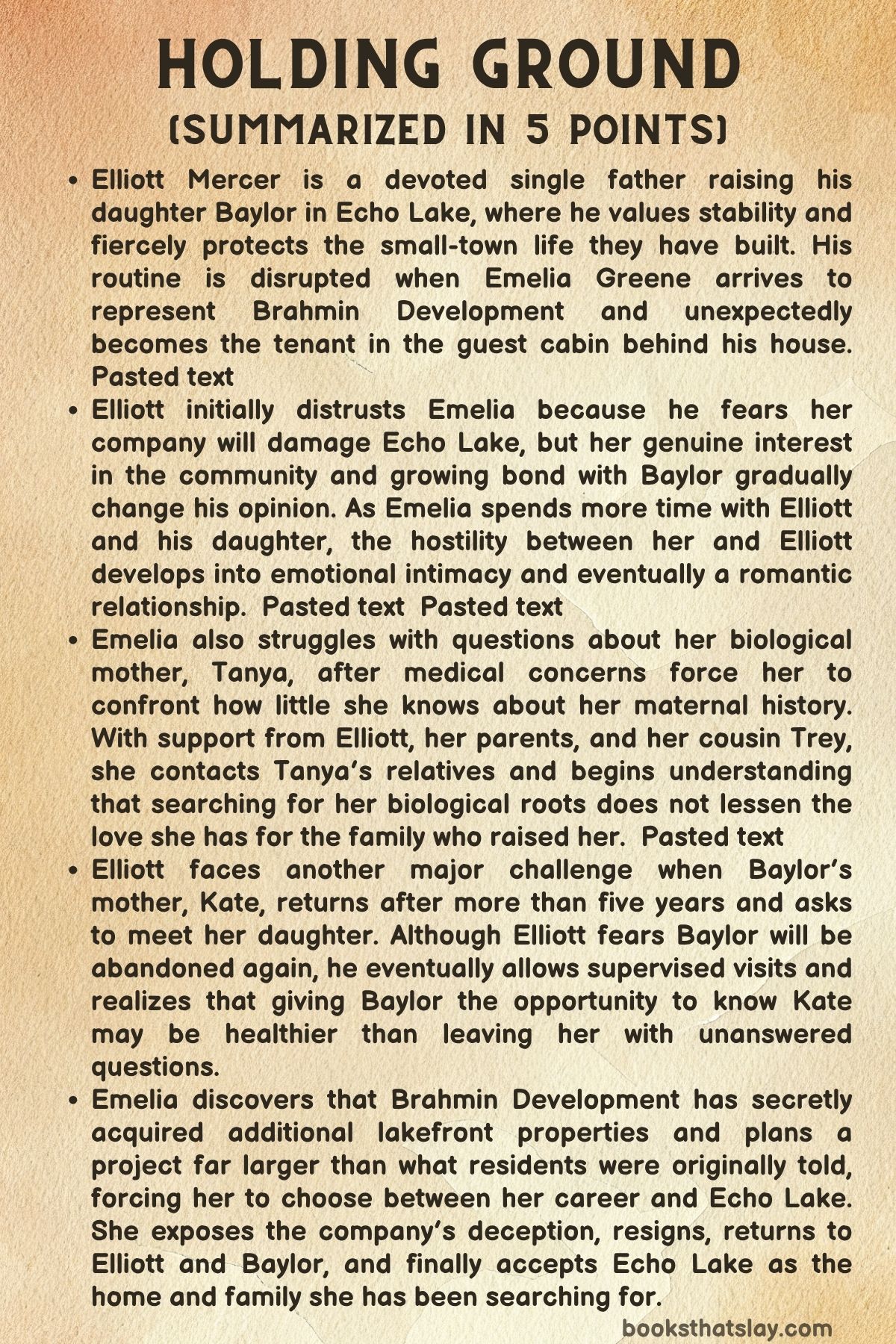
Summary
Elliott Mercer has created a tightly ordered life in Echo Lake, where he runs Anchor Point Camp and raises his five-year-old daughter, Baylor, alone. Baylor is the center of his world, and Elliott has spent years arranging every part of his life around giving her stability after her mother, Kate, left when Baylor was only six months old.
His emotional caution extends beyond romance. Elliott distrusts anything that threatens the predictable community he loves, so rumors that an outside company is interested in developing the Echo Lake waterfront immediately put him on guard.
Emelia Greene arrives from Boston as a representative of Brahmin Development, hoping to prove herself professionally by guiding the company’s new Echo Lake project. She grew up in a small Alaskan town, yet she has spent adulthood moving from place to place and investing heavily in her career instead of allowing herself to become rooted anywhere.
Her first meeting with Elliott at the Crow & Clover goes badly. He sees her as the face of a company that may destroy Echo Lake’s identity, while Emelia is offended by his assumption that she has dishonest motives. Their irritation becomes even more complicated when they discover that Roy has rented Elliott’s backyard guest cabin to Emelia for the entire three months of her assignment.
Elliott would prefer to keep his tenant at a distance, but Baylor makes that almost impossible. The little girl immediately likes Emelia, and Emelia responds to her with warmth, patience, and genuine affection.
As Emelia begins meeting local business owners, she also develops a more complicated understanding of the project she has been sent to promote. Residents such as Deacon, Dottie, and Lilith are not necessarily opposed to economic growth, but they fear losing the community that has sustained generations of families.
Elliott continues challenging Emelia publicly, especially during a town hall meeting where he questions whether Brahmin might later acquire more land than the proposal currently covers. Emelia initially cannot answer because the protections he asks about are missing from the documents, and his challenge makes her realize that she may not understand her own company’s intentions as fully as she believed.
At the same time, their personal relationship begins changing. Emelia helps Baylor with her hair, comforts her when she feels excluded by classmates, and becomes someone Baylor seeks out naturally. Elliott cannot ignore the good Emelia brings into his daughter’s life, even while he continues resisting his attraction to her.
A violent storm accelerates their closeness when a tree falls onto the bunkie. Elliott brings Emelia into his house while repairs are made, creating a temporary domestic arrangement that feels unexpectedly natural.
Emelia eats with Elliott and Baylor, helps with everyday tasks, and gradually becomes part of their household rhythm. What begins as simple hospitality starts resembling the kind of shared family life Elliott has not experienced in years.
Emelia is carrying another private concern. After abnormal bloodwork leads her doctor to ask questions about her maternal medical history, she becomes increasingly curious about Tanya Eaton, her biological mother, who died when Emelia was three.
Emelia was raised by her father, Jed, and stepmother, Molly, and she deeply loves the family they created for her. Because of that love, she has always felt guilty for wanting to know more about Tanya, as though curiosity might somehow diminish the parents who raised her.
Elliott becomes one of the first people with whom Emelia can discuss these complicated feelings. Their growing honesty allows Elliott to reveal his own history, including Kate’s abandonment and the guilt he still carries over believing he should have been able to prevent her departure.
He also explains the painful childhood that shaped him. After his mother died giving birth to Hollis, Elliott’s father collapsed under grief, addiction, and eventually criminal consequences, leaving Roy to raise Elliott and his siblings. Elliott learned early that protecting people meant taking responsibility for them, and that belief eventually became both his greatest strength and one of his emotional defenses.
Elliott’s brothers, Ansel and Hollis, see what he refuses to admit. They tell him that although his devotion to Baylor is sincere, he has also used fatherhood, routine, and responsibility as protection against the risk of loving someone again.
Elliott finally acknowledges that Emelia matters to him. The admission does not immediately solve their problem because Emelia is still expected to return to Boston, but it makes continued denial impossible.
After several near-kisses and emotionally intimate conversations, Emelia finally confronts Elliott about the distance he keeps creating between them. Elliott admits that he is already attached to her and fears what her eventual departure will do to both him and Baylor.
Their first kiss begins a romantic relationship they initially agree to keep secret from Baylor. They decide to focus on the present rather than define an uncertain future, even though their emotional investment already makes a truly casual arrangement impossible.
Their first official date takes them across Echo Lake, where Elliott explains how the lake received its name and reveals more of his family history. Emelia becomes one of the few people with whom he can discuss his childhood without hiding behind duty or humor.
Their attraction soon becomes physical, but the deeper change is emotional. Elliott allows Emelia into parts of his private life he has protected for years, while Emelia begins experiencing a sense of safety and belonging that she has never found through her constant movement between cities and jobs.
Emelia eventually speaks honestly with Jed and Molly about her search for Tanya’s relatives. Instead of feeling betrayed, they support her completely and explain that their earlier silence about Tanya came from an attempt to protect her.
Molly’s response especially releases much of Emelia’s guilt. Emelia then contacts Liz, Tanya’s niece, and learns that Tanya came from a family marked by abuse, addiction, estrangement, and instability. The information is painful, but it gives Emelia context for a part of her identity that had previously been blank.
Elliott also begins reconsidering how he has handled Baylor’s questions about Kate. When children at school ask Baylor why she does not have a mother, Elliott realizes that protecting his daughter from information cannot prevent her from eventually wondering about the missing part of her history.
That realization becomes critical when Kate suddenly returns to Echo Lake after five years. She does not demand custody or excuse what she did, but she asks Elliott for the chance to meet Baylor and establish some form of relationship with her.
Elliott’s immediate instinct is to refuse because he cannot bear the possibility that Kate might gain Baylor’s trust and disappear again. Yet conversations with Roy, his brothers, and the Thermos Crew force him to ask whether keeping Kate away would protect Baylor or simply preserve Elliott’s own emotional safety.
He finally allows one supervised meeting. Baylor responds with nervous excitement and gradually begins talking and playing with Kate, confirming to Elliott that his daughter needed the chance to know her mother even if the future remains uncertain.
Kate’s return also affects Emelia. Although she supports Baylor’s relationship with her mother, seeing Elliott, Baylor, and Kate together reawakens Emelia’s old fear that she is an outsider who has entered a family that ultimately does not have a permanent place for her.
At the same time, Emelia uncovers a serious problem with Brahmin Development. She discovers that several lakefront parcels have been purchased through separate LLCs and that the supposedly limited project she has been presenting may actually be one part of a far larger resort development.
The evidence eventually becomes undeniable. Brahmin’s financial assumptions make sense only if the company expects to control the surrounding properties as well, proving that Emelia has unknowingly been used as the public face of a misleading proposal.
Her professional identity collapses under the discovery. She knows that remaining silent would betray the people who trusted her, but exposing the company could destroy the career she has spent years building.
Before Emelia can explain the situation, Elliott confesses that he loves her and asks her to stay permanently in Echo Lake with him and Baylor. Emelia loves him too, but fear takes control because she believes the Brahmin revelation may make him regret loving her.
Instead of trusting him with the truth, she runs back to Boston. Elliott is devastated, but he eventually realizes that Emelia’s departure is not simple rejection; it comes from the same fear of not belonging that has governed much of her adult life.
In Boston, Emelia discovers that the condominium and career that once represented success no longer feel like home. Molly helps her understand that running has never protected her from rejection because the feeling of being unwanted has always followed her internally.
Emelia therefore makes two decisions. She will expose Brahmin regardless of the professional consequences, and she will return to Echo Lake rather than allowing fear to choose her future.
At the final town hall, Emelia publicly reveals Brahmin’s hidden land acquisitions and larger development plan. She admits that she failed to discover the deception sooner and announces that she has resigned.
Some residents initially accuse her of being part of the dishonesty, but Elliott publicly defends her character. The people she has come to know—Roy, Ansel, Hollis, Dottie, Deacon, and the Thermos Crew among them—also support her, proving that the community no longer sees her as an outsider.
Outside the meeting, Emelia admits that she loves Elliott and asks him to take her home. Elliott makes clear that her home is no longer the bunkie behind his house but the home he shares with Baylor.
Six weeks later, Emelia is fully established in Echo Lake. She has found new work in regional tourism and economic development, Kate remains in Baylor’s life through calls and visits, and Elliott, Emelia, and Baylor have formed the family they had gradually been creating long before any of them were willing to name it. Rumors that Elliott has visited a jewelry store suggest that his commitment to Emelia may soon become even more permanent.
Characters
Elliott Mercer
Elliott is the emotional anchor of Holding Ground, a man whose identity has been built around responsibility, protection, and the conviction that stability must be defended. His devotion to Baylor is unquestionable, but the novel gradually reveals that his strict routines are not simply good parenting; they are also a response to repeated abandonment and loss.
Losing his mother, watching his father collapse under addiction, being effectively abandoned by both parents, and later being left by Kate taught Elliott to associate emotional dependence with danger. This explains why he reacts so strongly to Emelia, Brahmin Development, and nearly every form of change: uncertainty threatens the structure he has spent years building.
His relationship with Emelia forces him to distinguish protection from avoidance. Elliott initially argues that he cannot risk a relationship because of Baylor, but Ansel and Hollis correctly recognize that he has also been using Baylor as a reason not to expose himself to another possible loss.
His growth is clearest when Kate returns. Rather than acting entirely from anger, Elliott chooses the decision that may best serve Baylor even though it terrifies him, proving that real protection sometimes requires accepting emotional risk rather than eliminating it.
Emelia Greene
Emelia is the central agent of change in Holding Ground, both within Echo Lake and within Elliott’s private life. At first she appears to be Elliott’s opposite: ambitious, mobile, professionally driven, and comfortable entering unfamiliar places, yet beneath that independence is a persistent fear that she never truly belongs anywhere.
Her unresolved feelings about Tanya help explain this instability. Emelia was deeply loved by Jed and Molly, but the missing half of her biological history produced questions she interpreted as evidence that something about her identity remained incomplete.
Her professional conflict reflects the same internal struggle. She arrives believing she can represent Brahmin while respecting Echo Lake, but the more she understands the residents, the more strongly her moral loyalty shifts toward them.
The decisive change comes when she stops defining belonging as something another person or place must grant her. By exposing Brahmin and returning to Elliott, Emelia finally chooses a community, a family, and an ethical position even though none of those choices come with guarantees.
Baylor Mercer
Baylor gives Holding Ground much of its emotional weight because the consequences of Elliott and Emelia’s decisions are rarely limited to the two adults. She is affectionate, socially observant, emotionally direct, and increasingly aware that her family does not resemble the households of some of her classmates.
Her questions about Kate become more difficult as she enters kindergarten. When classmates tell her that mothers do not leave their children, Baylor begins searching for explanations that Elliott has previously tried to avoid giving her.
Her attachment to Emelia develops naturally through small acts: hairstyles, nail painting, conversations, meals, bedtime routines, and ordinary companionship. Baylor does not consciously attempt to turn Emelia into a replacement mother; she simply responds to someone who consistently treats her with attention and affection.
Her response to Kate is equally important. Baylor can love Emelia while still wanting to know Kate, demonstrating that a child’s emotional world does not have to operate through replacement or competition.
Kate
Kate is one of the most difficult figures in Holding Ground because her return requires the story to address whether a person who caused severe harm can be allowed a second chance. She abandoned Baylor as an infant and remained absent for more than five years, leaving Elliott to carry every practical and emotional responsibility alone.
When she returns, however, Kate does not demand forgiveness, custody, or immediate acceptance. She acknowledges that what she did was wrong and gives Elliott control over the conditions under which she can meet Baylor.
Her role is less about restoring her relationship with Elliott than repairing, cautiously and imperfectly, her relationship with her daughter. Kate’s willingness to accept limited contact shows that she understands she cannot reclaim the years she missed.
Her reappearance also becomes a test for Elliott and Emelia. Elliott must separate his justified anger from Baylor’s needs, while Emelia must confront her fear that Kate’s biological connection to Baylor automatically makes Emelia less important.
Roy Mercer
Roy represents the enduring family structure surrounding Elliott in Holding Ground. He stepped in after Elliott’s father could no longer care for his children and prevented the Mercer siblings from being separated, establishing himself as far more than an uncle.
His influence remains important because he understands Elliott’s protective instincts without automatically agreeing with them. Roy regularly pushes him to judge Emelia as an individual rather than as a symbol of the corporation she represents.
When Kate returns, Roy again helps Elliott move beyond instinctive anger. His point that Elliott must make a decision for Baylor rather than against Kate captures his role throughout the novel: he does not remove Elliott’s burdens, but he helps him see those burdens more clearly.
Ansel Mercer
Ansel is more playful and openly provocative than Elliott, often using humor to say what his brother would rather avoid hearing. He sees Elliott’s attraction to Emelia very early and refuses to accept the argument that Elliott is too focused on Baylor to consider a relationship.
His most meaningful contribution comes when he challenges Elliott’s emotional avoidance. Ansel understands that Baylor is genuinely Elliott’s priority, but he also sees how easily that truth can become an excuse for remaining isolated.
His presence keeps Elliott connected to a sibling relationship in which criticism and loyalty coexist. Ansel can tease him mercilessly about Emelia while still being one of the people Elliott trusts with Baylor and with major family decisions.
Hollis Mercer
Hollis is quieter and more analytical than Ansel, which makes his observations especially difficult for Elliott to dismiss. He recognizes that Elliott has turned responsibility into part of his emotional armor.
When Hollis tells Elliott that he has used Baylor as a shield, he is identifying a pattern extending far beyond romance. Elliott protects others so consistently that he can avoid acknowledging when he himself needs companionship, reassurance, or emotional support.
Hollis also understands the family’s history from his own position as the child whose birth coincided with their mother’s death. His presence therefore quietly reinforces the complicated network of grief, guilt, and loyalty that shaped all the Mercer siblings.
Dottie
Dottie initially appears to function mainly as a humorous source of flirtation and local gossip, but she becomes an important example of Echo Lake’s social openness. She quickly welcomes Emelia rather than treating her entirely as an enemy because of her association with Brahmin.
Her conversations with Emelia help explain Elliott’s personality from an outside perspective. Dottie recognizes that his difficult exterior is connected to loyalty, responsibility, and fear rather than simple hostility.
She also represents the practical side of the development debate. Dottie understands that local businesses could benefit from stronger year-round activity, but she does not want financial opportunity to come at the price of Echo Lake’s identity.
Deacon
Deacon is reserved, observant, and quietly perceptive. Through the Birdhouse Bakery, he turns community relationships into something almost symbolic by naming pastries after local people.
His creation of “Emelia’s Compass” is especially meaningful because he normally reserves that recognition for Echo Lake residents. By naming something after Emelia before she has admitted that Echo Lake feels like home, Deacon suggests that the community has already recognized her belonging before she has accepted it herself.
His early conversation with Emelia also helps frame the development conflict in balanced terms. He does not reject growth automatically; he simply wants growth that allows the town to remain recognizable to the people who live there.
Trey
Trey is one of Emelia’s most important emotional confidants outside Echo Lake. His own history with foster care and biological-family questions makes him particularly capable of understanding why Emelia wants information about Tanya without assuming that curiosity means dissatisfaction with the family who raised her.
He directly challenges Emelia’s guilt by telling her that searching for biological history cannot erase her love for Jed and Molly. That reassurance helps her move toward the conversation she has been avoiding with her parents.
Trey also notices Emelia’s changing feelings about Elliott before she fully admits them. His observations show how dramatically Elliott has moved from being a frustrating local opponent to someone whose opinion and presence genuinely matter to her.
Jed and Molly
Jed and Molly represent the secure family Emelia has had all along but has sometimes struggled to recognize without qualification. Jed is her biological father, while Molly raised her as her own daughter after Tanya’s death.
Their response when Emelia finally discusses Tanya is crucial. Instead of feeling threatened, they apologize for allowing the subject to remain so silent and make clear that Emelia has every right to understand where she came from.
Molly becomes especially important when Emelia runs back to Boston. By sharing her own experience of running from Jed because of fear, Molly helps Emelia see that feelings of unworthiness can distort how a person interprets even genuine love.
Tanya Eaton
Tanya never appears alive in the story, yet her absence has shaped Emelia for most of her life. Because Tanya died when Emelia was three, she exists first as a blank space rather than as a fully understood person.
The photographs and information Liz provides gradually transform Tanya from an abstraction into someone with a painful family history. Learning about abuse, addiction, and instability does not give Emelia every answer, but it allows her to understand that Tanya’s life existed within circumstances Emelia had never known.
Tanya’s importance therefore lies in what knowing her history allows Emelia to release. Emelia no longer needs the unknown half of her background to define her as incomplete.
Liz
Liz gives Emelia a living connection to Tanya’s side of the family. Their physical similarities immediately make the relationship emotionally significant even before they know whether they will ever become close.
Liz is valuable because she offers information without pretending that biology automatically creates intimacy. She tells Emelia what she knows about Tanya’s difficult background, but both women understand that shared DNA does not instantly create the kind of bond Emelia has with Jed, Molly, and the family who raised her.
Through Liz, Emelia receives answers without being required to replace one family with another. That distinction is central to her eventual understanding of identity.
Collins
Collins is connected to the Mercer family through grief because her husband died while working as a firefighter with Ansel. Her presence reminds Elliott that loss can permanently reshape a life while still leaving room for continued relationships and community.
She also briefly triggers uncertainty in Emelia, who wonders whether Collins and Elliott ever shared a romantic history. Elliott’s clarification reinforces how little he has allowed himself to pursue relationships since Kate left.
Collins remains a secondary character, but she contributes to the wider picture of Echo Lake as a place where personal histories are widely known and where people continue supporting one another after tragedy.
Jimmy, Clyde, and Sam
The men known as the Thermos Crew serve as both comic observers and representatives of Echo Lake’s collective memory. Their habit of sitting outside the bait shop and discussing local affairs makes them an informal information network for the town.
Their gossip can embarrass Elliott and expose private matters quickly, but their involvement is not merely comic. When serious questions arise, particularly around Kate and Emelia, they offer perspectives based on long familiarity with Elliott’s family and the values of the community.
Their support for Emelia at the final town hall is especially meaningful because it signals that the town’s long-established social center has accepted her.
Lilith Nyland
Lilith gives Emelia one of the clearest explanations of why development frightens long-term residents. Her family’s blueberry farm represents continuity across generations, so the possibility of nearby sales and corporate expansion is not simply a financial question.
She worries about a chain reaction in which individual property decisions gradually dismantle the institutions and relationships that make Echo Lake sustainable for local families. Her conversation with Emelia helps move the development debate away from simplistic opposition to change and toward the issue of who controls that change.
Lilith also helps Emelia recognize how much her own values resemble those of the community she was originally hired to persuade.
Manuel
Manuel, the owner of the Crow & Clover, is one of the first Echo Lake residents to welcome Emelia without suspicion. His own decision to leave New York for small-town life provides an early example of someone consciously choosing a different definition of success and home.
That choice quietly anticipates Emelia’s later decision. At the beginning, she still sees professional advancement and mobility as essential parts of her identity, while Manuel represents the possibility that leaving a large city can be movement toward something rather than away from ambition.
Melissa and Gabrielle
Melissa and her daughter Gabrielle become important through Baylor’s experience of exclusion. When Baylor is left out of a park gathering organized largely by mothers, Elliott realizes that other families may unintentionally isolate his daughter because her household looks different.
Melissa’s apology creates an opportunity for Elliott to advocate for Baylor rather than simply shielding her from disappointment. He explains that Baylor should not be excluded because she does not have a mother living with her and asks Melissa to help Gabrielle understand that families take different forms.
Their small role supports the broader movement in Elliott’s parenting from protection through avoidance toward protection through honest engagement.
Themes
Belonging and the Choice to Stay
Belonging in Holding Ground is presented less as something automatically granted by birthplace or biology and more as something created through participation, trust, and conscious commitment. Emelia spends much of her adult life moving from city to city, believing that her repeated sense of displacement proves she has not yet found the place where she naturally fits.
Her search for Tanya’s family reveals the weakness in that belief. Learning about her biological relatives gives her valuable context, but it does not suddenly create a deeper family than the one she already has with Jed, Molly, her siblings, and cousins.
Echo Lake teaches her the same lesson socially. Dottie feeds her, Deacon names a pastry after her, Baylor trusts her, the Mercer family includes her, and residents eventually defend her publicly, yet Emelia still struggles to believe she belongs because the real barrier exists inside her.
Her final choice matters because she stops waiting for belonging to feel effortless. She returns knowing that relationships can still involve conflict, uncertainty, and fear, but she chooses Elliott, Baylor, and Echo Lake anyway.
Fear, Abandonment, and Emotional Self-Protection
Elliott and Emelia respond to abandonment in opposite ways that ultimately produce the same result. Elliott stays rooted so firmly that change feels threatening, while Emelia keeps moving so frequently that no place has enough time to become permanent.
Elliott’s childhood trained him to expect that people can disappear. His mother died, his father became incapable of parenting, and Kate later abandoned both him and Baylor, so Elliott responds by making himself indispensable and limiting emotional risks.
Emelia’s fear has a different origin. She was loved by Jed and Molly, but Tanya’s absence and the unanswered questions surrounding her biological history created an internal belief that some part of her identity was missing.
Their romance requires both characters to abandon strategies that once protected them. Elliott must stop treating isolation as responsible parenting, while Emelia must stop leaving before another person can decide whether she belongs.
The final conflict demonstrates that courage is not the absence of fear. Both characters remain capable of being hurt, but they begin making decisions based on what they value rather than on what might protect them from future pain.
Family Beyond Conventional Definitions
Family in Holding Ground is repeatedly shown as a relationship built through care rather than limited to biology or traditional household structure. Baylor begins the story in a loving but incomplete-feeling social position because other children notice that she does not have a mother living with her.
The novel refuses to solve this by simply replacing Kate with Emelia. Baylor is allowed to develop a strong bond with Emelia while also wanting to know Kate, and those relationships do not have to cancel one another.
Emelia’s own family provides a parallel. Molly is not her biological mother, yet she has fully occupied the emotional role of a parent through years of care, while learning about Tanya does not weaken that bond.
Roy provides another variation by becoming the stable parental figure Elliott and his siblings needed after their father’s collapse. The Mercer family survives because someone outside the traditional parent-child structure accepts responsibility for children who need him.
By the end, Elliott, Emelia, Baylor, Kate, and their extended relatives form a family system that is imperfect but larger and more flexible than the narrow model Baylor initially thinks she is missing.
Growth Without Losing Identity
The development conflict transforms the question of change into an ethical issue rather than a simple battle between progress and tradition. Many Echo Lake residents acknowledge that increased year-round economic activity could benefit businesses, create jobs, and strengthen the local economy.
Their objection is to growth controlled by outsiders who view the town primarily as a profitable asset. Brahmin’s secret acquisition of surrounding parcels proves that Elliott’s fears were not entirely unreasonable, because the company intends a scale of transformation far beyond what residents were initially told.
Emelia becomes important because she eventually separates development itself from Brahmin’s dishonest strategy. Her new career in regional tourism and economic development suggests that communities do not have to choose between complete stagnation and corporate domination.
The same principle applies personally. Elliott learns that preserving his family does not require keeping his life unchanged, and Emelia learns that committing to a place does not mean giving up ambition or independence.
Healthy growth therefore depends on continuity rather than erasure. Echo Lake can change while protecting what makes it distinctive, just as Elliott and Emelia can build new lives without denying the histories that shaped them.