Hollow Bones Summary, Characters and Themes
Hollow Bones by Jodi Picoult is a family drama about identity, motherhood, mental illness, grief, and the limits of control.
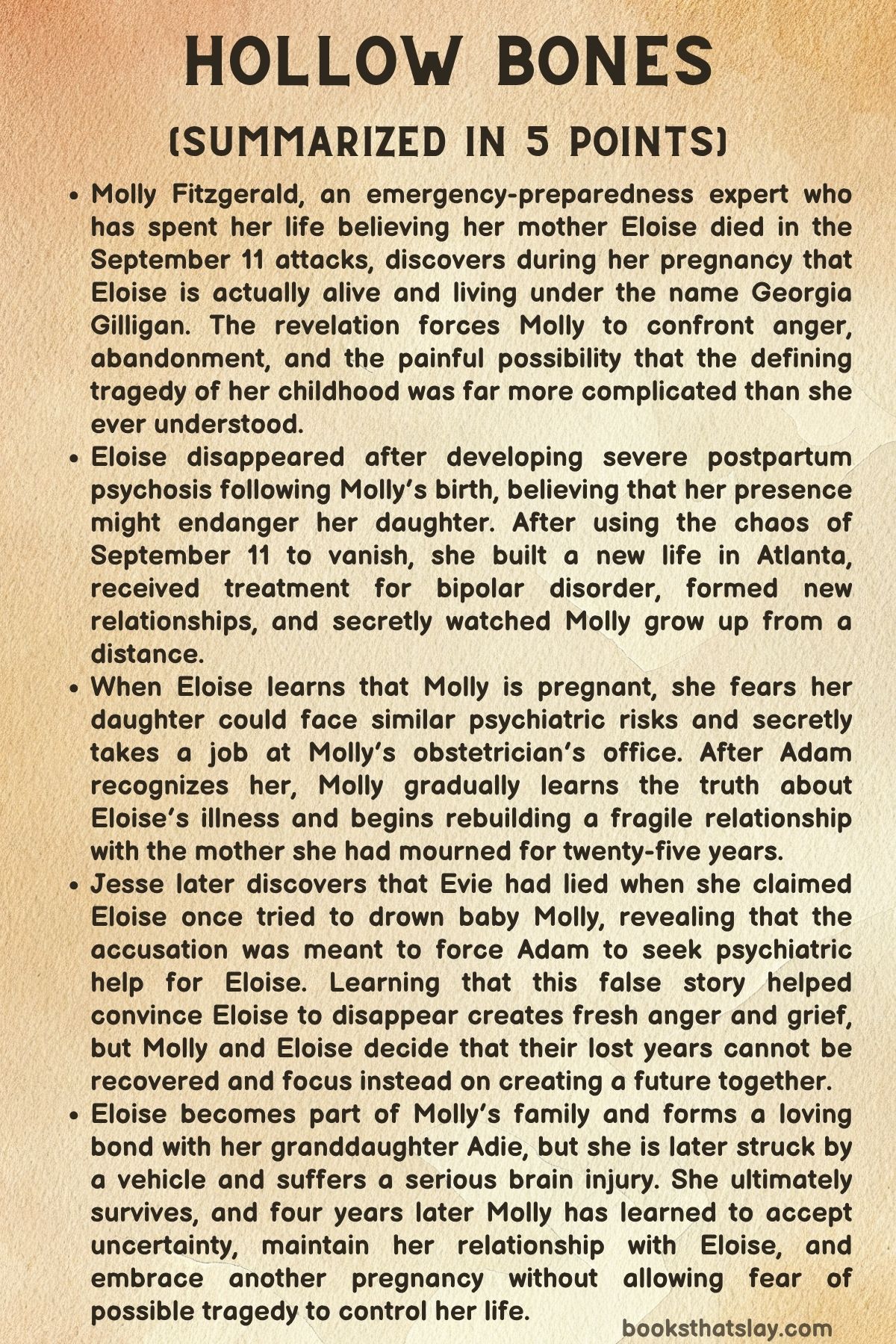
At its center are Molly Fitzgerald and the mother she believed died in the September 11 attacks, only to discover twenty-five years later that Eloise Ambrose survived and deliberately disappeared. The novel places that revelation beside Molly’s first pregnancy, forcing both women to reconsider what motherhood can demand and how fear can distort love. Through Eloise’s history with postpartum psychosis and Molly’s lifelong fixation on preparedness, the story asks whether people can rebuild relationships after decades of absence, secrecy, misunderstanding, and irreversible choices.
Summary
Molly Fitzgerald has built her adult life around preparing for disasters. As chief of Rhode Island’s Center for Emergency Preparedness and Response, she spends her days anticipating emergencies, arranging contingency plans, and reducing uncertainty wherever possible. Her professional discipline is deeply connected to a personal wound: her biological mother, Eloise Ambrose, was presumed to have died during the September 11 attacks when Molly was still an infant.
Molly is married to Jesse Fitzgerald, a Providence detective and polygraph expert whose own family has experienced devastating loss. Their relationship is strengthened by the fact that both understand what it means to live with grief that cannot be neatly resolved, and Jesse has gradually learned how much Molly depends on structure and control.
The twenty-fifth anniversary of September 11 brings Molly’s questions about her mother back to the surface. She travels to New York for the memorial and once again confronts the strange burden of mourning someone she never truly knew, wondering what Eloise might have been like and what kind of relationship they could have had.
Soon afterward, Molly discovers that she is eleven weeks pregnant despite having used birth control. The news destabilizes the carefully organized life she has created because motherhood represents exactly the kind of uncertainty she cannot manage through procedures, checklists, or professional expertise.
Jesse is delighted, while Molly fears that pregnancy and parenthood could interfere with a career she has spent years building. As the pregnancy progresses, however, her anxiety exists alongside a growing attachment to the child, and she begins to understand that fear does not prevent love from taking root.
Molly also becomes increasingly curious about Eloise. Research into her mother’s artistic life at the Rhode Island School of Design reveals a young woman who created mosaics and who had escaped an intensely religious Alabama upbringing before starting a new life with Adam, Molly’s father.
During her prenatal care, Molly meets Georgia Gilligan, a receptionist whose kindness repeatedly comforts her. Georgia understands Molly’s fears in ways that seem unusually personal, particularly when she reassures Molly about parenthood and later reveals that she once lost a child.
Molly and Jesse learn that their baby is a girl. Yet the joy of that discovery intensifies Molly’s fear that something could go wrong, and a severe winter storm eventually brings those fears close to reality.
While Jesse is away, Molly becomes involved in an emergency at a nursing home that has lost heat. After ensuring the residents are safe, she slips outside and falls hard on her abdomen, then becomes terrified when the baby stops moving.
Georgia is the person who takes Molly to the hospital when no one else is available. The baby survives, and Molly is temporarily placed on bed rest, but the incident creates an even stronger emotional connection between Molly and the receptionist.
That relationship changes completely when Adam later sees Georgia and recognizes her as Eloise Ambrose.
The revelation shifts the story into Eloise’s past. After Molly’s birth in 2001, Eloise had initially loved her daughter intensely, but severe sleep deprivation and worsening psychiatric symptoms began changing her perceptions.
Eloise had already survived a difficult childhood under her authoritarian father, Reverend Ezekiel Owens. The death of her beloved younger sister, Adie, had helped drive her away from Alabama, after which she reinvented herself as an artist and fell in love with Adam.
Following Molly’s birth, Eloise began hearing a voice she associated with Satan and became convinced that she and her baby were in spiritual danger. Doctors failed to recognize the seriousness of what was happening, leaving Eloise trapped in postpartum psychosis without adequate treatment.
Her friend Evie became increasingly alarmed. Eloise was eventually told that during a period she could not remember, she had been found apparently trying to drown Molly, a claim that convinced her she might truly become a danger to her daughter.
On September 11, Eloise was sent to an appointment near the World Trade Center. After witnessing the terrorist attacks and the chaos surrounding them, she recognized that the disaster provided an opportunity to disappear completely.
Believing Molly would survive only if she stayed away, Eloise crossed the Brooklyn Bridge and eventually made her way to Atlanta. There she adopted the identity Georgia Gilligan and attempted suicide before finally receiving psychiatric care that helped her understand that the terrifying thoughts and voices she had experienced were symptoms of illness.
Georgia was diagnosed with bipolar disorder and began learning about postpartum psychosis. Recovery was uneven, but treatment gradually allowed her to understand that what had happened did not mean she was evil or incapable of love.
She considered returning to Adam and Molly. Yet when she secretly traveled back and observed the people she had left behind, she saw Adam grieving alongside Evie while Evie cared tenderly for Molly.
To Georgia, they already looked like a family. She decided that revealing herself might destroy the stability Molly possessed, so she returned to Atlanta and attempted to make Georgia Gilligan her permanent identity.
Over the following years, Georgia built a fragile but genuine life. Her bipolar disorder remained difficult to manage, particularly when medication side effects led her to stop taking lithium and triggered periods of instability, but therapy and experience gradually taught her to see the illness as something requiring continuous management.
Ximena and her daughters became Georgia’s chosen family. At the same time, Georgia secretly kept track of Molly through an investigator and later through social media, watching her daughter grow up while accepting that she had surrendered the right to participate openly.
A relationship with a librarian named Edward briefly offers Georgia the possibility of intimacy. Yet because she conceals both her diagnosis and her real identity, the relationship ends when Edward discovers that significant parts of the history she gave him are false.
Years later, Georgia meets Kai Yazzie, a Diné police officer whose calmness and acceptance allow her to become more emotionally open. She eventually tells him about her bipolar disorder, and instead of rejecting her, Kai responds by sharing his own concerns about hereditary heart disease.
Georgia still cannot tell him about Molly or Adam. When Kai eventually proposes marriage, she refuses because she remains legally married to Adam and knows that the woman Kai wants to marry is partly an invented identity.
Their relationship ends, leaving Georgia once again separated from someone she loves because of the secrets on which her life has been constructed.
Georgia later sees how valuable her experience can be when she recognizes signs of postpartum psychosis in a new mother named Iris. Her insistence that medical professionals take the symptoms seriously results in psychiatric intervention and demonstrates how the suffering Georgia endured has given her the ability to recognize a danger that others might overlook.
Everything changes again in 2026 when Georgia discovers through social media that Molly is pregnant. Knowing that bipolar disorder and postpartum psychiatric illness may carry hereditary risks, Georgia becomes terrified that Molly could experience something similar without understanding the warning signs.
For the first time, remaining absent seems more dangerous than returning. Georgia therefore discovers the identity of Molly’s obstetrician and arranges to work at the office as a receptionist, allowing her to stay close without immediately revealing who she is.
After Adam recognizes her, Molly must confront an impossible emotional reality. The woman whose death shaped her entire childhood has been alive for twenty-five years and chose not to return.
Molly’s first response is anger. Yet after Evie explains Eloise’s severe psychiatric deterioration following childbirth, Molly gradually realizes that her mother’s disappearance cannot be understood as simple rejection.
Molly begins speaking with Georgia directly. Their conversations are uncomfortable, emotional, and incomplete, but Molly gradually replaces the imagined version of her dead mother with an understanding of Eloise as a living woman whose decisions were shaped by illness, fear, guilt, and a belief that leaving was an act of protection.
Near the end of Molly’s pregnancy, the two continue creating a fragile relationship. Molly eventually gives birth safely to a daughter, whom she and Jesse name Adie after Eloise’s younger sister.
Becoming a mother changes Molly’s understanding of Eloise’s decision. She still grieves the twenty-five lost years, but holding her own daughter allows her to understand how overwhelming the desire to protect a child can become.
Eloise, meanwhile, experiences the unexpected joy of becoming a grandmother. She begins participating in family life for the first time in decades while carefully avoiding the assumption that she can simply resume her old relationship with Adam.
Her survival eventually becomes public. Because Eloise had been counted among the dead of September 11, the discovery creates intense media attention, and some people respond with anger.
Molly chooses to defend her mother publicly, explaining that Eloise had suffered from postpartum psychosis and believed her disappearance was necessary to protect her baby. This marks a significant change in Molly, who is no longer merely processing what Eloise did but actively choosing to stand beside her.
A deeper secret then emerges through Jesse’s investigative instincts. He notices that Evie’s long-standing story about finding Eloise trying to drown Molly does not match a practical detail about the house: the relevant bathroom did not have functioning water at the time.
When confronted, Evie admits that Eloise had never actually tried to drown Molly. She had seen how severely Eloise was deteriorating and, frustrated that Adam was not taking the danger seriously, deliberately exaggerated the situation in the hope that he would finally get Eloise psychiatric help.
Evie never expected that Eloise would disappear the following day. Yet the lie became one of the main reasons Eloise believed she was capable of killing her child, meaning a desperate attempt to obtain help helped set twenty-five years of separation in motion.
Molly tells Eloise the truth. Eloise must then reinterpret the defining memory behind her disappearance: she may have feared harming Molly, but she had not actually committed the act she spent decades believing she had attempted.
The revelation intensifies the conflict between Eloise and Evie. Each has caused the other lasting pain, but neither can change what happened, and Eloise ultimately chooses not to reclaim Adam or compete for the life Evie built with him.
Instead, she concentrates on Molly and Adie. She creates a mosaic for her granddaughter’s nursery, using imagery of trees and phoenixes to represent survival, separation, destruction, and renewal.
Eloise and Molly later travel together to New York. At the September 11 Museum and memorial, Eloise confronts the catastrophe that allowed her to erase herself, while Molly shows her the Survivor Tree, which endured severe damage and continued living.
The symbol offers Eloise a new way to think about survival. She can acknowledge the damage, guilt, and absence without believing that surviving makes her undeserving of a future.
That future is suddenly threatened when Eloise is struck by a vehicle while crossing a street in New York. Jesse rushes to the hospital after Molly calls him, only to discover that Eloise requires emergency surgery for bleeding in her brain.
For Molly, the accident creates the possibility of losing her mother for a second time. This time, however, the loss would not involve an imagined woman or an unanswered disappearance; Molly now knows Eloise, loves her, and understands exactly what would disappear from her life.
Sitting beside Eloise in the ICU, Molly finally confronts the weakness at the center of her lifelong devotion to preparedness. Her work can reduce risks and improve responses, but no amount of planning can guarantee that the people she loves will remain safe.
Molly tells Eloise that she loves her and thinks she senses a response. The moment completes her movement away from trying to control uncertainty and toward accepting that loving someone requires living with the possibility of losing them.
Four years later, Molly, Jesse, their daughter Adie, and Eloise return to the September 11 Memorial. Eloise survived the accident, and her name remains carved among the dead even though she is very much alive, making the memorial a permanent marker of the life she abandoned and the life she eventually reclaimed.
Evie has also survived breast cancer and begun a new life in California. Molly continues working in emergency preparedness, but she no longer believes that constant anxiety is the same thing as protecting those she loves.
Before leaving New York to deal with another professional emergency, Molly carries unexpected news: she is pregnant again. She plans to name her second daughter Eloise, imagining a future in which Adie and Eloise can grow up together and create a relationship that an earlier generation of sisters never had.
Characters
Molly Fitzgerald
Molly is the emotional center of Hollow Bones, a woman whose professional identity has been shaped by the unresolved disappearance of her mother. Her career in emergency preparedness reflects both genuine public commitment and a deeply personal conviction that sufficient preparation can prevent the kind of unexplained loss that defined her childhood.
Pregnancy exposes the limits of that belief. Molly cannot control fetal development, the possibility of illness, childbirth, or the future of her daughter, and her fear repeatedly shows how difficult it is for her to tolerate uncertainty when the stakes involve someone she loves.
Her discovery that Eloise survived September 11 transforms grief into anger because Molly must replace the comforting idea of an involuntarily lost mother with the painful knowledge that her mother deliberately stayed away. Her development comes from learning that understanding Eloise does not require pretending the abandonment caused no harm.
Motherhood eventually gives Molly another perspective on Eloise’s decisions. By the end, she no longer treats preparation as a promise that catastrophe can be prevented; instead, she understands it as a way of protecting possibilities while still allowing ordinary life to happen.
Eloise Ambrose / Georgia Gilligan
Eloise is the most psychologically complex figure in Hollow Bones because almost every major decision she makes grows from a collision between love, mental illness, guilt, and fear. Her postpartum psychosis convinces her that she may be dangerous to Molly, and because those around her fail to recognize the seriousness of her condition, she interprets psychiatric symptoms through the religious fears implanted by her childhood.
Her disappearance is therefore both devastating and understandable within her altered state of mind. She does not leave because she lacks attachment to Molly; she leaves because illness, combined with Evie’s false account of the bathtub incident, convinces her that remaining present could lead to her daughter’s death.
Living as Georgia Gilligan gives Eloise a second identity but never frees her from the first one. She creates friendships, careers, romantic relationships, and routines, yet intimacy repeatedly becomes difficult because anyone who fully enters her life could uncover the daughter, husband, and history she has hidden.
Her eventual return demonstrates growth rather than simple reversal. Eloise risks exposure because Molly’s pregnancy creates a danger that she feels morally unable to ignore, and she later accepts that returning does not entitle her to reclaim Adam, erase Evie’s role, or demand immediate forgiveness from Molly.
Jesse Fitzgerald
Jesse serves as one of the stabilizing figures in Hollow Bones, but his importance extends beyond being Molly’s supportive husband. His profession as a detective and polygraph specialist makes him unusually sensitive to inconsistencies, which becomes crucial when he notices that Evie’s version of the bathtub incident does not fit the physical circumstances.
Emotionally, Jesse understands Molly’s fear of loss because his own family history includes the death of his sister Anna. This allows him to support Molly without dismissing her anxiety, even when her need for control becomes difficult.
Jesse also represents a healthier relationship with uncertainty. He cannot remove Molly’s fear, guarantee Eloise’s survival, or solve the family’s emotional conflicts, but he remains present through each crisis.
His discovery of Evie’s deception shows that truth can be painful without being optional. Once he realizes that something does not make sense, he pursues it because the family cannot genuinely rebuild itself on another falsehood.
Adam
Adam occupies a complicated position in Hollow Bones because he is simultaneously Eloise’s former husband, Molly’s father, Evie’s long-term partner, and a man whose earlier failures contributed indirectly to the tragedy. His inability or unwillingness to recognize the full seriousness of Eloise’s psychiatric deterioration helped create the desperation that led Evie to fabricate the bathtub story.
After Eloise disappears, Adam builds a new life with Evie and raises Molly within that family structure. His recognition of Georgia decades later demonstrates that the emotional imprint of Eloise has never entirely disappeared, despite the years separating them.
Eloise’s return therefore creates emotional possibilities that cannot ethically be treated as simple romantic destiny. Adam may still feel deeply connected to her, but the life he built with Evie carries its own history, loyalty, and obligations.
His eventual reconciliation with Evie reinforces the novel’s refusal to suggest that restoring the past is the same thing as healing. Adam must live with what he failed to see in 2001 while accepting that his present cannot simply be replaced by what might have happened.
Evie
Evie is one of the most morally difficult characters in Hollow Bones because her most damaging action begins with a genuine fear that Eloise and Molly are in danger. Watching Eloise deteriorate while Adam fails to act with sufficient urgency leaves Evie desperate to force the situation into the open.
Her decision to lie about seeing Eloise try to drown Molly has consequences far beyond anything she intended. Eloise treats the accusation as proof that she is capable of killing her daughter, and the lie becomes part of the reasoning that leads her to disappear.
Yet Evie cannot be reduced to a villain. She helps raise Molly, supports Adam through grief, and spends decades living inside a family created partly by an event she never expected to cause.
Her conflict with Eloise reveals the uncomfortable coexistence of love and wrongdoing. Evie acted because she believed a crisis was being ignored, but the extremity of her intervention deprived Eloise of the ability to understand her own past accurately and altered several lives for decades.
Kai Yazzie
Kai represents the possibility of love without immediate judgment. His relationship with Georgia becomes significant because he accepts her bipolar disorder after she finally tells him, responding not with fear but with vulnerability about his own inherited health risks.
His Diné background also introduces Eloise to a family culture in which tradition and contemporary life can coexist rather than cancel each other out. The warmth of his family offers her a glimpse of belonging she has rarely experienced without fear.
The tragedy of their relationship lies in the fact that Georgia cannot become fully honest. Kai is accepting of the truths she gives him, but he does not know that she is still legally married, that she has a daughter, or that Georgia Gilligan is an invented identity.
Her refusal of his proposal is therefore an act of both fear and integrity. She wants the life he offers but understands that accepting it without revealing everything would make their marriage dependent on deception.
Ximena
Ximena becomes the foundation of Georgia’s chosen family after her disappearance. At a period when Georgia has almost no support, limited resources, and a newly diagnosed psychiatric illness, Ximena offers companionship that is based on everyday loyalty rather than knowledge of Eloise’s former identity.
Through Ximena and her daughters, Georgia experiences forms of family life that she cannot experience with Molly. Weddings, children, celebrations, and ordinary milestones bring comfort while also reminding Georgia of everything she chose to surrender.
Ximena’s role demonstrates that family can be created through sustained care as well as biological connection. At the same time, her presence never completely replaces Molly, which reinforces the difference between building a new life and erasing an old one.
Edward
Edward represents Georgia’s first serious attempt to believe she might still have an ordinary romantic future. As a reference librarian, he is intellectually curious and initially appears capable of accepting the revelation that she has bipolar disorder.
The relationship fails because her illness is not actually the central problem. Edward discovers inconsistencies in the personal history Georgia has constructed and realizes that he does not know the person with whom he has been building a relationship.
His rejection forces Georgia to confront the practical cost of living under a false identity. Even people willing to accept mental illness cannot build trust when fundamental facts about a partner’s life remain deliberately concealed.
Adie
Baby Adie becomes a symbol of both continuation and repair. Molly and Jesse name her after Eloise’s deceased younger sister, connecting the new generation to a relationship Eloise lost long before Molly was born.
Adie gives Eloise access to experiences she had assumed were permanently gone, including becoming a grandmother and participating openly in family life. Her presence also helps Molly understand motherhood from inside rather than only through the unresolved story of her own childhood.
The child does not erase earlier losses, but she creates new possibilities around them. Her existence allows the family to honor the dead without allowing earlier tragedy to dictate everything that comes afterward.
Sara Fitzgerald
Sara functions as an important source of perspective during Molly’s pregnancy. When Molly becomes frightened by stories about harm coming to children, Sara reminds her that responsible parents can make good decisions and still be unable to control every outcome.
That idea anticipates one of Molly’s central lessons. Sara recognizes that parenting requires accepting vulnerability rather than treating love as a problem that can be solved through perfect preparation.
Tabs
Tabs shares an unusual bond with Molly because both grew up carrying the effects of September 11 through missing parents. Her presence at the anniversary memorial gives Molly companionship in a grief that can otherwise feel difficult to explain.
Tabs also represents the larger community of people whose identities were shaped by the unresolved personal aftermath of a public catastrophe. Through their friendship, Molly’s loss is placed within a broader generation of families still living with consequences decades later.
Mercedes and Victor
Mercedes is one of Ximena’s daughters and therefore part of the chosen family Georgia develops in Atlanta. Her wedding reminds Georgia of the milestones she has missed in Molly’s life, turning a happy celebration into a quiet confrontation with the cost of disappearing.
Mercedes’s son Victor extends that chosen-family connection into another generation. Spending time with him gives Georgia a limited experience of the grandmotherly role before she learns that Molly herself is pregnant.
Reverend Ezekiel Owens
Reverend Ezekiel Owens, Eloise’s father, represents the oppressive religious environment that shaped her earliest understanding of morality, danger, and punishment. His authoritarian beliefs contribute to the language Eloise later uses to interpret her postpartum hallucinations, making psychiatric symptoms feel to her like evidence of spiritual corruption.
His obituary, which effectively erases Eloise from the family record, repeats the pattern of exclusion that defined their relationship. Even after his death, Eloise must confront the damage created by a childhood in which acceptance was conditional.
Euphemia
Euphemia, Eloise’s mother, appears late in life with advanced Alzheimer’s, but her brief recognition of Georgia as Eloise carries major emotional significance. For a moment, the identity Georgia buried is acknowledged by someone connected to her earliest life.
The encounter shows that Eloise has never entirely ceased to exist beneath the constructed identity of Georgia. Recognition becomes especially meaningful because so much of her life has depended on convincing the world that Eloise Ambrose is dead.
Iris
Iris is a new mother whose unusual behavior alerts Georgia to the possibility of postpartum psychosis. Because Georgia recognizes symptoms that medical professionals once failed to identify in her, she refuses to allow the situation to be dismissed.
Helping Iris gives Georgia’s suffering a practical consequence without suggesting that trauma was somehow necessary or beneficial. Her experience enables her to intervene earlier for another woman and potentially prevent the kind of catastrophe she once feared she would cause.
Fenimore Hurlihy
Fenimore Hurlihy is the investigator Georgia hires to obtain information about Molly while remaining hidden. His work allows her to observe pieces of her daughter’s childhood without directly entering the life she abandoned.
Years later, she turns to him again when Molly’s pregnancy makes passive observation impossible. His assistance in identifying Molly’s obstetrician becomes an important step in Eloise’s eventual return.
Themes
Motherhood, Fear, and the Desire to Protect
Motherhood in Hollow Bones is repeatedly shown as a relationship in which love can create profound fear because the person a mother values most cannot be completely protected. Eloise’s postpartum psychosis transforms that protective instinct into terror, convincing her that the greatest threat to Molly may be Eloise herself.
Her disappearance is therefore based on a distorted form of maternal protection. She sacrifices her place in Molly’s life because she believes absence is safer than presence, even though the decision creates another form of damage that lasts for twenty-five years.
Molly faces a different version of the same struggle during pregnancy. Her professional identity has trained her to anticipate danger, but pregnancy makes her responsible for a life whose future cannot be controlled through planning.
The relationship between mother and daughter therefore shows both the necessity and danger of fear. Concern can motivate responsible action, but when fear becomes the basis for every decision, it can narrow life until protection itself becomes destructive.
By becoming a mother, Molly does not conclude that Eloise made the correct decision. Instead, she gains the emotional perspective necessary to understand how love, illness, and terror could combine to make an unthinkable decision feel necessary.
Mental Illness, Stigma, and Medical Recognition
Eloise’s experience demonstrates the consequences of severe psychiatric illness being misunderstood, minimized, or interpreted through moral and religious categories. Her postpartum psychosis produces hallucinations and terrifying thoughts, yet the medical response she initially receives does not adequately identify the danger or give her a framework for understanding what is happening.
Because Eloise lacks that framework, she interprets symptoms through the beliefs she learned in childhood. The voice she hears becomes Satan rather than a manifestation of illness, and frightening intrusive thoughts become evidence that she may be morally corrupted.
Her later treatment changes her understanding of herself. Diagnosis does not make her life easy, and bipolar disorder remains something she must manage over decades, but medical knowledge allows her to separate psychiatric symptoms from moral identity.
The story also rejects the idea that diagnosis alone solves everything. Georgia sometimes stops medication because of difficult side effects, experiences later crises, and must continually negotiate treatment, relationships, secrecy, and stigma.
Her recognition of postpartum psychosis in Iris demonstrates why informed observation matters. The intervention that Eloise needed in 2001 becomes the intervention she can help another woman receive years later, emphasizing how recognition and appropriate care can alter outcomes without reducing a person to a diagnosis.
Truth, Deception, and the Cost of Secrecy
Nearly every central relationship is shaped by information that has been concealed, altered, or misunderstood. Eloise creates an entirely new identity and allows her husband and daughter to believe she died, while Evie tells a false story about the bathtub because she believes a dramatic claim is necessary to force Adam to recognize a psychiatric emergency.
Neither deception begins as simple cruelty. Eloise believes her disappearance will save Molly, while Evie believes her lie will save both mother and child by forcing intervention.
The consequences demonstrate that good intentions cannot control what happens after truth is manipulated. Evie expects immediate medical action, not Eloise’s disappearance, while Eloise expects Molly to grow safely without her but cannot anticipate the emotional damage caused by decades of unanswered loss.
Georgia’s relationships with Edward and Kai further show how secrecy limits intimacy. She longs to be loved but cannot fully participate in relationships without exposing the identity she has built her survival around.
The eventual discoveries do not magically repair the damage. Truth gives the characters a more accurate foundation from which to move forward, but knowledge also brings anger, guilt, and grief, suggesting that honesty can be painful while still remaining necessary for genuine reconciliation.
Survival, Loss, and Learning to Live With Uncertainty
Hollow Bones repeatedly challenges the idea that survival means returning to the person one was before disaster. Eloise survives psychiatric illness, September 11, decades of separation, public exposure, and eventually a serious traffic accident, yet each experience permanently changes the shape of her life.
The Survivor Tree becomes the clearest representation of this idea. Damaged during the attacks but still alive, it does not deny what happened to it; its continued existence contains the evidence of destruction alongside new growth.
Molly undergoes a similar emotional transformation. She has spent years believing that preparedness can defend against chaos, but pregnancy, family revelations, childbirth, and Eloise’s accident prove that uncertainty cannot be eliminated.
Her final lesson is not that planning is useless. Her work remains valuable because preparation can reduce harm and preserve opportunities for people to continue living, but it cannot guarantee safety.
Accepting uncertainty allows Molly to value ordinary life differently. She can love her mother, husband, children, and career without demanding assurance that none of them will ever be lost, and the possibility of another daughter at the end represents a future embraced despite everything that could still go wrong.