Hollywood Ending Summary, Characters and Themes
Hollywood Ending by John Green is a novel about fame, performance, trauma, ambition, and the difficult boundary between a private self and a public image.
Through Juniper Castillo, a former child star determined to build an adult career, and Kai Laramie, an inexperienced actor unexpectedly pushed toward celebrity, the book examines what happens when genuine relationships become useful to an industry that treats personality as marketable material. Their connection develops through filmmaking, art, publicity, grief, and shared experiences of abuse. At its center, the novel asks whether success is meaningful when other people gain control over the story of who you are.
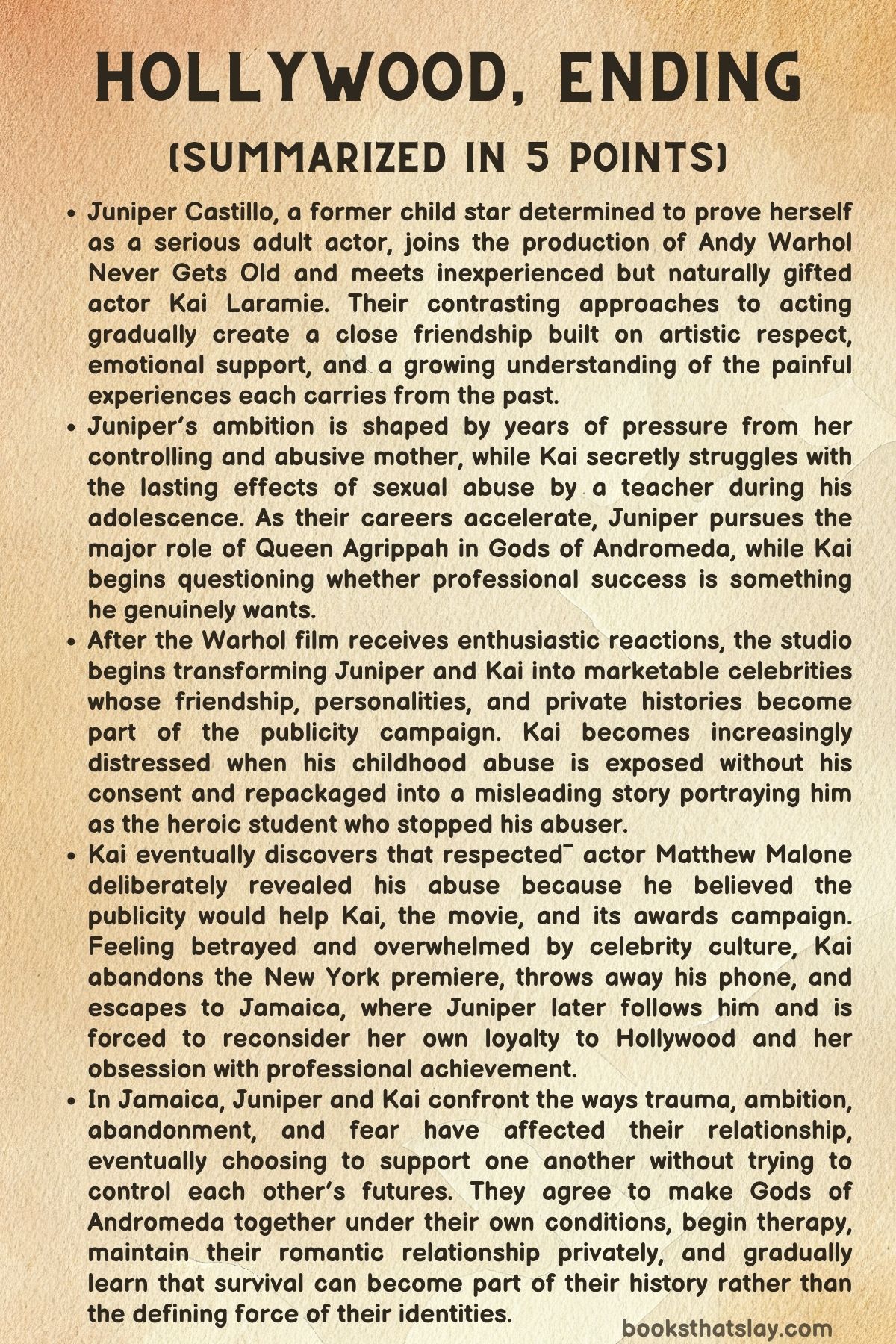
Summary
Juniper Castillo arrives in Pittsburgh to begin filming Andy Warhol Never Gets Old, a project she believes could finally establish her as a serious adult actor after years of being associated with childhood fame. Her career has always been tied to questions of identity because acting began before she was old enough to understand what professional ambition meant, and her recently deceased mother played a controlling role in shaping both her work and her sense of personal worth.
The film stars celebrated actor Matthew Malone as Andy Warhol, Juniper as Carly, and newcomer Kai Laramie as Jude. Juniper immediately notices how different Kai is from the professional environment surrounding them: he is inexperienced, openly nervous, emotionally expressive, and far less practiced at controlling his image.
During early rehearsals and discussions with director Kathryn Johnson, Juniper becomes fascinated by the film’s ideas about fame, loneliness, art, and the deliberate creation of celebrity identities. Warhol’s ability to turn himself into a recognizable public character makes Juniper think about her own carefully managed image, particularly the ways she has tried to escape the version of herself created during her childhood television career.
Kai and Juniper quickly develop an unusual friendship. She approaches acting through intense preparation, notebooks, research, and careful interpretation, while Kai relies more directly on instinct and personal emotion. His openness both attracts and confuses her, especially when he casually tells her that he loves her long before their relationship could reasonably be described as romantic.
Their connection deepens as production continues. Kai proves to be an unusually gifted performer once the cameras begin rolling, despite his insecurity away from the set, while Juniper continues questioning Kathryn’s interpretation of Carly. Juniper sees Carly as ambitious, sexual, intelligent, and aware of how people perceive her, while Kathryn prefers a younger and more innocent interpretation.
At the same time, Juniper’s career begins accelerating. Her agent informs her about several opportunities, including Gods of Andromeda, a major fantasy adaptation with the potential to make her a leading studio actor. Juniper becomes fascinated by Queen Agrippah, an ambitious ruler whose marriage to Gavinth combines attraction, political necessity, affection, and power.
Matthew takes an increasing interest in Juniper’s future and eventually uses his enormous influence to make sure the studio seriously considers her for Agrippah. Juniper is grateful but uncomfortable because the opportunity illustrates how much careers depend on relationships and power rather than talent alone.
Her audition nevertheless confirms that she belongs in the role. She prepares far beyond what the filmmakers request, studies the original novel closely, and performs an additional monologue simply because understanding it helps her grasp Agrippah’s inner life. Director Brian Arawas responds strongly, and Juniper soon learns that the part is essentially hers.
While Juniper moves confidently toward greater professional success, Kai struggles with material in the Warhol film that requires him to access painful memories. During an emotionally demanding nightclub sequence, he freezes because the experience he normally uses to reach difficult emotions is too disturbing to confront directly.
Juniper helps without demanding an explanation. She reminds him that whatever happened is no longer occurring and that he is safe with her in the present. Her ability to stay beside him without forcing disclosure becomes central to their relationship.
Juniper eventually reveals more of her own history. Her mother controlled her career, behaved unpredictably, and sometimes physically abused her while simultaneously teaching Juniper to control her body and emotions. Even after her mother’s death, Juniper remains emotionally trapped between anger, grief, longing, and the belief that achievement was the primary route to maternal approval.
Kai responds with quiet physical reassurance rather than trying to explain away her pain. Their friendship becomes increasingly intimate because each recognizes something familiar in the other’s relationship with the past, even though Kai still refuses to reveal exactly what happened to him.
The production eventually ends, leaving Juniper uncertain whether their intense bond can survive outside the temporary world of filmmaking. Kai arranges a final museum visit, where Juniper is encouraged to accept that art does not always require intellectual explanation; sometimes a work reaches emotions that language cannot fully define.
Kai again tells Juniper that he loves her. This time she admits that she loves him too, although she assumes their relationship may fade once work no longer places them together every day.
Several months later, however, the film’s publicity campaign reunites them and changes Kai’s life dramatically. Before traveling to Los Angeles for an early screening, studio publicist Ellen begins preparing him for celebrity and discovers the secret he has been hiding: when Kai was fourteen, a teacher sexually abused him.
The teacher manipulated Kai into believing their relationship was uniquely meaningful while also abusing other students. After another victim reported him, prosecutors selected Kai to testify partly because they believed his appearance and background would make him particularly credible to a jury.
Kai refuses Ellen’s suggestion that he disclose the story through a controlled profile. The courtroom had already forced him to describe private experiences publicly, and the possibility of repeating that process for millions of strangers terrifies him.
Meanwhile, the completed film receives extraordinary reactions. Kai is moved to tears while watching it, particularly as Matthew’s Warhol confronts illness, mortality, and loneliness. Juniper responds more analytically, immediately identifying changes she would prefer in the edit, demonstrating again the difference between her relentless professional focus and Kai’s more emotional relationship with acting.
Executives become convinced that Kai is about to become a major star. He is considered for Gods of Andromeda, first in the smaller role of Garon and eventually as Gavinth opposite Juniper. Yet Kai becomes increasingly unsure whether acting is the life he wants.
While nearly everyone around him treats talent as a reason he must pursue success, Juniper is willing to accept that being gifted at something does not obligate him to spend his life doing it. That acceptance gives Kai a level of emotional freedom he rarely receives from agents, studios, or publicists.
He finally tells Juniper about the abuse. She listens without treating him as helpless or heroic and understands his fear of having the experience turned into a public identity. Her own history with abuse allows her to recognize that survival can involve actions that outsiders later misunderstand as cooperation or consent.
Soon afterward, Kai auditions for Gavinth opposite Juniper. Their chemistry is immediate, and director Brian Arawas recognizes how strongly they work together. Kai appears on the verge of receiving the role when his worst fear suddenly becomes reality.
A gossip story exposes his childhood abuse. Worse, the article transforms him into a heroic teenager who supposedly stopped the abusive teacher and helped send him to prison. Kai knows this version is false because another student reported the teacher, while Kai testified only after adults selected him to do so.
The publicity campaign for Andy Warhol Never Gets Old intensifies. Kai and Juniper travel through interviews, premieres, television appearances, photo sessions, and carefully managed conversations in which authentic experiences must be converted into entertaining public narratives.
Their genuine affection becomes part of the film’s marketing. Interviewers repeatedly ask about their chemistry and possible romance, while publicists photograph moments of private support and transform them into promotional material.
Kai becomes increasingly disturbed by the heroic narrative surrounding his abuse. He remembers that the teacher manipulated him into sometimes seeking contact and responding emotionally to the relationship, memories that still produce shame despite the reality that he was a child being abused by an adult.
A New Yorker writer named Jill begins preparing a detailed profile and gives Kai more space to describe the complexity of what happened. The resulting piece eventually restores some truth by explaining that Kai survived abuse but was not the student who exposed the teacher.
The controversy nevertheless worsens when online commentators discover discrepancies in the earlier story and accuse Kai of pretending to be a hero. Juniper also becomes a target, with strangers questioning both her support for Kai and her own claims about her mother’s abuse.
Kai recognizes that Hollywood has created a public character around him without his consent. Even technically accurate statements lose meaning when he must repeat them endlessly, and he starts feeling that the famous version of Kai Laramie belongs more to the studio than to himself.
Ellen gradually reaches the same conclusion. Although she initially participates in shaping Kai’s story, she becomes disgusted by an industry that repeatedly justifies exploitation by calling it publicity, protection, or ordinary business.
Amid the chaos, Kai and Juniper finally become physically intimate. Their relationship is meaningful partly because they manage to keep this part of themselves private. Kai’s history makes desire frightening because abuse taught him to distrust what he wants, but Juniper gives him room to make choices rather than assuming what intimacy should look like.
The press tour takes them to Paris, where the scale of Kai’s fame becomes physically overwhelming. Crowds scream his name, photographers surround him, and publicists move him from one required position to another. Matthew jokes about accepting that celebrities become objects, but Kai increasingly realizes that he cannot accept such a life so easily.
At the New York premiere, the deepest betrayal is finally revealed. Matthew admits that he was responsible for exposing Kai’s abuse to the press. He believed the story could help Kai’s career, benefit the movie, and strengthen the awards campaign.
For Kai, Matthew’s reasoning confirms everything he has come to fear. Someone he trusted decided that professional advantage justified taking ownership of the most painful experience of Kai’s childhood.
Kai leaves the premiere, goes to the airport, throws away his phone, and disappears. His flight is chaotic, but it is also the first major decision in months that nobody else has planned for him.
Juniper enters the emotional emptiness that follows the film’s release while also trying to locate Kai. Todd discovers that Kai has traveled to Jamaica and sends Juniper there, hoping she can convince him to return before his disappearance threatens Gods of Andromeda and the studio’s awards plans.
Their reunion initially becomes an argument. Kai accuses Juniper of responding to Matthew’s betrayal like a professional crisis rather than recognizing immediately how deeply he had been hurt. Juniper admits that her reaction was wrong.
Kai also challenges her to ask whether her ambitions genuinely belong to her or whether she is still pursuing the life her mother trained her to desire. The accusation forces Juniper to confront the possibility that achievement has become inseparable from her need to prove herself worthy of love.
Juniper begins changing through action rather than explanation. She refuses to participate in an awards campaign with Matthew and fires Katie when her publicist insists that professional advantage should matter more than personal loyalty.
Kai and Juniper slowly reconnect through the activity that has always allowed them to share emotional space without forcing conversation: watching movies together. Juniper apologizes more fully, while Kai explains how childhood abuse damaged his ability to trust his own wants, especially around intimacy.
Neither tries to solve the other. Instead, they remain present until being together stops feeling like another argument about what one of them should do.
Juniper then confronts Kai about another truth: his disappearance did not only reject Hollywood. It abandoned someone who loved him. Kai apologizes and begins reconnecting with Ellen and others on terms that he chooses himself.
Their conversations about love become more direct. Juniper tells Kai that she loved him in every city and every stage of their relationship, while Kai acknowledges that saying he loves people has always been easier than believing he can safely receive love in return.
They rehearse an Agrippah and Gavinth scene and immediately rediscover the creative connection that first joined them. Yet Juniper finally understands that Kai’s talent does not give anyone the right to decide whether he should act.
By the end, both make more deliberate choices. Juniper still wants Gods of Andromeda, but she wants it because she has decided the work matters to her rather than because success proves her value. Kai negotiates directly with Todd and agrees to make the film with Juniper while refusing to participate in the Warhol awards campaign.
Andy Warhol Never Gets Old becomes a major commercial success, while Kai and Juniper receive Independent Spirit Award nominations and avoid the larger awards system they rejected. Ellen leaves the studio and becomes their personal publicist, helping defend the boundaries they struggled to establish.
Both eventually begin therapy and continue their relationship privately while filming Gods of Andromeda. Juniper builds a connection with Kai’s family and experiences a form of family life that does not measure affection through achievement.
By the conclusion of Hollywood Ending, neither Juniper nor Kai has erased the damage of the past, and neither possesses complete access to the other’s inner life. What changes is their understanding of survival: instead of remaining identities they must constantly perform, their traumatic experiences gradually become events that happened to them rather than definitions of who they are.
Characters
Juniper Castillo
Juniper Castillo is the central force of Hollywood Ending, a gifted actor whose extraordinary discipline has been built partly from genuine passion and partly from childhood conditioning. She approaches acting almost academically, filling notebooks, researching characters far beyond what is required, studying source material, and questioning directors whenever she believes a character is being reduced to a simpler interpretation.
Her ambition is both admirable and dangerous. Juniper genuinely loves the craft, but she has spent so many years receiving approval through professional success that she struggles to determine where her own desires end and her mother’s expectations begin.
Her mother remains one of the strongest psychological influences on her even after death. Juniper remembers physical violence, emotional volatility, financial control, and an environment in which composure was demanded even while she was being hurt.
Yet Juniper also misses her mother, which prevents her from turning the relationship into a simple story of cruelty. Her grief reflects the difficulty of mourning someone who caused damage while still occupying an irreplaceable place in one’s emotional history.
Professionally, Juniper knows how Hollywood operates far better than Kai. She understands social media, publicity agreements, casting politics, networking, studio hierarchies, and the importance of maintaining momentum.
This competence sometimes makes her morally slow to recognize exploitation because she instinctively responds to crises by asking how they will affect careers. When Kai learns that Matthew exposed his abuse, Juniper’s initial focus on what they should do professionally reveals how deeply the industry’s logic has entered her thinking.
Her development comes through learning that loyalty, boundaries, and personal desire can matter more than maximum career advancement. Refusing the awards campaign, firing Katie, and admitting that Gods of Andromeda is no longer worth sacrificing everything for represent significant departures from the survival rules she learned as a child.
Juniper’s relationship with Kai also teaches her to separate love from achievement. He does not require her to succeed before he values her, and being loved without having to perform becomes one of the most unfamiliar experiences of her life.
Kai Laramie
Kai Laramie is the emotional counterweight to Juniper in Hollywood Ending. Where she is experienced, professionally strategic, and relentlessly prepared, Kai is instinctive, uncertain, and initially unfamiliar with almost every unwritten rule governing celebrity.
His acting talent emerges most clearly when he stops thinking consciously about performance. Once a camera is running, he can access emotional truth with remarkable immediacy, but this strength is also dangerous because his method depends heavily on personal memory.
Kai’s childhood abuse shapes his adult relationship with fame, intimacy, desire, and control. His teacher manipulated him into believing abuse was affection, and the later courtroom testimony taught him that even after abuse ends, other people can demand access to the survivor’s private experience.
That history explains why publicity becomes intolerable. Being photographed or praised is not merely awkward for him; the larger danger is that strangers, studios, and journalists begin deciding what his life means.
The false heroic story is especially damaging because it replaces one distortion with another. Kai does not see himself as the courageous teenager who exposed an abuser, and he is haunted by memories in which he participated emotionally in a situation he now understands was exploitative.
His conflict over acting reflects a broader question about identity. Other people repeatedly interpret talent as destiny, but Kai gradually recognizes that ability does not create obligation.
His disappearance after the New York premiere is therefore both a breakdown and an act of resistance. He runs because he cannot tolerate being controlled any longer, although he later accepts that escaping the industry also meant hurting Juniper.
By the end, Kai’s growth does not consist of becoming comfortable with celebrity. Instead, he begins choosing which parts of professional life he will accept, which boundaries he will defend, and how he wants to relate to acting rather than allowing success to make those decisions for him.
Matthew Malone
Matthew Malone occupies a complicated position in Hollywood Ending because he is simultaneously mentor, admired artist, generous colleague, and betrayer. Early in the book, both Juniper and Kai see him as evidence that enormous fame can coexist with intelligence, curiosity, and seriousness about art.
Matthew takes Juniper’s ambition seriously and uses his professional influence to help her secure consideration for Agrippah. His willingness to support younger actors appears generous, and he frequently speaks about fame in ways that suggest he understands its emotional costs.
His treatment of Kai ultimately reveals the limitation of that understanding. Matthew decides that exposing Kai’s abuse could help Kai professionally, benefit the film, and strengthen an awards campaign, and he acts without Kai’s consent.
The betrayal is especially disturbing because Matthew does not behave like a simple villain. He genuinely seems to believe that he made a practical decision that could produce positive outcomes, showing how long exposure to celebrity culture has altered his ethical boundaries.
Matthew therefore represents the danger of becoming fully adapted to a system that converts private experience into public value. He can discuss loneliness, mortality, art, and human dignity with sophistication while still treating another person’s trauma as usable material.
His refusal to fully acknowledge the harm also separates him from Kai and Juniper’s later development. They begin accepting responsibility for the ways they hurt one another, while Matthew remains protected by the belief that professional logic justified his choice.
Kathryn Johnson
Kathryn Johnson is the director of Andy Warhol Never Gets Old and an important creative authority throughout the production. She approaches filmmaking with confidence and often allows actors to explore scenes before gradually steering performances toward her preferred interpretation.
Her relationship with Juniper exposes the tension between actor and director. Juniper wants Carly to be more knowingly ambitious and sexually self-aware, while Kathryn prefers greater innocence, leaving Juniper worried that the final film will present a version of Carly she considers incomplete.
Kathryn is nevertheless attentive to performance. She quickly recognizes when Juniper’s support helps Kai unlock difficult emotional material and understands that the relationship between the two young actors contributes directly to the quality of the film.
She also appears secure enough in her work to show the finished film to anxious performers and discuss possible changes. Unlike the publicity figures surrounding the project, Kathryn’s primary interest remains the movie itself.
Her role demonstrates that artistic collaboration involves negotiation rather than complete personal control. Juniper can contribute deeply to Carly without owning the final interpretation, just as Kai can provide a powerful performance without controlling how it is edited or marketed.
Ellen
Ellen becomes one of the most revealing industry figures in Hollywood Ending because her development parallels Kai’s growing awareness of what celebrity publicity demands. At first she approaches his history professionally, asking about potential scandals and recommending a controlled disclosure of the abuse before somebody else can reveal it.
Her position requires her to transform unpredictable human lives into manageable public narratives. She teaches Kai how to answer questions, what language to use, which topics to avoid, and how to make repeated responses sound spontaneous.
This creates moral conflict because Ellen is not indifferent to Kai. She often protects him physically and professionally, especially when crowds or interviews become overwhelming, yet she is also participating in a system that requires greater access to him than he wants to provide.
As the campaign continues, Ellen becomes increasingly disturbed by how publicity consumes private identity. She recognizes that the studio’s use of Kai’s abuse crossed an ethical boundary even if such behavior can be normalized within the industry.
Her decision to leave the studio is therefore meaningful. Instead of merely criticizing the system while continuing to benefit from it, she removes herself from the structure that required her to defend practices she no longer accepts.
When Ellen later becomes Kai and Juniper’s personal publicist, her expertise is redirected toward protecting their boundaries rather than maximizing the studio’s access to them. She evolves from manager of celebrity narratives into someone who helps the actors maintain greater ownership over those narratives.
Todd Simons
Todd Simons represents the corporate charm of Hollywood Ending. He is funny, sociable, enthusiastic about movies, and often pleasant company, which prevents the studio from appearing as an impersonal institution populated only by obviously cruel people.
Todd’s friendliness does not stop him from thinking primarily in terms of business outcomes. Audience testing, marketing narratives, casting leverage, awards possibilities, and publicity value shape his understanding of almost every situation.
His attitude toward Kai’s disappearance reveals the difference between professional concern and personal concern. He wants Kai found partly because Kai is in emotional crisis, but the disappearance also threatens Gods of Andromeda, awards campaigning, and the studio’s investments.
Todd embodies a larger institutional problem: harmful decisions do not always require malicious individuals. People can participate in exploitation while believing they are simply protecting projects, solving problems, or doing their jobs.
Kai’s later negotiation with Todd reverses their earlier power relationship. Instead of allowing executives to tell him what success requires, Kai establishes conditions and makes clear that he can walk away.
Juniper’s Mother
Juniper’s mother exists primarily through memory, but her influence reaches nearly every major decision Juniper makes. She directed her daughter’s childhood career, controlled money, demanded discipline, behaved violently, and connected approval so strongly to professional achievement that Juniper grows up equating success with emotional worth.
Her characterization avoids an easy division between love and cruelty. Juniper remembers moments of connection alongside abuse and continues longing for maternal approval even after her mother’s death.
The mother’s admission that she wanted to love her children but could not becomes especially painful because it gives Juniper no simple explanation for what happened. It suggests emotional incapacity without reducing responsibility for the damage she caused.
Juniper’s adult ambition consequently becomes partly an inherited structure. Each major success carries an imagined response from the woman who trained her to measure life through professional achievement.
Juniper’s eventual progress requires distinguishing what her mother wanted from what she wants. She does not reject acting; instead, she begins reclaiming it as a personal choice rather than an endless attempt to earn approval from someone who is no longer alive.
Kai’s Abusive Teacher
Kai’s former teacher is physically absent from the present story but remains psychologically active through Kai’s memories. His manipulation depended on convincing an adolescent that exploitation was intimacy and that being chosen by an adult represented affection rather than abuse.
The discovery that there were other victims destroys the false uniqueness on which the relationship had been built. Kai is left not only with memories of abuse but with shame about moments when he responded to the attention or actively sought contact.
That shame becomes one of the character’s most enduring injuries. Intellectually, Kai understands that he was a child and the teacher was responsible, but emotional understanding does not automatically follow intellectual knowledge.
The teacher’s influence continues into Kai’s adult relationships because desire itself becomes suspicious. Kai fears that wanting someone might mean surrendering control, and intimacy can activate questions about whether his feelings belong to him.
The book’s later emphasis on mutual choice directly counters this history. Kai’s recovery depends partly on learning that adult desire can exist without coercion, secrecy, manipulation, or unequal power.
Katie
Katie, Juniper’s publicist, reflects the professional worldview Juniper has absorbed since childhood. She is practical, career-focused, and accustomed to treating personal discomfort as secondary to long-term professional advantage.
Her advice after Matthew’s betrayal exposes this philosophy clearly. Katie wants Juniper to continue cooperating because awards recognition and industry relationships could benefit her career, regardless of what Matthew did to Kai.
Juniper’s decision to fire her therefore carries importance beyond a disagreement between actor and publicist. It represents Juniper rejecting the belief that every moral injury must be tolerated if resistance could reduce professional opportunities.
Katie is not portrayed as uniquely cruel. Rather, she represents the logic of an environment where emotional compromise is frequently presented as maturity, professionalism, or strategic thinking.
Brian Arawas
Brian Arawas is ambitious, theatrical, and intellectually enthusiastic about Gods of Andromeda. His conversations can become extravagant, especially when he discusses characters, power, villains, and the larger meaning of the fantasy story he wants to create.
He initially considers Kai for a smaller role but becomes increasingly interested in him as a potential Gavinth. What matters most is the chemistry between Kai and Juniper, which becomes undeniable once they perform together.
Brian also reflects the industry’s instability. Casting decisions depend on talent but also on fame, marketability, social-media reach, negotiations, and the unpredictable momentum surrounding individual actors.
Unlike Matthew, however, Brian’s influence over Kai is primarily professional rather than personal. He wants a performer who can serve the film, but he does not possess the same access to Kai’s private history.
Jill
Jill, the New Yorker writer, represents a different form of observation from the rapid publicity interviews Kai endures. Because she has time to ask questions, follow contradictions, and watch how Kai behaves rather than simply collecting promotional quotes, her profile offers greater complexity.
That greater depth is not completely comfortable. Kai knows that a thoughtful writer can still turn personal moments into public material, and Jill’s questions about Juniper, fame, and abuse require him to decide how much of himself he is willing to place permanently on record.
Her article becomes important when the simplified heroic narrative collapses. Instead of reinforcing the false claim that Kai single-handedly stopped his abuser, she allows him to explain the difference between survival and heroism.
Jill therefore demonstrates that public storytelling can be intrusive without necessarily being dishonest. Her work cannot restore Kai’s privacy, but it can resist the simplification that has made him feel alienated from his own history.
Jamie
Jamie serves as Juniper’s agent and is closely connected to her professional ambition. Jamie identifies opportunities, interprets industry interest, and understands how a successful performance with Matthew could reposition Juniper’s career.
Unlike Katie’s later insistence that Juniper preserve professional relationships regardless of personal cost, Jamie’s role is primarily centered on career management and negotiation. Juniper trusts Jamie to protect her position in Gods of Andromeda even while the situation with Kai becomes unstable.
Jamie therefore represents the practical support structure necessary for a working actor. Juniper’s growth does not require rejecting all representation or ambition; it requires deciding which professional relationships support her choices rather than determining those choices for her.
Themes
Fame, Performance, and the Construction of Identity
Hollywood Ending repeatedly questions whether celebrity can ever remain separate from performance. Acting begins as professional work, but publicity gradually extends performance into interviews, social media, relationships, clothing, personal history, and even spontaneous-looking moments of affection.
Juniper understands this system because she has lived inside it since childhood. She knows that photographs can create narratives, that friendliness may serve professional purposes, and that even private emotion can become useful to a studio.
Kai experiences the same machinery as a violation because he enters it as an adult without years of adaptation. Publicists begin choosing adjectives for him, teaching him how to describe colleagues, shaping answers about trauma, and deciding which version of his personality will be easiest for audiences to understand.
The novel repeatedly contrasts genuine feeling with marketable feeling. Kai and Juniper truly care for one another, but the studio also benefits financially from audiences believing that they care for one another, making authenticity difficult to separate from promotion.
Warhol’s presence inside the film they make reinforces the question. His deliberate public persona becomes a historical example of celebrity as artistic creation, while Kai’s experience shows the danger of losing control over that creation.
The final concern is therefore not whether public identity is fake. Every person presents different versions of themselves in different settings; the danger begins when institutions gain more authority over someone’s identity than the person living it.
Trauma, Survival, and Ownership of Personal History
Trauma in Hollywood Ending does not remain confined to past events. Juniper’s mother’s abuse continues shaping her ambition, emotional habits, and fear of abandonment, while Kai’s teacher continues affecting his relationship with sexuality, privacy, desire, and authority long after the teacher is gone.
Both characters struggle against simplified interpretations of what survival should look like. Juniper can miss her mother while acknowledging abuse, and Kai can remember moments of emotional participation without those memories becoming evidence that he consented to exploitation.
The publicity campaign shows why ownership of traumatic history matters. Kai has already been forced to narrate his abuse in court, so the media’s demand that he explain it publicly again becomes another experience of losing control.
The heroic narrative created around him appears positive but is still destructive. It tells Kai what his trauma supposedly means, converting a complicated history of manipulation, shame, testimony, and survival into a simple story about courage.
Juniper’s experience provides a parallel warning. She has spoken publicly about her mother’s behavior, sometimes helping other survivors, yet she understands that choosing disclosure differs fundamentally from having disclosure imposed upon someone.
Recovery therefore depends partly on reclaiming narrative authority. Neither character needs to erase the past or create a perfectly coherent interpretation of it; they need the right to decide when, how, and whether their experiences become stories for other people.
Ambition, Talent, and the Right to Choose
Juniper and Kai represent opposite relationships with professional ambition. Juniper wants major roles, studies obsessively, follows industry developments closely, and treats career momentum as something that must constantly be protected.
Kai possesses extraordinary talent but does not share her certainty. His success arrives so rapidly that agents, directors, executives, and publicists begin building a future for him before he has decided whether he wants that future.
This contrast creates one of the novel’s strongest questions: does talent create responsibility? Kai repeatedly receives the message that because he is good at acting, refusing major opportunities would be wasteful or irrational.
Juniper initially shares that assumption because achievement has structured her entire life. Over time, however, she recognizes that pushing Kai toward acting simply because he is gifted repeats the same kind of control that both characters are trying to escape.
Her own ambition must undergo a similar reconsideration. She eventually understands that rejecting her mother’s expectations does not require rejecting acting; she can still want Agrippah while asking whether the desire is genuinely hers.
Their final decision to make Gods of Andromeda therefore matters because it becomes a choice rather than an inevitability. Both characters continue working, but they do so after establishing conditions and refusing parts of the professional system they consider unacceptable.
The distinction between ability and obligation gives the theme its importance. A meaningful life requires more than identifying what someone can do well; it requires allowing that person to decide whether the ability belongs in the life they actually want.
Love, Privacy, and Remaining Present
Love develops in the novel less through dramatic declarations than through repeated acts of presence. Kai says “I love you” easily from the beginning, but the book gradually distinguishes verbal openness from the more difficult task of allowing oneself to depend on another person.
Juniper has the opposite difficulty. She is comfortable with professional commitment but cautious about emotional vulnerability because childhood taught her that affection could be conditional, unstable, or connected to achievement.
Their relationship becomes strongest when neither demands complete access to the other. Juniper does not force Kai to reveal his abuse before he is ready, and Kai does not demand that Juniper resolve her contradictory feelings toward her mother.
Privacy also becomes essential because so much of their connection is publicly consumed. Their friendship, physical closeness, interviews, photographs, and supposed romance all become promotional material, making the moments they successfully keep to themselves unusually valuable.
Their conflicts demonstrate that love does not automatically produce perfect understanding. Juniper initially responds badly to Kai’s betrayal by Matthew, while Kai’s disappearance causes serious emotional harm by ignoring what abandonment means to her.
Reconciliation becomes possible only when both accept responsibility without demanding instant resolution. Juniper listens instead of solving, Kai apologizes instead of defending his escape, and both gradually begin asking what the other person actually wants.
The ending therefore presents love as a relationship between separate people rather than complete emotional possession. They cannot heal one another’s trauma, determine one another’s future, or know every hidden part of each other’s mind, but they can remain present while each person builds a life that is no longer controlled entirely by what happened before.