No Place to Be Single Summary, Characters and Themes
No Place to Be Single by Felicia Kingsley, originally published as Non è un paese per single, is a romantic comedy set between rural Tuscany and polished London society, centered on second chances, family burdens, and the courage to choose a life that feels truly one’s own. The novel follows Elisa Benetti, a single mother and vineyard worker fighting to protect the Tuscan estate that has shaped her life, and Michael D’Arcy, her childhood friend turned high-powered businessman.
Their reunion begins with pride, resentment, and old wounds, but slowly becomes a story about love, belonging, responsibility, and the difference between inheriting a life and building one.
Summary
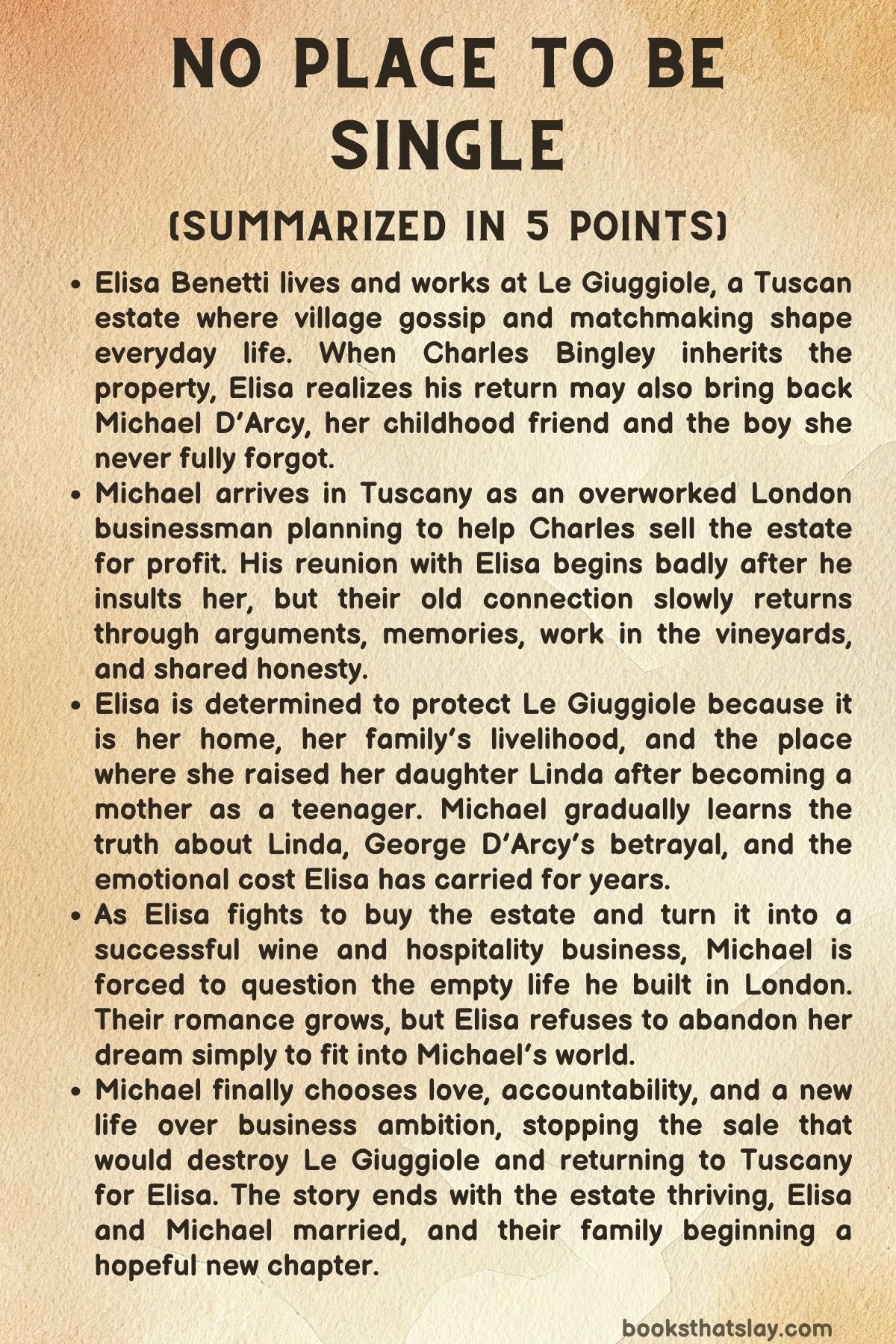
Elisa Benetti lives at Le Giuggiole, a Tuscan estate near Belvedere in Chianti, where everyone knows everyone’s business and marriageable men are treated like public property. When the village learns that Count Umberto Ricasoli’s estate may pass to his wealthy nephew from London, local mothers immediately begin imagining how to present their daughters to him.
Elisa realizes the heir is Charles Bingley, once known to her as Carletto, who spent childhood summers at the estate with his sister Caroline and his friend Michael D’Arcy. The news stirs memories Elisa would rather keep buried, especially because Michael was once her closest companion in childhood mischief.
In London, Michael is living a life of expensive suits, punishing work hours, and emotional distance. Charles tells him that he and Caroline have inherited the Tuscan estate, but Charles is unsure whether to accept it.
Caroline dislikes the countryside and wants nothing to do with the property. Michael, however, remembers Le Giuggiole, Elisa, and the summers when they ran through fields, stole fruit, and invented adventures.
Soon afterward, Michael’s work exhaustion catches up with him. His business partner and mentor, Saxton, forces him to take leave before he damages himself and the company.
When Charles declines the inheritance, Michael suggests a more profitable route: accept the estate, inspect it, and sell it to a wealthy buyer. Charles agrees, sending Michael to Tuscany during his unwanted break.
At Le Giuggiole, Elisa’s life is practical and crowded. Her mother Mariana runs the kitchen, Donatella manages the house, Elisa’s sister Giada searches for romance, and Elisa’s thirteen-year-old daughter Linda studies fiercely, determined to escape the limitations of village life.
Elisa is protective of Linda and hides the truth of her parentage from outsiders, presenting Linda as Donatella’s young relative. When distant Ricasoli relatives arrive assuming they will take over the estate, they treat Elisa’s family like servants and show no respect for the property.
Their arrogance is interrupted by Charles and Caroline’s arrival, and Elisa instantly recognizes Charles.
Michael arrives separately and badly. His taxi refuses the rough estate road, forcing him to drag his suitcase along the dusty path.
He finds the estate empty because everyone is at a village festival. There, Elisa sees him for the first time in years, but he fails to recognize her and speaks to her coldly.
Worse, she overhears him telling Charles that Belvedere has not changed, that London has more beautiful women, and that Elisa was never beautiful and only had personality. Hurt and furious, Elisa confronts him, throws off her apron, and leaves.
That insult sets the tone for their reunion: old affection is still present, but so are pride, humiliation, and anger.
Life at the estate quickly strips Michael of his London control. There is no proper Wi-Fi, poor phone signal, a faulty boiler, an annoying parrot named Renato, and no easy comfort.
He tries to make peace with Elisa by bringing her a raisin roll while she works among the vines. Their conversation is tense, but they begin to compare the adults they have become.
Elisa tells him she stayed after her father’s illness and death, giving up a publishing dream in Milan to care for the vineyard. Michael explains his elite education and his rise at Saxton & D’Arcy after his brother George died.
Their shared memories soften them, but their present lives remain sharply different.
Elisa also explains the value of Le Giuggiole: historic vineyards, olive groves, a seventeenth-century villa, and deep agricultural potential. Michael sees financial value, but he is also thinking like a broker.
He has already identified a likely buyer, Sergei Bogdanovic, a billionaire client who might turn the property into a golf club. Elisa does not know this at first.
Still angry about his insult, she gets revenge by sending him on dates with eligible local women. These outings become comic disasters, from Regina Cozzi’s overbearing family dinner to Intemerata’s intense religious expectations and Pompilia’s outrageous private business.
Through these humiliations, Michael becomes more entangled in village life than he intended.
Linda unexpectedly becomes one of Michael’s allies. She uses secret passages in the villa to reach the library and study in peace.
She is clever, guarded, and practical, and she charges Michael money after helping him escape unwanted visitors. Michael is impressed by her intelligence, and later he becomes involved in small acts of care, including buying her pads when she gets her first period.
At the pharmacy, his attempt to be discreet becomes a public embarrassment, but the episode reveals to him that Linda is actually Elisa’s daughter. This discovery changes his understanding of Elisa’s life.
He realizes she became a mother very young and that much of her strength came from surviving judgment and fear alone.
When Elisa learns about the plan to sell Le Giuggiole to Bogdanovic, she is furious. Michael insists it is business and that Charles has no obligation to maintain a property he never asked for.
Elisa sees it differently: the estate is her family’s home, livelihood, and future. Their argument is bitter, but it also pushes them into a more honest conversation.
While helping Elisa prepare for a difficult foaling, Michael hears the truth of her teenage pregnancy. Elisa tells him she became pregnant at sixteen, chose to keep Linda, endured gossip and isolation, and grew into responsibility before she was ready.
Together they help deliver a foal, and the shared intensity leads to a deal: Michael will stay through the harvest, study the estate properly, and only then advise Charles.
Elisa decides she wants to buy Le Giuggiole herself. Her plan is ambitious: loans, grants, wine orders, and a transformation of the estate into a luxury agriturismo while preserving the vineyard.
Her family worries about the risk, and Mariana still sees marriage as a safer path. Meanwhile, Elisa and Michael’s attraction grows.
Their old bond returns through cooking, teasing, memories, and physical tension. They almost give in to desire more than once, but interruptions keep stopping them.
Their relationship becomes more complicated when two women from London arrive and confront Michael, each believing she had a claim on him. Elisa, hurt by his casual approach to relationships, pulls away.
Michael begins to see the pattern of his life more clearly. He has used work and meaningless romantic arrangements to avoid real feeling.
He remembers the boy he once was with Elisa and recognizes how far he has moved from joy. At a harvest festival, he forces a moment of shared nostalgia by signing himself and Elisa up for karaoke.
The song brings back their childhood intimacy, and Elisa runs away in tears. When Michael follows her, he admits he loved her as a teenager but never said it.
Elisa wants to believe him, but she fears trusting a man who might leave.
Elisa’s relationship with Linda also deepens. After seeing Linda kiss Tommaso, Elisa has a frank conversation with her about desire, love, caution, and growing up.
She explains that Linda’s father was not the right person, but having Linda was still a source of joy. Linda’s wish that Michael could be her father shows how much he has entered their emotional world.
Michael later takes Elisa to Florence in her father’s restored yellow Cinquecento, honoring an old childhood promise. The evening is imperfect but tender, and the two become closer.
During the harvest, Michael works beside the vineyard crew and begins to understand the land through labor rather than spreadsheets. Yet Charles still leans toward selling, and Michael is torn between duty to his client and his growing belief in Elisa’s dream.
The conflict follows them to London when Elisa attends a wine fair. Michael goes to see her and admits he delayed the Bogdanovic deal to give her time to make an offer.
At dinner, Elisa reveals that Linda’s father was George, Michael’s late brother. George had seduced her, abandoned her when she became pregnant, and threatened her when she asked for help.
Michael is horrified, ashamed of what his family did, and moved by Elisa’s strength. Their love finally becomes open, and they spend meaningful time together in London.
Elisa’s wine sells out at the fair, bringing major buyers and press attention, and Michael’s friends welcome her warmly, even offering practical help for her plan.
But happiness breaks when Charles decides to sell immediately to Bogdanovic. Michael asks Elisa to stay in London with him, offering his apartment as a home for her and Linda.
Elisa refuses because she does not want to be absorbed into his life; she wants them to create a shared life. She asks him to come to Italy instead.
Michael cannot answer, and she leaves heartbroken.
Back in London, Michael realizes he cannot allow Le Giuggiole to be destroyed. At the sale meeting, he creates a false zoning obstacle that makes a golf course impossible, causing Bogdanovic to withdraw.
Charles discovers the document is fake but does not expose him, partly because he also mistrusts the buyer. Michael encourages Charles to return to Giada, who still loves him.
Elisa continues fighting for the estate. Charles offers her the chance to buy it, and although the bank resists, Donatella steps forward as guarantor, declaring that Le Giuggiole is her home too.
Elisa finally secures the estate. Michael, meanwhile, is offered full control of Saxton & D’Arcy but realizes that the life he once chased now feels empty.
He sells his apartment, gives up his old future, and returns to Tuscany. In the vineyard at dawn, he tells Elisa he is there to stay, ready to begin again with her.
Seven months later, Le Giuggiole is thriving as a luxury destination, Elisa and Michael are married, Giada’s story with Charles continues, and Elisa discovers she is pregnant. The future she once feared wanting has begun.
Characters
Elisa Benetti
In No Place to Be Single, Elisa Benetti is the emotional and practical center of the book. She is a woman shaped by early responsibility, public judgment, and deep loyalty to the land that raised her.
Becoming pregnant at sixteen forced her into adulthood long before she was ready, but Elisa never becomes a passive victim of that past. She turns pain into discipline, choosing to raise Linda, work the vineyard, and protect her family’s place at Le Giuggiole.
Her strength, however, is not flawless. Elisa can be sharp, defensive, and quick to judge others, especially when she fears being wounded or losing control.
Her argument with Lucia shows that her survival instincts sometimes make her dismiss other people’s compromises. Yet this complexity makes her convincing.
Elisa’s love for the estate is not sentimental decoration; it is tied to work, memory, identity, and Linda’s security. Her romance with Michael tests her ability to trust, but her most important growth comes from refusing to shrink her dreams.
She does not want rescue. She wants partnership, respect, and the right to build a future without abandoning herself.
Michael D’Arcy
Within No Place to Be Single, Michael D’Arcy begins as a man who has mistaken success for purpose. In London, he is wealthy, polished, and professionally admired, but he is also exhausted, emotionally guarded, and disconnected from any real sense of home.
His return to Tuscany exposes the emptiness beneath his control. At first, he sees Le Giuggiole as an asset, Charles’s inheritance as a transaction, and Elisa’s resistance as impractical emotion.
His arrogance is real, especially in the way he insults Elisa and treats relationships as arrangements without consequences. Yet the book gradually reveals that Michael is also carrying grief, guilt, and the burden of living in the shadow of his brother George’s ruin.
His transformation is not instant. He has to be embarrassed, challenged, rejected, and made useful before he can understand what Elisa already knows: life cannot be measured only by profit or convenience.
His care for Linda, his growing respect for vineyard labor, and his willingness to sacrifice his London future mark his change. By the end, Michael chooses love not as escape, but as a deliberate new beginning.
Linda Benetti
Linda Benetti is one of the sharpest and most revealing characters in the novel. At thirteen, she is intelligent, watchful, and already aware that Belvedere offers limited possibilities for girls who do not fight for more.
Her secret use of the villa library shows her hunger for education and independence, while her businesslike demand that Michael pay her for help proves her wit and confidence. Linda is not written as a simple child figure; she stands at the uneasy edge between childhood and adolescence.
Her first period, her crush on Tommaso, her questions about sex, and her wish to study in London all show a young girl trying to understand her body, future, and place in the world. Her relationship with Elisa is tender but tense because Elisa’s protectiveness sometimes becomes fear.
Linda’s desire for Michael to become her father is deeply significant, not because she needs a man to complete her life, but because she recognizes in him a form of care, attention, and belonging she has not had from her biological father’s side.
Giada Benetti
Giada Benetti brings brightness, glamour, and romantic energy into the story, but she is not merely comic relief. She begins as someone who seems unserious about love, moving through dating apps and crushes with dramatic confidence.
Because of this, others underestimate the sincerity of her feelings for Charles. Michael initially suspects she may be another fortune hunter, partly because he is used to protecting Charles from women with hidden motives and partly because he judges her through gossip.
Yet Giada’s affection for Charles is genuine. Her nervousness before their date, her decision to delete her apps, and her visible happiness around him all suggest that she is more vulnerable than her flirtatious surface implies.
Giada also functions as Elisa’s mirror and challenger. She teases Elisa, pushes her to admit the truth about Michael, and helps her see where fear is controlling her.
Her warmth and directness make her one of the people who can reach Elisa without cruelty. Giada represents a version of femininity that is playful, sensual, and sincere at the same time.
Charles Bingley
Charles Bingley is generous, pleasant, and easily influenced, but his uncertainty gives him real importance in the story. He inherits Le Giuggiole without fully understanding what the estate means to the people who live and work there.
To him, the property is initially a burden: beautiful, inconvenient, expensive, and far removed from his London-based life. His affection for Giada brings him closer to the village, but his habit of relying on Michael’s judgment keeps him from making independent decisions.
Charles is not cruel; his danger lies in passivity. By allowing others to handle the estate, he nearly becomes responsible for destroying something precious.
His relationship with Giada pushes him to reconsider what he wants, while Michael’s change also influences him. Charles’s eventual willingness to sell to Elisa shows growth.
He learns to see Le Giuggiole not only as an inheritance but as someone else’s home and future. His gentle nature becomes meaningful only when he finally attaches it to a responsible choice.
Caroline Bingley
Caroline Bingley represents class prejudice, comfort, and social vanity. She dislikes the countryside from the start and sees Le Giuggiole less as a place with history than as an inconvenience lacking the luxuries she expects.
Her complaints about food, rooms, signal, and rural life create comic irritation, but they also reveal her inability to value anything outside her narrow standards. In London, her dismissive attitude toward Elisa becomes sharper.
Caroline and her friends mock Elisa as rustic and unsuitable for Michael, treating class and polish as proof of worth. Her role in the book is important because she gives shape to the social world Michael must reject.
Caroline is not simply a romantic rival; she is a symbol of the shallow approval Michael has long lived around. When Elisa meets Michael’s warmer friends later, the contrast exposes Caroline’s cruelty more clearly.
She belongs to a world that confuses refinement with superiority, and the story uses her to show why Michael’s old life could never truly nourish him.
Mariana Benetti
Mariana Benetti is a practical mother whose love often appears through food, planning, worry, and social calculation. She wants security for her daughters, and because she has lived within Belvedere’s values, she often imagines that security in terms of marriage.
Her matchmaking instincts and concern over Elisa’s future can be frustrating, especially when she suggests a stable but unwanted option like Elmo. Yet Mariana’s thinking comes from fear, not malice.
She knows how harsh life can be for women without money, protection, or social approval. Her kitchen is one of the centers of Le Giuggiole, and her labor helps hold the household together.
Mariana also represents an older generation’s compromise with tradition. She does not always understand Elisa’s ambition to buy the estate, but her concern shows how risky Elisa’s plan truly is.
Through Mariana, the novel shows that love within families can be both supportive and limiting. She wants Elisa safe, even when Elisa wants something larger than safety.
Donatella
Donatella is one of the quiet pillars of the book. She runs the house with steadiness, observes more than she says, and understands the emotional structure of Le Giuggiole better than many of the people who legally own it.
Her role may appear domestic, but her significance grows as the story unfolds. She protects the rhythms of the estate, supports Elisa’s family, and treats Le Giuggiole as home in the deepest sense.
Her bond with Linda also helps maintain the fiction that protects Elisa from gossip, showing her loyalty and discretion. Donatella’s greatest moment comes when she offers to stand as guarantor for Elisa’s purchase of the estate.
That act transforms her from background support into a decisive force in the future of Le Giuggiole. She proves that family in the book is not only biological or legal.
It is formed through years of care, shared labor, trust, and belonging. Donatella’s faith in Elisa gives practical form to love.
Lucia
Lucia is Elisa’s friend, but she is also one of the few characters willing to challenge Elisa’s assumptions directly. Her decision to date Elmo Colli shocks Elisa, who sees Elmo as dull and opportunistic.
Lucia’s response reveals the painful reality behind her choice. Her academic career has stalled, money is uncertain, and Elmo offers stability, work, and a future she can actually hold.
Through Lucia, the book examines how easy it is to judge another woman’s decisions without fully understanding the pressures behind them. Lucia is not presented as weak for choosing security; instead, her confrontation with Elisa exposes Elisa’s blind spots.
Their argument matters because it forces Elisa to see that independence is complicated. Not everyone has the same resources, chances, or emotional endurance.
Lucia adds social realism to the romantic comedy structure, reminding the reader that practical compromises can carry their own dignity, even when they look unromantic from the outside.
George D’Arcy
George D’Arcy never appears alive in the main action, but his influence is enormous. For Michael, George is the reckless brother whose gambling, drugs, and fatal crash left behind financial and emotional wreckage.
Michael built his adult life partly in response to George’s failures, taking over responsibilities and trying to become the controlled opposite of him. For Elisa, George is the young man who seduced her, abandoned her when she became pregnant, and treated her fear as an inconvenience.
His cruelty shaped Elisa’s adolescence and deprived Linda of recognition from her father’s family. George therefore functions as a wound shared by Michael, Elisa, and Linda, though each carries it differently.
His absence creates many of the book’s conflicts: Michael’s fear of selfishness, Elisa’s distrust, and Linda’s uncertain place in the D’Arcy family. By facing the truth about George, Michael is finally able to stop living in reaction to him and begin choosing his own moral path.
Saxton
Saxton is Michael’s mentor, business partner, and father figure in the professional world. At first, he appears mainly as the person who forces Michael to stop working, but that decision reveals how well he understands Michael’s self-destructive habits.
Saxton sees that Michael’s exhaustion is not discipline but damage. He also represents the career structure Michael thinks he wants: status, ownership, money, and command.
When Saxton later offers Michael full control of the company, it should be the crowning achievement of Michael’s life. Instead, it becomes the moment Michael realizes that the dream no longer belongs to him.
Saxton’s reaction suggests that he may have been waiting for Michael to reach this understanding. He is not an antagonist; he is part of the life Michael must outgrow.
His role is valuable because he gives Michael a real choice. The decision to leave London matters precisely because Michael is not escaping failure.
He is walking away from success that no longer fits.
The Cozzi Sisters
Regina, Intemerata, and Pompilia Cozzi provide some of the book’s broadest comedy, but they also expose the absurdity of Belvedere’s marriage market. Each sister becomes part of Elisa’s punishment for Michael, and each date reveals a different exaggerated version of social expectation.
Regina is presented through family pressure, domestic display, and aggressive flirtation. Intemerata turns courtship into a moral and religious examination.
Pompilia shocks Michael by combining apparent sweetness with a secret business selling worn underwear online. Their scenes are funny because Michael, so controlled in London, is completely outmatched by local chaos.
Yet the sisters also show how women in the village are packaged, promoted, judged, and negotiated in the pursuit of marriage. Their extremity reflects a community where romantic possibility is treated as public entertainment.
Through them, the book mocks both Michael’s arrogance and the village’s intrusive matchmaking culture.
Themes
Home as a Chosen Future
In No Place to Be Single, home is not treated as a simple place of comfort. Le Giuggiole is beautiful, but it is also expensive, demanding, old, and constantly at risk.
For Elisa, the estate matters because it holds memory and labor together. Her father taught her patience through the vineyard, Linda grew up there, and the household depends on its continued survival.
Michael initially sees the estate as a financial problem that can be solved through sale, but the longer he stays, the more he understands that home is built through use, care, and responsibility. The threat of turning the vineyards into a golf course makes this theme sharper.
A golf club would preserve the land as scenery while destroying its meaning. Elisa’s fight to buy Le Giuggiole is therefore not nostalgia.
It is an act of authorship over her own future. Michael’s final choice to return to Tuscany completes the idea.
He does not simply move into Elisa’s home; he chooses to help make a shared one. The book suggests that home becomes real when people commit to tending it, not when they merely inherit it.
Love as Partnership Rather Than Rescue
Elisa and Michael’s romance works because the story refuses to let love become rescue. Elisa does not need Michael to save her from village gossip, motherhood, work, or uncertainty.
She has already survived all of that. What she needs is someone who sees the full scale of her dream and respects it enough to stand beside her.
This is why Michael’s offer in London fails, even though it sounds generous. He invites Elisa and Linda into his apartment, his city, and his existing life, but Elisa recognizes that this would make her the one who adapts while he remains unchanged.
Her refusal is one of the strongest emotional moments in the book because it defines love as mutual movement. Michael must decide whether he is willing to risk transformation too.
His return to Tuscany matters not because he gives up wealth for romance, but because he finally stops asking Elisa to fit into a life that was never truly his. The relationship becomes believable when both characters bring desire, sacrifice, and self-respect to the same table.
The Weight of Inheritance
Inheritance in the novel is not only about property. Charles inherits Le Giuggiole without understanding it, Michael inherits the consequences of George’s failures, and Linda inherits silence, stigma, and questions about her father.
Each form of inheritance creates pressure. Charles must decide whether ownership gives him the right to erase the estate’s living community.
Michael must decide whether he will continue living as the responsible replacement for his dead brother. Elisa must face the fact that George’s abandonment still shapes Linda’s identity and future.
The book is especially interested in what characters do with what they receive unwillingly. Some inherit money or land; others inherit shame, duty, or grief.
Elisa’s journey turns this idea around. She wants to buy Le Giuggiole not because it is handed to her, but because she has earned a moral claim through years of labor and devotion.
Michael’s choice to recognize Linda as family also repairs a broken inheritance. The novel suggests that what is passed down can damage people, but it can also be remade through truth, accountability, and chosen loyalty.
Growing Up Without Abandoning the Past
The book repeatedly shows characters standing between childhood memory and adult reality. Elisa and Michael’s bond began in games, secret places, stolen fruit, songs, and imaginary journeys in a broken yellow Cinquecento.
When they meet again as adults, those memories are not enough to solve anything. In fact, they make the pain sharper because each has become someone the other does not fully recognize.
Yet the past is not dismissed as childish. It becomes a guide to what they lost and what they still value.
Linda’s story echoes this theme on a younger scale. Her decision to throw away her teddy bear because she feels too old for it shows the mistaken belief that growing up requires rejecting tenderness.
Elisa helps her understand that maturity does not mean destroying every trace of childhood. Michael’s restoration of the Cinquecento carries the same meaning.
He is not trying to return to childhood; he is honoring a promise from it and giving it adult form. The novel argues that growth is healthiest when people can carry memory forward without being trapped by it.