In the Dark by Shain Rose Summary, Characters and Themes
In the Dark by Shain Rose is a dark mafia romance centered on Jasmina Ruiz and Callahan Knight, two strong-willed individuals belonging to rival criminal families.
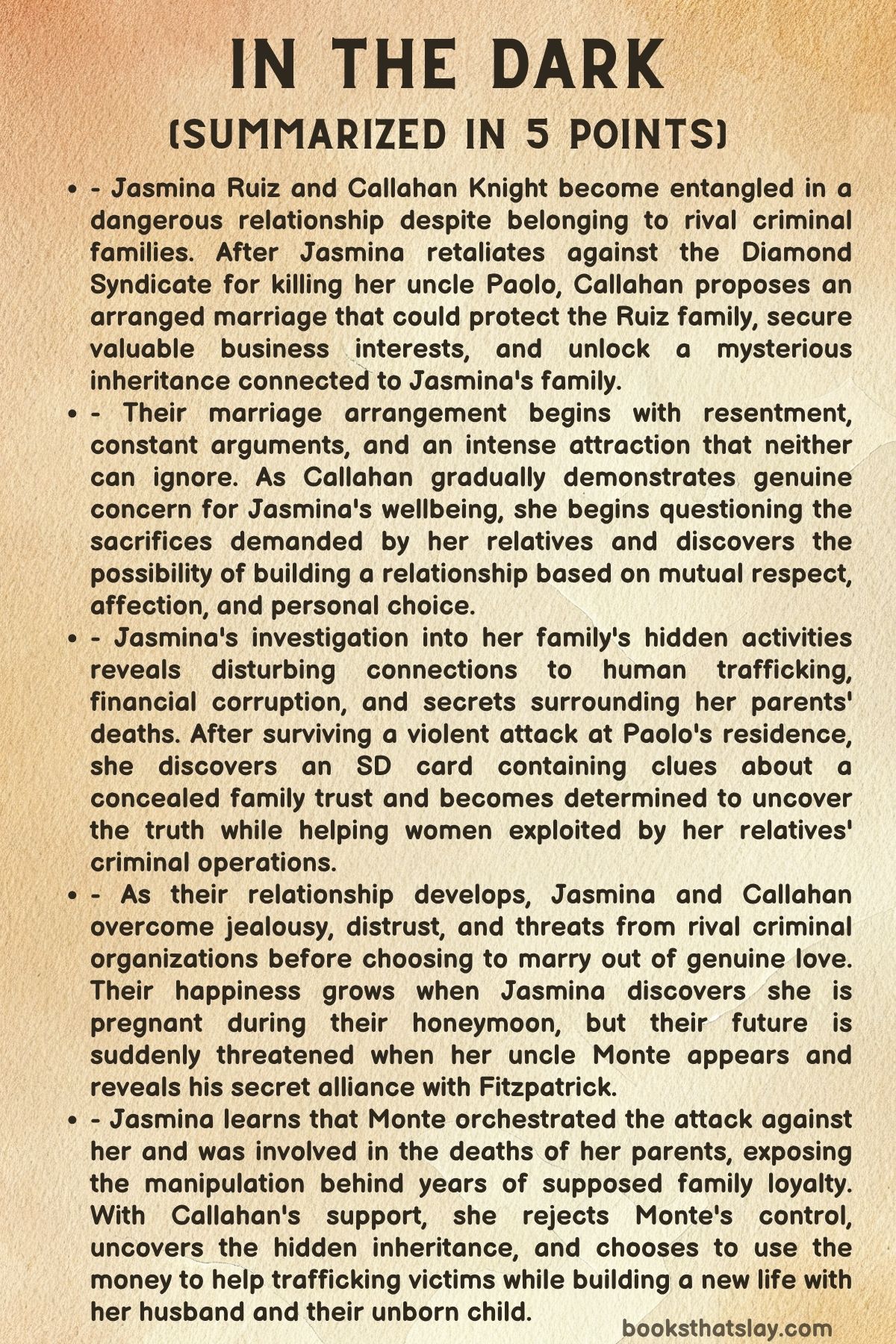
Their relationship begins with a forbidden encounter and develops into a dangerous arranged marriage intended to protect business interests and secure a mysterious family inheritance. As Jasmina confronts disturbing secrets about her relatives, Callahan struggles to balance his controlling instincts with genuine affection. Their relationship unfolds amid betrayal, organized crime, personal trauma, and violent power struggles. The novel examines how love, independence, trust, and moral responsibility can transform people raised in environments where loyalty often comes at a devastating personal cost. It’s the 2nd book in the Kept in Paradise series.
Summary
Jasmina Ruiz has spent most of her life serving a powerful criminal family that values loyalty, obedience, and financial advantage above personal happiness. Although she possesses exceptional fighting skills and considerable business knowledge, her relatives frequently treat her abilities as resources to be exploited rather than qualities deserving recognition.
Her life takes an unexpected turn when she attends an extravagant gala with Tomás Abarca, a wealthy businessman whose family possesses valuable connections. Their relationship exists primarily because it benefits her relatives, and Jasmina has little affection for his controlling personality.
When Tomás becomes aggressive during an argument outside the event, Callahan Knight intervenes. A prominent member of the Diamond Syndicate, Callahan belongs to an organization that has long competed with the Ruiz family for wealth, influence, and territory.
Despite their dangerous family connections, Jasmina and Callahan experience an immediate attraction. She recognizes his arrogance and intimidating confidence but finds herself drawn to his willingness to challenge anyone who attempts to control her.
They spend a passionate night together, temporarily disregarding the hostility between their families. However, Jasmina disappears the following morning, determined to prevent their encounter from developing into something that could compromise her independence.
A year later, tensions between the Diamond Syndicate and the Ruiz organization have intensified. Paolo Ruiz, Jasmina’s powerful uncle, has been killed following threats against Jameson Knight’s daughter, leaving the remaining Ruiz family vulnerable to rival criminal factions.
Devastated and furious, Jasmina retaliates by setting fire to a Diamond Syndicate property. She believes the attack will punish the Knights for destroying her uncle, but Callahan discovers her involvement and confronts her at Midnight’s Edge, an isolated coastal location associated with her childhood.
Their confrontation becomes a struggle involving anger, physical danger, and unresolved attraction. Jasmina refuses to apologize, while Callahan refuses to overlook an attack against his organization.
Meanwhile, the Knights discover information about a mysterious Ruiz family trust. Its inheritance provisions apparently allow biological grandchildren to access substantial wealth through the conception of a direct heir.
Monte Ruiz proposes an arranged marriage between his daughter Maribel and Callahan, hoping to secure Diamond protection. The agreement would also provide the Knights with access to Fuerte Firearms Corporation and strengthen their influence over East Coast territories.
Callahan unexpectedly demands Jasmina instead.
Although Jasmina resents being treated as an instrument of family negotiations, she agrees because the marriage offers protection to her vulnerable relatives. The arrangement initially requires two years of marriage, while the inheritance question introduces considerable pressure surrounding pregnancy.
Before the wedding, Jasmina attends Paolo’s funeral and returns to his former residence. While examining his study, she discovers suspicious evidence suggesting that he concealed important financial information.
Masked intruders suddenly attack her, apparently searching for a hidden safe. Jasmina fights courageously but suffers severe injuries, including multiple stab wounds.
Before collapsing, she manages to conceal an SD card recovered from Paolo’s desk.
Her family arranges private medical treatment, hoping to avoid unwanted attention. Although Jasmina narrowly survives, the doctor raises concerns about possible complications, including consequences for a future pregnancy.
Instead of responding primarily to her suffering, Monte concentrates on preserving the proposed marriage alliance. His apparent indifference reinforces Jasmina’s lifelong belief that her worth depends on what she can accomplish for others.
Jasmina hides her injuries and travels with Callahan to his luxurious estate in Paradise Grove, bringing her beloved cat, Romeo.
She initially regards the enormous property as an expensive prison. Callahan expects cooperation with wedding preparations, while Jasmina barricades herself inside her bedroom and refuses to accept his authority.
Their disagreements gradually change when Callahan notices her poor physical condition and insists that she eat properly.
During their conversations, Callahan reveals that Paolo had participated in trafficking women. Jasmina initially rejects the accusation, unwilling to believe that the uncle she defended could have committed such crimes.
After confronting the evidence, however, she begins questioning the activities she helped finance. Although she never intended to support exploitation, she fears that her professional work enabled wrongdoing she did not fully understand.
Determined to repair some of the damage, Jasmina resolves to assist the women harmed by the Ruiz criminal operations.
Callahan supports her intentions and encourages her to make personal decisions about the wedding. He eventually agrees to postpone the ceremony, allowing her more time to recover and prepare.
Their relationship becomes increasingly affectionate, although Callahan’s possessiveness creates serious conflict.
Jasmina discovers his romantic history, especially his connection with Demi. When Callahan suggests that he might continue pursuing other women despite expecting Jasmina’s fidelity, she immediately rejects the double standard.
The disagreement escalates when Callahan invites Demi into his bedroom. Jasmina discovers them together and confronts both with a knife.
Realizing how badly he has damaged their developing trust, Callahan apologizes and agrees that neither of them should pursue other romantic partners.
Their new understanding marks an important turning point. Although jealousy remains part of their relationship, they begin recognizing that mutual respect must accompany their attraction.
As wedding preparations continue, Jasmina develops friendships with Mia, Lucille, and other members of the Diamond community. These relationships introduce her to affection and companionship that do not depend upon financial usefulness.
She also becomes friendly with Archer, one of Callahan’s security personnel, whose interactions with her provoke Callahan’s jealousy.
Meanwhile, the marriage alliance attracts the attention of Fitzpatrick, a ruthless rival determined to prevent cooperation between the Knights and Ruizes.
When Fitzpatrick confronts Callahan at Paradise Grove, Jasmina openly defends her future husband. Her actions demonstrate that her loyalty is beginning to shift from the family that raised her toward the man she once considered an enemy.
The mysterious SD card continues occupying her thoughts. Its contents contain clues connected to Galaxy Skies, a business associated with her father’s past.
She also discovers that a phrase linked to the company resembles words from a lullaby her father sang during her childhood.
Although these discoveries suggest that the hidden inheritance genuinely exists, Jasmina hesitates to investigate because she fears learning more disturbing truths about her family.
Callahan eventually obtains surveillance footage of the attack against her and discovers how seriously she was injured. Horrified, he demands explanations and insists on proper medical examinations.
His concern affects Jasmina deeply. Throughout her childhood, she learned to conceal pain and endure suffering without complaint, but Callahan refuses to treat her injuries as insignificant.
Their emotional relationship becomes increasingly genuine, and Callahan admits that he wants something more permanent than the contractual marriage they originally negotiated.
He presents Jasmina with an enormous blue diamond ring and asks her to marry him as an equal, by choice rather than obligation.
Jasmina accepts.
Their wedding becomes a celebration of their growing affection, although Perla remains deeply anxious about the possibility of pregnancy and the mysterious family inheritance.
Jasmina realizes that she loves Callahan and proceeds with the ceremony despite her aunt’s warnings.
Callahan likewise recognizes that the political advantages of their alliance have become secondary to his desire to spend his life with Jasmina.
After the wedding, the newlyweds travel aboard a luxurious yacht for their honeymoon. Away from their families and business responsibilities, they enjoy the freedom of their new relationship.
Jasmina begins suspecting that she is pregnant and takes a test that confirms her suspicions. Callahan responds with happiness, and they start imagining their future as parents.
Their celebration is interrupted when Monte unexpectedly appears aboard the yacht.
He claims that Callahan is dangerous and attempts to force Jasmina to leave with him. However, his increasingly desperate behavior exposes a conspiracy far more disturbing than she imagined.
Monte reveals that he has secretly allied with Fitzpatrick to restore the Ruiz family’s former criminal influence. He opposes Jasmina’s efforts to dismantle the trafficking operations and fears that her marriage will transfer control of valuable resources to the Knights.
His betrayal becomes even more personal when Jasmina discovers that he arranged the earlier attack against her and attempted to prevent her from becoming pregnant.
As Monte’s explanations unravel, Jasmina begins recovering memories of her parents’ deaths.
She remembers her father refusing to surrender resources that he intended to use for helping vulnerable people. Her mother supported his principles, but the confrontation ended in violence that left Jasmina orphaned.
Monte’s involvement in the events surrounding their murders reveals that the relatives she trusted were responsible for exploiting her tragedy.
His years of apparent guardianship were closely connected to his desire to obtain the family inheritance.
Jasmina finally understands that her supposed obligation to repay Monte for raising her was built upon manipulation and deception.
When Monte threatens Callahan, Jasmina fights back, and Diamond security personnel intervene. Monte is captured, and Jasmina refuses to excuse his actions as necessary sacrifices for the family’s survival.
She reveals her pregnancy and makes clear that her future belongs with Callahan.
Rather than allowing Monte to continue controlling her decisions, she leaves his punishment to her husband and begins confronting the grief she has suppressed for years.
Later, Jasmina finally examines the SD card and follows the clues connected to her father’s lullaby. She discovers the information necessary to access the hidden family trust.
Instead of pursuing personal luxury, she chooses to direct the inheritance toward helping women harmed by the trafficking operations.
Callahan and Jameson support her efforts, allowing the resources once associated with exploitation to serve a more constructive purpose.
As her pregnancy progresses, Jasmina becomes increasingly comfortable within the Diamond community and enjoys a marriage defined by affection, friendship, and continuing playful disagreements.
Although Callahan remains possessive, their relationship is no longer merely an arrangement between competing families.
Jasmina has gained independence, discovered the truth about her past, and created a family based on genuine love.
The novel concludes with Jasmina and Callahan embracing a future together, having transformed a marriage originally intended to secure power into a relationship that changes both their lives.
Characters
Jasmina Ruiz
Jasmina Ruiz is the central female protagonist of In the Dark, characterized by her remarkable courage, fierce independence, emotional resilience, and complicated relationship with the criminal family that raised her. Her story follows a woman who gradually learns to distinguish genuine love from the obligations imposed upon her throughout childhood.
After losing her parents, Jasmina grows up under the guardianship of Monte and Perla Ruiz while working closely with her uncle Paolo. Although she receives shelter and family connections, her upbringing emphasizes usefulness rather than emotional security.
Her exceptional abilities in combat, financial management, and criminal operations demonstrate her intelligence and adaptability. However, these same abilities become instruments through which her relatives justify demanding continual sacrifice.
Jasmina’s loyalty to Paolo initially appears absolute, even prompting her to attack a Diamond Syndicate property following his death. This retaliation reflects both her devotion to family and her tendency to respond to emotional pain through aggression.
Her relationship with Callahan challenges these habits because he refuses to regard her simply as someone who must serve the interests of others. Although his controlling behavior frequently angers her, his concern for her physical and emotional wellbeing introduces an unfamiliar form of affection.
Jasmina’s reaction to the revelations about trafficking highlights her moral integrity. Rather than dismissing the suffering caused by her family, she questions her own involvement and becomes determined to assist the victims.
Her struggle with vulnerability is equally significant. She initially conceals serious injuries because she believes needing assistance makes her weak, but eventually recognizes that accepting love does not require surrendering independence.
The discovery of Monte’s betrayal transforms her understanding of family loyalty. By rejecting his manipulation and choosing to use her inheritance for humanitarian purposes, Jasmina develops an identity guided by personal principles rather than inherited expectations.
Her transformation gives the novel its emotional foundation, illustrating how a person conditioned to survive through obedience and aggression can establish a life based on freedom, responsibility, and mutual affection.
Callahan Knight
Callahan Knight is the male protagonist of In the Dark, a powerful member of the Diamond Syndicate whose commanding personality conceals a developing capacity for emotional vulnerability. His character combines ruthless business instincts, possessiveness, loyalty, and an increasingly genuine desire to protect the woman he loves.
Initially, Callahan approaches marriage as a strategic transaction designed to secure territory, financial resources, and influence over the Ruiz organization. His willingness to substitute Jasmina for Maribel demonstrates both his fascination with her personality and his assumption that his position allows him to control important decisions.
His treatment of Jasmina is frequently contradictory. He admires her independence and fighting abilities while simultaneously attempting to direct her movements, personal relationships, and choices.
These contradictions become particularly apparent in his interactions with Demi. Callahan initially assumes that the expectations of fidelity applying to Jasmina should not necessarily restrict his own behavior.
When his actions provoke a serious confrontation, he is forced to recognize the hypocrisy underlying his expectations. His subsequent apology and willingness to establish mutual boundaries demonstrate an important change in his understanding of partnership.
Callahan’s reaction to Jasmina’s injuries reveals a more compassionate side of his personality. He is deeply disturbed that she endured serious suffering without adequate medical attention and refuses to accept her family’s indifference.
His relationship with Romeo also softens his intimidating image. His growing affection for Jasmina’s cat introduces humor and suggests that his capacity for tenderness extends beyond romantic attraction.
Throughout the story, Callahan gradually abandons the belief that marriage must primarily secure business advantages. His decision to offer Jasmina financial independence and ask her to marry him by choice demonstrates his increasing respect for her autonomy.
Nevertheless, his possessiveness remains an enduring character trait, preventing his development from becoming a complete rejection of the values associated with his criminal environment.
By the conclusion, Callahan represents a man whose understanding of power has expanded beyond domination. His willingness to prioritize Jasmina’s happiness demonstrates how emotional commitment can alter even deeply established habits.
Monte Ruiz
Monte Ruiz is one of the most consequential antagonists in In the Dark, initially presenting himself as a protective family patriarch before emerging as a calculating figure motivated by wealth, influence, and personal ambition. His relationship with Jasmina demonstrates how authority can be disguised as affection while serving fundamentally exploitative purposes.
Following the deaths of Jasmina’s parents, Monte assumes responsibility for raising her. This arrangement allows him to cultivate her loyalty by encouraging the belief that she owes her guardians lifelong obedience.
His behavior during the marriage negotiations reveals his priorities. Rather than considering Jasmina’s emotional wellbeing, he evaluates her future according to the political and financial advantages available to the Ruiz family.
His response to the attack against her is especially revealing. Despite the severity of her injuries, he concentrates on preserving the alliance with the Knights rather than ensuring that she receives comprehensive medical treatment.
The eventual revelation that Monte arranged the attack transforms his apparent negligence into deliberate cruelty. His actions demonstrate that he is prepared to endanger someone he claims to love when her existence threatens his ambitions.
His alliance with Fitzpatrick exposes the extent of his duplicity. While publicly participating in negotiations intended to establish peace, he secretly works toward restoring the criminal activities and territorial influence that the alliance threatens.
Monte’s connection to the deaths of Jasmina’s parents provides the ultimate explanation for his treatment of her. His guardianship was inseparable from his pursuit of the hidden family trust and his desire to control its resources.
Even when confronted with his wrongdoing, Monte attempts to justify his actions as necessary for family survival. This refusal to accept moral responsibility distinguishes him from characters capable of acknowledging their mistakes.
His downfall allows Jasmina to reject the emotional debt that has governed her life and exposes the destructive consequences of confusing family authority with unconditional love.
Perla Ruiz
Perla Ruiz occupies a complicated position in the novel because her concern for Jasmina combines genuine anxiety with loyalty to a family system that has repeatedly denied the young woman independence. Unlike Monte, whose motivations become openly sinister, Perla represents the more ambiguous consequences of accepting harmful family traditions.
She participates in raising Jasmina after her parents’ deaths and appears sincerely distressed when the young woman suffers serious injuries. Her protective instincts suggest that she possesses emotional attachments beyond financial calculation.
However, her reactions frequently prioritize the consequences of Jasmina’s circumstances for the Ruiz family’s political position.
Her anxiety about the arranged marriage reflects an awareness of Callahan’s dangerous reputation and the vulnerability created by the inheritance agreement. Nevertheless, she does not consistently challenge the underlying assumption that Jasmina should sacrifice her future for her relatives.
Perla’s insistence that pregnancy must be avoided becomes especially significant as the wedding approaches. She fears the transfer of financial power that a child could trigger, revealing how family interests affect her advice.
Her confrontation with Jasmina on the wedding day exposes the growing distance between their perspectives. While Perla continues interpreting marriage primarily as a strategic risk, Jasmina has begun understanding it as a personal commitment.
Perla therefore illustrates a form of affection limited by institutional loyalty. She may wish to protect Jasmina, but her understanding of protection remains shaped by the power structures that have harmed her.
Paolo Ruiz
Paolo Ruiz exerts considerable influence over In the Dark despite dying before most of the central events unfold. His criminal activities, treatment of Jasmina, and concealed financial information continue shaping the decisions of both families long after his death.
As a powerful figure within the Ruiz organization, Paolo expects obedience and uses Jasmina’s intelligence and fighting abilities to maintain his operations. Her memories reveal that he rarely appreciates her efforts and often punishes challenges to his authority.
His death initially motivates Jasmina’s retaliation against the Diamond Syndicate. She interprets the killing as an attack against her family and feels obligated to avenge him.
However, revelations about his involvement in trafficking women fundamentally alter her understanding of his character.
The discovery forces Jasmina to confront the possibility that the financial work she performed for Paolo indirectly supported activities she would have condemned.
His former residence also contains evidence connected to the mysterious family inheritance. The SD card hidden in his desk becomes essential to uncovering the financial secrets surrounding Jasmina’s parents.
Paolo represents the destructive influence of inherited loyalty when individuals are encouraged to excuse wrongdoing simply because it originates within their families. His legacy forces Jasmina to examine the difference between devotion and moral responsibility.
Jameson Knight
Jameson Knight serves as an influential member of the Diamond Syndicate and an important presence in Callahan’s personal development. His decisions demonstrate the dangerous consequences of criminal rivalry, while his relationship with Mia and his family provides a contrasting example of emotional commitment.
His killing of Paolo Ruiz follows threats against his daughter, establishing the violent circumstances that initially separate the Knights and Ruizes. Although Jasmina resents his actions, Jameson refuses to apologize for protecting his family.
He approaches the proposed marriage alliance with considerable practical caution. Unlike Callahan, whose judgment becomes increasingly affected by his attraction to Jasmina, Jameson repeatedly evaluates the wider political consequences.
His warnings about Fitzpatrick demonstrate his awareness that the marriage could provoke rival organizations.
Jameson also helps investigate the attack against Jasmina and encourages restraint until the identities of those responsible can be established.
His discussions with Callahan reveal an affectionate brotherly relationship characterized by teasing, honesty, and mutual concern.
Through his relationship with Mia, Jameson demonstrates how even individuals accustomed to violence and authority can develop priorities centered on family and emotional responsibility.
Mia
Mia is an important supporting character whose kindness helps Jasmina develop a sense of belonging within the Diamond community. Her role is particularly meaningful because her family connections could easily have made her another source of hostility.
Rather than defining Jasmina exclusively through the conflict between their relatives, Mia makes a deliberate effort to establish a genuine friendship.
Her invitation to the country club provides Jasmina with opportunities to experience ordinary companionship outside the demands of criminal business.
Mia also acknowledges the painful circumstances involving Paolo and the Knight family without insisting that Jasmina abandon her complicated emotions.
This willingness to accept the past while seeking a different future distinguishes Mia from characters whose relationships are dominated by revenge.
Through Mia, Jasmina begins recognizing that affection can be freely offered without creating an obligation to sacrifice personal independence.
Mia’s relationship with Jameson also contributes to the novel’s broader examination of love within dangerous environments.
Archer
Archer is one of Callahan’s trusted security men and a supporting character whose interactions with Jasmina introduce humor, friendship, and occasional conflict. His professional responsibilities place him close to the couple, but his relationship with Jasmina develops beyond ordinary security arrangements.
He initially appears as a capable and disciplined employee accustomed to handling dangerous circumstances.
However, his conversations with Jasmina reveal a more relaxed personality, particularly when she involves him in crocheting activities and discussions about weapons.
Archer respects Jasmina’s fighting abilities and recognizes that she is far more capable than the conventional image of a protected wealthy bride.
Their friendship provokes Callahan’s jealousy, creating tension between Archer’s professional loyalty and his employer’s possessive instincts.
Archer’s apparent interest in Marian introduces another dimension to his character. His discomfort when she is mentioned suggests emotional vulnerability beneath his disciplined exterior.
His concern when Marian later disappears indicates that his feelings may be serious, establishing an unresolved personal storyline beyond the central romance.
Demi
Demi functions as a romantic rival and a catalyst for important conflicts between Jasmina and Callahan. Her previous involvement with Callahan makes her presence particularly threatening during the early stages of their engagement.
She represents the freedom and lack of commitment associated with Callahan’s earlier relationships.
When Jasmina encounters her at the salon, Demi’s confidence and familiarity with Callahan immediately expose insecurities that Jasmina would prefer to conceal.
Her later appearance in Callahan’s bedroom creates a confrontation that forces both protagonists to address the expectations governing their marriage.
Although Demi is not developed with the same psychological depth as the central characters, she serves an important narrative purpose.
Her involvement exposes Callahan’s hypocrisy regarding fidelity and compels Jasmina to insist upon mutual respect.
Demi’s role therefore demonstrates that the couple’s emotional relationship cannot mature until both are prepared to abandon destructive attempts to provoke jealousy.
Fitzpatrick
Fitzpatrick is a dangerous rival whose ambitions threaten the fragile alliance between the Diamond Syndicate and the Ruiz family. His character represents the external criminal pressures that continue shaping the protagonists’ decisions.
He opposes the marriage because cooperation between the two organizations threatens his opportunities to expand territorial influence.
His confrontation with Callahan at Paradise Grove demonstrates his willingness to employ intimidation and violence to achieve political objectives.
Jasmina’s defiance during this encounter reveals that Fitzpatrick has underestimated the strength of the relationship developing between his opponents.
His later alliance with Monte exposes his opportunistic nature. Rather than remaining loyal to any consistent principle, Fitzpatrick seeks partnerships that improve his chances of gaining control.
Although his personal background receives limited attention, his presence intensifies the consequences of the marriage and contributes to the final conspiracy.
He demonstrates how criminal competition encourages betrayal, making genuine peace difficult when powerful individuals continue prioritizing domination.
Maribel Ruiz
Maribel Ruiz is Monte and Perla’s daughter and the woman initially proposed as Callahan’s bride. Although she does not dominate the narrative, her position within the marriage negotiations reveals the transactional expectations surrounding women in the Ruiz family.
Monte originally offers Maribel because the Knights require a marriage alliance with the Ruizes to strengthen their political and financial position.
Her proposed marriage is treated primarily as a strategic arrangement rather than a personal relationship.
When Callahan chooses Jasmina instead, Maribel’s displacement demonstrates how easily family patriarchs and powerful businessmen attempt to determine women’s futures.
Her comparatively limited involvement also emphasizes Jasmina’s unusual willingness to challenge the decisions imposed upon her.
Maribel consequently serves as an important contrast to the protagonist’s resistance, highlighting the restrictive social expectations that make Jasmina’s determination to control her own life especially significant.
Tomás Abarca
Tomás Abarca appears near the beginning of the novel as Jasmina’s controlling romantic companion. His relationship with her establishes the emotional and social conditions that make her initial encounter with Callahan so consequential.
Their association exists largely because his family possesses valuable business connections, meaning Jasmina is expected to maintain the relationship regardless of her personal feelings.
Tomás treats her with aggression and attempts to impose his authority during their argument outside the gala.
His behavior reinforces Jasmina’s resentment toward men who believe wealth and influence entitle them to control her.
Callahan’s intervention exposes a contrast between two powerful men, although the novel subsequently demonstrates that Callahan also possesses troubling controlling instincts.
Tomás therefore serves as an early example of the transactional relationships Jasmina must eventually reject.
Lucille
Lucille is a supportive member of the Diamond community whose friendship helps Jasmina feel increasingly comfortable in Paradise Grove. Her role contrasts with the suspicion and political hostility that initially surround the proposed marriage.
She assists with wedding preparations and participates in social gatherings that allow Jasmina to experience ordinary enjoyment.
These interactions are meaningful because Jasmina has spent much of her life working rather than developing independent friendships.
Lucille’s welcoming attitude demonstrates that the Diamond community contains people capable of accepting Jasmina without reducing her identity to her family’s criminal history.
Her presence contributes to the gradual development of a chosen social circle in which Jasmina can experience companionship without continually proving her usefulness.
Marian
Marian, Mia’s sister, is a secondary character whose importance becomes more apparent through her connection with Archer. Although her direct involvement is limited, she contributes to the developing personal relationships surrounding the Diamond community.
When Jasmina mentions Marian during a conversation with Archer, his noticeable discomfort suggests that their relationship contains unresolved emotional tension.
This reaction gives Marian significance beyond her family connection to Mia.
Her later disappearance creates concern and prompts Archer to search for her, suggesting that their relationship may become the center of another conflict.
Marian’s storyline remains unresolved within the provided account, functioning as an indication that the wider fictional world contains other developing relationships and potential dangers.
Rafe Black
Rafe Black is a confident member of the Diamond social circle whose flirtatious behavior introduces humor and jealousy into Jasmina and Callahan’s relationship. His role is comparatively small but helps illustrate the continuing intensity of Callahan’s possessiveness.
During wedding-related gatherings, Rafe openly flirts with Jasmina, provoking an immediate reaction from Callahan.
His attention becomes particularly significant during the wedding reception, when Callahan interrupts their dance.
Rafe’s presence does not fundamentally threaten the marriage, but it exposes Callahan’s difficulty tolerating even harmless romantic attention directed toward his wife.
His interactions also demonstrate Jasmina’s increasing social confidence as she becomes more comfortable among the Diamonds.
Romeo
Romeo, Jasmina’s beloved cat, occupies a surprisingly meaningful position within the novel. Although an animal rather than a human character, his presence contributes to the development of emotional intimacy between Jasmina and Callahan.
Jasmina brings Romeo with her when she moves to Paradise Grove, preserving an important connection to her previous life.
Callahan initially approaches the cat as another complication associated with their unusual living arrangement.
Over time, however, he begins spoiling Romeo with attention and treats, gradually earning the animal’s affection.
Jasmina finds this transformation revealing because it allows her to see Callahan displaying patience and tenderness without seeking political advantage.
His relationship with Romeo encourages her to imagine him becoming a caring father, making the cat an understated symbol of the domestic happiness they are beginning to build.
Themes
Love, Trust, and Emotional Vulnerability
Love in In the Dark develops through a gradual transformation of hostility, attraction, and distrust into a relationship built upon emotional attachment. Jasmina and Callahan initially approach each other as representatives of competing criminal families, making genuine intimacy seem both dangerous and impractical.
Their early encounters demonstrate that physical attraction does not automatically establish trust. Both characters possess controlling instincts, and their attempts to dominate disagreements frequently prevent them from understanding one another.
Callahan’s behavior involving Demi exposes the limitations of a relationship founded on possessiveness. He expects Jasmina to remain faithful while initially refusing to accept equivalent restrictions upon himself.
The resulting confrontation forces both characters to recognize that emotional commitment requires consistent expectations and mutual respect.
Jasmina faces a different challenge because her childhood taught her that vulnerability invites exploitation. She conceals injuries, dismisses emotional suffering, and hesitates to request assistance because she associates independence with never needing another person.
Callahan’s concern gradually challenges this belief. His determination to obtain proper medical care and understand her experiences demonstrates that accepting help can strengthen rather than diminish personal agency.
Their eventual decision to marry by choice rather than contractual necessity represents the culmination of these changes.
Nevertheless, their relationship remains marked by jealousy and possessiveness, suggesting that emotional development does not eliminate established behavioral patterns immediately.
The novel ultimately presents love as a demanding process of learning to communicate honestly, acknowledge mistakes, and offer affection without reducing another person to an object of control.
Family Loyalty, Betrayal, and the Search for Belonging
Family loyalty governs many of the protagonists’ earliest decisions, but the novel repeatedly questions whether biological relationships and shared history necessarily deserve unquestioning obedience. Jasmina’s upbringing demonstrates how family obligations can become instruments of manipulation when affection is tied to usefulness.
After losing her parents, Jasmina grows up believing that Monte and Perla deserve her lifelong gratitude for providing shelter. This belief encourages her to sacrifice personal ambitions and accept responsibilities that other family members are not expected to carry.
Her loyalty to Paolo similarly prevents her from recognizing the full extent of his wrongdoing.
Even after his death, she initially defends his reputation and retaliates against the organization responsible for killing him.
The discovery of trafficking activities exposes the moral dangers of refusing to question relatives simply because they belong to one’s family.
Monte’s eventual betrayal makes this conflict intensely personal. His involvement in her parents’ deaths, his manipulation of the inheritance, and his responsibility for the attack against her reveal how thoroughly he has exploited her devotion.
Jasmina must confront the devastating realization that the people who raised her also contributed to the suffering that shaped her identity.
Her developing friendships within the Diamond community offer an alternative understanding of belonging.
Mia, Lucille, Archer, and others accept her through personal interactions rather than inherited obligations.
By choosing Callahan and building relationships based on affection, Jasmina discovers that family can emerge through trust, shared values, and voluntary commitment.
Her experience ultimately distinguishes meaningful loyalty from submission and suggests that rejecting abusive relatives can be necessary for developing healthier personal attachments.
Power, Control, and Personal Independence
Power in In the Dark operates through financial resources, criminal influence, physical intimidation, and interpersonal relationships. The novel examines how individuals accustomed to controlling others can mistake authority for strength while overlooking the damage their behavior causes.
Within the Ruiz family, Jasmina’s abilities make her valuable but rarely grant her meaningful independence.
She manages complicated financial responsibilities and performs dangerous assignments, yet major decisions concerning her marriage and future remain controlled by male relatives.
This contradiction reveals a system in which competence is welcomed only when it benefits established authority.
Callahan initially participates in similar behavior. His wealth, criminal influence, and commanding personality encourage him to assume that he can determine the terms of Jasmina’s life.
Although he admires her resistance, he frequently attempts to direct her choices, creating conflict between his attraction to her independence and his desire to possess her loyalty.
Their relationship begins changing when Jasmina insists on participating in decisions and demands equivalent expectations regarding fidelity.
Callahan’s willingness to revise the marriage agreement and protect her financial interests represents an important development because it shifts power from unilateral control toward shared responsibility.
The mysterious inheritance reinforces these questions on a larger scale.
Monte views the trust as an instrument through which he can recover criminal influence, while Jasmina eventually regards it as an opportunity to act according to her personal values.
Her decision to use the money for victims rather than domination demonstrates that independence involves more than possessing wealth.
It requires the freedom to determine how one’s abilities and resources should be used.
Trauma, Moral Responsibility, and Breaking Cycles of Harm
Childhood trauma shapes Jasmina’s understanding of herself long before she discovers the truth about her parents’ deaths. Her upbringing teaches her to suppress fear, endure pain, and interpret personal sacrifice as evidence of loyalty.
These habits allow her to survive within a dangerous criminal environment, but they also prevent her from recognizing how severely her relatives have exploited her.
Her response to the attack at Paolo’s residence illustrates the consequences of this conditioning. Despite suffering potentially life-threatening injuries, she prioritizes secrecy and family stability over receiving comprehensive medical treatment.
Her emotional development begins when Callahan challenges the assumption that pain must be handled privately.
However, recovery involves more than accepting his affection.
Jasmina must also confront the moral consequences of the criminal organization she helped sustain.
The discovery of trafficking activities forces her to examine the difference between personal intention and participation in harmful systems.
Although she did not knowingly support the exploitation of women, she recognizes that the financial operations she managed may have contributed to their suffering.
Instead of denying responsibility or excusing her relatives, she becomes determined to assist the victims and prevent similar abuses.
The revelations about Monte deepen this commitment by exposing how greed and coercion have damaged multiple generations of her family.
Her father’s earlier desire to protect vulnerable people provides an important contrast to the relatives who pursued wealth through exploitation.
When Jasmina finally accesses the inheritance, she chooses to continue that more compassionate legacy.
By redirecting the family’s resources toward helping victims, she demonstrates that recovering from trauma can involve transforming the very structures associated with past suffering.
The novel therefore presents healing not as forgetting what happened, but as developing the freedom and moral courage to prevent inherited patterns of harm from determining the future.