In the Killer’s Sight Summary, Characters and Themes
In the Killer’s Sight by Mike Omer is a psychological crime thriller that follows police officer and K-9 handler Kate Marino as she investigates the disappearance of her teenage cousin in the forests of New Hampshire.
What begins as a missing-person search gradually exposes a series of brutal murders committed by a predator who believes himself to be a protector of vulnerable women. As Kate follows the evidence, she must confront painful memories of her abusive childhood, navigate resistance from local authorities, and protect the people she loves. The novel examines obsession, manipulation, survival, family relationships, and the disturbing consequences of violence disguised as compassion. It’s the 1st book in the Kate Marino series.
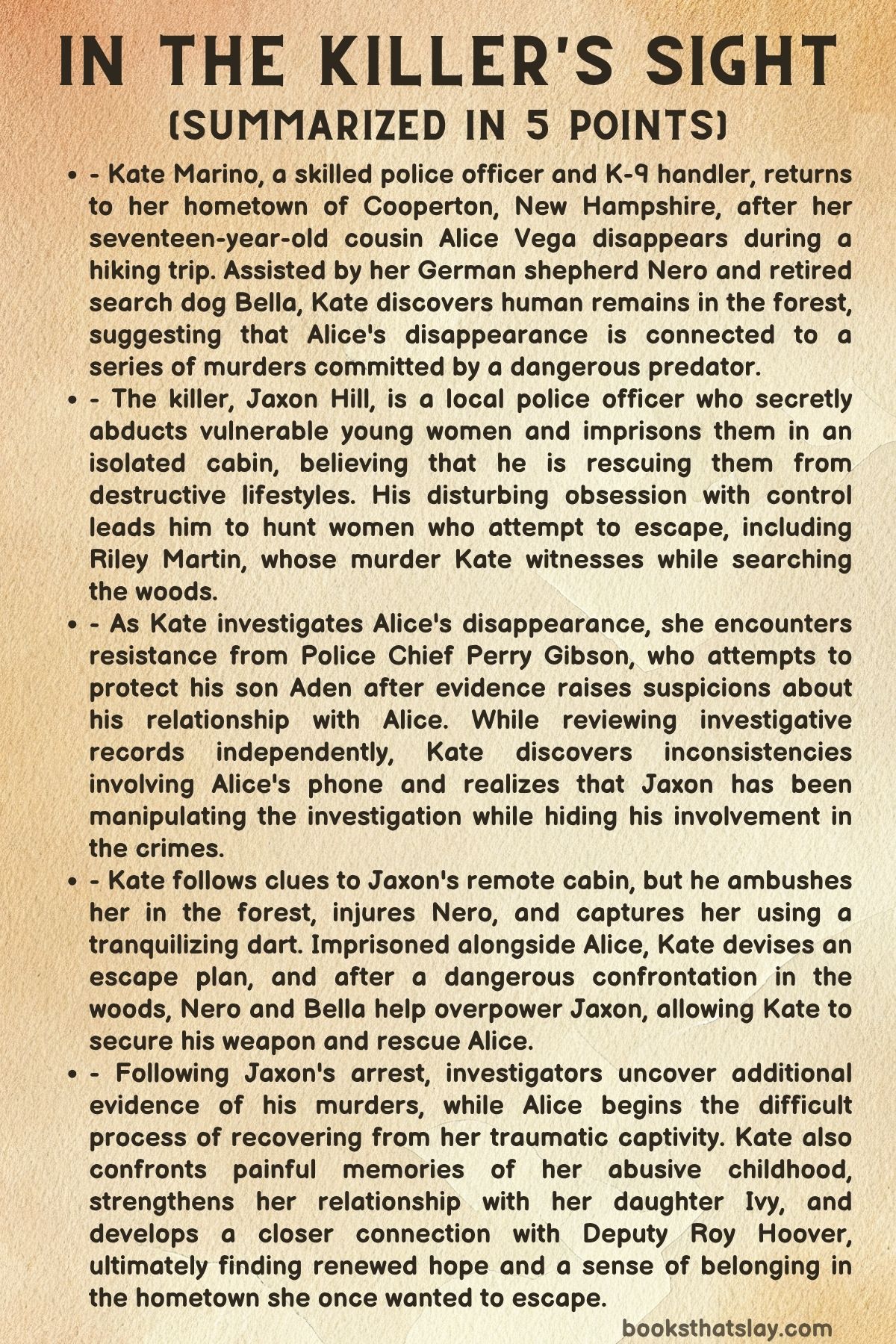
Summary
The story begins in a remote forest in New Hampshire, where an unidentified man watches a group of teenagers hiking through the wilderness. His attention settles on a young girl, revealing a disturbing fascination with observing and pursuing vulnerable people.
The man returns to his secluded cabin, where he holds two young women, Riley and Alice, captive. Although he considers himself their protector, his treatment of them is cruel and unpredictable, and he repeatedly justifies his violence as necessary discipline.
Meanwhile, police officer Kate Marino works as a K-9 handler in Manchester, New Hampshire, alongside her German shepherd, Nero. A successful nighttime operation demonstrates their exceptional partnership, with Nero tracking two armed fugitives through difficult woodland terrain.
Kate’s professional competence contrasts with the challenges of her personal life. Widowed after her husband Anthony was killed in the line of duty, she is raising their thirteen-year-old daughter, Ivy, while managing the emotional and practical demands of police work.
Her routine changes when her cousin Noelle Vega calls with devastating news. Noelle’s seventeen-year-old daughter, Alice, has disappeared during a hiking trip near Cooperton, the small town where Kate grew up.
Kate immediately travels to Cooperton with Nero, determined to use her search-and-rescue experience to find Alice. Returning home, however, forces her to confront memories of her abusive father, Frank Simmons, whose violence made her childhood deeply unhappy.
At the search headquarters in Frederick R. State Park, Kate meets Deputy Roy Hoover, Officer Jaxon Hill, and other officers coordinating the investigation. She notices that search teams have concentrated heavily on established trails and proposes examining less obvious areas.
While Kate searches the forest, Alice struggles to survive inside the cabin. Her fellow prisoner, Riley, has learned that pretending to obey their captor is essential, although she secretly dreams of escaping.
Riley reveals that she and a previous captive, Mabel, began loosening the metal grille covering their bedroom window. Alice joins the effort, and the women gradually develop a desperate escape plan.
Kate’s investigation produces an important lead when Nero behaves unusually near Tom’s Creek. His reactions suggest the possibility of human remains, prompting Kate to bring Bella, her retired Labrador trained to detect dead bodies, into the search.
Bella locates skeletal remains, transforming Alice’s disappearance into a possible murder investigation. Additional forensic examination reveals evidence of multiple victims buried in the area, raising fears that a serial killer has been operating around Cooperton.
State detectives Lopez and Fisher become involved, assisted by forensic specialist Colette. Kate proposes that the killer may have returned to an established burial location, accidentally disturbing older remains while disposing of another victim.
The investigation reveals connections to missing women, including Mabel Sutton and Jasmine. Evidence suggests that the perpetrator targets vulnerable women, particularly those whose circumstances make their disappearances easier to conceal.
At the cabin, the killer continues presenting himself as a compassionate man who rescues troubled women from destructive lifestyles. He interprets their resistance as ingratitude, refusing to accept responsibility for his own cruelty.
His background reveals a childhood shaped by a demanding father who associated masculinity with competition, hunting, and dominance. The boy learned to connect approval with control, developing a fascination with watching and pursuing living targets.
As an adult, these impulses became increasingly dangerous. An earlier encounter with a woman named Pepper intensified his excitement about chasing women, while the death of Paula, another captive, encouraged him to secure future prisoners more carefully.
Kate gradually recognizes a horrifying possibility: the killer may be releasing captive women into the woods and hunting them. The victims’ injuries, locations, and the surrounding geography support this interpretation.
Meanwhile, the pressure of the investigation strains Kate’s relationship with Ivy. Her daughter initially resents her repeated absences, but they eventually agree that Ivy will accompany her to Cooperton and stay with their relatives.
Being back in town also brings Kate into closer contact with Frank. His seemingly affectionate behavior toward Ivy unsettles her because she remembers the violence and intimidation hidden beneath his charming public personality.
Kate’s relationship with Roy becomes increasingly significant. Roy admits that he suspected Frank was abusing her when they were younger and regrets failing to intervene effectively.
The investigation takes a devastating turn when the killer brings Riley into the forest under the pretense of rewarding her cooperation. Recognizing an opportunity to escape, Riley runs, but the man positions himself above the terrain and shoots her.
Kate witnesses the shooting while searching with Nero. She rushes to Riley’s assistance despite the possibility of further gunfire and desperately attempts to save her life, but Riley dies from her injuries.
The killing strengthens Kate’s determination to rescue Alice before she suffers the same fate. She begins investigating Alice’s personal relationships, discovering that the teenager had been romantically involved with Aden Gibson, the adult son of local police chief Perry Gibson.
Aden has a troubling history involving drugs and allegations of sexual misconduct. Kate and Roy investigate him, discovering illegal substances in a vehicle connected to him and identifying potential similarities between its tires and impressions recovered near the burial site.
Although Aden’s behavior creates legitimate suspicion, the evidence fails to connect him directly to Alice’s disappearance. His arrest nevertheless provokes an angry response from his father.
Chief Gibson uses his authority to restrict Kate’s involvement in the investigation, claiming that her family connection to Alice creates a conflict of interest. Kate recognizes the decision as retaliation for investigating Aden.
Excluded from important task force discussions, she continues examining evidence independently. Meanwhile, Noelle receives an audio message apparently recorded by Alice, reassuring her family that she is alive.
Although the recording briefly restores hope, Kate suspects coercion. The killer has previously controlled similar messages, forcing captives to repeat statements designed to disguise their imprisonment.
Studying maps, evidence, and investigative timelines, Kate notices inconsistencies involving Alice’s phone. The information that originally directed searchers toward a particular location may have been deliberately manipulated.
She discovers that Officer Jaxon Hill was responsible for obtaining and communicating crucial information about the phone. His access to investigative operations would have allowed him to misdirect search teams and monitor developments.
Kate begins investigating Jaxon’s background and connections to an isolated cabin in the forest. Conversations with Frank about old hunting expeditions help her identify the general area.
The truth gradually emerges: Jaxon is the killer. His role as a police officer has allowed him to approach vulnerable women, conceal his activities, and participate in the search for people he abducted.
Jaxon originally encountered Alice during a police operation involving parties and drug activity. He became obsessed with her, convincing himself that she needed his guidance while secretly imagining pursuing her through the woods.
Kate travels into the northern section of the state park with Nero, following clues that might lead to Jaxon’s cabin. She informs Roy and other investigators about her suspicions, but poor reception and difficult terrain interfere with communication.
Jaxon realizes Kate is approaching his hiding place and prepares an ambush. Using his knowledge of the forest, he attacks from an elevated position, injuring Nero and striking Kate with a tranquilizing dart.
Although Kate attempts to resist, the drug weakens her. Jaxon overpowers her, beats her, and transports her unconscious body to the cabin, where Alice is still imprisoned.
Alice is horrified to discover her injured aunt but immediately begins caring for her. When Kate regains consciousness, Alice explains Jaxon’s behavior and the importance of appearing obedient.
Despite serious injuries, Kate refuses to surrender. She examines the damaged window grille and develops an escape strategy using the work Alice and Riley previously completed.
Meanwhile, Nero survives his injuries and attempts to return to Kate. After becoming trapped near a stream, he is rescued by an elderly couple, Ed and Darla, who provide water and basic medical assistance.
Rather than remaining with them, Nero eventually retraces his scent trail toward Kate.
Roy learns that Kate has disappeared and immediately joins the search. At Ruth’s house, Ivy suggests using Bella to find her mother, believing that the retired Labrador’s familiarity with Kate will prove valuable.
Roy takes Bella into the woods, following clues connected to Kate’s investigation and Frank’s recollections of the old hunting area.
Inside the cabin, Kate deliberately damages the window to attract Jaxon’s attention. When he enters and examines the destruction, she attacks him with broken glass, seriously injuring him.
Kate and Alice escape the cabin, and Kate punctures Jaxon’s vehicle tires to prevent him from pursuing them by car. They flee through the forest, but Kate’s injuries make movement increasingly difficult.
Jaxon arms himself and takes a shorter route through the woods, anticipating their attempt to reach the road. He eventually intercepts them, threatening to regain control.
Just as the situation appears hopeless, Nero emerges and attacks Jaxon. Kate joins the struggle, followed by Bella, who has broken away from Roy after detecting Nero’s scent and hearing gunfire.
Working together, Kate and the dogs overpower Jaxon. Kate secures his firearm, forcing him to surrender, and Roy arrives moments later.
Alice and Kate survive, while Jaxon is taken into custody.
The aftermath reveals the full extent of his crimes. Investigators discover additional bodies near his cabin, and Jaxon acknowledges responsibility for several deaths while continuing to excuse his actions.
Alice returns to her family but struggles with psychological trauma. Kate helps her begin recovering, encouraging ordinary activities and introducing the possibility of finding comfort through companionship with a dog.
Kate prepares to return to Manchester with Ivy, Nero, and Bella. Her experience has changed her feelings about Cooperton, allowing her to rediscover meaningful family relationships despite the painful presence of Frank.
Her growing affection for Roy also suggests the possibility of a new romantic beginning. The novel concludes with Kate recognizing that her hometown contains more than painful memories and that returning to her past has helped her reclaim important parts of her life.
Characters
Kate Marino
Kate Marino is the central protagonist of In the Killer’s Sight, a capable police officer whose professional determination is inseparable from her personal history. Her expertise in K-9 operations, wilderness searches, and criminal investigations makes her particularly effective when Alice disappears.
Kate approaches difficult situations methodically, preferring evidence and careful observation over unsupported assumptions. Her ability to interpret Nero’s behavior and identify overlooked patterns repeatedly advances an investigation complicated by institutional interference.
Beneath her professional confidence, Kate carries lasting emotional injuries from her childhood. Her father Frank subjected her to physical violence and humiliation, forcing her to seek refuge in the forests surrounding Cooperton.
Those experiences made her resourceful and independent, but they also created deep anxieties about authority, family relationships, and vulnerability. Returning to her hometown exposes emotional conflicts she has avoided confronting for years.
Kate is equally shaped by the death of her husband, Anthony. As a widowed mother, she struggles with the tension between protecting Ivy and fulfilling the responsibilities of a dangerous profession.
Her determination to rescue Alice occasionally leads her to take extraordinary risks, revealing both her courage and her difficulty accepting personal limitations. She feels responsible for preventing the suffering of others, even when doing so threatens her own safety.
Kate’s character develops through her willingness to confront Frank, trust Roy, and acknowledge that survival does not require complete emotional isolation. By the conclusion, she has reclaimed a stronger sense of control over her past while strengthening her relationships with her family.
Alice Vega
Alice Vega is the seventeen-year-old girl whose disappearance sets the central investigation in motion. Initially presented as a missing teenager, she gradually emerges as a frightened but determined survivor struggling against an intensely controlling captor.
Alice’s imprisonment exposes her to psychological manipulation, physical danger, and constant uncertainty. Jaxon attempts to convince her that her captivity is necessary for her improvement, creating an environment in which ordinary disagreement can provoke violence.
Her friendship with Riley becomes essential to her survival. Although initially overwhelmed by fear, Alice eventually participates in their secret attempts to loosen the window grille.
Alice’s willingness to continue resisting demonstrates that terror has not destroyed her desire for freedom. She learns to conceal her intentions while studying Jaxon’s behavior, developing practical survival instincts under terrible circumstances.
When Kate arrives at the cabin, Alice becomes a caregiver despite her own emotional exhaustion. Her attempts to protect her injured aunt reveal considerable compassion and courage.
After her rescue, Alice experiences panic, isolation, and heightened sensitivity to sudden noises. Her difficulties establish that escaping physical confinement does not immediately end the psychological consequences of abuse.
Her gradual return to ordinary activities, including her interest in getting a dog, suggests that recovery begins through small experiences of safety, choice, and companionship.
Jaxon Hill
Jaxon Hill is the central antagonist of In the Killer’s Sight, a police officer whose respectable position conceals a history of abduction, manipulation, and murder. His outward involvement in Alice’s disappearance gives him access to investigative information while allowing him to hide behind the authority of his profession.
Jaxon’s most disturbing characteristic is his inability to recognize the cruelty of his own behavior. He considers himself a rescuer of vulnerable women, particularly those he associates with drugs, sex work, or behavior he considers immoral.
This imagined benevolence allows him to interpret captivity as protection and violence as discipline. When his victims resist, he treats their actions as proof of their dishonesty rather than acknowledging their legitimate desire for freedom.
His childhood reveals the influence of a demanding father who emphasized competition, masculinity, and physical achievement. Jaxon internalizes the belief that dominance establishes worth and that rejection represents humiliation.
Hunting becomes closely associated with his need for approval and control. As his violent fantasies develop, he begins treating women as targets whose fear and vulnerability provide him with excitement.
His interactions with Riley, Alice, and Kate repeatedly expose the contradiction between his claims of kindness and his actual conduct. He offers food or privileges while denying his captives the freedom to reject him.
Even after being captured, Jaxon continues rationalizing his crimes. His refusal to accept responsibility demonstrates how deeply his distorted worldview has shaped his identity.
Riley Martin
Riley Martin is one of the most tragic figures in In the Killer’s Sight, representing both the vulnerability of Jaxon’s victims and their extraordinary determination to survive. Her experiences before captivity include poverty, exploitation, and involvement with people who take advantage of her difficult circumstances.
Jaxon uses those experiences to justify imprisoning her, claiming that he is offering rehabilitation and protection. In reality, he exploits her vulnerability to exercise absolute control.
Riley survives by learning to anticipate his moods and respond with apparent obedience. Her submissive behavior is not genuine acceptance but a deliberate strategy intended to reduce the risk of punishment.
Her relationship with Alice reveals her compassionate and protective nature. She offers reassurance, shares what she knows about their captor, and introduces Alice to the possibility of escaping through the barred window.
Riley also carries grief over Mabel, whose disappearance has taught her that Jaxon’s promises cannot be trusted. Her memories of her mother and grandmother sustain her determination to return home.
When Jaxon takes her into the forest, Riley seizes what appears to be an opportunity for freedom. Her decision to run is an act of resistance, although it ultimately leads to her murder.
Riley’s death has a lasting effect on Kate and the investigation. Her character exposes the cruelty of blaming vulnerable individuals for the violence committed against them.
Roy Hoover
Roy Hoover is a local deputy whose growing partnership with Kate becomes central to the investigation. He is practical, dependable, and willing to recognize expertise even when doing so creates difficulties within his department.
Unlike Chief Gibson, Roy places considerable importance on discovering the truth rather than protecting institutional reputation. His willingness to support Kate demonstrates professional integrity in an environment shaped by personal influence.
Roy’s relationship with Kate has roots in their adolescence. He suspected that Frank was abusing her and attempted to report his concerns, but his intervention failed.
His continuing regret reveals a character who understands that good intentions do not always prevent harm. Reconnecting with Kate gives him an opportunity to act with greater courage and persistence.
Throughout the investigation, Roy becomes increasingly willing to challenge authority, especially when Chief Gibson obstructs inquiries involving Aden. He risks professional conflict because he recognizes the consequences of ignoring evidence.
His concern for Kate also develops into personal affection. Rather than dominating or controlling her, he respects her independence and acknowledges her judgment.
Roy’s decision to search for Kate with Bella further establishes his loyalty. By the conclusion, he represents the possibility of a relationship built upon mutual trust, emotional honesty, and shared responsibility.
Nero
Nero is Kate’s highly trained German shepherd and one of the most important figures in In the Killer’s Sight. His extraordinary scent-tracking abilities make him an essential partner in police operations and the investigation into Alice’s disappearance.
Nero’s relationship with Kate extends beyond professional training. Their interactions reveal affection, trust, shared routines, and an intuitive understanding developed through years of working together.
He is energetic, playful, and occasionally impatient, particularly when ordinary circumstances interrupt his desire for activity. These characteristics make him a source of warmth amid the novel’s darker events.
His loyalty becomes especially important after Jaxon attacks Kate and leaves Nero injured in the forest. Despite pain, exhaustion, and separation from his handler, Nero remains focused on finding her.
His encounter with Ed and Darla demonstrates both his vulnerability and his capacity to accept help. Once he has recovered sufficient strength, however, he returns to searching for Kate.
Nero’s intervention during the final confrontation changes the outcome. His attack on Jaxon gives Kate the opportunity to resist and ultimately regain control.
Through Nero, the story presents loyalty as a powerful form of protection grounded in genuine attachment rather than coercion.
Bella
Bella is Kate’s retired Labrador, formerly trained in search-and-rescue operations and the detection of human remains. Although aging has reduced her physical stamina, her exceptional scenting abilities remain valuable.
Her discovery of skeletal remains near Tom’s Creek fundamentally changes the investigation. Without her contribution, the evidence connecting Alice’s disappearance to earlier murders might have remained undiscovered.
Bella’s personality is calmer and more relaxed than Nero’s. She enjoys food, affection, and ordinary family routines, providing comfort to Kate and Ivy.
Her age introduces a recurring concern about physical limitations. Kate must balance the importance of Bella’s abilities against the responsibility to protect her from unnecessary danger.
When Kate disappears, Ivy recognizes that Bella’s emotional connection to the family might help locate her. Although Roy is unfamiliar with handling Bella professionally, he agrees to search with her.
Bella eventually detects Nero’s scent and responds to his distress. Her arrival during the final confrontation helps overwhelm Jaxon and protect Kate and Alice.
Her character demonstrates that age and retirement do not erase experience, loyalty, or the capacity to make meaningful contributions.
Ivy Marino
Ivy Marino is Kate’s thirteen-year-old daughter, whose presence gives the novel an important emotional dimension beyond the criminal investigation. She is intelligent, observant, affectionate, and increasingly eager to be treated as someone capable of understanding difficult situations.
The death of her father has affected her childhood, leaving Kate as her primary source of security. Consequently, her mother’s repeated absences create anxiety and frustration.
Ivy also faces ordinary adolescent difficulties, including hurtful comments about her appearance on social media. These experiences reveal the vulnerabilities that Kate cannot always protect her from.
Her desire to accompany Kate to Cooperton initially creates conflict. However, Ivy’s interest in helping the Vega family reflects compassion rather than simple resistance to parental authority.
During her stay, she becomes closer to Jamie, Ruth, and other relatives. These relationships help her develop a stronger sense of family connection.
Ivy’s suggestion that Bella could locate Kate demonstrates her understanding of the dogs and her willingness to contribute during a crisis. Although she is not a trained investigator, she recognizes a possibility the adults have overlooked.
By the end, Ivy has gained greater independence while maintaining her emotional closeness with Kate.
Noelle Vega
Noelle Vega is Alice’s mother and Kate’s cousin, whose desperation drives much of the emotional urgency surrounding the investigation. Her daughter’s disappearance leaves her struggling with helplessness, guilt, and the terrifying uncertainty of not knowing whether Alice is alive.
Noelle responds by remaining active. She communicates with journalists, organizes public attention, and continually presses investigators for information.
Her determination contrasts with her husband Harry’s preference for trusting the authorities. Although their reactions differ, both are expressions of parental fear.
Noelle repeatedly questions whether arguments with Alice contributed to her disappearance. This guilt reveals how easily ordinary parenting decisions can become sources of self-reproach during a crisis.
Her faith in Kate creates additional pressure because she sees her cousin as someone uniquely capable of finding Alice. She desperately wants Kate to remain involved even when doing so disrupts Kate’s own family responsibilities.
Noelle’s character represents the emotional cost of uncertainty and the powerful determination of a parent refusing to abandon hope.
Frank Simmons
Frank Simmons is Kate’s abusive father and one of the novel’s most significant sources of personal conflict. His behavior demonstrates how cruelty can remain concealed behind charm, familiarity, and social respectability.
During Kate’s childhood, Frank used physical violence, intimidation, and humiliation to establish control. He continues believing that his harsh methods were justified because Kate eventually became a capable adult.
His inability to acknowledge wrongdoing parallels the controlling attitudes displayed by other men in the story. Frank repeatedly interprets authority as a right to dictate the behavior of family members.
His apparently affectionate relationship with Ivy creates considerable distress for Kate. She fears that his pleasant public behavior will obscure the experiences that led her to distance herself from him.
Frank also maintains connections with powerful local figures, including Chief Gibson. Their shared assumptions about discipline and authority reinforce one another’s prejudices.
Despite his harmful behavior, Frank possesses information useful to the investigation. Kate must temporarily cooperate with him to learn about Alice’s relationship with Aden and the old hunting locations associated with Jaxon.
Frank is not presented as a fully transformed man. Instead, his presence forces Kate to confront the difference between understanding her past and allowing it to control her future.
Ruth
Ruth is Kate’s aunt and one of the most reliable sources of emotional support in her life. During Kate’s difficult childhood, Ruth’s home provided an alternative environment characterized by stability and relative peace.
Her importance becomes apparent when Kate returns to Cooperton. Ruth offers practical assistance, family companionship, and a sense of belonging that contrasts sharply with Kate’s memories of Frank.
Ruth also supports Noelle through Alice’s disappearance. Her hospitality creates a place where frightened family members and concerned visitors can gather.
Her recollections about Bill Lozano and other local residents provide historical context that occasionally assists Kate’s investigation.
Ruth’s conversations with Kate help reveal that the people around her recognized more of her childhood suffering than she previously understood.
By inviting Kate to return after the case concludes, Ruth reinforces the possibility that Cooperton can become a place of connection rather than simply a reminder of pain.
Dolly Marino
Dolly Marino is Anthony’s mother and Ivy’s grandmother, providing an important connection between Kate’s present life and the family she lost through Anthony’s death. She remains actively involved in Ivy’s upbringing and frequently helps when Kate’s work becomes demanding.
Dolly’s concern for family stability sometimes creates tension with Kate. Her expectations remind Kate of the difficulties involved in balancing police responsibilities with motherhood.
Her visits to Anthony’s grave reveal the depth of her continuing grief. Gardening and maintaining the grave become ways of preserving her relationship with her son.
When Kate disappears, Dolly refuses to accept passive reassurance from the investigators. Her forceful demands reflect her determination to protect the family members who remain.
Although she can be demanding, Dolly’s behavior is rooted in affection and loyalty. She represents the importance of practical support within a family shaped by bereavement.
Perry Gibson
Chief Perry Gibson is the head of Cooperton’s police department and a significant example of institutional authority used to protect personal interests. His leadership is repeatedly influenced by his desire to preserve his reputation and shield his son Aden from scrutiny.
When Aden becomes a suspect, Perry reacts with anger rather than impartial concern. He treats the investigation as a threat to his family and professional standing.
His previous handling of allegations against Aden raises questions about whether he pressured a complainant into withdrawing her accusation. His behavior suggests a willingness to place influence above accountability.
Perry also dismisses Roy’s independent judgment and resents Kate’s contributions to the case. By restricting her involvement, he demonstrates how personal grievances can interfere with legitimate investigative work.
His friendship with Frank reinforces his authoritarian outlook. Both men regard challenges to their authority as disrespect rather than opportunities for reflection.
Perry’s character illustrates the dangers of leadership without meaningful accountability, particularly when institutional power becomes a means of protecting family privilege.
Aden Gibson
Aden Gibson is Perry Gibson’s adult son and a misleading but significant suspect in Alice’s disappearance. His secret relationship with the seventeen-year-old girl raises serious questions about his judgment and behavior.
Aden’s history includes drug involvement and allegations of sexual misconduct. His influential father appears willing to intervene when Aden’s actions threaten the family’s reputation.
During the investigation, Aden behaves defensively and initially resists police efforts to search a vehicle connected to him. Nero’s discovery of drugs leads to his arrest and further questioning.
Although the available evidence never establishes that Aden is Alice’s abductor, his activities expose other forms of wrongdoing within Cooperton.
Aden’s character demonstrates how an investigation can uncover serious misconduct without proving that a particular suspect committed the central crime.
Violet
Violet is one of Alice’s former friends and an important source of information about the missing teenager’s social life. Their friendship deteriorated before Alice disappeared, leaving Violet with feelings of guilt and uncertainty.
Initially, Violet struggles to discuss what she knows. She has become aware that Alice was associating with people outside their former friendship circle but is unsure how to interpret those relationships.
Her encounters with Kate show that she responds more openly when approached with patience rather than accusation.
Violet’s hope that Alice might have run away reflects her reluctance to confront the possibility of violence. Her emotional response demonstrates how a disappearance affects not only immediate family members but also peers whose relationships remain unresolved.
Mabel Sutton
Mabel Sutton is a former captive whose fate casts a shadow over Riley and Alice’s imprisonment. Although she is absent from the main events, her experiences influence the surviving prisoners’ expectations and decisions.
Mabel previously worked with Riley to loosen the bars covering their window. Their efforts established the possibility of escape that Alice and Kate later attempt to complete.
Her disappearance convinces Riley that Jaxon’s promises cannot be trusted. She becomes a warning of what may happen when he decides that a captive has disappointed him.
Mabel’s character also demonstrates that the killer’s violence did not begin with Alice. Her death connects the present investigation to a longer pattern of predatory behavior.
David Grant
David Grant is Alice’s English teacher and one of the individuals questioned during the investigation. His relationship with Alice through school makes him relevant when Kate begins examining the teenager’s private circumstances.
David expresses concern about Alice’s disappearance and describes its effect on the school community. His participation in search activities initially presents him as a helpful adult.
Kate nevertheless evaluates him as a potential suspect because she recognizes that familiar and apparently trustworthy individuals cannot automatically be excluded.
Although the evidence ultimately points elsewhere, David serves an important investigative function by illustrating the necessity of examining possibilities without confusing suspicion with proof.
Harry Vega
Harry Vega is Alice’s father and Noelle’s husband, whose quieter response to his daughter’s disappearance contrasts with his wife’s public determination. He prefers to trust investigators and allow professionals to coordinate the search.
His restraint should not be mistaken for indifference. Rather, he attempts to manage his fear through patience and confidence in established procedures.
Harry’s relationship with Alice also becomes part of the investigation when Frank criticizes his supposedly insufficient discipline. These accusations expose different beliefs about parenting and authority.
Harry represents the quieter emotional suffering of a parent attempting to remain composed during an unbearable crisis.
Colette
Colette is a forensic specialist whose examination of the recovered remains helps investigators understand the possible extent of the killer’s activities. Her work provides a scientific foundation for interpreting evidence discovered by Kate and the dogs.
She considers Kate’s theory that a more recent burial disturbed an older grave, demonstrating a willingness to evaluate useful observations regardless of their source.
Colette’s careful work helps distinguish evidence from speculation. Through her involvement, the novel emphasizes the importance of forensic expertise in connecting apparently separate crimes.
Detectives Lopez and Fisher
Detectives Lopez and Fisher are state investigators responsible for examining evidence, questioning suspects, and coordinating important aspects of the murder inquiry. Their participation brings additional experience and resources to an increasingly complicated case.
They assess physical evidence, investigate victims’ backgrounds, and question individuals such as Aden Gibson.
Although generally professional, their willingness to accept restrictions on Kate’s participation frustrates her. Their decisions reflect the complications that arise when investigative cooperation becomes entangled with local politics.
Their characters demonstrate the tension between institutional procedure and the urgent need to protect someone whose life may depend on rapid action.
Ed and Darla
Ed and Darla are an elderly couple whose kindness becomes unexpectedly important after Jaxon attacks Kate and Nero. They encounter the injured German shepherd while hiking and recognize that he urgently needs assistance.
Despite the risks of approaching an unfamiliar, wounded dog, they carefully free Nero from his tangled leash, provide water, and treat his injuries.
Their actions contrast with the cruelty dominating the central criminal plot. Unlike Jaxon, who claims to protect others while denying them freedom, Ed and Darla offer assistance without attempting to control the recipient.
Their brief appearance has lasting consequences because their help allows Nero to recover enough strength to return to Kate.
Themes
The Corruption of Protection and the Desire for Control
The difference between genuine protection and coercive control forms the central psychological conflict of In the Killer’s Sight. Jaxon repeatedly claims that he abducts vulnerable women because he wants to rescue them from dangerous lifestyles, yet his actions reveal that his actual motivation is the satisfaction of exercising power over others.
He provides food, clothing, and occasional privileges while denying his captives freedom, dignity, and personal choice. His supposed generosity depends entirely on their obedience, turning ordinary acts of care into instruments of manipulation.
When a captive attempts to escape, Jaxon interprets the behavior as betrayal rather than an understandable response to imprisonment. His reasoning allows him to justify increasingly severe punishment while maintaining the belief that he is morally superior to his victims.
The same distorted understanding of authority appears in Frank Simmons’s treatment of Kate. Frank argues that his abusive discipline contributed to her success, refusing to recognize that her achievements developed despite his cruelty.
Chief Gibson presents another version of this problem through his attempts to protect Aden. His devotion to his son becomes an excuse for obstructing accountability and compromising the integrity of an investigation.
These characters demonstrate how claims of love, protection, and responsibility can conceal selfish motives when authority is exercised without respect for another person’s independence.
In contrast, Kate’s relationships with Ivy, Alice, Nero, and Bella show that genuine care requires consideration of another being’s needs. Protection becomes meaningful when it preserves safety and autonomy rather than demanding submission.
Trauma, Survival, and Psychological Recovery
Experiences of violence continue shaping individuals long after the immediate danger has ended. Kate’s childhood abuse influences her professional identity, emotional relationships, and response to authority, even though she has spent years building an independent life away from Cooperton.
Her return to the town brings memories she has attempted to suppress. Familiar locations remind her of the isolation and fear she experienced while living with Frank, demonstrating how environments can become associated with lasting psychological distress.
Yet those same experiences contributed to her practical survival skills. The wilderness that once sheltered her from domestic violence becomes the setting where she uses her knowledge to help rescue Alice.
Riley and Alice provide different perspectives on survival under coercion. Riley develops a strategy based on apparent obedience, while Alice gradually learns to conceal her fear and participate in plans for escape.
Their behavior illustrates that survival does not always resemble open resistance. Sometimes remaining alive requires patience, compromise, and careful observation of a dangerous person’s expectations.
Alice’s experiences after her rescue reveal that physical safety does not immediately restore emotional security. Sudden noises provoke panic, and ordinary activities become difficult because her nervous system remains alert to threats.
Kate approaches Alice’s recovery with patience rather than demanding immediate improvement. Their walks with the dogs and conversations about ordinary interests establish opportunities for Alice to regain confidence through manageable experiences.
The novel ultimately portrays recovery as an ongoing process. Surviving violence is an essential beginning, but rebuilding trust, independence, and emotional stability requires time and supportive relationships.
Family Relationships, Grief, and the Meaning of Belonging
Family relationships provide both comfort and conflict throughout the novel. Kate’s connection to Cooperton is especially complicated because the town contains memories of childhood abuse alongside relationships with people who genuinely cared for her.
Frank represents the damaging consequences of authority within a family. His refusal to acknowledge Kate’s suffering continues affecting their relationship and complicates her efforts to establish boundaries around Ivy.
Ruth provides an opposing example through her kindness and emotional reliability. Her home offered Kate moments of safety during childhood and becomes a place of support when the investigation brings the family together again.
Kate’s relationship with Ivy is shaped by the loss of Anthony. Although Kate attempts to protect her daughter through careful parenting, her demanding profession creates fears about separation and the possibility of further loss.
Ivy’s growing independence challenges Kate to reconsider how much information and responsibility her daughter can manage. Their eventual decision to remain together in Cooperton reflects a developing relationship based on greater honesty.
Noelle and Harry demonstrate different expressions of parental grief during Alice’s disappearance. Noelle responds through constant activity and public appeals, while Harry tries to endure uncertainty by trusting the authorities.
Dolly’s continued devotion to Anthony’s memory reveals another form of enduring attachment. Her attention to his grave and concern for Ivy show that family relationships continue influencing daily life after death.
By the conclusion, Kate begins separating the harmful elements of her past from the meaningful connections she still possesses. Belonging no longer requires accepting Frank’s behavior or abandoning the independent life she has created.
Instead, family becomes something she can approach with clearer boundaries, mutual respect, and the freedom to choose which relationships deserve a place in her future.
Justice, Moral Responsibility, and Institutional Power
The investigation in In the Killer’s Sight repeatedly exposes the difference between possessing authority and exercising it responsibly. Police officers, detectives, and local officials hold positions intended to protect the public, yet their decisions demonstrate how easily institutional power can be compromised by personal interests.
Jaxon’s employment as a police officer provides him with access to vulnerable individuals and information about ongoing investigations. His official position makes his predatory behavior particularly dangerous because people are conditioned to regard law enforcement as a source of safety.
His ability to manipulate information about Alice’s phone illustrates the consequences of trusting institutional authority without sufficient verification. By influencing the direction of the search, he prolongs his victim’s captivity while maintaining the appearance of professional cooperation.
Chief Gibson represents a different failure of responsibility. His efforts to protect Aden reveal how family loyalty and concern for reputation can interfere with impartial justice.
Rather than examining allegations against his son objectively, Perry treats scrutiny as an attack upon his authority. His decision to restrict Kate’s participation demonstrates the danger of allowing personal grievances to influence public duties.
Roy provides a contrasting example of professional accountability. His memories of failing to protect Kate during childhood motivate him to act more decisively when he recognizes misconduct and obstruction.
Kate’s approach also emphasizes the importance of evaluating evidence independently of rank or social standing. She questions assumptions, examines overlooked details, and continues investigating even when officials attempt to exclude her.
The eventual identification of Jaxon demonstrates that justice requires more than formal procedures. Investigators must also possess the integrity to challenge familiar individuals, acknowledge institutional failures, and recognize that wrongdoing can exist within the organizations responsible for preventing it.
Through these conflicts, the novel argues that genuine public service depends on accountability, courage, and the willingness to protect vulnerable people even when doing so threatens powerful interests.