Observer by Nicholas Russell Summary, Characters and Themes
Observer by Nicholas Russell is a science-fiction horror novel that examines the boundaries of human perception, the mysteries of biological existence, and the lasting consequences of family abandonment.
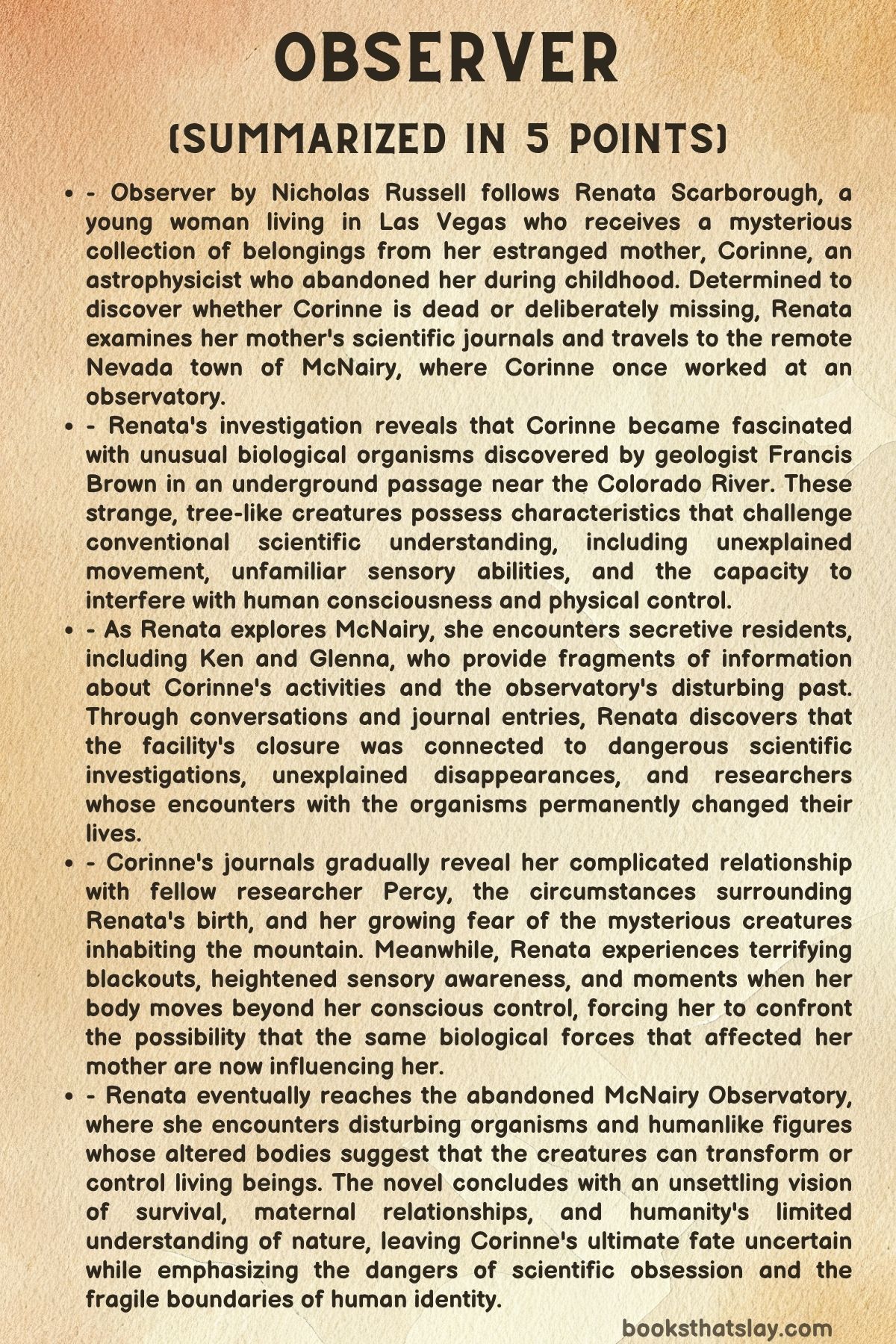
The story follows Renata Scarborough, a young woman who travels to an abandoned Nevada observatory to investigate the disappearance of her estranged mother, Corinne, an astrophysicist involved in disturbing scientific research. What begins as a personal search gradually exposes an ancient and unfamiliar form of life capable of altering human consciousness and controlling physical bodies. Through scientific journals, unsettling encounters, and revelations about the past, the novel explores what happens when human curiosity encounters something beyond its understanding.
Summary
Renata Scarborough lives in Las Vegas with her aunt Tara and cousin V, working at a photography print shop while carrying unresolved questions about her childhood. Her mother, Corinne Scarborough, was an astrophysicist who abandoned her when she was an infant, leaving Tara to raise her.
Renata has grown accustomed to Corinne’s absence, although she has never completely accepted it. Her understanding of her mother comes largely from family accounts, a few photographs, and the occasional personal object.
One afternoon, Renata discovers that her aging Toyota 4Runner has been damaged in a hit-and-run accident. When she returns home, however, she finds something far more unsettling: an enormous collection of her mother’s possessions has unexpectedly arrived at the house.
The delivery contains clothing, photographs, scientific papers, notebooks, jewelry, and other personal belongings. Tara believes the sudden arrival means Corinne has died, although no official confirmation accompanies the possessions.
Renata refuses to accept that conclusion without evidence. She begins searching through the belongings, hoping to discover where Corinne went and why she never returned to her daughter.
Among the items, Renata finds several journals documenting Corinne’s scientific work. She also discovers a locked safe and personal photographs that reveal aspects of her mother’s life she never knew existed.
Her investigation becomes more mysterious when an envelope bearing the insignia of the McNairy Observation Research Outpost arrives. Inside is a check for $300,000 made payable to Renata and Tara.
The money raises additional questions about Corinne’s circumstances. Renata cannot determine whether it represents compensation, an inheritance, or a deliberate attempt to provide for the family without explaining what happened.
As she examines the journals, she repeatedly encounters the name Francis Brown. The earliest entries describe Corinne’s experiences at McNairy Observatory in Nevada during the 1990s and her growing interest in Brown’s unusual geological discoveries.
Brown had worked near the Colorado River and become associated with a remote underground location called Francis Passage. Within this inaccessible site, researchers had discovered an extraordinary organism resembling a tree.
Its strange appearance, unusual movements, and unfamiliar biological characteristics challenged conventional scientific classifications. Although outwardly similar to vegetation, the organism appeared to possess abilities that ordinary plants did not.
Corinne’s fascination with the discovery extended beyond her professional responsibilities as an astrophysicist. She began investigating the passage, the surrounding mountain, and the possibility that the organism represented a previously unknown form of life.
Meanwhile, Renata researches McNairy Observatory and discovers that it operated for only a few years, opening in 1993 and closing in 1997. Its principal instrument used a liquid-mercury mirror, but reliable information about its closure is difficult to obtain.
Her curiosity is strengthened by an encounter with Deb Greatrake, an elderly customer at the photography shop. Deb brings photographs containing tiny images of an unusual bird she has repeatedly observed near her remote Nevada home.
The encounter introduces Renata to the strange environment surrounding McNairy and reinforces her determination to investigate the region herself. Despite Tara’s concern, Renata packs scientific journals, photographic equipment, and supplies before leaving Las Vegas.
The journey takes her across Nevada’s isolated desert highways into a landscape of abandoned buildings and sparsely populated settlements. Along the way, she imagines meeting Corinne and wonders whether she would confront her with anger or ask for an explanation.
When Renata reaches McNairy, she discovers a declining community dominated by the remains of the observatory’s former importance. Many structures stand empty, and the residents seem reluctant to discuss the mountain.
An announcement advertising a reunion of former observatory personnel offers a possible opportunity to learn about Corinne. Renata follows this lead to the Spyglass, a local gathering place where she encounters several residents familiar with McNairy’s past.
Among them is Ken, a guarded man whose scars and unsettling behavior suggest a difficult personal history. Ken warns Renata about the mountain and the abandoned observatory but provides few direct explanations.
At the Spyglass, Renata also meets Bobbie and hears stories about unusual visitors, unexplained incidents, and disturbing events in the surrounding countryside. The residents appear familiar with these occurrences, yet their conversations reveal a shared reluctance to discuss them openly.
An unidentified man carrying a briefcase creates noticeable tension among the patrons. Their reactions convince Renata that McNairy possesses a collective understanding of something dangerous, even if nobody is prepared to explain it to her.
As her investigation continues, Renata experiences a frightening disturbance outside town. Her perception of time changes, her senses register unfamiliar information, and she temporarily loses control over her own body.
When the episode ends, she cannot explain what happened. The experience resembles phenomena described in Corinne’s journals, suggesting that the mysterious organisms may still be active around the mountain.
Renata subsequently meets Glenna, an older resident who remembers Corinne and possesses information about the observatory’s history. Glenna reveals that Renata herself has connections to McNairy that she does not remember.
This discovery challenges Renata’s understanding of her earliest years. She had assumed that her life with Tara began after Corinne abandoned her, but Glenna’s account suggests that the family’s history is considerably more complicated.
Glenna also describes how people came to settle near the observatory and how disturbing experiences gradually became part of the community’s history. Her memories reveal that some researchers disappeared while others withdrew from public life.
As Renata continues reading, she learns that Corinne’s scientific work was increasingly dominated by the organisms discovered through Francis Brown’s investigations. Researchers encountered unusual biological structures capable of producing disorientation, physical changes, and disturbances in consciousness.
The observatory’s closure appears connected to these discoveries. Corinne’s later records describe disagreements among scientists about whether the creatures should be studied, controlled, or left undisturbed.
Some feared that continued exposure would endanger human lives. Others believed that the organisms might remain contained if people stopped entering their territory.
The creatures also seemed influenced by seasonal changes, moisture, and environmental conditions. These observations suggested that their behavior followed biological patterns, even if scientists could not adequately explain those patterns.
Renata’s investigation becomes increasingly dangerous when she enters an underground passage associated with the earlier research. Inside, she encounters animal remains, abandoned objects, and strange surfaces that appear responsive to her presence.
Contact with an unidentified organism causes another terrifying alteration in her awareness. She experiences sensations that suggest her body and perceptions can be influenced by something outside her conscious control.
After escaping, Renata is injured and exhausted. She searches Francis Brown’s writings for explanations and discovers accounts of organisms that resemble trees but display characteristics ordinarily associated with animals.
Brown had observed movement that seemed impossible for vegetation. He also recorded a damaged specimen that appeared to bleed, further challenging the distinction between plant and animal life.
His repeated visits reveal how scientific fascination can become an obsession. Although he eventually distanced himself from the site, his discoveries continued influencing later researchers, including Corinne.
Renata also discovers more personal material in her mother’s journals. Corinne writes about her relationship with fellow researcher Percy, her pregnancy, Renata’s birth, and the difficult circumstances surrounding her family.
These passages complicate Renata’s belief that her mother simply rejected her. They suggest that Corinne was experiencing increasingly frightening events while attempting to maintain her scientific responsibilities and protect the people around her.
Corinne describes abnormalities in local wildlife and vegetation, disturbing incidents involving Tara, and organisms capable of approaching sleeping human beings. She becomes convinced that the creatures can interact with human bodies in ways nobody fully understands.
Meanwhile, Renata encounters Ken again after discovering that he has followed her. Their confrontation becomes violent when she responds to his secrecy and intrusion with anger.
Afterward, Renata tends to his injured foot, and Ken recalls Corinne’s repeated visits to McNairy after the observatory closed. He remembers her examining maps, organizing excursions, and disappearing into the surrounding landscape.
His information confirms that Corinne remained involved with the mountain long after her official scientific work supposedly ended. Renata realizes that her mother’s absence cannot be explained simply by the observatory’s closure.
Determined to reach the abandoned facility, Renata continues climbing despite her injuries. A landslide forces her away from the damaged service road, and the difficult terrain leaves her physically depleted.
During the ascent, another extraordinary episode overwhelms her senses. She temporarily loses control over her movements and later discovers that she has crossed dangerous ground without remembering how she did so.
The experience suggests that the influence of the organisms extends beyond ordinary perception. Renata begins to fear that her own body may no longer respond entirely to her conscious decisions.
One of Corinne’s most revealing journal entries describes her deteriorating condition in 1997. She records blackouts, heightened awareness, unexplained sensations, and fears that her mind is becoming unreliable.
She also describes disturbing discoveries involving underground waterways, abnormal human remains, and biological structures that appear capable of altering people. Her research gradually becomes an attempt to understand the danger and prevent further exposure.
Corinne believes that the mountain contains something ancient that researchers have disturbed without comprehending its nature. She warns against entering certain areas and suggests that disturbed earth may indicate the creatures’ presence.
As Renata approaches the abandoned observatory, the historical accounts become immediate reality. She encounters organisms and humanlike figures whose bodies and behavior reveal the terrifying possibilities of biological transformation.
The creatures appear capable of influencing human movement, consciousness, and sensory experience. Renata struggles to distinguish her own actions from responses that may be imposed upon her by an unfamiliar force.
Her confrontation at the observatory becomes a desperate struggle for survival. Injured and disoriented, she faces the same dangers that consumed the lives and research of Corinne, Percy, and the earlier investigators.
The ending expands beyond Renata’s immediate experiences, presenting images of a fleeing child, a pursuing mother, a wounded survivor, and strange beings moving across the landscape. An aerial observer watches the unfolding events, emphasizing the uncertain relationship between those who observe and those being observed.
Rather than providing complete answers about Corinne’s ultimate fate or the organisms’ nature, the novel concludes with an unsettling vision of humanity’s limited place within the natural world. Renata’s search for her mother has exposed a reality in which identity, survival, and biological existence are far less stable than she once believed.
Characters
Renata Scarborough
Renata Scarborough is the central protagonist of Observer, a young woman whose search for her estranged mother gradually becomes a confrontation with forces that challenge her understanding of human identity. Living in Las Vegas with her aunt Tara and cousin V, Renata has built an ordinary life around her work at a photography print shop, although her mother’s abandonment remains an unresolved emotional burden.
Her personality combines independence, curiosity, resentment, and a determination to uncover uncomfortable truths. Although she initially appears relatively comfortable with her life, the unexpected arrival of Corinne’s possessions reveals how deeply her mother’s absence continues to influence her.
Renata’s relationship with Corinne is defined largely by uncertainty rather than direct experience. She has spent much of her life attempting to understand why her mother left, and the absence of reliable explanations has encouraged her to interpret Corinne’s behavior as indifference.
The journals disrupt this interpretation by revealing a woman whose circumstances were far more complicated than Renata imagined. As she reads, Renata must confront the possibility that her mother’s departure involved danger, scientific obsession, and an attempt to protect others rather than a simple rejection of motherhood.
Her profession as a photographer is significant because it reflects her desire to preserve and examine evidence. She approaches photographs and documents as sources of information, but her experiences at McNairy expose the limitations of observation when sensory perception itself becomes unreliable.
Renata’s courage is accompanied by impulsiveness and anger. Her confrontation with Ken reveals her capacity for aggression, while her determination to continue climbing the mountain despite serious injuries demonstrates how easily her need for answers can override self-preservation.
The most disturbing aspect of her development involves losing control of her own body. As unfamiliar sensations and interruptions of consciousness intensify, Renata becomes uncertain whether her thoughts and movements belong entirely to her.
This transformation makes her struggle both physical and psychological. She is no longer investigating only what happened to Corinne but also whether she can preserve her own identity.
By the conclusion, Renata represents humanity’s vulnerability when confronted with unfamiliar forms of existence. Her journey exposes the limits of personal knowledge while demonstrating how a search for family history can become an encounter with something much larger than an individual’s past.
Corinne Scarborough
Corinne Scarborough is one of the most psychologically complicated characters in Observer, functioning as both the source of Renata’s emotional suffering and the principal figure connecting the family mystery to the scientific discoveries at McNairy. An ambitious astrophysicist, Corinne devoted much of her professional life to research that eventually exposed her to dangerous biological phenomena.
At first, she exists primarily through Renata’s memories and resentment. Her absence encourages the impression of a woman who valued scientific achievement more than motherhood and willingly abandoned her daughter.
The journals gradually reveal a more complicated individual. Corinne was intellectually ambitious, intensely observant, and willing to pursue difficult questions even when her research led her outside her original scientific discipline.
Her fascination with Francis Brown’s discoveries demonstrates both her strengths and weaknesses. She recognizes the importance of investigating unfamiliar organisms, but her determination to understand them exposes her and others to dangers that conventional scientific methods cannot adequately contain.
Corinne’s relationship with Percy introduces another dimension to her personality. Her changing understanding of him reveals her capacity for affection, vulnerability, and emotional attachment beneath an outwardly analytical disposition.
Her experiences of pregnancy and motherhood further complicate her characterization. She attempts to reconcile family responsibilities with scientific obligations, but the worsening circumstances around McNairy make those competing commitments increasingly difficult to manage.
Corinne’s later writings reveal someone struggling against deteriorating physical and mental conditions. Blackouts, altered perception, and frightening sensory experiences undermine the rational control upon which she has built her professional identity.
Her concern about the organisms also develops from fascination into fear. She increasingly recognizes that scientific discovery does not necessarily justify continued experimentation, particularly when researchers cannot predict the consequences of exposure.
Corinne’s decisions remain morally ambiguous because her apparent efforts to prevent harm cannot erase the suffering caused by her prolonged absence. The novel neither entirely condemns nor fully excuses her, instead presenting a woman whose ambition, fear, responsibility, and maternal relationships became inseparable.
Through Corinne, the story examines the consequences of pursuing knowledge without understanding its potential cost. Her experiences suggest that intelligence and scientific training offer no guarantee of safety when researchers encounter phenomena beyond their established understanding.
Tara Scarborough
Tara Scarborough serves as Renata’s principal parental figure, providing the stability and care that Corinne failed to offer throughout much of her daughter’s life. As Corinne’s sister, Tara occupies a difficult position between protecting Renata and confronting the unresolved consequences of her own family history.
Her practical personality contrasts with Corinne’s intellectual ambition and emotional distance. Tara is accustomed to managing everyday responsibilities, and her decisions generally reflect a preference for stability over speculation.
When Corinne’s possessions arrive unexpectedly, Tara quickly assumes that her sister has died. Her reaction reflects years of disappointment and suggests that she has become unwilling to interpret Corinne’s unexplained behavior with optimism.
Her arguments with Renata expose tensions beneath their otherwise secure relationship. Tara believes that Corinne has repeatedly demonstrated her unreliability, while Renata feels that her aunt may be withholding information about the past.
These conflicts are especially painful because Tara is the person Renata trusts most. The possibility that she maintained contact with Corinne without telling her niece introduces uncertainty into a relationship previously defined by protection and familiarity.
Tara’s experiences around McNairy also suggest that her understanding of Corinne’s activities may be more complicated than she admits. Corinne’s journals describe frightening incidents involving her sister, connecting Tara directly to the disturbing history of the mountain.
Nevertheless, Tara remains an important emotional anchor. Her years of raising Renata demonstrate that parental responsibility is established through consistent care rather than biological connection alone.
Tara represents the ordinary family life threatened by the consequences of extraordinary scientific discoveries. Her determination to protect Renata is understandable, even when that protectiveness contributes to secrecy and misunderstanding.
V
V is Renata’s cousin and one of the most dependable sources of companionship in Observer. Having grown up alongside Renata under Tara’s care, V occupies a position closer to a sibling than a distant relative.
V’s personality is practical, supportive, and generally more grounded than Renata’s increasingly obsessive approach to investigating Corinne. Their familiarity allows them to discuss difficult subjects without the same emotional tensions that frequently arise between Renata and Tara.
Early in the story, V examines Renata’s damaged Toyota and offers reassurance about its condition. This seemingly ordinary interaction establishes V as someone capable of responding to problems with practical assistance rather than unnecessary alarm.
As Renata becomes absorbed in her mother’s journals, V remains interested in her discoveries. Although concerned about the risks of traveling to McNairy, V recognizes Renata’s need to investigate her family history independently.
Their telephone conversations provide Renata with emotional continuity during her increasingly disturbing experiences. V offers encouragement and suggestions while reminding her that people outside the isolated town remain concerned about her welfare.
The relationship also emphasizes the difference between inherited family obligations and relationships formed through shared experience. V and Renata possess a history of mutual companionship that contrasts sharply with Corinne’s prolonged absence.
V’s importance is not dependent upon directly confronting the organisms or solving the central mystery. Instead, the character represents the ordinary human connections that give Renata something worth returning to.
Through V, the novel shows how trust and familiarity can provide stability even when the larger world becomes unpredictable.
Francis Brown
Francis Brown is an important historical figure whose geological discoveries establish the scientific mystery underlying Observer. Although much of his involvement emerges through diaries and recollections, his investigations provide the foundation for Corinne’s research and Renata’s later experiences.
Brown worked on geological assignments involving remote measuring stations near the Colorado River. His professional responsibilities brought him into contact with an underground passage containing an organism unlike anything he had previously encountered.
Initially, Brown approached the discovery with skepticism and the observational discipline expected of a scientist. The creature’s apparent resemblance to a tree encouraged familiar botanical explanations, but its unusual movements and physical characteristics gradually made such interpretations inadequate.
His repeated visits demonstrate how fascination can develop into intellectual fixation. Even when direct evidence remained difficult to reproduce, he continued documenting the organism and searching for patterns in its behavior.
The discovery of a damaged specimen that appeared to bleed further challenged his assumptions about biological classification. Brown began confronting the possibility that the organism belonged to an unfamiliar category of life.
His relationship with Wilshire also illustrates the difficulty of evaluating extraordinary experiences through ordinary professional expectations. Behavior that initially appeared eccentric acquired new significance once Brown recognized the strangeness of their discovery.
Brown’s personal reflections, including references to Lenny, prevent him from functioning solely as a source of scientific information. They reveal an individual attempting to maintain an ordinary life while becoming increasingly occupied with something he cannot explain.
His eventual departure from the site suggests that curiosity has limits and that withdrawal may sometimes be a more reasonable response than continued investigation.
Francis Brown represents the first stage of humanity’s confrontation with the unknown. His records preserve observations that later investigators rely upon, but they also demonstrate how little understanding can emerge from repeated exposure to an unfamiliar phenomenon.
Percy
Percy is a significant researcher associated with Corinne and the investigations surrounding Francis Passage. His importance emerges through Corinne’s journals and Edith’s recollections, which describe both his intellectual abilities and his increasingly dangerous involvement with the mysterious organisms.
Corinne initially underestimates Percy before gradually recognizing his intelligence and emotional significance. This changing relationship reveals that Percy possesses qualities extending beyond his professional contribution to the research.
His association with the passage places him among those most directly exposed to the organisms. As his investigations progress, the risks surrounding his work become increasingly difficult to separate from the scientific questions he hopes to answer.
Edith’s recollections reveal that communication with Percy eventually diminished. This uncertainty suggests that his research led him into circumstances from which he could not easily withdraw.
Percy’s role also demonstrates how isolation can intensify the consequences of scientific obsession. The more deeply researchers become involved with the discoveries, the more difficult it becomes for outsiders to understand their experiences or intervene.
His relationship with Corinne contributes to the emotional dimension of the narrative. Her recollections reveal personal attachment alongside professional concern, making his uncertain circumstances especially significant.
Although the available account does not establish every detail of Percy’s fate, his disappearance from regular communication contributes to the broader pattern of people whose lives were permanently altered by their investigations.
Percy represents the vulnerability of researchers whose intellectual abilities cannot protect them against dangers they do not fully recognize.
Edith
Edith is an experienced figure connected to the research history of McNairy and the dangerous events surrounding the observatory. Her previous involvement with government operations and hazardous environments gives her a practical perspective on risk.
Unlike individuals motivated primarily by scientific discovery, Edith appears particularly aware of the consequences of entering dangerous places without sufficient information. Her background suggests familiarity with situations in which institutional procedures and personal survival can come into conflict.
Her recollections about Percy provide important historical context for Renata’s investigation. She explains how his communication diminished, contributing to the uncertainty surrounding the earlier research.
Edith is also associated with disagreements about the organisms and the appropriate response to their existence. These tensions highlight the difficulty of deciding whether an unfamiliar danger should be investigated further or left undisturbed.
Her importance lies partly in her connection to institutional knowledge. She represents a world in which scientific discoveries, government interests, and decisions about acceptable risk may overlap.
However, her experience does not grant her complete understanding of the organisms. The extraordinary nature of the discoveries challenges even people accustomed to dangerous environments.
Edith’s characterization reinforces the idea that practical knowledge and professional experience have limitations. She provides valuable information without resolving the fundamental uncertainty surrounding the creatures.
Ken
Ken is one of the most enigmatic residents of McNairy, initially appearing as a guarded local man whose scars and unsettling behavior suggest a complicated personal history. His interactions with Renata alternate between caution, secrecy, assistance, and confrontation.
When Renata first meets him, Ken warns her about approaching the abandoned observatory. His reluctance to provide straightforward explanations makes him appear suspicious, particularly because he seems familiar with dangers that outsiders do not understand.
At the Spyglass, Ken introduces Renata to aspects of the community’s social life. His reactions to unusual visitors and disturbing local incidents suggest that he shares the town’s habit of acknowledging strange events without openly discussing them.
Ken’s behavior becomes more troubling when Renata discovers that he has followed her. Their confrontation exposes the growing tension between her determination to uncover the truth and her suspicion that local residents are deliberately obstructing her.
Renata’s aggression leaves Ken injured, but their subsequent conversation reveals more about his past. He recalls growing up in McNairy, spending time with other teenagers, and observing activities associated with Corinne and the surrounding mountain.
His memories confirm that Corinne returned to the area after the observatory’s closure. He recalls her examining maps, organizing excursions, and maintaining relationships with local residents.
Ken’s character illustrates the difference between possessing knowledge and being willing or able to communicate it. Although he understands more about the town’s history than Renata initially realizes, his information remains incomplete.
His uneasy relationship with Renata also reveals the consequences of mistrust. Both characters possess reasons for caution, but their reluctance to understand each other’s intentions contributes to violence.
Ken ultimately represents the human aftermath of McNairy’s disturbing history, embodying the guarded survival instincts of a community accustomed to danger.
Glenna
Glenna is an older resident whose recollections provide Renata with important information about Corinne and McNairy’s history. Her connection to the town extends beyond the observatory’s scientific activities, allowing her to offer a broader perspective on the people affected by its existence.
Originally from Maine, Glenna moved west after experiencing serious medical difficulties. Her decision to settle in the remote desert reflects a search for a different life and establishes her as someone familiar with personal upheaval.
Her account of McNairy reveals how residents arrived for different reasons, including employment, isolation, and the desire to escape earlier circumstances. Through her memories, the community becomes more than an abandoned scientific settlement.
Glenna’s most significant contribution involves her familiarity with Corinne and Renata’s forgotten connection to the town. Her remarks challenge Renata’s assumptions about her early childhood and indicate that the family history she inherited is incomplete.
Unlike Tara, Glenna approaches Corinne through direct recollections of her activities in McNairy. This alternative perspective allows Renata to consider explanations that her family relationships previously discouraged.
Glenna also illustrates the importance of local memory in reconstructing events that formal records cannot adequately explain. Her knowledge comes from observing people, remembering relationships, and witnessing changes within the community.
Although she cannot answer every question, Glenna helps Renata recognize that individual experiences often survive beyond institutional histories.
Her character represents the value of testimony and the importance of perspectives that exist outside formal scientific documentation.
Deb Greatrake
Deb Greatrake is an elderly customer Renata encounters at the photography print shop. Although her appearance is relatively brief, she contributes to the story’s developing atmosphere of uncertainty.
Deb brings unusual black-and-white photographs that appear almost empty except for small, dark shapes. She explains that the images depict an unusually large bird she has repeatedly observed near her home.
Her familiarity with the remote settlement of Mercury connects her indirectly to the region surrounding McNairy. Her comments introduce Renata to the possibility that strange occurrences extend beyond the observatory itself.
Deb’s photographs also reinforce the significance of visual evidence. The images contain something recognizable yet difficult to examine, suggesting that photographic documentation cannot always provide complete understanding.
Her character contributes to the novel’s gradual shift from ordinary reality toward biological uncertainty. Something that initially appears insignificant becomes part of a larger pattern of unusual observations.
Deb serves as an early reminder that extraordinary phenomena may exist unnoticed within familiar environments, becoming visible only when someone pays closer attention.
Bobbie
Bobbie is one of the McNairy residents Renata encounters while visiting the Spyglass. Although the supplied account provides limited personal background, Bobbie contributes to the conversations that reveal the community’s unusual relationship with its surroundings.
The discussions involving Bobbie and other residents include unsettling visitors, strange behavior, and incidents that people have learned to regard as part of local life.
This apparent familiarity with disturbing events contrasts with Renata’s reactions as an outsider. What she considers extraordinary has become something the residents acknowledge without necessarily attempting to explain.
Bobbie contributes to the portrayal of McNairy as a community shaped by shared experiences and incomplete understanding. The residents’ reluctance to speak openly suggests that repeated exposure to danger can produce caution rather than curiosity.
Although Bobbie does not emerge as a principal investigator or central figure in the family mystery, the character helps establish the social atmosphere surrounding the abandoned observatory.
Wilshire
Wilshire is a colleague of Francis Brown whose unusual behavior initially appears eccentric rather than threatening. He becomes significant through Brown’s diary, which records their work and the circumstances surrounding the discovery of the unfamiliar organism.
Brown’s changing interpretation of Wilshire reflects the larger difficulty of distinguishing ordinary human behavior from the consequences of exposure to strange phenomena.
Their professional association demonstrates how research partnerships can become complicated when investigators encounter evidence that challenges accepted scientific knowledge.
Wilshire also helps establish the early history of Francis Passage, showing that the organisms attracted attention before Corinne and the McNairy researchers became involved.
Although the supplied material does not establish Wilshire’s complete personal history or ultimate fate, his presence contributes to the uncertainty surrounding the original discoveries.
Terrence
Terrence is Corinne’s brother, appearing through her personal recollections of family relationships and earlier conflicts. His presence expands the family history beyond the central relationships among Renata, Corinne, and Tara.
Corinne’s reflections reveal that her relationship with Terrence involved disagreements and regrets. These memories suggest that her difficulties with family obligations were not confined to her experience of motherhood.
Terrence’s role also connects Corinne’s scientific decisions to consequences affecting people outside her professional environment. Her acknowledgment of past mistakes indicates that she understands at least some of the personal damage associated with her choices.
Although Terrence occupies a limited position in the supplied account, he adds another dimension to Corinne’s emotional history and reinforces the importance of family responsibility.
Lenny
Lenny appears in Francis Brown’s personal recollections, providing a glimpse into the relationships that existed beyond his geological investigations. The references to Lenny show that Brown’s life was not exclusively defined by professional ambition or scientific curiosity.
This personal connection creates a contrast between ordinary human attachments and Brown’s growing fascination with Francis Passage.
As his attention becomes increasingly concentrated on the unfamiliar organism, his broader life provides a reminder of what scientific obsession can place at risk.
The supplied account does not establish enough information to describe Lenny’s personality or circumstances in greater detail. Nevertheless, the character helps humanize Brown by suggesting the existence of relationships outside his research.
Themes
The Limits of Scientific Knowledge and Human Understanding
The mysterious organisms discovered around McNairy challenge humanity’s confidence in its ability to classify and explain the natural world. Researchers initially approach these beings through familiar scientific methods, attempting to document their appearance, movement, biological characteristics, and environmental behavior.
However, the organisms repeatedly contradict conventional distinctions between plants and animals. Their tree-like structures suggest vegetation, yet their apparent mobility, responsiveness, and capacity to bleed reveal processes that established classifications cannot easily accommodate.
In Observer, scientific observation becomes increasingly unreliable because the beings appear capable of influencing the observers themselves. Researchers who hope to examine the creatures objectively experience changes in consciousness, physical control, and sensory awareness.
Corinne’s experiences demonstrate the limitations of intelligence and professional training. Her knowledge of astrophysics provides a disciplined approach to investigation, but it cannot protect her from biological phenomena that interfere with her ability to perceive reality.
Francis Brown faces a similar difficulty when repeated observations produce more questions than answers. His inability to reproduce certain experiences illustrates the challenge of studying phenomena that do not behave predictably.
The observatory becomes a powerful symbol of this contradiction. Constructed to extend humanity’s ability to examine the universe, it stands on a mountain containing forms of life that researchers cannot adequately understand within their own environment.
The novel does not necessarily reject scientific inquiry. Instead, it questions the assumption that every discovery can be safely investigated or that increased knowledge inevitably produces greater control.
Human understanding emerges as provisional, dependent upon the reliability of perception and the limitations of existing conceptual frameworks. The creatures expose the possibility that the natural world contains forms of existence fundamentally different from anything humans have previously recognized.
Motherhood, Abandonment, and the Burden of Family History
Renata’s search for Corinne grows from the emotional consequences of maternal abandonment. Having been raised by Tara, she understands the practical meaning of family responsibility but struggles to reconcile her mother’s biological connection with her prolonged absence.
Corinne initially exists in Renata’s imagination as a woman who chose professional ambition over her daughter. This interpretation has shaped Renata’s childhood and influenced her expectations about trust, affection, and personal commitment.
The discovery of Corinne’s journals complicates those assumptions. Her writings reveal a woman confronting dangerous circumstances, physical deterioration, scientific obligations, and difficult decisions involving the safety of others.
Yet understanding the circumstances surrounding abandonment does not automatically eliminate its consequences. Renata’s resentment remains legitimate because Corinne’s absence deprived her of a relationship she had no opportunity to develop.
Tara provides an alternative model of motherhood through consistent care and responsibility. Her position demonstrates that parental identity is not determined exclusively by biological relationships but also by the willingness to remain present.
The theme becomes more disturbing as Renata encounters evidence that her early history may differ from what she remembers. Her search therefore concerns not only why Corinne left but also whether the family narrative she inherited accurately represents what happened.
The ending’s imagery of a fleeing child and a pursuing mother gives these questions an unsettling biological dimension. Maternal connection becomes associated with pursuit, survival, protection, and possible danger rather than unconditional security.
Through these relationships, the novel examines how children inherit emotional consequences from decisions they did not make. Family history becomes something Renata must investigate and interpret before she can begin understanding her own identity.
Identity, Bodily Autonomy, and the Reliability of Perception
Renata’s experiences at McNairy gradually undermine her confidence in the relationship between her consciousness and her physical body. What begins as an investigation into external events becomes a disturbing examination of whether individual identity depends upon control over perception and movement.
Her unexplained blackouts and sensory disturbances establish that her body can apparently perform actions without her conscious participation. During one episode, she crosses dangerous terrain but cannot remember how she managed to move.
These incidents challenge a fundamental assumption about personhood: that an individual’s body belongs to and responds to a recognizable, continuous self. Renata increasingly fears that unfamiliar processes may influence decisions and movements she believes should remain under her control.
Corinne’s journals establish that these experiences are not unique. Her own blackouts, heightened senses, and altered awareness suggest that the organisms interfere with human consciousness in ways that researchers never fully understood.
The disturbances also complicate the distinction between psychological instability and external biological influence. Characters cannot easily determine whether their frightening experiences arise from their minds, their bodies, or something outside themselves.
The humanlike figures encountered near the observatory extend this uncertainty. Their altered behavior raises questions about whether recognizable physical appearance is sufficient evidence that a familiar personality remains present.
Observer treats identity as potentially unstable rather than permanently secured by memory or physical form. The organisms expose the possibility that human consciousness can be interrupted, redirected, or transformed without an individual’s permission.
This theme produces horror because it threatens something more intimate than physical survival. Renata must confront the possibility that she could remain alive while losing the ability to determine what her body does or even recognize which experiences belong to her.
Obsession, Human Interference, and the Consequences of Curiosity
Francis Brown’s repeated visits to the underground passage establish a pattern of curiosity developing into dangerous fixation. Although he initially approaches the unfamiliar organism as a geological discovery, his desire to understand it gradually becomes difficult to separate from personal obsession.
Corinne follows a comparable path when she becomes increasingly involved with the phenomena around McNairy. Her professional ambition and intellectual curiosity encourage her to continue investigating even as evidence accumulates that the organisms may threaten human life.
The researchers’ behavior raises questions about whether the pursuit of knowledge always justifies the risks associated with obtaining it. Their discoveries possess considerable scientific significance, but repeated contact appears to expose individuals to consequences they cannot predict or reverse.
Disagreements among the researchers further complicate the issue. Some believe that continued investigation is necessary, while others recognize that leaving the organisms undisturbed may be the safest available option.
The mountain’s environmental conditions suggest that the creatures existed independently of human discovery. Their connection to moisture, seasonal changes, and underground spaces presents them as participants in an unfamiliar ecological system rather than entities created for human observation.
The observatory’s construction and subsequent research activities represent attempts to impose human purposes upon a landscape whose biological history remains poorly understood. The resulting dangers suggest that interference can destabilize relationships that existed long before scientists arrived.
Renata’s behavior extends this theme into the present. Although her original motivation is emotional rather than scientific, her determination to uncover the truth increasingly places her in the same position as the researchers whose decisions contributed to McNairy’s tragic history.
Her willingness to continue despite injuries and frightening experiences demonstrates how the need for answers can become more powerful than the instinct for self-preservation.
The novel ultimately presents curiosity as both a valuable human quality and a potential source of destruction. It suggests that wisdom sometimes requires recognizing the limits of investigation and accepting that understanding something may come at a cost greater than the knowledge gained.