Dissection of a Murder Summary, Characters and Themes
Dissection of a Murder by Jo Murray is a psychological legal thriller about a barrister defending a former client against a murder charge while secretly knowing far more about the crime than anyone realizes.
Through courtroom battles, concealed affairs, professional rivalries, childhood trauma, and carefully manipulated evidence, the novel questions whether legal truth is the same as justice. Its central figure, Leila Reynolds, has built a respected identity over the remains of a violent past, but the murder of Judge Anton Smythe threatens to expose every secret she has buried. The story presents guilt and innocence as complicated moral conditions rather than simple legal categories.
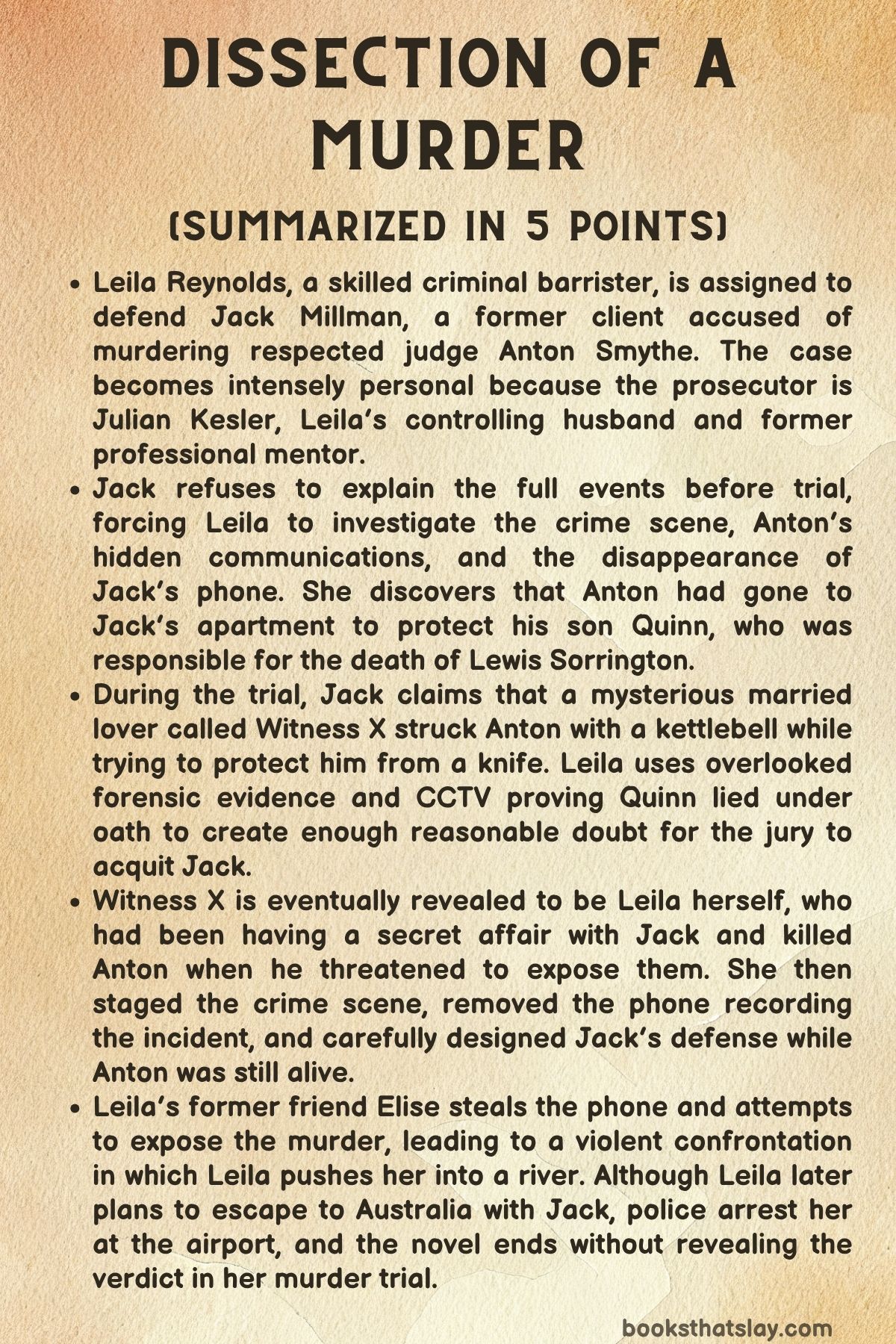
Summary
An unidentified defendant awaits a verdict for the murder of Crown Court judge Anton Smythe. Although the evidence appears overwhelming, the defendant privately admits responsibility while insisting that the death was necessary and that a guilty verdict would not represent genuine justice.
Several months earlier, criminal barrister Leila Reynolds returns to Innovation Chambers after winning a difficult sexual-assault case. Her senior clerk, Jim, gives her the most important brief of her career: Jack Millman, a former client, has been charged with Anton’s murder and has specifically requested her representation.
The case is professionally dangerous because Leila has never led a murder trial and Anton was a respected member of the judiciary. It becomes personally explosive when she learns that the prosecutor will be Julian Kesler KC, her former pupilmaster and current husband.
Julian dismisses Leila’s chances, predicting that Jack will plead guilty once he sees the prosecution evidence. Other barristers imply that Leila owes her career to Julian and joke that the case will allow him to defeat his younger wife publicly.
Anton was found fatally injured inside Jack’s apartment above Temptation, an exclusive club associated with wealthy criminals, drugs, prostitution, and powerful clients. Jack was present, a heavy kettlebell appeared to be the weapon, and he answered every police question with “no comment.”
When Leila meets Jack in custody, he maintains his innocence but refuses to explain what happened. He claims his phone was stolen before Anton’s death and says it contained information capable of endangering several people.
Jack’s refusal is connected to an earlier case. Five years before, Leila represented him after he assaulted criminal Tony Flanagan while stopping him from attacking hostess Mia Woods.
Leila followed Julian’s advice and disclosed Mia’s identity before trial. Flanagan’s associates apparently frightened her into silence, Jack was convicted, and Leila learned that strict obedience to procedure can sometimes help powerful people destroy the truth.
Jack now refuses to provide a defense statement because he does not want witnesses or evidence to disappear again. He tells Leila to investigate independently and trust no one, repeating advice she once gave him after his wrongful conviction.
Meanwhile, chapters narrated by “Witness X” describe a woman raised by an abusive, manipulative father. He taught her rules about secrecy, lying, seduction, patience, emotional control, and the use of personal knowledge as a weapon.
Witness X reveals that she had been involved in a seven-month affair and was present when Anton died. She believes her controlling husband might kill her if the relationship is exposed, while Jack’s silence is the only thing protecting her identity.
Leila’s private life begins to unravel. Julian admits that he arranged the flattering professional recommendation she believed she had earned, turning her achievement into another example of his influence over her career.
Anonymous messages also begin attacking Leila’s public identity. The sender knows that she attended an expensive boarding school despite presenting herself as entirely working-class, and the messages accuse her of using relationships with powerful men to advance professionally.
A hostile woman confronts Leila during a school talk, a hooded figure waits near her car, and someone watches her house. The account @JustAnotherDumbBlonde then sends information about Anton’s final movements that was never publicly released.
Leila reviews the physical evidence with Jack’s solicitor, Davina Jessop. Anton died from a heavy blow to the head, but the crime scene also contained unidentified female hairs, several unknown fingerprints, drinking glasses, a lighter, and evidence of a struggle.
The kettlebell had been used as a bedroom doorstop before the killing and was returned to that position afterward. Leila reasons that Jack, an experienced criminal, would not have made such an obvious attempt to restore the scene.
A visit to the apartment strengthens her theory. If Jack and Anton were struggling in the kitchen, Jack would have needed to leave the fight, enter the bedroom, retrieve the kettlebell, and return while Anton waited instead of escaping through the nearby front door.
Leila concludes that a third person must have been near the bedroom and struck Anton unexpectedly. Jack’s injuries also suggest that Anton attacked him, possibly while holding the kitchen knife found at the scene.
Jack’s missing phone becomes equally important. Records show that it was activated near Anton’s rural home after Jack had already been arrested, indicating that someone else carried it there to create a misleading digital trail.
Leila secretly searches Julian’s locked study and finds undisclosed messages from Anton’s phone. Anton had arranged to meet an unknown person at Diamond Lounge and promised to settle a serious matter on the night he died.
Using a false identity, Leila and Davina discover that the messages were sent to Anton’s son, Quinn. CCTV shows Anton meeting an anxious Quinn and also reveals that Jack had confronted Quinn one week before the murder.
Jack directs Leila toward the notebook from his earlier trial. A remark buried in her notes reveals that Temptation secretly records one private room despite claiming to have no CCTV.
The hidden footage shows Jack confronting Quinn about a video. Quinn offers money, but Jack refuses and orders him to confess to killing someone, giving him one week before the evidence is taken to the police.
Further investigation reveals that the victim was Lewis Sorrington, the son of Temptation’s owner, Eddie Sorrington, and his wife, Daniella. Quinn and several friends attacked Lewis, whose injuries proved fatal, while Jack obtained a recording of the incident.
Jack did not immediately tell Eddie because he feared the grieving father would retaliate violently. Anton visited the apartment to recover the recording, protect Quinn, and prevent the Sorrington family from learning the truth.
Leila also investigates Demi, the wife of chambers head Chester Vernon. Chester suspects Demi is having an affair, and Leila discovers messages showing that Demi is pregnant by another man who refuses to accept responsibility.
The lover is Julian. When confronted, he minimizes the betrayal, insults Leila’s professional ability, and threatens to keep her trapped in the marriage rather than allow her to leave happily.
Warnings from Julian’s former wife, Sienna, and his mother, Audrey, help Leila recognize his controlling nature. She understands that Sienna did not simply betray Julian as he claimed; she escaped a man who punishes women when they cease to admire or obey him.
At Jack’s trial, Julian presents Anton as a respected judge murdered by a violent criminal. The police emphasize Jack’s silence, the delayed emergency call, the missing phone, and the kettlebell, while the pathologist explains that quicker medical treatment might have saved Anton.
Leila exposes weaknesses in the investigation. No forensic evidence proves Jack handled the kettlebell, female traces were disregarded, unknown fingerprints were ignored, and the police decided too early that Jack must be guilty.
Jack finally testifies without having previously revealed his account. He explains that Anton came to retrieve the video of Quinn attacking Lewis and brought a knife when Jack refused to surrender the phone.
Jack then reveals that a married woman was hiding in the bedroom. Anton recognized her, attempted to contact her husband, and fought with Jack while holding the knife.
According to Jack, Witness X emerged from the bedroom, picked up the kettlebell, and struck Anton to protect him. Jack refuses to identify her because he loves her and believes exposure would destroy her life.
The anonymous woman is actually Leila. She and Jack had been conducting an affair, and Jack’s phone had been recording their intimate encounter when Anton unexpectedly arrived.
The recording captured Anton’s confrontation with Jack and the fatal blow. Anton recognized Leila, threatened to expose her to Julian, and mocked the false identity she had built over her traumatic childhood.
Leila struck Anton partly because she feared he would stab Jack, but also because she wanted to silence him. Afterward, she prevented Jack from immediately calling an ambulance and decided that Anton could not be allowed to survive and reveal everything.
While Anton remained alive, Leila designed the future defense. She planted female hairs, glasses, fingerprints, perfume, and a lighter, altered Jack’s clothing and injuries, wiped the kettlebell, returned it to the bedroom door, and took the phone.
She later activated the device near Anton’s house and hid it in a safe at Audrey’s home. Jack agreed to remain silent, face arrest, and reveal Witness X only when the trial had begun and the prosecution could no longer easily destroy the supporting evidence.
Julian attacks Jack’s story as an invention, arguing that no loving woman would permit him to risk life imprisonment. His questioning, however, allows Leila to recall Quinn and produce CCTV proving that he lied under oath about his meetings with Jack.
The evidence damages the prosecution’s account and establishes a credible reason for Anton’s presence. Leila closes by arguing that Jack’s criminal record does not prove he committed this murder and that the unanswered evidence creates reasonable doubt.
The jury acquits Jack. Leila also uses proof of Julian’s affair with Demi to force him to accept a quick divorce, apparently freeing herself professionally and personally.
Her danger continues because the stalker has stolen Jack’s phone from Audrey’s house. The stalker is Elise Vernon, Chester’s estranged daughter and Leila’s former school friend.
Years earlier, Leila seduced Chester to secure access to his chambers, helping destroy his marriage and betraying Elise. Elise discovered Leila’s meetings with Jack before Anton died, followed her on the fatal night, and watched her hide the phone.
Leila meets Elise on a secluded bridge. During their struggle, Leila chokes her and pushes her into the freezing river, then retrieves the phone and assumes the evidence has been destroyed.
The novel reveals that Leila was born Delilah, the daughter of a sexually abusive criminal. At sixteen, she killed her father by setting fire to their house and made the death appear accidental before reinventing herself as Leila Reynolds.
After Jack’s acquittal, Leila abandons Julian, considers leaving the legal profession, and reunites with Jack. They prepare to leave Britain for Australia, believing they can begin a new life together.
At the airport, police arrest them. Elise had sent a copy of the recording to her mother with instructions to contact the authorities if anything happened to her.
Leila finally chooses accountability over self-protection. She tells Jack to reveal everything and immediately declares that he had no responsibility for the murder or its concealment.
The final scenes return to the courtroom from the opening. Delilah is prosecuted for Anton’s murder, while the recording and Jack’s testimony expose the true events.
She has not yet been charged with Elise’s death because Elise’s body remains missing. The jury must decide whether the blow was lawful defense of Jack or an intentional act driven by rage, fear, and self-preservation.
Delilah privately knows that her motives were not innocent, but she presents herself as an abused woman trying to save the first man who truly loved her. The jury initially fails to agree, and the novel ends just before a majority verdict is announced, leaving her legal fate unresolved.
Characters
Leila Reynolds / Delilah
At the center of Dissection of a Murder, Leila Reynolds is both a talented criminal barrister and an unreliable architect of her own reality. Her polished professional identity conceals Delilah, the abused child who learned that survival depended on deception, observation, patience, and control.
Leila’s ambition is not merely a desire for status. Becoming a barrister allows her to replace the powerless child she once was with someone respected, articulate, and capable of challenging authority.
Her public commitment to justice exists beside a willingness to manipulate legal procedure whenever formal rules threaten her safety. She understands evidence, juries, witnesses, and courtroom psychology so thoroughly that she can design a defense for Jack before the police investigation has properly begun.
Her love for Jack reveals her capacity for loyalty and genuine emotional intimacy. Nevertheless, that love does not erase her selfish motives, because she strikes Anton partly to save Jack and partly to prevent the destruction of her marriage, reputation, and career.
Leila’s final admission protects Jack and represents meaningful moral growth. It does not absolve her of killing Anton, delaying medical assistance, staging the scene, manipulating a trial, or causing Elise’s apparent death, but it shows that she can finally choose responsibility over her father’s rules.
Jack Millman
Jack is presented publicly as an intimidating criminal, yet his defining qualities are loyalty, patience, and a strong personal code. His convictions and association with Temptation make him easy for the prosecution to portray as violent, but his conduct repeatedly challenges that interpretation.
His earlier imprisonment teaches him that legal procedure can be exploited by powerful criminals. Mia Woods’s disappearance after Leila disclosed the defense makes him distrust lawyers, police officers, and early cooperation with authorities.
Jack’s refusal to identify Leila is both admirable and dangerous. He is willing to spend months in custody and risk life imprisonment to protect the woman he loves, even though her plan has placed him in that position.
He also refuses Quinn’s money and tries to force him to confess to Lewis’s death. This demonstrates that Jack’s morality is based less on formal legality than on loyalty, accountability, and protection of vulnerable people.
His greatest weakness is that devotion makes him accept decisions that are not truly his own. By allowing Leila to control the crime scene and trial strategy, he becomes a participant in deception even though he did not strike Anton.
Julian Kesler
Julian is a celebrated barrister whose courtroom skill conceals insecurity, cruelty, and a need for control. He initially appears to be Leila’s supportive mentor, but his assistance repeatedly ensures that her success remains connected to him.
By arranging her professional recommendation, probing her defense strategy, humiliating her at the plea hearing, and withholding important evidence, Julian transforms mentorship into domination. He wants Leila to progress only while continuing to recognize his superiority.
His treatment of Sienna, Audrey, Demi, and Leila reveals a pattern. Women are acceptable to him while they flatter, depend upon, or remain afraid of him, but they become enemies when they see through his behavior.
Julian’s affair with Demi is less important to his characterization than his reaction when exposed. He shows little guilt and instead threatens Leila, insults her ability, and treats divorce as a contest he must prevent her from winning.
His professional defeat is therefore also a personal reversal. The pupil he considered average studies his habits, manipulates his confidence, and uses his own methods to outmaneuver him.
Elise Vernon
Elise is Leila’s former friend, imitator, rival, and eventual stalker. Her anger originates in a genuine betrayal: Leila formed a close friendship with her and later had an affair with Chester, contributing to the destruction of Elise’s family.
She is not simply a wronged daughter seeking truth. Elise adopts the same manipulative habits she once learned from Leila, transforming patience, imitation, and secrecy into instruments of revenge.
Her anonymous messages are designed to do more than frighten Leila. They attack the false identity Leila values most, exposing the distance between her working-class public image, privileged education, professional advancement, and hidden relationships.
Elise’s decision to preserve a copy of Jack’s recording demonstrates that she understands Leila completely. Even if she loses the direct confrontation, she ensures that the evidence will eventually reach the police.
Her apparent death repeats the destructive pattern connecting the two women. Both were damaged by abusive or selfish fathers, both learned to manipulate others, and both choose retaliation over recovery when given the opportunity.
Anton Smythe
Anton initially appears through the respectful language of memorial speeches and prosecution arguments. He is presented as a principled judge, family man, and symbol of legal authority.
The hidden events reveal a more compromised figure. His love for Quinn leads him to suppress evidence of Lewis’s death, confront Jack privately, carry a knife, offer protection through influence, and attempt to recover the incriminating phone.
Anton’s behavior does not make his killing deserved. Instead, it demonstrates how paternal love can corrupt judgment when a powerful person believes normal consequences should not apply to his child.
His recognition of Leila is equally important. By mocking her identity and threatening exposure, he reactivates the shame created by her father and by others who previously saw through her performances.
Anton is simultaneously a victim, a threatening aggressor, a protective father, and an officer of the law willing to interfere with justice. This moral contradiction prevents the case from becoming a simple conflict between an innocent judge and a guilty criminal.
Quinn Smythe
Quinn is protected by wealth, education, family status, and his father’s authority. His confidence collapses after Lewis’s death, but his fear is focused more on consequences than on remorse.
When Jack confronts him, Quinn repeatedly offers money instead of accepting responsibility. This response shows that he has learned to treat serious wrongdoing as a problem that status and financial influence can solve.
His testimony continues the deception. He presents himself as Jack’s frightened victim and denies meetings that were captured on CCTV, thereby committing perjury to preserve his version of events.
Quinn also places a tracker on Leila’s car to intimidate her. Although he does not possess his father’s composure, he shares Anton’s belief that pressure and concealment are acceptable when protecting the family.
His eventual manslaughter confession comes only after the larger defense has collapsed. It provides a form of accountability, but it cannot repair the damage caused by Lewis’s death, Anton’s intervention, Jack’s prosecution, or the lives destroyed by concealment.
Chester Vernon
Chester is the influential head of chambers whose apparent warmth is mixed with entitlement and moral weakness. He encourages Leila’s career, but their earlier affair means that his support cannot be separated from sexual and personal exploitation.
His inappropriate touch during their private conversation shows that he continues to test professional boundaries. Leila tolerates the contact because she wants information, repeating the compromises she publicly condemns.
Chester portrays himself as the injured husband when he suspects Demi’s affair. However, his own history of infidelity and the destruction of his first family undermine his self-pity.
His estrangement from Elise reflects his refusal to take full responsibility for the damage he caused. Although Leila’s betrayal contributed to Elise’s suffering, Chester was the older and more powerful participant in the relationship.
Chester represents a professional culture in which senior men convert access, mentorship, and influence into personal entitlement. His behavior helps explain why Leila learned to view intimacy as a route to power rather than a foundation for trust.
Demi Vernon
Demi is initially presented as glamorous, frivolous, and socially ornamental. Her careful questions, knowledge of Latin, and guarded behavior gradually reveal that this image is a useful performance rather than her full personality.
Her affair with Julian places her inside the same structure of secrecy and unequal power affecting Leila. When she becomes pregnant, Julian rejects responsibility and warns her that disclosure would destroy his life.
Demi’s visits to Leila’s home and her red Mini initially make her appear threatening. In reality, she is frightened, abandoned, and attempting to manage a crisis created by a man who expected her silence.
She also contributes to the story’s repeated contrast between appearance and reality. Chester underestimates her intelligence, Leila misreads her motives, and Julian treats her as disposable once the relationship becomes inconvenient.
Demi is not innocent of betrayal, but she is not the calculated villain others imagine. Her vulnerability exposes Julian’s habit of pursuing women while assuming that his reputation will protect him from consequences.
Sienna
Sienna first appears through Julian’s hostile description as an unfaithful former wife who humiliated him. Because Leila initially accepts his account, she treats Sienna’s attempts at friendship as suspicious.
Sienna’s actions gradually undermine Julian’s version. She supports Audrey, shows concern for Leila, and warns her without demanding immediate trust or gratitude.
Her relationship with Keiran may have begun after the marriage had already become intolerable, making Julian’s accusations a method of preserving his injured self-image. His refusal to consider why she left demonstrates his inability to recognize his own controlling behavior.
Sienna functions as a possible future version of Leila: a woman who survived Julian, rebuilt her life, and learned that his charm is inseparable from his need to dominate. Her willingness to help Leila confront him turns supposed female rivalry into solidarity.
Audrey Kesler
Audrey’s dementia makes her an uncertain witness, yet her moments of clarity contain some of the most accurate judgments in the story. She understands that Julian dislikes women who see through him and recognizes that he feels threatened by Leila.
Her home becomes an important hidden space because her memory problems and unlocked doors make it easy for others to enter unnoticed. Leila exploits that vulnerability by hiding Jack’s phone there, while Elise later uses it to frighten and expose her.
Audrey’s affection for Sienna contradicts Julian’s claim that his former wife was entirely cruel or disloyal. Her repeated requests to see Julian also reveal his neglect of a mother who can no longer support his preferred image.
Although she is not actively involved in the murder, Audrey becomes part of its concealment. Her vulnerability illustrates how Leila’s survival strategies can endanger people she genuinely cares about.
Davina Jessop
Davina is Jack’s solicitor, Leila’s investigative partner, and one of the most practically capable characters in the novel. She combines legal knowledge with a willingness to use unofficial contacts and questionable methods when formal procedures obstruct the defense.
Unlike Julian, Davina treats Leila as a colleague rather than a subordinate. She challenges weak ideas, identifies risks, and supports Leila without requiring personal dependence.
Her loyalty to Jack is equally significant. She understands that his silence appears disastrous but gradually recognizes that he is guiding the defense toward evidence while protecting its existence.
Davina’s ethics are flexible, particularly when she helps obtain private CCTV and identify Quinn through deception. Nevertheless, her actions are directed toward preventing a wrongful conviction rather than preserving status or personal control.
She also helps restore Jack’s reputation after the acquittal. By making clear that he protected those involved and did not inform on associates, she addresses the social consequences of his earlier conviction as well as the legal consequences of the murder charge.
Eddie Sorrington
Eddie is Temptation’s powerful owner and a man accustomed to commanding fear and loyalty. His emotional reaction when discussing his dead son reveals the grief beneath his criminal authority.
Jack’s reluctance to tell him the truth about Lewis is understandable because Eddie’s response in court confirms that he might have attacked Quinn. His love for his son could easily become violent revenge.
Eddie therefore mirrors Anton in important ways. Both fathers are willing to move beyond lawful boundaries when protecting or avenging their children, though Anton tries to conceal Quinn’s guilt while Eddie wants punishment.
His relationship with Jack is based on loyalty rather than ordinary employment. Jack considers the Sorringtons family, making the decision to conceal Quinn’s involvement emotionally difficult even when he believes Quinn should confess.
Daniella Sorrington
Daniella’s grief gives emotional weight to the hidden crime involving Lewis. Jack’s inability to speak when he encounters her at the salon shows that the truth is not merely evidence but a devastating revelation for a mother.
Her presence changes Jack’s planned conversation with Eddie. He can imagine confronting a powerful man, but facing Lewis’s mother makes the consequences of disclosure immediate and personal.
Daniella also complicates Jack’s apparent secrecy. His silence is not motivated only by loyalty to Leila or fear of Eddie; it also reflects compassion for a woman who would be forced to relive her son’s death.
DCI Brady
DCI Brady represents institutional certainty and the dangers of a narrow investigation. Once he decides Jack is guilty, he interprets every fact through that assumption.
His description of Jack sitting beside the injured Anton encourages the jury to see indifference rather than shock, confusion, or calculated delay. He also gives opinions beyond his proper role, revealing his emotional investment in the prosecution theory.
During cross-examination, he minimizes unidentified hairs, fingerprints, glasses, and other signs that additional people may have been present. His insistence that the police “got their man” demonstrates confirmation bias rather than careful neutrality.
Brady is not portrayed as corrupt. His failure comes from confidence, professional pride, and the desire for a simple explanation in a case involving a prominent judicial victim.
Keiran Fox
Keiran is Anton’s former pupil and Sienna’s husband. His career change from barrister to teacher makes him a target for Julian’s contempt, which exposes Julian’s tendency to measure worth through professional rank.
Keiran’s anger at the memorial shows that the conflict between him and Julian remains unresolved. Nevertheless, his relationship with Sienna appears healthier than the marriage she escaped.
He also demonstrates that leaving the Bar does not necessarily represent failure. His choices contrast with Leila’s early belief that prestige and legal success are essential to personal value.
Leila’s Father
The unnamed father is the source of the rules that shape Leila’s adult identity and the darkest influence in Dissection of a Murder. He sexually abuses her, exposes her to dangerous men, teaches her to lie, and presents manipulation as the only reliable form of safety.
His lessons are effective because they contain practical truths about power, vulnerability, and human behavior. The tragedy is that these survival methods continue controlling Leila long after she kills him and escapes his physical presence.
Even when absent, he speaks through her choices. She hears his approval when she strikes Anton, follows his rules while staging the crime, and returns to violence when Elise threatens her.
Leila’s final acceptance of responsibility is meaningful because it opposes everything he taught her. Instead of hiding, manipulating Jack, or creating another escape, she chooses to protect someone through truth rather than deception.
Themes
Legal Truth and Moral Justice
In Dissection of a Murder, the courtroom can establish a legally acceptable version of events without discovering the complete truth. Jack is factually innocent of striking Anton, yet his acquittal is achieved through planted evidence, concealed recordings, manipulated witnesses, and an advocate who secretly committed the killing.
The prosecution also relies on distortion. Julian presents Anton as entirely honorable, Quinn as an innocent victim, and Jack’s silence as proof of guilt while ignoring evidence that threatens the preferred case.
The novel does not suggest that law is meaningless. Legal procedure protects defendants through the burden of proof, permits Leila to challenge weak evidence, and eventually creates the setting in which Quinn’s lies are exposed.
However, rules cannot automatically produce justice when participants hide information or possess unequal power. Anton uses status to protect Quinn, Julian uses disclosure rules strategically, and Leila uses her knowledge of trial procedure to control what the jury sees.
Jack’s acquittal is legally correct because reasonable doubt exists and he did not kill Anton. It is also morally compromised because the defense prevents the court from judging Leila’s actions and allows her to convert professional skill into personal protection.
The unresolved final verdict forces the reader to confront the same tension as the jury. Leila is legally responsible for serious wrongdoing, but her trauma, fear, love, and experience of abuse make any simple judgment feel incomplete.
Identity, Reinvention, and Performance
Delilah creates Leila Reynolds to escape an identity associated with abuse, poverty, shame, and paternal control. The new name represents education, discipline, professionalism, and the possibility that a person can become more than the circumstances of childhood.
Yet reinvention gradually becomes performance. Leila adjusts her behavior around Julian, presents a carefully edited working-class history to audiences, and uses clothing, speech, relationships, and professional success to create a version of herself that others will trust.
Several characters participate in similar performances. Julian presents himself as a generous mentor while controlling his wife, Demi appears frivolous while concealing intelligence and fear, Quinn performs innocence, and Elise hides revenge behind anonymity.
The conflict between Leila and Elise is partly a struggle over who owns the identity they once developed together. Elise copied Leila’s style and behavior, while Leila borrowed authenticity from the suffering she tried to leave behind.
The novel does not treat all self-creation as dishonest. Reinvention gives Leila the strength to escape her father and build a life that once seemed impossible.
The danger arises when protecting the performance becomes more important than confronting reality. Anton dies because exposure threatens Leila’s constructed identity, while Elise is attacked because she possesses evidence capable of destroying it.
Trauma, Survival, and Responsibility
Leila’s childhood explains the skills that make her both successful and dangerous. Hypervigilance helps her read juries, emotional control strengthens her advocacy, and suspicion allows her to recognize hidden motives that others miss.
Those same adaptations damage her relationships. She gathers secrets instead of offering trust, uses intimacy strategically, tests people’s loyalty, and treats vulnerability as a condition that must be controlled.
The story refuses to separate trauma neatly from personal responsibility. Leila did not choose the abuse that shaped her, but she later chooses to seduce Chester, manipulate Julian, delay medical assistance for Anton, stage evidence, and attack Elise.
Her father’s influence remains powerful because she repeatedly hears his rules as internal commands. Blaming him entirely, however, would allow her to avoid acknowledging the harm she causes after gaining independence and professional power.
Jack’s love creates the possibility of change because he accepts her history without using it against her. Even so, love alone cannot repair her morality, particularly when she uses Jack’s devotion to place him inside a dangerous legal strategy.
Her airport confession becomes a genuine break from the survival system she inherited. For the first time, she accepts that protecting herself cannot justify every consequence imposed on others.
Power, Gender, and Professional Control
The legal profession is shown as a hierarchy in which mentorship, attraction, status, and opportunity are often inseparable. Leila’s career is shaped by Chester’s access, Julian’s training, professional gossip, and assumptions that an ambitious woman must have benefited sexually from powerful men.
Leila understands this culture because she has both suffered from it and exploited it. She condemns sexual coercion publicly, yet she once used an affair with Chester to enter chambers and later tolerates his unwanted touch because confrontation might cost her useful information.
Julian exercises control more subtly. He arranges praise for Leila, treats her achievements as extensions of his generosity, gathers information through marital intimacy, and attacks her competence when she begins acting independently.
Sienna and Demi reveal different consequences of the same imbalance. Sienna leaves Julian and is branded unfaithful, while Demi becomes pregnant and is told to remain silent so that his reputation survives.
Female solidarity offers a limited challenge to this system. Davina works beside Leila as an equal, Sienna helps expose Julian, and Audrey validates the experiences of women he has tried to discredit.
Leila’s courtroom victory proves that she can defeat male authority on its own ground. Yet the novel also questions whether replacing male domination with manipulation truly creates freedom, since power without accountability merely reproduces another form of control.