Dolly All the Time Summary, Characters and Themes
Dolly All the Time by Annabel Monaghan is a romantic novel about a woman who has spent most of her life solving problems for other people while expecting very little for herself.
Dolly Brick accepts a paid arrangement to pose as the girlfriend of wealthy businessman Stewart Whitfield, believing the money will protect her family home. What begins as a practical agreement gradually exposes the fears, desires, and emotional habits both characters have kept hidden. Through family responsibilities, class differences, romance, betrayal, and reconciliation, the book examines what happens when capable people finally admit that they need support, love, and lives shaped by personal choice.
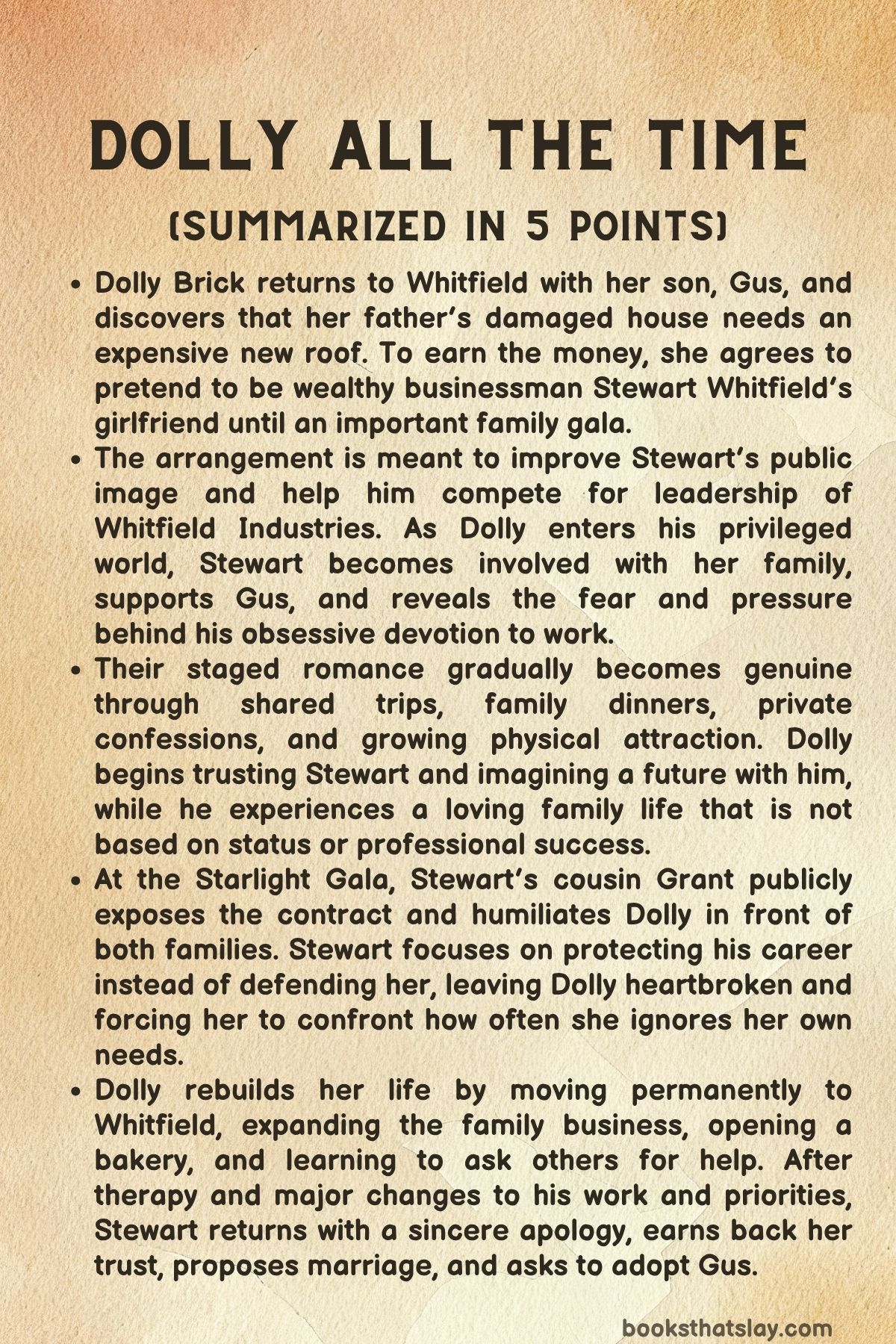
Summary
Thirty-nine-year-old Dolly Brick returns to Whitfield, Rhode Island, with her thirteen-year-old son, Gus, after a small fire damages her father’s house. Returning home means immediately resuming the role she has occupied since childhood: caretaker, organizer, problem-solver, and emotional support for nearly everyone around her.
Her father, Freddie, runs Brick Fish House, while her brother Christopher requires supervision because of a brain injury sustained during childhood. Christopher depends on medication, familiar routines, and the stability of the Goose Lane house, making any threat to the home especially serious.
Dolly initially believes the fire damage can be repaired through hard work and careful planning. That confidence changes when fire chief Gavin McCumber discovers extensive mold and rot in the roof, warning that replacing it will cost around fifty thousand dollars.
Freddie considers selling the house, but Dolly refuses to accept a solution that would uproot Christopher. She immediately begins searching for a way to raise the money, treating the crisis as one more responsibility that must become hers.
While delivering seafood to Eight Oaks, the vast Whitfield family estate, Dolly encounters Stewart Whitfield beside his disabled Range Rover. Stewart, heir to Whitfield Industries, has a flat tire, a dead phone, and no practical ability to solve the problem himself.
Dolly changes the tire while mocking his helplessness. During their interaction, Stewart reveals that his fiancée, Audrey, has been photographed with a professional baseball player, creating a public scandal just as Stewart is competing with his cousin Grant for the position of chief executive officer.
A photographer captures Dolly and Stewart together. The resulting newspaper story falsely identifies Dolly as Stewart’s new girlfriend and even suggests that Stewart taught her how to change the tire.
Stewart later approaches Dolly with an unusual proposal. His family believes he is too consumed by work to lead the company with balance and maturity, while Grant appears dependable, married, and socially stable.
Stewart wants Dolly to pretend to be his girlfriend until the Starlight Gala. A convincing romance would repair his public image, reassure his family, and strengthen his chances of becoming CEO.
Dolly initially rejects the idea. Once Stewart offers payment, however, she asks for sixty thousand dollars, enough to repair the roof and cover related expenses.
Stewart accepts immediately. Dolly therefore takes on what she privately considers another job, even though this one requires formal dinners, expensive clothes, public affection, and regular contact with a man she already finds dangerously attractive.
Dolly and Stewart negotiate clear conditions. She will attend several events each week, receive a clothing allowance, work around her family obligations, and never be required to have sex or engage in unwanted intimacy.
They create a fictional account of meeting while cycling in Boston. Their first planning dinner is awkward but increasingly personal, with Dolly discussing single motherhood and her distrust of romantic expectations while Stewart reveals how thoroughly work has consumed his life.
Stewart gives her half the payment in advance. Freddie is grateful that the house can be saved but worries that Dolly has once again sacrificed her time and emotional energy to protect everyone else.
Dolly tells Gus the truth because she does not want to deceive him. Gus finds the arrangement amusing, although he observes that pretending to live an exciting life might make returning to normality difficult.
Busy Whitfield, Stewart’s sister, helps Dolly select a new wardrobe. Perfectly altered clothing, a short haircut, and a gold dahlia necklace make Dolly feel visible in a way she has rarely allowed herself to be.
Her transformation does not erase her identity. Instead, it reveals how often she has accepted whatever was practical without considering what she liked, wanted, or deserved.
At a Providence fundraiser, Dolly begins learning how to perform as Stewart’s affectionate partner. She also discovers that Stewart’s charitable work is connected to Busy’s childhood cancer, giving her a more sympathetic understanding of him.
Dolly coaches Stewart on the details of intimacy. She explains that compliments should be specific and that holding someone’s hand should communicate tenderness rather than obligation.
When their fingers meet, the contact produces genuine desire. Both recognize the attraction, but Dolly quickly retreats behind the professional limits of the agreement.
Their relationship becomes less artificial during a sailing trip with Gus and his new friend Clay. Stewart is patient with the boys, teaches them sailing knots, and treats their interests seriously.
He also takes Dolly to a hidden coastal grotto. Following him through darkness and water forces Dolly to surrender control and trust someone else to guide her.
Inside the grotto, they discuss the experiences that shaped them. Stewart explains that Busy’s illness taught him to believe disaster could happen whenever he stopped paying attention, leading him to seek safety through constant work and control.
Dolly reveals that Gus’s father responded to her pregnancy by offering money for an abortion and abandoning her. She used the money to purchase a crib and raised Gus alone.
Dolly also explains that her mother gradually deserted the family after Christopher’s injury. Dolly became a substitute parent while still young, teaching herself to prevent crises, suppress disappointment, and avoid depending on unreliable people.
Stewart recognizes that they share the same emotional pattern. His wealth and corporate responsibilities look very different from Dolly’s domestic burdens, but both believe their worlds will collapse if they stop managing everything.
Dolly attends dinner at Eight Oaks and meets Stewart’s family. Busy, Oscar, Lilly, Victoria, and Henry show varying degrees of warmth, while Grant and several other relatives remain suspicious of Dolly’s background and Stewart’s judgment.
Instead of hiding her working-class roots, Dolly speaks honestly about teaching, the fish house, Gus, Christopher, and her grandmother Maud. Her openness wins respect and helps Brick Fish House secure the Starlight Gala catering contract.
During dinner, criticism of Stewart’s business decisions triggers a panic attack. Dolly follows him outside, steadies his breathing, and reassures him without treating him as weak.
Stewart admits that he feels responsible for protecting generations of Whitfield success. Dolly understands the fear because she has spent years believing that one overlooked task could endanger her own family.
Stewart later visits Goose Lane, where he fits comfortably into Dolly’s household. He jokes with Christopher, talks baseball with Gus, examines the damaged sleeping porch, and begins imagining improvements that extend beyond the immediate roof repair.
Dolly and Stewart soon take an evening cruise together. Alone on the water, Stewart admits that he cannot stop thinking about kissing her.
Their kiss is passionate and unmistakably real. Dolly calls it part of their performance, but neither of them truly believes that explanation.
When Stewart travels to New York, Dolly is disturbed by how much she misses him. His absence makes her recognize how completely she has organized her life around avoiding emotional dependence.
A series of family emergencies forces Dolly to ask Stewart for help. While she handles Christopher’s dental problem, Stewart retrieves an injured Gus and takes him to Victoria for medical attention.
Dolly returns to find that Stewart has handled the situation calmly and competently. For once, another person has protected someone she loves without creating extra work for her.
Gus notices Dolly’s feelings and questions her belief that Stewart is too wealthy or important for her. His challenge exposes the class hierarchy Dolly has internalized despite claiming not to respect it.
Stewart invites Dolly to Boston for an important business dinner concerning a preservation project. Dolly helps the investors understand that buildings and local businesses can hold emotional and communal value beyond immediate financial profit.
Afterward, Stewart brings her to his Beacon Hill home. The quiet intimacy frightens Dolly, so she leaves for her own apartment, but Stewart follows because he no longer wants distance between them.
They finally acknowledge their desire and sleep together. Their emotional closeness afterward makes it impossible to dismiss the encounter as a temporary physical exception.
Stewart tells Dolly that he wants to see her every day, even without sex. He asks her to raise her expectations of him rather than protecting herself by expecting nothing.
Their relationship becomes part of ordinary family life. Stewart spends time with Gus, teaches him to sail, accompanies the boys to a Red Sox–Yankees game, and regularly stays at Goose Lane.
Dolly introduces him to Naomi and Sully, while Stewart discusses future plans as though Dolly will naturally remain beside him. She begins to understand that he loves the person she already is, not a polished substitute created for wealthy society.
Before the Starlight Gala, Dolly and Stewart discuss a genuine future. Dolly explains that she does not want another pregnancy, while Stewart insists that their life can be shaped around their actual needs rather than conventional expectations.
Both admit that separation has become unbearable. Although they do not immediately use the word love, Dolly believes they have chosen one another.
At the gala, Grant publicly reveals the original contract. He presents the relationship as a calculated deception designed to influence Stewart’s family and the company board.
Grant also humiliates Dolly by insulting her background and Christopher. Henry condemns Stewart’s dishonesty, and Stewart immediately becomes focused on losing the CEO position.
Instead of defending Dolly or explaining that the relationship became real, Stewart retreats into the professional crisis. Outside, he says he does not know what the scandal means for them and promises to contact her once the situation is settled.
His mention of her remaining payment makes Dolly feel reduced to an employee. She leaves alone, realizing that Stewart has chosen work and family approval at the first moment their relationship required courage.
Stewart does not call. His messages remain formal and focused on the board, while a messenger delivers the final check.
Dolly finally admits to Freddie that Stewart has broken her heart. She also expresses anger at a family structure in which everyone expects her to survive any burden because she always has.
Returning to Boston, Dolly refuses to erase the confident woman she became. She keeps her shorter hair and new clothes, but her former teaching life no longer feels sufficient.
A confrontation with Patsy helps Dolly understand that she has contributed to their distance. Dolly handles every crisis without informing her sister, then resents Patsy for failing to offer help she did not know was needed.
Dolly admits that she wants to move to Whitfield, work at the fish house, and open a bakery. Gus enthusiastically supports the plan, having developed friendships, sailing interests, and a strong attachment to the town.
Dolly leaves her teaching position and moves home. Patsy begins taking a more active role in the family, while Dolly gradually allows Christopher greater independence instead of protecting him from every challenge.
When Gus becomes dangerously ill with meningitis, Dolly asks Freddie for help. The crisis makes her reconsider the difference between people who leave and people who remain imperfectly present.
Victoria later tells Dolly that Grant has been appointed CEO for a year. Stewart has responded to the loss by burying himself in work rather than contacting Dolly.
Dolly decides that she will not make his abandonment easy. Accompanied by Naomi, she confronts Stewart in Boston and tells him plainly that he broke her heart, failed to defend her, and sent money instead of an apology.
She argues that both of them have spent their lives fixing problems, but she has found the courage to change while he continues pursuing a job he may not even want. Dolly leaves after demanding that he identify his own desires and take responsibility for them.
In the following months, Dolly creates the life she chose. She adds baked goods to the fish house, develops an online seafood business with Patsy, gives Christopher meaningful work, and teaches Gus the financial side of the family company.
Stewart begins therapy, reduces his working hours, accepts Busy’s help, asks Henry for advice, and recognizes that Grant may be better suited to lead the main company. Almost a year after the gala, he comes to Dolly’s sleeping porch to apologize.
Stewart admits that his pursuit of the CEO role was driven by fear and identity rather than genuine desire. He explains that he wants to rebuild Dolly’s trust and spend his life with her.
Dolly learns that he has remained in contact with Gus, helping with sailing opportunities and baseball conversations. His independent commitment to her son helps prove that his feelings are not simply romantic impulse.
Dolly and Stewart reconcile, but she refuses to restore their former closeness immediately. Stewart must apologize to her family and accept that returning to Dolly means respecting the people who share her life.
He does so the next morning. Gus grants him permission to date Dolly on a trial basis, while Freddie and Christopher make clear that Stewart’s disappearance hurt them too.
During a later family sailing trip, Stewart struggles to surrender control of the vessel. Dolly encourages him to let Oscar take the helm, and Stewart finally joins the family instead of carrying responsibility alone.
A year later, Stewart operates a smaller preservation division while Grant manages conventional development. Dolly’s bakery and seafood business succeed, Christopher thrives with greater independence, and Gus develops strong interests in sailing and oceanography.
Stewart proposes to Dolly in the Eight Oaks herb garden. She accepts while choosing to keep the Brick name.
He also asks to pursue adopting Gus. Dolly agrees, recognizing that Stewart wants to become a dependable father rather than merely provide money or occasional excitement.
By choosing love without surrendering her identity, Dolly finally builds a life in which responsibility is shared. She remains capable, practical, loyal, and protective, but she no longer believes that being herself requires carrying everything alone.
Characters
Dolly Brick
Dolly is the emotional and practical center of Dolly All the Time, defined initially by her extraordinary competence and her inability to separate love from responsibility. Since her mother withdrew after Christopher’s accident, Dolly has measured her worth through usefulness, believing that safety depends on her ability to anticipate every problem and prevent every disappointment.
Her lists, repairs, cooking, teaching, financial schemes, and constant side jobs demonstrate intelligence and endurance, but they also conceal fear. Dolly avoids asking for help because dependence would require trusting someone who might fail or leave her, and she lowers her romantic expectations so that rejection cannot surprise her.
The arrangement with Stewart appears to fit her established pattern because she converts her time, image, and emotional energy into money for the family roof. However, the experience gradually gives her access to pleasure, attention, clothing chosen for her, travel, desire, and a relationship in which another person sometimes notices what she needs.
Her greatest development does not come from falling in love alone. It comes from recognizing that self-reliance can become a form of isolation, control, and resentment when she denies others the opportunity to contribute.
After Stewart abandons her, Dolly does not simply return to her previous life. She confronts Patsy, Freddie, Stewart, and her own assumptions, chooses to move to Whitfield, creates the bakery she wants, expands Christopher’s independence, and begins asking for support.
By the conclusion, Dolly remains a caretaker, but caretaking is no longer her entire identity. She accepts love while maintaining her name, preferences, ambitions, family loyalties, and right to expect consistency from the people who claim to love her.
Stewart Whitfield
Stewart initially appears to represent everything Dolly distrusts: inherited wealth, corporate privilege, social power, and helplessness in ordinary situations. Yet Dolly All the Time gradually reveals that his workaholism is not simple arrogance but an anxious response to childhood fear, family expectations, and a belief that he must protect the Whitfield legacy from collapse.
Busy’s cancer taught Stewart that disaster can arrive without warning. He responded by becoming watchful, productive, and controlling, treating constant effort as protection against powerlessness.
His relationship with Audrey failed because it possessed social suitability without emotional intimacy. Stewart barely understands his own heartbreak after her betrayal, showing how little of himself he had invested in their engagement.
Dolly challenges him because she is unimpressed by his status and attentive to the vulnerable person beneath his professional identity. Through her, he experiences family disorder, practical humor, physical affection, honest disagreement, and a form of care that is neither strategic nor dependent on his wealth.
His weakness emerges at the gala. Faced with professional humiliation, he abandons Dolly emotionally and retreats into the role that has always made him feel safe.
Stewart’s later growth requires more than an apology. He attends therapy, shares authority, accepts that Grant may be the better CEO, supports Busy’s career, remains connected to Gus, and creates a professional role based on preservation rather than competition.
His reconciliation with Dolly succeeds because he finally states what he wants and accepts that love demands accountability. By stepping away from the helm during the family sailing trip, Stewart demonstrates that he is learning to trust others and participate in life rather than endlessly supervising it.
Gus Brick
Gus is a thoughtful thirteen-year-old whose emotional maturity often allows him to see truths that Dolly avoids. At the beginning, he is socially isolated, caught between childhood friendships and peers who have moved toward behavior that makes him uncomfortable.
His summer in Whitfield gives him a new community. Clay, lifeguard camp, sailing, baseball, and work at the fish house help him develop confidence and imagine a future connected to the ocean.
Gus reacts to Dolly’s fake relationship with humor rather than judgment. His observation that an enjoyable fantasy might be difficult to leave behind quietly anticipates the emotional consequences of the arrangement.
He also challenges Dolly’s belief that Stewart is too important or wealthy for her. Gus recognizes that her reasoning is not humility but self-rejection based on social assumptions she would never impose on someone else.
Stewart’s presence gives Gus access to a trustworthy adult man who listens, teaches, remembers details, and remains interested in his development. Their independent contact after the breakup becomes important evidence that Stewart’s care for the family is genuine.
Gus never becomes merely a child who needs protection. His opinions influence Dolly’s decisions about romance, moving to Whitfield, and accepting Stewart again, making him an active participant in the family’s transformation.
Christopher Brick
Christopher is Dolly’s older brother, whose childhood brain injury reshaped the Brick family. His need for medication, supervision, familiar surroundings, and predictable routines motivates Dolly’s determination to save the Goose Lane house.
The family’s love for Christopher is genuine, but their protection of him has also restricted his life. Dolly often assumes that preventing difficulty is the same as ensuring happiness, leaving Christopher with fewer opportunities to prove his ability.
As Dolly changes, she begins giving him errands, public responsibilities, and meaningful work at the fish house. Christopher becomes more capable and engaged when the family stops defining safety as permanent limitation.
His directness also exposes emotional truths other characters avoid. When Stewart returns, Christopher immediately points out that he disappeared without saying goodbye, reducing a complicated romantic failure to its simplest moral fact.
Christopher represents both the origins of Dolly’s caretaker identity and one of the clearest measures of her growth. Her increasing willingness to trust him with responsibility shows that love can support independence rather than prevent every possible risk.
Freddie Brick
Freddie is Dolly’s father and the owner of Brick Fish House. He is affectionate, humorous, and deeply grateful for Dolly’s help, yet he has depended on her strength for so long that he has participated in making her responsible for burdens that should never have belonged to a child.
Unlike some members of the family, Freddie recognizes that Dolly’s agreement with Stewart repeats a troubling pattern. He understands that she has once again turned an opportunity into a solution for everyone else rather than asking what she wants for herself.
His warnings about Stewart arise from protectiveness rather than class resentment. Freddie knows how completely Dolly can commit herself to caring for others and fears that another abandonment will confirm her belief that love is unsafe.
His later conversation with Dolly during Gus’s illness reveals the complexity of their relationship. Freddie acknowledges the imbalance but reminds her that he remained after her mother left, forcing Dolly to distinguish imperfect presence from total desertion.
Freddie does not transform as dramatically as Dolly, but he becomes more aware of the cost of relying on her. His cautious acceptance of Stewart also shows that forgiveness must be earned through consistent behavior rather than declarations.
Naomi
Naomi is Dolly’s closest friend and emotional refuge. She provides humor, enthusiasm, practical assistance, and a space where Dolly can speak more openly than she does with her family.
Her excitement about the fake relationship initially gives the arrangement a playful quality. Naomi imagines luxurious clothes, yachts, romantic dinners, and an adventure that might briefly free Dolly from her exhausting routine.
However, Naomi is not simply comic support. She has witnessed Dolly’s pregnancy, abandonment, financial struggles, and habit of accepting too little from romantic partners, giving her confidence in Dolly’s desirability when Dolly herself lacks it.
Naomi repeatedly sees the truth of Dolly and Stewart’s feelings before Dolly is prepared to admit it. She also accompanies Dolly to Boston for the confrontation, providing support without attempting to speak on her behalf.
Her friendship demonstrates a healthy form of loyalty. Naomi encourages rather than controls, stands beside Dolly without demanding repayment, and celebrates the fuller life Dolly begins to claim.
Busy Whitfield
Busy is Stewart’s sister and one of the first Whitfields to welcome Dolly openly. Her warmth, humor, and interest in Dolly’s transformation weaken Dolly’s assumption that every wealthy person will judge her.
Busy’s childhood cancer had a lasting effect on Stewart, although she does not define herself solely through illness. She is aware of her brother’s fear, rigidity, and emotional isolation, and she quickly recognizes the positive changes Dolly produces in him.
Her own struggle concerns purpose. Surrounded by wealth and endless options, Busy feels directionless, creating an effective contrast with Dolly, whose choices have always been shaped by necessity.
Helping Dolly select clothes and cut her hair becomes more than a makeover. Busy helps her discover that personal style can express identity rather than function as a disguise.
Later, Busy enters management training and takes a more active role in Whitfield Industries. Her growth parallels Dolly’s because both women move toward lives chosen through desire and ability rather than family assumptions.
Victoria Whitfield
Victoria is Stewart’s mother, a perceptive woman who understands more about the fake relationship than Stewart expects. She recognizes that the arrangement began as a deception but also sees that the emotions between Dolly and Stewart become genuine.
Her medical experience makes her important during Gus’s injury and later his meningitis. These moments allow Dolly to experience Victoria not as a wealthy society figure but as a capable mother who responds calmly during emergencies.
Victoria understands Stewart’s burden and compares him to Atlas, carrying a world he believes cannot survive without him. However, she does not excuse his abandonment of Dolly and expresses disappointment that he failed to contact her.
Her developing friendship with Dolly is based on honesty, family concern, and shared frustration with Stewart’s avoidance. By encouraging Dolly to confront him, Victoria supports accountability rather than attempting to arrange a convenient reconciliation.
Henry Whitfield
Henry is Stewart’s father and the retiring leader of Whitfield Industries. He represents both the family legacy Stewart wants to protect and the authority whose approval Stewart has spent his life pursuing.
Henry evaluates business decisions through responsibility, profitability, and continuity. His doubts about Stewart’s preservation projects intensify Stewart’s fear that he will be judged unworthy of leadership.
At the gala, Henry reacts strongly to the exposed contract because the deception appears to confirm that Stewart manipulated the family and board. His condemnation contributes to Stewart’s professional collapse, although it does not justify Stewart’s treatment of Dolly.
Over time, Stewart learns to ask Henry for advice instead of treating him only as a judge. This change allows their relationship to become more collaborative and reduces the emotional power of Henry’s expectations.
Grant Whitfield
Grant is Stewart’s cousin and professional rival. He presents himself as stable, married, successful, and better prepared to lead Whitfield Industries.
His strongest quality is his business competence, but ambition makes him cruel. By exposing the contract publicly, he chooses maximum humiliation rather than private accountability.
Grant attacks Dolly’s class background and Christopher, demonstrating that his rivalry with Stewart has become personal and morally destructive. He uses truth without compassion, turning legitimate concerns about deception into an excuse for degradation.
Nevertheless, the conclusion does not portray Grant as entirely incapable. He appears better suited to manage conventional development, while Stewart finds greater satisfaction in preservation.
The restructuring suggests that professional suitability and moral decency are separate questions. Grant may possess the skills required for one kind of leadership, but his treatment of Dolly reveals serious flaws in character.
Patsy Brick
Patsy is Dolly’s sister, initially appearing distant from the daily problems at Goose Lane. Dolly interprets her absence as another form of abandonment and quietly resents her for failing to share family responsibilities.
Their confrontation reveals that Dolly has not given Patsy a fair opportunity to help. By withholding information, taking over every task, and presenting herself as endlessly capable, Dolly has helped create the very distance she resents.
Patsy’s honesty forces Dolly to recognize that martyrdom can contain an element of control. Dolly cannot insist on doing everything and simultaneously condemn others for allowing her to do it.
After their reconciliation, Patsy becomes actively involved in the family and helps develop the online seafood business. Her humor and social-media ability contribute something Dolly could not easily provide herself.
Their renewed relationship demonstrates that asking for help can uncover strengths in other people. Dolly does not lose importance by sharing responsibility; the family becomes more capable because it includes Patsy.
Audrey
Audrey is Stewart’s former fiancée, whose public involvement with a Yankees player creates the scandal that begins the fake relationship. Although she has limited direct presence, her role exposes the emotional emptiness of Stewart’s previous romantic life.
Stewart is embarrassed and professionally inconvenienced by Audrey’s betrayal, but he is uncertain whether he is truly heartbroken. This confusion suggests that their engagement offered social appropriateness and appearance rather than genuine vulnerability.
Audrey functions as a contrast to Dolly. Where Audrey fits easily into Stewart’s public world, Dolly reaches the private fears, needs, and desires he has avoided acknowledging.
Clay
Clay becomes Gus’s closest friend in Whitfield. Their meeting while clamming helps Gus escape the loneliness that worried Dolly at the beginning of the summer.
Clay joins lifeguard camp, sailing outings, baseball adventures, and the wider group of young people connected to the fish house. His friendship helps Gus see that growing older does not require adopting behavior that makes him uncomfortable.
Although Clay remains a supporting character, he represents belonging. His presence makes Whitfield feel like a possible permanent home for Gus rather than merely the location of a family crisis.
Izzy
Izzy is the contractor responsible for repairing the Brick roof and later reveals that Stewart has arranged a full renovation of the sleeping porch. Her work turns Dolly’s financial agreement into a visible, lasting change in the family home.
The completed porch carries mixed meaning. It proves that Stewart once imagined a future inside Dolly’s world, but it also becomes painful evidence of promises he failed to honor after the gala.
The space eventually becomes associated with reconciliation and renewal. Stewart returns there to apologize because it represents the point where his life first began entering Dolly’s family home.
Maud
Maud, Dolly’s grandmother, is present mainly through memory, family stories, and her antique sewing machine. Her domestic skills connect the Brick family’s working history to Eight Oaks, where she once sewed and prepared food for the Whitfields.
The sewing machine on the sleeping porch represents continuity, craft, and the practical ways love can be preserved through objects and labor. Dolly’s connection to Maud also reminds her that her background is not something to conceal.
Maud’s reputation helps create conversation between Dolly and Henry during the Eight Oaks dinner. Through that connection, Dolly’s family history enters the Whitfield estate with dignity rather than shame.
Lilly and Oscar Whitfield
Oscar, Stewart’s brother, and Lilly, Oscar’s wife, are among the more welcoming members of the Whitfield family. Their acceptance helps Dolly feel less like an outsider during intimidating family gatherings.
They also represent a more relaxed relationship to privilege and family obligation. Oscar can take control of the boat when Stewart finally allows him, showing that Stewart’s relatives are capable of sharing responsibility when given the opportunity.
Their presence at the later family sailing trip demonstrates the wider reconciliation between the Brick and Whitfield families. Love between Dolly and Stewart gradually becomes a relationship between households rather than an isolated romance.
Gus’s Father
Gus’s biological father never becomes an active participant in the story, yet his abandonment has profoundly shaped Dolly’s expectations. His response to her pregnancy taught Dolly that romantic vulnerability could lead to rejection, humiliation, and lifelong responsibility carried alone.
The three hundred dollars he gives Dolly becomes a symbol of his moral failure. She turns money intended to erase the pregnancy into a crib, transforming abandonment into an act of commitment to her son.
His absence also makes Stewart’s desire to adopt Gus especially significant. Stewart is not merely attracted to Dolly; he deliberately chooses the parental responsibility another man rejected.
Themes
Responsibility, Control, and the Fear of Disaster
Dolly and Stewart both organize their identities around the belief that constant vigilance prevents catastrophe. In Dolly All the Time, responsibility begins as an admirable quality but becomes destructive when it is driven by terror rather than free choice.
Dolly responds to her mother’s departure and Christopher’s injury by becoming indispensable. She repairs houses, manages money, cares for relatives, protects Gus, and hides her needs because she believes other people’s stability depends entirely on her effort.
Stewart responds to Busy’s illness and the pressure of the Whitfield legacy by controlling business decisions, pursuing the CEO position, and working without rest. He fears that slowing down will expose weakness or allow the family company to fail.
Their attraction grows partly because each recognizes the other’s exhaustion. Dolly understands Stewart’s panic attack without judgment, while Stewart sees that Dolly’s competence has concealed a life with almost no room for personal desire.
The story does not argue that responsibility should be abandoned. Instead, it distinguishes between committed care and compulsive control.
Dolly learns to ask Freddie, Patsy, Stewart, and others for help, while Stewart learns to share authority with Busy, Grant, Henry, consultants, and his siblings. Their final progress is measured not by escaping obligation but by accepting that a stable life can be supported by many hands.
Self-Worth and the Courage to Want More
Dolly’s low expectations protect her from disappointment but also prevent her from imagining a life shaped by desire. She accepts practical clothing, multiple jobs, emotional neglect, and romantic limitation because asking for more feels dangerous and selfish.
Her transformation begins with small experiences of preference. Altered clothes, a new haircut, specific compliments, and Stewart remembering how she takes her tea show her that attention can be directed toward her rather than merely received from her.
Stewart’s request that Dolly raise her expectations becomes an important challenge, although he initially fails to meet the standard he encourages. When he abandons her after the gala, Dolly must decide whether self-worth means accepting his fear or demanding accountability.
Her later choices prove that growth cannot depend entirely on romance. She leaves teaching, moves to Whitfield, opens the bakery, rebuilds her relationship with Patsy, gives Christopher more independence, and stops answering every work demand.
By the time Stewart returns, Dolly no longer needs him to create a meaningful life. This independence allows her to consider reconciliation without surrendering her dignity.
Her decision to keep the Brick name after accepting his proposal reinforces this balance. Love expands her identity, but it does not replace the self she has finally learned to value.
Love as Presence, Reliability, and Shared Labor
Romance begins as a purchased performance built from invented memories, staged affection, and public appearances. The relationship becomes real through ordinary acts that cannot be reduced to the contract.
Stewart helps Gus after an injury, teaches him to sail, remembers his interests, visits Goose Lane, talks with Christopher, and listens to Dolly’s family stories. Dolly steadies Stewart during his panic attack, supports his preservation project, challenges his assumptions, and gives him access to a family life where imperfection is accepted.
The gala exposes the difference between feeling love and acting lovingly. Stewart may genuinely love Dolly, but his failure to defend her proves that emotion without courage, presence, and accountability is insufficient.
His check cannot replace an apology, just as financing the sleeping porch cannot repair the injury caused by silence. Dolly refuses to perform the additional labor of explaining away his behavior or bringing him back herself.
Stewart’s eventual return is meaningful because it follows concrete change. He attends therapy, reorganizes his work, shares responsibility, maintains his relationship with Gus, and apologizes directly to the Brick family.
Their reconciliation therefore rests on a more demanding definition of love. To love someone is to remain present during difficulty, accept responsibility for harm, respect boundaries, and participate consistently in the work of building a shared life.
Family, Belonging, and the Choice to Stay
Family in the novel is not defined solely by blood, wealth, or obligation. It is created through repeated acts of staying, helping, listening, apologizing, and allowing others to participate.
Dolly’s mother and Gus’s father represent abandonment, but their departures affect Dolly differently from Freddie’s imperfections. Freddie may have relied too heavily on Dolly, yet he remained and cared for the family after his wife withdrew.
Patsy initially appears absent, but Dolly eventually recognizes that exclusion contributed to their distance. Once invited into the family’s work, Patsy becomes a valuable partner whose abilities strengthen the fish house.
Christopher’s development also expands the meaning of belonging. Protecting him from every challenge keeps him physically close but limits his participation, while meaningful responsibility allows him to become a fuller member of the household and community.
Stewart must learn that joining Dolly’s life means joining her family. He cannot maintain a private romance while ignoring Gus, Christopher, Freddie, Naomi, or the pain his disappearance caused them.
His request to adopt Gus becomes the strongest expression of chosen family. He does not seek merely to marry Dolly or provide financial security; he asks to accept a permanent parental role.
The combined sailing trip and final proposal show two families forming a new community without erasing their differences. Belonging becomes possible when people stop treating love as possession and begin treating it as the continuing choice to remain.