The Castle in the Glen Summary, Characters and Themes
The Castle in the Glen by Rhys Bowen is a historical mystery that combines literary intrigue, family secrets, romance, and a decades-old tragedy in the Scottish Highlands.
Set primarily in 1965, the novel follows Emma Callander, a young Australian writer who is invited to complete the unfinished manuscript of a celebrated crime novelist. What initially appears to be an extraordinary professional opportunity becomes a personal investigation when Emma discovers that the fictional murder mystery closely resembles actual events. Through its shifting narratives, the book explores identity, inherited trauma, social inequality, and the consequences of concealed truths. At its centre is a young woman’s search for belonging and a family history she never knew existed.
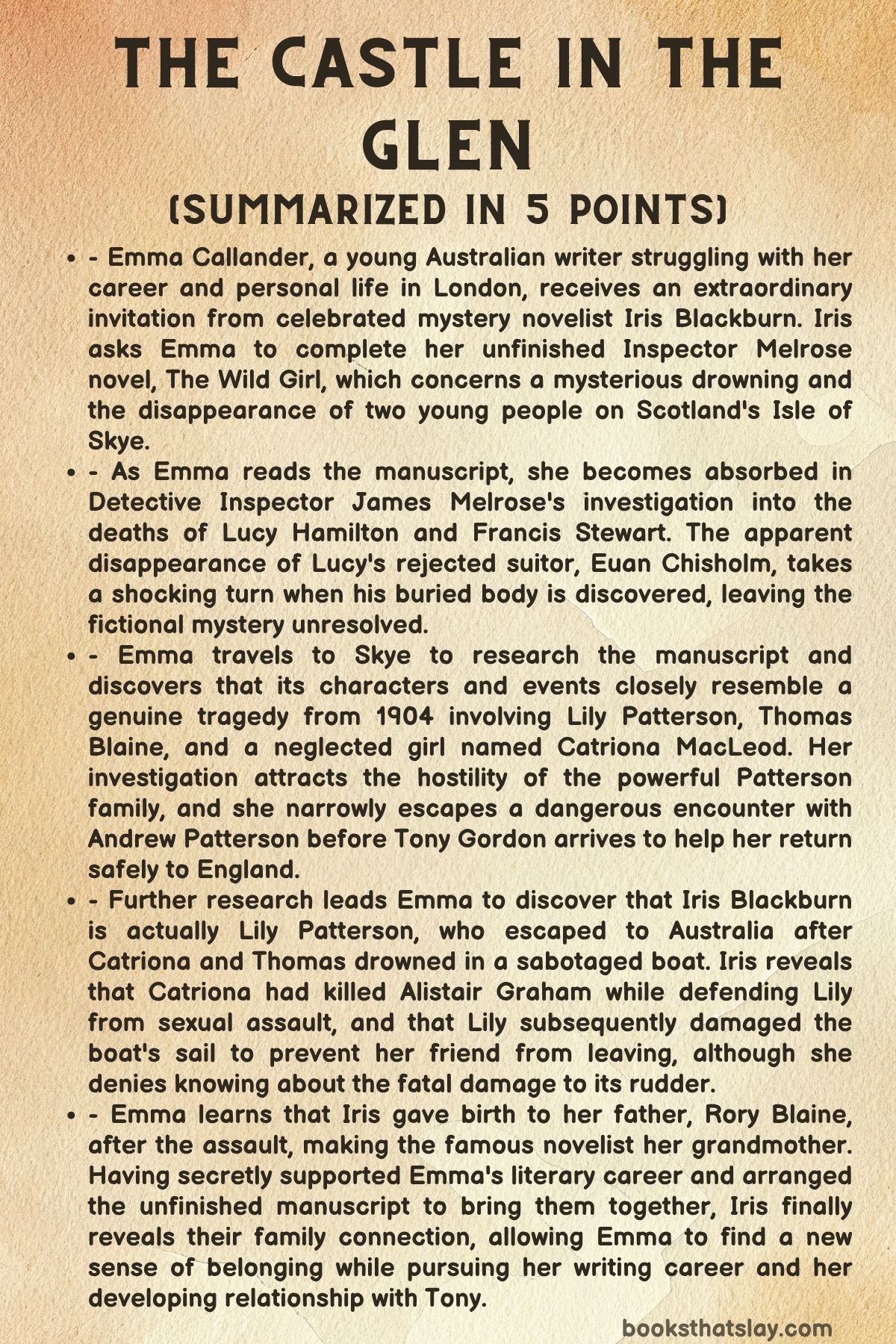
Summary
In September 1965, Emma Callander is living in London, increasingly disappointed with her personal and professional circumstances. Her relationship with Simon ended when she discovered his dishonesty, and another unpleasant encounter strengthens her desire to abandon England and return to Australia.
Although her first novel, The Blue Gum Murders, received favourable reviews, Emma has struggled to produce a second book. Her father’s death deprived her of the family vineyard she considered home, and her mother’s remarriage has further weakened her ties to Australia.
Emma works for Barlow and Barlow, a respected publishing house. One day, senior editor David Spencer unexpectedly invites her to visit Whitehaven, the country residence of the internationally successful mystery writer Iris Blackburn.
Originally Australian, Iris became famous through her Miss Faversham mysteries before creating the more psychologically complex Inspector Melrose series. She has not published a Melrose novel for years, but David reveals that she has recently begun writing again.
At Whitehaven, Emma meets Iris, her literary agent Jeremy Feathers, her secretary Cynthia Morton, and the young solicitor Tony Gordon. Iris immediately takes an interest in Emma’s Australian upbringing, literary achievements, and concern with social injustice.
Emma learns that Iris’s latest manuscript, The Wild Girl, concerns Inspector Melrose’s earliest investigation on the Isle of Skye. Unfortunately, Iris’s deteriorating memory has made completing the book increasingly difficult, and she wants Emma to finish it.
The proposal astonishes Emma, who fears that she cannot reproduce such an established author’s voice. Nevertheless, David and Jeremy persuade her to examine the manuscript before deciding whether to accept the assignment.
The arrangements quickly become complicated when Arthur Gordon, Tony’s father and Iris’s solicitor, prepares a contract denying Emma authorship recognition and royalties. Emma refuses to accept the unfavourable conditions, earning Iris’s approval.
Emma moves into a cottage on the Whitehaven estate and begins reading. Meanwhile, her attraction to Tony grows, although discovering that he has a girlfriend named Isobel makes her reluctant to pursue him.
The unfinished manuscript transports Emma to Scotland in 1932, where the newly promoted Detective Inspector James Melrose has been assigned to investigate a suspicious drowning. Lucy Hamilton, the daughter of a powerful landowner, apparently died while attempting to escape with Francis Stewart.
Melrose travels from Glasgow to Skye, encountering unfamiliar landscapes and communities. His investigation brings him into contact with Inspector MacDonald, whose knowledge of local affairs proves valuable despite their occasional professional disagreements.
The evidence indicates that someone deliberately damaged the sailing boat carrying Lucy and Stewart. Euan Chisholm, the wealthy young man Lucy was expected to marry, becomes the principal suspect because he disappeared immediately after the tragedy.
At Dun Akyn, the Hamilton family castle, Melrose encounters Sir Henry Hamilton, an authoritarian landowner determined to protect his family’s standing. Sir Henry considers Lucy’s association with Stewart unacceptable, particularly because the young man supported the island’s struggling crofters.
Melrose discovers that Lucy resented her restricted upbringing and her family’s attempts to arrange her marriage. Her closest companion was Flora MacLeod, an impoverished girl known locally as the Wild Girl.
Flora’s mother died when she was young, leaving her with a neglectful fisherman father. Lady Hamilton brought her into the household, where she developed an extraordinary friendship with Lucy.
Photographs reveal that the girls looked remarkably alike, although their personalities differed. Lucy appeared reserved, while Flora possessed a fierce independence developed through years of surviving without reliable parental care.
Flora has also disappeared, making her a potentially important witness. Melrose questions her father, Angus MacLeod, but discovers only that Flora frequently vanished into the wilderness and knew numerous places where she could hide.
Further interviews with the castle’s servants expose Chisholm’s predatory behaviour towards young women. They also reveal Sir Henry’s hostility towards Stewart, providing another possible motive for the boat’s destruction.
Melrose examines the damaged vessel and considers whether the tragedy resulted from jealousy, deliberate murder, or an unsuccessful attempt to prevent an escape. His investigation is complicated by the Hamilton family’s influence and the islanders’ reluctance to challenge powerful people.
A visit to Lucy’s former governess, Isla Anderson, introduces a new possibility. Isla believes Lucy primarily wanted freedom from her impending marriage and questions whether Chisholm would have chosen secret sabotage rather than direct confrontation.
Melrose becomes attracted to Isla, whose intelligence and independence impress him. Their growing connection reveals a gentler side of the detective, suggesting that his later emotional reserve may conceal a more complicated romantic history.
The investigation takes a startling turn when a trained search dog locates Chisholm’s buried body in woodland near the castle. The discovery transforms the apparent murderer into another victim.
At precisely this moment, Iris’s manuscript ends.
Emma confronts Iris, desperate to learn the intended solution, but the older woman claims that she cannot remember what happens next. She encourages Emma to travel to Scotland and discover the setting for herself.
Emma accepts the research expedition, hoping that experiencing Skye will help her devise a convincing conclusion. Tony assists with her arrangements, and their friendship becomes increasingly personal despite the uncertainty surrounding his relationship with Isobel.
Following the route described in the manuscript, Emma travels through Glasgow and the Highlands before reaching Skye. She stays at the Kings Arms Hotel, where Mrs Bruce welcomes her and introduces her to local taxi driver Jock MacLeod.
Emma soon discovers that Iris’s fictional geography closely resembles the real island. Most significantly, Dun Akyn corresponds to Craigard, an actual castle occupied by the Patterson family.
With Jock’s assistance, Emma investigates the estate and begins questioning whether Iris invented her mystery entirely. Historical newspaper records reveal that a remarkably similar tragedy occurred in September 1904.
Lily Patterson, the daughter of the local landowner, supposedly drowned with Thomas Blaine when their sailing boat capsized. Another young man, Alistair Graham, disappeared around the same time, while a girl named Catriona MacLeod also vanished.
Emma recognizes these figures as the apparent originals of Lucy Hamilton, Francis Stewart, Euan Chisholm, and Flora MacLeod. However, the newspapers contain no account of Graham’s murdered body being discovered.
Her investigation brings her into contact with Andrew Patterson, a charming young man whose family owns Craigard. Andrew introduces her to the estate and his elderly grandfather, Sir Robert Patterson.
When Emma asks Sir Robert about Lily’s death, he becomes extremely distressed. His insistence that the family knew nothing about Lily’s intentions makes Emma suspect that he possesses important information.
An elderly islander subsequently confirms that Catriona MacLeod was known as the Wild Girl and disappeared after the drowning. She also explains that Catriona’s childhood closely resembled Flora’s fictional upbringing.
Emma’s research attracts the hostility of Andrew’s father, Ross Patterson, who threatens legal action and demands that she leave Skye. His aggression convinces Emma that the family is determined to suppress something about its past.
Emma telephones Tony, who advises her to avoid further investigation until he can speak with Iris. Nevertheless, she accepts Andrew’s invitation to visit the Fairy Pools, hoping to enjoy one final excursion before departing.
During their outing, Andrew becomes disturbingly interested in her discoveries. When he proposes climbing towards an isolated viewpoint, Emma suspects that he intends to harm her.
She tricks him into climbing ahead, escapes through the countryside, and hides beside a stream. Fortunately, Jock finds her and drives her safely back to the hotel.
Jock reveals that Andrew previously faced a rape accusation, but his family’s lawyers discredited the young woman involved. He had suspected Andrew’s intentions and followed the excursion out of concern for Emma.
Tony arrives from London after failing to contact her by telephone. His unexpected appearance reassures Emma, and they immediately arrange to leave the island together.
Before returning south, they visit the Graham family estate, where Alexander Graham confirms that Alistair disappeared permanently. They also locate the elderly Isla Anderson, who remembers the historical tragedy and Iris’s earlier research.
Isla explains that Lily and Catriona were inseparable and that rumours suggested Catriona might have been Lily’s half-sister. She also recalls Lily’s possessive brother Robert, whom she considers another possible participant in the boat’s destruction.
During the journey home, Emma and Tony acknowledge their growing romantic feelings. Their first kiss occurs beside Loch Ness, although Emma remains troubled by Tony’s existing relationship.
A storm forces them to stop overnight at a Highland inn. There, Emma notices an architectural detail resembling one described in Iris’s manuscript, prompting her to reconsider the author’s extraordinary knowledge of Skye.
Emma suddenly realizes that Iris’s pen name, Blackburn, resembles the English translation of Allt Dubh, the place associated with Catriona’s childhood. She theorizes that Iris may actually be Catriona, who escaped to Australia under another identity.
Tony recalls that Iris once used the name Rose Byrne. Back in London, Emma asks Robyn to investigate Australian immigration records, eventually discovering that a woman named Rose Byrne travelled from Liverpool to Australia in 1904.
Rose subsequently worked at Fairview, an estate neighbouring Emma’s childhood home. The geographical connection suggests that Iris’s interest in Emma may have been far more personal than either woman initially acknowledged.
Emma returns to Whitehaven and confronts Iris with her findings. Although Iris denies being Catriona, she encourages Emma to reconsider the identities of the girls involved in the tragedy.
Emma finally understands that Iris is Lily Patterson, the young woman supposedly drowned in 1904. The actual victim was Catriona, whose resemblance to Lily and borrowed clothing caused her body to be misidentified.
Iris reveals that Alistair Graham raped her in the woods. Catriona witnessed the assault and killed him with a rock while defending her friend, after which the terrified girls buried his body.
They initially planned to escape together, but Catriona secretly arranged to depart with Thomas Blaine instead. Feeling abandoned, Lily damaged the boat’s sail, intending to prevent their departure rather than cause their deaths.
She maintains that she knew nothing about the more dangerous damage to the rudder. When Catriona and Blaine drowned, Lily fled to Liverpool and adopted the identity of Rose Byrne.
In Australia, Lily discovered that Graham’s assault had left her pregnant. She gave birth to a son, surrendered him for adoption, and subsequently followed his life from a distance.
The child was named Rory Blaine.
Emma realizes that Rory was her father, making Iris her biological grandmother. Their apparent professional connection has therefore been part of a concealed family relationship.
Iris admits that she secretly helped Emma obtain her Oxford opportunity and encouraged the publication of her first novel. Her invitation to complete The Wild Girl was intended partly to bring Emma close enough to uncover their shared history.
Although Iris’s memory difficulties are genuine, she exaggerated her inability to finish the manuscript. She had deliberately created a mystery that would lead Emma towards the truth.
The revelation changes Emma’s understanding of her past and gives her an unexpected family connection. However, the precise responsibility for the damaged rudder remains uncertain, with Robert Patterson’s possible involvement never conclusively established.
Emma and Iris recognize that publishing the real events could harm surviving families and expose painful secrets. They decide against revealing the historical truth through the manuscript.
Instead, Iris invites Emma to regard Whitehaven as her home and pursue her own literary career. The young woman who began the story contemplating an uncertain return to Australia now has the possibility of belonging in England.
The concluding excerpt from a later Inspector Melrose novel, credited to Iris Blackburn and Emma Gordon, suggests that their literary partnership has continued. It also depicts the older Melrose travelling back towards Scotland after receiving a letter from Isla Anderson.
His journey offers the possibility of renewing a relationship that remained unresolved for many years. Through this final fictional encounter, the novel extends its concern with second chances beyond Emma and Iris, suggesting that love and belonging can emerge even after decades of separation.
Characters
Emma Callander
Emma Callander is the central protagonist of The Castle in the Glen, a young Australian writer whose search for professional direction eventually becomes a discovery of her own family history. Her character combines intellectual curiosity, emotional vulnerability, independence, and a strong concern for justice.
When the novel begins, Emma feels unsuccessful despite having published a well-received debut novel. Her difficulty producing another book reflects her fear that her first achievement may have been accidental rather than evidence of lasting talent.
Her father’s death and the loss of the family vineyard have also weakened her sense of belonging. Although she longs for Australia, she gradually recognizes that returning to her birthplace will not necessarily restore the security she remembers.
Emma’s refusal to accept Arthur Gordon’s unfair contract establishes her independence. She understands that gratitude for an extraordinary opportunity should not require surrendering her professional rights.
Her investigation on Skye demonstrates her intelligence and persistence. Rather than simply reproducing Iris’s fictional world, she questions inconsistencies, consults historical records, and discovers connections that others would prefer to leave concealed.
However, her curiosity sometimes leads her into danger, particularly when she continues investigating despite warnings from Ross Patterson. Her encounter with Andrew forces her to recognize that pursuing the truth also requires understanding personal risk.
Emma’s developing relationship with Tony reveals another aspect of her emotional growth. Having experienced dishonesty in previous relationships, she is cautious about trusting someone who has not completely resolved his existing romantic commitments.
The revelation that Iris is her grandmother transforms Emma’s understanding of herself. By the conclusion, she no longer sees her future exclusively in terms of returning to a lost home, because she has discovered the possibility of creating a new one.
Iris Blackburn / Lily Patterson / Rose Byrne
Iris Blackburn is the most complicated character in The Castle in the Glen, occupying several identities that represent different stages of her extraordinary life. Beneath her public reputation as a celebrated mystery writer lies a history shaped by sexual violence, guilt, displacement, motherhood, and secrecy.
Born Lily Patterson, she grew up within a privileged Scottish household but remained subject to the expectations imposed upon wealthy young women. Her family intended to arrange her marriage, treating her personal wishes as secondary to social position.
Her friendship with Catriona offered affection and freedom beyond the restrictions of her upbringing. However, Lily’s fear of abandonment eventually contributed to the decision that would haunt her for the remainder of her life.
Following Graham’s assault and Catriona’s intervention, Lily participated in concealing his death. Her subsequent decision to damage the boat’s sail was motivated by desperation, but its consequences became inseparable from the deaths of her friend and Blaine.
Her escape to Australia under the name Rose Byrne marked an attempt to survive by abandoning her former identity. Although she established a successful career, she could never completely escape the events that had driven her from Scotland.
Her decision to surrender her son for adoption reveals both her circumstances and the painful limitations of the choices available to her. Watching his life from a distance allowed her to maintain a connection, but it also extended the separation that defined her personal history.
As a novelist, Iris transforms her experiences into stories concerned with injustice and moral responsibility. Her Inspector Melrose mysteries allow her to explore questions that remained unresolved in her own life.
Her relationship with Emma demonstrates both generosity and manipulation. She helps the younger woman’s career while withholding the truth about their connection, eventually constructing an elaborate literary mystery to guide Emma towards their shared past.
Iris’s declining memory adds urgency to her desire for reconciliation. She fears losing the opportunity to explain herself, yet her exaggerated inability to complete the manuscript shows that she retains considerable control over the situation.
Ultimately, she is neither simply an innocent victim nor a deliberately destructive person. Her story demonstrates how a single catastrophic period can shape an entire lifetime, even when outward circumstances suggest extraordinary success.
Tony Gordon
Tony Gordon serves as Emma’s principal romantic interest in The Castle in the Glen, but his importance extends beyond their developing relationship. Through him, the novel examines the tension between inherited expectations and personal choice.
As a young solicitor working with his father, Tony initially appears conventional and obedient. His professional manner conceals a desire for greater independence and a life less restricted by family obligations.
His childhood was marked by his father’s wartime injuries and his mother’s departure. These experiences help explain his loyalty to Arthur, whose suffering has influenced Tony’s willingness to accept a future designed for him.
His relationship with Isobel Farley reflects that sense of obligation. Although the arrangement offers stability and pleases his father, Tony gradually recognizes that it does not represent the emotional connection he desires.
Emma attracts him because she challenges accepted arrangements and speaks openly about her ambitions. Her independence encourages him to reconsider the assumptions governing his own decisions.
His response to Emma’s danger on Skye demonstrates his protective nature. Rather than merely offering professional advice, he travels through the night to ensure that she is safe.
Nevertheless, Tony does not simply abandon his obligations when his feelings change. His awareness of his responsibility towards Iris and his existing relationship creates genuine tension between affection, professional ethics, and personal loyalty.
By the conclusion, Tony represents the possibility of a relationship built on mutual understanding rather than social convenience. His willingness to reconsider his future parallels Emma’s growing recognition that she may find happiness outside the life she originally imagined.
Catriona MacLeod / Flora MacLeod
Catriona MacLeod, represented as Flora in Iris’s manuscript, is the emotional centre of the historical mystery in The Castle in the Glen. Although she died decades before Emma’s investigation, her experiences determine many of the novel’s central conflicts.
Catriona grows up in poverty after her mother’s death, receiving little reliable care from her father. Her childhood independence is therefore both a remarkable strength and a consequence of neglect.
The villagers’ description of her as the Wild Girl reflects their inability to understand someone who lives outside established social expectations. Their supernatural explanations also demonstrate how readily communities transform unfamiliar behaviour into suspicion.
Her friendship with Lily offers her companionship and a temporary escape from isolation. Within the Patterson household, she experiences opportunities and comforts that her own family could not provide.
Yet the relationship contains an imbalance. Lily possesses the security of family wealth, while Catriona remains dependent upon the goodwill of people whose social standing far exceeds her own.
Catriona’s intervention during Graham’s assault demonstrates her courage and fierce loyalty. She acts to protect Lily, but the resulting death forces both girls into secrecy.
Her decision to leave with Thomas Blaine suggests that she also desires an independent future. Although Lily experiences the decision as betrayal, Catriona’s wish to choose her own life deserves consideration apart from her friend’s expectations.
Her death becomes particularly tragic because she is mistaken for Lily. The authorities effectively erase her identity, allowing the surviving girl to begin another existence while Catriona remains publicly unrecognized.
Through Catriona, the novel explores the vulnerability of socially marginalized young women and the injustice of allowing their identities to disappear beneath more powerful family histories.
Detective Inspector James Melrose
James Melrose occupies the central fictional narrative within The Castle in the Glen, providing a second investigative perspective alongside Emma’s. His journey also reveals a previously unexplored stage in the life of Iris’s celebrated detective.
At thirty, Melrose is newly promoted and uncertain whether his superiors genuinely value his abilities. His youth and relative inexperience make him especially sensitive to the dismissive attitudes of older policemen and influential landowners.
His investigation on Skye requires him to negotiate unfamiliar geography, local traditions, and complicated class relationships. He gradually learns that effective police work depends upon understanding a community without allowing its prejudices to determine his conclusions.
Melrose’s encounters with Sir Henry Hamilton establish his determination to investigate independently. He refuses to treat wealth or social position as evidence of innocence.
His treatment of servants and marginalized islanders also distinguishes him from the powerful men around him. He recognizes that people denied authority may nevertheless possess essential knowledge.
The introduction of Isla Anderson gives the character an unexpected emotional dimension. His attraction to her reveals vulnerability beneath the reserved personality associated with his later career.
Melrose’s investigation also mirrors Emma’s circumstances. Both arrive on Skye as outsiders, question accepted explanations, and discover that the apparent truth conceals a more complicated history.
The concluding glimpse of his retirement offers a continuation of this development. After dedicating his career to resolving other people’s problems, he finally approaches the possibility of addressing his own unfinished emotional life.
Isla Anderson
Isla Anderson appears in both the historical reality and Iris’s fictional adaptation. As Lily’s former governess, she possesses valuable knowledge of the young woman’s frustrations, friendships, and family circumstances.
Her intelligence distinguishes her from many characters who simply accept the authority of the landowning families. She recognizes Lily’s desire for education and independence, understanding that her supposed romantic escape may have been an attempt to avoid an imposed marriage.
Isla’s observations challenge Melrose’s initial interpretation of the crime. Her assessment of Alistair’s character and her suspicion concerning Robert introduce possibilities overlooked by investigators focused on the obvious jealous suitor.
Her connection with Melrose also establishes her as an important figure in his personal development. Unlike the women he encounters through his professional work, Isla offers the prospect of an equal intellectual and emotional relationship.
When Emma meets the elderly Isla, she discovers that the governess has preserved memories that the Patterson family would prefer to suppress. Her testimony becomes essential to understanding the historical events.
The later fictional reunion between Isla and Melrose suggests that affection need not disappear merely because circumstances prevented its fulfilment earlier. Her character therefore connects the investigative plot with the novel’s interest in delayed happiness.
Andrew Patterson
Andrew Patterson initially appears to be a charming young man who helps Emma navigate Skye. His easy manner, university education, and knowledge of the island make him an attractive companion during her research.
However, his apparently friendly behaviour conceals a threatening attitude towards women. His earlier involvement in a rape accusation, together with his family’s intervention on his behalf, reveals the protection afforded by inherited wealth.
Andrew’s interest in Emma’s investigation becomes increasingly suspicious as she approaches the Patterson family’s secrets. His invitation to the Fairy Pools ultimately places her in a vulnerable position far from immediate assistance.
His behaviour during the excursion exposes the danger beneath his charm. Emma’s decision to escape demonstrates that his apparently pleasant personality cannot be separated from his willingness to intimidate or harm someone.
Andrew represents a continuation of the entitlement associated with the historical landowning families. Although decades have passed, the advantages of wealth still appear capable of protecting men while leaving less powerful women exposed.
Sir Robert Patterson / Roland Hamilton
Sir Robert Patterson is Andrew’s elderly grandfather and Lily’s brother. Within Iris’s fictional manuscript, his historical counterpart appears as Roland Hamilton.
As a young man, Robert possessed a privileged position within the family and enjoyed opportunities unavailable to his sister. His relationship with Lily was unusually close, suggesting an emotional attachment that may have extended beyond ordinary sibling affection.
In the fictional narrative, Roland appears dismissive of Flora and eager to resolve the investigation without exposing the household to further embarrassment. His attitude reflects his assumption that protecting family standing is a legitimate priority.
When Emma questions the elderly Robert, he reacts with remarkable agitation. His repeated insistence that the family did not know about Lily’s plans raises doubts about whether his distress arises solely from grief.
Isla Anderson’s suggestion that Robert might have sabotaged the boat gives his behaviour additional significance. Nevertheless, his involvement is never conclusively established, and the novel preserves uncertainty about the precise circumstances of the tragedy.
Robert consequently represents the persistence of buried family secrets. His distress suggests that the past remains emotionally active even when the people involved are approaching the end of their lives.
Alistair Graham / Euan Chisholm
Alistair Graham is the historical counterpart of Euan Chisholm, the wealthy young man suspected of sabotaging the boat. Both figures represent the dangers of entitlement reinforced by social privilege.
In the fictional narrative, Euan behaves inappropriately towards servants and expects women to accommodate his wishes. His treatment of Lucy similarly reflects the assumption that marriage can be secured through family arrangements regardless of her preferences.
The historical revelation establishes Alistair’s actions more explicitly. He rapes Lily during a woodland encounter, prompting Catriona to intervene and kill him.
His death initiates the concealment that eventually contributes to the boating tragedy. Because Lily and Catriona fear that their account will not be believed, they bury his body rather than seek help.
The circumstances expose the unequal credibility afforded to wealthy men and vulnerable women. Alistair’s social standing makes the girls’ fear of disbelief understandable within the world they inhabit.
By initially presenting him as the apparent murderer and subsequently revealing him as an earlier victim of violence, the novel complicates the investigation without excusing his conduct.
Thomas Blaine / Francis Stewart
Thomas Blaine appears in Iris’s fictional narrative as Francis Stewart, the young man supposedly drowned with the landowner’s daughter. His historical importance lies in his relationship with Catriona rather than the romantic attachment originally attributed to Lily.
Within the fictional story, Stewart is associated with political agitation on behalf of struggling crofters. His willingness to challenge powerful landowners establishes him as a threat to the established social hierarchy.
Sir Henry’s hostility towards him introduces a possible motive for murder. The fictional investigation initially assumes that Stewart’s relationship with Lucy provoked the dangerous attempt to escape.
The eventual revelation changes the meaning of his death. Blaine was actually leaving with Catriona, whose desire for an independent future had created a painful misunderstanding with Lily.
He consequently becomes another casualty of decisions made by other people. His death demonstrates how destructive actions motivated by jealousy or fear can harm individuals who are not their intended targets.
Sir Henry and Lady Hamilton
Sir Henry Hamilton represents the authoritarian power of the Scottish landowning class. He treats his daughter primarily as a means of preserving family standing and expects police officers to recognize his social superiority.
His hostility towards Stewart is intensified by the young man’s support for crofters. Sir Henry views challenges to his authority as personal insults rather than legitimate expressions of disagreement.
Lady Hamilton provides a contrasting presence within the household. Her decision to welcome Flora demonstrates compassion towards a neglected child, and she recognizes the affection between the two girls.
Nevertheless, Lady Hamilton remains part of a family structure that restricts Lucy’s independence. Her kindness towards Flora does not fundamentally alter the unequal expectations governing the household.
Together, the couple illustrate how personal benevolence and institutional inequality can coexist within the same privileged environment.
Ross Patterson
Ross Patterson is Andrew’s father and one of the clearest representatives of the family’s determination to control its public reputation. His aggressive confrontation with Emma demonstrates how quickly that concern can become intimidation.
He frames Emma’s historical investigation as an unacceptable intrusion into private matters. Rather than addressing her questions, he threatens legal consequences and attempts to force her departure.
His behaviour suggests that preserving the family’s standing matters more to him than allowing a truthful examination of its history. However, the novel does not establish precisely how much he knows about the original tragedy.
Ross also helps explain the environment that protects Andrew. The family’s wealth and influence appear to provide a defence against accusations that might seriously damage someone without comparable resources.
Arthur Gordon
Arthur Gordon is Tony’s father and Iris’s long-standing solicitor. His severe wartime injuries have left him dependent upon a wheelchair, while his personal history has encouraged a demanding and protective attitude towards those close to him.
His interrogation of Emma initially appears unnecessarily intimidating. However, his questions reflect his determination to protect Iris from exploitation and establish whether the younger writer can withstand professional pressure.
Arthur’s approach to the proposed publishing contract demonstrates the limitations of his perspective. His concern with protecting Iris’s interests leads him to overlook Emma’s legitimate rights as a potential collaborator.
His ambitions for Tony are similarly restrictive. He favours a relationship with Isobel partly because it would strengthen the family’s professional position.
Arthur is not presented simply as an antagonist. His loyalty and protectiveness are genuine, but they become obstacles when he assumes that his judgment should govern other people’s futures.
Cynthia Morton
Cynthia Morton is Iris Blackburn’s secretary and an important source of conflict at Whitehaven. Her position gives her considerable influence over the elderly author’s daily life.
Cynthia resents Emma’s arrival, partly because Iris makes the decision without consulting her. She questions Emma’s experience and worries that the unfinished manuscript may damage Iris’s established reputation.
Her concerns are not entirely unreasonable, given Iris’s worsening memory. However, Cynthia’s hostility suggests that professional anxiety has become entangled with jealousy and a desire to maintain control.
Her treatment of Emma, including the uncomfortable arrangements at the cottage, makes the younger woman’s early experience at Whitehaven unnecessarily difficult.
Cynthia illustrates how a protective relationship can become possessive when one person begins treating another’s autonomy as an inconvenience.
David Spencer and Jeremy Feathers
David Spencer and Jeremy Feathers serve as the professional intermediaries who bring Emma into Iris’s life. Both recognize the commercial and literary importance of the unfinished Inspector Melrose novel.
David understands Emma’s abilities through his work at Barlow and Barlow. His invitation to Whitehaven provides an opportunity that she would never have imagined seeking independently.
Jeremy approaches the situation as Iris’s literary agent. He appreciates the value of preserving her final work while understanding that Emma’s participation requires careful negotiation.
Together, they demonstrate the professional structures surrounding a successful author. Their enthusiasm also contrasts with Emma’s uncertainty about whether she deserves such an important assignment.
Jilly and Robyn
Jilly and Robyn are Emma’s London flatmates and her closest sources of everyday emotional support. Their friendship compensates for the loss of the stable family environment she once enjoyed in Australia.
Jilly approaches Emma’s circumstances with humour and enthusiasm, particularly when discussing her attraction to Tony. Her encouragement helps Emma recognize possibilities beyond the disappointments of her recent relationships.
Robyn is more practical, emphasizing the importance of fair contracts, financial security, and professional recognition. She refuses to allow Emma’s admiration for Iris to obscure the potential risks of the assignment.
Robyn also becomes essential to the historical investigation when she traces Rose Byrne’s journey to Australia. Her research provides the documentary evidence connecting Iris’s concealed identity with Emma’s family history.
Together, the women represent friendship as an alternative form of family. Their loyalty gives Emma the confidence to undertake the assignment without feeling that she must face every difficulty alone.
Jock MacLeod and His Family
The MacLeod taxi drivers connect the different generations of Skye’s history. Their occupation gives them unusual access to local stories, family movements, and information that might otherwise remain confined within private households.
Young Jock becomes Emma’s guide during her research, introducing her to the island’s geography and the places associated with Iris’s manuscript. His knowledge helps transform Emma’s literary investigation into a historical inquiry.
Old Jock contributes memories inherited from the previous generation. His recollections help Emma identify the earlier date of the Patterson tragedy and direct her towards contemporary newspaper reports.
Young Jock’s most significant contribution occurs when he rescues Emma from Andrew. His awareness of Andrew’s reputation prompts him to watch the excursion, demonstrating an understanding of local dangers that Emma initially lacks.
The family’s role emphasizes the importance of community knowledge. Unlike the powerful Pattersons, the MacLeods use their familiarity with the island to assist someone whose safety has been threatened.
Mrs Bruce
Mrs Bruce, the proprietor of the Kings Arms Hotel, provides Emma with hospitality and practical assistance throughout her Scottish visit. Her kindness contrasts sharply with the hostility Emma later encounters from the Patterson family.
She introduces Emma to Jock and helps her understand local geography, including the significance of the name Allt Dubh.
Her hotel also becomes Emma’s temporary refuge after the dangerous excursion with Andrew. Mrs Bruce’s concern reinforces the distinction between genuine hospitality and the misleading friendliness offered by people pursuing concealed interests.
Angus and Fiona MacLeod
Angus and Fiona MacLeod are central to understanding Catriona’s childhood. Fiona dies while her daughter is young, depriving the girl of an important source of affection and stability.
Angus, an alcoholic fisherman, frequently leaves Catriona to survive without adequate care. His neglect contributes to her reputation as the Wild Girl and encourages her familiarity with the island’s remote landscape.
In Iris’s fictional treatment, Angus possesses a rough personality and resents the privileged family that has taken his daughter into its household. Nevertheless, he insists that Flora loved Lucy and would not deliberately harm her.
His character demonstrates the contradictions of a parent who possesses some attachment to his child but fails to provide the protection and security she requires.
Inspector MacDonald
Inspector MacDonald is the local policeman assigned to investigate the fictional drowning. His familiarity with Skye and its inhabitants provides knowledge that Melrose cannot acquire through formal training alone.
However, MacDonald’s pride sometimes becomes condescension towards his younger colleague. He initially appears too willing to accept the explanations offered by the powerful families.
His limitations reflect the difficulty of conducting an impartial investigation within a small community. Personal relationships and social expectations can influence which possibilities investigators consider credible.
MacDonald’s interactions with Melrose establish an important professional contrast between local experience and independent judgment.
Morag and Agnes
Morag and Agnes are servants at Dun Akyn whose testimony exposes aspects of the household that its owners would prefer to conceal. Their observations reveal the experiences of women occupying vulnerable positions within the social hierarchy.
Morag initially fears speaking to Melrose because she understands the potential consequences of displeasing her employers. Her account nevertheless establishes Sir Henry’s hostility towards Stewart and Chisholm’s misconduct towards female servants.
Agnes provides more intimate knowledge of Lucy’s personal circumstances. She confirms Lucy’s resistance to marriage and remembers details concerning her clothing, belongings, and unexplained movements.
The two servants demonstrate that historical truth is often preserved by people whose social positions prevent them from speaking freely. Their contributions also expose the injustice of a system in which powerful men can threaten the livelihoods of women who challenge them.
MacGregor and Whisky
MacGregor and his search dog, Whisky, provide the breakthrough that transforms Melrose’s fictional investigation. Their experience locating missing people in difficult Highland terrain makes them valuable when ordinary questioning produces little progress.
Whisky’s discovery of buried clothing and Chisholm’s body overturns the prevailing assumption that the missing young man fled after committing murder.
Their role emphasizes the importance of practical knowledge and physical evidence. Where rumours and social prejudice have directed suspicion towards Chisholm, the search produces facts that require the detective to reconsider the entire case.
Alexander Graham
Alexander Graham is a surviving member of Alistair Graham’s family and an important source of information during Emma and Tony’s return journey. He confirms that Alistair disappeared without leaving descendants.
His account demonstrates how little reliable information remained publicly available about the historical tragedy. The family possesses no definitive explanation for Alistair’s disappearance.
Alexander’s testimony also highlights the difference between an unresolved disappearance and a concealed murder. For Emma, this distinction strengthens the possibility that Iris possesses firsthand knowledge of events never officially recorded.
Isobel Farley
Isobel Farley is Tony’s girlfriend and a trainee solicitor whose family connections make her an attractive prospective partner in Arthur Gordon’s eyes. Her relationship with Tony represents the conventional future his father expects him to accept.
Although Isobel remains largely outside the central action, her existence creates a genuine obstacle between Emma and Tony. Emma refuses to assume that their attraction justifies ignoring his existing commitment.
Isobel is not established as a malicious or unsuitable person. Rather, her significance lies in the difference between a socially convenient relationship and one shaped by deeper personal attachment.
Mrs Fisk and Maggie
Mrs Fisk is Iris’s formidable housekeeper, responsible for maintaining order at Whitehaven. Her authority within the household contributes to Emma’s impression that entering Iris’s world requires adjusting to an established and carefully managed environment.
Maggie performs a more welcoming role by bringing Emma refreshments while she reads. These small acts of hospitality provide comfort during the demanding assignment.
Although neither character drives the central mystery, both help establish Whitehaven as a functioning household rather than merely a setting for literary negotiations. Their presence also emphasizes the contrast between the practical routines of everyday life and the extraordinary secrets concealed within the estate.
Themes
Identity, Belonging, and the Search for Home
Emma’s desire to return to Australia arises from a feeling that she has lost the foundations of her identity. Her father’s death, the disappearance of the family vineyard from her immediate life, and her mother’s remarriage leave her uncertain about where she belongs.
In The Castle in the Glen, home is therefore presented as something more complicated than a birthplace or familiar landscape. Emma remembers Australia as a place of warmth and security, but the circumstances that created those feelings no longer exist.
Her life in London offers professional opportunity without the emotional stability she desires. Although Jilly and Robyn provide companionship, Emma initially considers her existence in England temporary.
The invitation to Whitehaven begins to change that understanding. Working with Iris allows Emma to imagine a future based upon her abilities rather than her attachment to a lost childhood.
Her journey to Skye develops this transformation further. As she encounters places connected with Iris’s manuscript, Emma unexpectedly discovers that the unfamiliar Scottish landscape belongs to her own ancestral history.
The revelation that Iris is her grandmother changes the meaning of Emma’s search. She has travelled to a foreign country in pursuit of literary answers, only to discover a family connection that her Australian upbringing had concealed.
Iris’s own history provides a contrasting examination of identity. By abandoning the name Lily Patterson and becoming Rose Byrne, she creates the conditions necessary for survival but sacrifices her established personal history.
Her eventual transformation into Iris Blackburn demonstrates the possibility of constructing a new identity through work and achievement. Nevertheless, professional success does not eliminate her attachment to the people and experiences she has left behind.
The novel suggests that identity cannot be understood exclusively through either origins or personal reinvention. Emma needs both knowledge of her ancestry and the freedom to determine what that knowledge means for her future.
By the conclusion, belonging becomes a relationship rather than a fixed geographical destination. Emma’s connection with Iris and her growing affection for Tony create the possibility of a home founded upon mutual recognition rather than the recovery of something permanently lost.
Secrecy, Guilt, and the Consequences of the Past
Iris’s life demonstrates how a concealed event can continue shaping a person long after its immediate circumstances have disappeared. Her public identity as a successful author exists alongside private memories of violence, death, and separation.
The original tragedy begins with Graham’s assault and Catriona’s attempt to protect Lily. Although Catriona acts defensively, the girls’ fear of disbelief leads them to conceal the death rather than approach the authorities.
Their decision initiates a series of events that neither fully understands or controls. Lily’s subsequent sabotage of the boat emerges from emotional desperation, but its consequences permanently destroy her friendship with Catriona.
The uncertainty concerning the damaged rudder complicates the question of responsibility. Lily acknowledges one destructive action while insisting that she did not cause the more dangerous damage.
This distinction prevents the tragedy from becoming a simple account of intentional murder. The novel instead explores how guilt can persist when a person contributes to disastrous events without necessarily intending their ultimate consequences.
Lily’s escape to Australia appears to offer freedom from her former identity. Yet the need to conceal her history affects her motherhood, personal relationships, and eventual literary career.
Her decision to surrender her son for adoption extends the effects of the tragedy into another generation. Emma grows up unaware that her grandmother is alive and has been following her family’s circumstances.
The Patterson family’s behaviour demonstrates a different response to the same history. Rather than seeking reconciliation, its surviving members attempt to protect themselves through silence and intimidation.
Sir Robert’s agitation suggests that concealed knowledge has remained emotionally burdensome. Ross and Andrew’s hostility indicates that family reputation can become a justification for suppressing legitimate questions.
Iris eventually attempts to end the silence through fiction. Her unfinished manuscript creates a structure through which Emma can approach the truth gradually.
However, the conclusion does not treat disclosure as an uncomplicated moral obligation. Emma and Iris recognize that publishing every historical detail could expose surviving people to consequences beyond their control.
The novel therefore distinguishes between discovering the truth and making it public. Reconciliation becomes possible when Iris acknowledges her past to Emma, even though the precise events surrounding the rudder remain unresolved.
Gender, Class, and Unequal Power
The historical setting exposes the restrictions imposed upon women by family expectations and social position. Lily Patterson possesses material comforts, but her wealth does not guarantee control over her education, marriage, or future.
Her family expects her to accept Alistair Graham because the arrangement would preserve or strengthen established social relationships. Her preferences are treated as less important than the interests of the household.
Catriona faces a different form of restriction. Her poverty deprives her of security, education, and reliable protection, making her dependent upon the goodwill of a wealthy family.
Although Lily and Catriona develop a close friendship, their unequal circumstances remain significant. Lily can experience Catriona’s independence as freedom, while Catriona’s independence originates partly from having no dependable alternative.
The treatment of female servants reinforces this inequality. Morag and Agnes understand that their employment depends upon remaining acceptable to powerful employers.
Alistair’s misconduct towards women demonstrates how social status can become a means of intimidation. The servants’ reluctance to challenge him reflects their awareness that their testimony might carry less authority than his position.
Lily’s fear that the authorities will disbelieve her account of the assault follows the same pattern. The possibility that an influential man’s reputation will outweigh a young woman’s experience shapes her decision to conceal his death.
The novel carries these concerns into the twentieth-century narrative through Emma’s encounters with men. Her previous romantic disappointments establish the importance of personal boundaries and mutual respect.
Andrew represents a particularly disturbing continuation of historical privilege. His family’s resources have helped protect him from the consequences of an earlier accusation, while the woman involved suffered devastating consequences.
His attempt to isolate Emma demonstrates how apparent charm can conceal a desire for control. Emma’s escape becomes an assertion of agency in circumstances where another person seeks to deprive her of it.
Professional inequality also appears in Arthur Gordon’s proposed publishing contract. Emma’s willingness to challenge its terms demonstrates that questions of power extend beyond physical safety into intellectual ownership and economic independence.
Across its different periods, the novel presents gender and class as interacting forces that determine whose choices are respected, whose experiences are believed, and whose interests receive protection.
Storytelling, Justice, and Second Chances
Fiction serves several purposes throughout The Castle in the Glen, functioning as professional work, personal expression, historical reconstruction, and a means of reconciliation. Iris’s literary career is inseparable from her attempts to understand experiences that ordinary life never satisfactorily resolved.
Her Inspector Melrose mysteries are particularly concerned with justice. The detective’s willingness to challenge influential suspects reflects Iris’s belief that fiction can provide forms of accountability frequently absent from reality.
Melrose’s investigation demonstrates this ideal through his refusal to accept the Hamilton family’s preferred explanation. He questions servants, examines evidence, and considers possibilities that threaten the interests of powerful people.
However, the historical revelation exposes the limitations of conventional detective fiction. The truth cannot be reduced to a single criminal whose identification restores moral order.
Graham’s assault, Catriona’s defensive intervention, Lily’s sabotage, and the uncertain damage to the rudder involve different forms of responsibility. The circumstances resist the neat resolution expected from a traditional murder mystery.
Emma’s assignment consequently becomes more than an exercise in imitating another author’s style. Her research forces her to confront the relationship between literary invention and the experiences upon which stories may be based.
Iris’s manuscript also provides a carefully designed opportunity for personal disclosure. Rather than simply announcing their relationship, she creates a narrative that encourages Emma to discover the truth independently.
This strategy is ethically complicated because Emma is initially unaware of Iris’s intentions. Nevertheless, the process allows her to encounter her grandmother’s history as an investigator rather than merely receive it as an explanation.
The eventual decision not to publish the historical ending recognizes that storytelling carries responsibilities towards living people. A compelling narrative does not automatically justify exposing every private experience.
The theme of second chances emerges through the relationship between Emma and Iris. Their discovery cannot restore the years they lost, but it creates an opportunity to establish a connection during the time they still share.
Emma’s developing relationship with Tony offers another possibility of beginning again. Both characters must reconsider futures shaped by earlier disappointments and family expectations.
The concluding fictional encounter between Melrose and Isla extends this idea across an even longer period. Their renewed contact suggests that emotional possibilities can survive years of separation.
Ultimately, the novel presents storytelling as a way to preserve memory without remaining permanently imprisoned by it. The past cannot be changed, but understanding it allows the characters to make different choices about the lives that remain before them.