The Calamities Summary, Characters and Themes
The Calamities by Chuck Wendig is a supernatural horror novel about a hidden society of powerful families that purchase human souls and transform them into a substance called elixir. This extraordinary resource sustains their wealth, influence, and supernatural abilities, but their carefully maintained order begins to collapse when their reserves mysteriously disappear.
The novel follows four unlikely companions: Mourning Mayne, a reluctant heir; Kioni, a soul broker; Quinn Kerkowski, an artist undergoing a terrifying transformation; and Silas Borne, a notorious killer living in servitude. Their separate struggles eventually lead them toward an impossible structure whose existence threatens humanity and the supernatural powers that secretly govern it.
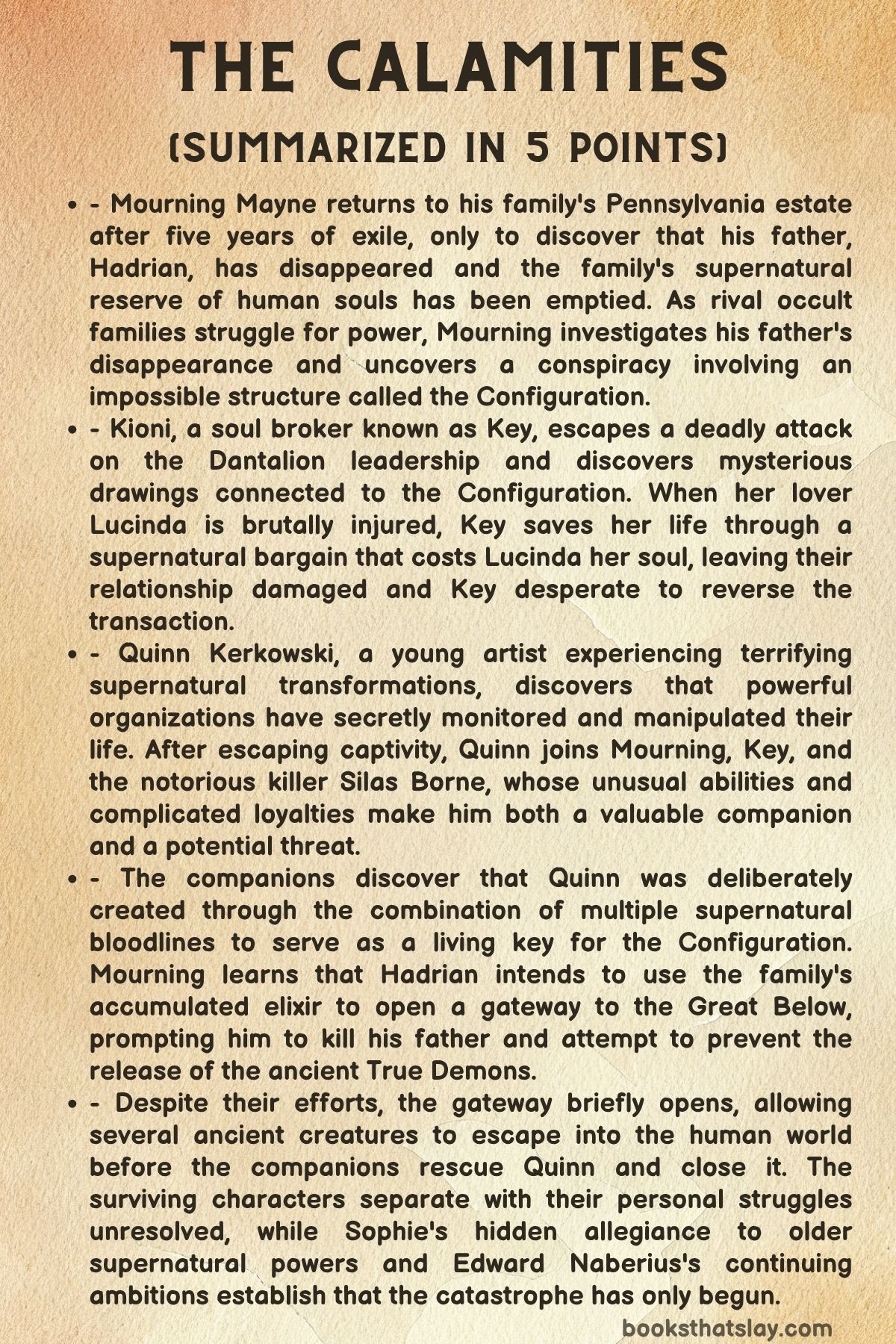
Summary
Mourning Mayne awakens in a luxurious vehicle without remembering how he arrived there. After five years of self-imposed exile in Seattle, he discovers that his father, Hadrian Mayne, has summoned him back to the family estate in Pennsylvania.
The Maynes belong to Agares House, one of several powerful supernatural organizations whose members acquire human souls through binding transactions. These souls are transformed into elixir, a substance that provides extraordinary abilities and sustains the family’s authority.
Mourning’s homecoming is uncomfortable from the beginning. The estate has deteriorated, his father remains elusive, and his cruel siblings, Lachlan and Lorelei, welcome him with a supernatural impersonator resembling Sophie Gireau, the woman Mourning loved in his youth.
Sophie represents the central wound in Mourning’s relationship with his father. Years earlier, Hadrian demanded that Mourning claim her soul as proof of his loyalty to the family, but Mourning refused and was consequently exiled.
When Hadrian finally meets his son, he appears unusually willing to reconcile. He takes Mourning into the family cellar and immerses him in the immense fount of souls, exposing him to an intoxicating supernatural power that awakens something unfamiliar within his body.
The following morning, the fount is completely empty, and Hadrian has disappeared. Mourning learns that his father has also frozen the family’s financial accounts, preventing him from escaping the crisis through the money that secretly sustained his supposedly independent existence.
The disappearance threatens the entire supernatural hierarchy. Lesser families depend upon the Maynes for elixir, rival organizations are becoming increasingly aggressive, and similar disturbances have already affected other powerful bloodlines.
Mourning begins investigating his father’s whereabouts with Sophie’s assistance. Their search reveals Hadrian’s growing obsession with a mysterious structure called the Configuration, an impossible building that appears in Mourning’s recurring dreams.
Meanwhile, in Seattle, Kioni, who goes by Key, works as a broker for the Dantalion, another supernatural organization. Unlike many of her relatives, she refuses to consume elixir, fearing the destructive dependency that characterized her mother’s life.
Key records the initials of everyone whose soul she acquires as tattoos on her arm. Although she continues making supernatural bargains, these permanent reminders expose her discomfort with the human suffering that supports her livelihood.
Her ordinary existence is disrupted when the Dantalion summons her to Portugal. There, its leader, Caetano Adamastor, interrogates her about Mourning Mayne and demands that she investigate his activities.
Before Caetano can complete his threats, a mysterious attacker wearing a White Rabbit mask enters the compound and kills him. The attacker also destroys several powerful supernatural guards, allowing Key to escape with a folder containing drawings of an extraordinary building.
Key recognizes that the drawings depict the same structure in different architectural forms. Their creator is identified only as Quinn K., and the images become her principal clue to understanding the violence surrounding the supernatural families.
After returning to Seattle, Key discovers that the Dantalion is searching for her. Its operatives attack her lover, Lucinda, leaving the woman gravely wounded and forcing Key to make a devastating decision.
To save Lucinda’s life, Key offers her a supernatural bargain in exchange for her soul. Lucinda accepts, but the transaction transforms their relationship because she begins experiencing a disturbing loss of ordinary emotional attachment.
Key promises to recover the soul, although she has no idea whether such a reversal is possible.
Elsewhere, Quinn Kerkowski, a young artist living in Philadelphia, discovers that their therapist has secretly been receiving payments from Oriax-Agares, LLC. The organization has also been collecting Quinn’s private information and disturbing drawings of the Configuration.
Quinn’s attempts to uncover the truth coincide with a frightening supernatural transformation. They experience violent visions, uncontrollable physical changes, and encounters with a horned creature that appears to exist within their own body.
When their therapist is murdered under circumstances matching one of these visions, Quinn realizes that their experiences may have consequences beyond their conscious control. An organization called the Watchers subsequently captures them and attempts to suppress their powers through ritual restraints.
Quinn eventually escapes when their cat, Apple, disrupts the protective circle. The resulting violence kills several Watchers and leaves Quinn terrified by the destructive abilities emerging inside them.
Mourning and Key, who have joined forces while investigating the mysterious drawings, encounter Quinn immediately afterward. They also meet Silas Borne, a seemingly helpful stranger who intervenes when a surviving Watcher attacks them.
Silas is actually the Cleaver, an infamous supernatural murderer who once consumed human souls directly. After being captured, he was deprived of his abilities and forced into servitude by Nils and Sascha Gremory, another powerful supernatural family.
The four companions retreat to the Mayne family’s secluded lake house. There, they discover that Quinn’s condition differs fundamentally from an ordinary supernatural awakening, suggesting that someone deliberately manipulated their development.
Their investigation reveals that Quinn possesses connections to multiple supernatural bloodlines. The mysterious structure appears to be calling directly to them, while several powerful organizations are independently attempting to locate it.
Mourning’s search for Hadrian meanwhile leads him into conflict with the Oriax faction, whose members resent the Maynes’ control over elixir. Their leader, Oswald Lambert, sacrifices his own son, Dash, during a ritual that unleashes a monstrous serpent.
Mourning survives, but the experience exposes the lengths to which the supernatural families will go to preserve their authority. His relatives prove equally dangerous, particularly his ambitious cousin Callahan, who believes the Configuration can provide enough power to transform the existing hierarchy.
As the companions investigate further, Sophie disappears, and evidence suggests that she has been communicating secretly with Mourning’s uncle Julian. Mourning’s desperate attempts to locate her become inseparable from his growing suspicion that everyone around him is concealing important information.
At the lake house, Quinn experiences another supernatural episode and enters the nearby lake. Key rescues them from a monstrous underwater presence, but Quinn returns with a vision identifying the Cosmos Diner in Corning, Kansas.
The diner provides the companions with their first definite geographical lead. They travel west, knowing that the Configuration may offer Key a chance to restore Lucinda’s soul, Mourning freedom from his family, and Silas the return of his lost powers.
However, Silas learns that Quinn was deliberately created through the combination of numerous supernatural inheritances. The artist is not merely connected to the Configuration but may be the sacrifice required to activate it.
Upon reaching Kansas, the companions discover that their enemies have already anticipated their arrival. The Dantalion attacks Key, while Edward Naberius, a mysterious man connected to experiments conducted decades earlier, approaches Quinn.
Key barely survives an encounter with the Dantalion enforcer Ivo Cantor. She is forced to consume elixir to heal her injuries, experiencing the extraordinary pleasure and strength that she has resisted throughout her life.
Mourning receives a message apparently sent by Sophie and goes to an abandoned restaurant. Instead of finding her, he encounters Hadrian, who finally reveals the purpose behind his disappearance.
Hadrian has concealed the missing elixir within his own body and intends to use it as an offering. He explains that the Configuration is a gateway to the Great Below, where ancient entities known as the True Demons have been imprisoned.
These beings existed before the demonic ancestors of the modern supernatural families. Hadrian believes that assisting their return will secure his position in a new order.
Mourning realizes that Quinn is being prepared as the gateway’s living key. Rejecting his father’s plan, he attacks Hadrian, tears the supernatural keystone from his chest, and kills him.
The victory is short-lived. Mourning absorbs the keystone himself, only to be captured by Callahan, Julian, and his siblings, who intend to use his accumulated elixir to complete the ritual.
Meanwhile, Quinn reaches an abandoned missile installation called Atlas Haven. Edward Naberius reveals that Quinn was created twenty-two years earlier through an experiment that combined numerous demonic inheritances within a single child.
Quinn is Legion, a living vessel containing multiple supernatural presences. Their body has been designed to unlock the barrier separating the human world from the Great Below.
As Quinn’s transformation begins, monstrous appendages emerge from their body and anchor them to the floor. Mourning’s captors arrive, and the confrontation releases the elixir stored within him into the underground gateway.
During the struggle, Key discovers that the White Rabbit is actually Sophie. The woman Mourning believed was an ordinary victim of his family’s cruelty has been participating in a much older supernatural conspiracy.
The gateway opens, and ancient creatures begin escaping into the world. Silas attempts to free Quinn, while Key and Mourning abandon their competing ambitions to help rescue the artist.
Although the companions pull Quinn from the opening and the gateway closes, several True Demons have already escaped. Atlas Haven collapses, and the nearby town begins burning under the consequences of their arrival.
The companions survive, but their alliance fractures. Silas is recaptured by the Gremorys, Quinn accepts the companionship of an ancient winged creature, and Key returns toward Seattle, hoping to repair her relationship with Lucinda.
Mourning prepares to return home after killing Hadrian, only to discover Sophie waiting beside him on the airplane. She reveals that her family serves powers older than the Maynes’ demonic ancestors and intends to help him govern Agares House.
Mourning understands that his father’s death has not freed him from supernatural manipulation. Meanwhile, Edward Naberius regards the catastrophe as a partial success and begins searching for another passage through which the remaining ancient beings can escape.
The novel closes with the established supernatural order weakened, ancient monsters loose in the human world, and its principal characters facing futures that remain deeply uncertain.
Characters
Mourning Mayne
Mourning Mayne is one of the central protagonists of The Calamities, a privileged young man whose apparent independence conceals a lifetime of emotional manipulation. Raised within the powerful Mayne family, he has inherited supernatural abilities, immense wealth, and an expectation that he will eventually participate in the family’s exploitation of human souls.
His defining conflict involves his father, Hadrian, whose authority has shaped Mourning’s understanding of love, duty, and personal worth. Even after spending five years in exile, Mourning remains financially dependent upon the man he believes he has escaped.
Mourning initially responds to difficulties through alcohol, drugs, reckless behavior, and avoidance. His comfortable lifestyle allows him to disregard the suffering of others, while his refusal to claim Sophie’s soul represents one of the few occasions when he openly challenges his family’s values.
His relationship with Sophie reveals both his capacity for affection and his tendency to confuse love with possession. He believes that refusing to take her soul demonstrates his devotion, yet he frequently overlooks her independence and assumes that he understands her better than she understands herself.
His experiences with Key, Quinn, and Silas gradually challenge his assumptions. He discovers that the supernatural system sustaining his privilege depends upon cruelty and that his reluctance to participate does not automatically free him from responsibility.
The confrontation with Hadrian becomes the decisive moment in his development. By killing his father to prevent the release of the True Demons, Mourning finally rejects the authority that has governed his existence.
However, his decision to absorb the keystone demonstrates that he remains susceptible to the same desire for supernatural power. His refusal to sacrifice Quinn later suggests genuine moral growth, but the novel deliberately avoids presenting his transformation as complete.
Mourning ultimately survives without achieving the freedom he anticipated. His father’s death removes one source of control, only for Sophie’s revelations to expose another, leaving him to confront the possibility that independence requires more than escaping a powerful parent.
Kioni “Key” Larage
Kioni, commonly called Key, serves as one of the principal moral counterpoints in The Calamities. Unlike Mourning, she grew up without the protection of a wealthy supernatural household and understands the personal consequences of addiction, poverty, and exploitation.
Her mother’s death and her difficult introduction to the Larage family profoundly influence her relationship with the Dantalion. Although her bloodline grants her membership in an influential supernatural organization, she remains uncomfortable with its customs and expectations.
Key earns her living by arranging bargains in which people surrender their souls in exchange for extraordinary rewards. She accepts financial compensation rather than elixir, believing that this arrangement protects her from repeating her mother’s destructive dependency.
However, refusing to consume the substance does not eliminate her participation in the system. The initials tattooed on her arm represent the people she has exploited, making her body a permanent record of decisions she cannot entirely justify.
Her relationship with Lucinda becomes the novel’s clearest demonstration of her contradictory values. Key wants an affectionate relationship untouched by supernatural transactions, yet she ultimately saves Lucinda’s life by acquiring her soul.
The resulting consequences force Key to confront the difference between performing an apparently compassionate act and respecting another person’s autonomy. She cannot accept that Lucinda might interpret survival without her soul as a terrible loss.
Key’s protective feelings toward Quinn similarly challenge her professional habits. Although she briefly considers surrendering the artist to the Dantalion, she ultimately chooses to protect someone whose extraordinary nature makes them valuable to competing supernatural interests.
Her decision to consume elixir after Ivo’s attack exposes the fragility of her abstinence. She experiences its intoxicating effects firsthand and discovers that her fears about dependency were justified.
By the conclusion, Key has become more willing to acknowledge her own contradictions, but she has not resolved them. Her continued longing for Lucinda, vulnerability to elixir, and uncertain future with the Dantalion leave her personal struggle unfinished.
Quinn Kerkowski
Quinn Kerkowski is the emotional and supernatural center of The Calamities, an artist whose search for personal identity becomes inseparable from a catastrophe threatening the entire world. Their life initially appears ordinary, although difficult family relationships, anxiety, and recurring nightmares have left them deeply uncertain about their place in society.
Quinn’s artistic abilities provide a means of expressing experiences they cannot understand. Their increasingly disturbing drawings of the Configuration reveal a connection to supernatural forces long before they consciously recognize its significance.
The discovery that their therapist has been secretly reporting to a supernatural organization destroys their remaining confidence in the people responsible for their care. Their subsequent captivity demonstrates that their supposed protectors regard them primarily as an experimental subject.
Quinn’s transformation combines extraordinary physical strength with violent impulses they cannot reliably control. Their horror at the destruction they cause is complicated by the relief of escaping confinement and discovering a power that others cannot easily suppress.
The revelation that Quinn contains numerous supernatural inheritances profoundly changes their understanding of themselves. They were deliberately created to serve as Legion, a living key intended to open the Configuration.
This discovery gives a terrible explanation for their childhood instability and the manipulation surrounding their development. Their identity has been shaped by people who never intended to allow them meaningful control over their future.
Quinn’s relationship with Apple provides an important connection to ordinary affection. Their attachment to the cat contrasts with the instrumental treatment they receive from almost every supernatural organization.
Their growing bond with Silas similarly reflects a desire to belong, although his violent history complicates the relationship. Quinn repeatedly encounters people who offer protection while concealing ambitions involving their powers.
After the gateway closes, Quinn loses the purpose that others assigned to them. Their willingness to accompany an ancient creature offering maternal affection reveals that their search for identity has not ended, even after they escape the role for which they were created.
Silas Borne
Silas Borne, once known as the Cleaver, is among the most morally ambiguous characters in The Calamities. His cheerful manners, intelligence, and occasional kindness exist alongside a history of extreme violence and the direct consumption of human souls.
Unlike members of the supernatural families who obtain souls through formal bargains, Silas developed the ability to seize them for himself. This independence made him exceptionally dangerous because his power did not depend upon the conventional systems governing the broods.
His relationship with Oliver exposes the brutality beneath his charming exterior. Although Oliver offers him affection and the possibility of a shared future, Silas kills him to consume his unusually powerful soul.
Oliver’s apparent vulnerability proves deceptive, however, because his invitation leads Silas into a carefully arranged trap. Captured and deprived of his abilities, Silas becomes the servant of Nils and Sascha Gremory.
His captivity reverses his former position of dominance. The man who once treated others as objects of consumption becomes someone whose body, labor, and freedom belong to more powerful masters.
Silas’s intelligence survives his supernatural punishment. He studies obscure subjects, secretly writes poetry, and searches for an opportunity to recover the abilities that previously defined him.
His encounter with Quinn introduces an unexpected emotional conflict. He recognizes that their unusual nature might restore his powers, but he also develops genuine protective feelings toward the artist.
This contradiction becomes especially apparent when he chooses to rescue Quinn from the Configuration. For a moment, his affection for another person outweighs the opportunity to reclaim his former strength.
Nevertheless, Silas has not abandoned his violent ambitions. He remains willing to obtain freedom through rituals requiring human sacrifice, and his murder of Julian’s living archive reveals the brutality concealed within his apparently generous promises.
His recapture by the Gremorys leaves his development unresolved. He demonstrates a capacity for attachment without becoming a morally transformed person, making him both a victim of supernatural enslavement and a continuing danger to others.
Sophie Gireau
Sophie Gireau occupies a deceptive position in The Calamities, initially appearing to be a comparatively ordinary woman trapped within the cruel traditions of Agares House. Her relationship with Mourning begins when she cares for him during his adolescence and becomes the focus of his resistance to Hadrian.
Mourning believes that refusing to claim Sophie’s soul protects her from his father’s exploitation. However, the revelation that Hadrian eventually acquired her soul demonstrates that Mourning never fully understood her circumstances.
Throughout the novel, Sophie appears knowledgeable, practical, and unusually composed when confronted with supernatural dangers. She repeatedly challenges Mourning’s selfishness and reminds him that his desire to escape does not erase the consequences of his actions.
Her apparent disappearance encourages Mourning to question everyone around him. His growing jealousy and suspicion reveal how little he understands about her private activities.
The revelation that Sophie is the White Rabbit fundamentally transforms her role. She possesses a capacity for violence far beyond what Mourning imagined, and her actions have helped destabilize some of the world’s most powerful supernatural families.
Her final explanation establishes that her family serves beings older than the supernatural ancestors of the Maynes. Her relationship with Mourning therefore involves an inheritance and purpose that extend beyond the familiar hierarchy of Agares House.
Sophie presents herself as someone liberated by Hadrian’s death, yet she remains deeply involved in the manipulation of his son. Her determination to accompany Mourning home suggests that affection, ambition, and supernatural obligation have become difficult to separate.
Her character challenges the assumption that apparent vulnerability necessarily indicates powerlessness. The woman Mourning imagines himself protecting ultimately possesses knowledge and intentions that exceed his understanding.
Hadrian Mayne
Hadrian Mayne is the authoritarian patriarch of Agares House and the principal architect of Mourning’s troubled upbringing. His immense supernatural authority allows him to control the family through wealth, emotional manipulation, and access to elixir.
He understands his children’s vulnerabilities and frequently exploits them to enforce obedience. His treatment of Mourning demonstrates how conditional affection can become a particularly effective instrument of domination.
Hadrian’s apparent reconciliation with his youngest son initially suggests that age and deteriorating health may have changed him. However, his subsequent disappearance reveals that his apparent generosity was part of a much larger calculation.
His obsession with the Configuration demonstrates the extent of his ambition. Rather than preserve the existing supernatural hierarchy, he intends to offer the family’s accumulated elixir to ancient beings in exchange for a privileged position under their rule.
Hadrian’s willingness to sacrifice Quinn reveals how completely he subordinates individual lives to his objectives. Even his own son becomes an instrument whose experiences and relationships can be manipulated to achieve the desired outcome.
His death at Mourning’s hands represents the destruction of a particular form of familial authority. Nevertheless, the continued influence of his plans demonstrates that removing an abusive patriarch does not automatically destroy the structures he created.
Lucinda Lawson
Lucinda Lawson is Key’s lover and one of the clearest representations of the human cost of supernatural bargains. As a tattoo artist, she initially offers Key a connection to ordinary life outside the transactions and obligations of the Dantalion.
Their relationship begins casually but gradually develops emotional significance. Lucinda’s desire for a genuine commitment challenges Key’s habit of maintaining distance from people she cares about.
Her brutal assault transforms their relationship into a confrontation with the supernatural economy. By agreeing to surrender her soul in exchange for survival, Lucinda enters a system whose consequences she cannot fully anticipate.
After the transaction, she experiences changes in her emotional life that leave her questioning whether she remains the same person. Her apparent indifference to danger and growing rejection of ordinary restraint frighten Key.
Lucinda refuses to accept Key’s claim that saving her life necessarily justified the bargain. Her response reveals the limitations of Key’s confidence in her ability to decide what constitutes another person’s welfare.
The revelation that Key never knew her full name further exposes the incompleteness of their intimacy. Lucinda becomes more than a victim through her insistence that her altered experience deserves recognition, even when Key finds it disturbing.
Edward Naberius
Edward Naberius is a mysterious supernatural manipulator whose activities connect Quinn’s creation to the larger conflict surrounding the Configuration. His experiments extend across decades and involve religious institutions, supernatural bloodlines, and attempts to transform the boundaries of reality.
Edward presents his activities as a means of restoring dignity to people who have been exploited or denied their identities. However, his methods repeatedly involve coercion, psychological manipulation, and the destruction of individual freedom.
His treatment of Quinn reveals the contradiction between his professed values and his actions. Although he claims to offer the artist an understanding of their stolen childhood, he refuses to respect their wishes when they ask him to stop the ritual.
Edward’s belief that destruction enables renewal provides the ideological foundation for his experiments. His willingness to sacrifice entire worlds demonstrates that his abstract vision of liberation has displaced concern for the individuals affected.
The revelation that he has pursued similar objectives across ninety-nine worlds expands his significance beyond the immediate events in Kansas. He regards the partial release of the True Demons as a temporary setback rather than a reason to abandon his ambitions.
Lachlan Mayne
Lachlan Mayne is Mourning’s older brother and one half of the malicious pair that dominates much of his childhood experience. His behavior combines casual cruelty with an unquestioning assumption that family privilege entitles him to control others.
Lachlan’s treatment of Mourning initially appears motivated by sibling rivalry. However, his willingness to participate in conspiracies involving Callahan reveals that his loyalties are shaped by calculations of power and survival.
His reaction to the disappearance of the family’s elixir demonstrates that he understands the practical foundations of Agares House. Without its supernatural reserves, the Maynes cannot maintain the obedience of their dependent families.
Lachlan represents someone thoroughly accustomed to the advantages of an exploitative system. He recognizes its dangers without seriously questioning the values upon which it depends.
Lorelei Mayne
Lorelei Mayne shares Lachlan’s cruelty but frequently expresses it through disturbing intimacy and psychological provocation. Her treatment of Mourning demonstrates a particular willingness to exploit his emotional vulnerabilities.
The supernatural impersonation of Sophie reflects her understanding of the attachment that continues to influence her brother. She treats another person’s humiliation as entertainment rather than recognizing its emotional consequences.
Lorelei’s behavior also reveals her dependence upon the family’s established hierarchy. Despite her apparent independence and confidence, she has built her identity around Hadrian’s authority and the privileges it provides.
Her devastation upon learning of her father’s death reveals an emotional attachment that her cruelty often conceals. The reaction complicates her portrayal without excusing her participation in the family’s violence.
Julian Mayne
Julian Mayne is Hadrian’s brother and a knowledgeable participant in the family’s hidden supernatural affairs. His apparently respectable existence conceals a grotesque underground archive constructed from transformed human beings.
The living archive demonstrates Julian’s attitude toward knowledge and power. He has reduced people to instruments for storing information, treating their continued suffering as an acceptable price for his intellectual resources.
His investigation of ancient rituals suggests that he understands the Configuration more thoroughly than Mourning initially realizes. His involvement with Callahan and the White Rabbit places him within the conspiracy surrounding the gateway.
Julian functions as an example of how supernatural knowledge can become another justification for exploitation. His pursuit of extraordinary secrets depends upon the systematic removal of other people’s autonomy.
Callahan Mayne
Callahan Mayne is Mourning’s ambitious cousin, a man whose extravagant lifestyle and exaggerated displays of confidence conceal a desire for greater political and supernatural authority. He resents the traditional arrangement in which the powerful broods exercise influence without openly claiming public recognition.
The Configuration represents an opportunity to change that arrangement. Callahan believes its extraordinary power could allow him to establish a new hierarchy with himself occupying a more prominent position.
His elaborate gathering on Shearwater demonstrates his willingness to use family relationships as instruments of manipulation. He presents himself as a welcoming relative while secretly coordinating efforts to locate Hadrian and obtain the missing elixir.
His alliance with Julian and Sophie reveals that he possesses information Mourning does not. However, his confidence repeatedly exceeds his control over events.
Callahan’s decision to shoot Mourning and use him as a supernatural vessel exposes the violence underlying his ambitions. His eventual fall into the gateway demonstrates how his pursuit of extraordinary authority places him directly in the path of forces he cannot govern.
Oswald Lambert
Oswald Lambert leads the resentful Oriax faction, whose members have long depended upon the Maynes for access to elixir. He regards Hadrian’s disappearance as an opportunity to challenge the hierarchy that has kept his family subordinate.
His supernatural ritual reveals the brutality beneath his demands for restitution. Rather than accept diminished authority, Oswald sacrifices his own son to summon an entity capable of restoring his faction’s power.
His treatment of Dash demonstrates how completely ambition has displaced paternal affection. The willingness to destroy his own family for supernatural advantage makes him a disturbing counterpart to Hadrian.
Dash Lambert
Dash Lambert is Mourning’s wealthy acquaintance and Oswald’s son. His privileged upbringing has encouraged selfishness, cruelty, and the belief that his actions carry few consequences.
His confession concerning sexual violence and the death of a young woman exposes the moral corruption concealed within his social circle. His betrayal of Mourning further demonstrates that friendship becomes expendable when family interests are threatened.
However, Dash is also a victim of his father’s authoritarian ambitions. His terror during the Oriax ritual reveals that the privilege he has enjoyed cannot protect him from the violence of the system sustaining it.
His death illustrates how the supernatural families ultimately value power above even their closest relationships.
Caetano Adamastor
Caetano Adamastor is the leader of the European Dantalion and represents the organization’s authoritarian traditions. He expects unquestioning obedience from members of his bloodline and regards Key’s refusal to consume elixir as a personal insult.
His treatment of Key exposes the cruelty of a hierarchy based upon inherited supernatural privilege. He uses physical violence, intimidation, and humiliation to reinforce her subordinate position.
His abrupt murder by the White Rabbit demonstrates that the established leaders are vulnerable to forces beyond their customary understanding. His death creates further instability and places Key under suspicion.
Augustinho Mouros
Augustinho Mouros serves as Caetano’s representative and enforcer. His outward courtesy conceals formidable supernatural abilities, suggesting how thoroughly the Dantalion has mastered the combination of refined appearances and coercive power.
His encounter with Key in Portugal initially resembles an ordinary meeting between acquaintances. However, his participation in her abduction reveals that the politeness of the supernatural elite offers no guarantee of safety.
His death during the White Rabbit’s attack demonstrates the limitations of the powers upon which the Dantalion relies.
Ivo Cantor
Ivo Cantor is a Dantalion operative who captures Key in Kansas and interrogates her about Caetano’s murder. He represents the organization’s continuing determination to punish anyone suspected of involvement in the destruction of its leadership.
His methods rely upon physical torture and psychological manipulation. By confronting Key with her history of arranging destructive bargains, he attempts to weaken her resistance and obtain information about Quinn.
Ivo’s attack forces Key into the very dependency she has spent her life avoiding. Her consumption of elixir to survive their confrontation makes his role significant beyond the immediate danger he presents.
His subsequent disappearance from the motel leaves open the possibility that he survived.
Theodora Adamastor
Theodora Adamastor is Caetano’s daughter and an important figure in the power struggle following his death. Although she does not become a central participant in the immediate action, her reputation influences Key’s decisions.
Herschel’s warning about her cruelty discourages Key from attempting a direct explanation of her circumstances. Theodora consequently represents the continuing threat posed by the Dantalion even after its leader has been killed.
Nils Gremory
Nils Gremory is one of Silas’s supernatural masters. He participates in maintaining the binding that deprives the former Cleaver of his freedom and extraordinary abilities.
Nils understands Silas’s violent history and recognizes that his servant’s former identity might become useful during the crisis affecting the broods. His willingness to encourage the return of those abilities demonstrates the dangerous calculations underlying his authority.
When Silas attempts to establish an independent existence, Nils helps reassert the binding that controls him. His treatment of Silas reflects a system in which even exceptionally powerful individuals can be reduced to possessions.
Sascha Gremory
Sascha Gremory shares authority over Silas with Nils. Together, they maintain a secluded supernatural household sustained by a small but powerful fount of souls.
Sascha participates in the degrading treatment that defines Silas’s captivity. The household’s apparent domestic order conceals a relationship based upon coercion and the removal of personal freedom.
The Gremorys’ arrival in Kansas destroys Silas’s hopes of independence. Sascha’s role in this confrontation reinforces the fact that the power structures surrounding the characters remain intact despite the larger supernatural catastrophe.
Oliver
Oliver is a young man whose supernatural gift allows him to perceive and remove suffering from other people. His unusual soul contains an accumulated burden of pain that makes him particularly attractive to Silas.
His relationship with the former Cleaver initially suggests the possibility of affection and an ordinary shared future. Oliver invites Silas to an abandoned cider barn where they might build a life together.
Silas instead murders him and consumes his soul, revealing the extent to which his appetite for power overrides intimacy. However, Oliver’s invitation also leads Silas into a supernatural trap.
Oliver’s role challenges the assumption that apparent innocence necessarily indicates helplessness. His extraordinary abilities and connection to the trap complicate the encounter without diminishing the violence committed against him.
Dan Oatland
Dan Oatland is Quinn’s therapist and an important participant in the secret surveillance of their development. His apparent professional concern conceals an arrangement through which Oriax-Agares receives confidential information about Quinn’s experiences and artwork.
His betrayal is particularly damaging because Quinn has trusted him with personal vulnerabilities. The revelation that their therapy has become part of a supernatural experiment destroys the distinction between care and exploitation.
Oatland’s murder also marks a turning point in Quinn’s transformation. Their inability to determine whether they consciously committed the killing intensifies their fear of losing control over their own body.
Arthur, Mary, Cosmo, and Angelica
Arthur, Mary, Cosmo, and Angelica are members of the Watchers who participate in Quinn’s confinement. Their organization studies supernatural phenomena and maintains relationships with the powerful blooded families.
The group possesses specialized knowledge and ritual techniques capable of restraining beings with extraordinary abilities. However, its treatment of Quinn demonstrates a willingness to prioritize research and containment over personal autonomy.
Angelica becomes a direct victim of Quinn’s violent escape when the protective circle is disrupted. The subsequent deaths and destruction reveal that the Watchers have underestimated the power developing within their captive.
Collectively, these characters represent the institutional side of the conspiracy surrounding Quinn. Their actions demonstrate how scientific curiosity, supernatural knowledge, and coercive control can become closely connected.
Herschel Keene
Herschel Keene is an information broker familiar with the supernatural families and their secret activities. His meeting with Key in a secluded cemetery demonstrates his preference for privacy and caution.
He provides useful information about the Dantalion’s pursuit of Key and the dangers surrounding Theodora Adamastor. However, his reaction to the drawings of the Configuration reveals that even experienced supernatural intermediaries fear certain kinds of knowledge.
His refusal to explain the structure’s significance increases the mystery surrounding it. Herschel represents someone who survives within the supernatural world by recognizing when information is too dangerous to investigate.
Carla Jaworsky
Carla Jaworsky is Key’s acquaintance in Portugal and provides essential assistance after the destruction of the Dantalion compound. She offers shelter, medical attention, and access to the contacts necessary to obtain false identification.
Her willingness to help initially reflects genuine friendship. However, her subsequent request to sell her soul reveals that she also views Key’s supernatural abilities as a potential solution to her financial difficulties.
When Key refuses, Carla interprets the decision as an insult rather than an expression of concern. Their disagreement reveals how easily affection becomes complicated when one person possesses the apparent ability to transform another’s circumstances.
Carla illustrates the desperation that makes supernatural bargains attractive. Her desire for security is understandable, even though Key recognizes that the proposed transaction could destroy the very happiness she hopes to obtain.
Lee Scott
Lee Scott is a grieving father who approaches Key seeking revenge against three men he believes responsible for his daughter’s death. His suffering makes him vulnerable to the promise that supernatural intervention can provide justice.
Although Key warns him about the consequences, Lee agrees to surrender his soul. His decision becomes another transaction through which the Dantalion converts human desperation into supernatural wealth.
Lee’s role reveals the moral difficulty of distinguishing personal revenge from genuine justice. His grief is real, but the bargain offers no guarantee that achieving retaliation will restore anything he has lost.
George Jackson Cash
George Jackson Cash is a young man whose bargain with Key becomes one of the most disturbing events in her history. Seeking revenge against an abusive religious leader, he ultimately commits a mass shooting that leaves the pastor alive to witness the destruction.
His actions demonstrate how supernatural bargains can enable desires to develop into consequences far beyond what their brokers initially anticipate. His case becomes an enduring source of guilt and fear for Key.
Key later hunts George down and shoots him. The episode establishes her willingness to use violence against someone whose supernatural transaction she previously facilitated.
His connection to the White Rabbit imagery also provides an unsettling precedent for the later attacks on the Dantalion.
Apostle Alden Maydock
Apostle Alden Maydock is a charismatic religious leader involved in one of Edward Naberius’s early experiments. His public spiritual authority conceals private participation in disturbing supernatural practices.
The ritual conducted under his supervision demonstrates how religious institutions can become instruments for people pursuing entirely different objectives. His followers’ apparent devotion provides a setting in which power, bodily control, and supernatural experimentation intersect.
Maydock’s presence establishes that the conspiracy surrounding Quinn has roots in events occurring decades before their personal crisis.
Sarah
Sarah participates in the supernatural experiment arranged by Edward Naberius and Apostle Alden Maydock. Her unusual resistance to ordinary methods of manipulation makes her particularly interesting to Edward.
Unlike the other participants, Sarah does not respond predictably to shame, humiliation, or desire. Her emotional independence complicates the assumptions underlying the experiment.
Her question about whether they have ended the world reveals an awareness that the ritual carries consequences beyond its immediate participants. Edward’s response suggests that her involvement belongs to the earliest stages of his larger destructive project.
Verner
Verner is the Mayne family’s driver and a familiar representative of the household Mourning has attempted to escape. He transports Mourning back to Pennsylvania and provides some of the first information about the estate’s deterioration.
His subsequent murder at Julian’s property demonstrates that the disappearance of Hadrian has already produced deadly consequences. Verner’s death also establishes that ordinary household employees can become casualties of conflicts among the supernatural elite.
Amandia
Amandia is a young woman Mourning meets during his unsuccessful attempt to resume his former lifestyle. Her resemblance to Sophie contributes to his attraction, revealing how strongly his unresolved emotional attachments continue to influence him.
Mourning brings her to Hadrian’s bedroom as an act of rebellion against his absent father. Their encounter illustrates his tendency to use personal relationships as temporary distractions from problems he refuses to confront.
Captain Vick
Captain Vick transports Mourning and his siblings to Callahan’s private island. His ordinary occupation places him temporarily within the orbit of a family whose members regard people outside their supernatural hierarchy as inferior.
The twins’ harassment of him demonstrates how casually they exercise their privilege. Mourning’s limited intervention reveals that his growing moral discomfort has not yet translated into consistent resistance.
Annalisa
Annalisa receives Mourning and his siblings upon their arrival at Shearwater. Her role in directing them toward Callahan’s residence helps establish the controlled circumstances of the gathering.
Her assurances about transportation become significant because Mourning realizes that the boat he arranged has departed. She contributes to the uneasy impression that the supposed celebration has been carefully organized to restrict his choices.
Violetta Crassus
Violetta Crassus belongs to the wider network of supernatural figures whose reported deterioration signals the growing instability among the broods. Her apparent loss of sanity is mentioned alongside other disturbing developments affecting powerful families.
Although she does not occupy a substantial role in the immediate action, her circumstances help establish that the crisis extends beyond Agares House. Her uncertain condition contributes to the sense that familiar supernatural arrangements are failing.
Richard Ledesma Torres
Richard Ledesma Torres is the author of the work on supernatural architecture discovered among Hadrian’s possessions. His writing provides important intellectual context for the investigation of the Configuration.
The passages concerning unusual currents and impossible structures help Mourning recognize that his father’s interests extend beyond ordinary occult practices. Although Torres does not directly participate in the events, his work becomes part of the trail leading toward the larger mystery.
Raymond
Raymond is an acquaintance remembered by Key when Carla asks to sell her soul. His earlier bargain made him wealthy but ultimately damaged his relationships and left him spiritually diminished.
His experience provides Key with a concrete reason to refuse Carla’s request. Raymond demonstrates that obtaining the material benefits promised by a supernatural transaction does not necessarily produce personal satisfaction.
Mamie Borne
Mamie is Silas’s sister, whose memory becomes important during his growing attachment to Quinn. Remembering her helps him recognize that a person he considers family cannot be treated simply as another source of supernatural power.
Although her direct involvement is limited, Mamie represents an emotional connection that survives beneath Silas’s violent history. Her memory helps explain why his feelings for Quinn become stronger than his immediate desire to recover his abilities.
Apple
Apple is Quinn’s orange cat and one of the most important sources of emotional stability in their life. During the artist’s disturbing transformation, the animal provides comfort without demanding explanations or attempting to exploit their extraordinary nature.
Apple also performs a decisive action by accidentally disrupting the Watchers’ protective circle. This seemingly insignificant act allows Quinn to escape captivity and brings the principal characters together.
The cat’s disappearance near the Configuration intensifies Quinn’s feelings of abandonment. However, the final encounter with Edward Naberius, in which Apple scratches him and escapes, confirms that the animal survives the catastrophe.
Apple’s role gives the novel a recurring connection to ordinary affection amid supernatural cruelty.
The Ancient Winged Being
The ancient winged creature that approaches Quinn after the Configuration closes represents a new and uncertain form of supernatural companionship. Unlike the modern broods, it belongs to the older order released from the Great Below.
The creature recognizes Quinn as Legion and offers to become their mother. Its proposal directly addresses the artist’s longing for family, belonging, and an identity independent of the people who created them.
Quinn’s decision to accompany it reflects their desperation for companionship after Silas and Apple fail to return. The encounter offers apparent comfort, but the creature’s true intentions remain uncertain.
The True Demons
The True Demons are the ancient beings imprisoned beyond the Configuration. Their existence establishes that the archfiends associated with the modern supernatural families are not the oldest powers within the novel’s universe.
Their release threatens both humanity and the established supernatural hierarchy. Some appear capable of recognizing bloodlines and negotiating relationships, while others display immediate predatory violence.
Their arrival transforms the conflict from a struggle among privileged families into a crisis involving the foundations of the existing world. The uncertainty surrounding their motives allows the novel to end without establishing a simple division between supernatural liberators and supernatural destroyers.
Themes
The Commodification of the Human Soul
The Calamities depicts a society in which human souls have become commodities that can be acquired, stored, consumed, and exchanged for supernatural advantages. The powerful families maintain their extraordinary privileges by transforming the essential identities of ordinary people into resources.
This arrangement creates an economy in which human desperation becomes a source of wealth. Grief, financial insecurity, revenge, and the desire for survival provide opportunities for supernatural brokers to acquire something far more valuable than the benefits they offer.
Key’s profession illustrates the moral contradictions of this system. She recognizes the suffering associated with many transactions, yet she continues participating because her livelihood and position within the Dantalion depend upon it.
Her tattoos reveal that even a person who acknowledges the human cost of exploitation can become accustomed to its continuation. Recording the names of her clients preserves their individuality, but it does not prevent their souls from becoming supernatural property.
Lucinda’s transformation demonstrates the consequences of treating the soul as something separable from the person who possesses it. Although she survives her injuries, the bargain changes her relationship with emotion, personal identity, and the people she loves.
Her experience challenges the assumption that a supernatural transaction can be judged solely by whether it delivers the promised result. Survival becomes a complicated outcome when the price involves losing something essential to the experience of being alive.
Silas introduces another perspective by questioning whether stealing a soul is fundamentally different from obtaining it through a bargain. His argument exposes the possibility that formal agreements merely provide an appearance of legitimacy to an exploitative practice.
The disappearance of the families’ elixir also reveals how completely their political authority depends upon accumulated human suffering. Once their supernatural reserves vanish, their supposedly permanent hierarchy begins collapsing almost immediately.
Through these developments, the novel examines the consequences of reducing human existence to a resource. The characters’ repeated attempts to reverse or escape particular transactions reveal the difficulty of recovering what has already been surrendered.
Family, Control, and Inherited Power
Hadrian Mayne’s relationship with Mourning demonstrates how familial authority can become an instrument of emotional domination. Rather than establish obedience through physical force alone, Hadrian controls his son by manipulating affection, financial security, and the fear of rejection.
Mourning’s exile initially appears to represent freedom from this authority. However, the discovery that Hadrian continued financing his lifestyle exposes the extent to which his independence remained dependent upon the family structure he rejected.
His father’s decision to freeze the family’s accounts removes the illusion that physical distance necessarily produces personal autonomy. Mourning must confront the fact that his upbringing continues to influence his decisions even when Hadrian is absent.
The behavior of Lachlan and Lorelei demonstrates another consequence of this household. Having grown up within a system that rewards domination, the twins reproduce its cruelty in their treatment of Mourning and ordinary people.
Oswald Lambert’s sacrifice of Dash provides an especially extreme representation of the same principle. Family relationships become subordinate to supernatural ambition, and even a child can be treated as an expendable resource.
Silas’s relationship with the Gremorys reverses the conventional parent-child arrangement while preserving its underlying hierarchy. His masters exercise control over his body and abilities, demanding obedience while presenting their domination as an established obligation.
Quinn offers a different perspective because their family history has been deliberately manipulated. Their childhood was shaped by people who considered them an experiment rather than an individual entitled to discover their own identity.
Their attraction to the ancient creature offering maternal companionship demonstrates the continuing desire for family even after repeated experiences of betrayal. The offer is powerful precisely because Quinn has been denied stable relationships throughout their life.
Sophie’s revelations complicate the theme further by revealing that inherited obligations extend beyond the familiar supernatural families. Her association with older powers suggests that the desire to escape one hierarchy may expose a person to another.
The novel consequently presents family as both a potential source of belonging and a mechanism through which power reproduces itself. Its characters struggle to determine whether affection can exist independently of the obligations, expectations, and coercion imposed by their origins.
Identity, Autonomy, and the Search for Belonging
Quinn’s transformation places the question of personal identity at the center of the narrative. Their memories, artistic abilities, and bodily experiences are all affected by supernatural forces whose origins they do not understand.
The discovery that they were deliberately created as Legion threatens their understanding of themselves as an independent individual. Their existence has been shaped by an experiment designed to fulfill a purpose determined before they were born.
The Watchers reinforce this loss of autonomy by treating Quinn as a subject to be observed and restrained. Their willingness to violate therapeutic confidentiality demonstrates how easily institutions can justify coercion when they believe their research serves a larger objective.
Quinn’s violent awakening complicates their struggle for independence. Their extraordinary strength enables escape, but the destruction accompanying it makes them fear that their own body has become something they cannot control.
Their relationship with Apple therefore acquires considerable emotional significance. The cat provides companionship without requiring Quinn to perform a supernatural function or conform to an identity imposed by someone else.
Lucinda experiences a related crisis after surrendering her soul. Although she remains physically alive, her changing emotions raise questions about which aspects of personality determine whether someone remains the same person.
Key’s insistence that Lucinda needs her soul restored initially appears compassionate. However, Lucinda’s resistance reveals that Key is again attempting to determine what another person should become.
Mourning faces a similar problem in his relationship with Sophie. His desire to protect her often prevents him from recognizing that she possesses an independent history, intentions, and understanding of the supernatural world.
Silas’s captivity offers another examination of bodily autonomy. His masters have stripped him of an essential supernatural capacity, leaving him unable to experience the abilities that previously defined his existence.
The characters’ circumstances demonstrate that identity cannot be understood solely through inheritance, physical ability, or an assigned supernatural purpose. Their continuing struggles concern the more difficult question of whether they can choose what to become.
Quinn’s decision to leave with the ancient winged creature brings this uncertainty into particular focus. The choice offers an opportunity for belonging, but it also raises the possibility that their longing for affection may expose them to another form of manipulation.
Freedom, Moral Compromise, and Catastrophic Change
The Calamities repeatedly presents freedom as something its characters desire without fully understanding the consequences of obtaining it. Their attempts to escape established restrictions often lead them toward new dependencies, dangerous bargains, or destructive uses of power.
Mourning believes that leaving his father will allow him to establish an independent existence. His eventual return reveals that neither geographical distance nor inherited wealth can free him from the habits and obligations created by his upbringing.
Killing Hadrian appears to complete the process of liberation. However, Sophie’s subsequent revelations demonstrate that Mourning has escaped one controlling figure without gaining a comprehensive understanding of the forces governing his life.
Key’s refusal to consume elixir represents another attempted form of freedom. By accepting money instead of supernatural nourishment, she hopes to avoid the addiction that destroyed her mother.
Her eventual consumption of elixir demonstrates how extreme circumstances can undermine even deeply held commitments. The substance saves her life while exposing her to a dependency she previously believed she could resist indefinitely.
Silas’s desire for freedom creates a different moral problem. Although his captivity is undeniably oppressive, he intends to recover his abilities through methods that would reproduce the violence he once inflicted upon others.
His decision to rescue Quinn reveals a capacity to place another person’s welfare above his immediate ambitions. Nevertheless, his continued willingness to sacrifice human lives prevents this moment of compassion from becoming a complete moral transformation.
Edward Naberius extends the theme to a much larger scale through his belief that destruction is necessary for renewal. He presents the release of ancient beings as an opportunity to dismantle established hierarchies and restore dignity to those who have suffered under them.
The catastrophe in Kansas reveals the danger of pursuing abstract liberation without regard for its immediate human consequences. Although the Configuration’s opening disrupts the existing supernatural order, the escaping creatures also bring violence and destruction into the ordinary world.
Quinn’s rescue prevents the complete opening of the gateway, but it does not undo the damage already caused. Their survival also leaves them uncertain about their identity because the purpose imposed upon them has been interrupted.
The ending refuses to establish freedom as a simple destination that the characters reach after overcoming their enemies. Instead, their experiences demonstrate that liberation from one form of power can create new responsibilities, dependencies, and dangers.
The surviving characters must confront the consequences of their decisions in a world whose familiar rules have begun to collapse. Their uncertain futures suggest that genuine freedom requires not only the destruction of oppressive structures but also the difficult work of deciding what should replace them.