Prey for Me Summary, Characters and Themes
Prey for Me by Allie Oleander is a dark romance that combines psychological suspense, unconventional desire, and the difficult process of recovering from an abusive relationship.
The story follows Margot Walker, a fiercely independent woman whose attempt to rebuild her life is threatened when her dangerous former husband begins stalking her. Her growing relationship with Caine Underwood, a tattoo artist and horror attraction owner, introduces a different understanding of intimacy, trust, and personal freedom. Against the unsettling atmosphere of haunted attractions, masked pursuers, and mysterious threats, the novel examines the difference between consensual fear and genuine violence, while exploring love between two people marked by painful experiences. It’s the 2nd book in the Feral Love series.
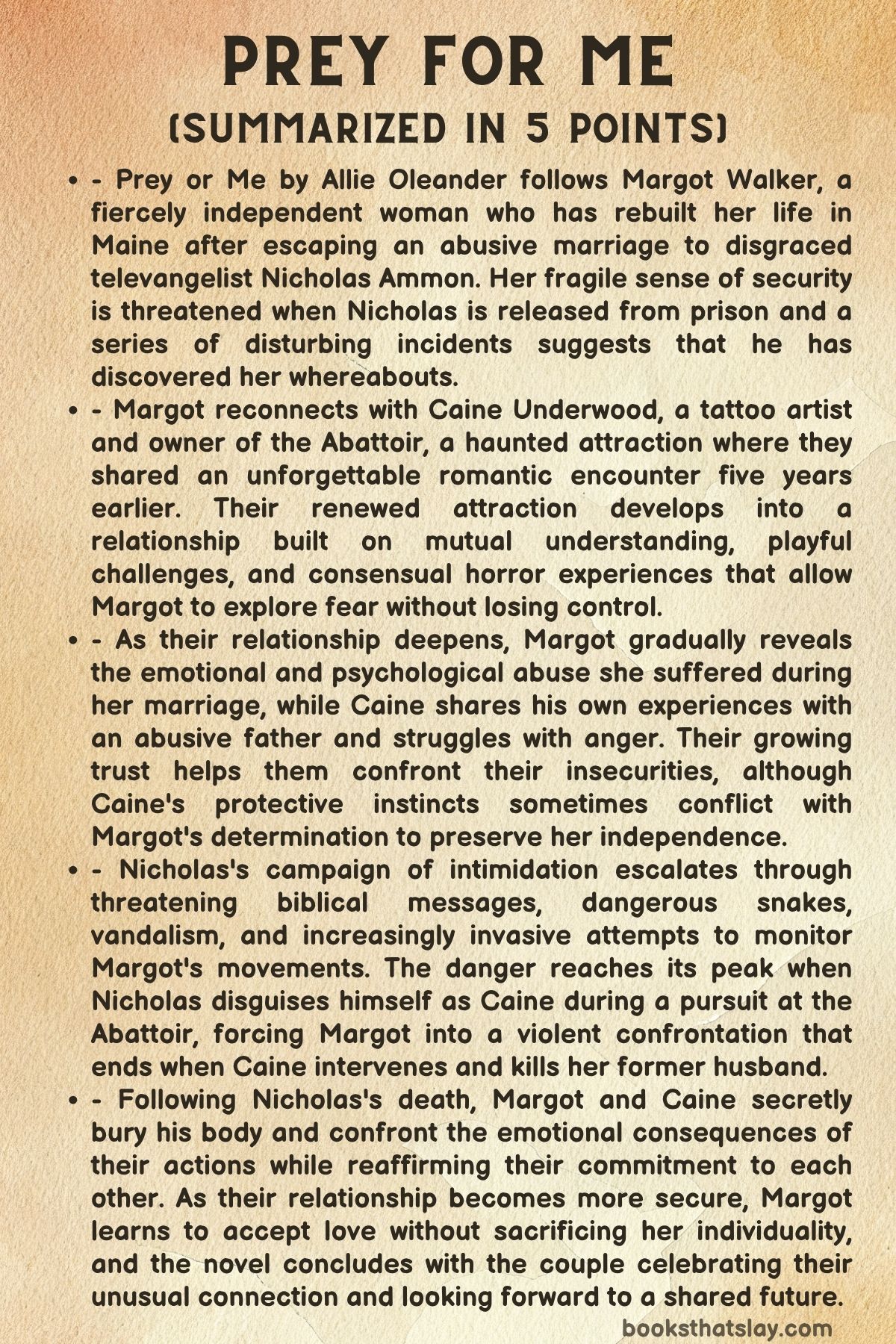
Summary
Margot Walker has created a relatively peaceful existence in Newbound, Maine, after escaping a deeply damaging marriage. She temporarily occupies the secluded home of her friends Shane and Claire Underwood, who are hiking the Appalachian Trail, while working as Shane’s personal assistant and managing freelance responsibilities.
Although her friend Lauren worries about the isolation of the property, Margot values the independence she has fought to achieve. Her carefully maintained routine changes when she learns that Caine Underwood, Shane’s brother and a man with whom she shares an intense romantic history, is returning to town permanently.
Caine is a successful tattoo artist and former reality television personality who has decided to purchase the Abattoir, a haunted attraction where he previously worked. He intends to transform the business into a year-round entertainment venue, incorporating escape rooms and elaborate horror experiences.
His return awakens memories of an encounter five years earlier, when Margot reluctantly volunteered at the Abattoir during Halloween. Playing Little Red Riding Hood opposite Caine’s frightening wolf character, she discovered an unexpected attraction to theatrical pursuit and controlled fear.
Their professional performance eventually developed into a private encounter that profoundly affected Margot. Caine’s attention to her boundaries and willingness to let her determine what she wanted offered a striking contrast to the controlling relationship she had recently escaped.
Although their connection was powerful, neither pursued a conventional relationship afterward. Nevertheless, Caine never forgot her, and their renewed communication quickly develops into flirtatious challenges, including a wager involving one of the Abattoir’s extreme horror experiences.
The first serious disturbance occurs during a storm at Shane and Claire’s house. When the electricity fails and Margot hears an apparent intruder, she assumes that her former husband, Nicholas Ammon, may have found her.
Armed with the self-defense skills she developed after escaping him, she violently confronts the stranger before discovering that he is Caine. He has arrived unexpectedly and entered the house while investigating the power failure, leaving both shaken by the dangerous misunderstanding.
Their concern increases when they discover a rattlesnake inside the property. Margot recognizes disturbing similarities between the incident and intimidation tactics previously used by Nicholas, a disgraced televangelist who manipulated religious authority to control her throughout their marriage.
Nicholas has recently been released from prison, and Margot fears that he intends to punish her for escaping. A threatening message and indications of unauthorized entry suggest that the snake’s appearance was deliberate rather than accidental.
Caine insists that the danger must be taken seriously, but Margot hesitates to identify Nicholas to the authorities. Her experiences have taught her that powerful and charismatic abusers can manipulate public opinion, making victims appear unreliable.
A reptile specialist named Brady removes the snake while Caine begins investigating Nicholas’s criminal history. Although he is disturbed by what he discovers, he realizes that protecting Margot will require respecting the independence that has become essential to her survival.
When Caine and Margot travel to a professional convention, their shared journey creates opportunities for emotional honesty. Margot describes her former husband’s intimidation, manipulation, and deliberate exploitation of her fears, while Caine reveals troubling experiences from his own past.
Caine explains that his appearance on the reality television competition Love & Ink brought professional recognition but also exposed his problems with anger. His aggressive behavior embarrassed him, and he eventually sought therapy to understand his reactions and develop greater emotional control.
His childhood was shaped by his abusive father, Joel, whose physical resemblance to Caine became a source of distress. Tattoos and an unconventional appearance helped Caine construct an identity separate from the man he feared becoming.
Margot recognizes the significance of his willingness to accept responsibility for his behavior. Their conversation establishes an important difference between genuine personal change and Nicholas’s public claims of religious redemption, which she believes are another calculated deception.
At the convention, Caine’s professional reputation attracts considerable attention, while Margot struggles with crowds and unfamiliar social situations. She also encounters Bee, a photographer connected to the Abattoir, and becomes increasingly insecure about whether she fits into Caine’s world.
Although Caine is openly attracted to her, Margot fears that women who appear more confident and socially adventurous would make better romantic partners. Caine, meanwhile, privately imagines a serious future with her but struggles to communicate the depth of his feelings.
Their shared hotel accommodations produce amusing conflicts over personal boundaries. They watch horror movies, exchange provocative jokes, and grow comfortable with the ordinary companionship that gradually becomes as important as their physical attraction.
A crowded nightclub event eventually overwhelms Margot, prompting Caine to accompany her outside. When rain forces them into his truck, their conversation becomes more intimate, and Caine finally makes clear that he wants to take her on a genuine date.
Margot responds positively but reveals that Shane once participated in a consensual pursuit experience with her. Caine initially misunderstands her confession, believing that she may have been romantically involved with his brother, before recognizing what she actually means.
Their conversation opens the possibility of exploring fear-based role-play together. Caine’s understanding of her interests strengthens their attraction, and the pair share an intimate encounter that confirms the intensity of their connection.
After returning to Newbound, they begin working together at the Abattoir. Margot gradually becomes comfortable discussing desires that she previously considered embarrassing, while Caine responds with curiosity rather than criticism.
They carefully negotiate a consensual pursuit scenario, discussing boundaries, signals, and the distinction between exciting theatrical danger and genuine distress. Margot then runs through the attraction as Caine follows in his frightening masked persona.
The experience proves especially meaningful because Margot can enjoy being pursued without surrendering her ability to stop what is happening. Their growing intimacy allows her to separate the frightening situations she chooses from the abuse Nicholas imposed upon her.
However, genuine danger continues intruding upon their relationship. A fallen tree blocks the driveway to Shane and Claire’s house, and the couple discovers animal blood spread across the porch beside the threatening word REPENT.
The police investigate, and a forensic technician named Raven confirms that the blood is not human. Nevertheless, Margot remains doubtful that the authorities can prevent Nicholas from escalating his campaign.
As Caine helps clean the property, Margot explains more about her marriage, including the religious manipulation that initially made Nicholas appear trustworthy. She still conceals the full circumstances of their final confrontation, fearing that Caine will judge her if he learns everything.
Their relationship continues developing despite these threats. They become physically intimate, and Margot begins recognizing how different Caine’s consideration feels from Nicholas’s demands for obedience.
Caine appreciates her defiance rather than expecting submission in everyday life. Small gestures of affection, including Margot’s willingness to share personal belongings and physical space, reveal that she is slowly allowing him into areas of her life she previously guarded.
Their progress is not without conflict. Caine mistakenly attacks Jeremy, Margot’s former fiancé, after assuming that he might pose a threat, while Margot becomes angry when Caine follows her to a community computer class without permission.
Another disagreement emerges when she discovers that Caine has secretly kept some of her underwear. Margot insists that their shared attraction does not excuse taking her possessions, and their confrontation leads to an explicit negotiation about boundaries and respect.
The Abattoir becomes the setting for further consensual pursuits and encounters in which Margot increasingly asserts control. Caine discovers that he enjoys allowing her to lead, and their compatibility grows through their willingness to experiment and communicate honestly.
Meanwhile, additional threats appear, including a brick bearing a biblical reference thrown through a window at the Abattoir and another dangerous snake placed near Margot’s belongings. The repeated incidents convince Caine that Nicholas has found a way to monitor their movements.
They examine potential security weaknesses and discover that applications on Margot’s phone have access to her location, including a fitness application recommended by Lauren. Although Nicholas’s online activity appears to place him in Sedona, Arizona, the threats indicate that he knows far more about Margot’s whereabouts than he should.
Caine strengthens security around the properties, but his desire to act immediately clashes with Margot’s determination to document the harassment before involving the authorities more extensively. Their disagreement exposes the tension between his protective instincts and her fear of losing control over her life again.
The emotional conflict reaches a turning point when Caine admits that he loves Margot. She questions whether his feelings extend beyond their physical compatibility and insists that he cannot truly love someone whose history and flaws he does not fully understand.
Caine responds by giving her a notebook he calls the Book of Margot, containing observations and thoughts that demonstrate his long-standing affection. Reading it forces Margot to reconsider her assumption that emotional intimacy inevitably leads to manipulation.
She acknowledges that Nicholas repeatedly weaponized her vulnerabilities and that she has unfairly anticipated similar behavior from Caine. In a decisive act of trust, she confesses that she once attempted to kill her former husband.
Rather than condemning her, Caine recognizes the circumstances of prolonged terror in which her actions occurred. He also reveals that he nearly killed his abusive father during a violent confrontation, allowing them to understand the anger and guilt that continue affecting them both.
Their relationship becomes more secure, but Nicholas remains determined to reclaim Margot. While she is resting among the Abattoir’s props, a masked figure approaches, and she assumes that Caine has initiated another playful pursuit.
She runs through the attraction and into the surrounding countryside, initially enjoying what she believes is a familiar game. Gradually, however, the stranger’s refusal to respond to her signals makes her realize that something is terribly wrong.
When Margot removes the mask, she discovers Nicholas beneath it. He claims that imprisonment and religion have transformed him, but his demands for reconciliation reveal the same coercive entitlement that characterized their marriage.
Nicholas attempts to overpower her, and Margot fights desperately to escape. Elsewhere, Caine has been investigating Nicholas’s supposed spiritual retreat through a prison ministry, but he is violently attacked before he can reach her.
Caine eventually intervenes in Margot’s confrontation with Nicholas. The encounter turns deadly, ending the immediate threat but leaving the couple facing the consequences of Nicholas’s death.
Rather than reporting what happened, they decide to conceal the body. Caine contacts his wildlife biologist sister, Delaney, under a misleading pretext, before transporting Nicholas’s remains with Margot to secluded land that he owns.
The exhausting experience forces Margot to confront guilt over the violence committed on her behalf. Caine reassures her that protecting her was his choice and that Nicholas’s abuse does not make her responsible for everything that followed.
As they finish burying the body, they discuss their histories more openly. Caine shares details about his violent confrontation with Joel, while Margot challenges his habit of minimizing the abuse he endured.
The experience strengthens their emotional commitment, even as they accept the burden of a shared secret. Caine also reveals the significance of tattoos connected to their first encounter, demonstrating that his attachment began long before their recent relationship.
A month later, Shane and Claire return from their hiking trip, allowing Margot to reconnect with the friends who supported her after she escaped Texas. She begins sharing more of her experiences with Claire, who reassures her that friendship does not require hiding painful truths.
News eventually reports that Nicholas has disappeared during his supposed retreat in Sedona. The public explanation allows Margot and Caine to maintain their secrecy, while the Abattoir continues operating and their relationship develops into an enduring partnership.
Later, they celebrate the anniversary of their first encounter at a secluded woodland rental. Caine arranges another elaborate but consensual horror experience, reflecting the unique interests that initially brought them together.
Their anniversary also includes quiet domestic pleasures, horror movies, time with Gremlin, and additional pages for the Book of Margot. Margot recognizes that she can embrace her desires, accept love, and remain independent without returning to the helplessness Nicholas once imposed upon her.
The novel concludes with Margot and Caine committed to a future together, united by an understanding that neither must erase the past to build a life defined by trust, acceptance, and shared happiness.
Characters
Margot Walker
Margot Walker is the central protagonist of Prey for Me, a woman whose determination to protect her independence conceals considerable emotional pain. Having escaped an abusive marriage, she has rebuilt her life around professional responsibility, self-reliance, and carefully maintained personal boundaries.
Her experiences with Nicholas have left her suspicious of emotional intimacy, particularly when another person expresses concern for her safety. She has learned to associate dependence with vulnerability because her former husband repeatedly used her trust to manipulate and frighten her.
Margot’s personality is characterized by intelligence, sarcasm, courage, and an occasionally reckless determination to confront danger herself. Her willingness to attack an apparent intruder demonstrates her resourcefulness, but it also exposes the lingering hypervigilance that governs many of her reactions.
Her interest in horror and consensual pursuit introduces an important contradiction within her character. Although she has experienced genuine terror, she enjoys theatrical fear when she retains control over the situation and trusts the person participating with her.
This distinction becomes essential to her developing relationship with Caine. His acceptance allows her to explore desires she once considered embarrassing without treating them as evidence that something is wrong with her.
Margot’s greatest emotional challenge is learning that accepting another person’s love does not automatically require surrendering her autonomy. She frequently misinterprets Caine’s protective instincts because they remind her of Nicholas’s attempts to control her.
Her development becomes particularly apparent when she reads the Book of Margot and acknowledges how her expectations of betrayal have affected their relationship. Rather than continuing to withdraw whenever she feels vulnerable, she begins communicating openly about her fears and desires.
Her confession that she once attempted to kill Nicholas reveals the guilt she carries alongside her anger. Margot’s eventual willingness to share this history represents a significant movement toward accepting herself without allowing her past to define her worth.
By the conclusion, she remains assertive, unconventional, and fiercely independent. What changes is her understanding of intimacy, as she discovers that love can strengthen her sense of freedom rather than diminish it.
Caine Underwood
Caine Underwood is the romantic counterpart in Prey for Me, a tattoo artist and horror attraction owner whose intimidating appearance contrasts with his capacity for tenderness and emotional consideration. His personality combines playful arrogance, intense loyalty, theatrical confidence, and a persistent desire to make Margot feel secure.
His romantic attachment to Margot began years before the novel’s principal events. Although their original encounter was brief, he retained a strong emotional connection to her, eventually expressing his devotion through personal observations and meaningful tattoos.
Caine’s past is marked by childhood abuse and his difficult relationship with Joel, his father. His physical resemblance to Joel creates a painful association with a man whose violence he fears repeating.
His participation in Love & Ink revealed aspects of his own anger that he later came to regret. Through therapy, he learned to recognize destructive reactions, accept responsibility for his behavior, and develop healthier ways of communicating.
This history distinguishes him from Nicholas, who uses claims of personal transformation to avoid accountability. Caine understands that meaningful change requires sustained effort rather than declarations of repentance.
His relationship with Margot also exposes his limitations. His desire to protect her sometimes leads him to disregard her boundaries, particularly when he follows her without permission or reacts aggressively toward someone he mistakenly considers dangerous.
His secret possession of her belongings creates another conflict, demonstrating that his intense attachment does not always translate into appropriate behavior. Margot’s insistence on an apology requires him to acknowledge that mutual desire cannot justify every action.
Nevertheless, Caine repeatedly demonstrates his willingness to listen and adjust. He approaches their unconventional intimacy through negotiation, communicates about boundaries, and respects Margot’s right to determine what she wants.
His love becomes most apparent in the ordinary moments when he cares for her during illness, prepares meals, accommodates her discomfort in crowds, or notices gestures of trust that others might overlook.
His killing of Nicholas introduces a morally troubling dimension to his protectiveness. Although he acts to defend Margot, his subsequent participation in concealing the body demonstrates his willingness to cross serious ethical and legal boundaries.
Caine ultimately represents a complicated combination of devotion, personal growth, possessiveness, and moral ambiguity. His development depends not on becoming a flawless protector but on learning to love Margot without treating her independence as an obstacle.
Nicholas Ammon
Nicholas Ammon functions as the central antagonist of Prey for Me, embodying coercive control disguised as religious righteousness. A disgraced televangelist and Margot’s former husband, he possesses the charisma necessary to convince others of his respectability while concealing deeply abusive behavior.
His manipulation begins through emotional and religious authority rather than openly acknowledged violence. By presenting himself as morally superior, he creates circumstances in which Margot feels compelled to question her judgment and accept his interpretation of events.
Nicholas exploits her vulnerabilities through calculated intimidation, including frightening nocturnal encounters and threats involving snakes. These incidents demonstrate that his objective is not simply to make Margot afraid but to convince her that she cannot trust her own perceptions.
His imprisonment does not end his determination to control her. After his release, threats bearing biblical references and disturbing acts of harassment suggest that he intends to reestablish the influence she escaped.
His supposed spiritual redemption is central to his characterization. Nicholas presents himself as a changed man, but his actions continue expressing entitlement, resentment, and a refusal to respect Margot’s wishes.
His final appearance beneath a horror mask exposes the fundamental difference between theatrical fear and actual predation. Unlike Caine, Nicholas does not recognize Margot’s right to refuse participation or withdraw consent.
The confrontation that ends his life also reveals how extensively his violence has shaped the decisions of other characters. Even after his death, Margot must confront the emotional consequences of the marriage and the secrecy surrounding his fate.
Nicholas represents the destructive use of authority, public reputation, and professed morality to excuse abuse. His downfall ends the immediate danger he poses, but the psychological harm he caused remains part of Margot’s experience.
Shane Underwood
Shane Underwood serves as an important supporting figure in Prey for Me, particularly because of the practical stability he provides Margot after she leaves Texas. As her employer and friend, he helps her establish a professional life in which she can maintain financial independence.
His willingness to let her occupy his home while he and Claire travel demonstrates the trust that exists between them. Their friendship gives Margot a dependable connection to Newbound and a place within a supportive community.
Shane also participates in one of Margot’s earlier consensual pursuit experiences, revealing that he understands something about her unconventional interests. His involvement is significant because it shows that these desires are not exclusively connected to Caine.
Caine’s misunderstanding of Shane’s role produces humor while establishing how confidently Margot can discuss her experiences when she feels respected. Shane’s character therefore contributes to the distinction between nonjudgmental friendship and controlling relationships.
Although he is absent during much of the central conflict, his return restores an important element of Margot’s emotional support system. He represents the stability and acceptance she has gradually built for herself.
Claire Underwood
Claire Underwood occupies a relatively understated but emotionally meaningful position in Prey for Me. As Shane’s partner and Margot’s friend, she belongs to the circle of people who have offered Margot security without demanding that she explain every aspect of her history.
Her absence during the central events makes her later return particularly significant. By that point, Margot has experienced renewed danger, entered a serious relationship, and begun reconsidering how much of her personal history she is willing to disclose.
When Margot finally opens up, Claire responds with compassion rather than discomfort or judgment. She makes clear that genuine friendship includes sharing difficult experiences instead of pretending that everything is manageable.
Claire’s response challenges Margot’s belief that revealing emotional pain necessarily burdens other people. Her acceptance reinforces the possibility of building relationships that do not depend on constant self-protection.
Through Claire, the novel demonstrates that recovery is supported not only by romantic love but also by friendships characterized by patience, loyalty, and emotional openness.
Joel
Joel, Caine’s abusive father, is an influential figure despite his limited direct involvement in the present-day storyline. His violence shaped Caine’s childhood and contributed to the anger, insecurity, and self-perception problems that continued into adulthood.
Caine’s physical resemblance to Joel is particularly disturbing because it makes his father’s legacy difficult to escape. His tattoos and distinctive appearance become attempts to establish an identity separate from the person who frightened him.
Their relationship reaches a violent turning point when Caine nearly kills Joel during a confrontation. This incident forces Caine to recognize the destructive consequences of his accumulated anger.
Joel’s significance extends beyond his role as an abusive parent. He represents the possibility that an individual’s understanding of strength, masculinity, and conflict can become distorted through repeated exposure to violence.
Caine’s decision to seek therapy illustrates his determination not to repeat the behavior he experienced. Joel therefore remains an important influence on Caine’s development, even as the younger man works to define himself through different choices.
Lauren
Lauren initially appears as a concerned acquaintance who accompanies Margot during her morning runs. Her worries about the isolated property suggest that she recognizes risks Margot prefers to dismiss.
She offers Margot alternative accommodation, presenting herself as someone willing to help if the secluded house becomes uncomfortable. This concern establishes Lauren as part of Margot’s everyday social environment.
Her recommendation of a fitness application later becomes significant when Margot and Caine discover that the application has access to location information. The discovery raises questions about how Nicholas may have obtained details of Margot’s movements.
However, the provided events do not establish Lauren’s knowledge of or involvement in the harassment. Her characterization therefore remains ambiguous rather than confirming her as either an accomplice or an entirely uninvolved observer.
Through Lauren’s connection to Margot’s routine, the novel also introduces the possibility that seemingly ordinary technology can create unexpected privacy risks.
Jeremy
Jeremy, Margot’s former fiancé, enters the story when he approaches her to return a personal possession. His appearance immediately provokes Caine’s suspicion, resulting in an unnecessary physical confrontation.
The encounter demonstrates how easily Caine’s protective instincts can become excessive when he assumes danger without sufficient information. Jeremy’s position in the scene exposes the potential consequences of acting before understanding another person’s intentions.
Jeremy explains that he has moved on romantically, reducing the likelihood that his visit represents an attempt to reclaim Margot. His presence therefore challenges Caine’s initial assumptions rather than establishing a major romantic rivalry.
Although his role is relatively brief, Jeremy contributes to the novel’s exploration of jealousy, suspicion, and personal autonomy. His interaction with the couple shows that affection becomes problematic when fear encourages someone to disregard reasonable boundaries.
Brady
Brady is a reptile specialist who becomes involved after dangerous snakes begin appearing around Margot. His professional knowledge allows him to handle the animals safely while explaining their behavior and characteristics.
His calm approach provides an important contrast to the alarm experienced by Caine. Margot’s familiarity with snakes also allows her to communicate with Brady from a position of knowledge rather than helplessness.
Brady’s repeated assistance gives the couple practical support as the threats continue. His character demonstrates the value of specialized expertise in situations where fear and uncertainty might otherwise encourage dangerous decisions.
His role also emphasizes that the snakes themselves are not inherently malicious. Their significance arises from the intentions of the person using them to intimidate Margot.
Bee
Bee is a photographer and former colleague associated with the Abattoir who reconnects with Margot at the convention. Her creative work captures the emotional complexity of horror imagery, particularly the relationship between apparent danger and vulnerability.
Margot is attracted to Bee’s photography because it reflects feelings she has difficulty explaining through ordinary conversation. The disturbing yet carefully constructed images parallel her own fascination with fear experienced under controlled circumstances.
Bee also offers Margot insight into Caine’s professional history and the way other people perceive him. Her interactions help Margot understand the wider artistic community in which he has developed his identity.
Although she is not central to the romantic conflict, Bee represents creative freedom and the possibility of expressing unconventional interests without shame.
Riley
Riley is one of the acquaintances Caine encounters during the convention-related social gathering. Her friendly manner makes her approachable, although the crowded environment prevents Margot from feeling entirely comfortable during their conversations.
Riley’s presence helps reveal the difference between Margot’s ability to socialize and her capacity to tolerate excessive sensory stimulation. Even pleasant interactions become exhausting when several conversations compete for her attention.
She also belongs to the professional and social environment associated with Caine’s television career. Through Riley, the novel briefly explores the connections and expectations that continue following him after his public recognition.
Her character primarily contributes to the atmosphere of the convention and provides opportunities to observe Margot’s social insecurities.
Gremlin
Gremlin is Margot’s small rescue dog and an important source of companionship throughout the novel. His presence provides comfort during periods when Margot feels isolated, anxious, or reluctant to depend on other people.
Margot’s determination to keep Gremlin safe reveals her protective nature. During the repeated snake incidents and other threatening situations, his safety becomes one of her immediate concerns.
Caine’s affectionate treatment of Gremlin also strengthens Margot’s trust in him. His willingness to care for the dog demonstrates that he appreciates the ordinary responsibilities and emotional attachments that define her life.
Gremlin contributes humor and warmth to an otherwise threatening environment. More importantly, his presence helps establish a sense of home that gradually expands to include Caine.
Delaney Underwood
Delaney is Caine’s sister and a wildlife biologist whose professional knowledge becomes relevant following Nicholas’s death. Caine contacts her under a misleading pretext to obtain information useful to his plans.
Delaney responds with practical observations without realizing the seriousness of the circumstances behind his questions. Her unwitting involvement demonstrates how Caine’s decision to conceal Nicholas’s death begins affecting people beyond the central couple.
Her role also establishes another aspect of the Underwood family, showing that Caine has relationships and resources outside his professional life. Although her appearance is brief, her expertise becomes consequential during one of the novel’s darkest developments.
Josiah
Josiah is a young representative associated with the prison ministry connected to Nicholas. Caine contacts him while pretending to consider a donation, hoping to learn more about Nicholas’s whereabouts.
Josiah repeats the explanation that Nicholas is undergoing a spiritual retreat in Sedona and cannot be contacted. Whether he understands the deception surrounding Nicholas’s location is not established.
His role demonstrates how Nicholas’s religious affiliations continue supporting the public image of a supposedly redeemed man. Josiah also provides an example of how institutional explanations can unintentionally complicate attempts to uncover the truth.
Sydney
Sydney is Margot’s cohost at the community computer class where Margot volunteers her technological knowledge. Sydney’s absence requires Margot to manage a session independently.
Although little is revealed about Sydney’s personality, the shared teaching arrangement provides evidence of Margot’s involvement in community service. This aspect of her life demonstrates that her identity extends beyond her romantic relationship and traumatic history.
Sydney’s absence also contributes to the circumstances surrounding the incident in which Margot believes she is being followed. The character therefore serves a small but identifiable function in establishing Margot’s everyday responsibilities.
Raven
Raven is a forensic technician who investigates the disturbing display outside Shane and Claire’s house. Her examination establishes that the blood spread across the property is animal blood rather than human blood.
Her role introduces professional evidence into a situation dominated by fear, suspicion, and uncertainty. Although the investigation does not resolve the broader harassment, Raven’s contribution helps distinguish confirmed facts from the characters’ interpretations.
Her limited appearance also reinforces Margot’s frustration with the difficulty of proving that a series of intimidating incidents originates from one individual.
Alondra
Alondra appears among the acquaintances gathered during the convention-related nightclub event. Her presence helps establish the broader network of people associated with Caine’s professional life and television experience.
The crowded gathering contributes to Margot’s insecurity because she feels uncomfortable among people who appear familiar with one another and confident in social environments. Alondra forms part of that setting, although the available events reveal little about her individual personality.
Her role is therefore primarily atmospheric, contributing to the contrast between Caine’s public professional identity and the quieter, more private relationship he is developing with Margot.
Themes
The Difference Between Consensual Fear and Genuine Terror
Fear operates in two fundamentally different ways throughout Prey for Me, creating a distinction between experiences deliberately chosen for excitement and threats intended to establish control. Margot’s fascination with horror initially seems contradictory because she has already endured years of genuine intimidation during her marriage.
However, the novel makes clear that fear does not possess the same meaning in every situation. When Margot participates in a theatrical pursuit with Caine, she understands the circumstances, helps establish boundaries, and retains the authority to end the experience.
The resulting excitement comes from voluntarily approaching something frightening while knowing that her wishes will be respected. Her ability to make decisions transforms fear into an experience associated with anticipation, pleasure, and personal freedom.
Nicholas creates the opposite circumstances. His threats, manipulations, and frightening surprises are designed to destroy Margot’s sense of control and convince her that resistance is useless.
The use of snakes, religious messages, and unexpected intrusions illustrates his desire to make ordinary environments feel unsafe. Even places associated with friendship, employment, and recreation become locations where Margot anticipates danger.
This contrast reaches its clearest expression when Nicholas disguises himself as the masked figure Margot believes to be Caine. What begins as an apparently consensual pursuit becomes terrifying when she realizes that her signals are being ignored and that the person following her has no intention of respecting her wishes.
The incident reveals that the central difference is not the costume, location, or physical intensity of the experience. It is the presence or absence of informed consent, trust, and the ability to withdraw.
Through this distinction, the novel examines how someone who has experienced real violence can still enjoy controlled frightening situations without those interests being reduced to symptoms of trauma.
Independence, Vulnerability, and the Meaning of Trust
Margot’s independence is both an achievement and a defensive response to her past. Having escaped a relationship in which ordinary decisions were subjected to manipulation, she considers self-reliance essential to preserving her freedom.
Her reluctance to accept protection arises from the fear that assistance may eventually become another person’s excuse for making decisions on her behalf. Even when Nicholas’s threats become increasingly dangerous, she resists arrangements that would require constant supervision.
Caine initially struggles to understand this distinction. His affection encourages him to intervene whenever he believes she may be at risk, but his actions sometimes reproduce the very circumstances Margot is determined to avoid.
Their disagreements about police involvement, personal security, and Caine’s decision to follow her demonstrate that good intentions do not automatically justify disregarding another person’s wishes. His development requires understanding that trust cannot be demanded in exchange for protection.
The relationship at the center of Prey for Me gradually changes as both characters learn to communicate without interpreting every disagreement as rejection. Caine becomes more attentive to Margot’s need for agency, while Margot begins recognizing that concern does not always conceal an attempt to control her.
The Book of Margot represents an important turning point because it exposes how consistently Caine has observed and valued her individuality. Rather than discovering that he wants to transform her personality, she finds evidence that he appreciates qualities she previously believed made her difficult to love.
Her willingness to discuss the full circumstances of her marriage further demonstrates her growing trust. Emotional openness becomes possible when she no longer assumes that every disclosed vulnerability will eventually be used against her.
The novel ultimately presents healthy interdependence as something different from helplessness. Margot does not abandon her independence when she accepts Caine’s love; she begins discovering that meaningful relationships can exist alongside personal boundaries, individual judgment, and freedom of choice.
The Lasting Effects of Abuse and the Possibility of Personal Change
Past abuse continues shaping the protagonists long after their immediate circumstances have changed. Both Margot and Caine have physically escaped the environments in which they suffered, but their reactions, beliefs, and emotional defenses reveal that the consequences remain active.
Margot’s experiences with Nicholas have damaged her ability to distinguish genuine concern from manipulation. She sometimes expects betrayal even when Caine behaves kindly, illustrating how repeated exploitation can alter a person’s understanding of relationships.
Her instinctive apologies, reluctance to accept practical assistance, and tendency to minimize danger reveal habits developed under coercive circumstances. These reactions do not disappear simply because she recognizes that Nicholas was abusive.
Caine experiences a different manifestation of trauma. Growing up with Joel leaves him struggling with anger and fearful that he may share characteristics with the father who hurt him.
His past behavior on Love & Ink demonstrates that these fears are not entirely imaginary. He has acted destructively, and his eventual decision to seek therapy requires acknowledging his responsibility rather than using childhood suffering to excuse everything.
The contrast between Caine and Nicholas becomes central to the novel’s treatment of personal transformation. Both men have histories involving violence, but they respond differently when confronted with the consequences of their behavior.
Caine recognizes that he must actively change harmful patterns, while Nicholas presents religious repentance as evidence that others should forgive him. Nicholas’s subsequent actions expose the emptiness of a transformation that does not include respect for his former wife’s autonomy.
The novel consequently suggests that change must be evaluated through sustained conduct rather than convincing language or dramatic declarations. Genuine accountability involves listening, accepting criticism, and making different choices.
At the same time, the story does not present healing as a complete disappearance of trauma. Margot and Caine remain shaped by their histories, but they gradually learn to discuss those experiences without treating themselves as permanently defined by them.
Love, Protection, and Moral Ambiguity
Love becomes increasingly complicated when the desire to protect another person conflicts with personal freedom, legal responsibility, and ethical judgment. Caine’s devotion to Margot is presented through ordinary consideration as well as extraordinary willingness to confront danger.
His thoughtful gestures demonstrate that affection often emerges most clearly through attention to another person’s needs. Preparing food, respecting personal preferences, and offering comfort during distress allow him to establish emotional security without demanding dramatic expressions of gratitude.
Yet his protectiveness also possesses a darker side. When he attacks Jeremy without understanding the situation or follows Margot against her wishes, his behavior reveals how concern can become excessive when it is governed by fear.
These incidents complicate the romantic ideal of a protector who always knows what is best. The novel repeatedly shows that protecting someone and respecting that person’s decisions are not necessarily the same thing.
The moral tension becomes far more serious during the confrontation with Nicholas. Caine’s intervention prevents further violence against Margot, but Nicholas’s death initiates a sequence of decisions that extend beyond immediate self-defense.
The couple’s decision to conceal the body raises questions about loyalty, accountability, and the ethical limits of protecting someone one loves. Although their actions are shaped by the history of abuse and immediate danger, they also involve deliberate secrecy with lasting consequences.
Margot’s guilt demonstrates that she understands the gravity of what has happened. She fears that Caine has sacrificed too much on her behalf, while he insists that his decisions are his own responsibility.
This disagreement adds complexity to their relationship because neither character can completely separate emotional devotion from the choices made in its name. Their shared secret becomes both a source of intimacy and a reminder of the violence surrounding their partnership.
The conclusion does not offer a conventional legal or moral reckoning. Instead, it emphasizes the couple’s commitment to building a future while carrying the consequences of their actions.
Through this unresolved tension, the novel presents love as a powerful but imperfect force, capable of inspiring generosity, courage, and emotional healing while also encouraging decisions that challenge ordinary moral boundaries.