Protocols: An Operating Manual for the Human Body Summary and Analysis
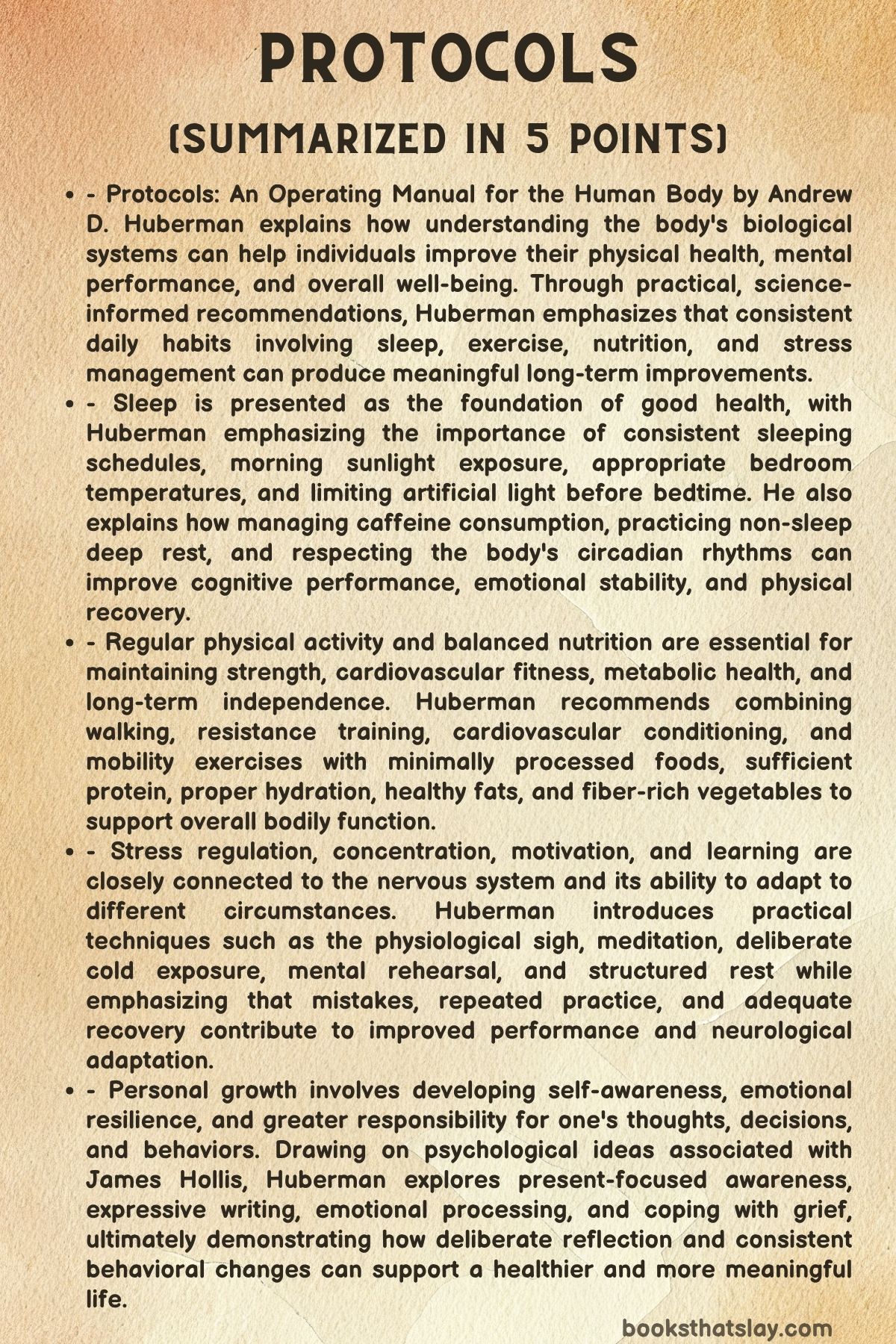
Protocols: An Operating Manual for the Human Body by Andrew D. Huberman is a nonfiction guide to understanding and improving human health through practical, science-informed habits.
Drawing on neuroscience, physiology, and psychology, Huberman explains how everyday behaviors influence sleep, physical fitness, emotional regulation, nutrition, concentration, and personal development. Rather than presenting complicated medical theories, the book translates biological concepts into structured practices that readers can incorporate into their routines. Its central argument is that understanding the mechanisms governing the brain and body allows people to make deliberate choices that improve their physical performance, mental well-being, and overall quality of life.
Summary
Protocols: An Operating Manual for the Human Body begins with Andrew Huberman’s exploration of sleep, which he identifies as a fundamental requirement for maintaining physical health, emotional stability, and cognitive performance. He explains that sleep influences nearly every major biological system, including memory formation, metabolism, cardiovascular function, hormonal regulation, and the body’s ability to recover from daily demands.
Drawing on his personal experiences with disrupted sleep, Huberman describes how understanding circadian rhythms can help individuals establish more consistent sleeping patterns. These internal biological rhythms regulate the body’s natural cycles of alertness and rest, responding particularly strongly to environmental signals such as light and temperature.
Huberman emphasizes the importance of obtaining natural sunlight shortly after waking, ideally within the first thirty to sixty minutes of the day. Morning light helps synchronize the internal clock, while exposure to sunlight later in the afternoon provides additional information that supports the body’s natural preparation for nighttime rest.
He also recommends limiting artificial light before bedtime, maintaining consistent sleeping and waking schedules, and keeping the sleeping environment comfortably cool. Other recommendations address caffeine consumption, alcohol, cannabis, naps, and techniques such as non-sleep deep rest, which may support relaxation and recovery.
Sleep improvement is presented not as an isolated objective but as a foundation for nearly every other aspect of health. By establishing reliable rest patterns, individuals can improve their ability to concentrate, regulate their emotions, sustain physical activity, and manage everyday challenges.
The discussion then turns to exercise and the importance of maintaining physical capacity throughout life. Huberman explains that regular movement strengthens the cardiovascular system, improves muscular function, supports brain health, and helps preserve independence as people age.
He organizes physical activity around four essential practices: frequent walking, resistance training, cardiovascular conditioning, and mobility exercises. Walking receives particular attention because it is accessible, requires little specialized equipment, and can be incorporated into everyday routines.
Resistance training is recommended approximately three times per week to develop muscular strength, maintain lean body mass, and support metabolic health. Cardiovascular training is also emphasized three times weekly, with different intensities and durations serving different purposes in improving endurance and aerobic capacity.
Mobility and flexibility exercises complete this framework by supporting joint function and movement quality. Huberman stresses that effective exercise does not require an unnecessarily complicated program; consistent participation, gradual progression, suitable intensity, and adequate recovery are more important than elaborate routines.
Together, these recommendations establish exercise as a long-term investment in physical functionality rather than merely a method of changing appearance. The broader objective is to build a body capable of meeting everyday demands while supporting cognitive health and emotional well-being.
After establishing the importance of physical activity, Huberman examines stress and the physiological mechanisms responsible for responding to challenging situations. He explains that stress is not inherently harmful, because short-term activation of the nervous system can improve alertness, motivation, and readiness to act.
However, prolonged stress can negatively affect physical health and psychological stability. Huberman therefore introduces techniques designed to help individuals regulate physiological arousal, including the physiological sigh, which involves two successive inhalations followed by a prolonged exhalation.
Deliberate cold exposure is presented as an opportunity to practice maintaining mental control during discomfort, while meditation and non-sleep deep rest provide ways to encourage relaxation. Huberman also discusses the body’s natural morning increase in cortisol and catecholamines, explaining their roles in establishing alertness and preparing individuals for daily activity.
Although certain supplements are discussed as possible aids for excessive stress, behavioral techniques remain central to his approach. His underlying argument is that effective stress management involves learning to regulate the nervous system rather than attempting to eliminate every source of discomfort.
Nutrition becomes the next area of attention, with Huberman explaining how dietary habits influence metabolism, brain function, energy regulation, and long-term health. Instead of promoting a highly restrictive eating system, he emphasizes food quality, adequate hydration, balanced nutrient intake, and sustainable dietary choices.
He recommends obtaining at least ninety percent of one’s diet from unprocessed or minimally processed foods. This approach prioritizes nutrient-rich ingredients and encourages individuals to develop reliable eating habits without becoming dependent on complicated dietary rules.
Hydration is another essential consideration, particularly drinking water after waking and maintaining adequate fluid intake throughout the day. Huberman also discusses complete proteins for maintaining muscle and supporting recovery, alongside fibrous vegetables, selected fruits, and healthy fats that contribute to bodily function.
Fermented foods receive attention because of their possible benefits for gut microbial diversity, while fatty ocean fish and omega-3 supplementation are discussed as sources of important fatty acids. These recommendations reinforce the relationship between nutrition and the other health practices described throughout the book.
Huberman then returns to light, examining its influence on the body’s internal timing systems, hormone regulation, mood, and alertness. Drawing on his background in visual neuroscience, he explains that light affects physiological processes extending beyond the ordinary experience of seeing.
Morning sunlight is emphasized because of its role in supporting healthy circadian rhythms and daytime alertness. Exposure to natural light in the late afternoon or early evening provides additional timing signals, while minimizing bright artificial light before bedtime helps protect the body’s preparation for sleep.
He also discusses the physiological effects of sunlight exposure on the skin and considers potential applications of red, near-infrared, and infrared light. Importantly, he distinguishes among different wavelengths, exposure durations, and environmental conditions, explaining that the biological effects of light depend on how and when it is encountered.
The discussion subsequently moves toward concentration, motivation, and learning. Huberman explains that the brain’s capacity for neuroplasticity allows individuals to develop new abilities, but meaningful improvement requires appropriate mental preparation, deliberate effort, repeated practice, and recovery.
He recommends establishing a focused and alert mental state before beginning demanding tasks. Mental contrasting, which involves considering desired outcomes alongside the obstacles preventing their achievement, is introduced as a method for strengthening motivation and directing effort.
Mistakes are presented as valuable signals that encourage the nervous system to modify its responses. Rather than treating errors as evidence of personal failure, Huberman encourages readers to recognize their importance in developing skills and improving performance.
Rest also plays a central role in learning, particularly through sufficient sleep and brief pauses during practice sessions. Mental rehearsal provides another method of reinforcing skills, illustrating how the brain can benefit from structured preparation even when a task is not being physically performed.
The final part of the book broadens the discussion from physical and cognitive performance to personal growth. Huberman considers how neuroscience and psychology can help individuals understand their emotional experiences, recognize habitual patterns of behavior, and develop greater self-awareness.
He introduces present-tethered awareness as a practice for reducing excessive mind wandering and directing attention toward immediate experiences. This approach encourages individuals to observe their thoughts and reactions more deliberately rather than automatically following familiar mental patterns.
Huberman also draws on the psychological ideas of James Hollis, particularly the importance of examining personal motivations and distinguishing authentic values from expectations imposed by society. Personal responsibility and honest self-examination become essential components of meaningful psychological development.
Expressive writing is presented as a structured method for confronting difficult memories and processing unresolved emotions. Huberman also addresses grief, explaining how the brain responds to separation and loss and how individuals gradually adjust their emotional expectations when someone or something important is no longer present.
The book concludes by bringing together its central principles of sleep, movement, stress regulation, nutrition, environmental awareness, learning, and emotional development. Huberman presents human well-being as the outcome of repeated practices that support the body’s biological systems while strengthening the individual’s capacity for deliberate, informed action.
Key People
As a nonfiction book organized around scientific explanations and behavioral practices, the work does not contain fictional characters or a conventional character-driven storyline. Its two explicitly identified individuals are Andrew D. Huberman, who serves as the author and guiding voice, and James Hollis, whose psychological ideas contribute to the discussion of personal growth.
Andrew D. Huberman
Andrew D. Huberman is the central intellectual presence in Protocols: An Operating Manual for the Human Body, functioning as both the author and the principal guide through the book’s discussions of neuroscience, physiology, and human behavior. His perspective provides continuity across subjects that might otherwise appear unrelated, connecting sleep, exercise, nutrition, stress, learning, and emotional development through their biological foundations.
Huberman approaches health from the standpoint of a neuroscientist who is interested in translating scientific knowledge into practical actions. His explanations repeatedly connect everyday experiences with underlying mechanisms, suggesting that people can make more informed decisions when they understand how their bodies respond to environmental and behavioral influences.
His personal experiences occasionally provide a basis for these discussions, particularly when he describes his difficulties with disrupted sleep. These references establish that his interest in physiological regulation is not purely academic but also connected to problems individuals encounter in their own lives.
In Protocols: An Operating Manual for the Human Body, Huberman demonstrates a strong preference for structured methods of behavioral improvement. Rather than relying on vague encouragement, he presents specific practices that readers can adopt, evaluate, and incorporate into their daily routines.
His approach reflects the belief that many aspects of human performance can be improved through deliberate adjustments to ordinary habits. Morning sunlight, regular exercise, breathing techniques, structured learning sessions, and dietary consistency are presented as accessible ways of influencing biological processes.
An important aspect of Huberman’s role is his emphasis on understanding rather than merely following instructions. He frequently explains why a practice might be useful, connecting the recommended action to the nervous system, circadian rhythms, hormonal activity, or other physiological mechanisms.
This explanatory approach makes him an educational guide rather than a motivational figure whose authority depends exclusively on personal experience. His arguments generally encourage readers to recognize the relationship between scientific principles and the practical circumstances of everyday life.
The author’s treatment of stress demonstrates another defining characteristic of his outlook. Instead of portraying all discomfort as undesirable, he distinguishes between manageable challenges that can support adaptation and prolonged physiological activation that may undermine health.
His discussion of exercise similarly favors sustainable participation over excessive ambition. By emphasizing walking, resistance training, cardiovascular conditioning, and mobility, he presents physical fitness as a collection of complementary abilities developed through repeated effort.
As Protocols: An Operating Manual for the Human Body progresses, Huberman’s perspective expands beyond measurable physical functions to include motivation, emotional processing, grief, and personal responsibility. This development shows that his understanding of well-being is not restricted to physical performance or the optimization of biological systems.
He acknowledges that psychological growth requires forms of reflection that cannot be reduced entirely to exercise routines or environmental adjustments. Practices such as expressive writing and self-examination demonstrate his interest in the connection between internal experience and observable behavior.
His discussion of sleep, nutritional habits, and stress regulation also suggests that successful self-improvement depends on recognizing the interactions among different aspects of health. Poor sleep can influence attention and emotional regulation, while physical activity and dietary choices can affect energy, recovery, and general functioning.
Huberman ultimately emerges as a figure defined by scientific curiosity, structured reasoning, and confidence in the value of consistent behavioral change. His role in Protocols: An Operating Manual for the Human Body is to help readers understand their physiological capacities while encouraging them to develop greater responsibility for their daily choices.
At the same time, his presentation leaves room for distinguishing between recommendations with different levels of scientific support. His emphasis on personal experimentation and physiological understanding is most useful when accompanied by an awareness that individual responses, medical circumstances, and the strength of available evidence can vary.
Through this combination of education and practical guidance, Huberman establishes himself as the organizing voice of the book. His intellectual identity is built around the idea that informed habits can create meaningful improvements in physical health, mental performance, and personal well-being.
James Hollis
James Hollis appears in Protocols: An Operating Manual for the Human Body as an important psychological influence on the discussion of personal growth. Unlike Huberman, he does not serve as a narrator or a figure whose personal experiences are developed throughout the work, but his ideas provide a framework for examining identity, responsibility, and emotional maturity.
Hollis is associated with the importance of self-examination and the challenge of developing a life guided by personal values. His perspective encourages individuals to question motivations that may have developed through social conditioning, external expectations, or familiar psychological patterns.
An important element of his philosophical contribution is the distinction between living according to one’s authentic priorities and allowing outside pressures to determine personal decisions. This distinction becomes particularly relevant when considering how people evaluate achievement, fulfillment, and their relationships with others.
Hollis’s ideas add psychological depth to an otherwise strongly physiological approach to human improvement. His contribution suggests that changing behavior is not always enough if individuals have not considered the motivations and emotional assumptions underlying their actions.
For example, developing healthier routines may improve physical functioning, but such improvements do not automatically resolve questions about personal identity or purpose. Honest reflection is therefore presented as a necessary companion to the structured behavioral practices discussed elsewhere in the book.
Within Protocols: An Operating Manual for the Human Body, Hollis represents an approach to personal development that places responsibility and self-understanding at the center of psychological change. His perspective reinforces the idea that individuals must participate actively in examining the direction and meaning of their lives.
His contribution is especially important because it broadens the definition of health beyond observable physical measurements. Personal growth becomes a process involving emotional awareness, independent judgment, and the willingness to confront uncomfortable truths about one’s own behavior.
Although the supplied material does not provide extensive biographical information about Hollis, his intellectual role is clear. He serves as a source of psychological insight that complements Huberman’s scientific framework and strengthens the book’s argument that meaningful improvement involves both the body and the inner life.
Themes
The Relationship Between Biological Rhythms and Human Health
Biological timing shapes many of the body’s essential functions, influencing when people feel alert, experience fatigue, respond to stress, and prepare for restorative sleep. Protocols: An Operating Manual for the Human Body emphasizes that these rhythms are not random but are regulated by internal physiological systems responding to environmental conditions.
Light exposure serves as an especially significant example of this relationship. Morning sunlight provides a signal that helps synchronize the circadian clock, while appropriate light exposure later in the day supports the body’s understanding of the passage of time.
Conversely, excessive artificial light during the evening can interfere with natural processes associated with preparing for sleep. This relationship demonstrates how modern environments sometimes create conditions that conflict with the biological systems governing human behavior.
Huberman’s discussion of sleep illustrates the consequences of disregarding these natural rhythms. Inconsistent schedules, poorly timed caffeine consumption, and unsuitable sleeping environments can contribute to problems that extend beyond tiredness, affecting concentration, emotional stability, and physical recovery.
The same biological principles influence other areas of health, including hormonal activity and the daily fluctuations in alertness. Understanding these processes allows individuals to make decisions that support rather than unnecessarily disrupt their physiological functioning.
This theme also highlights the role of environmental design in maintaining health. Many beneficial changes do not require extraordinary effort but involve adjusting the timing of activities, arranging appropriate lighting, and developing consistent routines.
The broader implication is that human health depends partly on establishing a productive relationship between biology and everyday surroundings. Instead of attempting to overcome every natural limitation through willpower, individuals can improve their routines by recognizing and respecting the body’s internal regulatory systems.
Consistency, Discipline, and Sustainable Behavioral Change
Lasting improvement depends less on occasional extraordinary efforts than on actions repeated consistently over time. Huberman develops this idea through recommendations that emphasize regular participation, manageable adjustments, and habits capable of fitting into ordinary life.
His approach to exercise provides a clear example. Walking regularly, performing resistance training, maintaining cardiovascular fitness, and practicing mobility exercises are presented as complementary responsibilities rather than temporary activities undertaken solely to achieve short-term results.
The same principle governs his nutritional recommendations. Prioritizing minimally processed foods, maintaining adequate hydration, and obtaining appropriate nutrients can gradually establish a healthier dietary pattern without requiring excessive restrictions or complicated systems.
Consistency also shapes his recommendations concerning sleep. Regular waking and sleeping schedules, appropriate light exposure, and attention to environmental conditions work together to support biological processes that benefit from predictable daily patterns.
The theme challenges the assumption that personal improvement must involve dramatic transformation. Small actions may appear insignificant when considered individually, but their repeated influence can gradually alter physical capacity, behavioral patterns, and general well-being.
Discipline in this context is not portrayed as relentless effort without recovery. Rest, adaptation, and the recognition of individual limitations are important parts of maintaining a routine that remains useful over long periods.
Huberman’s emphasis on sustainability also gives his recommendations a practical dimension. A habit that can be maintained alongside work, relationships, and personal responsibilities may provide greater long-term value than an ambitious program that quickly becomes unmanageable.
Ultimately, the book presents consistency as a bridge between scientific understanding and meaningful results. Knowledge becomes valuable when individuals translate it into realistic practices and maintain those practices long enough for beneficial changes to develop.
The Connection Between Physical Regulation and Mental Performance
Mental functioning is closely connected to the physiological conditions of the body, challenging the assumption that concentration, motivation, and emotional stability are exclusively psychological matters. Huberman repeatedly demonstrates how biological processes influence the ability to think clearly, learn effectively, and respond constructively to everyday challenges.
Sleep represents one of the clearest examples of this relationship. Adequate rest supports memory consolidation, emotional regulation, and cognitive performance, while insufficient sleep can interfere with the processes necessary for learning and decision-making.
Physical activity provides another important connection. Exercise influences cardiovascular function and metabolic health while also supporting brain function, demonstrating that movement has consequences extending beyond muscular strength or physical appearance.
Stress regulation further illustrates how bodily processes affect subjective experience. Changes in breathing, nervous system activation, and physiological arousal can influence whether a person feels overwhelmed, alert, calm, or capable of responding effectively to a demanding situation.
The physiological sigh and non-sleep deep rest are presented as practical methods for influencing these internal states. Their inclusion reinforces the possibility that deliberately changing certain bodily behaviors can support improvements in emotional and cognitive functioning.
Huberman also emphasizes that productive learning requires periods of effort and recovery. Focused practice encourages neurological adaptation, while sleep and strategic rest support the consolidation of information and newly acquired skills.
This theme suggests that mental performance should not be approached solely through determination or intellectual effort. An individual’s capacity to concentrate and learn is influenced by sleep quality, physical condition, stress levels, and the surrounding environment.
Recognizing these connections encourages a more comprehensive understanding of well-being. Supporting the body’s physiological needs becomes an essential part of creating the conditions necessary for sustained concentration, emotional stability, and effective learning.
Self-Awareness, Emotional Resilience, and Personal Responsibility
Personal development requires more than improving physical performance or maintaining healthy routines. Protocols: An Operating Manual for the Human Body extends its discussion of human functioning into questions of identity, emotional awareness, responsibility, and the psychological challenges associated with meaningful change.
Present-tethered awareness illustrates the importance of recognizing where attention is directed. By repeatedly returning attention to immediate experiences, individuals can become more conscious of habitual thoughts and less dependent on automatic patterns of mental activity.
The ideas associated with James Hollis expand this discussion by emphasizing honest self-examination. Understanding personal motivations involves questioning whether decisions reflect independently chosen values or expectations absorbed from family, society, and previous experiences.
This process can be uncomfortable because it requires individuals to reconsider beliefs and behaviors that may have remained unquestioned for long periods. Nevertheless, such reflection can create opportunities for making decisions that better correspond with personal priorities.
Expressive writing provides another method of developing psychological understanding. By putting difficult experiences into words, individuals may gain greater awareness of their emotional responses and begin organizing thoughts that previously felt confusing or unresolved.
The discussion of grief introduces a particularly important dimension of resilience. Loss cannot always be resolved through behavioral efficiency, and adjusting to separation often requires time, emotional processing, and changes in the expectations associated with important relationships.
Huberman’s treatment of these subjects recognizes that psychological growth is not identical to eliminating distress. Difficult emotions are part of human experience, and greater resilience involves developing the capacity to acknowledge and respond to them without expecting complete control over every circumstance.
Personal responsibility therefore emerges as a form of informed participation in one’s own development. By combining self-observation, emotional processing, and deliberate action, individuals can gradually establish a more conscious relationship with their behavior, values, and experiences.