Receipts from the Bookshop Summary and Analysis
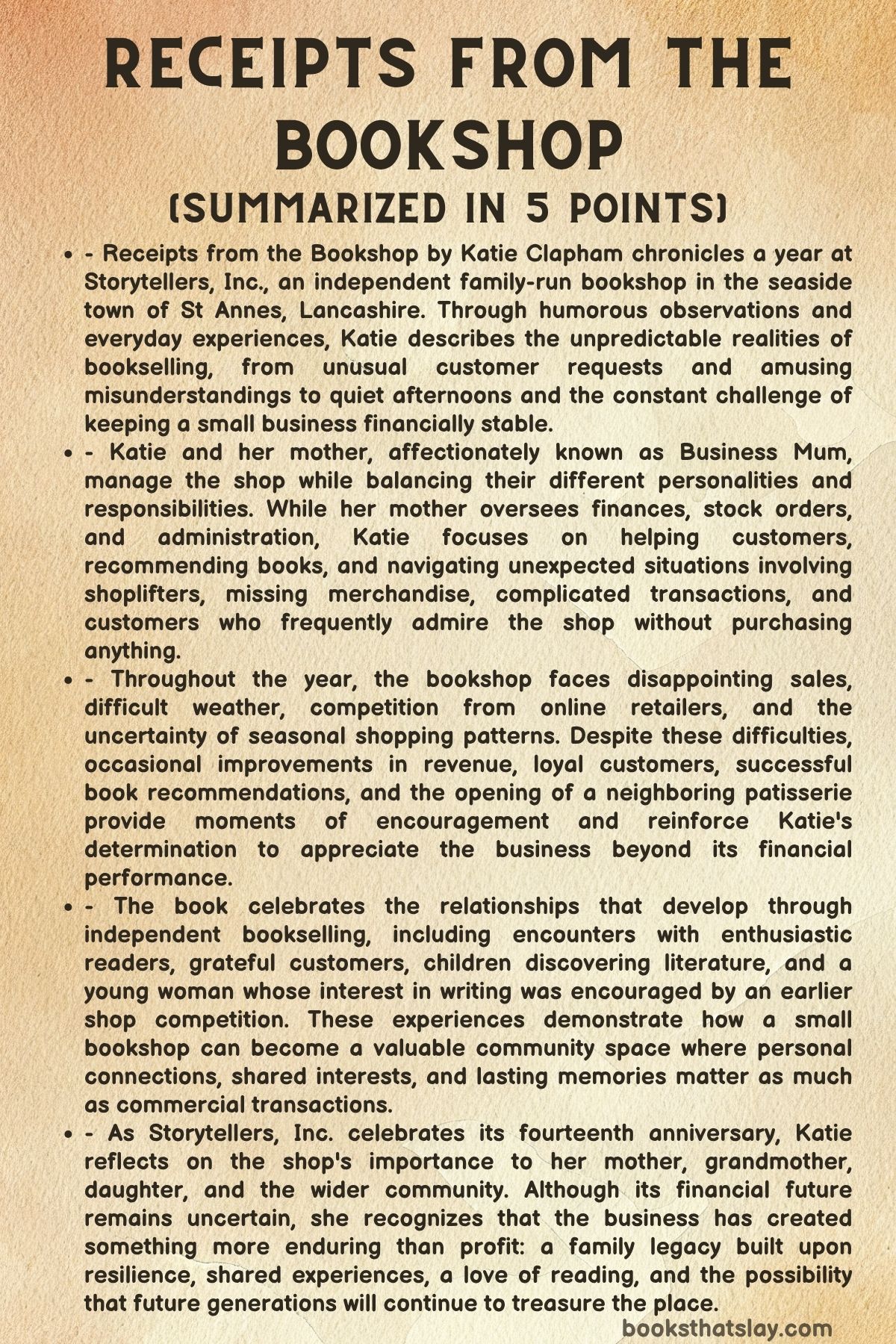
Receipts from the Bookshop by Katie Clapham is a humorous nonfiction account of everyday life at Storytellers, Inc., an independent bookshop in the seaside town of St Annes on the Lancashire coast.
Through a year of customer encounters, family conversations, financial challenges, and unexpected incidents, Clapham reveals the realities of running a small business devoted to books. Her observations celebrate the pleasures of helping readers while acknowledging the frustrations of slow sales, unpredictable visitors, and demanding responsibilities. Combining personal memories with reflections on community life, the book explores how a modest bookshop can become an important source of identity, connection, and continuity across generations.
Summary
Katie Clapham introduces readers to Storytellers, Inc., the independent bookshop she operates with her mother in St Annes, a coastal town known for its beaches, Victorian pier, cafés, and small businesses. The shop occupies an important place in their family’s life, providing both a livelihood and a gathering place where customers, relatives, and unexpected visitors contribute to the daily activity.
The premises themselves reflect the character of the business, with crowded bookshelves, colorful children’s displays, unusual storage arrangements, and an office filled with the accumulated necessities of retail work. Katie’s mother, affectionately called Business Mum, manages most of the administration and daily operations, while Katie generally works on Fridays, recommending books, helping customers, and observing the strange situations that arise.
The year begins with the familiar disappointment following the profitable Christmas shopping season. January brings freezing temperatures, depleted shelves, reduced customer spending, and the discouraging realization that the bookshop must survive another quiet period before sales have much chance of improving.
Business Mum’s planned holidays leave Katie temporarily responsible for the shop, where she encounters customers seeking Wilbur Smith novels, information about DVDs, and other items that do not always correspond to the bookseller’s usual responsibilities. Technological problems, damaged deliveries, and an unexpected fire-alarm test further complicate days that might otherwise have been spent waiting for customers.
An unexpected piece of publicity briefly raises the bookshop’s profile when The Times includes Storytellers, Inc. among twelve independent bookshops recommended by readers. A local newspaper exaggerates the distinction by describing the business as Britain’s seventh-best bookshop, a claim Katie finds amusing because its financial performance is considerably less impressive than the publicity suggests.
She also recalls Horace, the first customer, who purchased an Elmer the Elephant toy when the shop opened in 2010. The memory demonstrates how individual transactions acquire emotional significance over time, even when their monetary value is small.
As the weather remains unpleasant and January’s disappointing figures become impossible to ignore, Katie approaches February with renewed but cautious hope. An encounter with a familiar woman brings back memories of an early customer-service mistake, when Katie and her mother were so occupied with visiting relatives that they failed to acknowledge a browsing customer who subsequently criticized them.
That experience continues to influence Katie’s determination to welcome everyone who enters, although visitors frequently arrive with vague requests or expectations that are difficult to satisfy. Books about smartphones, pies, fairy tales, and organized crime compete for her attention, while encounters with children choosing books and an adorable dachshund puppy named Betty provide more enjoyable diversions.
A collection box for unwanted spectacles becomes unexpectedly popular, sometimes attracting more attention than the merchandise. Meanwhile, spoiled milk, missing teabags, and other minor inconveniences remind Katie that a bookshop must also function as a workplace, complete with mundane domestic problems.
The opening of a Starbucks in St Annes encourages her to consider the complicated relationship between national chains and independent businesses. Although corporate expansion can threaten smaller shops, she also recognizes that a popular new establishment might draw additional visitors into the town and indirectly help neighboring retailers.
The approach of World Book Day introduces another contradiction into the realities of independent bookselling. Katie supports the initiative because it encourages children to discover reading, but distributing specially published books in exchange for vouchers does little to improve the shop’s immediate cash takings.
She becomes increasingly conscious of the difference between the public’s romantic image of bookselling and its practical demands. Visitors often imagine that booksellers spend their working hours reading, whereas Katie must contend with stock management, orders, deliveries, administrative work, and long stretches of inactivity.
News of a forthcoming Sally Rooney novel creates enthusiasm within the literary world, while a mysterious package from Japan introduces an unusual distraction. The parcel contains artwork and correspondence from an unknown sender, leaving Katie uncertain about its purpose or how someone so far away discovered the small shop.
Another recurring frustration concerns people who praise the existence of independent bookshops without actually buying anything. Their admiration offers encouragement, but it cannot pay the bills or replace the income that regular purchases would provide.
An avoidable misunderstanding sends Katie to work on Good Friday even though Business Mum has decided that the shop will remain closed. After preparing the premises for customers, Katie discovers that she has arrived for a working day that was never supposed to happen.
Spring brings further disappointments as poor weather continues to discourage visitors. Katie observes a peculiar trumpet-playing street performer and becomes fascinated by the practical challenge of transporting a musical instrument while riding a motorcycle, illustrating her tendency to find entertainment in ordinary street life.
A more troubling episode occurs when Business Mum notices a suspected shoplifter concealing merchandise. Although she recovers one book, the woman escapes with a special anniversary edition of The Gruffalo, demonstrating how vulnerable a small shop can be when theft occurs.
The neighborhood also provides reassuring moments, including an incident in which residents cooperate to help a dog that appears to need assistance. News that a patisserie will open nearby gives Katie something else to anticipate, particularly because she hopes that an attractive new business might increase activity along the street.
Sales remain disappointing, and Katie must repeatedly consider which books justify their shelf space. Advance reading copies, specialized customer requests, and comparisons with cheaper online prices reveal the difficult choices involved in maintaining a varied inventory without spending money the shop cannot afford.
The arrival of May brings continued uncertainty, but Katie finds satisfaction in helping customers locate obscure titles and fulfilling special orders. One particularly valuable customer lives far away and regularly purchases books remotely, demonstrating that loyalty to a small independent business need not depend upon geographical proximity.
As construction progresses at the anticipated patisserie, Katie watches the neighborhood change and reflects on environmental concerns surrounding the nearby beach. Her attention moves continually between the commercial life of the street and the wider qualities that make St Annes meaningful to its residents.
After several disappointing months, May finally delivers encouraging financial results, with sales exceeding those of the corresponding month in the previous year. Katie marks the achievement by leaving a cheerful message in Business Mum’s spreadsheet, turning an otherwise ordinary administrative document into a celebration of their modest success.
Summer approaches with a substantial delivery of puppets, popular products that supplement the shop’s book sales. Although Katie enjoys replenishing the display, she acknowledges that ordering inventory requires careful financial planning because unsold stock represents money that cannot be used elsewhere.
Her conversations with customers repeatedly expose the difference between online convenience and the experience of purchasing books in person. She believes that a book acquired during a holiday or memorable visit can preserve a connection to that particular place, giving the object a personal significance beyond its contents.
The annual carnival brings decorations, crowds, and the possibility of increased business, but the excitement produces little financial benefit. Many visitors leave the shopping streets after the procession to attend the fair, reminding Katie that a crowded town does not necessarily mean a profitable day for retailers.
July proves particularly difficult as heavy rain discourages people from entering the shop. Although remote orders provide a little reassurance, the decline in physical visitors makes Katie increasingly anxious about whether the month will become the worst July in the business’s history.
Business Mum takes another holiday, and Katie manages deliveries, unusual requests, and the unpredictable demands of customers. She successfully identifies a specialized cricket coaching book for one visitor and helps another maintain a tradition of purchasing an annual horoscope publication.
A particularly satisfying occasion arises when Katie locates a requested book while several people watch, earning enthusiastic appreciation for her knowledge. Such encounters offer valuable reminders that attentive personal service remains one of the independent bookseller’s strongest advantages.
Nevertheless, the financial results confirm her fears, and July becomes the shop’s worst July on record. Katie’s humorous response cannot conceal the seriousness of the situation, especially when the family compares current sales with previous years through Business Mum’s carefully maintained spreadsheets.
August introduces a welcome development with the opening of Beurre, the long-awaited patisserie. Katie enthusiastically samples its cakes, admires the establishment, and hopes its success will encourage more people to explore the surrounding businesses.
During the school holidays, she spends additional time working while Business Mum helps care for her daughter. The arrangement illustrates the close connection between the shop and family life, as responsibilities for childcare, retail work, and household organization frequently overlap.
A young woman who previously participated in a writing competition organized by the shop returns, still interested in reading and writing. Her visit provides an encouraging reminder that independent bookshops can influence young readers long after an individual event has ended.
Katie also reflects on the similarities between parenting and bookselling, observing that both require guidance without excessive control. Just as children must develop their own interests and independence, customers benefit from knowledgeable recommendations without being pressured into decisions.
The arrival of autumn brings the publication of a new Richard Osman novel, accompanied by an abundance of promotional materials. Posters, decorations, and display equipment create excitement around a release that Katie hopes will generate much-needed sales.
The annual international kite festival attracts visitors to St Annes, although unfavorable weather limits its effectiveness as a commercial opportunity. Meanwhile, a grateful customer presents Business Mum with book-shaped soaps after receiving assistance with a Marvel title, showing how meaningful a successful interaction can be.
An administrative mistake creates particular anxiety when Katie accidentally issues a book token without any credit. Unable to contact the buyer, she worries about the consequences until the customer eventually returns, understands the situation, and accepts a properly credited replacement.
October begins with further rain and familiar challenges involving hesitant customers, complicated requests, and the difficulty of competing with online retailers. A woman seeking a book about making bags points out that she could simply order it herself, leaving Katie confronting the limitations of personalized service in a world where almost any title can be purchased online.
Other encounters are more entertaining, including a traveling horoscope specialist who claims to perceive Katie’s aura and a customer who leaves his spectacles behind. The latter incident becomes especially amusing because the shop already operates a collection scheme for unwanted glasses.
Business at Beurre continues to flourish, and Katie’s personal spending on pastries increases even as she worries about the shop’s financial position. October nevertheless produces another encouraging result, with sales exceeding the previous year’s figures and providing some hope that activity on the street may be improving.
With Christmas approaching, the bookshop begins receiving seasonal merchandise, festive children’s titles, and advent calendars. Customers frequently inquire about a Harry Potter advent calendar without necessarily purchasing it, illustrating once again the difference between interest and actual spending.
A malfunctioning lock, stock deliveries, and organizational problems complicate the daily routine. Business Mum introduces a spreadsheet to prevent duplicate orders, but Katie fails to consult it and subsequently orders stock unnecessarily, confirming the usefulness of her mother’s administrative methods.
Literary conversations provide welcome relief from financial worries, including a discussion with a customer purchasing Emily Brontë’s complete poems. Another visitor chooses to buy a Raynor Winn book rather than remain on a long library waiting list, providing a small example of how readers continue to support local shops for practical reasons.
November’s financial results are discouraging, despite the approaching festive season. Yet Katie recognizes that the family’s achievement cannot be measured exclusively through monthly comparisons, because the bookshop has remained open through fourteen years of changing conditions.
December marks the shop’s fourteenth anniversary and brings the final rush of Christmas shoppers. While Business Mum is occupied with a local pantomime, Katie manages gift purchases, seasonal stock, customer conversations, and the amusing inability of some visitors to recognize that a closed door does not necessarily indicate a closed business.
As the year ends, Katie turns her attention toward the deeper importance of Storytellers, Inc. within her family. Her grandmother has become such a familiar presence that local people contact the shop when trying to find her, while Katie’s daughter has grown up surrounded by books and is recognized by customers as part of the business.
Katie imagines the possibility that her daughter might eventually inherit the shop, although she understands that the child’s ambitions may lead elsewhere. She also considers whether she could eventually assume the demanding administrative responsibilities currently handled by Business Mum.
The book concludes by emphasizing that fourteen years of survival represent an achievement far greater than any isolated month’s sales figures. Despite financial uncertainty, countless awkward encounters, and the difficulties of independent retail, the shop has provided lasting friendships, family memories, opportunities for young readers, and a shared place of belonging that cannot be expressed through a spreadsheet.
Key People
Katie Clapham
Katie Clapham is the narrator and central figure of Receipts from the Bookshop, presenting the realities of independent bookselling through her humorous observations, personal experiences, and affectionate understanding of family life. Her perspective gives the book its distinctive personality, transforming ordinary retail situations into revealing accounts of human behavior.
Katie possesses an observant and curious nature, frequently noticing details that other people might overlook. Whether she is watching a street musician, examining unusual customer behavior, or contemplating how someone transports a trumpet on a motorcycle, she demonstrates an ability to find entertainment in the everyday world.
Her humor often serves as a response to frustration rather than evidence that she takes her responsibilities lightly. Disappointing sales, unexpected expenses, difficult customers, and administrative mistakes create genuine difficulties, but Katie prefers to approach these situations with wit rather than surrender to discouragement.
Her relationship with books reflects a personal understanding of reading as an experience connected to memory and place. She believes that purchasing a book from a particular shop can make it a reminder of a holiday, conversation, or meaningful occasion.
Katie also demonstrates considerable patience and resourcefulness when helping customers locate unfamiliar titles. Her satisfaction after successfully identifying a specialized cricket book illustrates how professional achievement can emerge from relatively small interactions.
At the same time, she acknowledges her limitations, particularly when comparing her relaxed working habits with her mother’s organizational discipline. Mistakes involving book tokens, duplicate orders, and misunderstandings about opening hours reveal her imperfections without diminishing her commitment to the business.
Her identity as a mother adds another dimension to her experiences. She increasingly recognizes similarities between encouraging children to develop their interests and guiding customers toward books without controlling their choices.
By the end, Katie emerges as someone who understands that success cannot be judged solely through financial results. Her greatest achievement lies in recognizing the lasting relationships, memories, and opportunities for reading that the shop has created.
Business Mum
Business Mum, Katie’s mother, is one of the most influential figures in Receipts from the Bookshop, representing the discipline and practical responsibility required to keep an independent business operating. Although Katie provides the narrative perspective, her mother’s efforts form the organizational foundation of the shop.
She manages finances, stock orders, administration, deliveries, and many of the customer-service responsibilities that determine whether the business can function efficiently. Her dedication demonstrates that independent bookselling requires much more than enthusiasm for literature.
Business Mum’s commitment to careful recordkeeping becomes particularly visible through her spreadsheets. These documents track sales comparisons, prevent ordering mistakes, and provide a structured understanding of the shop’s financial position.
Katie occasionally treats these systems with amusement, but their usefulness becomes undeniable when she neglects to consult a stock spreadsheet and orders merchandise unnecessarily. The incident illustrates the differences between their personalities without suggesting that either woman’s contribution is unimportant.
Business Mum also demonstrates practical confidence when responding to unexpected difficulties. Her confrontation with a suspected shoplifter reveals her willingness to protect the shop’s merchandise, even though she cannot prevent the entire theft.
Her relationship with Katie is affectionate, familiar, and occasionally marked by misunderstandings. The Good Friday confusion, her frequent holidays, and their contrasting approaches to organization create amusing situations that reveal the informal dynamics of a family business.
Despite these differences, their partnership depends upon mutual trust. Katie can manage the premises during her mother’s absences, while Business Mum provides the administrative continuity necessary for long-term survival.
She also contributes directly to family life by helping care for Katie’s daughter during the school holidays. This involvement establishes her as more than a capable businesswoman, emphasizing her importance as a mother and grandmother.
Business Mum ultimately represents persistence, responsibility, and the often-unrecognized work behind a welcoming retail environment. The book’s celebration of fourteen years in business is inseparable from her sustained effort.
Katie’s Daughter
Katie’s daughter represents the possibility of generational continuity in Receipts from the Bookshop, giving the narrative an emotional dimension that extends beyond the immediate demands of running a business. Growing up surrounded by shelves of books, familiar customers, and family members, she experiences the shop as an ordinary yet meaningful part of childhood.
Her connection to Storytellers, Inc. reflects the influence of an environment where reading is encouraged through everyday exposure rather than formal instruction alone. Books become familiar objects associated with family, imagination, conversation, and discovery.
She also illustrates how closely family responsibilities and professional commitments overlap. During the school holidays, Business Mum helps care for her while Katie works additional days, demonstrating the cooperative arrangements that allow the family business to continue.
As the year progresses, Katie considers whether her daughter might eventually inherit the shop. This possibility introduces questions about tradition, independence, and the responsibilities that one generation may pass to another.
However, Katie understands that her daughter’s ambitions may lead far beyond St Annes. Her willingness to acknowledge that possibility demonstrates an important distinction between preserving a family legacy and expecting a child to follow a predetermined path.
The daughter therefore represents both belonging and personal freedom. Whatever direction her future takes, her childhood connection to books and the family shop will remain part of her personal history.
Through her presence, the business becomes more than a commercial establishment. It becomes a place where childhood memories are formed and where the influence of stories may continue long after individual books have been read.
Katie’s Grandmother
Katie’s grandmother contributes to the multigenerational atmosphere of Receipts from the Bookshop, showing how a small family business can become closely connected to the personal lives of its owners. Although she does not occupy the same professional role as Katie or Business Mum, her presence helps establish the shop as a familiar community institution.
She is sufficiently well known around St Annes that people contact the bookshop when they need to find her or return something she has misplaced. This unusual arrangement reveals how thoroughly the family’s private life has become associated with the premises.
Her relationship with the shop demonstrates the social importance of places where people regularly encounter familiar faces. Storytellers, Inc. functions not only as a destination for purchasing books but also as a recognizable point of contact within the neighborhood.
The grandmother’s role also broadens the meaning of family continuity. Her presence connects the business to an older generation, while Katie’s daughter represents the possibility of its future.
Through these connections, the shop becomes a place where different stages of life intersect. Its significance cannot be fully understood through sales figures because it also preserves habits, relationships, and shared memories.
Although her appearances are relatively brief, Katie’s grandmother embodies the sense of permanence that develops when a family becomes closely identified with a particular place.
The Super Remote Customer
The Super Remote Customer is an important supporting presence in Receipts from the Bookshop, demonstrating that a meaningful relationship between a bookseller and a reader does not always require physical proximity. This customer regularly orders books despite never having visited the premises.
The customer’s loyalty is especially valuable because the business experiences repeated periods of disappointing sales. While many people admire the shop without buying anything, this distant reader contributes through consistent purchases.
The contrast challenges the assumption that supporting local independent businesses depends entirely upon living nearby. A customer can recognize the value of a small shop and deliberately choose to purchase from it even when other options might appear more convenient.
Katie’s appreciation for this individual reflects the importance of dependable customer relationships. Regular orders offer financial reassurance, but they also confirm that the shop provides something customers consider worth returning to.
The remote customer further demonstrates how independent bookselling can adapt to changing purchasing habits without abandoning personal service. Distance does not eliminate the possibility of trust, familiarity, or individual attention.
Although the reader’s personal life remains largely unexplored, their consistent support makes them an encouraging presence. They represent the kind of loyalty that helps small businesses survive uncertain conditions.
Horace
Horace occupies a small but historically important place in the book as the first customer of Storytellers, Inc. His purchase of an Elmer the Elephant toy in 2010 became a memorable milestone for Katie and her family.
The significance of Horace’s appearance lies less in his personality than in the meaning attached to that initial transaction. What might have been an ordinary purchase elsewhere became a defining moment in the shop’s history.
His contribution illustrates how the earliest experiences of a business can acquire increasing emotional value as the years pass. The family continues to remember the first sale because it represents the beginning of a venture that would eventually survive for fourteen years.
Horace also symbolizes the importance of individual customers within small businesses. A single purchase may seem insignificant when compared with the transactions of large retailers, but it can become part of a shop’s identity and collective memory.
His brief role reinforces Katie’s conviction that commercial activity cannot always be understood through monetary value alone. Some purchases matter because of what they represent rather than how much they cost.
The Returning Young Writer
The young woman who returns after previously participating in a writing competition organized by the shop represents the long-term influence of community-based literary activities. Her reappearance provides Katie with evidence that the business has affected people’s lives beyond the immediate experience of buying books.
Having participated in the competition when she was younger, the woman returns with her interest in reading and writing still intact. Her continued enthusiasm suggests that early encouragement can contribute to an enduring relationship with literature.
The encounter is particularly meaningful because it occurs during a period when financial pressures frequently overshadow the shop’s achievements. Katie is reminded that its contribution cannot be judged exclusively by monthly sales comparisons.
The young writer also demonstrates the educational and creative role of independent bookshops. Such businesses can provide opportunities for aspiring readers and writers to participate in activities that make literature feel accessible and personally relevant.
Her appearance offers a contrast to the many fleeting interactions Katie experiences with customers. Rather than being remembered for an unusual request or amusing misunderstanding, she represents a connection that has endured over time.
Although little is revealed about her personal circumstances, she embodies the lasting possibilities created when a community encourages children to engage with stories and creative expression.
The Customers and Visitors
The customers and visitors collectively form one of the most varied and influential groups in the book. Their unpredictable behavior shapes the daily atmosphere of Storytellers, Inc., providing Katie with entertainment, satisfaction, irritation, and occasional financial relief.
Some customers arrive with highly specialized requests, expecting Katie to identify books from limited information. Others seek merchandise unrelated to literature or assume that an independent shop can provide the same prices and immediate availability as a major online retailer.
These encounters expose the challenges of serving people whose expectations are not always realistic. Katie must balance politeness and helpfulness with the practical limitations of a small business.
Other customers are thoughtful and appreciative. The individual who presents Business Mum with book-shaped soaps after receiving assistance demonstrates how a positive shopping experience can inspire genuine gratitude.
Literary conversations also reveal the intellectual pleasures of working among books. Customers discussing Emily Brontë’s poetry or searching for works by favorite authors give Katie opportunities to participate in exchanges that go beyond routine commercial transactions.
Not every interaction is positive, however. The suspected shoplifter and the disappointed customer from the shop’s early days reveal that retail work sometimes involves confrontation, criticism, or the possibility of financial loss.
The customer who receives an incorrectly credited book token provides a more reassuring example. Their understanding response allows Katie to correct her mistake and demonstrates the value of patience in maintaining trust.
Children entering the shop create a particularly important set of encounters because their developing interests suggest the future of reading itself. Whether choosing books independently or participating in literary activities, they remind Katie that a bookshop can influence people at an early stage of life.
Taken together, these individuals represent the complexity of a community rather than a single recognizable personality. Their contrasting habits, expectations, and attitudes give the shop its daily energy and reinforce the importance of human interaction in independent retail.
Themes
The Challenges of Independent Bookselling
The financial vulnerability of independent businesses shapes much of Receipts from the Bookshop, where the pleasures of selling books exist alongside persistent economic uncertainty. Katie repeatedly confronts the uncomfortable reality that affection for a shop does not necessarily translate into sufficient revenue to sustain it.
Customers frequently express admiration for independent bookshops without making purchases, creating a distinction between emotional support and practical financial contribution. Their enthusiasm may be sincere, but rent, stock, administration, and other expenses require actual sales rather than compliments.
The competition from online retailers adds further pressure. Customers can often locate specialized titles themselves and may expect smaller businesses to match discounts that are difficult to offer without sacrificing profitability.
Seasonal fluctuations make the situation more complicated. Christmas provides a period of increased activity, while the early months of the year bring depleted shelves, miserable weather, and reduced consumer spending.
Even community events such as festivals and carnivals do not guarantee increased revenue. Streets may be crowded with visitors who have little intention of entering the bookshop.
The recurring financial spreadsheets become symbols of the pressure underlying daily business decisions. Each disappointing comparison with the previous year raises questions about sustainability, while an occasional improvement provides a welcome sense of achievement.
Stock management illustrates another challenge because books and other merchandise must be purchased before they can be sold. Every unsold item represents an investment that may not generate the expected return.
Despite these difficulties, Katie’s experiences demonstrate why independent retailers continue to matter. Their survival preserves personalized service, local employment, distinctive shopping environments, and opportunities for community interaction that cannot be measured through price comparisons alone.
Family Bonds and Generational Continuity
Family relationships provide the emotional foundation of the bookshop, shaping its operation and giving its history a significance that extends beyond commerce. Katie and Business Mum share responsibility for a business that requires cooperation even when their personalities and working methods differ.
Business Mum approaches the shop with an emphasis on financial management, stock control, and organizational discipline. Katie contributes her conversational approach, enthusiasm for books, observational humor, and willingness to handle unpredictable situations.
Their contrasting habits occasionally produce misunderstandings, but these incidents reveal the familiarity and trust underlying their partnership. The shop survives partly because their different strengths serve complementary purposes.
Family responsibility also extends into childcare. When Katie works additional days, her mother helps care for her daughter, illustrating how the business operates through arrangements that connect professional and domestic life.
The grandmother’s association with the premises adds another generational dimension. Her familiarity within the neighborhood demonstrates how the shop has become a recognizable part of the family’s shared identity.
Katie’s daughter represents the future of that identity. Growing up surrounded by books and family members, she develops a relationship with the shop that does not depend upon understanding its commercial responsibilities.
In Receipts from the Bookshop, the possibility of passing the business to another generation raises questions about inheritance and individual freedom. Katie can imagine her daughter eventually taking responsibility for the shop, but she also accepts that the child’s ambitions may lead elsewhere.
This balance prevents family tradition from becoming an obligation. The greater achievement lies in creating a place that future generations can remember, appreciate, and return to, regardless of whether they choose to continue operating it.
The bookshop consequently becomes a symbol of family continuity, preserving relationships and experiences that remain meaningful even when its financial future is uncertain.
The Power of Books and Human Connection
Books function as sources of personal identity, shared memory, and social connection throughout Katie’s experiences. Their importance extends beyond the information or entertainment contained within their pages to include the circumstances in which readers discover, purchase, and discuss them.
Katie believes that a book purchased while traveling can preserve memories of a particular holiday or location. The physical object becomes associated with the experience of finding it, giving the purchase an emotional significance that may not exist when ordering the same title online.
This understanding helps explain her commitment to personalized bookselling. Identifying the right book for a customer requires attention, curiosity, and an appreciation of the reader’s individual interests.
Her successful search for a specialized cricket title demonstrates the satisfaction created when professional knowledge solves a particular problem. The customer’s appreciation confirms that a bookseller can offer something more personal than access to a large digital catalogue.
Literary conversations also create opportunities for genuine engagement. Readers discussing poetry, favorite authors, or childhood stories transform the shop into a place where shared interests encourage spontaneous relationships.
The returning young writer illustrates the lasting influence of such an environment. Her continued interest in literature suggests that encouragement received during childhood can remain important well into adult life.
Children choosing books independently provide another example of reading as an act of personal discovery. Katie recognizes the importance of helping young people explore their interests while allowing them the freedom to develop their own preferences.
These interactions establish the bookshop as a cultural and social space rather than merely a commercial establishment. Its value lies partly in enabling encounters between people who might otherwise never have spoken.
Through these experiences, reading becomes an activity that connects individuals across differences in age, background, and geographical distance. The books themselves remain central, but the relationships formed around them give the shop much of its enduring significance.
Humor, Resilience, and Finding Meaning Beyond Financial Success
Katie’s ability to recognize absurdity in everyday situations provides an important counterbalance to the frustrations of retail work. Her humor does not eliminate the difficulties facing the shop, but it allows her to approach them without becoming entirely defined by disappointment.
Unusual customer requests, malfunctioning equipment, confusing conversations, and unpredictable weather regularly disrupt her expectations. Rather than treating every inconvenience as a personal disaster, she often transforms these experiences into amusing reflections on human behavior.
The Good Friday misunderstanding illustrates this attitude particularly well. Arriving to operate a shop that was never meant to open is inconvenient and embarrassing, yet the incident becomes memorable because of its ridiculous circumstances.
Her fascination with the trumpet-playing motorcyclist and her encounters with an unconventional horoscope specialist similarly reveal an appreciation for life’s unexpected details. These observations suggest that curiosity can make ordinary routines more interesting.
Resilience becomes especially important when monthly sales figures are disappointing. The shop repeatedly experiences periods of reduced trade, and there is no guarantee that the following month will bring improvement.
Katie nevertheless continues working, helping customers, celebrating small victories, and finding pleasure in the surrounding community. Her enthusiasm for the neighboring patisserie adds a humorous contrast between her own spending habits and the shop’s financial concerns.
The fourteenth anniversary provides the clearest expression of the book’s broader understanding of achievement. Survival itself becomes meaningful because the business has endured economic uncertainty, changing shopping habits, and countless practical difficulties.
In Receipts from the Bookshop, financial results remain important, but they are not presented as the only measure of success. The relationships established with customers, the memories shared across generations, and the encouragement given to young readers represent accomplishments that cannot be recorded in an ordinary spreadsheet.
Ultimately, resilience is portrayed not as freedom from failure but as the willingness to continue finding purpose despite repeated setbacks. Katie’s account suggests that a worthwhile life can be constructed through ordinary responsibilities, meaningful relationships, curiosity, and an enduring appreciation for the small experiences that make each day different.