Red by Izzy Barry Summary, Characters and Themes
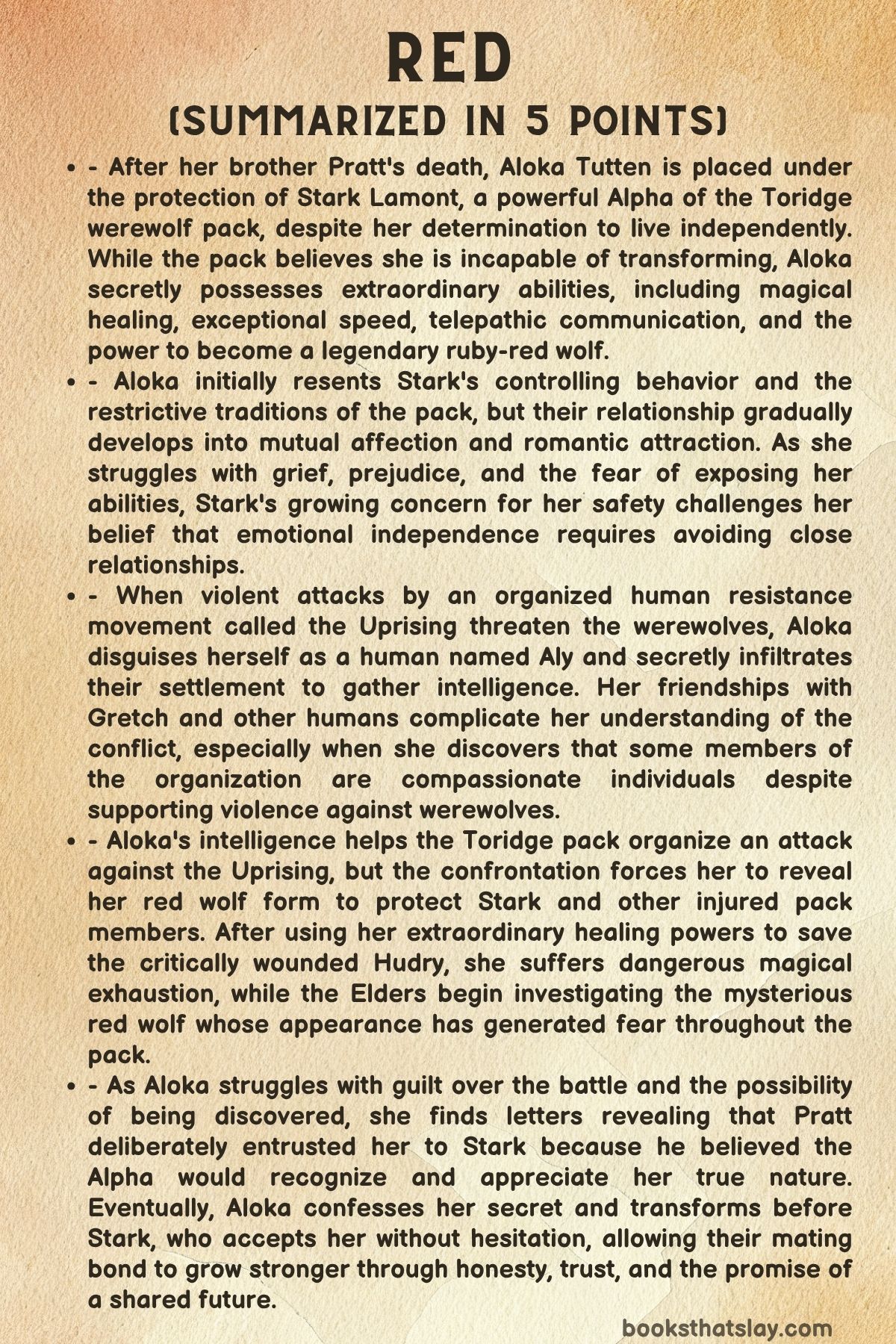
Red by Izzy Barry is a paranormal romance and fantasy novel that follows Aloka Tutten, a young woman living among werewolves who believe she is incapable of transforming.
Following her brother’s death, she is placed under the protection of Stark Lamont, a powerful Alpha whose authority challenges her desire for independence. Unknown to the pack, Aloka possesses extraordinary abilities connected to the legendary red wolves, creatures feared for their mysterious powers. As conflict grows between werewolves and an organized human resistance movement, Aloka must confront grief, prejudice, hidden identities, and unexpected love while deciding whether revealing her true nature is worth the danger. It’s the 1st book in the Myth That Burns series.
Summary
Aloka Tutten’s life changes dramatically when her older brother, Pratt, is killed by armed humans. At twenty-five, she finds herself without the person who protected her, understood her unusual abilities, and helped her maintain a life away from the judgment of the Toridge werewolf pack.
Following Pratt’s death, the pack’s Elders place Aloka under the protection of Stark Lamont, the Alpha responsible for the South cohort. Ancient laws require unmated females to remain under male guardianship, and Pratt has supposedly left instructions naming Stark as her protector.
Aloka desperately wants to return to the secluded cabin where she lived with Pratt. She distrusts the Elders, resents Stark’s authority, and fears that living among other werewolves will expose the secret she has spent years concealing.
Most pack members believe Aloka is a failed werewolf who never transformed, making her little better than a human in their eyes. In reality, she possesses extraordinary powers, including exceptional speed, magical heat, rapid healing, selective telepathic communication, and the ability to transform into a magnificent ruby-red wolf.
Pratt taught her to hide these abilities because red wolves are considered legendary creatures whose unusual powers inspire fear. Aloka understands that revealing herself could make her a target of the very community that should protect her.
At Stark’s spacious woodland residence, Aloka struggles with constant supervision and unfamiliar social expectations. She begins exploring his extensive historical library, where books about werewolf territories and unusual abilities awaken her curiosity about her own origins.
Her relationship with Stark initially consists of arguments and disagreements. He considers himself responsible for her safety, while she interprets his restrictions as attempts to control her life.
Their early morning runs gradually challenge his assumptions about her physical limitations. Despite supposedly being human, Aloka demonstrates exceptional endurance, tolerates freezing temperatures, and moves with a speed that makes Stark suspicious.
Meanwhile, Aloka encounters hostility from pack members who consider her weak and undeserving of protection. When the Juker brothers confront and insult her, Stark intervenes in his enormous black wolf form, revealing both his exceptional strength and his willingness to defend her.
Aloka also develops a friendship with Jocko, a sociable member of Stark’s cohort. His kindness offers companionship without the intimidating authority that characterizes her interactions with Stark, although he remains unwilling to disobey instructions concerning her safety.
As Aloka becomes increasingly frustrated with confinement, she secretly escapes into the forest and transforms into her red wolf form. Running freely allows her to release the magical energy accumulating inside her body, but her attempts to increase her speed demonstrate that even extraordinary powers require careful control.
The danger surrounding her becomes more immediate when she suffers a violent attack in the Toridge shopping district. Her injuries are severe, but she refuses conventional medical treatment because doctors might discover her supernatural nature.
Instead, Aloka uses cold water and concentrated internal heat to heal herself. The experience reinforces her determination to regain independence, although Stark’s concern begins creating emotional complications she cannot easily dismiss.
Their relationship gradually changes as Aloka discovers that Stark is vulnerable despite his imposing authority. When he suffers injuries, she remains near him and secretly attempts to assist his recovery, revealing a growing affection that conflicts with her insistence on remaining emotionally independent.
Aloka eventually escapes to her family cabin, hoping to recover the freedom and peace she experienced with Pratt. Returning home brings painful memories, and she realizes that the familiar surroundings cannot restore the life she has lost.
Stark searches desperately for her, initially believing she may have been abducted or injured. When he finally finds her, their confrontation reveals that his anger comes from genuine fear for her safety rather than a desire to punish her.
Their growing closeness is complicated by Nikki, a possessive female werewolf who repeatedly claims that Stark will become her mate. Believing Nikki’s assertions, Aloka attempts to suppress her attraction to him, convinced that developing feelings for an unavailable Alpha will only bring disappointment.
At the same time, the conflict between the Toridge pack and an organized human resistance movement becomes increasingly violent. Injured werewolves return from patrols, and Aloka helps Faira and Lirea treat their wounds while learning more about the attackers responsible for Pratt’s death.
Determined to contribute rather than remain protected, Aloka devises a dangerous plan to infiltrate the human organization known as the Uprising. Because she appears human, she believes she can enter its settlement without attracting the suspicion that would immediately endanger an ordinary werewolf.
Using the false identity Aly, she approaches the camp as a frightened young woman seeking assistance. She is welcomed by Gretch, a friendly resident who introduces her to the community and explains how its leader, Hudson, has inspired loyalty among its members.
Aloka discovers that the Uprising is a substantial organization with weapons, training facilities, organized patrols, and considerable resources. Its members sincerely believe they are protecting humanity from dangerous supernatural creatures, creating moral uncertainty for Aloka as she encounters kindness among people who have killed members of her pack.
Her discomfort intensifies when Tripp, an important member of the organization, tells a terrifying legend about a red wolf capable of controlling minds and wielding destructive fire. Aloka recognizes disturbing similarities between the creature described in the story and her own abilities.
As she participates in weapons training, Aloka gathers information about the Uprising’s membership and operations. Tripp takes a particular interest in her, but his casual attitude toward killing werewolves reminds her that his friendliness cannot erase the harm his organization causes.
During an armed patrol, Aloka notices Stark in his black wolf form within range of the hunters. She secretly communicates with him through her mental powers and deliberately fires away from him, allowing him to escape without revealing her allegiance.
The incident makes her realize how deeply she cares about Stark. She eventually leaves the camp and returns to Toridge territory, bringing intelligence that could help protect the pack from further attacks.
However, the Elders respond to her unauthorized mission with punishment rather than gratitude. They sentence her to three lashes, disregarding the possibility that someone believed to possess a human body might not survive such treatment.
Stark intervenes furiously and removes Aloka from the chamber. During her recovery, he witnesses her extraordinary healing abilities and begins questioning the truth about her identity.
Their emotional relationship intensifies as Stark supports her recovery and provides rare historical books discussing unusual werewolf powers. Among these discoveries is Scarlett’s diary, an account of another red wolf whose experiences resemble Aloka’s own isolation, magical abilities, and physical struggles.
The diary helps Aloka understand that her abilities are connected to a history much larger than herself. Nevertheless, she remains terrified that revealing her wolf form will cause Stark to reject her or expose her to the Elders.
As she assists the pack in preparing for conflict, Aloka gradually becomes more accepted by some of its members. Her friendships with Jocko, Kiya, Lirea, and others provide a sense of belonging that she has rarely experienced outside her relationship with Pratt.
A misunderstanding concerning Nikki finally begins to unravel when Jocko and Kiya explain that Stark has never been romantically involved with her. Aloka recognizes that she has been suppressing feelings for someone who may genuinely be destined to become her mate.
Aloka and Stark acknowledge their powerful attraction and mating bond, allowing their relationship to become more intimate. Yet their happiness remains incomplete because Stark still believes she cannot transform, while Aloka fears that revealing her secret will destroy everything they have developed.
Preparations for the attack on the Uprising create another serious disagreement. Stark intends to keep Aloka away from the battlefield, but she insists that her knowledge of the human settlement makes her participation essential.
Aloka joins Kiya and Nikolas in an operation to place explosives near important facilities. When circumstances threaten the plan, she volunteers to remain behind and ignite the explosives, risking her life to help the attacking werewolves.
The resulting destruction causes chaos throughout the settlement. Aloka is intercepted by human patrol members and forced to resume her identity as Aly while the Uprising organizes its armed response.
During the fighting, she witnesses Stark injured and Hudry suffering devastating wounds. Realizing that maintaining her disguise could cost the lives of people she loves, Aloka transforms into her enormous red wolf form and attacks the gunmen.
Her extraordinary strength, speed, and mental abilities allow her to protect several werewolves, although her transformation exposes the legendary creature to witnesses. The killing also leaves her deeply disturbed, especially because she has developed genuine affection for Gretch and understands that the human community contains individuals capable of kindness.
After the battle, Aloka concentrates on saving Hudry, whose injuries appear fatal. She takes him to her family cabin and uses extraordinary amounts of magical energy to repair his body, pushing herself into dangerous physical exhaustion.
Hudry survives, but Aloka collapses from magical burnout. Stark witnesses enough of her healing and mental communication to understand that her abilities are far beyond those of an ordinary wolf, although he still does not know the full truth.
When the survivors return, Stark publicly announces that Aloka is his mate. His declaration establishes her position beside him, but the pack’s attention soon turns toward identifying the mysterious red wolf that appeared during the battle.
Some Elders regard the creature as a possible threat despite its assistance against the Uprising. Darwin advocates investigating its identity, and Aloka becomes increasingly terrified that the search will expose her.
While struggling with the guilt of killing humans, Aloka discovers correspondence explaining why Pratt selected Stark as her protector. Her brother believed Stark could appreciate her courage and strength and hoped she would eventually trust him enough to reveal her identity.
The letters transform Aloka’s understanding of Pratt’s intentions. What she once perceived as another attempt to restrict her independence becomes evidence that her brother carefully considered her future happiness and safety.
Nevertheless, the growing investigation creates tension between Aloka and Stark. His increasingly distant behavior convinces her that he suspects her involvement, while her inability to speak openly threatens their relationship.
Determined to repair their connection, Aloka arranges a private outing in the forest. As they run together and discuss their mating bond, Stark admits that he is troubled by the secrets surrounding her actions during the battle.
Aloka finally decides that continuing to hide will destroy the trust they have developed. She tells Stark about her transformation at fifteen, her family’s efforts to protect her, and the extraordinary abilities that have defined her existence.
Then she transforms before him, revealing the enormous red wolf the Elders have been searching for. Stark admits that he had already begun suspecting the truth, but instead of rejecting her, he accepts her identity and reassures her of his affection.
The couple transforms into their wolf forms and runs together through the forest, allowing Aloka to experience freedom without deception. Although the Elders’ investigation and the pack’s future challenges remain unresolved, Aloka finally finds someone who recognizes her true nature and chooses to remain beside her.
Characters
Aloka Tutten
Aloka Tutten is the central protagonist of Red, a twenty-five-year-old werewolf whose extraordinary abilities have remained concealed from nearly everyone around her. Her character is defined by the conflict between her fierce desire for independence and her fear that revealing her true identity will lead to rejection or persecution.
Although the Toridge pack believes she has never transformed, Aloka possesses the ability to become an enormous ruby-red wolf. Her powers include exceptional speed, supernatural healing, control over intense magical heat, and the capacity to communicate privately through thoughts.
Aloka’s abilities make her extremely powerful, but they also create profound loneliness. Her brother Pratt has been the only person who fully understands her identity, and his death leaves her without the emotional security she has depended upon for years.
Her determination to return to their family cabin reflects more than stubbornness. The cabin represents freedom, familiarity, and the last remaining connection to a brother whose protection allowed her to live without constantly defending herself.
Aloka frequently challenges authority, particularly when Stark and the Elders attempt to make decisions without consulting her. Her resistance reflects the accumulated effects of years spent being underestimated because of her supposedly human nature.
Despite her confrontational behavior, Aloka is deeply compassionate and willing to risk her life for others. Her decision to infiltrate the Uprising demonstrates considerable courage, while her desperate efforts to save Hudry reveal a willingness to sacrifice her own safety to preserve another person’s life.
Her romantic relationship with Stark forces her to confront her deepest insecurities. She wants to be loved, but years of concealment have convinced her that revealing her true identity could destroy even the strongest emotional connection.
Aloka’s development culminates in her decision to transform openly before Stark. By allowing him to see her true form, she begins overcoming the fear that has controlled much of her adult life and discovers that genuine acceptance does not require her to hide her abilities.
Stark Lamont
Stark Lamont is the powerful Alpha of the South cohort and the principal romantic interest in Red. His enormous black wolf form, commanding personality, and dedication to protecting his community establish him as a formidable leader who is accustomed to exercising authority.
Initially, Stark approaches Aloka as someone entrusted to his care by Pratt. He believes that protecting her requires monitoring her movements and limiting her exposure to danger, particularly as attacks against the Toridge pack become increasingly violent.
His protective instincts frequently create conflict because Aloka refuses to accept restrictions simply because he considers them necessary. Stark struggles to understand that his determination to keep her safe can become another form of control.
However, his character is considerably more compassionate than his stern exterior initially suggests. He takes responsibility for injured pack members, opens his home to those requiring assistance, and demonstrates genuine concern for the individuals under his leadership.
His treatment of Aloka gradually reveals a man capable of tenderness, patience, and emotional vulnerability. When she disappears, his frantic search demonstrates that his feelings extend beyond the responsibilities imposed by Pratt’s instructions.
Stark’s confrontation with the Elders after Aloka’s punishment also exposes his willingness to challenge established authority. Although he respects pack traditions, he cannot accept the unnecessary suffering inflicted upon someone he loves.
His relationship with Aloka develops through disagreements, shared experiences, and the gradual recognition of their mating bond. Nevertheless, his possessiveness remains an important weakness because he sometimes confuses protecting his partner with making decisions on her behalf.
Stark’s ultimate response to Aloka’s transformation represents his most meaningful development. Instead of fearing her unusual powers, he accepts her identity, demonstrating that his love can exist without demanding that she conform to conventional expectations.
Pratt Tutten
Pratt Tutten is Aloka’s deceased older brother and one of the most influential figures in Red, despite his death occurring before the main events. His importance emerges through Aloka’s memories, the survival skills he taught her, and the decisions he made concerning her future.
Pratt understood the danger associated with Aloka’s extraordinary abilities and devoted considerable effort to helping her conceal and control them. His protection allowed her to develop confidence in her powers without being subjected to the pack’s fear of legendary red wolves.
Their relationship was built upon trust, companionship, and shared isolation. For Aloka, Pratt represented not only family but also the only person who understood the difference between her public identity and her true nature.
His death creates the emotional crisis that drives much of her behavior. Her repeated attempts to return home reflect her inability to accept that the life they shared has permanently ended.
Pratt’s letter naming Stark as her protector initially appears to contradict his respect for her independence. However, later correspondence reveals that he deliberately selected Stark because he believed the Alpha could recognize Aloka’s courage and eventually earn her trust.
These revelations establish Pratt as a thoughtful and protective brother who attempted to prepare for a future in which he could no longer care for her. His influence continues guiding Aloka long after his death, particularly when she recalls his warnings about magical exhaustion and the importance of controlling her abilities.
Jocko
Jocko is a loyal member of Stark’s cohort and one of Aloka’s most dependable friends in Red. His relaxed personality, humor, and approachable manner provide a welcome contrast to the strict authority of Stark and the hostility of certain older pack members.
Unlike those who judge Aloka for appearing human, Jocko treats her with friendliness and curiosity. Their early conversations help her understand the relationships and responsibilities within the South cohort.
Jocko becomes especially important because he offers companionship without expecting Aloka to justify her value. Although he follows Stark’s instructions concerning her safety, his concern generally feels more personal and less intimidating.
His own history contains considerable tragedy, as his parents were killed by humans. This loss helps explain his attachment to Stark, whom he regards as his closest remaining family.
Jocko’s friendship with Aloka develops into a relationship resembling the sibling bond she lost when Pratt died. He comforts her during emotionally difficult moments and repeatedly demonstrates that loyalty can be expressed through patience and understanding.
He also helps resolve the misunderstanding concerning Nikki and Stark, allowing Aloka to recognize that her romantic feelings are not necessarily hopeless. His contributions emphasize the importance of friendship in helping Aloka regain emotional stability and develop trust within the pack.
Nikki
Nikki is a possessive female werewolf whose antagonistic behavior creates substantial tension in Red. She believes herself entitled to Stark’s affection and repeatedly presents their relationship as though they are destined to become mates.
Her hostility toward Aloka originates largely from jealousy and insecurity. The presence of another woman in Stark’s home threatens Nikki’s imagined future, particularly because Aloka receives attention and protection that Nikki believes should belong to her.
Nikki frequently exploits Aloka’s uncertain social position by treating her as inferior. Her insults reflect the broader prejudice against wolves who do not conform to established expectations of supernatural strength and transformation.
Her behavior also demonstrates how misinformation can influence emotional relationships. Aloka’s mistaken belief that Nikki and Stark are romantically involved delays her willingness to acknowledge her own feelings.
When the truth emerges, Nikki’s claims are exposed as expressions of personal ambition rather than evidence of a genuine mating bond. Her character consequently represents jealousy, entitlement, and the harmful consequences of attempting to establish superiority through humiliation.
Gretch
Gretch is a young woman living within the Uprising’s settlement who becomes Aloka’s closest human friend. Her friendliness and willingness to welcome a newcomer complicate Aloka’s understanding of the people responsible for attacking the Toridge pack.
Gretch believes in the community created by Hudson because it provided support during a difficult period of her life. Her gratitude reveals why individuals might become loyal to an organization without recognizing the full consequences of its violent activities.
Her friendship with Aloka develops through ordinary conversations, companionship, and shared feelings of loneliness. These interactions allow Aloka to experience genuine acceptance among humans while secretly belonging to the supernatural community they oppose.
Gretch’s importance lies in the moral uncertainty she introduces. She demonstrates that kindness and participation in a dangerous organization can exist within the same individual.
During the final confrontation, her presence makes Aloka’s violent actions especially disturbing. Gretch represents the personal relationships that are threatened when communities begin regarding one another only as enemies.
Tripp
Tripp is an influential member of the Uprising who participates in weapons training and armed patrols against werewolves. His confidence, friendliness, and willingness to assist Aloka make him initially appear approachable.
He helps Aloka improve her shooting abilities and provides information about the organization’s operations. However, his casual discussion of killing werewolves repeatedly reminds her of the danger concealed beneath his welcoming behavior.
Tripp’s account of the legendary red wolf introduces an important source of anxiety for Aloka. His description of a creature capable of controlling minds and wielding destructive power resembles abilities she has concealed for years.
His interest in Aloka also complicates her undercover mission because she must maintain his trust while opposing the violence he supports. During the patrol involving Stark, she deliberately misses her target, using Tripp’s confidence in her supposed human identity to conceal her intervention.
Tripp represents the frightening possibility that ordinary social warmth can coexist with deeply ingrained hostility toward an opposing group. His character also illustrates the danger of beliefs that transform supernatural beings into enemies whose deaths require little moral consideration.
Hudson
Hudson is the leader associated with the establishment and development of the Uprising. Although the supplied events reveal comparatively little about his personal life, his influence over the human settlement is substantial.
He has created a community with organized facilities, training programs, armed patrols, and a collective identity centered on resisting werewolves. His leadership gives the movement a structure that makes it more dangerous than an isolated collection of attackers.
Gretch’s gratitude toward Hudson indicates that his influence is not maintained solely through fear or aggression. He has also provided belonging and assistance to people who believe they have few other places to turn.
This combination makes Hudson an important representation of ideological leadership. By offering security and purpose, he inspires loyalty to a movement whose actions cause suffering beyond the boundaries of its own community.
Elder Graden
Graden is an influential Elder of the Toridge pack who helps enforce the traditions governing Aloka’s life. His authority becomes especially apparent when he informs her that Pratt’s instructions require her to remain under Stark’s protection.
He represents the institutional power that Aloka finds difficult to challenge. Even when she argues that she is capable of caring for herself, Graden relies on established law rather than allowing her circumstances to determine an alternative arrangement.
His relationship with Stark adds complexity to his position because he helped raise the younger Alpha. This history suggests a longstanding personal connection alongside the political authority he exercises.
Graden’s presence demonstrates the tension between tradition and individual freedom. Although he operates within a system intended to preserve order, his adherence to its rules contributes to Aloka’s sense of powerlessness.
Elder Otis
Otis is an experienced member of the Toridge pack’s leadership who previously commanded the South cohort. His earlier position establishes him as someone familiar with the responsibilities and difficulties associated with protecting pack territory.
He participates in the social and political structure that determines Aloka’s circumstances following Pratt’s death. His authority contributes to the environment in which established rules carry considerable influence over personal decisions.
Otis also has a connection to Faira, whose property becomes a boundary for Aloka’s permitted runs. This association places him within the network of familiar pack members surrounding Stark’s household.
Although his individual motivations are not explored as extensively as those of the central characters, Otis helps illustrate the continuity of leadership across generations. His position reinforces the importance of senior figures in preserving Toridge customs and maintaining the established hierarchy.
Elder Darwin
Darwin is one of the more threatening representatives of the Toridge Elders’ Council. His participation in the authority structure responsible for Aloka’s punishment gives him a disturbing association with her experiences of fear and humiliation.
Following the Uprising’s defeat, Darwin argues that the mysterious red wolf must be identified and investigated. He regards the creature’s exceptional powers as a possible danger despite the assistance it provided during the battle.
His reasoning reflects an institutional preference for controlling unfamiliar abilities rather than first considering their potential value. For Aloka, his investigation threatens to transform her greatest strength into evidence that could justify further punishment.
Darwin represents the darker consequences of authority when suspicion becomes more influential than compassion. His presence helps explain why Aloka remains terrified of revealing her identity even after discovering that Stark loves her.
Faira
Faira is a member of the Toridge community who assists in caring for injured werewolves. Her medical involvement becomes particularly important when Aloka suffers severe injuries and when human attacks create increasing demands for treatment.
She belongs to the practical support network that allows the pack to function during periods of danger. Rather than concentrating exclusively on political authority or physical combat, Faira contributes through care and assistance.
Her interactions with Aloka also reveal the limitations of the pack’s understanding of unusual supernatural abilities. Because Aloka is believed to be essentially human, Faira and the others must consider conventional treatment options without knowing the extraordinary healing powers she possesses.
Faira’s character demonstrates the importance of caregiving within a community frequently defined by strength, hierarchy, and territorial conflict.
Lirea
Lirea is a member of Stark’s cohort who helps treat wounded wolves and later becomes part of Aloka’s developing social circle. Her presence contributes to the supportive relationships that gradually make Stark’s home feel less alienating.
During the escalating conflict, Lirea assists with medical responsibilities alongside Faira and Aloka. These shared activities give Aloka opportunities to demonstrate competence despite the assumptions surrounding her supposed lack of werewolf abilities.
Lirea also participates in moments of relaxation and companionship among the younger pack members. Her presence during drinking, dancing, and social gatherings helps Aloka experience ordinary friendship after years of relative isolation.
Although Lirea’s personal history receives limited attention, her character contributes to the novel’s portrayal of communal acceptance. She represents the possibility of friendship developing through shared experiences rather than inherited social judgments.
Kiya
Kiya is a capable werewolf and the mate of Mitus. She becomes increasingly important as Aloka participates in planning and operations against the Uprising.
Her interactions with Aloka move beyond casual acquaintance as the conflict intensifies. Kiya helps explain the truth about Nikki’s false romantic claims, allowing Aloka to understand Stark’s actual relationship status.
She also accompanies Aloka and Nikolas during the dangerous mission to place explosives near the human settlement. Her participation establishes her as an active contributor to the pack’s military response.
Kiya’s concern when Aloka volunteers to remain behind demonstrates that she recognizes the risks involved. Her character offers an example of loyalty expressed through cooperation, practical responsibility, and concern for another person’s survival.
Mitus
Mitus is a member of the Toridge pack whose relationship with Kiya establishes an example of an existing mating bond. Although the supplied events provide limited information about his individual actions, his connection to Kiya helps introduce Aloka to the social relationships within the cohort.
His presence contributes to the novel’s depiction of mating as an established and meaningful aspect of werewolf life. For Aloka, observing bonded pairs provides a contrast to her own uncertainty about whether she will ever experience a similar relationship.
Mitus also helps establish the wider community surrounding Stark and Aloka. His limited role emphasizes how the pack functions through interconnected personal relationships rather than through its leadership alone.
Hudry
Hudry is one of the younger members of Stark’s cohort whose severe injuries become central to Aloka’s greatest act of magical healing. His presence initially helps establish the range of personalities and relationships within the pack.
During the battle against the Uprising, Hudry suffers catastrophic wounds that threaten his survival. His condition forces Aloka to confront a situation in which her concealed abilities may be the only means of saving another life.
She takes him to her family cabin and uses extraordinary amounts of magical energy to repair his injuries. Her determination nearly kills her, demonstrating the physical costs of employing her powers beyond their normal limits.
Hudry’s survival becomes evidence of Aloka’s remarkable abilities and provides Stark with further reasons to question her supposed human nature. His character therefore becomes particularly significant through the effect his injuries have on Aloka’s development.
Nikolas
Nikolas is a member of the werewolf operation organized against the Uprising. He accompanies Aloka and Kiya during the mission to transport and place explosives near the human settlement.
His participation demonstrates the trust placed in coordinated action among pack members. Although Aloka possesses knowledge of the settlement that her companions lack, Nikolas contributes to the operation through cooperation and willingness to accept substantial danger.
When Aloka insists upon remaining behind to ignite the explosives, Nikolas is reluctant to abandon her. This concern reflects the risks faced by the mission participants and the seriousness of her decision.
His character helps establish the collective nature of the pack’s response to the Uprising. Victory depends not simply on exceptional individual powers but also on planning, cooperation, and the willingness of ordinary participants to undertake difficult assignments.
Merik
Merik is a friendly werewolf whom Aloka encounters while traveling among different cohorts. His approachable behavior offers another example of someone willing to interact with her without immediately treating her as inferior.
His friendliness also draws attention to Stark’s growing romantic feelings. Aloka notices Stark’s reactions when she interacts with other males, helping her recognize the possessive emotions associated with their developing mating bond.
Later, Merik supports Stark’s argument that the mysterious red wolf should not automatically be regarded as dangerous. His willingness to defend a creature that helped protect the pack contrasts with the Elders’ suspicious response.
Merik represents a more open attitude toward unfamiliar individuals and extraordinary abilities. His relatively limited but meaningful involvement demonstrates that the established pack hierarchy does not determine every member’s opinions.
Scarlett
Scarlett is a historical red wolf whose experiences survive through a rare personal diary. Although she does not participate directly in the present-day events, her account becomes a crucial source of information for Aloka.
Scarlett describes experiences involving intense magical heat, unusual powers, loneliness, and the difficulties of living with abilities that separate her from ordinary wolves. These details allow Aloka to recognize similarities between her own life and that of someone who existed before her.
For years, Aloka has depended on incomplete legends and distorted descriptions of red wolves. Scarlett’s diary offers something more valuable: evidence that another individual experienced the physical and emotional consequences of possessing similar abilities.
Scarlett consequently represents historical connection and the possibility of self-understanding. Her words help Aloka recognize that her powers are part of a larger supernatural history rather than an unexplained condition belonging to her alone.
Aloka’s Mother
Aloka’s mother is an important figure in her family history, although her direct participation in the present-day events is limited. Her influence emerges through Aloka’s memories and through references to the unusual abilities shared within their family.
Aloka recalls her mother’s comforting words during periods of extreme physical exhaustion. These memories provide emotional reassurance when she is vulnerable and struggling to recover from magical strain.
Her mother also participated in the private mental communication that Aloka learned to use with selected individuals. This connection indicates that Aloka’s understanding of her powers developed within a family environment where extraordinary abilities could be discussed and controlled.
Her character helps establish that Aloka’s secrecy was not simply a personal preference. It formed part of a protective family tradition intended to shield her from a community that might respond to her unusual nature with fear.
The Juker Brothers
The Juker brothers are hostile werewolves whose treatment of Aloka illustrates the prejudice embedded within parts of the Toridge pack. They openly insult her because of her human appearance and question why Pratt devoted so much effort to protecting her.
Their behavior demonstrates that Aloka’s greatest difficulties do not originate exclusively from the Uprising. Even within her own supernatural community, she faces contempt from individuals who associate personal value with the ability to transform.
Their confrontation with Aloka ends when Stark appears in his intimidating black wolf form. His intervention exposes their unwillingness to challenge someone possessing greater authority and physical power.
The brothers represent the everyday cruelty produced by rigid social hierarchies. Their treatment of Aloka helps explain why she distrusts unfamiliar pack members and fears the consequences of revealing an identity that would make her even more unusual.
Themes
Identity, Secrecy, and Self-Acceptance
Aloka’s concealed identity creates a persistent division between the person she presents to others and the powerful supernatural being she actually is. Her public reputation as a failed werewolf protects her from attention, but it also forces her to endure humiliation and discrimination.
In Red, secrecy serves as both a survival strategy and an emotional burden. Pratt’s insistence that Aloka conceal her powers is rooted in genuine concern, particularly because legends portray red wolves as dangerous creatures capable of extraordinary destruction.
However, the protection offered by secrecy gradually becomes restrictive. Aloka cannot transform freely, discuss her abilities openly, or establish intimate relationships without fearing that someone might discover the truth.
Her experiences demonstrate that identity is shaped not only by personal abilities but also by the expectations imposed by society. The Toridge pack defines Aloka through its belief that she cannot transform, while the Uprising regards red wolves as terrifying supernatural threats.
Neither perspective allows her to exist as a complete individual. She must continually decide which aspects of herself can be safely revealed and which must remain hidden.
Scarlett’s diary becomes significant because it offers evidence that Aloka’s experiences are not entirely unique. Recognizing herself in another red wolf’s account helps reduce the isolation created by years of concealment.
Her eventual confession to Stark represents a decisive movement toward self-acceptance. By transforming before him, she rejects the assumption that being loved requires maintaining a carefully constructed false identity.
Stark’s acceptance confirms that emotional intimacy becomes possible when individuals are willing to recognize one another beyond inherited assumptions. The ending consequently emphasizes the freedom that comes from being understood without having to deny essential parts of oneself.
Freedom, Protection, and Personal Autonomy
The conflict between Aloka’s desire for independence and the pack’s insistence upon protecting her raises important questions about the relationship between safety and personal freedom. Following Pratt’s death, the Elders place her under Stark’s guardianship without giving meaningful consideration to her wishes.
The ancient laws governing unmated females reflect a social system in which protection is inseparable from male authority. Although these arrangements are presented as safeguards, they also deny women the ability to make important decisions about their own lives.
Aloka’s opposition is therefore more than an expression of personal stubbornness. Her resistance challenges the assumption that someone perceived as vulnerable must surrender control over her movements, relationships, and responsibilities.
Stark initially reinforces this system because he sincerely believes that restricting Aloka will keep her safe. His concerns are understandable given the violence surrounding Toridge territory, but he frequently overlooks the emotional consequences of treating her as incapable of making reasonable decisions.
The difference between their perspectives becomes especially apparent during preparations for the attack on the Uprising. Stark attempts to exclude Aloka from the operation despite her having gathered the intelligence essential to its success.
His decision reflects the contradiction at the center of his protective instincts: he values her contributions but continues to underestimate her capacity for independent action.
Aloka’s repeated escapes demonstrate the intensity of her need for autonomy, although they also expose her to genuine danger. The novel does not present complete independence as a guarantee of safety, nor does it suggest that protection is inherently harmful.
Instead, it explores the importance of mutual respect in relationships. Aloka and Stark can build a sustainable partnership only when protection becomes a shared responsibility rather than a justification for unilateral control.
Their final experience of running together symbolizes the possibility of combining emotional closeness with individual freedom.
Prejudice, Fear, and the Abuse of Power
The societies portrayed in Red repeatedly demonstrate how fear of difference can justify discrimination, violence, and coercive authority. Aloka faces hostility from both werewolves and humans, although the two communities perceive her in dramatically different ways.
Among the Toridge wolves, she is considered inferior because she supposedly lacks the ability to transform. Her unusual status makes her an acceptable target for insults, suspicion, and exclusion, revealing how strongly the pack associates worth with physical power.
The discovery of a mysterious red wolf produces the opposite reaction. Instead of dismissing the creature as weak, influential Elders become concerned that its exceptional abilities might threaten their authority.
This contradiction reveals that prejudice does not necessarily depend on an individual’s actual characteristics. Both perceived weakness and exceptional strength can become reasons for persecution when they challenge established expectations.
The Elders’ decision to punish Aloka after her successful infiltration of the Uprising demonstrates how authority can prioritize obedience over fairness. Her actions provide information valuable to the pack, yet the Council responds through physical punishment intended to reinforce its control.
The Uprising exhibits a related form of intolerance through its organized campaign against werewolves. Its members regard supernatural creatures as threats, making violence appear acceptable regardless of the individual circumstances involved.
Gretch’s friendship with Aloka complicates this division by showing that participants in discriminatory systems may still possess kindness and empathy. The existence of such qualities does not excuse violence, but it reveals the limitations of judging entire communities through simplified categories.
Stark’s eventual acceptance of Aloka provides an alternative response to unfamiliar power. Rather than treating her difference as something to suppress, he recognizes it as part of the individual he loves.
The theme ultimately questions systems that maintain authority by encouraging fear of those who do not conform to established social expectations.
Grief, Love, and the Search for Belonging
Pratt’s death leaves Aloka struggling with a profound loss that influences nearly every important decision she makes. Her repeated desire to return to their family cabin reflects an attempt to preserve the emotional security associated with their shared life.
For Aloka, grief is intensified by the fact that Pratt understood her true identity. Losing him means losing not only a beloved brother but also the person who allowed her to exist without constantly concealing her abilities.
Her attachment to the cabin consequently reflects the relationship between physical places and personal memory. She hopes that returning to familiar surroundings will restore her former sense of belonging, but the absence of Pratt makes such restoration impossible.
As the story develops, Aloka gradually discovers that connection can emerge beyond the relationships she has already lost. Jocko offers the dependable companionship of a brotherly friend, while Kiya, Lirea, and other pack members begin creating opportunities for acceptance within a community she previously distrusted.
Her friendship with Gretch introduces another dimension of belonging. Although the Uprising is responsible for violence against werewolves, Aloka experiences kindness among its members and briefly discovers the comfort of being welcomed without suspicion.
This experience complicates her understanding of loyalty because emotional connections do not always follow the boundaries established by political or communal conflict.
Her developing love for Stark becomes the central expression of her changing relationship with belonging. Initially, she fears that attachment will create dependence and expose her to another devastating loss.
Pratt’s letters help transform this fear by revealing that he deliberately entrusted her to someone he believed could appreciate her strength and character. His final wishes therefore become a bridge between the family she has lost and the possibility of building a new future.
The novel ultimately presents belonging as something created through trust, shared vulnerability, and mutual acceptance. Aloka cannot recover the life she had with Pratt, but she can honor his memory while allowing herself to form relationships in which she no longer has to face the world alone.