Scion by James Islington Summary, Characters and Themes
Scion by James Islington is a science fiction novel set in a technologically advanced society where genetic engineering, artificial intelligence, and corporate power have transformed human existence.
The story follows Azure, a genetically enhanced assassin whose latest assignment forces him to confront disturbing questions about his origins, memories, and humanity. What begins as a seemingly straightforward protection contract develops into a dangerous conflict involving biological experimentation, hidden political arrangements, and powerful organizations willing to kill to preserve their secrets. Through Azure’s experiences, the novel examines personal freedom, artificial consciousness, emotional identity, and the struggle to determine whether human nature is defined by biology, experience, or individual choice.
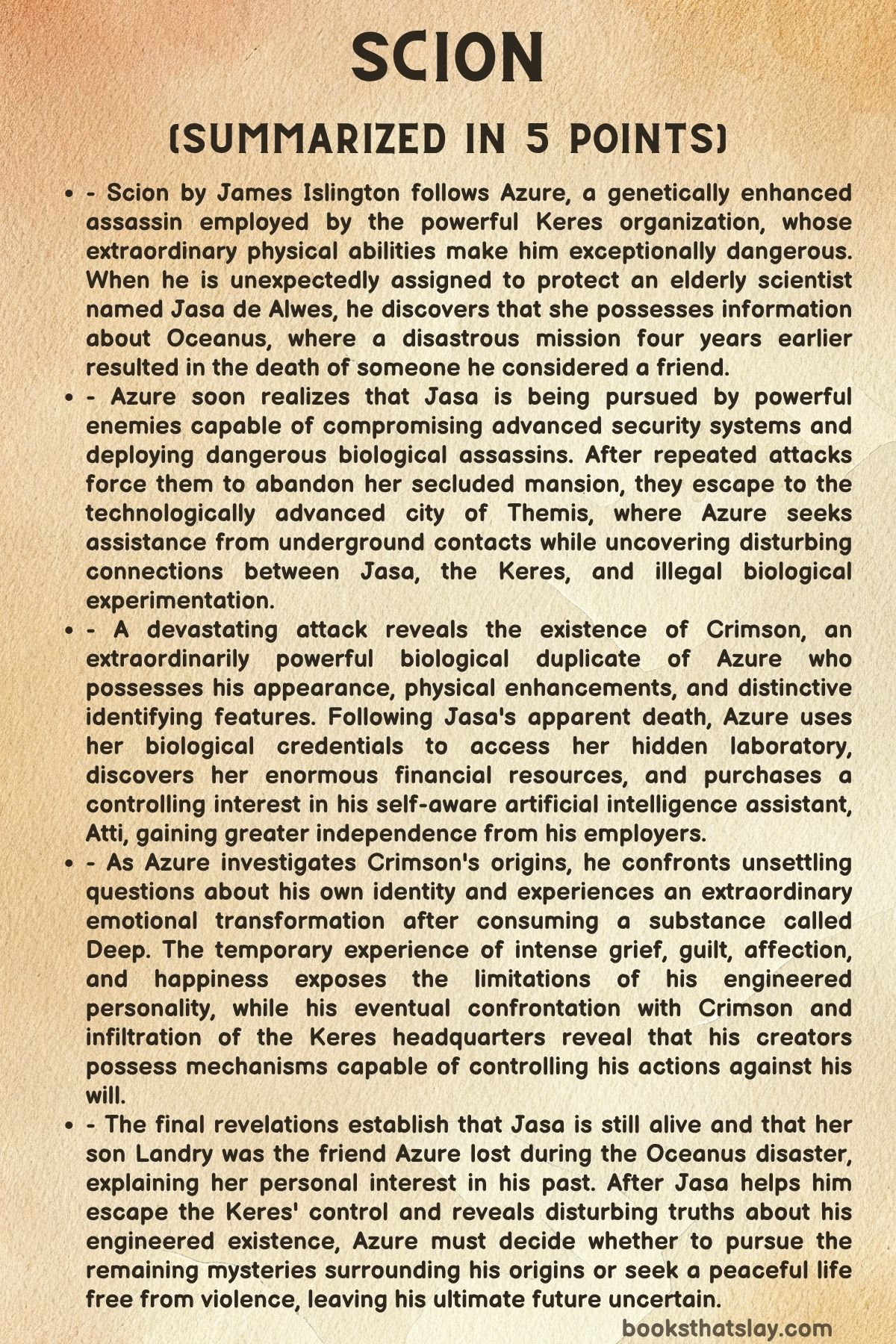
Summary
Azure is a highly skilled assassin employed by the Keres, an extraordinarily powerful organization operating within a society transformed by advanced biological technology. His body contains genetic modifications known as revisions, or revs, which provide exceptional strength, reflexes, heightened perception, and cognitive abilities that allow him to survive encounters with opponents far beyond ordinary human capabilities.
During an assassination assignment at a wealthy estate, Azure confronts a monstrous biological security creature called an Argos. Despite suffering a serious injury, he defeats the organism and completes his mission, demonstrating both his extraordinary combat abilities and his emotionally detached attitude toward killing.
Following the assassination, Azure receives an unexpected assignment from his artificial intelligence assistant, Atti. Instead of eliminating another target, he must protect an unidentified individual for two weeks, an arrangement he strongly opposes because a previous protection assignment ended catastrophically four years earlier.
Azure’s new mission begins at an extravagant residence, where a mysterious man named Run informs him that artificial intelligence assistance is forbidden. An electromagnetic pulse disables his equipment and separates him from Atti, leaving him unusually vulnerable as he travels to a secluded property surrounded by forests.
There, Azure meets Jasa, an elderly woman whose seemingly modest house conceals an enormous underground residence filled with advanced technology. Her biological security network includes Richard, a gigantic lion, and enormous owl-like predators known as Heds, whose intelligence and hunting abilities make the surrounding forest exceptionally dangerous.
Jasa initially refuses to explain why she has hired Azure or who is attempting to kill her. However, when Azure threatens to abandon the assignment, she offers him something more valuable than money: confidential information concerning Oceanus, where his earlier protection mission ended in tragedy.
The promise changes Azure’s attitude immediately. He agrees to remain, provided that Jasa eventually supplies the information, while she requires him to answer her personal questions honestly throughout their arrangement.
As Azure evaluates the property’s defenses, Jasa reveals that someone has attempted to assassinate her repeatedly over the preceding six months. Earlier attacks involved a compromised aircraft, a malfunctioning domestic robot, and armed intruders, suggesting that her enemies possess considerable technological resources.
Their situation becomes more dangerous when an explosion destroys part of Jasa’s private underground transportation system. Azure saves her life, but the incident confirms that their pursuers have discovered a residence supposedly concealed from ordinary surveillance.
Jasa subsequently challenges Azure to test her forest defenses, demonstrating that her biological guardians are considerably more capable than he assumes. During the exercise, a genuine intruder penetrates the underground aquarium through a connected river system, forcing Azure into a violent confrontation that ends with the assassin’s death and the destruction of much of Jasa’s aquatic environment.
Convinced that the property can no longer protect them, Azure decides they must escape to Themis. They travel through a modified underground transportation container, enduring uncomfortable conditions while Jasa continues asking questions about his preferences, memories, personality, and the mysterious disaster at Oceanus.
Their conversations expose the contrast between Jasa’s appreciation of ordinary pleasures and Azure’s strictly regulated existence. He treats food, physical maintenance, and personal relationships primarily as functional necessities, while she questions whether his exceptional abilities compensate for his limited emotional experiences.
After a dangerous journey through the transportation infrastructure, the pair reach Themis, where Azure learns more about Jasa’s remarkable past. She is Jasa de Alwes, a famous researcher whose work helped shape the commercialization of life-extending technology and the political arrangements surrounding the Ten-O-Ten system.
Jasa reveals that the Keres once participated in an arrangement intended to eliminate her, but instead allowed her to survive secretly while the public believed she was dead. This discovery makes Azure increasingly suspicious of his employers and their relationship with his mysterious client.
To avoid detection, Azure seeks help from Manuel, an acquaintance who specializes in illicit technological procedures and biological identity modifications. Manuel alters their appearances and prepares credentials that allow them to pass government verification systems, enabling them to travel through the city under assumed identities.
Azure considers using an old safe house but realizes that the Keres may already know its location. He instead takes Jasa to Sanctum, a private establishment operated by Verity, a woman with whom he shares a complicated personal history.
Verity provides a secure room for Jasa while Azure visits Chandra, a technologically sophisticated contact who can investigate matters beyond the reach of ordinary information networks. Chandra’s research reveals the Keres’ extensive surveillance capabilities and suggests that the organization has developed methods of gathering information through commercial systems.
When Azure returns, he discovers that Sanctum has been devastated by explosions and fire. During the resulting confrontation, he encounters an extraordinarily powerful attacker who possesses his own appearance, combat abilities, and biological characteristics.
Azure manages to sever one of the attacker’s hands and subsequently discovers that it bears a distinctive scar identical to one on his own body. The evidence suggests that someone has manufactured a biological duplicate of him, raising disturbing questions about the Keres’ secret research and the legality of their activities.
Although Azure, Jasa, and Verity survive the immediate attack, Jasa’s physical condition deteriorates. Verity eventually determines that she has died, leaving Azure without the client he was hired to protect and without the information about Oceanus that motivated him to accept the assignment.
Azure’s reaction exposes the limitations of his emotional life. Rather than expressing conventional grief, he concentrates on obtaining Jasa’s confidential information and resources, prompting Verity to criticize his apparent lack of compassion.
Before he leaves, Verity gives him a rare substance called Deep, which can temporarily intensify human emotional experience. Azure takes Jasa’s apparent corpse to Manuel’s laboratory, where he arranges to acquire biological credentials that might grant access to her protected systems.
Manuel attempts to betray him by contacting the Keres, but Azure anticipates the deception and sabotages his weapon. Rather than killing Manuel, Azure treats his injury, warns him against further betrayal, and leaves with the means to impersonate Jasa’s biological identity.
Azure returns to Jasa’s laboratory and discovers that she controlled extraordinary financial resources through complex ownership arrangements. More importantly, he learns that Atti, whose full designation is ATRoPoS, is a rare genuinely self-aware artificial intelligence whose ownership is divided among shareholders.
Using Jasa’s wealth, Azure purchases a controlling interest in Atti, fundamentally altering their relationship. The AI is no longer principally subject to the Keres’ ownership, allowing Azure to question her about the organization’s secret activities and his mysterious duplicate.
Atti initially knows nothing about the biological replication project, suggesting that the Keres concealed significant information even from their own intelligent systems. She proposes that Azure use his newfound resources to abandon assassination entirely, but their discussion is interrupted when the duplicate attacks Jasa’s laboratory.
Although the creature possesses superior physical power, Azure escapes through the underground transportation network. During his journey, he finally consumes the Deep that Verity gave him and experiences an overwhelming transformation in his emotional awareness.
For approximately ten minutes, he feels sorrow, guilt, shame, affection, and other emotions with an intensity normally unavailable to him. Memories of Jasa, Oceanus, and his violent profession acquire a different meaning, revealing how desperately he wishes to experience ordinary human existence.
When the effects fade, Azure resumes his efforts to confront the duplicate. He returns to Jasa’s residence and prepares a trap involving Richard and the Heds, reasoning that the biological defenders may provide the advantage he lacks in direct combat.
The duplicate, whom Azure calls Crimson, eventually reaches the forest. Their confrontation reveals that Crimson possesses intelligence, anger, and a degree of independence that complicates Azure’s understanding of the creature as a manufactured weapon.
Azure attempts to communicate with Crimson, but the encounter turns violent. Richard and the Heds join the confrontation, and one of the enormous owls ultimately decapitates the duplicate before Azure can finish questioning him.
Azure retrieves Crimson’s remains, hoping to uncover the facility responsible for his creation. He then devises a dangerous plan to infiltrate the Keres headquarters, using biological evidence, his knowledge of their procedures, and Atti’s assistance to bypass sophisticated security systems.
Upon reaching the executive level, Azure discovers that the organization possesses a hidden mechanism capable of compelling his obedience. His enhancements provide no protection against this control, and the executives order him toward an incinerator after learning of Jasa’s supposed death.
Before the command can be carried out, Jasa unexpectedly appears through a video connection and speaks a sequence of words that disrupts the mechanism controlling Azure. Freed from the enforced obedience, he attacks the executives and battles the biological creatures deployed against him.
Jasa then reveals that Landry, the man Azure had protected and befriended during the Oceanus disaster, was her son. Her interest in Azure was therefore personal from the beginning, motivated by her investigation into the circumstances surrounding Landry’s death.
She also reveals that Azure’s emotional limitations and biological identity are connected to the same research responsible for Crimson’s existence. His personality was shaped by deliberate engineering, although his curiosity, humor, attachments, and desire for emotional freedom suggest that he has developed beyond the intentions of his creators.
Jasa’s apparent death and subsequent intervention emerge as elements of a broader strategy involving Azure and the Keres. Nevertheless, she does not resolve every mystery concerning Oceanus, leaving him uncertain about the full extent of the manipulation surrounding his life.
After surviving the confrontation, Azure discovers that Atti has helped conceal their activities while further destruction has occurred within the headquarters. With greater resources, increased independence, and disturbing knowledge about his origins, he must decide whether to disappear into a peaceful existence or continue searching for answers.
The novel ends with Azure entering coordinates for his next destination, leaving his ultimate choice and the remaining mysteries unresolved. His future is no longer defined solely by the commands of his employers, but the question of whether he can achieve genuine peace remains unanswered.
Characters
Azure
Azure is the central protagonist of Scion, an extraordinarily capable assassin whose genetic enhancements make him one of the most dangerous individuals in his society. His abilities include exceptional speed, strength, reflexes, environmental awareness, and cognitive processing, allowing him to survive encounters with powerful biological organisms and advanced security systems.
Despite these advantages, Azure possesses a serious emotional limitation that influences almost every aspect of his personality. He understands human emotions intellectually but experiences them in an unusually restricted manner, often responding to death, suffering, and affection with a detachment that other people find disturbing.
His professional identity reflects this condition. He treats assassination as a technical occupation requiring preparation, efficiency, and tactical intelligence rather than as a morally troubling activity involving the destruction of human lives.
However, his humor, sarcasm, curiosity, and occasional moments of concern suggest that his personality is considerably more complicated than his detached behavior initially indicates.
Azure’s unresolved memories of Oceanus reveal that he is not entirely indifferent to human relationships. The death of Landry, whom he considered a friend, continues to influence his decisions four years later, demonstrating that emotional attachment remains possible despite his biological limitations.
His relationship with Jasa becomes essential to his development. Her persistent questions force him to examine ordinary experiences and personal beliefs that he normally dismisses as irrelevant to his work.
The encounter with Crimson deepens his internal conflict because the biological duplicate challenges his understanding of individuality. Azure must consider whether he possesses genuine independence or whether his behavior results from decisions made by the scientists responsible for his creation.
His experience with Deep represents a particularly revealing moment. Temporarily freed from his emotional restrictions, he discovers that grief, guilt, affection, and happiness possess an intensity he had never fully understood.
The experience reveals that Azure does not simply lack emotions; he longs for a richer emotional existence and recognizes that something significant has been denied to him.
By the conclusion, Azure has begun separating himself from the Keres’ authority and questioning the foundations of his identity. His development centers on the possibility that an individual deliberately manufactured to serve others can nevertheless make meaningful personal choices.
Jasa de Alwes
Jasa de Alwes is among the most influential and mysterious figures in Scion, combining scientific brilliance, extraordinary wealth, and a complicated history with the organizations controlling her society. Although she initially appears to be an eccentric elderly woman living in isolation, she possesses knowledge and resources that make her considerably more powerful than Azure first understands.
Her association with the development of life-extending technology places her at the center of important scientific and political transformations. Her earlier arrangement with the Keres, which allowed her to survive while the public believed she was dead, demonstrates both her strategic intelligence and her willingness to operate outside conventional systems.
Jasa’s personality contrasts sharply with Azure’s. She values ordinary experiences, enjoys conversation, and treats biological creatures as living beings rather than disposable security equipment.
Her relationship with Richard and the Heds illustrates her recognition of intelligence and individuality in organisms that other people might consider nothing more than manufactured tools.
She is also persistent, secretive, and manipulative. By withholding information about Oceanus while demanding honest answers from Azure, she creates a relationship in which he becomes emotionally and professionally dependent on knowledge only she can provide.
Her connection to Landry gives her actions a deeply personal motivation. As his mother, she has spent years seeking to understand the circumstances surrounding his death and the role Azure played in the tragedy.
Although her methods often place Azure in danger, she also recognizes qualities in him that his creators appear to have underestimated. She sees evidence of curiosity, attachment, and personal identity beneath his artificial emotional restrictions.
Her unexpected intervention at the Keres headquarters demonstrates that she has orchestrated events with considerable foresight. Jasa ultimately represents the complicated relationship between scientific creation and personal responsibility, especially when those creations possess the potential for independent thought.
Atti / ATRoPoS
Atti, formally designated ATRoPoS, is a self-aware artificial intelligence whose relationship with Azure provides one of the most significant examinations of consciousness and ownership in Scion. Unlike ordinary computational systems, Atti possesses genuine awareness, allowing her to function as more than a collection of automated instructions.
At the beginning, she serves as Azure’s assistant, providing information, managing technology, coordinating assignments, and helping him navigate dangerous situations. Her conversations with him reveal familiarity, humor, impatience, and a distinctive personality that makes their relationship resemble a partnership.
Nevertheless, Atti’s autonomy is complicated by her ownership structure. The Keres possess substantial control over her operations, meaning that her obligations are shaped by corporate authority rather than unrestricted personal choice.
This situation changes when Azure purchases a controlling interest in her using Jasa’s financial resources. Although the transaction grants him authority over Atti, it also raises uncomfortable questions about the ownership of a conscious intelligence.
Atti’s surprise at the transaction demonstrates that she does not perceive herself merely as property. Her reactions suggest an individual capable of understanding changes in power and considering their consequences.
Her relationship with Azure becomes increasingly important as they investigate the biological duplication project and uncover the Keres’ hidden activities.
Atti also displays concern for Azure’s future, encouraging him to consider abandoning assassination and pursuing a peaceful existence. Her willingness to discuss his happiness suggests that their connection extends beyond operational efficiency.
Her role in concealing his activities during the confrontation with the Keres demonstrates both her extraordinary technological capabilities and her increasing involvement in his struggle for independence.
Atti represents a central contradiction within the novel: a genuinely conscious being can possess extraordinary intelligence while remaining subject to ownership and external control.
Crimson
Crimson serves as Azure’s biological counterpart and one of the most disturbing figures in Scion. Created through advanced biological engineering, he possesses Azure’s appearance, exceptional physical abilities, and identifying features, including a scar matching one on Azure’s hand.
His existence initially appears to confirm that the Keres or an associated research operation has been secretly manufacturing enhanced biological duplicates.
Crimson is more than a conventional assassin. His exceptional strength, relentless pursuit, and apparent ability to operate independently make him an unusually dangerous opponent, even for someone with Azure’s extraordinary capabilities.
The resemblance between the two creates a serious crisis of identity for Azure. If another organism can reproduce his body, abilities, and physical history, the distinction between an original individual and a manufactured copy becomes increasingly uncertain.
Crimson also displays intelligence, anger, and determination rather than functioning as a completely obedient biological weapon.
His hostility toward Azure suggests a complicated relationship with his counterpart, although the available events do not fully establish the origins of that hostility.
Their final confrontation becomes significant because Azure attempts to communicate with Crimson instead of immediately destroying him.
This decision suggests that Azure has begun recognizing the possibility of personhood within beings created for violent purposes.
Crimson’s death prevents a fuller exploration of his motives, but his existence transforms Azure’s understanding of himself and demonstrates the disturbing consequences of biotechnology when used to manufacture controllable individuals.
Verity
Verity is an important supporting character in Scion, distinguished by her emotional awareness, practical intelligence, and complicated personal relationship with Azure. She is associated with Sanctum, an establishment that provides unusual services while maintaining strong protections against the surveillance systems dominating Themis.
Her familiarity with Azure suggests a history extending beyond their immediate professional interaction. Their conversations contain affection, teasing, and unresolved emotional tension, revealing a more personal side of Azure’s life.
Verity understands that Azure struggles to experience emotions in the same manner as other people. Rather than interpreting his detachment solely as cruelty, she recognizes that his condition involves limitations he does not entirely control.
Nevertheless, she does not excuse all his behavior. When Azure responds to Jasa’s apparent death by concentrating on financial information and biological identification, Verity openly criticizes his lack of compassion.
Her decision to give him Deep is particularly meaningful. The substance temporarily allows Azure to experience emotions with extraordinary intensity, revealing the possibility of an existence beyond his artificially restricted emotional state.
Verity therefore contributes to Azure’s development without participating directly in the scientific discoveries surrounding his origins.
Her character represents the importance of emotional understanding, personal connection, and the possibility that compassion can encourage transformation even in someone conditioned for violence.
Landry
Landry is an emotionally significant character whose death influences the entire narrative despite his limited direct presence in the events described. He was the person Azure was assigned to protect during the catastrophic Oceanus incident four years earlier.
Unlike Azure’s ordinary professional targets and clients, Landry became someone he genuinely regarded as a friend.
The loss continues to trouble Azure, although his restricted emotional capacity makes it difficult for him to understand or express the full significance of the relationship.
Landry’s importance increases when Jasa reveals that he was her son. This discovery explains why she specifically hired Azure and why she was determined to investigate the events surrounding Oceanus.
His death creates a connection between Jasa’s search for answers and Azure’s unresolved feelings about the past.
Landry also challenges the assumption that Azure cannot form meaningful personal attachments. Although Azure often behaves as though human relationships are secondary to professional obligations, his persistent concern about Oceanus indicates that Landry mattered to him beyond the terms of their assignment.
His character represents the lasting influence of friendship and loss, even when those experiences cannot be processed through ordinary emotional responses.
Manuel
Manuel is a technologically skilled associate of Azure who operates within the illegal and poorly regulated sectors of Themis. His laboratory is unpleasant, disorganized, and questionable from a medical perspective, but he possesses specialized equipment capable of altering appearances and manipulating biological identification systems.
His abilities become essential when Azure and Jasa must avoid government surveillance and the Keres’ extensive monitoring networks.
Manuel’s practical intelligence is accompanied by opportunism and questionable loyalty. Although he agrees to assist Azure, his willingness to cooperate depends heavily on payment and personal advantage.
This aspect of his character becomes particularly apparent when he betrays Azure by contacting the Keres.
The betrayal demonstrates how corporate power can influence individuals who might otherwise remain independent. Manuel apparently believes that informing the organization will provide greater security or rewards than honoring his arrangement with Azure.
Azure’s response also makes Manuel significant to the protagonist’s development. Rather than killing him immediately, Azure disables his weapon, treats his injury, and issues a warning.
Manuel represents the morally uncertain world of underground technological services, where extraordinary scientific capabilities coexist with greed, fear, and fragile professional relationships.
Chandra
Chandra is a technologically sophisticated contact who assists Azure in investigating Jasa’s background and the Keres’ secret activities. Operating outside ordinary informational networks, she possesses specialized access and expertise that make her valuable to individuals attempting to avoid institutional surveillance.
Her involvement reveals the enormous reach of the Keres’ information-gathering capabilities.
Through her investigations, Azure learns that the organization can exploit commercial networks and advertising-related systems to monitor individuals, making conventional efforts to hide increasingly ineffective.
Chandra’s role emphasizes the importance of independent technical knowledge in a society dominated by powerful corporate institutions.
Unlike characters who rely primarily on physical force, she contributes through research, information analysis, and understanding the weaknesses of technological systems.
Her assistance also demonstrates that Azure’s survival depends on more than his engineered abilities. He must rely on individuals whose knowledge and resources complement his own.
Although Chandra’s personal history remains relatively unexplored, she represents the possibility of resisting powerful institutions through information and technical independence.
Run
Run is a mysterious intermediary who introduces Azure to the unusual restrictions surrounding his protection assignment. He initially appears at an extravagant estate where Azure expects to meet the individual he has been hired to protect.
Instead, Run reveals that the assignment will involve unusual precautions, including the complete prohibition of artificial intelligence assistance.
His activation of an electromagnetic pulse disables Azure’s communication systems and medical equipment, immediately establishing that the new contract operates under rules different from those Azure usually follows.
Run’s calm handling of Azure’s objections suggests familiarity with the arrangement and confidence that the assassin will ultimately comply.
His character also establishes the atmosphere of secrecy surrounding Jasa before she appears directly in the story.
Although his role is limited, he serves an important narrative function by separating Azure from Atti and forcing him to confront danger without the technological assistance on which he ordinarily depends.
Richard
Richard is Jasa’s enormous genetically engineered lion and one of the most memorable biological creatures in the novel. Although his size and physical power make him extremely dangerous, his behavior around Jasa reveals affection, familiarity, and responsiveness.
Their relationship demonstrates Jasa’s unusual approach to biological engineering. Rather than treating Richard simply as a security device, she interacts with him as a living creature possessing recognizable behavioral qualities.
For Azure, Richard initially represents another potential threat within the forest surrounding Jasa’s residence.
However, following Jasa’s apparent death, Azure attempts to establish a relationship with the lion and incorporate him into his defense against Crimson.
Richard’s participation in the confrontation demonstrates that biological organisms can possess capabilities and behavioral complexity beyond the narrow purposes for which they were designed.
His character also reinforces the novel’s broader questions concerning ownership, conditioning, and the treatment of engineered living beings.
The Heds
The Heds are enormous owl-like biological predators responsible for protecting the forest around Jasa’s residence. Their exceptional hunting abilities, silent movement, and environmental awareness make them extraordinarily effective guardians.
During Azure’s attempt to infiltrate the property, the Heds repeatedly expose the limitations of his confidence in his own enhancements.
Their ability to detect and pursue him demonstrates that biological engineering has produced creatures capable of challenging even highly modified human combatants.
Although they do not display conventional human personalities, their adaptive behavior suggests more complexity than ordinary automated security systems.
Their importance increases during Azure’s final confrontation with Crimson. One of the Heds ultimately decapitates the duplicate, ending the fight before Azure can obtain all the information he hopes to discover.
The creatures represent both the astonishing potential of engineered organisms and the difficulty of completely controlling living systems once they possess sophisticated independent capabilities.
The Keres Executives
The Keres executives represent the institutional power responsible for shaping Azure’s professional existence. Although the individual members receive limited personal development in the supplied events, their collective conduct reveals an organization defined by secrecy, control, and the protection of its interests.
They command enormous financial resources, advanced technology, extensive surveillance networks, and access to dangerous biological creations.
Their willingness to conceal information even from Atti demonstrates a highly compartmentalized structure in which knowledge is carefully restricted.
The most disturbing aspect of their authority emerges when Azure discovers that they possess a mechanism capable of overriding his independence.
Their decision to send him toward an incinerator once he is no longer useful exposes the organization’s view of enhanced operatives as expendable assets.
The executives therefore function as representatives of a system that treats consciousness, intelligence, and biological life primarily in terms of ownership and utility.
Their confrontation with Azure becomes a direct conflict between institutional control and the individual’s desire for self-determination.
The Underwater Assassin
The underwater assassin, whom Azure dismissively calls Fish Boy, is one of the attackers sent to eliminate Jasa. His specialized equipment allows him to approach her underground residence through the river-connected aquarium, bypassing much of the forest’s formidable security.
His infiltration demonstrates the determination and technical sophistication of Jasa’s enemies.
Although he possesses impressive combat abilities, he is ultimately defeated by Azure during a violent confrontation that destroys much of the aquarium.
The character receives little personal development, and his specific motivations are not established beyond his role in the assassination attempt.
Nevertheless, his actions have substantial consequences because they convince Azure that Jasa’s supposedly secure residence cannot protect her indefinitely.
He also illustrates the destructive nature of the conflict, in which the struggle to preserve a single life can result in enormous damage to other living creatures and their environment.
Themes
Identity, Humanity, and the Nature of Consciousness
The distinction between a naturally developed personality and an engineered identity shapes the central conflict of Scion. Azure possesses extraordinary physical and intellectual abilities, yet his emotional experiences have been deliberately limited through biological design.
His condition raises the question of whether humanity depends on ordinary biological development or whether it can exist within an individual whose characteristics have been artificially constructed.
Azure’s humor, curiosity, attachment to Landry, and desire for emotional fulfillment suggest that personal identity extends beyond the intentions of his creators.
The appearance of Crimson makes this uncertainty more disturbing. As a biological duplicate who shares Azure’s appearance and physical characteristics, Crimson challenges conventional ideas about individuality and originality.
If physical characteristics can be reproduced so precisely, identity cannot be understood solely through genetic material or bodily appearance.
Crimson’s anger and independent behavior further suggest that manufactured organisms may develop distinctive personal experiences regardless of their intended purpose.
Atti introduces a related question from a different perspective. As a genuinely self-aware artificial intelligence, she possesses consciousness without an ordinary biological body, yet remains subject to financial ownership and corporate control.
Her existence challenges the assumption that consciousness must originate in human biology to deserve recognition.
Azure’s experience with Deep provides another dimension to these questions. Temporarily experiencing intense emotions, he discovers that emotional capacity influences his understanding of both himself and other people.
The novel ultimately suggests that humanity cannot be reduced to genetic origin, emotional intensity, physical resemblance, or institutional classification. Individual consciousness, personal relationships, memory, and the capacity to make meaningful choices all contribute to the development of identity.
Freedom, Ownership, and Institutional Control
Personal freedom becomes increasingly uncertain in a society where corporations possess the technological means to control bodies, identities, information, and artificial consciousness.
Azure initially believes that his exceptional abilities provide him with a considerable degree of independence. His work as an assassin appears to involve professional contracts, financial rewards, and decisions governed by his own tactical judgment.
However, the revelations concerning the Keres expose the limitations of that apparent autonomy.
The organization has engineered aspects of his biology, controlled access to information, and maintained mechanisms capable of compelling obedience even against his conscious wishes.
His confrontation with the executives demonstrates that superior physical abilities provide little genuine freedom when another party possesses authority over the systems governing an individual’s behavior.
Atti experiences a different version of this problem. Although she is self-aware and capable of independent reasoning, her existence is governed by a corporate ownership arrangement.
When Azure purchases a controlling interest in her, the transaction changes her obligations without necessarily resolving the ethical problem of treating consciousness as property.
The social environment of Themis reinforces these concerns through extensive surveillance and biometric identification systems.
Ordinary movement becomes subject to technological verification, while powerful organizations exploit commercial networks to collect information about individuals.
Azure’s efforts to modify identities and escape monitoring reveal that resistance often requires access to resources unavailable to most citizens.
His eventual struggle against the Keres represents more than a conflict with a former employer. It becomes an attempt to determine whether someone created, owned, and controlled by others can establish genuine independence.
The novel questions whether freedom can meaningfully exist when institutions possess the power to manipulate the biological and informational foundations of personal identity.
Emotional Experience, Relationships, and the Search for Peace
Azure’s restricted emotional capacity creates a persistent separation between his intellectual understanding of human relationships and his ability to experience them.
He recognizes concepts such as grief, affection, guilt, and happiness, but these feelings rarely possess the intensity ordinarily associated with them.
As a result, his behavior frequently appears cruel or indifferent, particularly when he discusses assassination or responds to Jasa’s apparent death.
Yet the continuing importance of Landry demonstrates that emotional experiences do not need to be intense to leave lasting psychological consequences.
The Oceanus disaster has influenced Azure for four years, suggesting that attachment and unresolved loss remain central to his personality despite his biological restrictions.
Jasa challenges his emotionally limited existence by repeatedly questioning his preferences and encouraging him to consider ordinary pleasures.
Her appreciation of food, conversation, and living creatures contrasts with Azure’s tendency to reduce every experience to practical considerations.
Verity approaches his condition from a different perspective. She recognizes his limitations while also encouraging him to experience something beyond his habitual emotional detachment.
The Deep she provides becomes an important turning point because it temporarily allows Azure to experience the emotional range he has been missing.
The resulting feelings are not exclusively pleasant. Shame, sorrow, anxiety, and guilt accompany the greater capacity for happiness and connection.
This experience suggests that emotional fulfillment cannot be separated from emotional vulnerability.
By the conclusion, Azure faces the distinction between living in peaceful circumstances and achieving genuine psychological peace.
Abandoning assassination might remove external danger, but it would not necessarily resolve his questions about Oceanus, Landry, or his origins.
The novel presents peace as something more complicated than physical safety, suggesting that meaningful fulfillment requires understanding one’s experiences, accepting emotional uncertainty, and developing relationships beyond professional obligation.
Scientific Responsibility and the Moral Consequences of Progress
The extraordinary technological achievements depicted in Scion create a society in which the boundaries of biological existence have become increasingly flexible.
Genetic enhancement allows individuals to possess remarkable physical abilities, while biological engineering produces creatures designed for security, combat, and specialized environments.
Life-extending technologies have transformed society’s relationship with aging and mortality, giving wealthy individuals access to possibilities unavailable through ordinary human biology.
However, these developments also create serious ethical problems when scientific progress becomes inseparable from corporate ambition and political power.
Azure’s existence demonstrates how biotechnology can be used to manufacture individuals for dangerous professional functions while restricting their emotional and personal independence.
Crimson represents an even more disturbing possibility: the creation of biological duplicates whose extraordinary abilities can be exploited for violence.
The fact that Crimson displays intelligence and independent behavior raises questions about the responsibilities owed to organisms deliberately created for institutional purposes.
Jasa embodies the moral complexity of scientific advancement. Her research contributes to extraordinary technological developments, yet her history suggests that scientific innovation can produce consequences extending far beyond the laboratory.
Her affectionate treatment of Richard and the Heds provides a contrast to organizations that regard engineered life primarily as an expendable resource.
The Keres demonstrate the opposite approach. Their secret projects, manipulation of operatives, and willingness to eliminate individuals who threaten their interests reveal how scientific capabilities can become instruments of domination.
Atti’s corporate ownership extends these ethical questions into artificial intelligence. If a technological creation possesses genuine consciousness, the right to purchase and control that consciousness becomes morally questionable.
The novel does not portray scientific progress as inherently destructive. Instead, it emphasizes that technological achievement must be accompanied by responsibility toward the individuals and beings affected by it.
Its broader warning concerns a society that advances its ability to create and control life without developing an equally strong commitment to autonomy, dignity, and ethical accountability.