Saving Noah Summary, Characters and Themes
Saving Noah by Lucinda Berry is a psychological fiction novel that examines the difficult boundaries of parental love, moral responsibility, guilt, and forgiveness.
The story follows Adrianne Coates, a mother whose life changes after her teenage son is convicted of sexually abusing two young girls. As she struggles to support him through rehabilitation and social rejection, she faces painful questions about whether love can overcome every wrongdoing. Through the experiences of a divided family, the novel explores the consequences of sexual offenses, the limitations of treatment, the effects of shame, and the moral conflicts surrounding a mother’s determination to protect her child.
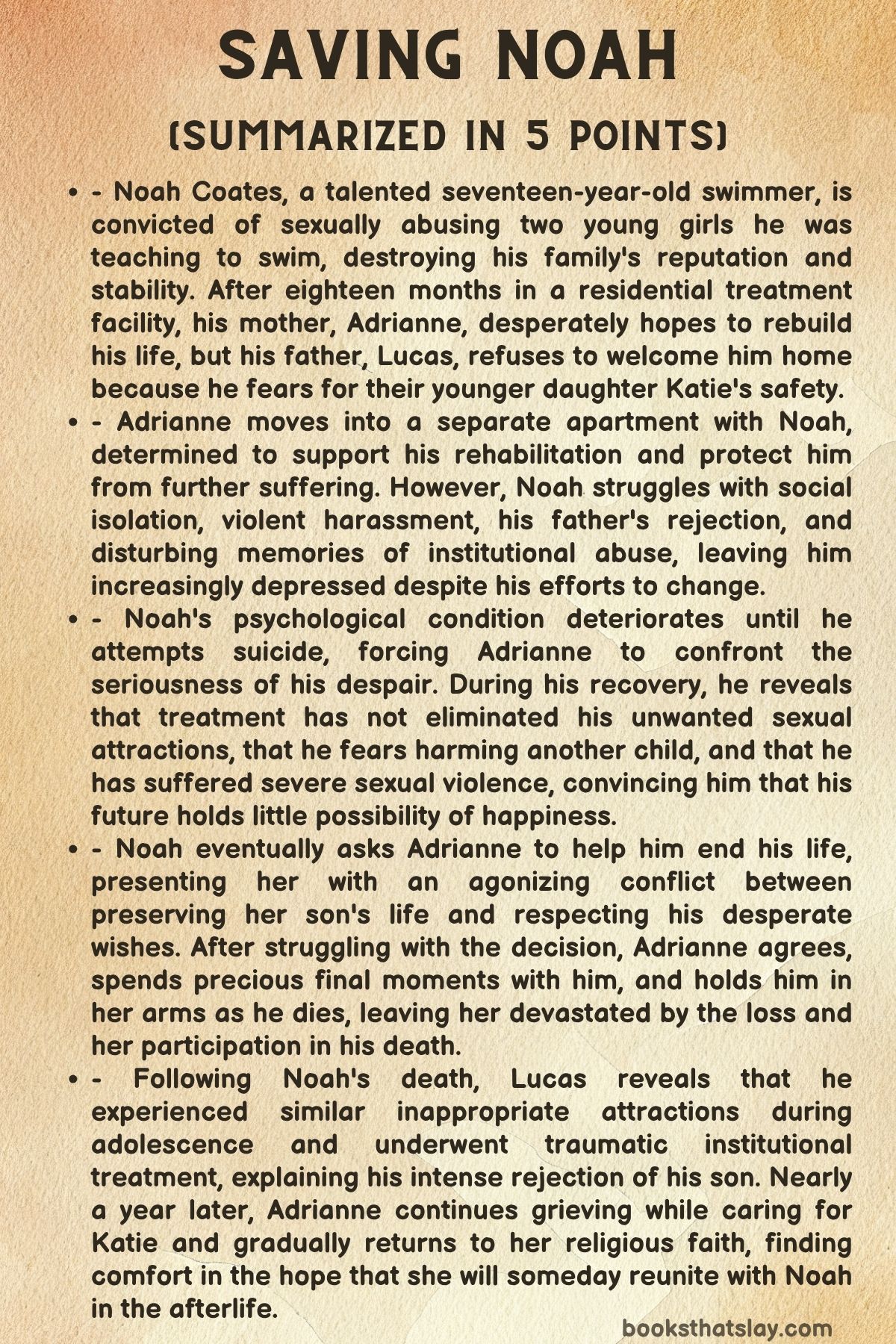
Summary
Adrianne Coates has spent eighteen months waiting for the day her seventeen-year-old son, Noah, will return home from the Marsh Foundation, a residential treatment center for juvenile sex offenders. Noah was convicted of sexually abusing two young girls during swimming lessons, an offense that destroyed his reputation, devastated his victims, and permanently changed the lives of everyone in his family.
Before his conviction, Noah had been a talented competitive swimmer, an excellent student, and a beloved son whose future appeared promising. Adrianne remembers a comfortable family life in Buffalo Grove, where she and her husband, Lucas, raised Noah and their younger daughter, Katie, while participating in religious and community activities.
The family’s collapse began when Noah approached Adrianne and confessed that he had repeatedly behaved inappropriately with girls he had been teaching to swim. He explained that he had stopped giving lessons because he feared he could not control his behavior, leaving his mother shocked and unable to reconcile his actions with the boy she believed she knew.
Initially, Adrianne hoped the situation could be resolved through conversations with the victims’ parents. Instead, the disclosure led to police involvement, legal proceedings, and widespread public condemnation, while Noah’s former swimming teammates violently attacked him and the family’s home became a target for vandalism.
Lucas lost clients, Adrianne experienced public humiliation, and the family’s relationships with friends and neighbors deteriorated. Eventually, they relocated to Dolton, hoping to escape the hostility surrounding Noah’s conviction and recover some degree of anonymity.
Following legal proceedings, Noah was sentenced to eighteen months of residential treatment and required to register as a sex offender. His attorney, Meryl, helped him navigate the legal system, while Dr. Park and the treatment staff at Marsh supervised his rehabilitation and prepared him for a future governed by strict restrictions.
Throughout his confinement, Noah generally followed institutional rules, participated in therapy, and accepted responsibility for his offenses. Adrianne interpreted his excellent treatment record as evidence that he could eventually return to ordinary life, although Dr. Park remained cautious about whether the program had changed Noah’s underlying attractions.
The reality of Noah’s institutional experience was considerably more disturbing than Adrianne understood. He lived among frightened and sometimes violent residents, including Joe, a particularly dangerous boy who intimidated others and sexually assaulted vulnerable residents while staff members appeared unwilling or unable to intervene.
Noah witnessed the abuse of Sam and the relentless persecution of Mark, a younger resident whose suffering eventually led to a suicide attempt. These experiences intensified Noah’s fear, guilt, and hopelessness, especially because he felt powerless to protect anyone or challenge the violence occurring around him.
His treatment also involved painful electrical aversion sessions intended to alter his unwanted sexual responses. Although he eventually demonstrated apparent improvement, his private thoughts, disturbing dreams, and fear of future offending convinced him that completing treatment did not necessarily mean he had become the person he desperately wanted to be.
As his release approaches, Adrianne faces another devastating problem: Lucas refuses to allow Noah to return to the family home. He insists that Katie’s safety must take priority because she is close in age to Noah’s victims, while Adrianne argues that their son deserves support after completing his punishment.
Unable to reconcile their positions, Adrianne agrees to live with Noah in a separate apartment while Lucas remains with Katie. She furnishes the modest residence with familiar belongings and swimming trophies, hoping to recreate some of the comfort Noah experienced before his conviction.
Noah’s homecoming proves less joyful than Adrianne anticipated, as he returns withdrawn, anxious, and uncertain about his future. Although Katie enthusiastically welcomes her brother and enjoys spending time with him, Lucas remains distant, leaving Noah increasingly aware that his father may never forgive him.
Adrianne attempts to preserve family relationships by encouraging visits and reminding Lucas that Noah has accepted responsibility for his behavior. Her determination produces another conflict when she secretly permits Katie to stay overnight at the apartment, violating their safety agreement and provoking Lucas into seeking legal advice about protecting their daughter.
Meanwhile, Noah struggles to adjust to his new school, where he experiences isolation, academic difficulties, and renewed hostility over his offenses. His situation becomes more dangerous when he suffers another brutal assault, leaving him hospitalized with serious injuries and deepening the depression that already threatens his emotional stability.
Adrianne later discovers that an online page publicly identifies Noah as a child molester and contains hateful comments and threats. Hoping to protect him from further humiliation, she arranges supervised online education through Dr. Park, but removing him from school does little to improve his condition.
Noah becomes increasingly withdrawn, neglects his personal hygiene, refuses food, and spends most of his time isolated in his bedroom. Adrianne devotes herself to monitoring him, while her marriage deteriorates into arguments about responsibility, forgiveness, and the consequences of their son’s actions.
His distress reaches a frightening point when Adrianne discovers that he has taken an excessive quantity of medication. Although he survives, she does not take him to the hospital because he begs her not to, a decision that exposes the dangerous limits of her attempts to manage his suffering without adequate intervention.
Convinced that Noah desperately needs his father’s acceptance, Adrianne persuades Lucas to invite the family for dinner and privately asks him to reconnect with their son. Lucas remains resistant, and shortly afterward Noah attempts suicide by hanging himself from the apartment balcony, forcing Adrianne and several neighbors into a desperate struggle to save his life.
Noah survives, but his heart stops twice during emergency transportation, and doctors place him in a medically induced coma because of swelling in his brain. As Adrianne waits beside his hospital bed, she discovers a suicide note explaining that Noah believes his unwanted attractions will never disappear and that his death would release his family from further suffering.
When Noah recovers sufficiently to speak, he challenges his mother’s persistent assurances that he can eventually live a normal life. He explains that he has continued experiencing inappropriate attractions despite treatment and that his fear of harming another child has become central to his understanding of himself.
Adrianne also learns that Lucas previously offered Noah financial support to move to California on the condition that he permanently sever contact with the family. This revelation increases her anger toward her husband and helps her understand why Noah feels so thoroughly rejected.
The full extent of Noah’s suffering becomes clearer when he reveals that the assault he experienced after returning to school included sexual violence involving a baseball bat. Adrianne is horrified to discover that her son has endured a degree of physical and psychological trauma far beyond what his visible injuries originally suggested.
Noah receives psychiatric care under Dr. Phillips, who observes improvement in his participation in therapy and believes he may eventually continue treatment outside the hospital. Adrianne doubts these assessments because Noah continues expressing suicidal thoughts privately, and she fears that he has learned to tell professionals what they want to hear.
Their conversations become increasingly painful as Noah argues that his future offers little beyond isolation, constant self-surveillance, and the possibility of causing further harm. Adrianne searches for treatments and alternative possibilities, but she cannot find the certainty she wants about his long-term recovery.
Eventually, Noah asks whether Adrianne would help him die rather than leave him to attempt suicide again. The request horrifies her because it places her maternal instinct to preserve his life against his insistence that continued existence represents unbearable suffering.
Adrianne’s conflict becomes more complicated as she recognizes that Katie is also suffering because of the family’s prolonged crisis. Her daughter struggles emotionally and needs stability, forcing Adrianne to acknowledge that her responsibilities extend beyond Noah even when his condition demands nearly all her attention.
Gradually, Adrianne begins considering Noah’s request, although she remains tormented by its implications. When he leaves psychiatric care, Noah appears unexpectedly cheerful, expresses interest in family activities, and becomes enthusiastic about creating pleasant final memories with the people he loves.
The family visits Navy Pier, spends time together, and attends church, temporarily recalling the routines that once defined their lives. Noah particularly enjoys being with Katie, while Adrianne experiences these moments with the painful knowledge that he regards them as preparations for his death.
After considerable hesitation, Adrianne obtains the medication involved in their plan. Noah reacts with relief and gratitude, but his happiness devastates her because she understands that the prospect of losing him has become the very thing that gives him a sense of peace.
On the appointed day, Adrianne remains beside Noah as he takes the medication and gradually approaches death. She holds him in her arms, remembers his infancy, and assures him that she loves him and will somehow continue living without him.
Noah dies while his mother embraces him, leaving Adrianne with an irreversible loss and the knowledge that she participated in the decision that ended his life. The novel does not erase the disturbing ethical questions surrounding her choice, even as it portrays the extraordinary emotional suffering that brought mother and son to this moment.
After Noah’s death, an unexpected revelation emerges through Lucas’s perspective. He discloses that he himself experienced inappropriate sexual attractions during adolescence, committed offenses, and underwent institutional treatment involving humiliation, violence, and painful aversion procedures.
Lucas had spent his adult life attempting to suppress his past by maintaining strict personal discipline and building a respectable family identity. Noah’s offenses forced him to confront the part of himself he had tried to conceal, explaining why his son’s presence awakened intense shame, fear, and emotional rejection.
Rather than face those memories, Lucas distanced himself from Noah and eventually regarded his death with relief because it seemed to remove the reminder of his own history. This revelation fundamentally complicates his earlier insistence that his rejection was motivated solely by his concern for Katie.
Nearly a year later, Adrianne continues struggling with grief and frequently visits a swimming pool to watch a talented young swimmer whose movements remind her of Noah. Although she recognizes that her son is permanently absent from her daily life, Katie gives her a continuing responsibility and a reason to maintain ordinary routines.
Her religious beliefs, severely damaged by the suffering her family endured, gradually become important again because she needs to believe that death has not permanently separated her from Noah. The novel concludes with Adrianne imagining a future reunion with her son in the afterlife, holding on to that possibility as she learns to live with an absence that will never completely disappear.
Characters
Adrianne Coates
Adrianne Coates is the central character and emotional foundation of Saving Noah, representing a mother’s determination to love and protect her child despite circumstances that challenge her understanding of morality and responsibility. Her experiences reveal how parental devotion can become both a source of extraordinary strength and a reason for making dangerous or ethically questionable decisions.
Before Noah’s confession, Adrianne considers herself a responsible mother who has provided her children with a stable home, religious values, and opportunities for success. Her son’s offenses destroy her confidence in that identity because she cannot understand how a child raised in a loving environment could cause such serious harm.
Adrianne initially approaches Noah’s wrongdoing with an optimism that borders on denial, believing that confession, treatment, and cooperation should eventually make forgiveness possible. Her desire to protect him sometimes prevents her from fully acknowledging the lasting injuries suffered by his victims and the legitimate concerns expressed by Lucas.
Her conflict with her husband exposes the limitations of her maternal perspective, particularly when she violates their agreement by allowing Katie to stay overnight with Noah. Although she insists that she trusts her son, her own anxiety during the visit demonstrates that she cannot completely dismiss the risks involved.
As Noah becomes increasingly depressed, Adrianne sacrifices her personal relationships, financial security, and emotional well-being to care for him. She believes that sufficient love and attention should enable her to save him, making his repeated suicidal behavior especially devastating.
Her eventual willingness to participate in Noah’s death represents the most difficult transformation in her character. What she comes to regard as an act of mercy remains ethically troubling, especially because her son’s despair is connected to psychological suffering, trauma, and a future he has come to see as hopeless.
Adrianne’s grief after Noah’s death demonstrates that her decision has not provided emotional resolution. Her return to religious belief reflects her enduring need to maintain a connection with the son she has lost, even when that connection depends on faith rather than certainty.
Noah Coates
Noah Coates is the central figure around whom the conflicts of Saving Noah develop, although much of his story is presented through his mother’s experiences and recollections. His character forces readers to confront the uncomfortable reality that someone who has committed serious harm can also experience remorse, vulnerability, trauma, and profound psychological distress.
Before his offenses become known, Noah appears to be a successful teenager with exceptional swimming abilities, strong academic performance, and a close relationship with his family. His outward achievements conceal his growing awareness of unwanted sexual attractions and his fear that he may lose control of his behavior.
His decision to confess reveals that he recognizes the seriousness of his actions and wants to prevent further offenses. However, this acknowledgment does not diminish the harm experienced by the girls he abused or eliminate his responsibility for what happened.
At the Marsh Foundation, Noah becomes an unusually cooperative resident who follows instructions, participates in therapy, and works toward rehabilitation. His compliance reflects genuine efforts to change, but it also emerges from his fear of institutional punishment and his desperate desire to return home.
His experiences with Joe and other violent residents deepen his psychological suffering, particularly because he witnesses sexual abuse and learns that speaking against powerful aggressors may expose him to retaliation. The institution becomes another source of trauma rather than an uncomplicated place of recovery.
Noah’s relationship with Lucas is especially painful because he continues longing for his father’s approval even after repeated rejection. His father’s proposal that he disappear from the family’s life reinforces Noah’s belief that his existence has become an intolerable burden.
His depression after returning home reflects several overlapping pressures, including public hatred, social isolation, sexual victimization, persistent unwanted attractions, and fear of reoffending. These experiences complicate any interpretation that reduces his suffering to guilt alone.
Noah increasingly distinguishes between his ability to refrain from offending and his inability to guarantee that his unwanted feelings will disappear. His belief that he can never live safely or happily becomes central to his suicidal thinking, although that belief should not be mistaken for proof that recovery or a meaningful future was impossible.
His affection for Adrianne and Katie reveals emotional capacities that coexist with his history of wrongdoing. Ultimately, Noah remains a deeply conflicted character whose death raises difficult questions about responsibility, psychological illness, vulnerability, and the ways prolonged despair can narrow a person’s understanding of available choices.
Lucas Coates
Lucas Coates is one of the most psychologically complicated characters in Saving Noah, initially appearing as a rigid and unforgiving father who cannot accept his son’s offenses. His eventual revelation transforms the meaning of his behavior by exposing the concealed shame and traumatic experiences that influence his decisions.
Before the family’s crisis, Lucas is presented as a devoted husband and father who takes pride in Noah’s athletic achievements and helps maintain a financially comfortable household. His identity depends heavily on discipline, respectability, and the belief that he has created a stable life through personal responsibility.
When Noah confesses, Lucas reacts with revulsion and emotional withdrawal, refusing to treat his son’s completion of rehabilitation as sufficient grounds for reconciliation. His insistence on protecting Katie is a legitimate parental concern, but his rejection extends beyond practical safeguards into a refusal to provide emotional support.
Lucas’s willingness to allow Adrianne and Noah to live separately demonstrates his determination to maintain boundaries he believes are necessary for Katie’s safety. However, his later proposal to pay Noah to disappear permanently reveals how thoroughly he wants to remove his son from his own life.
The disclosure of Lucas’s childhood history provides an explanation for this intensity, revealing that he himself committed sexual offenses and underwent institutional treatment. He had constructed his adult identity around suppressing unwanted attractions and distancing himself from everything associated with that earlier life.
Noah’s behavior threatens Lucas’s carefully maintained understanding of himself, forcing him to recognize similarities that he desperately wants to deny. Rather than confront these feelings, Lucas directs his fear and self-hatred toward his son.
His reaction after Noah’s death is particularly disturbing because he experiences relief at the disappearance of the person who reminded him of his own past. This does not necessarily mean he never loved Noah, but it demonstrates how deeply unresolved shame has damaged his capacity for compassion.
Lucas embodies the consequences of secrecy and untreated psychological trauma, while also showing that an understandable concern for one child’s safety does not excuse emotional cruelty toward another.
Katie Coates
Katie Coates represents innocence, familial affection, and the frequently overlooked needs of children living through another family member’s crisis. Her presence in Saving Noah emphasizes that the consequences of Noah’s offenses extend beyond the relationship between the offender and his parents.
At seven years old, Katie struggles to understand why her brother cannot live with the family or why her parents have established separate households. She experiences the changes primarily as the loss of familiar routines, daily companionship, and the security she once associated with home.
Her affection for Noah remains strong despite the restrictions surrounding their relationship, and she eagerly looks forward to spending time with him. Their interactions provide some of the novel’s rare moments of ordinary happiness, reminding Adrianne of the family connections she hopes to preserve.
However, Katie’s confidence that Noah would never hurt her cannot function as an adequate assessment of her safety. Her innocence makes her emotionally important while also emphasizing why the adults must accept responsibility for establishing appropriate boundaries.
Katie becomes a source of conflict when Adrianne permits an overnight visit against Lucas’s wishes. The incident illustrates how competing parental priorities can place a child in the middle of decisions she is too young to evaluate.
As Noah’s condition worsens, Katie begins experiencing difficulties of her own, including problems with concentration and emotional stability. Her struggles reveal that Adrianne’s nearly exclusive attention to Noah has unintended consequences for her younger child.
After Noah’s death, Katie provides Adrianne with a continuing reason to participate in everyday life. She represents both the possibility of survival after devastating loss and the continuing obligation to care for those who remain.
Dr. Park
Dr. Park is an important professional figure in Saving Noah, serving as one of the primary links between Noah’s institutional rehabilitation and his difficult return to society. His character represents both the potential benefits of specialized treatment and the limitations of professional intervention when dealing with complicated psychological and behavioral conditions.
During Noah’s placement at Marsh, Dr. Park supervises his progress and observes that he consistently accepts responsibility, cooperates with treatment, and avoids disciplinary problems. Nevertheless, he recognizes that outward compliance does not prove that Noah’s unwanted attractions have disappeared.
His caution contrasts with Adrianne’s desire for a definitive assurance that her son has recovered. She initially interprets his reservations as unnecessary pessimism because acknowledging them would threaten her hope of restoring Noah’s former life.
After Noah’s release, Dr. Park continues offering advice concerning depression, educational arrangements, and treatment options. He recommends psychiatric intervention when Noah’s emotional condition becomes dangerous, demonstrating his awareness that the young man’s needs extend beyond preventing further offenses.
His professional limitations become particularly significant when Adrianne learns that Noah’s therapy was never guaranteed to eliminate his underlying feelings. Dr. Park represents the difficult responsibility of communicating uncertainty without abandoning the possibility of improvement.
Dr. Phillips
Dr. Phillips is the psychiatrist responsible for Noah’s treatment following his serious suicide attempt. Her character illustrates the challenges mental health professionals face when evaluating patients whose observable behavior may not fully reflect their private intentions.
She observes encouraging changes in Noah’s participation in therapy, willingness to communicate, and apparent reduction in depressive symptoms. These developments lead her to consider whether continued outpatient treatment might eventually become appropriate.
Adrianne disputes this interpretation because Noah continues speaking to her about death and appears capable of concealing his intentions during clinical assessments. Their disagreement exposes the limitations of evaluating psychological recovery through structured appointments and visible improvements alone.
Dr. Phillips is not necessarily indifferent to Noah’s suffering, but her professional assessment differs sharply from the fears of a mother who encounters her son’s despair in private. Her presence emphasizes the importance of complete communication between patients, families, and medical professionals, particularly when suicidal thoughts remain a concern.
Meryl
Meryl is the attorney who represents Noah following his confession and arrest. Although her appearances are limited, she plays an important role in establishing the legal consequences of his offenses and the family’s earliest attempts to respond to the crisis.
When Noah initially wants to plead guilty immediately, Meryl advises him against making an impulsive decision that could expose him to more severe punishment. Her intervention demonstrates that legal representation involves protecting a defendant’s rights even when the defendant acknowledges having committed serious wrongdoing.
Meryl helps the family navigate a system that Adrianne initially understands poorly and regards with fear. Her practical approach contrasts with Adrianne’s emotional reactions, emphasizing that the legal process follows standards and procedures that cannot simply be replaced by parental sympathy.
Her character also illustrates the difference between legal responsibility and psychological rehabilitation. Even when the formal proceedings establish consequences for Noah’s actions, they cannot resolve his family’s emotional conflicts or guarantee that treatment will eliminate future risks.
Joe
Joe is one of the most frightening residents of the Marsh Foundation and represents the violent institutional environment that shapes Noah’s experiences. His history of serious aggression, intimidation, and cruelty makes him a dominant figure among other residents, many of whom fear attracting his attention.
He uses violence and sexual assault to establish control, while his apparent ability to act without meaningful intervention from staff reinforces his power. His attack on Sam and prolonged persecution of Mark reveal how an institution intended to prevent further harm can become an environment in which vulnerable residents are victimized.
Joe also demonstrates a disturbing moral contradiction by condemning certain offenses committed by other boys while engaging in brutal behavior himself. His attacks on Mark show how selective judgments about wrongdoing can become excuses for further abuse rather than expressions of genuine moral concern.
For Noah, Joe embodies the fear that dominates daily institutional life and the consequences of being unable to protect oneself or others. His character exposes the danger of treatment settings that fail to provide meaningful safeguards against violence.
Ben
Ben is Noah’s assigned treatment partner at the Marsh Foundation and serves as a comparatively harmless presence in an environment dominated by hostility and intimidation. Noah describes him as socially awkward and unhygienic, suggesting that their relationship develops more from shared circumstances than genuine friendship.
Ben’s significance lies partly in the contrast between his behavior and that of residents such as Joe. Although Noah does not appear particularly comfortable around him, Ben does not represent the same immediate threat of physical violence or sexual aggression.
His presence also emphasizes the variety of personalities and behavioral histories among the boys receiving institutional treatment. The residents cannot reasonably be understood as identical simply because they have been placed in the same correctional program.
Through Ben, the novel provides a reminder that institutional labels can obscure differences in temperament, vulnerability, and individual circumstances.
Sam
Sam is a resident at the Marsh Foundation whose experience reveals the institution’s failure to protect vulnerable boys from sexual violence. He becomes a target after laughing at Joe during a basketball game, an apparently minor incident that provokes a brutal act of retaliation.
Joe subsequently attacks and sexually assaults Sam in the communal showers while other residents remain silent out of fear. The unwillingness or inability of staff members to prevent the incident demonstrates how institutional authority can become ineffective when violent residents operate without sufficient supervision.
Sam’s victimization has a significant effect on Noah, who recognizes the injustice but feels unable to intervene. Noah’s silence becomes another source of guilt, illustrating the psychological damage caused by witnessing violence while fearing retaliation.
Although Sam receives limited individual development, his role challenges any assumption that boys who have committed offenses cannot also become victims deserving protection and care.
Mark
Mark is a thirteen-year-old resident whose experiences at Marsh reveal the destructive consequences of sustained abuse, humiliation, and institutional neglect. His history of sexually abusing his younger sister makes him a particular target for Joe, who repeatedly attacks him while claiming moral superiority over his actions.
Mark suffers ongoing intimidation and sexual violence until his despair culminates in a suicide attempt. The reactions of residents who mock him afterward reveal an environment in which vulnerability is treated as weakness rather than a reason for protection.
Noah responds differently because he recognizes the suffering that has brought Mark to such a desperate point. His private understanding of Mark’s decision also reveals how closely Noah has begun identifying with hopelessness and the desire to escape unbearable circumstances.
Mark’s experience anticipates Noah’s later psychological collapse without suggesting that their situations are identical. His character demonstrates how institutional abuse can worsen the conditions treatment is supposed to address and how inadequate safeguards can place already vulnerable adolescents in further danger.
Sheriff Anderson
Sheriff Anderson is a law enforcement official who oversees important aspects of Noah’s release and registration requirements. His role represents the continuing legal responsibilities imposed on individuals convicted of sexual offenses after completing their formal sentences or treatment programs.
During his meeting with Noah and Adrianne, Sheriff Anderson explains the restrictions Noah must follow and questions the safety precautions that will govern his daily life. His attention to supervision and legal compliance reflects the authorities’ responsibility to reduce opportunities for further harm.
For Adrianne, his questions are painful because they remind her that Noah’s return home does not mean society will regard him as an ordinary teenager. She views his supervision through the emotional perspective of a mother, while the sheriff approaches the situation through public safety obligations.
Sheriff Anderson’s character reinforces the distinction between completing a treatment program and being released from the legal consequences of an offense. His presence also establishes why Adrianne’s decisions about Noah’s education, Internet use, and contact with children cannot be made without considering formal restrictions.
Noah’s Former Swimming Coach
Noah’s former swimming coach is a minor but significant figure because of his response to the violence directed against Noah after the offenses become public. The coach had previously occupied a position of authority in an activity where Noah demonstrated exceptional talent and achieved considerable recognition.
When members of the swimming team assault Noah, the coach watches without intervening. His failure to protect a young person under his authority demonstrates how public outrage can weaken an adult’s willingness to uphold basic standards of safety.
The coach’s behavior does not excuse Noah’s offenses, but it reveals a troubling willingness to tolerate retaliatory violence against someone who has committed serious wrongdoing. His silence becomes part of the wider community’s punitive reaction and contributes to Noah’s loss of trust in adults who had once supported him.
Through this character, the novel distinguishes accountability from revenge and raises questions about the responsibilities of authority figures when confronted with someone who has become socially despised.
The Two Young Victims
The two young girls abused by Noah are essential to the novel’s moral foundation, even though their individual experiences receive comparatively little attention. Their victimization initiates the legal proceedings, destroys the family’s former stability, and establishes the seriousness of Noah’s wrongdoing.
Because the story concentrates primarily on Adrianne and Noah, the girls are not developed through independent perspectives or extensive personal histories. This narrative decision makes their relative absence significant, as readers encounter the offender’s suffering in far greater detail than the consequences endured by those he harmed.
Their role is nevertheless crucial to understanding why Lucas fears for Katie’s safety and why Noah’s return to ordinary life requires supervision. The harm done to them remains a moral reality that cannot be canceled by Noah’s remorse, rehabilitation, or subsequent experiences of violence.
The girls represent the individuals whose rights and safety must remain central to discussions of accountability. Their limited presence also invites readers to consider the perspectives missing from a story dominated by the emotional experiences of an offender’s family.
The Victims’ Parents
The parents of the two girls represent the devastation experienced by families who discover that someone they trusted has sexually abused their children. Their response becomes especially significant during the dinner Adrianne arranges in the hope of addressing Noah’s behavior privately.
Adrianne approaches the meeting with an expectation that the situation might be resolved through direct communication between families. When Lucas reveals the seriousness of Noah’s actions, the parents react with shock and distress, demonstrating how unrealistic Adrianne’s assumptions were.
Their position contrasts sharply with Adrianne’s because they must confront the knowledge that their daughters were harmed by an older boy who occupied a position of trust. While Adrianne concentrates on her son’s future, these parents must consider their children’s safety, emotional recovery, and need for justice.
Although they remain peripheral to the continuing narrative, their presence establishes a necessary ethical perspective. The novel’s attention to Noah’s suffering does not remove the legitimacy of their anger or the lasting consequences of the offenses committed against their daughters.
Themes
Parental Love and the Limits of Protection
Parental love becomes a source of both extraordinary devotion and serious moral conflict when a child’s needs appear incompatible with the safety and well-being of others. In Saving Noah, Adrianne and Lucas represent opposing responses to this dilemma, with each parent emphasizing a different understanding of responsibility.
Adrianne believes that Noah’s wrongdoing does not eliminate his need for affection, protection, and opportunities to recover. Her commitment remains strong even when public condemnation, financial hardship, and family conflict make supporting him emotionally exhausting.
Lucas places greater emphasis on protecting Katie, arguing that Noah’s history creates risks that cannot be ignored simply because he has completed treatment. His position raises legitimate safeguarding concerns, although his eventual rejection of Noah extends beyond reasonable precautions and becomes emotionally destructive.
The conflict between these parents demonstrates that love does not always produce agreement about what constitutes responsible behavior. Adrianne’s decision to allow Katie to stay overnight illustrates how her desire to restore family closeness can undermine boundaries established for her daughter’s protection.
As Noah’s depression worsens, Adrianne increasingly believes that her ability to save him depends on providing enough emotional support. His continuing suicidal thoughts force her to confront the possibility that maternal devotion cannot independently resolve severe psychological suffering.
Her eventual involvement in his death takes this conflict to its most disturbing point, as she comes to interpret cooperation with his wishes as an expression of compassion. The novel leaves readers to question whether this decision represents love overcoming self-interest or love becoming entangled with despair and impaired judgment.
Through Katie’s experiences, the story also emphasizes that responsible parenting requires attention to every child’s welfare rather than exclusive concentration on the child experiencing the most visible crisis. Parental love therefore emerges not as an unlimited justification for action, but as a powerful emotion that must coexist with boundaries, accountability, and difficult ethical responsibilities.
Shame, Social Rejection, and the Cycle of Violence
Shame shapes the lives of nearly every central character, influencing how they understand themselves and respond to the actions of others. Noah’s offenses produce justified condemnation, but the hostility that follows extends into public humiliation, physical assault, and a sustained rejection that complicates his attempts at rehabilitation.
The family’s former community turns against them, destroying social relationships and contributing to their financial difficulties. Even relocation fails to provide meaningful distance from Noah’s past because his identity remains publicly associated with his conviction.
His experiences demonstrate the difference between holding someone responsible for serious wrongdoing and subjecting that person to continuing violence. The attacks he endures do not repair the harm inflicted on his victims, yet they contribute significantly to his isolation and psychological deterioration.
The Marsh Foundation exposes another dimension of this cycle, as residents who have themselves committed sexual offenses become victims of intimidation and sexual assault. Joe’s treatment of Sam and Mark demonstrates how condemnation can be manipulated into a justification for cruelty.
Lucas provides a particularly revealing example of internalized shame because his rejection of Noah is connected to his own concealed history. He has spent years attempting to separate his adult identity from his earlier behavior, only to discover that his son’s offenses reactivate the memories he has tried to suppress.
Instead of confronting his unresolved trauma, Lucas distances himself from Noah and attempts to eliminate the reminder of his past. His behavior reveals how shame can damage relationships across generations without necessarily producing genuine accountability or psychological recovery.
The novel distinguishes remorse, which can motivate responsibility and change, from a consuming belief that one’s identity is permanently defined by wrongdoing. Through Noah and Lucas, it illustrates how secrecy, humiliation, and self-hatred can reinforce destructive patterns rather than provide a meaningful foundation for rehabilitation.
Rehabilitation, Moral Responsibility, and the Possibility of Change
Noah’s treatment raises difficult questions about what rehabilitation can realistically achieve and how society should evaluate a person who has committed serious sexual offenses. His experience demonstrates that accepting responsibility and following treatment requirements are meaningful developments, but they do not automatically resolve every psychological difficulty or eliminate every risk.
At the Marsh Foundation, Noah participates in specialized interventions, attends therapy, and earns privileges through cooperation. His excellent institutional record suggests motivation and behavioral progress, encouraging Adrianne to believe that he has fundamentally changed.
However, Noah continues experiencing unwanted attractions and fears that he may someday offend again. His private distress creates a contrast between externally observable compliance and the psychological experiences that professionals cannot assess through behavior alone.
Dr. Park’s cautious explanations challenge Adrianne’s expectation that successful treatment should produce a complete transformation. His observations emphasize the importance of recognizing uncertainty rather than promising an outcome that cannot be guaranteed.
The novel also questions the conditions under which treatment occurs, particularly when Noah encounters sexual violence, intimidation, and procedures that he experiences as painful and humiliating. These experiences raise concerns about whether a punitive institutional environment can support recovery when residents themselves remain inadequately protected.
Noah’s continuing distress should not be interpreted as evidence that all attempts at rehabilitation are futile. Instead, his story shows the dangers of treating improvement as a simple distinction between being completely cured and being permanently beyond help.
His responsibility for abusing the two girls remains separate from his own subsequent victimization, and neither experience cancels the other. Effective rehabilitation requires recognition of the harm committed, meaningful protection of potential victims, sustained psychological care, and the possibility of building a life organized around safe behavior.
The theme ultimately challenges the expectation that moral accountability must require either complete social forgiveness or permanent exclusion. It asks readers to consider whether protection, compassion, supervision, and responsibility can exist together without denying the seriousness of the original wrongdoing.
Death, Personal Autonomy, and the Search for Meaning
Death becomes the central moral and emotional question as Noah’s suffering intensifies and his belief in a worthwhile future gradually disappears. In Saving Noah, the conflict between his wish to end his life and Adrianne’s determination to preserve it exposes profound disagreements about autonomy, compassion, psychological suffering, and the responsibilities of those who love someone experiencing suicidal despair.
Noah believes that his unwanted attractions, public identity, and fear of reoffending have permanently destroyed his prospects for happiness. His experiences of sexual violence, paternal rejection, and repeated humiliation reinforce his conviction that continued existence will only produce further suffering.
Adrianne initially refuses to accept this conclusion because she believes that treatment, affection, and time may eventually improve his circumstances. Her position reflects both maternal love and an understanding that Noah’s present despair may prevent him from recognizing possibilities beyond his immediate suffering.
His request for assistance in dying transforms their relationship by requiring Adrianne to confront an action she previously regarded as unimaginable. As she begins considering his wishes, she struggles to distinguish respect for his expressed autonomy from surrendering to the hopelessness that dominates his thinking.
The contrast between Noah’s cheerful final days and Adrianne’s increasing dread further complicates the issue. His apparent peace emerges from his expectation of death, raising questions about whether an improvement in mood necessarily indicates genuine psychological recovery.
The novel portrays Adrianne’s decision through her emotional experience without resolving the serious ethical concerns involved in helping a suicidal adolescent die. Noah’s belief that his suffering is permanent remains his own interpretation of his future, rather than an established certainty about what treatment or continued support might have made possible.
Following his death, Adrianne’s relationship with religion changes because she can no longer tolerate the possibility of permanent separation. Her renewed belief in heaven gives her a way to imagine continuity beyond death, even though it cannot restore the life she has lost.
The conclusion presents faith as a source of meaning amid uncertainty rather than proof that every painful decision was justified. Through Adrianne’s continuing grief, the novel explores humanity’s need to believe that love can endure beyond physical existence, while acknowledging that some losses remain permanently woven into the lives of those who survive.