Switzy by Emma Cline Summary, Characters and Themes
Switzy by Emma Cline is a literary novel that examines aging, memory, regret, and the difficult choices people confront when their independence begins to disappear.
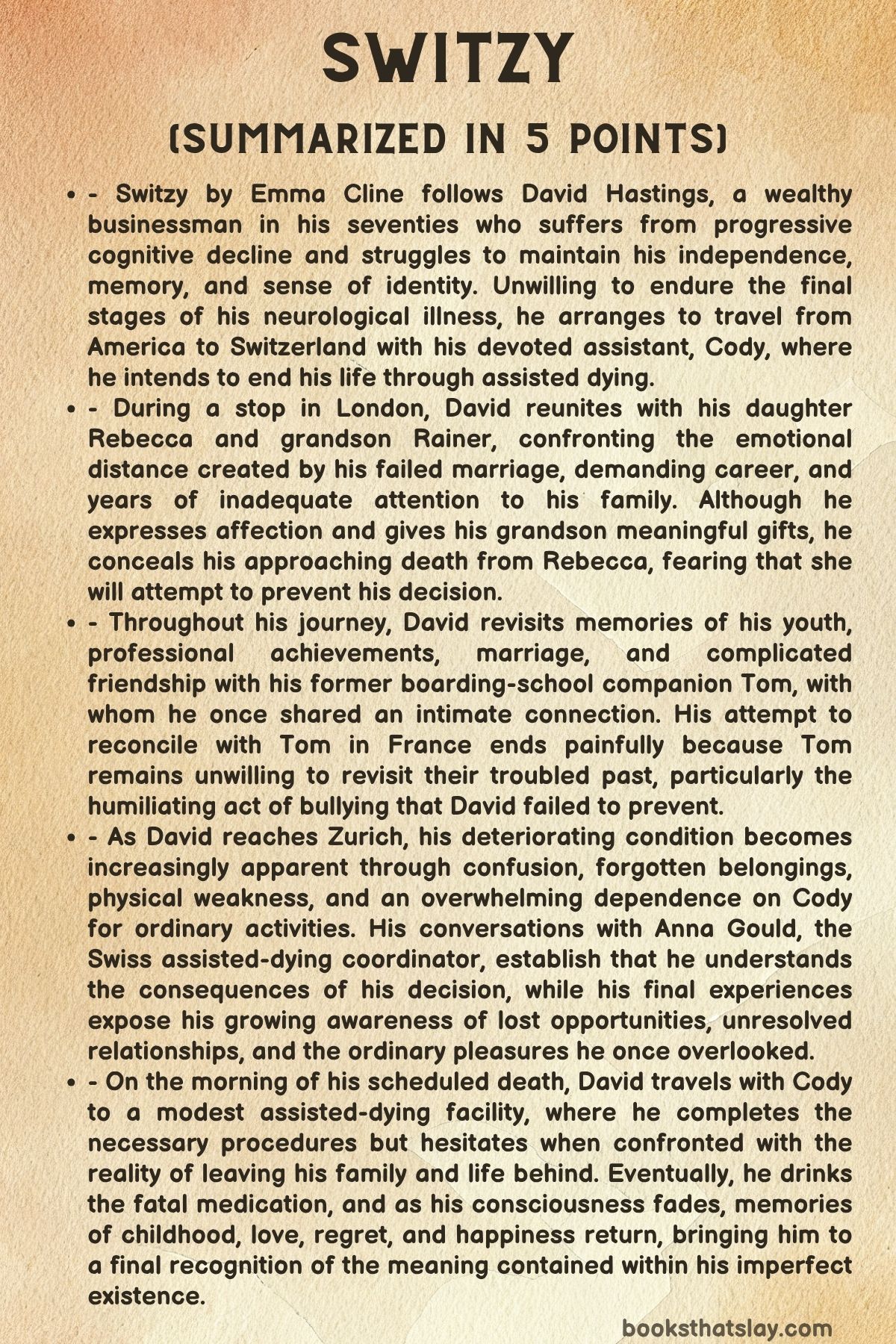
The story follows David Hastings, a wealthy elderly businessman experiencing progressive cognitive decline, as he travels from America to Switzerland to end his life through assisted dying. Along the way, David revisits the relationships, accomplishments, betrayals, and emotional failures that have shaped his existence. Through his increasingly unreliable perception, the novel explores the connection between memory and personal identity, the limitations of wealth, and the complicated relationship between the desire for control and the instinct to survive.
Summary
David Hastings is a wealthy American businessman in his seventies whose once-successful life has been transformed by a degenerative neurological disease. Having spent decades navigating the demanding world of finance, David now struggles to remember basic information, recognize familiar surroundings, and perform ordinary tasks without assistance.
He travels aboard a luxurious private jet belonging to Stearns, a longtime business associate, accompanied by his devoted assistant, Cody. Their destination is Switzerland, where David has arranged to end his life through an assisted-dying organization before his cognitive abilities deteriorate further.
David’s decision emerges from his growing awareness that his condition cannot be reversed. Although expensive medical examinations and treatments once gave him confidence in his ability to manage his health, the diagnosis has exposed the limitations of money, professional influence, and modern medicine.
His illness has already ended his career. After increasingly embarrassing mistakes undermined his professional standing, he lost his position, and even the alternative employment offered by Stearns eventually became impossible.
During the flight, David repeatedly consults a leather notebook containing reminders, instructions, and information that he can no longer reliably retain. Cody manages his appointments, travel arrangements, and personal needs, allowing David to maintain some appearance of independence despite his increasing helplessness.
The journey includes a stop in London, where David intends to visit his daughter, Rebecca, before continuing to Zurich. Rebecca moved to England years earlier, married an Englishman named Geoff, and established a family life that David knows surprisingly little about.
Their relationship has suffered from decades of emotional distance. David remembers his unsuccessful marriage to Rebecca’s mother, Annabel, their eventual divorce, and his attempts to compensate for his absence through expensive presents and carefully arranged outings.
After arriving in London, David struggles with the airport, transportation, and hotel arrangements. Cody repeatedly intervenes when unfamiliar procedures or unexpected complications overwhelm him, demonstrating how thoroughly the balance of power between employer and assistant has changed.
David also reflects on the administrative preparations for his death. Anna Gould, the Swiss coordinator responsible for evaluating his request, has required medical documentation, identification, and a written statement explaining why he wishes to proceed.
Composing the statement proved nearly impossible because David could no longer organize his thoughts and language consistently. Cody helped him complete it, just as he has assumed increasing responsibility for the practical and legal arrangements surrounding David’s final days.
David has granted Cody substantial authority over his affairs, including power of attorney and medical decision-making responsibilities. He suspects that his assistant may have taken money from him, but his dependence and gratitude complicate his response to this possible dishonesty.
At their London hotel, David becomes increasingly conscious of his diminishing physical abilities. Bathing, shaving, dressing, and even tying his shoes have become sources of anxiety or humiliation, reminding him that his body is no longer reliably under his control.
He remembers his honeymoon with Annabel, when their marriage was already marked by awkwardness and emotional uncertainty. Other recollections take him back to boarding school, early employment, and the social expectations that shaped his ambitions.
One memory concerns a humiliating neurological examination in which David failed to recall three simple words and could not correctly draw a clock. These failures demonstrated the severity of his illness more clearly than any medical explanation.
David meets Rebecca for dinner at an exclusive London club. She notices signs of his declining health, but he deliberately conceals the seriousness of his condition and presents his journey as a professional engagement.
Their conversation reveals affection constrained by years of misunderstanding. Rebecca has previously encouraged her father to try supplements and alternative treatments, while David has privately concluded that such measures cannot change his future.
He has arranged for her to receive an explanatory email after his death. Although he recognizes the pain his decision may cause, he fears that informing her beforehand would lead to attempts to prevent him from proceeding.
Later that evening, unable to sleep, David wanders into the hotel bar and meets a woman named Radha. After he offers to pay for her drinks, she spends time talking with him and eventually helps him find his hotel room.
Radha appears interested in a sexual encounter, but David responds with detachment and confusion. While she bathes in his room, his thoughts drift toward former relationships, youthful experiences, and the emotional consequences of intimacy.
The following day, Cody takes David to an art museum. Paintings and familiar spaces bring back memories of his marriage and his old school friend Tom, whose intelligence and artistic interests once fascinated him.
David’s deteriorating perception makes the visit unsettling. He becomes distracted by isolated details, forgets what he intended to write in his notebook, and struggles to recall an acquaintance whose email Cody reads aloud.
The connection between David and Tom becomes increasingly significant as the journey continues. Their friendship began during adolescence, when Tom’s intellectual confidence and sensitivity offered David companionship during a difficult period of his upbringing.
David also visits Rebecca’s home, where he meets Geoff and spends time with his nine-year-old grandson, Rainer. The boy’s musical talent impresses him and brings back memories of Rebecca’s childhood piano lessons.
When Rainer plays music associated with Mahler’s Ninth Symphony, David is moved by its suggestion of farewell. Eventually, however, the emotional intensity becomes unbearable, and he asks his grandson to stop.
David considers telling Rainer about his approaching death but cannot bring himself to do so. Instead, he gives the boy his watch, leaving behind an object that may preserve some connection between them.
Before departing, David tells Rebecca that he loves her. She remains concerned about his condition, but he continues withholding the truth about Switzerland.
An unexpected return to Rebecca’s house to retrieve his missing telephone exposes David to a private situation involving a woman named Lauren. He senses that something complicated is happening in his daughter’s life but cannot fully understand it.
The experience reinforces a painful realization: despite being Rebecca’s father, David knows relatively little about her adult existence. His approaching death will permanently close the possibility of repairing some of the distance between them.
David and Cody continue to Zurich, where the approaching assisted-dying procedure makes every ordinary experience seem charged with significance. During the flight, David remembers an intimate encounter with Tom during their school years, a memory connected to feelings of affection, shame, and an unresolved betrayal.
Arriving in Switzerland, David imagines the immigration official as a representation of Death. Familiar activities such as passing through passport control, checking into a hotel, and eating dinner now seem like the final repetitions of routines he has performed throughout his adult life.
His meeting with Anna Gould becomes a decisive stage in the process. Anna interviews David privately, attempting to establish whether he understands the consequences of his decision and genuinely wishes to proceed.
Although David struggles to follow parts of their conversation, he explains his fear of experiencing further mental deterioration while remaining conscious of what is happening to him. Anna appears satisfied that he understands his circumstances, allowing the arrangements to move forward.
David spends time exploring Zurich and purchases an expensive illustrated antique book for Rainer. He also receives a telephone call from Stearns, and their affectionate conversation becomes an understated farewell between two men whose professional lives have long been connected.
His thoughts repeatedly return to Tom. Their youthful friendship deteriorated after their physical encounter, and David remembers how resentment and social pressure contributed to his participation in a cruel episode of bullying.
A group of schoolboys once restrained Tom, drove him into the woods, and terrorized him with a gun. David failed to protect his friend, and the humiliation effectively destroyed their relationship.
Determined to confront this history, David travels to France to visit Tom. The reunion initially seems impossible when Tom’s wife refuses to admit him, and David becomes so distressed that he falls and injures himself.
Eventually, Cody arranges a brief conversation between the former friends. David attempts to communicate his affection, regret, and approaching death, but Tom remains uncomfortable and cannot offer the reconciliation David desires.
Back in Zurich, David shares an elaborate dinner with Cody. He becomes unusually attentive to small details such as flowers, candlelight, food, and music, recognizing beauty in experiences that he previously treated as ordinary.
Later, he wanders outside alone and becomes lost near the waterfront. Unable to locate his telephone or notebook, he must ask a security guard for assistance.
Upon returning to the hotel, David finds Cody with his partner, Sam. Confused and suspicious, he accuses Sam of wearing one of his sweaters, creating an uncomfortable confrontation that reveals his increasing inability to distinguish evidence from fear.
That night, Cody helps David into bed. David reaches toward him for reassurance, and his confused memories seem to transform Cody momentarily into the comforting presence he once associated with Tom.
On the morning scheduled for his death, David awakens with a growing awareness that everything around him will continue after he disappears. The hotel room will be cleaned, his belongings removed, and another guest will eventually occupy the bed.
He prepares himself, eats little breakfast, and descends with Cody toward the waiting car. Their journey takes them through nearly deserted Zurich streets to an ordinary industrial park, where the assisted-dying facility is located.
The building’s unremarkable surroundings disappoint David, who had imagined something more ceremonious. Nevertheless, he recognizes that he still possesses the right to turn back and chooses to enter.
Inside, Anna and another woman guide him through the remaining paperwork and record his confirmation that he understands the consequences of taking the prescribed medication. David demonstrates that he knows the substance will cause his death.
He receives preliminary medication to prevent nausea, but the approaching final step brings an unexpected surge of emotion. David realizes that neither Rebecca nor Annabel is present, and he regrets the absence of the family relationships he never fully repaired.
When the waiting period expires, he hesitates and requests another dose of the preliminary medication, granting himself additional time. His hesitation exposes the tension between his carefully planned decision and the instinctive reluctance to surrender life.
Eventually, David announces that he is ready and drinks the bitter fatal solution. As the medication takes effect, his thoughts move rapidly through childhood, love, marriage, sexuality, professional success, parental failures, friendship, and the countless experiences that have defined him.
His final awareness is marked by tears, recollection, and a recognition that his life contained significance beyond the accomplishments he once considered essential. The novel ends as his consciousness fades, leaving the reader within his final experience rather than following the world he leaves behind.
Characters
David Hastings
David Hastings is the central character of Switzy, an elderly businessman whose progressive cognitive decline forces him to confront the disappearance of the independence and intellectual abilities that once defined his existence. His situation is especially painful because his professional identity was built around calculation, judgment, discipline, and the belief that difficult circumstances could be managed through careful planning.
David has spent much of his life accumulating wealth, maintaining social status, and satisfying the demanding expectations of the financial world. Yet his illness reveals how little protection these achievements provide against the gradual destruction of memory and personal autonomy.
His reliance on a leather notebook illustrates his desperate effort to maintain continuity between his former and present selves. Every forgotten appointment, unfamiliar location, or ordinary physical difficulty reminds him that the authority he once exercised over his environment is disappearing.
David is not portrayed as an entirely sympathetic or admirable figure. He can be arrogant, suspicious, emotionally evasive, and insensitive to the needs of others, particularly when his pride is threatened.
His relationships with Annabel and Rebecca expose the consequences of his emotional limitations. He understands that he has often substituted financial generosity for affection, but recognizing these mistakes late in life does not automatically give him the ability to repair them.
His memories of Tom reveal another dimension of his personality. David once experienced genuine intimacy and attachment, but his fear of vulnerability contributed to a betrayal that continued troubling him for decades.
His behavior toward Cody further exposes his contradictions. He depends on the younger man almost completely while occasionally resenting that dependence and suspecting him of dishonesty.
The decision to pursue assisted dying represents David’s final attempt to exercise authority over his circumstances. He wants to determine the manner of his death before his illness deprives him of the capacity to make that choice.
However, his hesitation inside the Swiss facility demonstrates that intellectual determination cannot entirely overcome emotional attachment or the instinct to remain alive. By the conclusion, David emerges as a deeply imperfect individual who discovers, almost too late, that the experiences he overlooked may have been as meaningful as the achievements he spent his life pursuing.
Cody
Cody is one of the most significant supporting characters in Switzy, functioning as David’s assistant, caretaker, organizer, and closest companion during his final journey. His calm efficiency makes David’s complicated international travel possible despite the older man’s increasing confusion and physical vulnerability.
Cody handles transportation, hotel arrangements, appointments, paperwork, and countless small emergencies. He also anticipates David’s needs, often intervening before a minor problem becomes a humiliating or dangerous experience.
Their relationship is complicated by an unequal distribution of financial power and practical responsibility. David remains Cody’s wealthy employer, but Cody possesses the competence and information necessary to manage almost every part of his employer’s life.
David suspects that Cody has taken money from him, introducing uncertainty about the younger man’s motives. Nevertheless, Cody’s continued attentiveness suggests that their relationship cannot be understood simply as exploitation or professional obligation.
Cody’s relationship with Sam also establishes that he possesses an independent emotional life beyond his responsibilities to David. The confrontation involving Sam’s sweater shows how David’s suspicions can disrupt the private relationships of those caring for him.
Cody’s importance becomes especially apparent during David’s unsuccessful reunion with Tom and the final assisted-dying procedure. He provides practical and emotional support without attempting to replace David’s decisions with his own.
His character represents the demanding responsibilities of caregiving, particularly when affection, financial interests, exhaustion, and personal freedom exist within the same relationship.
Tom
Tom occupies a central emotional position in Switzy, even though he appears directly only toward the end of David’s journey. As David’s former boarding-school friend, he represents youthful intimacy, intellectual admiration, vulnerability, and the lasting consequences of betrayal.
During their adolescence, Tom possessed an understanding of literature, philosophy, music, and art that fascinated David. His intelligence offered an alternative to the competitive social environment in which David struggled to establish himself.
Their friendship also contained a physical intimacy that neither boy openly addressed afterward. This experience created an emotional complication that David never fully understood or resolved.
Tom’s subsequent withdrawal appears to have intensified David’s insecurity. Rather than responding with honesty, David allowed resentment and the pressures of masculine conformity to damage their relationship.
The cruel incident in which other boys restrained and terrorized Tom became a defining betrayal. David’s failure to intervene demonstrated the weakness of his loyalty when defending Tom required courage.
Tom’s adult life remains largely beyond David’s knowledge, emphasizing how completely their paths separated. When David finally visits him in France, he discovers that the emotional significance of their shared past does not guarantee a willingness to reconnect.
Tom’s refusal to provide the reconciliation David seeks is crucial to his characterization. He retains the right to determine his own relationship with the past, regardless of David’s approaching death.
Through Tom, the novel illustrates that regret does not automatically produce forgiveness and that certain injuries cannot be repaired merely because the person responsible finally recognizes their seriousness.
Rebecca
Rebecca is David’s daughter and one of the most emotionally important figures in Switzy, representing the family relationship that David repeatedly failed to nurture when he had the opportunity. Her childhood was shaped by her parents’ unhappy marriage, their divorce, and her father’s difficulty expressing affection.
As an adult, Rebecca has established a life in England with her husband, Geoff, and their son, Rainer. Her geographic separation from David reflects an emotional distance that developed over many years.
Despite this distance, Rebecca demonstrates concern for her father’s health. Her attempts to introduce him to supplements and possible treatments suggest a desire to protect him, even when she does not fully understand the seriousness of his illness.
Rebecca’s outward competence contrasts with David’s increasing helplessness. During their dinner, she helps him navigate practical difficulties, revealing how the traditional relationship between parent and child has begun to reverse.
Her own domestic life contains complexities that David only partially perceives. The unexpected encounter involving Lauren suggests that Rebecca has concerns, relationships, and experiences beyond her father’s understanding.
David’s decision to conceal his assisted-dying plans deprives Rebecca of the opportunity to participate in his final decision or say goodbye. Although he believes he is protecting his autonomy, his secrecy also repeats the emotional avoidance that has characterized their relationship.
Rebecca therefore represents both the possibility of familial connection and the consequences of opportunities that have been allowed to disappear.
Annabel
Annabel is David’s former wife and an important presence throughout his recollections. Although their marriage ended long before the events of the novel, memories of their relationship repeatedly return as David evaluates the emotional failures of his life.
Their honeymoon already revealed difficulties in communication and emotional compatibility. The young couple struggled to establish genuine closeness, suggesting that the weaknesses of their marriage existed well before its eventual collapse.
Annabel’s character emerges primarily through David’s memories, which means that her independent perspective remains largely unavailable. Nevertheless, her remembered habits, preferences, and responses reveal the significance of ordinary domestic experiences that David once neglected.
Her fondness for flowers becomes particularly meaningful when David notices floral decorations during his final dinner in Zurich. His attention to such details suggests a belated appreciation of the pleasures and emotional gestures he previously undervalued.
As Rebecca’s mother, Annabel also remains connected to David’s regrets concerning parenthood and divorce. Their unsuccessful marriage created consequences extending beyond their relationship as husband and wife.
David’s wish that Annabel might be present during his death reveals that emotional connections can survive the dissolution of a marriage. She represents a form of familiarity and belonging that his wealth cannot recreate.
Stearns
Stearns is David’s longtime business associate and an important representative of his former professional world. Their relationship developed through shared financial interests, business experiences, and the privileged lifestyle associated with substantial wealth.
Stearns’s private aircraft enables David’s final international journey, demonstrating that the resources of his former career remain available even after his illness has deprived him of professional authority. His earlier willingness to offer David alternative employment also suggests a degree of personal loyalty.
At the same time, Stearns represents a world that David can no longer meaningfully inhabit. The professional confidence, social arrangements, and shared ambitions that once united them have become inaccessible to him.
Their telephone conversation in Zurich acquires significance because both men express affection without making the approaching separation excessively dramatic. The exchange shows that genuine emotional attachment can exist beneath relationships initially defined by business.
Stearns functions as a reminder of David’s earlier successes, but he also reveals the inability of professional accomplishments to protect a person from illness and mortality.
Anna Gould
Anna Gould is the Swiss assisted-dying coordinator whose professional responsibilities make her essential to the final stages of Switzy. She must determine whether David possesses sufficient understanding and independence of judgment to proceed with his decision.
Anna approaches her responsibilities with calmness, patience, and procedural discipline. Her manner creates an unusual contrast between the extraordinary consequence of the appointment and the ordinary formality of a professional consultation.
During their meeting, she initially discusses familiar subjects such as Zurich’s architecture, climate, and public spaces. This conversation allows her to observe David’s responses while establishing an atmosphere in which he may feel comfortable speaking.
She eventually asks more direct questions about his reasons for seeking death and the practical arrangements surrounding the procedure. David’s difficulty following the conversation makes her evaluation especially important.
Anna recognizes the particular suffering associated with anticipating further cognitive decline. Her apparent understanding of David’s explanation enables the process to advance without presenting his decision as an impulsive response to temporary distress.
At the facility, she ensures that David understands the medication’s consequences and reminds him that he retains the right to withdraw. Her character represents the intersection of compassion, professional accountability, and personal autonomy in decisions concerning the end of life.
Rainer
Rainer is David’s nine-year-old grandson and the child of Rebecca and Geoff. His presence introduces a younger generation into a narrative otherwise dominated by memories of aging, loss, and approaching death.
Rainer’s musical ability particularly interests David. Their discussion of music and his performance of Mahler reveal how artistic experiences can create a connection between people separated by considerable differences in age and understanding.
For David, the music becomes associated with farewell and the knowledge that his own life is nearly over. Rainer, however, remains largely unaware of the personal significance his grandfather attaches to the performance.
David’s decision to give Rainer his watch demonstrates his desire to leave a tangible inheritance. The gift expresses affection without requiring the difficult explanation of his impending death.
The later purchase of an antique illustrated book continues this impulse toward remembrance. Rainer represents the future that will proceed without David and the possibility that some part of an individual’s presence may survive through objects, relationships, and memories.
Radha
Radha is a woman David meets in the bar of his London hotel. Their encounter begins when David offers to pay for drinks and develops into an unexpected evening that reveals his loneliness, confusion, and changing relationship with physical intimacy.
Radha appears sociable, confident, and comfortable discussing contemporary experiences such as travel and technology. Her familiarity with a changing world contrasts with David’s growing inability to understand modern conventions.
When she accompanies him upstairs, she seems to anticipate a romantic or sexual encounter. David, however, experiences her presence primarily as a source of practical assistance and temporary companionship.
Her extended stay in his bathtub becomes an awkward illustration of their mismatched expectations. While she apparently seeks intimacy, David withdraws into memories of former relationships and unresolved emotional experiences.
Radha’s character highlights the difficulty David experiences in responding to situations that would once have seemed familiar. Their encounter also emphasizes the distinction between physical proximity and meaningful emotional connection.
Sam
Sam is Cody’s partner, and his appearance in Zurich introduces an important complication into David’s relationship with his assistant. Although Sam appears only briefly, his presence reveals that Cody possesses personal attachments and responsibilities independent of his employment.
Sam treats David with warmth and expresses appreciation for the influence he has had on Cody. This behavior suggests that Cody’s professional relationship with David has affected his private life in significant ways.
The encounter deteriorates when David becomes convinced that Sam is wearing one of his sweaters. David’s accusation transforms an ordinary social meeting into a humiliating confrontation.
Sam eventually removes the sweater at Cody’s request, demonstrating how the demands of caring for David can interfere with Cody’s personal relationships. The incident leaves uncertain how much of David’s suspicion is justified and how much emerges from his illness.
Sam represents the people indirectly affected by David’s deterioration, especially those whose relationships with caregivers require patience and compromise.
Geoff
Geoff is Rebecca’s English husband and Rainer’s father. He belongs to the family environment that Rebecca has established outside David’s immediate influence.
His presence emphasizes the independence of Rebecca’s adult life. She has developed a household, marriage, and parental identity that David can observe but does not entirely understand.
Geoff remains a relatively understated figure, largely because the narrative is filtered through David’s limited perceptions. His role is less concerned with individual conflict than with establishing the domestic world from which David has become emotionally distant.
The comfortable household associated with Geoff and Rebecca also contrasts with David’s increasingly unstable existence. It represents continuity, routine, and the ordinary responsibilities of a younger family.
Freddie
Freddie is one of the boys involved in the traumatic incident that destroyed David’s friendship with Tom. His behavior illustrates the cruelty and social intimidation operating within the boarding-school environment.
During the nighttime attack, Freddie fires a gun, terrifying Tom and intensifying his humiliation. The act transforms what the boys treat as a prank into an episode of serious psychological cruelty.
Freddie represents a form of aggressive masculinity that relies on domination and the public humiliation of vulnerable individuals. His willingness to escalate the incident also exposes the danger of group behavior when participants abandon personal responsibility.
His importance lies in the lasting consequences of his actions. Decades later, David continues remembering the incident, particularly his own failure to prevent it.
Tom’s Wife
Tom’s wife appears during David’s attempted visit to France. She responds to his arrival with visible discomfort and initially refuses to allow him access to her husband.
Her protective behavior suggests an awareness that David’s presence may cause distress. Although the full extent of her knowledge is unclear, she recognizes that the unexpected reunion is not a simple meeting between old friends.
Her resistance challenges David’s assumption that his approaching death entitles him to immediate attention or emotional reconciliation. She represents the boundaries established around Tom’s adult life, a life that David has not shared for many decades.
By attempting to control the encounter, she also emphasizes the difference between David’s urgent desire for closure and Tom’s right to preserve his emotional distance.
Lauren
Lauren is a woman whom David unexpectedly encounters when he returns to Rebecca’s home to retrieve his missing telephone. Her presence creates visible discomfort and suggests an aspect of Rebecca’s private life that David does not understand.
The disordered room and Rebecca’s reaction indicate that David has interrupted a situation with personal significance. However, his limited understanding prevents him from establishing its precise nature.
Lauren’s role is therefore closely associated with uncertainty and restricted perception. She reminds the reader that David’s knowledge of other people’s lives is incomplete, regardless of his confidence in his own interpretations.
Her brief appearance also complicates David’s understanding of Rebecca, revealing that his daughter possesses an existence beyond the familiar categories through which he has traditionally viewed her.
Mark
Mark is David’s first employer and appears through recollections of his early professional development. His presence connects David’s present circumstances with the period when ambition, opportunity, and social advancement shaped his expectations.
The memories associated with Mark belong to a time when David was learning how to conduct himself within professional environments. They suggest how strongly he once depended on work to establish his identity and measure his personal success.
Although Mark remains a minor figure, he contributes to the contrast between David’s younger self and the elderly man who can no longer perform basic professional or personal tasks independently.
He represents the beginning of the career whose eventual loss becomes one of David’s most painful experiences.
Themes
Memory, Identity, and the Loss of Self
The relationship between memory and personal identity shapes nearly every aspect of Switzy. David’s neurological deterioration threatens more than his ability to remember facts, because his sense of individuality depends heavily on the experiences, achievements, and relationships that memory allows him to recognize.
His leather notebook becomes an external substitute for the mental continuity he is losing. By recording appointments, names, instructions, and personal information, he attempts to preserve a stable connection with the individual he once understood himself to be.
Yet written reminders cannot restore the emotional or intellectual associations that previously gave these details meaning. David may possess information about his schedule without understanding its context or recognize a familiar person without remembering the relationship that connects them.
His memories also expose the complicated nature of personal identity. Some recollections are vivid and emotionally powerful, while more recent experiences disappear almost immediately, creating an imbalance between the past and the present.
This condition gradually makes David a stranger within his own existence. His professional achievements remain part of his history, but he can no longer perform the activities through which those achievements once defined him.
The novel also suggests that memory is an imperfect foundation for understanding oneself. David remembers past events selectively, sometimes excusing his behavior and sometimes confronting uncomfortable truths that he avoided for decades.
His final recollections gather experiences of affection, failure, desire, work, and ordinary happiness into an unstable sequence. As these memories fade, the story raises a difficult question about whether personal identity survives when the capacity to remember one’s life disappears.
Autonomy, Dignity, and the Right to Choose
David’s decision to pursue assisted dying emerges from his determination to maintain authority over his own existence. Having spent his adult life exercising judgment and managing difficult situations, he experiences dependence as an especially severe form of humiliation.
The gradual disappearance of his abilities makes ordinary activities threatening. He struggles to dress himself, navigate unfamiliar locations, recognize people, and complete tasks that previously required little conscious effort.
His fear extends beyond physical disability to the anticipated disappearance of his mental independence. David knows that continued deterioration may eventually make him incapable of understanding his circumstances or expressing a meaningful choice.
Switzerland therefore represents an opportunity to act before that capacity disappears. The elaborate administrative procedures initially seem frustrating, but they also establish that his decision must be voluntary, informed, and repeatedly confirmed.
Anna Gould’s interviews demonstrate the difficulty of evaluating autonomy when an individual is experiencing cognitive decline. David’s memory and language are unreliable, yet he can still articulate his fear of further deterioration and explain the consequences of the medication.
The story does not present his decision as entirely free from contradiction. David fears accidental injury, hesitates before taking the final medication, and discovers that his emotional attachment to life remains strong despite his determination.
His temporary postponement illustrates the distinction between making a decision in anticipation of death and confronting the immediate possibility of dying. The instinct for survival continues operating even when his intellectual reasoning supports the opposite course.
Through this uncertainty, the novel examines dignity as something more complicated than independence or control. David’s vulnerability does not erase his humanity, and his final choice remains inseparable from the fears, regrets, and emotional needs that have shaped his life.
Regret, Guilt, and the Limits of Reconciliation
The approaching end of David’s life forces him to reconsider relationships that he neglected or damaged over several decades. In Switzy, regret emerges not simply from harmful actions but also from the affection withheld, conversations avoided, and opportunities for understanding that were repeatedly postponed.
His marriage to Annabel illustrates the consequences of emotional distance. Although they shared important years and raised a daughter together, David remembers how difficult they found it to communicate and how often he failed to recognize the significance of ordinary intimacy.
His relationship with Rebecca continues this pattern. Expensive gifts and occasional family outings could not replace consistent attention, and his eventual recognition of this failure arrives when their remaining time together is extremely limited.
David’s secrecy concerning his approaching death becomes another expression of the same difficulty. He wishes to protect his decision from interference, but doing so denies Rebecca the opportunity to understand his intentions or participate in his final days.
The memories involving Tom expose an even more painful form of regret. Their youthful friendship contained affection and vulnerability, yet David failed to defend Tom when other boys subjected him to a terrifying humiliation.
David’s final attempt to reconnect arises from a desire to confront this unresolved history. However, his expectations are shaped by his own emotional urgency rather than by an understanding of Tom’s possible feelings.
The unsuccessful reunion demonstrates that reconciliation cannot be demanded from someone who has suffered harm. Tom’s refusal to provide comfort preserves his independence and acknowledges that the consequences of betrayal can survive for decades.
The novel ultimately distinguishes regret from redemption. David’s recognition of his failures is meaningful, but it cannot restore lost years or guarantee forgiveness from the people he hurt.
Mortality, Wealth, and the Meaning of an Ordinary Life
David’s considerable wealth has provided comfort, influence, professional recognition, and access to exceptional medical resources. As death approaches, however, he discovers that financial power cannot prevent the deterioration of his mind or resolve the emotional difficulties he has carried throughout his life.
His luxurious surroundings create a powerful contrast with his helplessness. Private aircraft, prestigious hotels, expensive restaurants, and carefully managed transportation cannot eliminate the vulnerability of a man who sometimes cannot remember where he is.
The institutions surrounding his final journey also reveal how society organizes even the most personal experiences through payments, appointments, documentation, and professional services. David’s death becomes something extensively planned, yet its deepest emotional consequences remain beyond administrative control.
His increasing attention to ordinary objects and experiences suggests a transformation in his understanding of value. Flowers, music, food, birds, childhood memories, and the physical appearance of familiar places begin attracting an intensity of attention that professional accomplishments rarely received.
This sensitivity reveals how much of his earlier existence was consumed by ambition and social expectations. David once measured success through status and achievement, but his approaching death encourages him to recognize meaning in experiences that cannot be accumulated or possessed.
The hotel room he occupies before his death becomes a particularly effective symbol of impermanence. After he leaves, employees will clean the space, remove the evidence of his presence, and prepare it for another person.
The same principle extends to the world beyond the hotel. His daughter and grandson will continue living, Cody will regain freedom from his responsibilities, and the social structures that once seemed to revolve around David will continue functioning without him.
The novel does not reduce this realization to a statement that life is meaningless. Instead, David’s final awareness suggests that life’s significance may reside precisely in its temporary experiences, imperfect relationships, and ordinary moments of human connection.
His death marks the disappearance of one consciousness rather than the disappearance of the world. Through that distinction, the story presents mortality as both an unavoidable personal ending and a reason to reconsider what deserves attention while life remains.