Storm Caller Summary, Characters and Themes
Storm Caller by Nisha J. Tuli is a dystopian science-fiction romance that follows Poet Graves as she discovers the disturbing truth behind the powerful society that raised her.
Set in a world where dangerous storms shape civilization and people with extraordinary abilities are persecuted, the novel explores political corruption, forbidden knowledge, family relationships, and personal freedom. Poet’s growing relationship with Rook Athira introduces her to a civilization beyond New Manhattan and forces her to reconsider everything she once believed. As hidden experiments, government conspiracies, and military conflicts emerge, she must decide what she is willing to sacrifice to protect the people she loves. It’s the 2nd book in the Storm Breaker series.
Summary
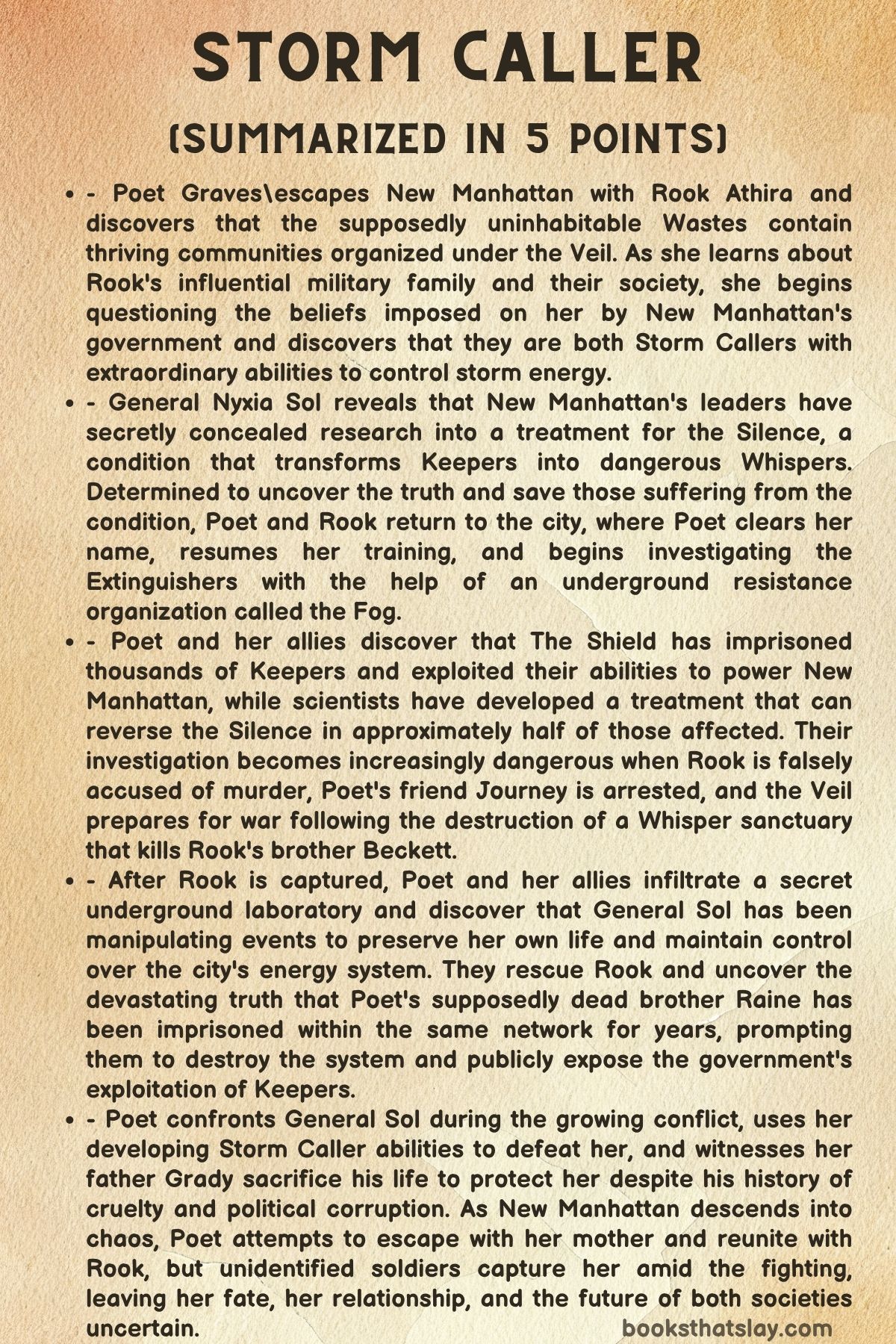
Poet Graves and Rook Athira escape New Manhattan only to find themselves surrounded by armed Solitudes in the supposedly uninhabitable Wastes. Rook is seriously injured, and their captors, led by a hostile young woman named Calliope, regard Poet with suspicion because of her privileged upbringing.
Although Rook demands that they be protected, Calliope knocks Poet unconscious before transporting them to a fortified settlement known as Station Five. When Poet awakens, she discovers a functioning community with electrical defenses, medical facilities, permanent buildings, and technology that contradicts everything she has been taught about life outside New Manhattan.
At Station Five, Poet meets Commander Fisher Sterling, whose resemblance to Rook immediately attracts her attention. Their hostile exchanges reveal that Fisher is Rook’s half brother and that Rook belongs to an influential military family, although he continues concealing important details about his mission.
Their temporary imprisonment is interrupted when a dangerous storm approaches and terrifying figures called Whispers attack the settlement. These individuals are Keepers afflicted by the Silence, a condition that causes them to lose control of their actions, but Poet is astonished to discover that the Solitudes try to capture rather than kill them.
When a Whisper attacks Poet, Rook kills it to save her life, violating his people’s laws against killing afflicted individuals. He subsequently explains that they are in Tiera Frais, a vast territory containing organized communities, independent settlements, and surviving cities, and reveals that they are both Storm Callers rather than ordinary Keepers.
Poet learns that Rook’s father, Summit Athira, commands the Veil, a powerful society that has resisted New Manhattan’s aggression for generations. Rook’s mother, Faroe, and several of his siblings also hold important positions within their community, making his true identity considerably more significant than Poet imagined.
The pair travel to Cloudspire, the Veil’s mountain headquarters, where Poet encounters fertile landscapes, advanced defenses, and a society organized around shared responsibility. Meeting Rook’s affectionate family challenges her understanding of both the Wastes and family relationships, although his secrecy continues to complicate their romance.
Summit questions Rook about his unauthorized activities and warns Poet that her connections to New Manhattan’s ruling elite make her a potential security threat. Rook explains that The Shield maintains its authority through social divisions, fear, and the exploitation of people both within and beyond the city’s borders.
As Poet explores Cloudspire, she begins appreciating the freedom and community that Rook has always valued. Their growing closeness is interrupted when Rook and Fisher must undergo public combat punishments, during which Summit severely injures Rook before General Nyxia Sol unexpectedly arrives.
Sol reveals that Poet and Rook are Storm Callers capable of interacting with galvanic storm energy in extraordinary ways. She explains that she possesses similar abilities and once researched the Silence alongside Dr. Philip Mowry, seeking a treatment for the condition that transforms Keepers into Whispers.
According to Sol, New Manhattan’s chancellors secretly possess a cure but refuse to release it because the persecution of Keepers strengthens their political authority. She proposes that Poet return to the city, clear her name, and infiltrate the Extinguishers through her former friend Trinity.
Despite the obvious danger, Poet and Rook accept the mission because a cure could save countless people, including members of Rook’s family. Before departing, Rook confesses his love for Poet, strengthening their relationship even as they prepare to enter hostile territory.
Their return to New Manhattan begins with a deliberately staged pursuit that ends in their capture by the Extinguishers. Poet is imprisoned at the Tempestade and subjected to a trial before The Shield, where testimony from her parents, teachers, scientific experts, and Trinity determines whether she will survive.
Dr. Ada Eze and Lieutenant Henry Crawford help explain Poet’s unusual reactions to galvanic energy, weakening the accusations against her. Although Trinity testifies about suspicious incidents from their time at Amery Academy, the evidence proves insufficient, and Sol eventually secures Poet’s release.
Reunited with Rook, Poet resumes her academy training while secretly investigating the Extinguishers. Her experiences outside the city have transformed her attitude toward New Manhattan’s social hierarchy, leaving her increasingly indifferent to the marriage expectations and status competitions that once controlled her life.
Sol begins training Poet and Rook to manipulate Spark, demonstrating how storm energy can be collected and transformed into a destructive force. Poet shows considerable potential, although she worries about the possibility that her abilities could eventually be used against the people of her former home.
Meanwhile, Poet attempts to restore her friendship with Trinity as part of their infiltration strategy. She discovers that her former friend remains closely associated with Captain Dire, an ambitious Extinguisher whose knowledge could provide access to restricted government facilities.
An unusually powerful storm strikes during a training exercise, and Poet risks exposing herself while attempting to save Henry from a devastating electrical discharge. After recovering, she discovers that Ada and Henry belong to the Fog, an underground resistance organization dedicated to protecting Keepers and challenging The Shield.
Poet and Rook join forces with the resistance and share their discoveries about the Veil, Sol, and the possible cure. Their investigation also focuses on Edward Chu, who disappeared after helping them obtain security footage connected to the mysterious fate of Poet’s brother Raine.
Using credentials stolen from Captain Dire, Poet, Rook, and Henry infiltrate the Tempestade and rescue Edward. His imprisonment has left him physically and emotionally damaged, but he reveals that he encountered information about a secret research facility connected to Dr. Mowry.
The resistance eventually locates Mowry, who confirms that he has been forced to continue researching the Silence under Chancellor Marks’s supervision. His experimental treatment can reverse the condition in approximately half of its recipients, proving that The Shield has deliberately concealed a potentially lifesaving scientific discovery.
While the investigation progresses, New Manhattan intensifies its persecution of suspected Keepers through mass testing. Journey is arrested despite Poet’s protests, and Rook is identified as infected, forcing him to escape while Poet is detained for interfering with the authorities.
The government soon brands Rook a dangerous fugitive responsible for several murders. Poet refuses to believe the accusations and secretly reunites with him, only to learn that the Veil has suffered a devastating attack on a Whisper sanctuary, killing more than a hundred people, including Rook’s brother Beckett.
Summit prepares military retaliation against New Manhattan, bringing the possibility of open war closer. Shortly afterward, Rook is captured, and Poet confronts Sol in desperation, only to be sedated and returned to her family’s residence.
As the Veil advances toward the city, Poet joins Rook’s siblings and the Fog in a renewed effort to find him. Mowry eventually reveals that Sol has been suffering from a condition resembling the Silence and has become desperate to discover a treatment using another Storm Caller’s abilities.
Poet’s father, Grady Graves, confirms that Sol is responsible for the murders attributed to Rook. He admits that he helped conceal her violent episodes because she threatened to expose Poet’s powers, revealing the extent of his involvement in the corruption surrounding her.
Forced to cooperate, Mowry leads the rescuers to a secret underground laboratory where thousands of imprisoned Keepers are connected to machinery supplying New Manhattan with electricity. The Extinguishers have been capturing these individuals not to protect the population, but to exploit their ability to absorb and channel storm energy.
The concealed cure has been used to prolong this exploitation, temporarily reversing the Silence so captives can continue generating power. Poet discovers Rook inside a containment tank, already being integrated into the network, and desperately works with the others to free him.
After a violent confrontation with Sol’s guards, they break his tank open and revive him. Their escape becomes even more traumatic when Poet discovers Raine suspended in another tank, revealing that her supposedly dead brother has been imprisoned and exploited for years.
Raine has been connected to the system too long for a realistic recovery, leaving Poet devastated by the knowledge that her own government destroyed his life. Rook finally severs the network’s electrical connections, shutting down New Manhattan’s power supply and allowing the rescuers to escape with classified research.
At the Fog’s headquarters, Poet broadcasts the truth to the city’s citizens, exposing the persecution of Keepers, the concealed cure, the existence of civilizations beyond New Manhattan, and the human exploitation supporting the city’s prosperity. Her public declaration challenges The Shield’s authority and transforms her into an open opponent of the political system that once protected her family.
Sol responds by taking several resistance members hostage and attempting to capture Poet as a replacement energy source. During the confrontation, Grady intervenes to protect his daughter, but Sol strikes him with a devastating electrical weapon.
Poet finally succeeds in concentrating Spark into a powerful sphere and uses it to incapacitate Sol. She then returns to her dying father’s side, where he admits his cruelty, acknowledges his failures, and apologizes for the suffering he inflicted on his family.
Although Poet cannot forgive everything he has done, she recognizes that he protected her abilities from discovery and sacrificed himself to save her. After his death, she refuses to kill the unconscious Sol, choosing instead to have her taken into custody.
With New Manhattan descending into chaos, Rook urges Poet to escape to the Veil. Poet returns home to collect her mother, who is devastated by Grady’s death and struggles to accept that the world she has always known is collapsing.
The two women head toward a meeting place near the city’s outskirts, where Poet hopes to reunite with Rook. However, powerful explosions devastate the surrounding battlefield, and unfamiliar armed forces suddenly appear among the fighting soldiers.
While searching desperately for Rook, Poet is captured by unidentified soldiers who are collecting prisoners from the conflict. Bound and forced into a transport vehicle, she is taken away without learning who her captors are or what they intend to do, leaving her relationship, her mother’s safety, and the future of New Manhattan unresolved.
Characters
Poet Graves
Poet Graves is the central protagonist of Storm Caller, and her transformation from a privileged young woman into a determined opponent of political oppression drives the novel. Raised within New Manhattan’s wealthy ruling society, she initially accepts many of the assumptions surrounding her upbringing, particularly the belief that Keepers are dangerous and civilization beyond the city is almost nonexistent.
Her escape with Rook forces her to confront an unfamiliar world where the supposed enemies of New Manhattan have established thriving communities. Through her experiences in Cloudspire, she recognizes that her education has been shaped by propaganda and that the privileges she once enjoyed were sustained by exploitation.
Poet’s character is also defined by her struggle with trust, particularly after discovering that Rook concealed his military identity and original mission. Although his deception hurts her, she gradually learns to evaluate people through their actions rather than their social positions or the information they choose to reveal.
Her relationship with her father adds considerable emotional complexity to her development. Having endured years of manipulation and intimidation, she struggles to reconcile his cruelty with the discovery that he secretly protected her from persecution.
As Poet learns to control her abilities as a Storm Caller, her growing confidence becomes inseparable from her moral independence. She eventually confronts The Shield publicly, rescues people endangered by its policies, and refuses to allow revenge to govern her decisions.
Rook Athira
Rook Athira is the principal romantic figure in Storm Caller and an important representative of the Veil’s military society. Initially introduced to Poet as an ordinary young man attending Amery Academy, he is revealed to be a highly trained officer and the son of High Commander Summit Athira.
His concealed identity creates considerable tension because his mission required him to mislead the woman he eventually falls in love with. Although his secrecy damages Poet’s confidence in him, his willingness to protect her repeatedly demonstrates the seriousness of his attachment.
Rook’s personality combines exceptional combat ability with compassion and a strong sense of responsibility. His determination to protect afflicted Keepers, even when they become violent, reflects the values of the society that raised him.
His relationship with his father reveals another side of his character, particularly his willingness to accept punishment for killing a Whisper despite having acted in Poet’s defense. His grief over Beckett’s death also demonstrates that his commitment to finding a cure is deeply personal.
Throughout the novel, Rook must balance his loyalty to the Veil with his love for someone raised within the opposing civilization. His emotional development becomes especially visible when he openly expresses his love and imagines building a peaceful future with Poet.
General Nyxia Sol
General Nyxia Sol is one of the novel’s most influential and morally disturbing characters, initially presenting herself as a protector whose scientific knowledge might save vulnerable Keepers. In Storm Caller, her apparent cooperation with Poet and Rook conceals a desperate effort to preserve her own life and political importance.
As the leader of New Manhattan’s Storm Guard, Sol possesses extraordinary authority and an unusual ability to control galvanic energy. Her status makes her indispensable to the city’s infrastructure while allowing her to conceal the darker purposes of its energy system.
Her earlier research with Dr. Mowry initially suggests genuine scientific ambition, but her decision to exploit other people reveals how thoroughly that ambition has become corrupted. As her condition deteriorates, she becomes increasingly willing to imprison, manipulate, and sacrifice innocent people.
The revelation that she committed the murders blamed on Rook establishes her as a dangerous figure whose public authority protects her from accountability. Her willingness to use Rook and Poet as energy sources further exposes her belief that individual lives are expendable when her survival is at stake.
Sol represents the destructive consequences of power without moral restraint. Her defeat comes when Poet refuses to become another instrument of her plans and demonstrates abilities that the general underestimated.
Grady Graves
Grady Graves, Poet’s father, is a politically influential man whose controlling behavior has profoundly affected his family. His obsession with authority, social status, and obedience creates an atmosphere in which Poet and her mother have learned to suppress their feelings.
His characterization becomes more complicated when Poet discovers that he knew about the unusual abilities possessed by both her and Raine. Despite his authoritarian behavior, he secretly protected his children from The Shield, revealing that his actions were not entirely governed by political ambition.
However, his protection is compromised by his willingness to participate in government corruption. He helps conceal Sol’s murders and suppress damaging evidence, allowing innocent people to suffer because he fears the consequences of defying her.
Grady’s final intervention demonstrates that he is capable of sacrificing himself for his daughter. His dying apology acknowledges the suffering he caused without erasing the damage inflicted throughout their relationship.
His death leaves Poet mourning both the father she knew and the loving parent she never truly experienced.
Poet’s Mother
Poet’s mother represents the emotional consequences of living under prolonged control within an outwardly prosperous household. Although she enjoys the material comforts associated with New Manhattan’s ruling class, her marriage to Grady has left her exhausted, isolated, and uncertain of her independence.
Poet initially interprets her mother’s passivity as weakness because she does not openly challenge her husband’s authority. Their later conversations reveal that enduring years of emotional mistreatment has required a different kind of strength.
Her concern for Poet remains genuine even when she cannot fully understand the dangers surrounding her daughter’s abilities. She wants Poet to experience the affection, freedom, and security that have been absent from her own marriage.
Grady’s death and the collapse of New Manhattan’s political order leave her profoundly disoriented. Her eventual departure with Poet represents the possibility of escaping a life defined by fear, even though the journey ahead remains uncertain.
Raine Graves
Raine Graves is Poet’s missing brother, whose supposed death profoundly influences her decisions throughout the novel. Although he is absent from much of the immediate action, the mystery surrounding his disappearance becomes central to the investigation into New Manhattan’s government.
Poet remembers Raine as someone she loved and trusted, making the uncertainty surrounding his fate particularly painful. As she discovers his connections to the resistance and his unusual storm-related abilities, she realizes that he understood more about their society than she previously knew.
The revelation that Sol removed Raine from the scene of his supposed death changes Poet’s understanding of her family history. Her eventual discovery of him inside the underground energy network exposes the devastating human consequences of The Shield’s policies.
Raine becomes a symbol of stolen freedom and the personal suffering hidden beneath the city’s prosperity. His condition demonstrates that government persecution can destroy lives while leaving families trapped in uncertainty for years.
Fisher Sterling
Fisher Sterling is Rook’s half brother and a commander within the Veil, whose initially hostile behavior reflects both military suspicion and unresolved family tensions. His competitive relationship with Rook developed during childhood, when both brothers struggled for their father’s recognition.
Fisher’s suspicion of Poet is understandable from the perspective of someone responsible for protecting a community threatened by New Manhattan. However, his resentment sometimes prevents him from recognizing the importance of Rook’s personal relationships and decisions.
His public punishment demonstrates that his military status does not exempt him from the Veil’s disciplinary system. Despite disagreements with Rook, Fisher eventually helps organize the effort to rescue him, revealing that family loyalty remains important beneath their rivalry.
Summit Athira
Summit Athira is the High Commander of the Veil and the father of Rook, Navy, Justin, and Beckett. His leadership is characterized by discipline, strategic thinking, and an uncompromising commitment to protecting communities threatened by New Manhattan.
Summit’s relationship with Rook is particularly important because he treats his son as a military officer subject to the same laws as other soldiers. His willingness to punish Rook physically reveals the severity of the Veil’s traditions and raises questions about the relationship between justice and brutality.
Although Summit initially distrusts Poet, he gradually recognizes the significance of her abilities and her relationship with his son. The destruction of the Whisper sanctuary and Beckett’s death expose the limitations of his restraint, leading him toward military retaliation.
His character demonstrates how leadership can become morally difficult when protecting one’s people requires decisions that may endanger others.
Faroe Athira
Faroe Athira is Rook’s mother and a senior military strategist whose authority is accompanied by considerable affection for her family. Her warmth toward her children provides Poet with a striking contrast to the emotionally restrictive household in which she was raised.
Faroe’s position within the Veil establishes her as more than a supporting family figure. She contributes to the community’s military organization while also helping maintain the personal relationships that give its members a sense of belonging.
Her willingness to arrange accommodations for Poet suggests a capacity for hospitality despite the political dangers associated with welcoming someone from New Manhattan. Faroe represents a form of authority that combines professional responsibility with emotional generosity.
Navy Athira
Navy Athira is Rook’s outspoken younger sister, whose confidence and willingness to tease Poet introduce warmth into the tense atmosphere surrounding Cloudspire. She quickly recognizes the romantic attachment between Poet and Rook and openly comments on their feelings.
Her playful behavior exists alongside genuine courage and loyalty. When Rook disappears, Navy participates in the effort to locate him and confronts the dangers surrounding the secret research facility.
The possibility that a cure could help members of her family also places her within the novel’s larger examination of the Silence. Her experiences show how the condition affects entire families, even when its immediate victims are not always visible.
Justin Athira
Justin Athira is Rook’s youngest brother, distinguished by his friendliness, compassion, and willingness to help people who are frightened or unfamiliar with the Veil. His welcoming treatment of Poet makes her adjustment to Cloudspire easier.
Unlike some of his relatives, Justin rarely approaches Poet with immediate hostility or suspicion. His behavior reveals the supportive family environment that Rook values and wishes to preserve.
Justin also demonstrates courage during the rescue operation at the hidden laboratory. His participation in the effort to free Rook shows that his gentle personality does not prevent him from acting decisively when someone he loves is endangered.
Beckett Athira
Beckett Athira is Rook’s brother and one of the tragic figures associated with the Silence. His condition gives the search for a cure deeply personal significance for Rook and the wider Athira family.
Although Beckett does not receive the same direct attention as his siblings, his circumstances influence their understanding of Keepers and their opposition to New Manhattan’s policies. He represents individuals who have lost control of their abilities but remain deserving of care and protection.
His death during the destruction of a Whisper sanctuary becomes a turning point in the conflict between the Veil and The Shield. The loss devastates Rook and strengthens Summit’s determination to retaliate.
Calliope
Calliope is a fierce Solitude soldier whose initial treatment of Poet is openly hostile and often humiliating. Her use of the insult “Crust” reflects the resentment that many people in the Wastes feel toward New Manhattan’s wealthy population.
She appears deeply committed to the safety of her community and unwilling to trust someone associated with the society responsible for generations of aggression. Her confrontational personality also reveals the cultural divisions that Poet must overcome.
Although Calliope initially treats Poet as a possible enemy, she later participates in the dangerous effort to rescue Rook. Her actions demonstrate that loyalty to her companions and community can take priority over personal dislike.
Trinity
Trinity is one of the most significant examples of betrayal in Storm Caller, having once occupied an important place in Poet’s life as her close friend. Her decision to accuse Poet of being a Keeper destroys their relationship and places Poet in immediate danger.
Trinity justifies her actions by claiming that Poet’s unusual behavior frightened her and that she believed reporting her suspicions was necessary. However, her testimony and later conversations expose jealousy, resentment, and insecurity beneath the surface of their friendship.
Her association with the Extinguishers strengthens her willingness to accept their ideology. Her participation in guarding the facility where Edward is imprisoned makes her betrayal particularly disturbing because she becomes directly involved in the persecution Poet is trying to expose.
Trinity illustrates how fear and personal ambition can transform relationships into instruments of political control.
Dr. Ada Eze
Dr. Ada Eze is an important scientific and moral figure in Storm Caller, representing the possibility of using specialized knowledge to protect rather than exploit vulnerable people. Although she works within New Manhattan’s medical and educational institutions, she secretly belongs to the Fog.
Her involvement in protecting Keepers demonstrates considerable courage because discovery would threaten both her career and her life. She helps establish safe houses, coordinate rescue operations, and challenge the official claims used to justify persecution.
Ada’s caution is also an important aspect of her personality. She sometimes makes difficult decisions, including restricting Dr. Mowry’s freedom, because she fears that misplaced trust could destroy the resistance.
Her character emphasizes the responsibility that accompanies scientific expertise. Unlike Sol, she recognizes that medical knowledge should serve human welfare rather than political domination.
Lieutenant Henry Crawford
Lieutenant Henry Crawford is a Storm Guard trainer whose relationship with Poet extends beyond his official responsibilities at Amery Academy. His familiarity with Raine and his understanding of unusual storm-related abilities suggest that he has long been aware of secrets hidden by The Shield.
Henry’s involvement with the Fog reveals his commitment to protecting vulnerable individuals while operating inside the institutions responsible for their persecution. His professional position allows him to support the resistance without immediately attracting suspicion.
His conduct during the rescue of Edward and the investigation into the secret laboratory demonstrates considerable courage. Henry represents individuals who use their positions within compromised institutions to challenge injustice from the inside.
Edward Chu
Edward Chu is a technically gifted young man whose willingness to help Poet investigate Raine’s disappearance exposes him to extraordinary danger. His access to restricted information makes him valuable to the investigation, but it also attracts the attention of the authorities.
His imprisonment at the Tempestade subjects him to physical suffering and psychological pressure. Despite this treatment, Edward refuses to reveal information that could endanger Poet or others involved in the investigation.
His eventual rescue does not restore his former life because the government has already informed his mother that he is dead. Nevertheless, he remains determined to help the resistance uncover the concealed research.
Edward’s courage emerges from his willingness to accept responsibility for difficult choices. His technical expertise becomes essential in locating evidence and helping Poet expose the government’s crimes.
Domino
Domino is one of Poet’s closest friends and an important source of emotional support during her return to New Manhattan. Unlike individuals who abandon Poet after she becomes politically vulnerable, Domino continues treating her with affection and loyalty.
Her willingness to accept the truth about Poet’s abilities demonstrates independence from the prejudices encouraged by The Shield. She recognizes that personal experience and genuine friendship are more reliable than government accusations.
Domino also takes an active role in the resistance’s operations, including the scheme to obtain Captain Dire’s security credentials. Her concern for Journey after the mass arrests reveals how deeply she values her relationships.
Through Domino, the novel presents friendship as a source of courage and stability during political uncertainty.
Journey
Journey is another of Poet’s close friends, whose loyalty becomes particularly important after Poet’s true nature is revealed. Although she has been raised in a society that teaches citizens to fear Keepers, she refuses to abandon Poet because of her abilities.
Her participation in the group’s plans demonstrates that she is willing to accept considerable personal risk for the people she cares about. However, her own arrest during the mass testing operation exposes the arbitrary nature of New Manhattan’s accusations.
Journey becomes a victim of the same persecution that Poet has struggled to escape. Her detention reinforces the understanding that no one is truly safe within a system where government authorities can declare individuals dangerous without meaningful evidence.
Dr. Philip Mowry
Dr. Philip Mowry is a scientist whose research lies at the center of New Manhattan’s concealed medical and technological activities. His early partnership with General Sol was connected to the search for a treatment for the Silence, but political interference eventually transformed his work into an instrument of exploitation.
Mowry’s position is morally complicated because he is both a victim of coercion and a participant in terrible experiments. Chancellor Marks threatens his family to secure his obedience, leaving him trapped inside a research program he cannot freely abandon.
His discoveries demonstrate that the Silence can sometimes be reversed, but his continued involvement in the energy network implicates him in the suffering of imprisoned Keepers. His character raises difficult questions about personal responsibility when scientific work is conducted under threats and political control.
Captain Dire
Captain Dire is an ambitious Extinguisher whose promotion reflects his position within New Manhattan’s persecutory security apparatus. His arrogance and eagerness to discuss his professional accomplishments reveal a man who takes considerable pride in the authority he exercises over suspected Keepers.
Dire’s relationship with Trinity provides Poet and Rook with an opportunity to infiltrate the organization. His susceptibility to flattery and alcohol eventually allows the resistance to steal his security credentials and rescue Edward.
His subsequent dismissal demonstrates how quickly individuals can become disposable within the authoritarian system they serve. Dire represents the ordinary officials whose ambition and obedience allow institutional cruelty to continue.
Knox
Knox is Poet’s former romantic partner, whose relationship with her was closely connected to New Manhattan’s expectations surrounding marriage, social position, and family advancement. Their unsuccessful engagement represents the restrictive future that Poet once believed she was expected to accept.
His presence becomes less emotionally significant as Poet develops a stronger relationship with Rook and gains independence from her upbringing. When Knox becomes engaged to Winter Jenkins, Poet realizes that she no longer envies the social position associated with their marriage.
Knox primarily serves as a reminder of Poet’s former priorities and the emotional limitations of relationships shaped by status rather than mutual understanding.
Winter Jenkins
Winter Jenkins is a socially ambitious young woman whose engagement to Knox reflects the competitive culture of New Manhattan’s privileged Houses. Her apparent satisfaction in displaying her engagement ring suggests that she hopes to provoke jealousy or embarrassment in Poet.
However, Poet’s lack of resentment undermines Winter’s attempt to establish superiority. The encounter reveals how little importance Poet now attaches to the social achievements that once dominated her life.
Winter’s character illustrates the continued influence of conventional expectations on individuals who have not experienced Poet’s transformation.
Chancellor Marks
Chancellor Marks is one of New Manhattan’s powerful political leaders and an important figure behind the secret scientific program. His decision to recruit Dr. Mowry demonstrates the government’s willingness to preserve useful research while concealing its discoveries from ordinary citizens.
Marks maintains control over Mowry through threats against his family, revealing a calculated willingness to exploit emotional vulnerability. His actions connect scientific progress directly to the coercive methods sustaining The Shield.
His character represents political authority that values technological advantage and institutional survival above ethical responsibility.
Chancellor Orsen
Chancellor Orsen is another powerful member of The Shield’s leadership and participates in the political system responsible for New Manhattan’s treatment of Keepers. His position places him among the authorities associated with the suppression of scientific knowledge and the preservation of rigid social divisions.
Although he receives less individual development than Marks or Sol, his importance lies in his role within the governing structure. He represents the collective responsibility of leaders who maintain oppressive policies while enjoying the security and authority those policies provide.
Cole
Cole is a Solitude associated with the settlement where Poet and Rook are initially detained. His familiarity with Rook helps establish that Rook has longstanding personal connections to the communities beyond New Manhattan.
Although Cole remains suspicious of Poet, his occasional friendliness contrasts with Calliope’s more aggressive behavior. His interactions contribute to Poet’s growing realization that the Solitudes are ordinary people with relationships, responsibilities, and distinct personalities.
Safira
Safira is another member of the Solitude community who helps supervise Poet and Rook during their early imprisonment. Her explanation of the derogatory term “Crust” introduces Poet to the resentment directed toward New Manhattan’s wealthy citizens.
Safira’s behavior reflects the cautious attitude of a population accustomed to exploitation and military threats. Through her, Poet begins recognizing that the hostility she encounters is rooted in a much larger history of conflict.
Vess
Vess is a medic who treats Rook’s injuries after the pair are captured in the Wastes. Her medical knowledge and access to advanced supplies contradict Poet’s assumptions that people outside New Manhattan lack sophisticated healthcare.
However, Vess refuses to treat Poet’s injury because of her origins, revealing the strength of the prejudices operating in both societies. Her character demonstrates that the Veil and surrounding communities are not free from hostility or moral contradictions.
Lieutenant General Rey
Lieutenant General Rey is a formidable military officer responsible for administering punishment during the public disciplinary proceedings at Cloudspire. Her combat abilities become evident when she overwhelms Fisher in a contest that initially appears relatively balanced.
Rey’s position reflects the Veil’s emphasis on discipline, physical strength, and accountability. Her participation in the punishment also raises questions about whether severe physical violence is a justifiable way to enforce military regulations.
Elena Chu
Elena Chu is Edward’s mother, whose suffering demonstrates the consequences of government deception for ordinary families. She is told that Edward died during the Blood Storm, while he is actually being held and mistreated by New Manhattan’s authorities.
When Poet visits her, Elena’s grief makes it painfully difficult for Poet to conceal the truth. Her affection for her son and the support she receives from relatives emphasize the human relationships destroyed by political persecution.
Elena represents families denied even the basic truth about what has happened to their loved ones.
Danica
Danica plays a significant role during Poet’s trial by offering an alternative explanation for the unusual physical reactions that Trinity presents as evidence of infection. Her scientific reasoning helps weaken the accusation against Poet.
Although her role is relatively limited, her testimony demonstrates how factual evidence can challenge assumptions encouraged by fear. She contributes to Poet’s release by showing that suspicious behavior does not automatically establish dangerous abilities.
Cara
Cara is the longtime housekeeper employed by Poet’s family, representing the familiar domestic environment Poet encounters when she returns home. Her presence recalls the routines and relationships of Poet’s childhood.
Her initial reaction to Rook also reveals the social prejudices embedded within New Manhattan’s privileged households. Poet’s determination to ensure that Rook is treated respectfully demonstrates how her experiences outside the city have changed her expectations.
Dean Withers
Dean Withers is an authority figure at Amery Academy who announces the implementation of widespread testing for suspected Keepers. The announcement transforms an educational gathering into an intimidating operation conducted by the Extinguishers and Patrol officers.
His role demonstrates how educational institutions can become instruments of political enforcement. The academy’s apparent willingness to accommodate the operation reveals the limited independence of organizations operating under The Shield.
Silver and Hazel
Silver and Hazel are students associated with the privileged social environment that once shaped Poet’s identity. Their behavior reflects the superficial friendships, gossip, and shifting loyalties common among members of New Manhattan’s influential Houses.
Their interactions with Poet after her return demonstrate how quickly social relationships change when a person’s status becomes uncertain. They help illustrate the difference between genuine friendship and connections maintained primarily for social advantage.
Jackson and Sal
Jackson and Sal belong to Poet’s wider circle at Amery Academy, where personal relationships become increasingly complicated after the events surrounding her exposure as a Keeper. Their presence reminds Poet of the conflicting loyalties and pressures that shaped her earlier life.
Although their individual development is limited in the provided account, they contribute to the depiction of an academy community where friendship, institutional obedience, and personal survival frequently come into conflict.
Summer Aster
Summer Aster is among the students detained during the mass testing operation at Amery Academy. Her arrest demonstrates that the authorities are prepared to target multiple individuals regardless of their social backgrounds or previous standing.
Her role reinforces the arbitrary nature of the government’s campaign against suspected Keepers. She represents the ordinary students whose futures can be destroyed by accusations presented as scientific findings.
Themes
Political Oppression and the Manipulation of Truth
The citizens of New Manhattan have been taught to believe that their city represents one of humanity’s last secure civilizations and that Keepers pose an enormous threat to public safety. In Storm Caller, these beliefs are revealed to be carefully maintained distortions that allow The Shield to preserve its authority while concealing its exploitation of vulnerable people.
The government’s control extends beyond laws and military enforcement into education, public communication, and scientific research. By restricting knowledge about the outside world, the chancellors prevent citizens from recognizing that other communities have established functional and comparatively cooperative societies.
The persecution of Keepers demonstrates how fear can be transformed into an instrument of political control. Citizens are encouraged to report suspected individuals, believing that their cooperation protects the population, while the government secretly uses the captives to maintain the city’s energy supply.
The manipulation of information becomes especially evident when Edward’s imprisonment is concealed through fabricated reports and Rook is falsely accused of murders committed by General Sol. These lies demonstrate how easily public opinion can be directed when authorities control the evidence available to ordinary people.
Poet’s eventual broadcast challenges this system by making concealed information publicly accessible. Her decision suggests that political freedom depends not only on removing oppressive leaders but also on allowing citizens to examine the institutions and assumptions that govern their lives.
The novel also demonstrates that institutions can conceal exploitation behind apparently beneficial achievements. New Manhattan’s technological prosperity appears impressive until Poet discovers the suffering required to sustain it.
Love, Trust, and the Difficulty of Forgiveness
Poet’s relationship with Rook develops under circumstances that repeatedly test their ability to trust one another. His concealed identity creates a painful conflict because she recognizes his genuine affection while struggling to accept that he deliberately misled her about his background and intentions.
Their relationship gradually strengthens because Rook acknowledges the harm caused by his deception rather than simply demanding forgiveness. Poet also begins understanding that his secrecy arose from responsibilities connected to the safety of his people, although this does not eliminate the emotional consequences.
The importance of trust extends into Poet’s friendships, particularly her relationships with Trinity, Domino, and Journey. Trinity’s betrayal demonstrates how jealousy and fear can undermine years of affection, while Domino and Journey prove that genuine loyalty can survive even when friendship carries substantial personal risk.
Poet’s relationship with Grady introduces a more complicated form of forgiveness because his late attempts to protect her cannot erase years of mistreatment. Their final conversation allows him to acknowledge his failures, but Poet refuses to pretend that his sacrifice transforms their relationship into something it was never allowed to become.
Her decision not to kill General Sol also reflects the distinction between forgiveness and moral restraint. Poet does not excuse the general’s crimes, but she refuses to allow hatred to determine her own behavior.
Together, these relationships suggest that love must be accompanied by accountability, respect, and freedom of choice. Affection alone cannot repair harm unless individuals are willing to recognize the consequences of their actions.
Identity, Freedom, and Personal Transformation
Poet’s identity is initially defined by the expectations attached to her family, social class, and education. She has been raised to value obedience, political loyalty, and prestigious relationships, leaving little opportunity to imagine a future that differs from the one selected for her.
Her discovery that she is a Storm Caller challenges the foundation of this identity. The abilities she has been taught to fear become an essential part of who she is, forcing her to reconsider the distinction between supposedly respectable citizens and those condemned as dangerous outsiders.
Her experiences beyond New Manhattan further transform her understanding of freedom. The Veil’s communities possess fewer luxuries than the city’s ruling class, yet their shared responsibilities and greater concern for collective welfare reveal possibilities she had never seriously considered.
As Poet gains independence, her romantic decisions also change. She no longer regards marriage to a wealthy and influential man as a necessary achievement, instead recognizing that a meaningful relationship should allow her to develop as an individual.
Learning to control Spark provides a physical expression of this personal transformation. Rather than remaining frightened by her abilities, she gradually discovers that they can be used to protect others and challenge the systems that have controlled her life.
Her final declaration of freedom during the broadcast demonstrates how completely her perspective has changed. She is no longer merely trying to survive persecution but actively attempting to create a world in which others can live without the restrictions that once defined her existence.
Nevertheless, her abduction at the novel’s conclusion complicates this achievement. The ending suggests that gaining personal independence does not guarantee lasting safety, particularly when larger political conflicts remain unresolved.
Scientific Ethics, Exploitation, and the Value of Human Life
Scientific knowledge occupies a contradictory position throughout Storm Caller, offering both the possibility of healing vulnerable people and the means to exploit them on an extraordinary scale. The difference between these outcomes depends largely on whether those controlling the research regard human beings as individuals deserving protection or resources available for political use.
General Sol and Dr. Mowry’s research into the Silence initially appears motivated by the possibility of developing a lifesaving treatment. However, the government transforms the discoveries into a mechanism for maintaining control over Keepers and increasing the efficiency of the concealed energy network.
The underground laboratory reveals the consequences of treating human lives primarily as sources of technological value. Thousands of imprisoned Keepers are connected to machinery that absorbs and distributes galvanic energy, allowing New Manhattan to maintain its advanced infrastructure while concealing the suffering behind it.
The government’s decision to withhold the cure is particularly disturbing because the treatment could reduce suffering and potentially restore some afflicted individuals. Instead, scientists repeatedly administer it to prolong the period during which imprisoned Keepers can remain useful to the city.
Dr. Mowry’s circumstances introduce questions about scientific responsibility under coercion. Although threats against his family limit his freedom, his continued participation in the experiments demonstrates how moral accountability becomes complicated when researchers are forced to operate within oppressive institutions.
Poet’s decision to shut down the energy network establishes the novel’s strongest rejection of technological progress achieved through exploitation. The resulting blackout threatens the entire city, but allowing the system to continue would mean accepting the indefinite suffering of its prisoners.
The discovery of Raine inside the network makes the ethical questions intensely personal. His condition forces Poet to confront the human cost of an energy system that citizens have accepted without understanding its origins.
Ultimately, the novel argues that scientific advancement cannot be judged solely by the benefits it provides to society. Its moral value also depends on the treatment of the people whose bodies, abilities, and freedom make those achievements possible.