Stitched by Eli McCann Summary, Characters and Themes
Stitched by Eli McCann is a contemporary novel about friendship, aging, personal insecurities, and the unexpected ways people become family. Set in Utah, the story follows the Ogden Quilters Association, a group of older women whose preparations for a major quilting competition are complicated by rivalries, misunderstandings, illness, and the arrival of two unconventional new members.
What initially appears to be a humorous account of competitive quilting gradually becomes an examination of loneliness, emotional vulnerability, and the importance of belonging. Through its distinctive characters and ordinary domestic experiences, the novel demonstrates how people can discover courage, forgiveness, and acceptance through relationships that survive disappointment and change.
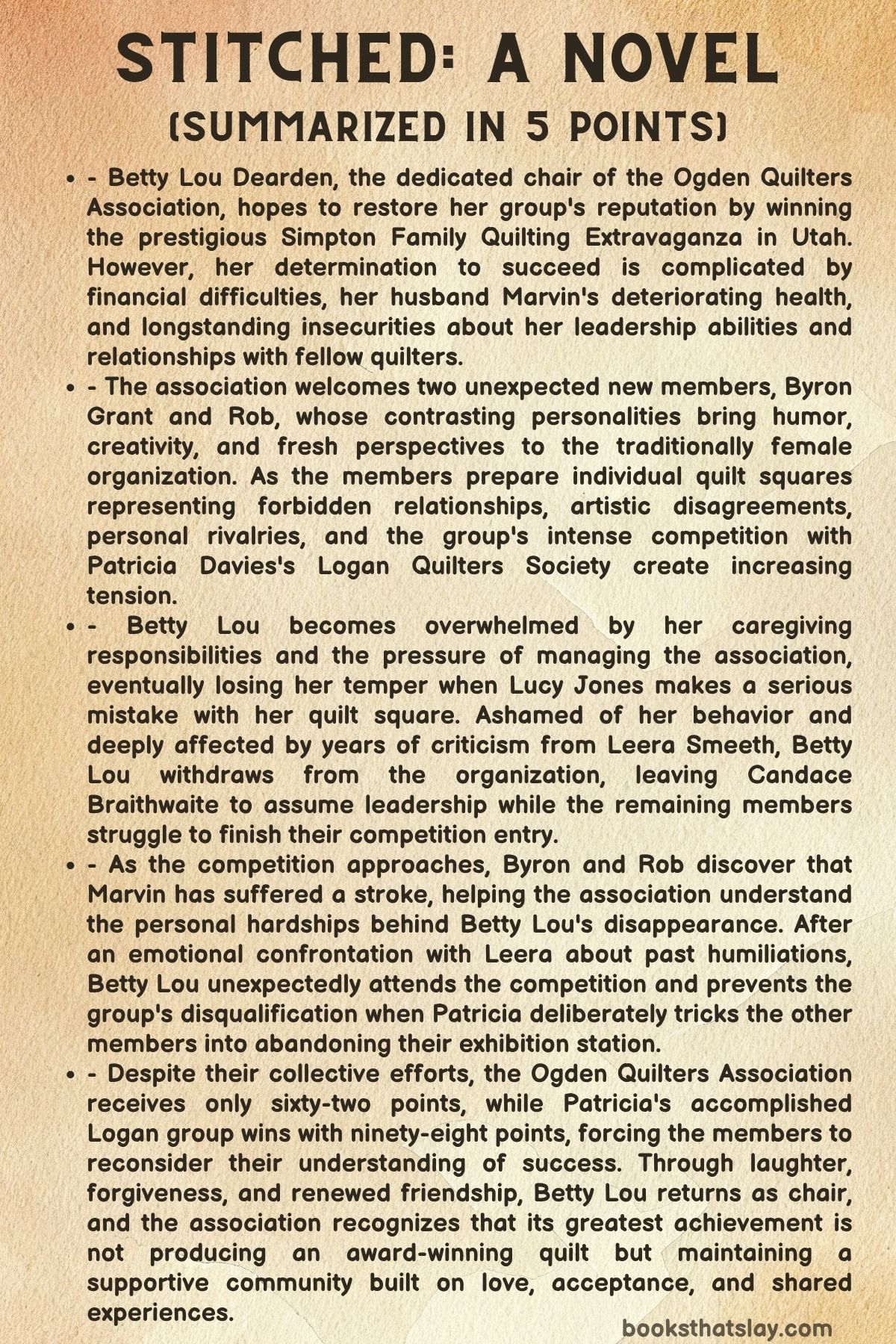
Summary
Betty Lou Dearden has dedicated much of her adult life to the Ogden Quilters Association, a small organization of women who share an enthusiasm for quilting and a complicated history of friendship. As the association’s chair, she hopes that the upcoming Simpton Family Quilting Extravaganza in Smithfield, Utah, will provide an opportunity to restore its competitive reputation after several disappointing performances.
The competition’s theme, “I Wish I Knew How To Quilt You: Famous Forbidden Relationships,” allows considerable artistic freedom, and Betty Lou believes the association can produce an impressive entry. The possibility of winning an all-expenses-paid vacation to Tampa provides additional motivation, particularly because her family has been experiencing financial difficulties.
Her husband, Marvin, has been forced into early retirement because of persistent migraines and other health problems, leaving Betty Lou to supplement their income by working at a grocery store. Although their marriage remains affectionate, Marvin’s increasing exhaustion and withdrawal have made their once-comfortable domestic life uncertain.
Meanwhile, Candace Braithwaite, a longtime association member and successful owner of Fab Funky Fabrics, decides that the group needs additional participants. She invites two of her younger friends, Byron Grant and Rob, believing that Rob’s artistic abilities and Byron’s enthusiasm could benefit the association.
Byron is an outspoken, humorous fabric-store manager who enjoys entertaining people with exaggerated stories, while Rob is a reserved artist who feels more comfortable observing others than participating in conversations. Neither man has much experience quilting, and both initially regard the invitation as an opportunity for an unusual social experience rather than a serious commitment.
Candace neglects to inform the older women that their prospective members are men, causing considerable surprise when she introduces them at Leera Smeeth’s house. Leera, one of the association’s founding members, questions whether men belong in a traditionally female organization, but other members argue that there is no reasonable justification for excluding them.
After a spirited discussion, the association votes to admit Byron and Rob, although neither has formally agreed to permanent membership. The decision begins an unexpected transformation in the group’s social atmosphere, gradually challenging the assumptions of its older members.
As preparations proceed, the association struggles to choose a suitable competition design. Betty Lou favors Romeo and Juliet, while other members propose biblical relationships, abstract symbols, and increasingly unusual interpretations of the competition’s theme.
Their disagreements become particularly intense because of the group’s longstanding rivalry with the Logan Quilters Society, whose president, Patricia Davies, has repeatedly treated the Ogden women as inferior competitors. Betty Lou regards defeating Patricia as an opportunity to establish the association’s legitimacy and demonstrate her competence as its leader.
A compromise eventually emerges when Leera suggests allowing each member to create an individual square representing a different forbidden relationship. Candace proposes connecting the squares through a shared color scheme and decorative stitching, allowing the participants to contribute their individual talents while creating a single quilt.
The creative process reveals the members’ contrasting personalities. Leera designs a square inspired by Alice and the Cheshire Cat to honor her deceased cat, Chuck, while Diane Williams imagines an encounter between the Statue of Liberty and the Golden Gate Bridge.
Alice Flagstaff chooses Eve and the serpent, Lucy Jones develops an elaborate scene involving rain and children, and Betty Lou produces an abstract interpretation of Romeo and Juliet influenced by Picasso. Byron and Rob initially struggle with their contributions, relying heavily on Candace’s technical assistance.
Beyond quilting, the association’s members face personal difficulties that gradually become more important than the competition. Leera continues grieving Chuck while resisting the romantic attention of Arnold Bullock, an enthusiastic former theater acquaintance who seems determined to become part of her life.
Alice experiences worsening memory problems, hearing difficulties, and declining independence, placing increasing responsibility on Diane, with whom she lives. Lucy, meanwhile, continues providing emotional support to her friends, even when her absentmindedness and impractical ideas create additional problems.
Betty Lou’s situation grows particularly difficult as Marvin’s health deteriorates. His medications, depression, physical limitations, and eventual dependence leave her frightened about their future, while mounting household expenses force her to consider working additional grocery-store shifts.
Her emotional distress is intensified by longstanding insecurities about her position within the association. She admires Candace’s business success and confidence but privately worries that her own contributions are insignificant, especially when Leera challenges her suggestions or criticizes her judgment.
Eventually, Betty Lou asks Candace to assume temporary leadership so she can concentrate on Marvin’s care. Candace agrees, also taking responsibility for a proposed collaboration between the Ogden association and Patricia’s Logan Quilters Society in organizing the regional competition.
Unfortunately, tensions within the OQA reach a breaking point when Lucy reveals that she has made her quilt square considerably larger than the required dimensions. Already overwhelmed, Betty Lou lashes out, accusing Lucy of repeatedly undermining the association through careless mistakes.
Lucy is devastated and offers to resign, while Leera and the other members defend her. Recognizing that her anger has become uncontrollable, Betty Lou leaves the meeting, abandoning both her leadership responsibilities and her completed quilt square.
Her departure exposes emotional wounds that have existed for decades. During an earlier association gathering, a former chair named Darlene Burton suffered a heart attack, and Betty Lou froze in panic rather than immediately helping.
Leera angrily criticized her for being useless, a remark that Betty Lou never forgot. Although Leera scarcely remembers the incident, Betty Lou has spent years interpreting subsequent criticism as confirmation that she is inadequate.
As Betty Lou withdraws from her friends, Candace discovers that leadership is more difficult than she expected. Organizing the quilt, managing competing personalities, and enduring Leera’s criticism gradually help her understand the pressure Betty Lou experienced.
Patricia further complicates matters by refusing to provide meaningful responsibilities to the Ogden group despite publicly presenting the competition as a collaborative effort. Her actual intention is to control preparations while keeping her rivals away from important decisions.
Meanwhile, Betty Lou becomes increasingly isolated, ashamed of her confrontation with Lucy but unwilling to return to an environment where she feels constantly judged. A humiliating dispute over discounted fabric at a department store eventually causes her suppressed emotions to erupt into tears.
Afterward, she unexpectedly asserts herself and obtains the discount she was entitled to receive. Although the incident seems minor, it marks the beginning of a change in her willingness to defend her own interests rather than surrender to other people’s dismissive behavior.
As the competition approaches, Byron and Rob attempt to persuade Betty Lou to return. Byron’s affectionate but unsuccessful appeal is followed by an unusually direct conversation between Rob and Betty Lou, during which Rob learns that Marvin has suffered a serious stroke.
Rob discovers that Betty Lou is struggling with substantial caregiving responsibilities and insufficient assistance from her children. When the association learns about these circumstances, its members begin to understand that her absence cannot be explained simply by wounded pride.
The group eventually completes its quilt, naming the finished piece “All Shapes And Sizes.” Although the individual designs vary in quality and interpretation, the members take pride in their collective effort and dedicate the quilt to Betty Lou, acknowledging her importance to the association.
Shortly before the competition, Leera visits Betty Lou, and their conversation develops into a confrontation about years of hurtful remarks. Betty Lou finally explains how deeply Leera’s criticism has affected her, including the lasting consequences of the incident involving Darlene.
Leera begins to recognize that her sarcastic manner has caused genuine suffering. Although their differences cannot disappear immediately, she acknowledges Betty Lou as one of her closest friends and later encourages Betty Lou’s son Matthew to become more involved in caring for Marvin.
At the Smithfield competition, the Ogden women encounter impressive quilts from numerous organizations. They discover that Patricia’s association has created an exceptionally detailed Romeo and Juliet quilt, highlighting the artistic weaknesses of their own entry.
Patricia then deliberately misleads Candace into gathering the association for a nonexistent meeting, causing the members to abandon their exhibition station just as the judges arrive. Because unattended quilts can be disqualified, her deception threatens to destroy their entire effort.
Unexpectedly, Betty Lou arrives at the exhibition and discovers the abandoned display. Deeply moved by the quilt’s dedication to her, she remains beside it long enough to represent the association when the judges appear.
The other members return, discover what has happened, and welcome Betty Lou with overwhelming affection. When Patricia subsequently insults their work, Betty Lou openly confronts her arrogance and cruelty, demonstrating a confidence that once seemed impossible.
The judges eventually award the Ogden quilt only sixty-two points out of one hundred, criticizing its inconsistent craftsmanship and lack of artistic unity. Patricia’s Logan Quilters Society wins with ninety-eight points, confirming the substantial difference between the groups’ competitive abilities.
Initially disappointed, the Ogden members gradually begin laughing about their mistakes, particularly Lucy’s questionable interpretation of forbidden relationships and Byron’s admission that Candace performed much of his sewing. Their laughter transforms defeat into a moment of collective recognition that the true value of the association has never depended on awards.
After the competition, the OQA resumes its regular meetings and considers making quilts for children undergoing chemotherapy. Betty Lou eventually returns as chair, supported by Matthew’s promise to visit Marvin on Wednesday evenings so she can continue attending.
In the final gathering, the members settle back into their familiar routine of sewing, storytelling, and affectionate disagreements. Leera quietly reaches for Betty Lou’s hand, and Betty Lou returns the gesture, affirming that their friendship has survived its most painful disagreement.
The novel concludes by presenting the association not as a collection of accomplished competitors but as a chosen family whose greatest achievement is its continued commitment to one another.
Characters
Betty Lou Dearden
Betty Lou Dearden is the central character of Stitched, and her experiences provide the emotional foundation of the novel. As chair of the Ogden Quilters Association, she is a dedicated, hardworking woman whose determination to succeed conceals considerable insecurity about her abilities and personal worth.
For much of her life, Betty Lou has relied on the association for friendship, acceptance, and a sense of purpose. Having struggled to feel included during her younger years, she regards her fellow quilters as an essential part of her identity.
Her desire to win the Simpton Family Quilting Extravaganza is therefore about much more than competitive recognition. She believes that producing an exceptional quilt will prove her competence as a leader and earn the respect she fears she does not fully possess.
Betty Lou’s insecurities become especially apparent in her relationship with Candace. Although she admires her friend’s professional success, financial independence, and confidence, she frequently compares their lives and concludes that her own accomplishments are comparatively insignificant.
Her relationship with Leera is equally complicated because Leera’s sarcastic remarks reinforce her longstanding fear of inadequacy. A criticism made decades earlier, when Betty Lou froze during Darlene Burton’s medical emergency, continues to influence how she interprets Leera’s behavior.
At home, Betty Lou faces increasingly difficult responsibilities as Marvin’s health deteriorates. His illness creates financial strain, emotional uncertainty, and physical demands that leave her exhausted, yet she struggles to communicate the seriousness of her situation to her friends.
Her emotional collapse during the quilting meeting represents the accumulated effects of these pressures. By directing her frustration toward Lucy, Betty Lou hurts someone who genuinely cares for her, demonstrating how unexpressed suffering can damage even deeply valued relationships.
Her subsequent withdrawal initially appears to be an act of resentment, but it also reflects shame, loneliness, and her inability to ask for assistance. She needs the association’s support while simultaneously fearing that returning will expose her to further judgment.
Betty Lou’s development becomes evident when she begins defending herself, first during the dispute over discounted fabric and later in her confrontation with Leera. These experiences teach her that maintaining relationships does not require accepting every criticism or constantly subordinating her feelings to those of others.
Her unexpected arrival at the quilting competition demonstrates the strength of her attachment to the group. By protecting its entry from disqualification and standing up to Patricia, she discovers that courage can emerge even after prolonged self-doubt.
Ultimately, Betty Lou returns to the association with a more balanced understanding of leadership, friendship, and personal achievement. Her transformation lies not in becoming flawless or universally admired, but in recognizing that she deserves love and respect without having to prove her worth through success.
Candace Braithwaite
Candace Braithwaite is one of the most influential characters in Stitched, functioning as both an organizing force within the association and an emotional connection between its different members. Her confidence, professional success, and generosity initially make her appear considerably more secure than her friends.
As the owner of Fab Funky Fabrics, Candace has built a successful business from modest beginnings. Her stores serve not merely as commercial establishments but as welcoming environments where customers can explore artistic interests and develop meaningful relationships.
Her decision to introduce Byron and Rob to the association reveals her willingness to question traditional assumptions. Although she understands that admitting men may provoke resistance, she believes their personalities and abilities will enrich the organization.
Candace’s strongest quality is her instinct to help others, particularly those who lack confidence or experience. She supports Betty Lou’s creative ideas, encourages Rob’s artistic participation, and patiently assists Byron as he attempts to develop his quilting skills.
However, her helpfulness occasionally becomes excessive. Byron recognizes that she sometimes allows other people’s problems to consume her attention, suggesting that generosity can become exhausting when it is not accompanied by personal boundaries.
Her relationship with Betty Lou is especially important because she provides encouragement without fully realizing how deeply Betty Lou struggles with comparison and self-criticism. Candace’s decision to nominate Betty Lou for chair demonstrates genuine admiration, even though Betty Lou has difficulty accepting it.
When Candace temporarily assumes leadership, she discovers that managing the association is far more demanding than she previously understood. Leera’s criticism, Patricia’s evasiveness, and the approaching competition gradually undermine her confidence.
This experience gives Candace greater appreciation for Betty Lou’s emotional burden. She realizes that qualities she once interpreted as unnecessary sensitivity can emerge naturally when someone feels responsible for the expectations of an entire group.
By the conclusion, Candace remains a capable and supportive figure, but her understanding of leadership has become more compassionate. Her development demonstrates that emotional intelligence involves not only helping others but also recognizing burdens that are not immediately visible.
Leera Smeeth
Leera Smeeth is among the most complicated personalities in Stitched, combining intelligence, independence, loyalty, stubbornness, and a frequently abrasive sense of humor. As one of the Ogden Quilters Association’s founding members, she represents the organization’s history and its resistance to unnecessary change.
Her sharp comments often create tension because she values honesty more than diplomacy. Although she generally believes that her criticisms are justified, she rarely considers how her words might affect people who are less confident than herself.
Leera’s initial opposition to admitting Byron and Rob illustrates her attachment to tradition. She worries that including men will change the atmosphere of gatherings where the women have long discussed personal matters without restraint.
Nevertheless, her gradual acceptance of the newcomers demonstrates that her stubbornness is not absolute. She develops an unexpected affection for Byron and begins appreciating the energy and companionship he brings to the group.
Her grief over the death of Chuck, her beloved cat, reveals an emotionally vulnerable side that her sarcastic manner usually conceals. Chuck represented companionship and stability, and his absence leaves Leera struggling with loneliness and a heightened awareness of mortality.
Her developing acquaintance with Arnold Bullock creates another opportunity for emotional growth. Although she repeatedly dismisses his romantic interest, her resistance suggests discomfort with vulnerability as much as genuine irritation.
The central conflict in Leera’s character concerns her relationship with Betty Lou. She has spent years making dismissive remarks without understanding that Betty Lou regards her opinions as deeply important.
Their confrontation forces Leera to recognize that an apparently insignificant comment can have consequences lasting decades. The memory of Darlene’s medical emergency shows her that intentions do not erase the harm caused by careless criticism.
Leera’s decision to encourage Matthew to help care for Marvin demonstrates a more practical expression of friendship. Rather than relying entirely on verbal affection, she begins recognizing the importance of supporting people through difficult circumstances.
Her final gesture of squeezing Betty Lou’s hand represents reconciliation without requiring a dramatic declaration. Leera remains outspoken and occasionally difficult, but she becomes more aware that loyalty must include consideration for other people’s feelings.
Lucy Jones
Lucy Jones is one of the novel’s warmest and most consistently compassionate characters. Her optimism, enthusiasm, and occasional absentmindedness frequently create humorous situations, yet these same qualities make her an essential source of emotional support within the association.
Lucy approaches friendship with remarkable openness. She enjoys organizing gatherings, maintaining old acquaintances, and encouraging her companions to participate in activities that might otherwise seem uncomfortable or unnecessary.
Her relationship with Leera demonstrates her ability to appreciate people whose personalities differ substantially from her own. While Leera is critical and suspicious, Lucy is hopeful and welcoming, and their friendship benefits from these contrasting perspectives.
Lucy’s approach to quilting reflects her imaginative but sometimes impractical thinking. Her decision to represent forbidden relationships through rain and children wanting to play outdoors illustrates her willingness to interpret artistic instructions in unconventional ways.
Unfortunately, her lack of attention to measurements results in an oversized quilt square, creating additional work for the association. Betty Lou’s angry response devastates Lucy because she genuinely wants to contribute and has never intended to create difficulties.
Her reaction demonstrates that cheerful people are not immune to humiliation or self-doubt. Although she often appears carefree, Lucy is deeply affected by the suggestion that her efforts have consistently harmed her friends.
Her decision to approach Betty Lou afterward shows considerable emotional maturity. When she sees how distressed her friend has become, she abandons her intention to demand an apology and instead offers a simple gesture of understanding.
Later, Lucy becomes the first person to laugh after the association receives its disappointing competition score. Her willingness to recognize the absurdity of their mistakes helps the group regain perspective.
Lucy represents a form of wisdom rooted in kindness rather than technical expertise. Her greatest contribution is not the quality of her stitching but her ability to preserve relationships when pride and disappointment threaten to divide people.
Byron Grant
Byron Grant introduces much of the humor and social energy that distinguish Stitched from a conventional account of an aging community organization. His talkative personality, exaggerated stories, and tendency to challenge expectations make him an unlikely but increasingly valuable member of the association.
As general manager of Fab Funky Fabrics, Byron has developed a close relationship with Candace despite their differences in age and temperament. His humor often masks genuine concern for the people around him, especially those he considers part of his extended social circle.
Initially, Byron has little interest in quilting and questions why anyone would travel regularly to Ogden to spend time with older women. His eventual participation begins partly because he feels offended that Candace has invited Rob without including him.
Once admitted, however, he becomes fascinated by the association’s personalities, disagreements, and longstanding rivalries. His enthusiasm for gossip and dramatic storytelling allows him to fit into the organization more naturally than his limited sewing abilities might suggest.
His relationship with Leera is particularly revealing. Although she initially objects to his presence, Byron gradually earns her affection through persistence, humor, and an unexpected willingness to accept her criticism.
The incident involving Chuck demonstrates both his social impulsiveness and his capacity for embarrassment. His astonishment upon discovering that Leera’s deceased companion was a cat rather than a husband creates an uncomfortable misunderstanding, but he eventually tries to repair the damage.
Byron’s private attempts to improve his sewing illustrate an important change in his motivation. He begins wanting to contribute genuinely rather than simply entertaining everyone while Candace completes his work.
His attachment to the association also reflects an unmet emotional need. Having lost his mother, Byron misses the comfort of belonging to a family, and the older women gradually provide a sense of continuity and affection.
His visit to Betty Lou demonstrates that beneath his theatrical personality is someone capable of taking friendship seriously. Although he cannot persuade her to return, he recognizes the danger of allowing an important relationship to disappear through prolonged silence.
Byron’s development lies in learning that affection brings responsibility. The association becomes more than an amusing weekly activity because he begins caring about its members, their problems, and their happiness.
Rob
Rob is one of the most quietly significant characters in Stitched, providing a contrast to Byron’s outgoing personality and demonstrating that emotional strength does not always require confidence or verbal expressiveness. His reserved nature initially causes other people to misunderstand him, but his actions reveal considerable sensitivity.
Throughout his life, Rob has struggled with the fear that speaking too freely will lead others to dislike him. Consequently, he often remains silent in unfamiliar situations, sometimes creating the mistaken impression that he is arrogant or uninterested.
Fab Funky Fabrics offers him an environment where he can pursue artistic interests without facing constant social expectations. Candace and Byron accept his quiet companionship, allowing him to participate in their lives without feeling pressured to entertain anyone.
His artistic abilities make him an attractive prospective member of the Ogden Quilters Association. Although he lacks advanced quilting skills, he possesses creativity and visual imagination that distinguish his contribution from those of the more experienced participants.
Rob’s relationship with Byron is central to his characterization. Their friendship succeeds because Byron’s energetic personality complements Rob’s reserved manner, while Rob provides a thoughtful presence that balances his friend’s constant conversation.
As the association becomes more important to them, Rob realizes that he enjoys the companionship even more than the craft itself. The weekly gatherings offer a form of belonging that he may not have expected to find among people from a different generation.
His conversation with Betty Lou is one of his most important actions. Where Byron’s elaborate attempt at persuasion fails, Rob’s quiet approach creates enough trust for Betty Lou to disclose Marvin’s stroke and the difficulties she has been facing.
This moment demonstrates that listening can accomplish what persuasion cannot. Rob understands that Betty Lou needs someone to recognize her suffering rather than insist that she immediately return to her previous responsibilities.
His willingness to express affection toward Byron afterward represents another meaningful step. By acknowledging the importance of their friendship, Rob moves beyond the emotional restraint that has shaped much of his life.
Ultimately, Rob shows that belonging does not depend on being socially impressive. His greatest strength is the empathy that allows him to recognize suffering and respond without demanding attention for himself.
Diane Williams
Diane Williams is a practical, patient, and emotionally dependable member of the Ogden Quilters Association. Her calm personality frequently provides stability when the other members become distracted by disagreements, misunderstandings, or competitive ambitions.
She demonstrates sound judgment when Candace proposes admitting Byron and Rob, recognizing that their gender provides no legitimate reason to exclude them. Her willingness to consider unfamiliar possibilities makes her an important counterbalance to the association’s more traditional members.
Diane’s relationship with Alice reveals the demanding responsibilities she carries outside quilting. As Alice experiences worsening memory problems, physical limitations, and difficulties managing medication, Diane increasingly assumes the role of caregiver.
Although she remains devoted to Alice, she must confront the possibility that professional assistance may eventually become necessary. This situation introduces difficult questions about independence, responsibility, and the limits of personal care.
Diane also recognizes Betty Lou’s emotional distress and supports Candace’s efforts to provide assistance. Her concerns demonstrate that she values the association as a community of people whose well-being matters beyond their quilting achievements.
Her suggestion that the members create quilts for children undergoing chemotherapy reflects her practical compassion. By redirecting their skills toward helping others, she offers the association a purpose independent of competitive recognition.
Diane represents the quiet reliability that sustains long-term friendships. She rarely seeks attention, but her patience, responsibility, and concern for others make her indispensable.
Alice Flagstaff
Alice Flagstaff combines an outspoken personality with growing vulnerability caused by aging and cognitive decline. Her frequent misunderstandings, hearing difficulties, and sarcastic remarks provide humor, but her experiences also introduce some of the novel’s most serious concerns.
Alice has been accustomed to expressing her opinions directly, sometimes without fully understanding the conversations around her. Her deteriorating hearing creates confusion during meetings and telephone calls, frequently requiring Diane or other members to repeat information.
As her memory problems worsen, ordinary activities become increasingly difficult. Struggling with crossword puzzles, remembering medication, and following familiar routines forces Alice to confront changes she cannot control.
Her greatest fear is losing her independence and becoming a burden on Diane. Although she often responds to discussions about medical care with irritation, her anger conceals genuine anxiety about her future.
Alice’s difficulties are particularly visible during the quilting competition, when her exhaustion and confusion limit her participation. Her attempt to help at the admission desk ends unsuccessfully because she allows visitors to enter without paying.
Despite these problems, Alice remains emotionally connected to the association. When she realizes that Betty Lou is suffering, she immediately insists that the group should do something to help.
This reaction reveals the distinction between declining cognitive abilities and the continuing capacity for affection. Alice may struggle with practical responsibilities, but she still recognizes the importance of loyalty and companionship.
Her character challenges the assumption that usefulness determines personal value. Even as her abilities change, Alice deserves patience, dignity, and a continuing place among people who have known and loved her for years.
Patricia Davies
Patricia Davies is the primary antagonist of the novel and the dominant figure within the Logan Quilters Society. An exceptionally skilled quilter and accomplished organizational leader, she possesses the technical expertise and professional reputation that the Ogden women hope to achieve.
Her success, however, has encouraged arrogance and an excessive desire for control. She treats competing associations as inferior and regards disagreement as a threat to her authority.
Patricia’s relationship with the Ogden Quilters Association is characterized by contempt. Rather than respecting its members as fellow participants in a shared artistic tradition, she uses her influence to belittle their work and undermine their confidence.
Her involvement in organizing the Smithfield competition demonstrates her willingness to manipulate institutional arrangements. She attempts to increase Logan’s influence while presenting herself as someone interested in cooperation.
Her invitation for the Ogden association to assist with preparations is largely insincere. By limiting its members to minor responsibilities and avoiding meaningful coordination, Patricia exploits their goodwill for public appearances.
Her most serious act occurs when she deliberately misleads Candace about the judging schedule. The deception nearly results in the Ogden quilt being disqualified, showing that Patricia is willing to sacrifice fairness to protect her competitive advantage.
Importantly, Patricia’s artistic abilities are never presented as imaginary or undeserved. Her association produces a genuinely exceptional quilt and wins with an impressive score, establishing that her personal cruelty exists alongside real professional achievement.
This contrast makes Patricia more than a simple representation of incompetence or jealousy. She illustrates how success can become morally hollow when recognition matters more than integrity, generosity, or respect for others.
Marvin Dearden
Marvin Dearden is Betty Lou’s husband and an important source of both emotional stability and personal anxiety in her life. Their relationship began during their younger years, when Marvin’s kindness helped Betty Lou feel accepted despite her difficulties forming friendships.
Throughout their marriage, he has recognized the importance of the Ogden Quilters Association to her happiness. His encouragement reflects an understanding that his wife needs meaningful relationships and activities beyond their household.
Marvin’s declining health gradually changes their marriage. Persistent migraines force him into early retirement, while additional medical problems, depression, and exhaustion increasingly limit his independence.
These difficulties create financial pressures and leave Betty Lou responsible for managing many aspects of their daily lives. Marvin’s withdrawal also causes emotional suffering because she feels the absence of the companionship they once shared so easily.
Nevertheless, the affection between them remains evident. When Betty Lou breaks down at the kitchen table, Marvin reaches out to comfort her and suggests taking a walk together.
This small interaction demonstrates that illness has not eliminated their emotional connection. Even when he cannot solve their problems, Marvin continues trying to provide reassurance.
His subsequent stroke intensifies the family’s difficulties and exposes the limitations of Betty Lou’s ability to manage everything alone. Marvin’s character emphasizes the challenges of aging within a loving marriage and the importance of shared family responsibility.
Matthew Dearden
Matthew Dearden is Betty Lou and Marvin’s youngest son, whose presence connects the older generation’s experiences with changing social attitudes and family expectations. Having come out as gay several years earlier, he has parents who love him and continue learning about his experiences.
His explanation of the quilting competition’s reference to Brokeback Mountain introduces an interesting contrast between the group’s traditional background and the theme of forbidden relationships. Matthew’s perspective helps his mother understand a cultural reference that initially escapes her.
Although Matthew is not continuously involved in the association’s activities, his role becomes increasingly important as Marvin’s condition deteriorates. Betty Lou’s caregiving responsibilities reveal that the family’s adult children have not been providing all the support she needs.
Leera’s direct intervention encourages Matthew to recognize the seriousness of the situation. Rather than treating his parents’ difficulties as problems they can manage independently, he begins assuming a more active role.
His commitment to visiting Marvin every Wednesday allows Betty Lou to resume attending association meetings. This arrangement is significant because it demonstrates that supporting a caregiver also means preserving that person’s independence, friendships, and opportunities for enjoyment.
Matthew represents the potential for greater understanding between generations and the importance of translating family affection into practical assistance.
Arnold Bullock
Arnold Bullock is an enthusiastic, sociable man whose developing relationship with Leera introduces humor and the possibility of companionship later in life. He originally knows Leera and Lucy through their participation in a community theater production of Fiddler on the Roof.
Unlike Leera, Arnold appears comfortable expressing enthusiasm and pursuing social opportunities. His continued involvement in amateur theater reflects his desire to remain active and connected after retirement.
His interest in Leera is persistent, even though she responds to his attention with irritation and avoidance. Rather than immediately abandoning the possibility of friendship or romance, he continues seeking opportunities to spend time with her.
Arnold’s presence encourages Leera to confront her reluctance to accept affection and emotional intimacy. His patience contrasts with her defensive sarcasm, creating a relationship that challenges her established habits.
He eventually becomes increasingly involved in the association’s social gatherings and develops an interest in knitting. His participation illustrates how a community can expand naturally when its members welcome people with different backgrounds and interests.
Arnold also supports the group’s competition ambitions, expressing enthusiasm for their completed quilt. Although his artistic understanding is limited, his encouragement contributes to the association’s growing sense of community.
His character suggests that new friendships and romantic possibilities remain meaningful regardless of age.
Walter Braithwaite
Walter Braithwaite is Candace’s husband and a relatively understated supporting character whose presence helps establish her domestic circumstances. His relationship with Candace provides a contrast to the more visibly troubled marriage of Betty Lou and Marvin.
Walter is practical and attentive, particularly regarding Candace’s attachment to her aging minivan, Martha. His encouragement to replace the vehicle reflects concern for reliability and convenience, while Candace’s reluctance reveals her sentimental connection to family memories.
Although Walter does not play a central role in the competition, his appearance at the association’s Christmas gathering demonstrates his connection to Candace’s broader social life. He belongs to the network of family members who support the quilters without necessarily sharing their intense interest in the craft.
Walter’s significance lies largely in the domestic stability surrounding Candace. His character helps explain the comparatively secure circumstances that Betty Lou both admires and envies.
Terry
Terry is one of the association’s older members whose deteriorating health contributes to the novel’s continuing examination of aging and loss. Her inability to remain actively involved in the OQA reminds the surviving members that their organization has changed considerably over time.
Terry’s departure creates a vacancy that partly motivates Candace’s search for new participants. What initially appears to be a practical membership problem therefore originates in a more serious reality: the gradual decline of a generation of longtime friends.
Leera’s concern about Terry is especially revealing. Already struggling with Chuck’s death, she regards Terry’s condition as another reminder that familiar relationships and routines cannot be preserved indefinitely.
Visits to Terry’s assisted living facility also demonstrate the emotional difficulty of witnessing someone’s increasing dependence. Although Terry has limited direct involvement in the central events, her circumstances influence the atmosphere of the association.
She represents the members whose shared history remains important even after illness prevents them from participating in ordinary gatherings.
Darlene Burton
Darlene Burton is a former chair of the Ogden Quilters Association whose importance emerges through a recollection of the organization’s earlier years. Her leadership belongs to a period when several members were younger, raising children, and developing friendships that would continue for decades.
During a gathering at her house, Darlene suffers a serious heart attack. The emergency creates panic among the quilters and becomes particularly important to Betty Lou’s emotional history.
While Candace responds by contacting emergency services, Betty Lou freezes in confusion. Leera’s angry criticism of her inability to help causes a wound that continues influencing Betty Lou many years later.
Darlene’s medical emergency therefore becomes a defining event in the relationship between two other characters. It demonstrates how an experience that lasts only a short time can shape someone’s confidence for decades.
Darlene also represents the association’s earlier tradition of communal support. The gathering at her home shows how quilting provided opportunities for companionship, childcare, and emotional connection long before competitive ambitions dominated the group’s attention.
Mary Berrett
Mary Berrett is a former member of the Ogden Quilters Association who subsequently becomes involved with the Simpton Family Quilting competition’s governing organization. Her position provides the Ogden women with information about developments that might otherwise remain inaccessible.
Through Mary, Betty Lou learns about the controversy surrounding the competition venue and Patricia Davies’s attempts to influence organizational decisions. These revelations intensify the association’s suspicion of its Logan rivals.
Mary also provides information about the appointment of a new judging panel, giving the Ogden group hope that its work will receive a fair evaluation. Her communications therefore affect both the practical preparations and the emotional expectations surrounding the event.
Although Mary has a limited personal presence in the narrative, she connects the association’s intimate social world with the larger competitive institution. Her character demonstrates the importance of longstanding professional and personal relationships within specialized communities.
Marty Simpton
Marty Simpton is the president of the competition’s organizing body and represents the administrative side of the quilting extravaganza. His responsibilities involve coordinating an event complicated by regional rivalries, competing organizational interests, and inadequate facilities.
During the Smithfield exhibition, Marty encounters practical difficulties involving the community center’s maintenance and operations. These problems expose tensions between the official ambitions of the competition and the less impressive reality of its available resources.
His arguments with Patricia reveal the pressure created by her attempts to influence organizational arrangements. Marty must manage participants whose enthusiasm for competition sometimes interferes with cooperation.
Although he is not developed as extensively as the association’s central members, his role gives the competition institutional structure and helps establish the environment in which Patricia exercises influence.
Chuck
Chuck is Leera’s deceased cat, whose absence has a surprisingly significant effect on her emotional life. Although Byron initially mistakes Chuck for a deceased husband, the revelation that he was a pet does not diminish the importance of Leera’s grief.
Chuck provided companionship that had become deeply embedded in Leera’s daily routines. His death leaves her confronting an unfamiliar loneliness at a stage of life when other losses are becoming increasingly common.
Leera’s decision to honor Chuck through her Alice and Cheshire Cat quilt square illustrates the lasting emotional importance of their relationship. Her attachment also reveals a tender side beneath her impatient and sarcastic exterior.
Chuck’s significance lies in the novel’s recognition that love and grief extend beyond conventional human relationships. His memory becomes part of Leera’s artistic expression and personal development.
Themes
Friendship, Belonging, and Chosen Family
Friendship provides the emotional structure of Stitched, transforming an apparently ordinary quilting association into a community whose relationships carry greater significance than its official activities. The members gather to sew and compete, but their continued participation is sustained by the comfort of being known, accepted, and included.
For Betty Lou, the association represents the belonging she struggled to experience during her younger years. Her friendships give her an identity beyond marriage, motherhood, and employment, making her eventual withdrawal especially painful.
The group’s relationships are not idealized as permanently harmonious. Members criticize one another, become impatient with mistakes, compete for influence, and sometimes fail to recognize the difficulties their friends are experiencing.
These disagreements make their emotional connections more realistic. The novel suggests that enduring friendships require patience, forgiveness, and the willingness to acknowledge harm rather than simply ignoring conflict.
Byron and Rob’s admission expands the meaning of belonging beyond traditional expectations. Although they differ from the older women in age, gender, and experience, they gradually discover that shared affection matters more than superficial similarities.
Byron’s longing for the family connections he associates with his deceased mother is particularly significant. Through the association, he finds a community that offers emotional continuity without requiring biological relationships.
Rob discovers a different kind of acceptance. His quiet personality is not treated as a deficiency, allowing him to experience companionship without constantly struggling against his natural temperament.
The association’s response to Betty Lou’s return provides the clearest expression of chosen family. Rather than demanding that she immediately explain herself or compensate for her absence, the members welcome her because their affection remains stronger than their disappointment.
The final gathering reinforces this understanding through ordinary conversation, sewing, and Leera’s quiet gesture of reconciliation. Friendship emerges as an enduring commitment sustained through imperfect behavior, changing circumstances, and the recognition that people need one another.
Aging, Illness, and the Preservation of Dignity
Aging changes the association in ways that its members cannot fully control. Health problems, bereavement, financial pressures, and declining independence gradually transform their familiar routines, forcing them to confront the uncertainty of circumstances they once took for granted.
Alice’s increasing memory difficulties provide one of the clearest examples of this process. Activities that previously required little effort become frustrating, while concerns about medication and personal safety threaten her independence.
Her resistance to additional care reflects a fear of losing authority over her own life. Rather than presenting her irritation merely as stubbornness, the novel reveals the anxiety beneath her behavior.
Diane’s responsibilities illustrate the complementary difficulties experienced by caregivers. Her commitment to Alice does not eliminate the emotional and practical demands of providing assistance, especially when those demands may eventually exceed her capabilities.
Marvin’s deteriorating health introduces another perspective through Betty Lou’s marriage. His illness changes the household’s financial circumstances and disrupts the emotional balance of a relationship that has provided stability for decades.
Betty Lou’s exhaustion demonstrates that caregiving is not simply an expression of love. It can also involve isolation, fear, resentment, and guilt, particularly when someone believes that asking for help would represent personal failure.
Leera’s experiences add the grief associated with losing familiar companionship. Chuck’s death and Terry’s declining health remind her that old age involves repeated changes to relationships that once seemed secure.
Nevertheless, the novel does not portray aging as the disappearance of individuality or meaningful experience. Leera can still develop new relationships, Alice can still express affection, and the association’s older members remain capable of artistic ambition, humor, and personal growth.
Dignity emerges through the recognition that people remain valuable even when their independence or abilities diminish. The continuing presence of vulnerable members within the association reinforces the importance of companionship that is not dependent on productivity or physical strength.
Self-Worth, Emotional Vulnerability, and the Power of Criticism
Betty Lou’s struggle with insecurity demonstrates how deeply personal identity can be shaped by other people’s opinions. Despite years of dedication to her family and the association, she continues questioning whether she is intelligent, capable, or deserving of admiration.
Her comparisons with Candace reveal the damaging influence of measuring personal worth through external achievements. Candace’s business success becomes evidence of Betty Lou’s supposed inadequacy, even though the two women possess different responsibilities, strengths, and circumstances.
Leera’s criticism intensifies this insecurity because Betty Lou attaches considerable importance to her approval. What Leera considers an ordinary expression of frustration can become, in Betty Lou’s mind, confirmation of a longstanding personal weakness.
The memory of Darlene’s medical emergency demonstrates the lasting consequences of humiliation. Betty Lou’s inability to respond effectively during a frightening situation becomes inseparable from Leera’s accusation that she is useless.
This experience also reveals the difference between intention and impact. Leera does not remember her words as particularly significant, but Betty Lou has carried their emotional consequences for decades.
The problem becomes more serious because Betty Lou rarely communicates her distress. Her determination to remain agreeable prevents others from understanding how deeply she has been hurt.
Eventually, her suppressed emotions emerge as anger directed toward Lucy. This episode demonstrates how unresolved pain can be transferred onto someone who is not responsible for its original cause.
Betty Lou’s development begins when she stops accepting humiliation as an unavoidable part of maintaining relationships. By defending herself at the department store and confronting Leera, she establishes boundaries without entirely rejecting the people around her.
Candace also experiences a smaller version of this transformation when leadership exposes her to criticism. She begins understanding that confidence can become fragile when an individual feels constantly judged.
The novel ultimately suggests that genuine self-worth requires more than praise or achievement. It develops when people recognize their limitations without equating mistakes with personal failure and learn to express vulnerability without considering it a weakness.
Creativity, Imperfection, and the Meaning of Success
The quilting competition in Stitched provides a framework for examining the difference between measurable achievement and personal fulfillment. At first, the association views the extravaganza as an opportunity to gain recognition, defeat established rivals, and prove that its members possess considerable artistic talent.
Betty Lou invests particular emotional significance in winning because she associates competitive success with her effectiveness as chair. The other members also become increasingly absorbed in rankings, judging procedures, and Patricia’s dismissive attitude.
Their artistic disagreements expose the difficulty of creating a unified project from strongly individual perspectives. Each participant interprets forbidden relationships according to personal experiences, interests, or imaginative associations.
The resulting quilt reflects the members’ contrasting personalities. Betty Lou’s abstract Romeo and Juliet design demonstrates technical creativity, while Lucy’s rain-inspired square offers a considerably less convincing interpretation of the theme.
These differences produce artistic inconsistencies, but they also make the quilt a representation of the people who created it. Its uneven craftsmanship preserves the individuality of participants who do not always agree or work with equal skill.
Candace’s elaborate stitching attempts to connect these contributions into a coherent whole. Her work can be understood as a reflection of the association itself, where friendship holds together people whose personalities and abilities are often incompatible.
Patricia’s association provides an important contrast because its quilt genuinely demonstrates superior technical accomplishment. The novel does not pretend that artistic standards are meaningless or that good intentions automatically produce exceptional work.
Instead, the difference lies in how the competitors understand success. Patricia treats winning as confirmation of superiority, while the Ogden members gradually recognize that their greatest achievements cannot be measured by judges.
Their disappointing score of sixty-two points initially appears to invalidate months of effort. However, their shared laughter transforms the result into an opportunity to appreciate the experiences, mistakes, and relationships that accompanied the project.
The decision to make quilts for children undergoing chemotherapy extends this transformation. Their creativity becomes a means of serving others rather than simply competing for recognition.
The finished quilt is therefore valuable not because it meets every artistic expectation, but because it records cooperation, patience, reconciliation, and shared experience. The novel presents meaningful success as the ability to create something that strengthens human connections, even when the finished product remains imperfect.