The Black Orchid Summary, Characters and Themes
The Black Orchid by Loreth Anne White is a psychological thriller and murder mystery that explores the destructive consequences of hidden identities, unresolved crimes, and personal ambition.
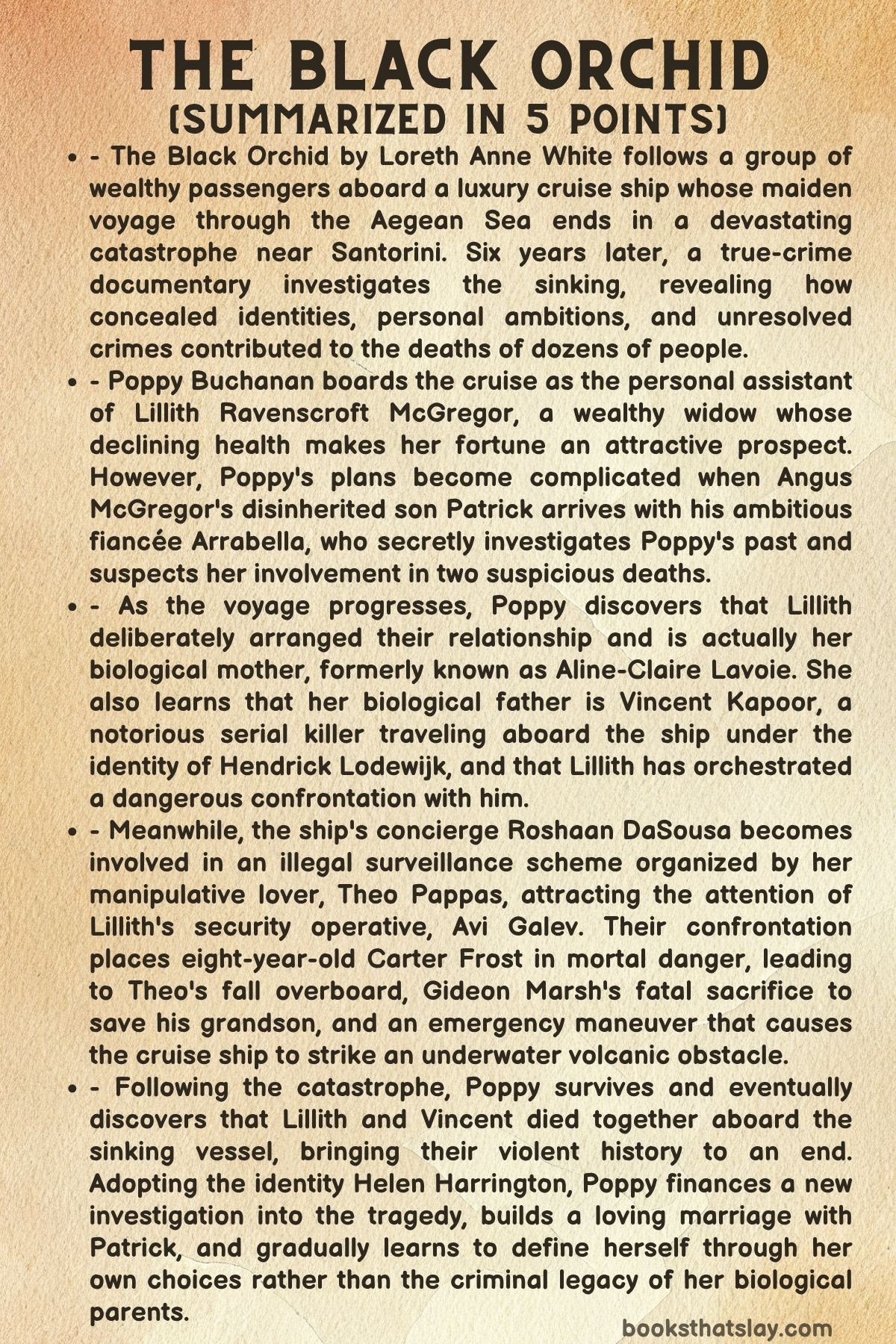
Set aboard a luxurious cruise ship traveling through the Aegean Sea, the novel follows a group of passengers whose seemingly unrelated lives become connected through deception, greed, and a violent criminal history. The narrative moves between the events preceding a maritime catastrophe and a documentary investigation conducted six years later. Through its complex characters and unexpected revelations, the book examines the influence of the past, the psychological effects of manipulation, and the difficult relationship between justice, revenge, and personal responsibility.
Summary
The story begins with a documentary called It’s Criminal, produced by Trinity Scott and Gio Rossi, examining the mysterious sinking of the luxury cruise ship MS Black Orchid near Santorini in September 2019. During its maiden voyage, the enormous vessel suffered a catastrophic collision with an underwater volcanic formation after two man-overboard alarms prompted an emergency maneuver.
The disaster claimed dozens of lives, while several passengers remained missing. Six years later, a woman named Helen Harrington finances a new underwater investigation, convinced that the catastrophe resulted from a complicated series of actions involving passengers who boarded the ship with concealed intentions.
Three days before the disaster, Poppy Buchanan arrives at the Port of Piraeus with her wealthy employer, Lillith Ravenscroft McGregor. Poppy is a middle-aged former caregiver who has struggled financially and sees her position as Lillith’s personal assistant as an opportunity to transform her life.
Lillith is a celebrated former war photographer and the widow of Angus McGregor, a powerful media magnate who left his considerable fortune to her rather than his children. Poppy hopes to become indispensable to the aging widow and secure a generous inheritance, although her growing affection for Lillith complicates her original motives.
Poppy also carries a dangerous secret concerning her former husband, Peter Doyle, whose death led to a murder prosecution from which she was acquitted. Her anxiety increases when she notices a mysterious man in a tan jacket apparently following her, raising fears that her concealed history has finally caught up with her.
Among the other passengers is eight-year-old Carter James Frost, traveling with his mother, Sarah, and his grandfather, Dr. Gideon Marsh. Gideon is a celebrated retired FBI profiler who intends to deliver lectures about serial killers and criminal psychology during the cruise.
Carter idolizes his grandfather and maintains a notebook documenting suspicious behavior. He is particularly fascinated by Gideon’s investigation of Vincent Kapoor, a notorious criminal known as the Bikini Killer, who murdered and exploited travelers across Asia during the 1970s.
Vincent’s history includes his relationship with a Canadian woman named Aline-Claire Lavoie, who helped attract victims and became implicated in his criminal activities. Gideon remains uncertain about the ultimate fate of several accomplices and suspects that important information has been concealed.
Meanwhile, the ship’s elite concierge, Roshaan DaSousa, is involved in an illegal surveillance operation organized by her lover, Theo Pappas. Theo performs as Sorin the Magnificent, a mentalist who intends to use secretly recorded information about wealthy passengers to create the illusion that he possesses extraordinary psychological abilities.
Roshaan has installed hidden cameras inside several luxury suites, but she increasingly regrets participating in the scheme. Theo manipulates her through declarations of love, financial promises, and an engagement ring that eventually proves to be far less valuable than he claimed.
Another conflict develops when Patrick McGregor, Angus’s disinherited son, boards the ship with his fiancée, Lady Arrabella Fairfax. Arrabella deliberately arranged the voyage because she wants Patrick to confront Lillith and recover his financial position.
Patrick becomes furious when he discovers the deception, having already suffered considerable emotional damage from his difficult relationship with Angus. Arrabella, however, remains convinced that Poppy is exploiting Lillith and may have been responsible for Angus’s sudden death.
Arrabella secretly hires a mysterious investigator named Avi Galev to examine Poppy’s background. He discovers her previous murder prosecution and the possibility that digitalis poisoning contributed to Peter Doyle’s death.
The information appears particularly disturbing because Angus also died following cardiac complications, and Poppy had access to poisonous plants at Lillith’s Scottish estate. Arrabella hopes that exposing these connections will force Lillith to dismiss Poppy.
As the voyage continues, Poppy discovers that Lillith is suffering from a serious progressive neurological illness, apparently amyotrophic lateral sclerosis. She also finds evidence suggesting that her employer is preparing for death, making the question of inheritance increasingly urgent.
Poppy’s suspicions deepen when she searches Lillith’s private belongings and discovers a handwritten list revealing that their supposedly accidental meeting in Brighton was deliberately arranged. Lillith had searched for Poppy and carefully established their relationship long before offering her employment.
This discovery transforms Poppy’s perception of the widow. She begins questioning whether Lillith is a benevolent employer, a calculating manipulator, or someone pursuing an objective that Poppy cannot yet understand.
During Gideon’s midnight lecture about women who become involved with violent criminals, Poppy notices disturbing similarities between the historical account of Aline-Claire Lavoie and Lillith’s personal history. Both women possess unusual physical injuries, and details of their lives appear increasingly connected.
Carter independently discovers a recent photograph of Vincent Kapoor among his grandfather’s research materials. He begins suspecting that the murderer is aboard the ship under an assumed identity.
The voyage becomes more dangerous during an excursion to Crete, where Patrick confronts Arrabella about her dishonesty and possible involvement with a former lover. Their argument becomes physical, and Patrick leaves after Arrabella strikes a stone wall.
Arrabella subsequently suffers a life-threatening allergic reaction while ashore. Because she has misplaced her emergency epinephrine injector, she cannot immediately treat herself, although medical intervention eventually saves her life.
She misses the ship’s departure and later travels to Santorini, where she plans to reconcile with Patrick. Her near-death experience forces her to reconsider the importance she has placed on money, social position, and controlling her fiancé.
Back aboard, Roshaan’s secret activities are discovered by Avi, who proves to be far more dangerous than she anticipated. He threatens her into cooperating with him and orders her to retrieve Theo’s surveillance equipment.
Poppy meanwhile discovers that Avi is actually connected to Lillith, who has employed him as a trusted security operative. Lillith has used him to manage sensitive personal matters, including Arrabella’s investigation and the complicated affairs of the McGregor family.
As Poppy becomes increasingly frightened, Avi escorts her to Lillith’s suite for a private confrontation. There, Lillith reveals that she is Poppy’s biological mother.
Poppy had grown up believing she was abandoned as a baby in a police telephone box before being adopted by loving parents. Lillith admits that she placed the child there herself, ensuring that emergency services would rescue her before disappearing.
She explains that she was originally Aline-Claire Lavoie, the Canadian companion of Vincent Kapoor. Vincent used psychological manipulation, emotional dependence, threats, and violence to draw her into his criminal activities.
Pregnancy eventually gave Aline-Claire the determination to escape. She abandoned her original identity, created a new life as Lillith Ravenscroft, and eventually married Angus McGregor, who knew about her past and helped protect her.
Poppy is devastated to discover that Vincent Kapoor is her father. She must confront the possibility that both biological parents were involved in terrible crimes, while trying to understand why her mother abandoned her and later deliberately returned to her life.
Lillith explains that Vincent eventually discovered her new identity and attempted to exploit her wealth. With help from Avi and information associated with Gideon’s investigation, she devised a plan to confront the man who had controlled her life for decades.
The confrontation is approaching as the ship prepares for Theo’s exclusive Moonlight & Mentalism Soiree. Guests are instructed to wear masks representing Greek mythological figures, creating an atmosphere in which deception, punishment, and identity become central to the evening.
Lillith chooses the mask of Circe, while Poppy selects a silver harpy mask. Avi wears the mask of Thanatos, representing death, and Roshaan identifies herself with the Furies, supernatural figures associated with vengeance.
During the performance, Poppy finally recognizes that the passenger introduced as Hendrick Lodewijk, a Dutch antiquities dealer, is actually Vincent Kapoor. She is forced to stand near her biological father while knowing that her mother has arranged a potentially fatal confrontation.
Meanwhile, Avi has forced Roshaan to collect Theo’s phones, computer, and surveillance recordings. Roshaan completes the assignment but becomes overwhelmed by the realization that she has helped an exceptionally dangerous man prepare an attack against her lover.
Seeking relief from her fear and guilt, she goes onto an exposed deck during worsening weather. A heavy structural beam breaks loose in the violent wind and strikes her head, leaving her gravely injured.
Elsewhere, Carter secretly leaves his suite to explore the ship and discovers Theo using a vaping device near the lifeboats. Before he can approach, a mysterious figure wearing the mask of Thanatos emerges and attacks the magician.
When Carter cries out, Theo seizes him and holds him over the ship’s railing by the straps of his yellow backpack. The boy becomes a hostage as Theo attempts to protect himself from his attacker.
During the struggle, Theo is severely injured and falls into the sea. Carter also slips from the backpack, but Gideon arrives and catches his grandson by the ankle before he can disappear into the water.
Gideon manages to pull Carter back aboard despite extraordinary physical strain. His effort saves the child’s life but causes a fatal cardiac arrest.
The falling backpack triggers the ship’s first man-overboard alarm, while Theo’s fall produces the second. Believing people are in the water, Captain Sophia Bellini orders an emergency maneuver intended to facilitate rescue.
Unfortunately, the enormous vessel strikes an uncharted underwater volcanic obstacle. Its hull is breached, water floods multiple compartments, and the ship loses power and propulsion.
Severe weather drives the damaged ship toward the rocky shoreline, where it begins listing dangerously. Lifeboats become trapped, passengers panic, and the evacuation deteriorates into a desperate struggle for survival.
Poppy suffers a serious head injury during the collision but is helped by Patrick, who refuses to abandon her. Despite his own danger, Patrick later searches for Carter and ultimately succeeds in helping the boy and Sarah escape.
Poppy survives aboard an overcrowded lifeboat, although she remains uncertain about the fate of Lillith and the other passengers. At dawn, Avi approaches her in disguise and explains that Lillith established private trusts for Poppy and Patrick before the voyage.
The arrangements reveal that Lillith intended to provide for both of them, even while preparing for her own death. Poppy realizes that the wealth she originally sought has become secondary to the devastating knowledge of her family’s history.
Six years later, the documentary investigation reaches the wreck and discovers two skeletons near a mural depicting Narcissus and Nemesis. The remains strongly indicate that Lillith and Vincent died together aboard the sinking ship.
The discovery supports the conclusion that Lillith deliberately drew Vincent into a final confrontation and intended to end both his life and her own. Her carefully constructed plan succeeded in ending his influence over her, although the surrounding events contributed to a catastrophe that killed innocent people.
The documentary finally reveals that Helen Harrington is Poppy Buchanan, who survived the disaster and reclaimed her identity. She financed the investigation to establish the truth about her biological parents, the sinking, and the people whose lives were destroyed.
Patrick also survived, and his engagement to Arrabella ended after the cruise. He and Poppy eventually developed a loving relationship through shared grief, charitable work, and their determination to establish independent identities, marrying three years after the disaster.
Carter survived because of Gideon’s sacrifice and Patrick’s assistance, and he continues to honor his grandfather’s legacy through his interest in criminal investigation. The final revelations establish that the sinking resulted from a succession of deliberate schemes, personal betrayals, violent confrontations, and unpredictable circumstances rather than a single isolated decision.
The novel ends by examining how secrets from one generation can produce consequences for people who never participated in the original wrongdoing. Although Poppy cannot change her biological origins or the catastrophe that shaped her life, she ultimately chooses honesty, meaningful relationships, and the pursuit of answers over the identities and ambitions that once controlled her.
Characters
Poppy Buchanan / Helen Harrington
Poppy Buchanan is the central protagonist of The Black Orchid, a woman whose pursuit of financial security gradually becomes a confrontation with her identity, childhood trauma, and complicated family history. Initially presented as an ambitious personal assistant seeking a place in a wealthy widow’s inheritance, she develops into a psychologically complex character whose motivations cannot be reduced to greed.
Her difficult financial circumstances and experience in an abusive marriage have left her desperate for stability. She understands how easily security can disappear and believes that money might protect her from the helplessness she has experienced.
Poppy’s relationship with Lillith demonstrates the tension between self-interest and genuine affection. Although she initially cultivates their friendship because of Lillith’s wealth, she gradually develops protective feelings for the older woman and becomes frightened by signs of her declining health.
Her secret past involving Peter Doyle adds another dimension to her personality. Having been prosecuted and acquitted following his death, Poppy fears that other people will judge her solely through the circumstances of her violent marriage rather than understand the suffering she endured.
The discovery that Lillith deliberately engineered their meeting destroys Poppy’s confidence in her ability to judge other people’s intentions. Her subsequent realization that Lillith is her biological mother, and Vincent Kapoor her father, forces her to reconsider nearly everything she believes about her origins.
Poppy’s horror at her biological father’s crimes raises difficult questions about whether children inherit responsibility for their parents’ actions. Her determination to uncover the truth demonstrates her refusal to accept that her origins must determine her character.
By the conclusion, Poppy has moved beyond the limited ambition of securing a comfortable inheritance. As Helen Harrington, she uses her resources to investigate the disaster, acknowledge her family’s history, and support meaningful causes.
Her marriage to Patrick represents a relationship built upon mutual understanding rather than manipulation or financial dependence. Poppy’s development ultimately illustrates how personal identity can be consciously reconstructed through honesty, responsibility, and the decisions a person makes after confronting painful truths.
Lillith Ravenscroft McGregor / Aline-Claire Lavoie
Lillith Ravenscroft McGregor is among the most morally complicated characters in The Black Orchid, occupying several contradictory positions as a loving mother, a survivor of psychological abuse, a former criminal accomplice, and the architect of a dangerous revenge plan. Her outward identity as a distinguished war photographer and wealthy widow conceals decades of fear, guilt, and unresolved violence.
Originally known as Aline-Claire Lavoie, she became involved with Vincent Kapoor when she was young and vulnerable. Vincent manipulated her through affection, emotional dependency, intimidation, and gradual isolation, drawing her into activities that exposed innocent travelers to deadly danger.
Although Lillith describes herself as a victim of coercive control, her history contains troubling evidence of complicity. The distinction between actions performed under psychological domination and actions requiring personal accountability remains central to understanding her character.
Pregnancy provides the motivation for her escape from Vincent. By abandoning her newborn daughter and constructing an entirely new identity, she attempts to protect the child from a father whose criminal behavior makes ordinary family life impossible.
Her later accomplishments reveal extraordinary intelligence and determination. She establishes a successful career, marries Angus McGregor, and obtains the resources necessary to protect herself from her past.
However, her ability to reconstruct her life also demonstrates a willingness to manipulate circumstances and conceal uncomfortable truths. Her reunion with Poppy is not accidental but deliberately arranged, and she similarly influences Patrick’s relationship with Arrabella through Avi Galev.
Lillith’s terminal illness intensifies her determination to settle unfinished business. She wishes to provide for her children, expose Vincent’s crimes, and prevent him from continuing to threaten her.
Her final decision to confront Vincent and die alongside him carries both tragic and disturbing implications. She succeeds in ending the control he exercised over her, but her elaborate arrangements also form part of the sequence that brings disaster to innocent passengers.
Lillith therefore cannot be understood simply as either a heroic survivor or a calculating criminal. She embodies the consequences of prolonged abuse while demonstrating that suffering does not automatically justify the harm someone may cause to others.
Vincent Kapoor / Hendrick Lodewijk
Vincent Kapoor is the principal antagonist, a notorious serial murderer whose influence extends far beyond the period in which he originally committed his crimes. Known as the Bikini Killer, he exploited young travelers through deception, false identities, financial manipulation, and calculated violence.
His intelligence and apparent charm allowed him to gain the confidence of people who did not initially recognize the danger he represented. The contrast between his cultivated appearance and his history of brutality demonstrates the terrifying effectiveness of his manipulative personality.
Vincent’s relationship with Aline-Claire reveals his capacity to control others without relying exclusively on physical force. He exploited her emotional vulnerabilities, encouraged dependence, and gradually normalized criminal behavior until she became implicated in his activities.
His use of the identity Hendrick Lodewijk demonstrates that concealment remains a central part of his character decades after his original crimes. Aboard the cruise ship, he appears to be a respectable Dutch antiquities dealer rather than a murderer connected to an international criminal investigation.
Vincent’s discovery that Aline-Claire survived under a new identity reveals his continuing obsession with control. Instead of allowing her to remain free, he attempts to exploit her marriage, wealth, and fear of exposure.
His biological relationship with Poppy introduces an additional emotional dimension to his presence. For her, he represents not simply a historical criminal but the horrifying reality of a father she never knew.
The eventual discovery of his remains beside Lillith’s suggests that the past he repeatedly used against others finally becomes the means of his destruction. His character illustrates how a life organized around exploitation can leave consequences that endure long after the original crimes.
Patrick McGregor
Patrick McGregor provides an important contrast to the more openly calculating characters in The Black Orchid. Although he belongs to an extraordinarily wealthy family, his life has been shaped by emotional insecurity, paternal rejection, and the pressure to satisfy other people’s expectations.
His conflict with Angus McGregor reveals a fundamental difference in their values. Patrick resists a business acquisition that would harm employees, demonstrating compassion and ethical independence even when his father interprets these qualities as weakness.
Being excluded from Angus’s inheritance intensifies his feelings of inadequacy. He struggles with the possibility that his father considered him a disappointment, leaving him vulnerable to others who promise approval or affection.
Patrick’s relationship with Arrabella repeats some of these destructive patterns. She attempts to manage his decisions, protect his financial prospects, and shape him into the influential husband she envisions, while he gradually realizes that her ambitions do not necessarily reflect his wishes.
His confrontation with Arrabella in Crete exposes the anger beneath his restrained personality. The incident also reveals that his effort to establish independence is imperfect and complicated by the emotional damage he has accumulated.
Patrick’s interactions with Poppy reveal a more thoughtful side of his character. Instead of immediately condemning her for the allegations concerning Peter Doyle, he recognizes the suffering associated with domestic abuse and questions the failures of the institutions that should have protected her.
His actions during the sinking provide the clearest evidence of his underlying values. Despite the danger, he protects an injured Poppy and later searches for Carter, choosing responsibility for others over his own immediate safety.
After surviving the disaster, Patrick builds a life that is no longer organized around satisfying his father’s expectations or preserving his inherited social position. His eventual marriage to Poppy reflects personal growth, genuine affection, and a greater willingness to determine his own future.
Arrabella Fairfax
Arrabella Fairfax is an ambitious woman whose desire for wealth, influence, and emotional security drives her into increasingly dishonest behavior. Her determination to marry Patrick is complicated by the extent to which she associates their relationship with access to the McGregor fortune.
Arrabella believes that Patrick has been unfairly deprived of his inheritance and that Poppy represents a serious threat to his financial future. However, her attempts to correct this perceived injustice are inseparable from her own desire for status.
Her decision to arrange the cruise without Patrick’s knowledge demonstrates her belief that she can manipulate events for an outcome she considers desirable. Rather than trusting Patrick to make his own decisions, she attempts to control the circumstances surrounding him.
Arrabella’s secret investigation of Poppy further reveals her willingness to violate personal boundaries. She regards Poppy’s previous murder prosecution as a useful weapon, giving limited consideration to the possibility that Poppy suffered genuine abuse.
Her continuing connection with a former lover also undermines her claims of loyalty. As Patrick begins uncovering her dishonesty, Arrabella discovers that the relationship she believed she could control is far less secure than she imagined.
The confrontation in Crete exposes her vulnerability beneath an outwardly confident personality. Patrick’s rejection leaves her frightened, injured, and uncertain about the future she has worked so aggressively to construct.
Her near-fatal allergic reaction becomes a turning point because it forces her to recognize the fragility of her own life. Survival encourages her to question whether social standing and financial advantage deserve the importance she has assigned them.
Arrabella’s eventual separation from Patrick demonstrates that personal change does not guarantee the restoration of damaged relationships. Nevertheless, her recognition of her mistakes suggests the possibility of developing a more independent and honest understanding of herself.
Carter James Frost
Carter James Frost represents innocence, curiosity, and the desire to discover truth in The Black Orchid. At only eight years old, he possesses an unusually strong interest in criminal investigation, inspired by his admiration for his grandfather, Gideon Marsh.
His notebook of suspicious happenings reflects both childish enthusiasm and remarkable observational ability. While the adults around him frequently underestimate his investigations, Carter notices connections that prove essential to understanding the ship’s hidden conflicts.
His curiosity about Vincent Kapoor gradually draws him toward dangers he cannot fully appreciate. He discovers photographs suggesting that Vincent may still be active and begins suspecting that someone aboard the ship is connected to the killer’s criminal history.
Carter’s relationship with Poppy reveals his openness toward adults who treat his ideas seriously. Their conversations become significant because he unknowingly exposes information about her past while providing clues that help her understand Lillith’s concealed identity.
Despite his intelligence, Carter remains a vulnerable child distressed by his parents’ separation. His hope that Sarah and his father will reconcile reminds readers that his detective ambitions coexist with ordinary emotional needs.
His encounter with Theo and Avi becomes the most terrifying experience of his life. When Theo suspends him over the ship’s railing, Carter’s fascination with criminal danger is replaced by an immediate understanding of human vulnerability.
Gideon’s sacrifice creates a devastating loss that fundamentally changes Carter’s relationship with the world. The grandfather he regarded as an almost invincible investigator dies while saving him, demonstrating that courage sometimes carries an unbearable personal cost.
Carter’s survival and continued interest in investigation suggest that the experience does not destroy his curiosity. Instead, he gains a deeper understanding of responsibility, danger, and the human consequences concealed behind criminal mysteries.
Dr. Gideon Marsh
Dr. Gideon Marsh is a celebrated retired FBI profiler whose experience investigating violent criminals gives him exceptional insight into psychological manipulation. His presence aboard the cruise ship connects the immediate mystery with murders committed decades earlier.
Gideon’s investigation of Vincent Kapoor demonstrates his professional persistence. Even after retirement, he remains determined to understand the roles of the killer’s accomplices and uncover evidence capable of explaining unresolved deaths.
His research into Aline-Claire Lavoie raises difficult moral questions about women who become involved with dangerous men. Gideon recognizes that coercive relationships can undermine personal autonomy, but he also believes that psychological manipulation cannot automatically erase responsibility for knowingly harming others.
His conversations with Roshaan illustrate the practical importance of these ideas. Without knowing every detail of her relationship with Theo, Gideon identifies patterns of emotional exploitation that force her to reconsider her own conduct.
As a grandfather, Gideon combines intellectual encouragement with genuine affection. He supports Carter’s interest in investigation, although his willingness to discuss disturbing criminal histories sometimes exposes the child to matters beyond his emotional maturity.
Gideon’s relationship with Sarah also reveals his concern for family stability. He encourages her to confront the problems in her marriage rather than allowing resentment and avoidance to determine her future.
His death while saving Carter provides the clearest expression of his moral values. Although he devoted his professional life to studying people capable of extraordinary cruelty, his final act demonstrates extraordinary love and self-sacrifice.
Through Gideon, the novel presents the pursuit of truth as valuable but ultimately subordinate to the responsibility people have toward those they love.
Roshaan DaSousa
Roshaan DaSousa is among the most tragic characters in The Black Orchid, illustrating how emotional dependency can gradually compromise an otherwise conscientious person’s judgment. A hardworking concierge who left South Africa seeking independence, she becomes involved in criminal surveillance because of her attachment to Theo Pappas.
Her professional competence and desire for financial stability contrast with her vulnerability in romantic relationships. She understands that installing hidden cameras violates the privacy of passengers, yet she repeatedly accepts Theo’s assurances that their activities are harmless.
Theo’s manipulation depends upon alternating affection with deception. His promises of marriage, financial success, and an extraordinary future encourage Roshaan to ignore evidence of his gambling, dishonesty, and emotional exploitation.
The emerald ring symbolizes the falseness of their relationship. When she discovers that its value does not match Theo’s claims, she begins recognizing that his declarations of love may be instruments of control rather than expressions of genuine commitment.
Gideon’s lecture provides Roshaan with a framework for understanding her experience. His discussion of coercive relationships helps her recognize Theo’s behavior, but it also forces her to consider her own responsibility for violating the trust of innocent passengers.
Her confrontation with Avi intensifies her moral crisis. By agreeing to retrieve Theo’s surveillance equipment, she attempts to escape immediate danger but becomes dependent upon another man who uses intimidation to control her actions.
Roshaan’s final experiences reveal the psychological cost of her decisions. Overwhelmed by fear, guilt, and the realization that she has enabled dangerous events, she withdraws to the exposed deck during a violent storm.
Her severe injury occurs just as she appears increasingly capable of recognizing the truth about her relationship. Her storyline demonstrates that understanding manipulation is not always sufficient to escape its consequences, particularly after personal compromises have created circumstances beyond one’s control.
Theo Pappas / Sorin the Magnificent
Theo Pappas is a manipulative entertainer who uses charisma and psychological observation to create the appearance of extraordinary insight. Performing as Sorin the Magnificent, he exploits the public’s fascination with mentalism while secretly obtaining private information through illegally installed cameras.
His relationship with Roshaan demonstrates a profound absence of genuine emotional responsibility. Although he promises love and commitment, his behavior consistently places his own financial and professional interests above her safety.
Theo encourages Roshaan to risk her career and freedom by accessing private guest accommodations. He presents the surveillance operation as a harmless opportunity for financial advancement, even though he understands that the recordings could be used for exploitation and blackmail.
His gambling addiction further illustrates his lack of self-control. Despite repeated promises to reform, he continues losing money and relying on Roshaan to absorb the consequences of his irresponsible decisions.
Theo’s confidence depends upon believing that he possesses information and power unavailable to his audience. However, he fails to recognize that some passengers are involved in criminal activities far more dangerous than his theatrical deceptions.
His discovery by Avi reverses the power relationship that originally gave him confidence. The man accustomed to observing others without their knowledge suddenly becomes the target of someone who understands and exploits his vulnerabilities.
His desperate decision to use Carter as a hostage exposes the cruelty beneath his entertaining public persona. When threatened, he abandons any pretense of harmless deception and endangers a child to preserve his own life.
Theo’s death becomes a decisive event in the catastrophe, demonstrating how an apparently limited scheme of surveillance and financial exploitation can escalate into consequences far beyond its original intentions.
Avi Galev
Avi Galev is an exceptionally capable security operative whose concealed activities make him one of the novel’s most intimidating figures. A former Mossad operative connected to Angus McGregor, he works for Lillith and performs assignments that demand secrecy, surveillance, and the willingness to employ violence.
Initially, Avi appears to be a mysterious stranger following Poppy, encouraging both her and the reader to suspect that he represents a threat connected to her criminal past. His simultaneous involvement with Arrabella’s investigation makes his loyalties even more difficult to understand.
The revelation that he works for Lillith changes the interpretation of his earlier behavior. He is not operating independently but helping the widow manage complicated personal arrangements and protect herself from dangerous individuals.
His treatment of Roshaan reveals the morally troubling methods he considers acceptable. Although he recognizes that she has been emotionally manipulated, he uses fear and physical intimidation to compel her cooperation.
Avi’s confrontation with Theo demonstrates the dangers associated with employing violence as a means of resolving problems. His intervention helps produce the struggle during which Theo falls overboard and Carter nearly loses his life.
Nevertheless, Avi’s loyalty to Lillith is not entirely reducible to brutality. After the disaster, he ensures that Poppy learns about the trusts established by her mother, helping preserve the financial arrangements Lillith intended to leave behind.
Avi embodies the ambiguous distinction between protection and coercion. His effectiveness as a security operative depends upon skills that can also place innocent people in extraordinary danger.
Sarah Frost
Sarah Frost is Carter’s mother and Gideon Marsh’s daughter, a woman struggling to balance parental responsibility with the emotional difficulties of her troubled marriage. Her relationship with Carter reveals genuine maternal affection, although her personal problems sometimes prevent her from recognizing the seriousness of his concerns.
Sarah frequently dismisses Carter’s suspicions about the passengers as products of an overactive imagination. Her responses contrast with Gideon’s encouragement, creating tension between her desire to protect her son and his wish to develop greater independence.
Her relationship with Gideon reveals a complicated family dynamic in which concern sometimes takes the form of uncomfortable criticism. Gideon encourages Sarah to recognize her own contribution to the breakdown of her marriage, suggesting that reconciliation requires honesty rather than assigning blame exclusively to her husband.
Sarah’s determination to locate Carter during the sinking demonstrates the intensity of her maternal devotion. Even when evacuation becomes increasingly dangerous, she refuses to abandon the ship without knowing whether her son is safe.
The loss of Gideon adds another devastating dimension to her experience. She survives with Carter, but their rescue comes at the cost of the man who sacrificed his life to protect her child.
Angus McGregor
Angus McGregor is a wealthy media magnate whose influence continues to shape the lives of several characters after his death. His enormous fortune becomes a source of conflict because he leaves his estate to Lillith while excluding his children and former wives.
Angus’s relationship with Patrick reveals a controlling personality accustomed to measuring success through commercial achievement and personal authority. He regards Patrick’s concern for employees as weakness, demonstrating a fundamental inability to respect values that differ from his own.
His treatment of Patrick contributes to the emotional insecurity that influences the younger man’s relationship with Arrabella. Even after Angus dies, Patrick continues struggling against the expectations and judgments established during their difficult relationship.
However, Angus’s willingness to protect Lillith despite knowing her criminal history reveals a different dimension of his character. His connection with Avi and his efforts to shield his wife from Vincent suggest that his capacity for loyalty could coexist with emotional harshness.
Angus therefore remains an influential presence whose contradictions help explain both the McGregor family’s conflicts and the dangerous circumstances surrounding Lillith.
Maxine Morello
Maxine Morello is a senior member of the cruise ship’s hospitality management team and Roshaan’s supervisor. Her responsibilities place her in frequent contact with the wealthy passengers whose demands require careful attention and discretion.
Maxine represents the professional environment in which Roshaan has worked to establish financial independence. Her expectations emphasize efficient service, guest satisfaction, and the maintenance of the ship’s luxurious reputation.
Her apparent closeness with Theo contributes to Roshaan’s insecurity and suspicion about their relationship. Although Maxine does not understand the full extent of the surveillance operation, her interactions with Theo create additional tension for Roshaan.
When Arrabella fails to return from Crete, Maxine becomes involved in efforts to determine her whereabouts. Her concern reflects the responsibilities of staff members attempting to protect passengers and maintain order under increasingly unusual circumstances.
Maxine’s role illustrates how ordinary professional duties can become entangled with private conflicts that employees have neither created nor fully understood.
Manolis Karamidos
Manolis Karamidos is a Greek fisherman whose presence connects the catastrophic sinking with the documentary investigation conducted years later. His discovery of bodies, wreckage, and Carter’s yellow backpack provides some of the earliest physical evidence associated with the disaster.
Unlike the wealthy passengers, Manolis has no interest in inheritance, reputation, or concealed personal relationships. His actions are motivated by an immediate desire to assist people endangered by the wreck.
His familiarity with the Aegean Sea and the volcanic landscape gives him a distinctive perspective on the catastrophe. He recognizes that the natural environment contains dangers beyond the control of even the most sophisticated modern technology.
Manolis also introduces an atmosphere of superstition and uncertainty through his reflections on the strange objects and mythological masks floating in the water. His observations emphasize the contrast between human confidence and forces that remain unpredictable.
The recovery of Carter’s backpack is especially significant because the object eventually helps investigators reconstruct the events that triggered the ship’s emergency maneuver.
Captain Sophia Bellini
Captain Sophia Bellini commands the Black Orchid during its disastrous maiden voyage. Her actions become central to the investigation because the emergency maneuver ordered after the man-overboard alarms leads to the collision with the underwater volcanic formation.
Sophia faces an extraordinarily difficult professional situation. The worsening weather makes rescue operations dangerous, while reports of passengers or crew falling into the sea require immediate action.
Her decision to maneuver the ship reflects an attempt to fulfill her duty rather than evidence of intentional recklessness. She cannot know that an uncharted geological obstacle lies in the vessel’s path.
Sophia’s death makes her one of the disaster’s victims rather than merely a figure associated with its cause. Her character illustrates how responsible decisions can produce catastrophic outcomes when crucial information is unavailable.
Miguel Santos
Miguel Santos is a surviving ship’s officer whose testimony becomes essential to understanding the maritime disaster. As the officer on watch when the man-overboard alarms sounded, he witnessed the critical sequence of decisions preceding the collision.
His account provides a professional explanation of the captain’s actions and the ship’s emergency procedures. He emphasizes that the crew responded to what appeared to be an immediate threat to human life.
Miguel also explains how the vessel’s damaged hull, loss of propulsion, severe weather, and dangerous position contributed to the sinking. His testimony distinguishes the original cause of the emergency from the factors that made its consequences so devastating.
Through Miguel, the novel demonstrates the importance of examining technical evidence before assigning responsibility. His perspective challenges explanations that reduce a complicated disaster to a single mistake.
Trinity Scott
Trinity Scott is one of the producers of the true-crime documentary It’s Criminal, which investigates the sinking six years after the catastrophe. Her narrative role is particularly important because the documentary provides the structure through which the historical mystery is gradually reconstructed.
Trinity introduces evidence from recovered recordings, interviews, forensic investigations, and the memories of survivors. Her presentation encourages viewers to look beyond the apparent maritime accident and consider the personal histories of those aboard.
She also interprets the ship’s Greek mythological imagery, connecting individual characters to ideas of vengeance, destiny, moral responsibility, and concealed identity.
Trinity represents the investigative desire to transform fragmented evidence into an understandable account of the past. Her work demonstrates how storytelling can preserve important truths while influencing the way audiences judge complicated events.
Gio Rossi
Gio Rossi works alongside Trinity Scott in producing the documentary examining the disaster. His involvement helps establish the investigative framework through which the surviving witnesses and recovered evidence become part of a larger narrative.
Although Gio receives less individual attention than several other characters, his role remains important to the story’s structure. The documentary team revisits testimony, physical evidence, and unanswered questions that earlier investigations failed to resolve completely.
His professional partnership with Trinity reflects the collective effort necessary to investigate a catastrophe involving numerous conflicting accounts. Their work also supports Helen Harrington’s determination to establish what happened to her biological parents.
Gio represents the importance of sustained investigation when official findings leave significant questions unanswered.
Lorenzo Cantori
Lorenzo Cantori is a pianist performing aboard the cruise ship during the disaster. His testimony provides a disturbing account of how quickly the emergency transformed a luxurious entertainment setting into a scene of violence and death.
He recalls his piano breaking free during the ship’s sudden movement and striking a waiter. The incident demonstrates how ordinary objects can become deadly when a large vessel abruptly loses stability.
Lorenzo’s recollections emphasize the confusion experienced by people who have no knowledge of the developing emergency. He witnesses injuries, panic, darkness, and the breakdown of the orderly environment that previously surrounded the passengers.
His survival account expands the narrative beyond the central characters’ personal conflicts. Through Lorenzo, the human cost of the disaster becomes visible among people whose lives were affected by events they could neither anticipate nor control.
Catherine Montague
Catherine Montague is Poppy’s adoptive mother and an important figure in her childhood memories. Although she does not participate directly in the shipboard events, her influence is essential to understanding Poppy’s emotional development.
Catherine helped provide the affection and security that Poppy’s biological parents could not offer. Her presence in Poppy’s memories represents the comfort of belonging to a family built through care rather than biological connection.
Poppy’s grief over losing Catherine continues to influence her adult relationships. Her desire for stability and her growing affection for Lillith are partly shaped by the absence of the maternal security she once experienced.
Catherine’s role demonstrates that parenthood is defined not only through birth but through sustained emotional commitment and responsibility.
James Harrington
James Harrington is Poppy’s adoptive father, whose influence forms part of the stable childhood she experienced after being abandoned as a baby. Alongside Catherine, he provided a family environment that contrasted sharply with the dangerous lives of her biological parents.
Poppy’s childhood aboard a medical relief vessel exposed her to people from different countries and backgrounds. These experiences gave her memories of international travel, community, and meaningful service.
James represents the importance of chosen family in shaping personal identity. Although Poppy later becomes preoccupied with discovering her biological origins, her upbringing demonstrates that those origins do not completely determine the person she becomes.
Her eventual decision to use the Harrington name reconnects her publicly with the family that raised her. His influence therefore remains significant in her effort to establish an identity independent of Vincent’s criminal history.
Peter Doyle
Peter Doyle, also known as Paz, is Poppy’s deceased husband, whose abusive behavior continues to affect her long after his death. Although he appears primarily through accounts of the past, he is central to understanding her fear, defensiveness, and desire for financial independence.
Peter’s history of domestic violence placed Poppy in circumstances where personal safety and freedom were severely compromised. His connections to gambling debts and organized crime also created dangerous associations beyond the marriage itself.
The circumstances of his death resulted in Poppy being charged with murder, although she was eventually acquitted. The possibility of digitalis poisoning becomes a source of suspicion when Arrabella investigates Poppy’s background.
Peter’s influence demonstrates that an abusive relationship can continue shaping a survivor’s life even after the relationship has ended. His death becomes both a source of public suspicion and a reminder of the circumstances Poppy struggled to escape.
Sanjay Lohar
Sanjay Lohar is one of Vincent Kapoor’s criminal associates, connected to the murders and fraudulent activities committed against travelers in Asia. His role helps demonstrate that Vincent’s crimes depended partly upon the participation of other people.
Sanjay’s disappearance becomes one of the unresolved mysteries that attract Gideon’s attention. His uncertain fate illustrates the difficulty of reconstructing criminal activities that occurred across multiple countries and involved false identities.
Information about his death eventually becomes significant to Gideon’s investigation and Lillith’s efforts to expose Vincent’s history. Sanjay represents the broader network of victims and accomplices whose lives were shaped by the killer’s influence.
His presence in the novel also reinforces the idea that prolonged criminal exploitation can destroy the people who initially believe they will benefit from participating in it.
Hugh
Hugh is Arrabella’s former lover, whose continuing connection with her contributes to the breakdown of her relationship with Patrick. Although his direct involvement in the central action is limited, he becomes important because he exposes the contradictions between Arrabella’s declarations of loyalty and her actual conduct.
Patrick’s awareness of their continued contact reveals that he understands more about Arrabella’s private behavior than she believes. Her attempts to conceal the relationship strengthen his conviction that their engagement has been built upon dishonesty.
Hugh functions primarily as evidence of Arrabella’s divided commitments. His presence helps Patrick recognize that he must evaluate his relationship independently rather than accept the future Arrabella has planned for him.
Marin Grant
Marin Grant is a young passenger whose death becomes one of the devastating human consequences of the sinking. Although the child does not occupy a major place in the central narrative, the eventual identification of Marin resolves an especially painful uncertainty.
After surviving the disaster, Poppy sees a small body bag and fears that Carter may have died. The later revelation that the child was Marin provides relief concerning Carter’s survival without reducing the tragedy of another family’s loss.
Marin’s death demonstrates that the catastrophe affected innocent people who had no connection to the crimes, schemes, or conflicts responsible for initiating the emergency.
The character’s significance lies in this contrast between individual wrongdoing and collective suffering. Marin represents the victims whose stories might otherwise disappear beneath the larger mystery.
Themes
The Construction of Identity and the Burden of the Past
Personal identity in The Black Orchid is shaped by a constant struggle between the person an individual presents to the world and the history that person attempts to conceal. Several central characters have deliberately constructed public identities that protect them from shame, danger, judgment, or unwanted responsibility.
Lillith’s transformation from Aline-Claire Lavoie into an accomplished photographer and wealthy widow provides the clearest example. Her new identity allows her to escape Vincent’s control and establish a life that would have been impossible had she remained publicly connected to his crimes.
However, her reinvention requires extensive deception and the abandonment of her biological daughter. The freedom she gains comes with unresolved guilt, and her later reunion with Poppy demonstrates that a concealed identity cannot permanently erase personal history.
Poppy experiences a related conflict because her previous marriage and murder prosecution threaten the respectable life she has created. She fears that people will define her through allegations concerning Peter Doyle rather than recognize her circumstances, personality, and achievements.
Discovering that she is Vincent Kapoor’s daughter creates an even more troubling question about the relationship between biological origins and moral identity. Poppy must decide whether her father’s crimes are part of an inherited burden or simply facts about a past for which she bears no responsibility.
Patrick faces a less criminal but equally significant crisis of identity. He has spent much of his life attempting to satisfy Angus’s expectations and later allowing Arrabella’s ambitions to influence his decisions.
His development involves recognizing that wealth, family reputation, and romantic approval cannot provide a stable identity when they require the abandonment of personal values.
The novel ultimately distinguishes identity from inheritance, reputation, and concealed history. Although the past influences the characters’ circumstances, their responses to newly discovered truths determine whether they remain trapped by earlier experiences or develop more independent lives.
Psychological Manipulation, Coercive Control, and Moral Responsibility
The relationships between Vincent and Aline-Claire, Theo and Roshaan, and Peter and Poppy reveal different forms of psychological domination. Each relationship demonstrates how fear, dependency, and emotional manipulation can gradually reduce a person’s confidence and ability to exercise independent judgment.
Vincent exploits Aline-Claire through a combination of affection, intimidation, isolation, and criminal normalization. By gradually changing the circumstances in which she makes decisions, he draws her into conduct she might once have rejected.
Theo employs similar methods with Roshaan, although his goals initially concern surveillance and financial exploitation rather than murder. He encourages her to disregard professional boundaries by presenting their illegal activities as necessary steps toward a shared romantic future.
His false promises and deceptive engagement ring create an illusion of commitment that makes Roshaan reluctant to confront his misconduct. When she begins recognizing the truth, she has already placed herself in serious legal and personal danger.
Gideon’s lecture raises the difficult question of where victimhood ends and responsibility begins. His analysis acknowledges that coercive relationships can undermine autonomy, but it also emphasizes that knowingly harming innocent people creates moral obligations that cannot be dismissed.
This distinction becomes particularly important in evaluating Lillith. Her suffering under Vincent is undeniable, yet her participation in his criminal activities raises questions that cannot be resolved solely by describing her as a victim.
The same ambiguity appears when she later develops a revenge plan that involves numerous people whose lives she cannot completely control. Her determination to end Vincent’s influence has understandable origins, but the wider consequences complicate the moral legitimacy of her methods.
The novel therefore refuses to treat manipulation as a simple relationship between innocent victims and entirely independent perpetrators. Instead, it examines how domination can create situations in which people suffer genuine coercion while still making choices that harm others.
Wealth, Ambition, and the Search for Genuine Security
Money functions as both an instrument of power and a misleading promise of personal freedom throughout the novel. Several characters believe that financial security will protect them from rejection, vulnerability, and emotional suffering, yet their pursuit of wealth frequently increases the instability of their relationships.
Poppy initially regards Lillith’s fortune as a possible solution to years of financial disappointment. Her ambition grows from experiences of insecurity, making her desire for money understandable even when her methods involve deliberate manipulation.
Arrabella approaches wealth from a different social position but displays a similarly intense dependence upon its promises. She views Patrick’s inheritance as essential to their future and believes that preserving their privileged status justifies interfering in his decisions.
Her determination gradually undermines the relationship she wants to protect. By treating Patrick’s financial position as inseparable from his personal value, she fails to recognize his need for emotional independence and authentic affection.
Angus represents the authority wealth can provide within a family. His ability to exclude Patrick from his inheritance demonstrates how financial control can extend the power of parental approval and punishment into adulthood.
Patrick’s refusal to support a harmful business acquisition establishes an alternative understanding of success. His willingness to place ethical concerns above financial gain challenges the values that dominate his father’s worldview.
Lillith’s relationship with money is particularly complicated because wealth eventually allows her to protect herself, support Poppy, and finance arrangements connected to her final objectives. Her resources create possibilities for restitution, but they also enable elaborate manipulation.
The private trusts established for Poppy and Patrick demonstrate that money can become an expression of care when it is used to support another person’s independence. However, neither inheritance can compensate for the emotional losses and deaths associated with the disaster.
By the conclusion, financial security remains valuable without being treated as sufficient for happiness. Poppy and Patrick discover that meaningful relationships depend upon honesty, compassion, and shared principles rather than access to a powerful family’s fortune.
Fate, Revenge, and the Unpredictable Consequences of Human Choices
Greek mythology provides a recurring framework through which The Black Orchid examines the relationship between personal decisions and forces beyond human control. Images of the Fates, Furies, Nemesis, Circe, and Thanatos encourage consideration of punishment, destiny, vengeance, and the limits of individual power.
Lillith’s elaborate preparations suggest that she believes careful planning can finally give her control over a life once dominated by Vincent. Her terminal illness intensifies this determination because she has limited time to confront her past and settle unfinished obligations.
Her plan involves selecting allies, manipulating relationships, arranging financial trusts, and drawing Vincent into a confrontation. These actions demonstrate exceptional strategic ability, but they also reveal the danger of believing that human behavior can be predicted with complete certainty.
Other characters share versions of this illusion. Arrabella believes she can engineer Patrick’s reconciliation with his family, while Theo assumes that secretly observing wealthy passengers will allow him to exploit their weaknesses without consequences.
Both discover that other people possess intentions and information beyond their control. Their schemes generate reactions that neither anticipated when making the original decisions.
The sinking provides the clearest illustration of how small actions can produce enormous consequences. Roshaan’s installation of hidden cameras leads to Avi’s discovery of Theo, which contributes to a violent confrontation involving Carter.
Carter’s backpack and Theo’s body trigger separate man-overboard alarms, prompting the captain to perform an emergency maneuver. That professionally justified decision brings the vessel into contact with an uncharted volcanic obstacle, transforming several personal conflicts into a maritime catastrophe.
The disaster cannot be attributed to fate alone because the sequence depends upon recognizable human choices. Nevertheless, its scale also depends on unpredictable circumstances, including dangerous weather, the ship’s position, and geological hazards unknown to the crew.
Revenge adds another moral complication because Lillith’s desire to punish Vincent is rooted in genuine suffering. Her determination to prevent further exploitation can be understood, yet the possibility of justice becomes inseparable from actions that contribute to widespread tragedy.
The contrast between Lillith and Gideon offers two distinct responses to wrongdoing. Lillith seeks control through secrecy and confrontation, whereas Gideon pursues knowledge and ultimately sacrifices himself to protect someone else.
The novel does not suggest that every outcome is predetermined or that individuals possess unlimited freedom to shape their futures. Instead, it presents human life as a combination of intentional decisions, inherited circumstances, moral responsibilities, and events no individual can completely anticipate or control.